
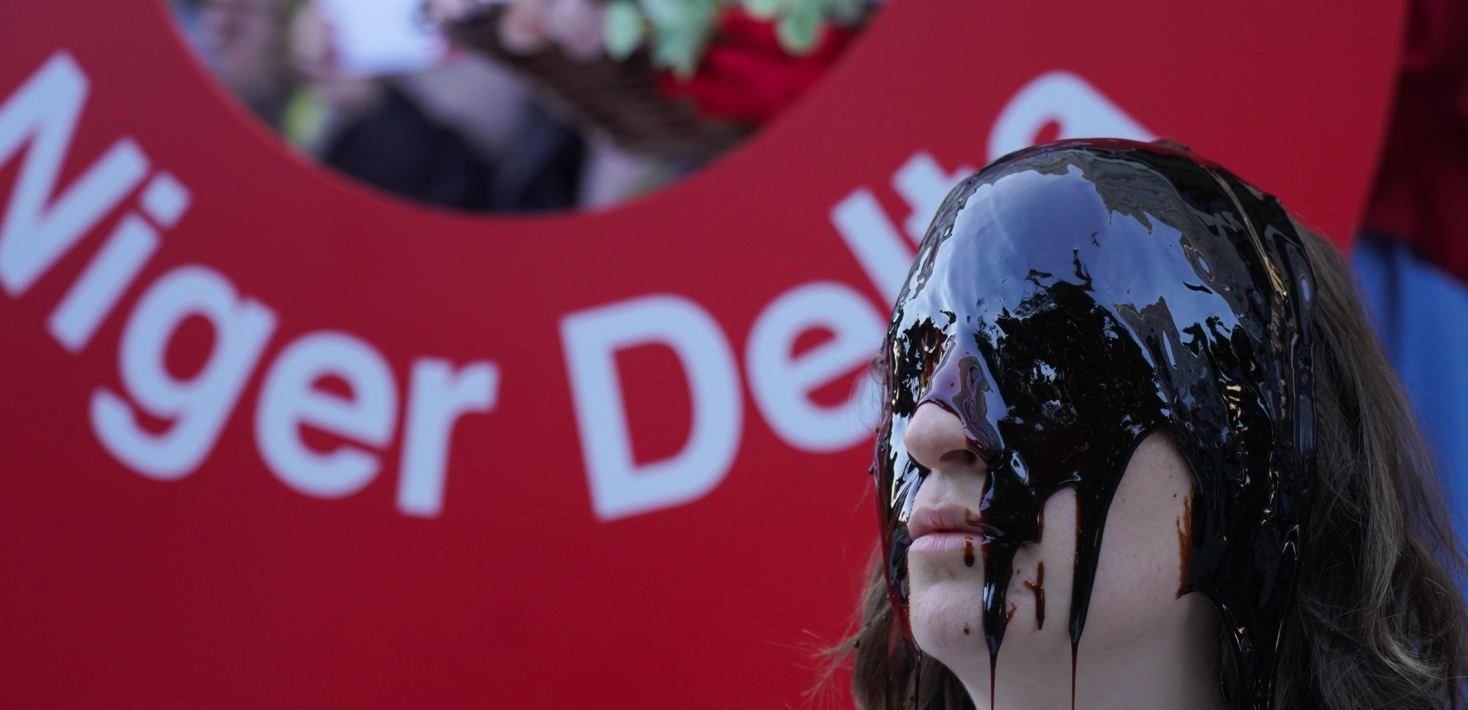


The Niger Delta is one of the world’s largest wetlands and also one of its most valuable oil-producing regions. For decades, oil spills, gas flaring, waste dumping and failed clean-ups have devastated communities who depend on its land, rivers and creeks for food, water and livelihoods. Amnesty International’s research has shown that Shell’s record there is not only an environmental scandal. It is a human rights crisis.
Why does the Niger Delta matter?
The Niger Delta is a vast network of creeks, rivers, mangrove forests and wetlands in southern Nigeria. Millions of people rely on farming and fishing there.
But it is also one of the world’s most important oil-producing regions. Shell began exporting its oil in 1958 and went on to operate around 50 oil fields and a vast pipeline network. Other fossil fuel majors, like Chevron, Eni, ExxonMobil, and Total also went into business there, in partnership with the Nigerian government. Its export economy has consisted majorly of oil and gas ever since, making up more than 90% of the country’s total exports for years.
For communities living near oil infrastructure, the cost has been devastating.
What has Amnesty International documented in the Niger Delta?
The Nigerian writer and activist, Ken Saro-Wiwa first drew the world’s attention to the human cost of oil extraction in the Niger Delta in the 1990s. But Nigeria’s then military government launched a brutal crackdown on the peaceful protest movement that he led in his home region of Ogoniland. A court then sentenced Saro-Wiwa and eight other men to death after a blatantly unfair trial. Amnesty International joined many others in campaigning for their release, but the men, known collectively as the “Ogoni Nine”, were executed on 10 November 1995.
In 2009, Amnesty International published a new investigation. Nigeria: Petroleum, Pollution and Poverty in the Niger Delta, which documented how oil pollution has harmed people’s rights to water, health, food, livelihoods, remedy and a clean, healthy environment. It also found that the regulatory system in the Niger Delta was deeply flawed. Nigeria has laws and regulations that required companies to comply with internationally recognized standards and protect the environment, but these laws and regulations were poorly enforced. Meanwhile, oil companies were exploiting Nigeria’s weak regulatory system. They did not employ sufficient measures to prevent environmental damage, and they frequently failed to properly address the devastating impact that their bad practice has on people’s lives.
What was Shell’s response?
Shell has consistently argued that it has operated responsibly in the Niger Delta, and that most oil spills have been caused by oil thieves, who pipe this to artisanal refineries, which turn the crude oil into refined products such as petrol and diesel for sale in local markets. These refineries cause soil, water and air pollution.
But further investigations by Amnesty International have documented how Shell’s failures, rather than the actions of others, have been a major cause of pollution. For instance, in ‘The True “Tragedy”’, Amnesty International examined two major oil spills that continued for weeks before being stopped in 2008. The spills came from poorly maintained Shell pipelines and affected the lives and livelihoods of around 69,000 people living in the Bodo community.
In the 2013 report, ‘Bad information: Oil spill investigations in the Niger Delta’, Amnesty found that Shell had wrongly reported key facts about oil spills, including their causes, the volume of oil spilt and the adequacy of clean-up efforts. Amnesty warned that the spill investigation system was deeply flawed because oil companies played a major role in assessing incidents involving their own infrastructure.
Has Shell cleaned up the pollution from the oil-spill?
A major cause of the levels of pollution has been the failure to clean up spills and properly remediate the contaminated environment. In its 2015 report, Clean it up: Shell’s false claims about oil spill response in the Niger Delta, Amnesty investigated four cases of where pollution was still visible many years after spills.
The report found that Shell was not meeting its responsibility under Nigerian law to clean up and remediate spills from its infrastructure, which it must do regardless of the cause. Amnesty also documented failures by Nigeria’s oil spill watchdog, the National Oil Spill Detection and Response Agency. The agency remained under-resourced and continued to certify some visibly polluted areas as clean.
As Mark Dummett, Head of Business and Human Rights at Amnesty International said: “Shell’s blame game can no longer deflect attention from its broken promises and neglected infrastructure. As long as oil companies fail to live up to their commitments, the Niger Delta will remain a cautionary tale of communities promised prosperity, but left with blighted, devastated lands.”
What was the 2015 Shell settlement?
In 2015, Shell agreed to an unprecedented £55 million settlement with the Bodo community in relation to harm caused by the two 2008 spills.
The settlement included:
- £35 million for 15,600 individuals
- £20 million for the wider community
This was an important victory for affected residents. But it took six years and legal action in the UK to secure compensation.
Amnesty International stressed that compensation alone was not enough. Full justice also required proper clean-up of polluted creeks, swamps and fishing areas, so people could rebuild their livelihoods.
How much oil pollution has Shell admitted to in the Niger Delta?
Key figures
- The Niger Delta covers around 70,000 km², roughly the size of Sierra Leone, the Republic of Ireland, or Sri Lanka.
- Shell has admitted to 1,693 recent oil spills in the Niger Delta. (2015 data)
- Shell has admitted spilling approximately 55.8 million litres of oil in the Niger Delta since 2007, enough to fill more than 22 Olympic-size swimming pools. (2015 data)
Amnesty has warned that the real scale of pollution is likely to be much higher.
Why have communities taken Shell to court outside Nigeria?
Several cases have moved through courts in the UK and the Netherlands, where Shell has been headquartered.
In 2020, Amnesty International published ‘On Trial: Shell in Nigeria’, where it highlighted several cases against Shell, including one brought by Esther Kiobel and three other widows of the “Ogoni Nine” who blamed Shell for the deaths of their husband, accusing the company of complicity with the Nigerian military. Shell denied the accusations, and the court eventually ruled that there was not enough evidence to support the claims.
There were other cases related to pollution: Four farmers took Shell to court in the Netherlands. Despite the payout resulting from the 2015 case, the people of Bodo called for Shell to meet their responsibility to clean up the contaminated creek where they used to fish. Two other communities, Ogale and Bille, also filed claims against Shell in London.
These cases have set important precedents for holding multinational polluters to account.
How did the UK Supreme Court rule on the Shell-related cases?
After years of technical hearings, in which Shell tried to get the Bille and Ogale cases dismissed, the UK Supreme Court opened the door to accountability for the oil spills in Nigeria in 2021.
Amnesty International welcomed the ruling, and said it could mark the end of “a long chapter of impunity”. The same year, Shell announced plans to sell its onshore oilfields and assets in the Niger Delta after more than 60 years of highly profitable operations.
Why is Shell’s exit from the Niger Delta a human rights concern?
Shell’s sale of its assets raised significant human rights concerns, as Shell could try to wash its hands of its responsibility to repair ageing infrastructure and to remedy communities for past harm.
In 2023, Amnesty warned in Nigeria: Tainted Sale? that Shell’s planned sale of its Nigerian oil interests must not leave communities without remedy. Amnesty and partner organizations called for the Shell sale to be halted unless rights are protected.
Subsequently, Shell announced a deal to sell Shell Petroleum Development Company (SPDC), their Nigerian subsidiary, to a group of mainly Nigerian companies operating as the Renaissance Africa consortium for up to US$2.4 billion. Nigeria’s oil regulator provided a fast-track approval option for the sale.
Amnesty warned that the process allowed Shell to “cut and run” as it could walk away with billions while communities remained trapped with polluted land, poisoned water and no justice. It called for any divestment to be rights-based, transparent and community-centred and include environmental studies, an inventory of assets, guaranteed clean-up funds and safeguards for decommissioning.
What is happening in the Ogale and Bille case?
In 2025, the Ogale and Bille communities’ case against Shell entered a new legal phase in the UK as the preliminary issues trial began at the UK High Court in February 2025.
In March 2026, Amnesty International called for an investigation, after Bille residents reported bubbling water, strong methane smells and gas leaks, noting the leaks occurred near former Shell infrastructure. Worrying video footage from the community dated 13 May 2026 showed methane gas igniting at a drinking water pump in Bille.
A new 2026 report by a coalition of human rights and environmental organisations, including Amnesty International, Nigeria: Lifting the Lid, reveals how internal Shell documents detailed a wider human rights scandal than previously reported. While Shell presented its operations as meeting global standards, the documents point to concerns raised by the Nigerian army over alleged complicity in oil theft, suspected staff and contractor collusion, exemptions from safety standards, serious weaknesses in pipeline management, missing well data, weak leak detection and flawed spill monitoring.
As Isa Sanusi, Director of Amnesty International Nigeria, said: “The real scandal is Shell’s pursuit of profit at the expense of people’s rights. Shell was willing to accept further environmental damage in Nigeria that would not have been tolerated elsewhere, and years of public denial are now challenged by its own documents.”
Amnesty International wrote to Shell on 3 July 2026 to share its findings related to the disclosed documents. In response to Amnesty’s report, Shell wrote that: “The characterisation and portrayal of Shell in your letter is not one we recognise. Shell is committed to honesty, integrity and respect for people, and to conducting business in an ethical and transparent manner.” Shell says that the findings do not reflect the “challenging operating environment in the Niger Delta at the time”. Their full response is included in the report.
The Ogale and Bille communities affected by the oil spills refuse to be silenced. A trial in their case against Shell is due to be held in 2027.
What is Amnesty calling for?
Amnesty International has repeatedly called on Shell to:
- clean up oil pollution
- compensate affected communities
- repair the damage caused by decades of oil operations
- respect people’s right to remedy
- remain accountable, even after selling or leaving parts of its Niger Delta business
Oil companies made billions from the Niger Delta. They must not be allowed to leave behind poisoned land, polluted water and communities still fighting to be heard.
Knowledge is power
Learn how you can take action against fossil fuels
People around the world are demanding the end of fossil fuels and you can join them.