


One month after Indian police deployed unlawful and deadly force against peaceful protesters at the Cockroach Janata Party (CJP)-led “Chalo Sansad” march, not a single officer in Delhi has been held accountable, Amnesty International said today as it published a new digital investigation documenting the police response to the protests.
Witness testimony and video and photographic evidence verified by Amnesty International’s Evidence Lab confirm that police used weapons including pellet-firing shotguns, tear gas launchers, grenades, batons and electric shock devices against protesters between 20 July and 24 July in Delhi and Siwan town in Bihar state. The weapons were deployed in a manner that breached international law and standards and domestic policing guidelines. Amnesty International also verified two instances of a police officer unlawfully using lethal force against a crowd.
On X, the Delhi Police publicly denied any disproportionate use of force, repeating it before India’s Supreme Court, describing its handling of the protest as “professional”. Evidence gathered by Amnesty International directly contradicts this account.
“Instead of facilitating the right to protest, Indian authorities suppressed it first with a communication blackout, barricades and transport disruption. They then attempted to crush it with unnecessary or excessive use of force against peaceful protesters, including children. This heavy-handed response was state-sanctioned violence masked as crowd control. The continued impunity after a month is a testament to that,” said Aakar Patel, Chair of Board, Amnesty International India.
Amnesty International’s Evidence Lab verified 17 videos filmed on 20 July in central Delhi across the area spanning Jantar Mantar, Sansad Marg and Connaught Place and two videos filmed in Siwan town of Bihar state on 24 July. In videos filmed in Delhi, personnel from Delhi Police, the Rapid Action Force (RAF), and the Central Reserve Police Force (CRPF) were identified.
Use of birdshot against protesters
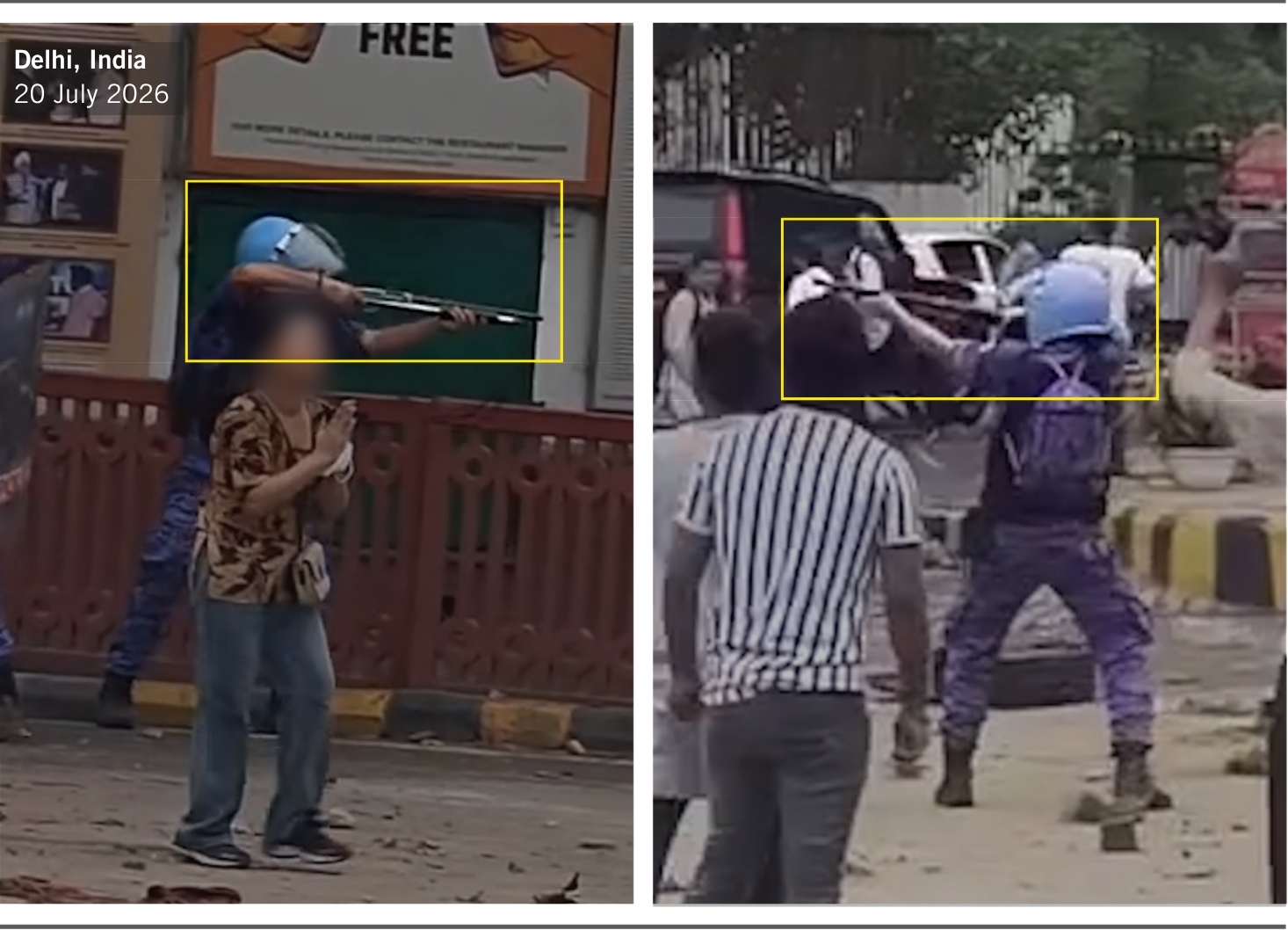
Amnesty International’s Evidence Lab verified two videos showing an RAF officer firing a shotgun into the crowd, at the intersection of Connaught Place and Sansad Marg. This type of weapon can be used to fire lethal and less lethal ammunition. Two other verified videos show two protesters near the same intersection with wounds consistent with those caused by birdshot, a hunting round that fires a large number of small metal pellets. The weapons used are colloquially known as “pellet firing shotguns” in India. CCTV footage verified by Amnesty International also shows two RAF officers carrying shotguns among the crowd a few blocks away.
Speaking to Amnesty International on a condition of anonymity, a protester who sustained pellet injuries said:
“I was near Connaught Place and an altercation took place between the protesters and the police. Even then, most of the protest remained peaceful. RAF officials were using tear gas but then, without any warning, started using pellet-firing shotguns. I saw an officer standing roughly 300-400 metres away aiming the shotgun towards where I was standing. I started running in the opposite direction and that’s when I got hit on my back, otherwise I would have been hit on my face and chest. I had roughly 25-30 wounds and immediately went to the hospital. The doctors confirmed that they were pellet injuries. Thankfully, my bones have been saved but my body has been scarred badly.”
Birdshot ammunition has not been developed for law enforcement purposes. Due to the spread of the metal pellets, it is inherently inaccurate and presents a high risk of serious injuries to the targeted person and even bystanders. Its use has been associated with deaths and multiple cases of blindings in Egypt, Iran and Jammu & Kashmir. Birdshot ammunition has no legitimate use in law enforcement and must be explicitly prohibited for this purpose.
The ‘Standard Operating Procedures to deal with Public Agitations with Non-Lethal Measures’ prepared by India’s Bureau for Police Research and Development recommend that security forces warn protesters before using less lethal or lethal force. According to the victim interviewed by Amnesty International, no prior warning was given before the pellet-firing shotgun was used. International standards on the use of force also require that law enforcement officials use non-violent means before resorting to the use of force. This includes issuing a clear warning whenever possible and giving sufficient time for people to react.
Delhi Police responded to reports of pellet injuries on X with a “Fake News Alert,” calling the reports “completely false and misleading” and warning that “appropriate legal action” would be taken against anyone “spreading rumours”.
In addition to pellets, the national newspaper The Hindu reported that an RAF unit had fired “two ballistic cartridges loaded with plastic pellets” on the evening of 20 July on the orders of a Deputy Commissioner of Police, alongside “55 non-electrical and 15 electrical crowd-control shells and five tear gas grenades”. A subsequent internal CRPF inquiry reportedly found that RAF personnel had fired at least seven rounds of ammunition containing metal pellets. Responding to a Right to Information request filed by Saket Gokhale, an All India Trinamool Congress spokesperson, at least ten people were injured by pellets during the protests.
Tear gas and batons
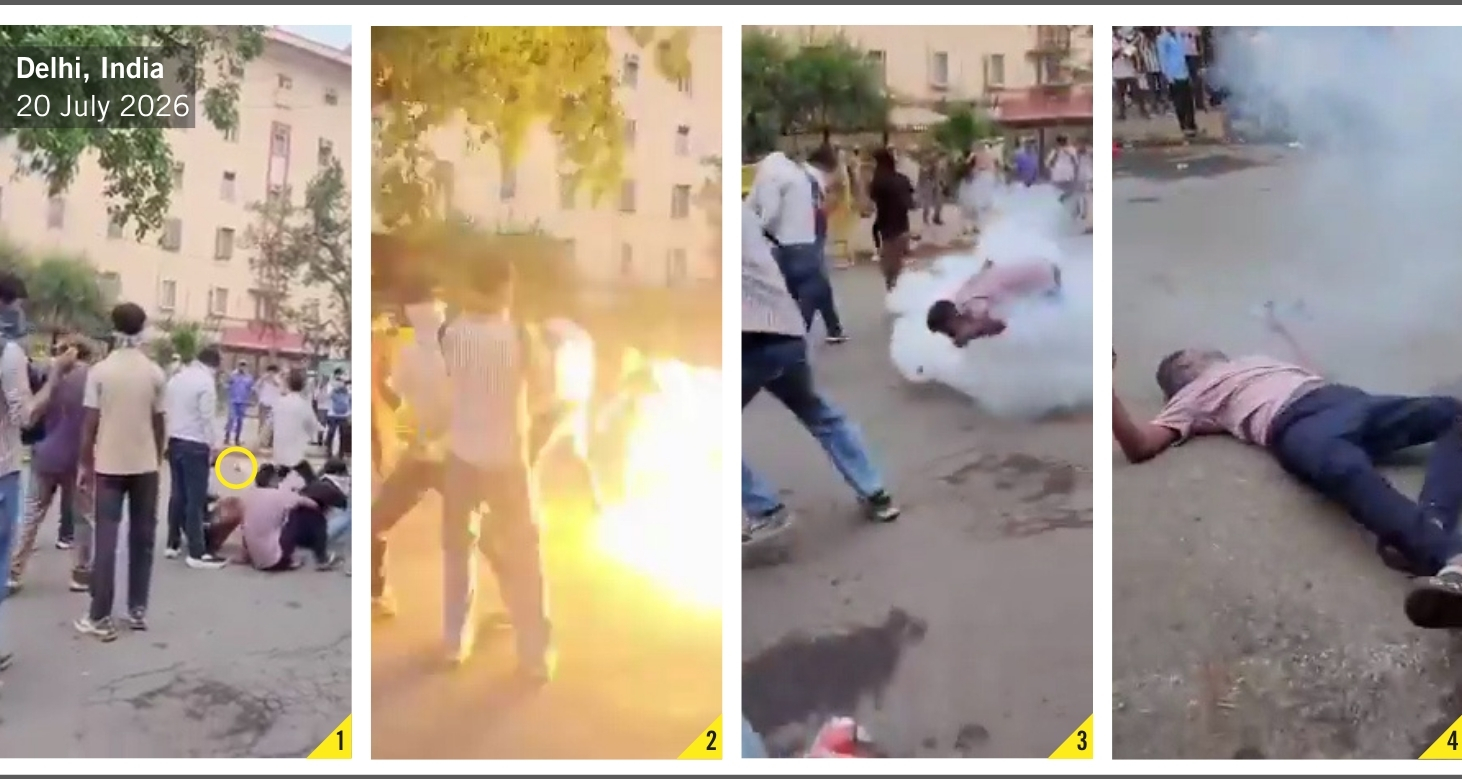
Another video verified by Amnesty International shows a tear gas grenade landing near a group of protesters and immediately exploding with a heavy blast. Tear gas grenades releasing an excessive amount of explosive energy are extremely dangerous and should be prohibited for use in public assemblies.
Eyewitnesses told Amnesty International that tear gas grenades were launched directly at protesters instead of at an angled trajectory above the head of protesters, at odds with UN Guidance on the use of Less-Lethal Weapons in Law Enforcement. The use of tear gas should be limited to situations of widespread and serious violence. There is no evidence available that suggests such a level of violence by protesters. While there were isolated incidents of protesters throwing stones, this would not reach that threshold.
Amnesty International documented frequent misuse of long, flexible batons, widely known as lathis in India, during the protest. The organization verified eight videos showing Delhi Police officers in khaki uniform and RAF officers striking lathis against peaceful protesters, including a young boy, who offered no provocation or any sign of resistance. In many instances they hit people indiscriminately on all parts of the body. In one video, a man knocked to the ground is struck repeatedly while unable to move or pose any threat.
The UN Special Rapporteur on Torture considers lathis to be inherently cruel, inhuman or degrading as “they deliver a greater level kinetic force than conventional batons, causing excessive pain and increasing the risk of serious injury” and has called for them to be prohibited – a position supported by Amnesty International.
In at least two videos, men in plain clothes, including some wearing black helmets marked “Delhi Police” on the back, are seen beating protesters with lathis while uniformed officers, who escorted them toward the crowd, stand beside them and make no attempt to intervene. The absence of visible identification, such as name tags or badge numbers, on these individuals is itself a breach of the accountability principle, which requires that law enforcement officials be identifiable in any encounter involving the use of force.
Amnesty International also verified one video of an RAF officer using an electric shock baton on a peaceful protester. Direct-contact electric shock devices inflict severe pain without incapacitating a person and serve no legitimate law enforcement purpose that could not be achieved through less harmful means. Amnesty International, together with the UN Special Rapporteur on Torture, has called for an absolute prohibition on their use by law enforcement, given the risk of severe suffering, lasting disability, psychological harm and, with prolonged use, death. Authorities in India should immediately withdraw this weapon from their law enforcement personnel.
Firearms
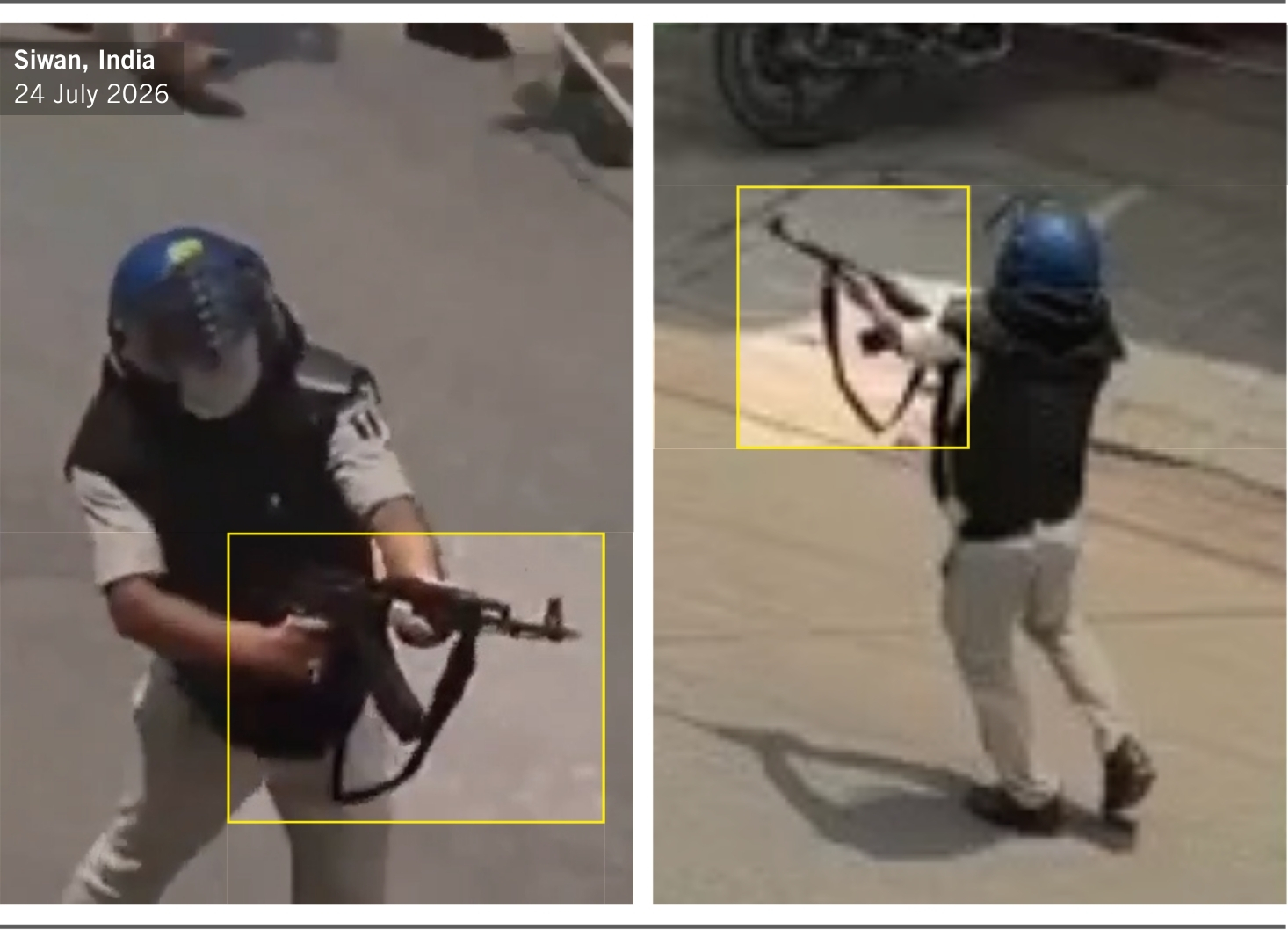
Amnesty International also verified two videos filmed on 24 July in Siwan, Bihar, where a state police officer is firing an AK-type assault rifle against protesters. Firearms of this kind are designed to kill and, in the context of assemblies, may lawfully be used only to meet an imminent threat of death or serious injury to a specific individual, and only as an absolute last resort. Amnesty International has found no evidence any such threat existed.
“Despite this body of evidence, the Indian authorities have made no public commitment to investigate or prosecute any officer involved. We call on Indian authorities to order a prompt, impartial and effective investigation into the use of firearms, birdshot ammunition, tear gas, lathis and electric shock weapons against protesters in Delhi and Siwan, and to publish its findings,” said Aakar Patel.
“The deployment and use of birdshot ammunition and direct contact electric shock devices must also end immediately.”
Background
For further context on the protests, see here.
In response to the “Chalo Sansad” march, authorities denied permission for the march, imposed an internet shutdown around the areas where the protest was scheduled to take place, issued orders prohibiting gatherings of more than five people, closed multiple Delhi metro stations and erected barricades across central Delhi. Under international human rights law, holding an assembly must not be subject to prior authorization or permission. Where a notification is required, it should only serve to prepare the authorities in facilitating the assembly and should not be used as means to further restrict the right to freedom of peaceful assembly. Further, the issuing of prohibitory orders is akin to a blanket ban on an entire march. This does not meet the standard of legality, necessity and proportionality, nor does the blanket internet shutdown imposed by authorities.
According to the Delhi Police, more than 400 people were injured including police personnel and protesters. At least three people were injured in Siwan including one bystander who was shot and sustained a bullet wound to the neck.
Previously, Amnesty International has extensively documented the numerous injuries – including blindings – and killings caused by Indian authorities’ use of shotguns loaded with birdshot as a means of crowd control in Jammu & Kashmir. In August 2016, the seven-member committee set up by the Ministry of Home Affairs to explore alternatives to shotguns recommended that they be used only in “rarest of rare cases” but fell short of calling for a complete ban. In 2018, the Office of the United Nations High Commissioner for Human Rights recommended India to immediately order the end of the use of pellet-firing shotguns in Jammu and Kashmir for the purpose of crowd control. A petition has been filed in the Supreme Court of India seeking decommission of the use of pellet-firing shotguns by law enforcement agencies for policing assemblies.