
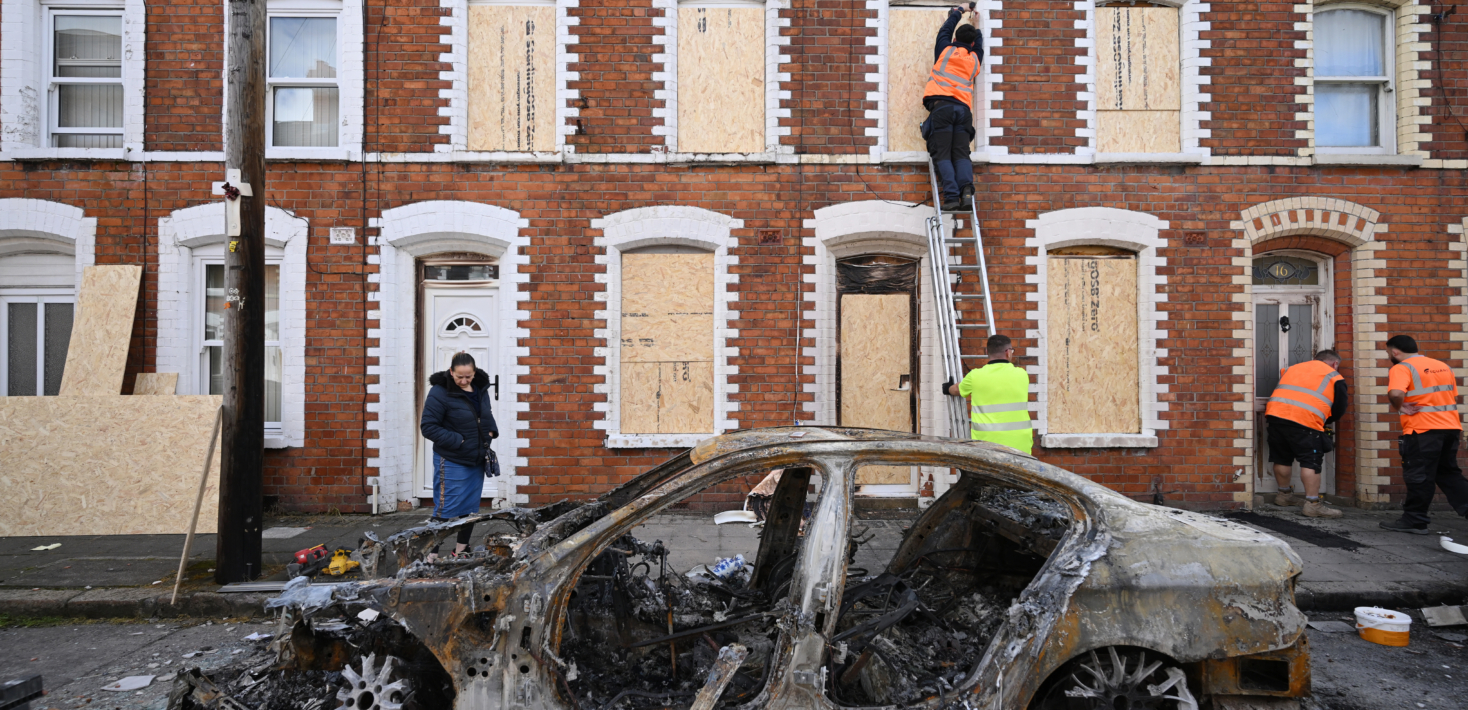


On the evening of 10 June, less than 24 hours after a horrendous knife attack that left the survivor with life-long injuries, the city of Belfast was shut down by masses of hooded people going door to door and street to street terrorizing anyone who didn’t look like them – and blaming racialized communities for the act of an individual.
I watched the live news stream in horror as houses and cars were torched, the rolling coverage showing people fleeing moments before their homes were engulfed by flames. My phone notifications began to ping as videos came in of young men kicking down doors and setting living rooms on fire, revelling in a collective joy of violent destruction.
This is the third year in a row of racist violence during riots against racialized people, who are perceived as being migrants based on the colour of their skin regardless of their citizenship or immigration status. In Northern Ireland, these violent outbursts fit into a UK and EU-wide chamber of racism and xenophobia, where chants of “send them back” echo through the streets and the halls of power.
In June, Belfast was shut down by masses of hooded people going street to street terrorizing anyone who didn’t look like them
Emily Humphreys
The reality is that the moment an act of violence comes from the hands of a racialized person, it unleashes a wave of unchecked racist rhetoric and violence that escalates and worsens every time.
The majority in Northern Ireland say they feel shame for the racist violence that is erupting every year. Yet, I am bearing witness to how the people of Belfast and Northern Ireland, including its migrant community, are transforming this shame into solidarity, and are showing the best in the human spirit by rebuilding a broken society from the ground up.
What started as a small emergency response WhatsApp group on the first night of riots has turned into thousands of people doing whatever they can to help those in need. The day after the riots began, a make-shift solidarity hub was set up in a city-centre church, where over the next few days hundreds of us volunteers flocked to help in whatever way we could: dividing the initial WhatsApp group into a series of groups based on area, need and emergency level; filling in Excel sheets of safe refuges for people who left their homes in fear; sorting through bags of donations for families unsure when it would be safe enough to return home; a clown entertaining young children with games, balloons and laughs galore; preparing meals, filling vats of tea and making sure nobody driven out of their home went hungry; small groups led by CATU –- Community Action Tenants Union rushing to Belfast’s streets to non-violently confront the intimidation and violence of rioters.
Over the first few days, this solidarity network ensured that more than 507 racialized men, women and children were brought to safe places, between volunteers’ own homes, to community centres and churches. That initial WhatsApp group has now grown into a network of thousands divided between the north, east, west and south of the city. We continue to mobilise support for anyone in need, and more than six weeks later requests for help and solidarity are still coming in.
This solidarity anti-racism movement may sound spontaneous, but it has emerged from the foundations laid by people and organisations from across Belfast and Northern Ireland, like Participation & Practice of Rights (PPR) and Anaka Women’s Collective. We may not be as loud as a riot, but we are not less powerful.
A fundraiser to support the people impacted by the racist attacks has amassed more than £250,000 in donations from across the globe. Volunteer testimonies give touching insights into the experience of stepping up for one’s neighbour and being part of a wider movement of hope and unity. Six weeks later, people in every sector, from education, faith groups, the arts to sports clubs are busy organising anti-racism events and fundraising to support our communities, including migrants and racialized people. We are mobilising to reclaim public space for all, make sure neighbours know one another and ensure everyone feels safe in their home. While we fear a return of racist violence, thousands of us are ready to respond and, hopefully, prevent further attacks.
What has emerged in Belfast is an alternative path forward: hope, solidarity and togetherness, beyond race and religious divides
Emily Humphreys
The racist violence in Belfast is a product of persistent racism, xenophobia and othering in Northern Ireland, much like the rest of the UK and Europe. While those in power fail to protect people, especially those most vulnerable, us ordinary citizens are doing our best to fill the gaps.
There is so much work to be done in the aftermath of this, but what has emerged in Belfast is an alternative path forward: hope, solidarity and togetherness, beyond race and religious divides, that is bringing the best of our communities together. We are sending out a clear message that not all people in Northern Ireland are buying into attempts to exploit race-based divisions to fuel violence, discrimination and hatred.
The road ahead is long, but we will keep working together in community to build an anti-racism landscape of solidarity, care and action.
Emily Humphreys is a Belfast resident and member of Amnesty International UK. She has been involved in the solidarity response supporting those affected by the racist riots, particularly racialized people.
Amnesty International offers a human rights education online course on Racial Justice and Human Rights. You can enrol in the course for free here]’;. Racial Justice and Human Rights – Amnesty Human Rights Academy
This article was published first hereby EU Alive