
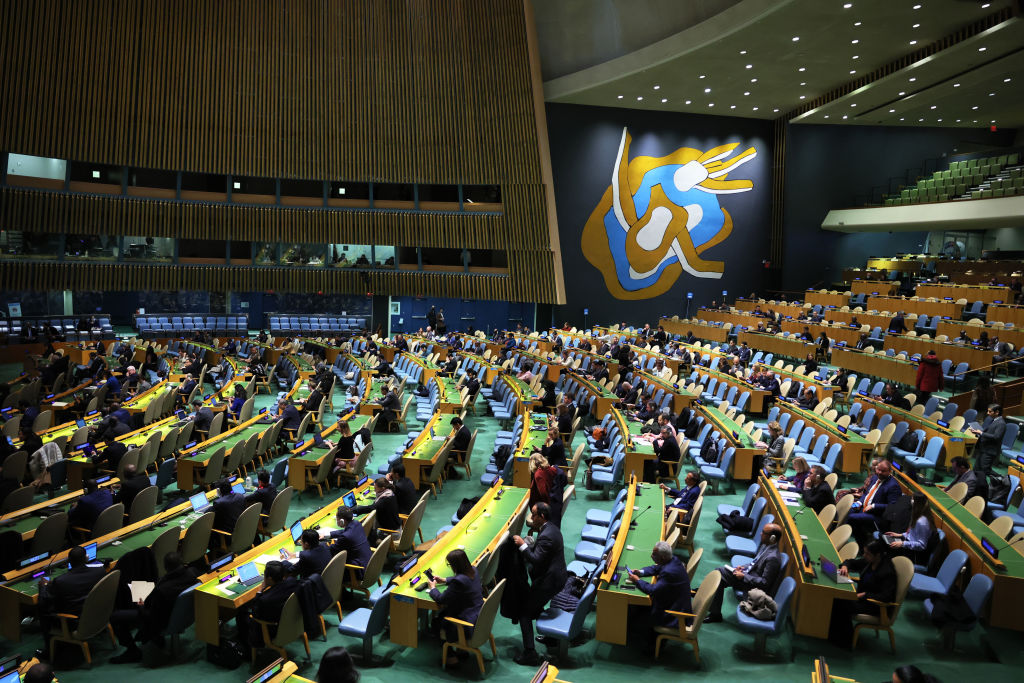


Responding to the adoption of the climate accountability resolution at the United Nations General Assembly by overwhelming majority today, Camile Cortez, Senior Campaigner on Climate Justice at Amnesty International, said:
“Today’s vote marks an important step in advancing climate justice. By adopting this resolution, states have recognized that they have legal duties to address the profound human rights crisis posed by climate change as set forth in the 2025 International Court of Justice’s (ICJ) Advisory Opinion. This resolution brings renewed momentum towards ensuring accountability for climate-driven human rights harms and protecting present and future generations.
“At a time when fragmentation between nations feels more visible than ever, the UN resolution endorsing the ICJ climate ruling offers a renewed path for international cooperation. Political and authoritarian choices by some world leaders, like rolling back climate protections or revoking phase out regulations, have weakened global progress just when we need stronger climate action. Fossil fuel infrastructure alone poses risks for the health and livelihoods of at least 2 billion people globally, roughly a quarter of the world’s population.
“This new UN resolution paves the way for governments to show they stand for climate justice and has the potential to shape global climate accountability for years to come.”
This new UN resolution paves the way for governments to show they stand for climate justice and has the potential to shape global climate accountability for years to come.
Camile Cortez, Senior Campaigner on Climate Justice at Amnesty International
Background:
The UN climate accountability resolution seeks to turn the ICJ Advisory Opinion on states’ obligations concerning the “urgent and existential threat” posed by climate change, into a roadmap for concrete action and accountability.
Vanuatu, which has repeatedly warned that it could disappear under rising sea levels, spearheaded the efforts to secure the resolution. The Pacific island nation and archipelago had previously also led the diplomatic drive for the ICJ’s 2025 Advisory Opinion through active campaigning initiated by a group of young law students. In a rare unanimous opinion, the ICJ made it clear that protecting the global climate system is a legal obligation – not a political choice. Failure to do so threatens human rights and the well-being of present and future generations. The ICJ also stated that countries must act together to remediate existing harm and prevent more climate havoc.
In a bid to ‘operationalize’ this ICJ Advisory Opinion, a core group of states contributed to the “zero draft” first version of the resolution adopted in today, with cross-regional representation from Vanuatu, Barbados, Burkina Faso, Colombia, Jamaica, Kenya, the Marshall Islands, the Federated States of Micronesia, the Kingdom of the Netherlands, Palau, Philippines, Singapore, and Sierra Leone. Read our explainer on the UN climate resolution here.