


In 2019, a group of 27 law students from the University of the South Pacific in Vanuatu began campaigning to take the issue of human-induced climate change and its impacts on human rights to the International Court of Justice (ICJ). Their initiative led the ICJ to issue a landmark Advisory Opinion in July 2025, which made it clear that governments have a legal obligation to protect human rights against climate change.
Today, the Pacific islands are leading on a draft UN climate change resolution to turn the ICJ’s groundbreaking Advisory Opinion into a roadmap for action and accountability, pushing leaders to phase out the fossil fuels and meet their human rights obligations.
Fijian-born Vishal Prasad is the director at Pacific Islands Students Fighting Climate Change (PISFCC). Here he shares about the journey of turning “heartbreak into action.”
“In late 2019, I joined a group of 27 law students from the University of the South Pacific in Vanuatu that came together to take climate change to the world’s highest court. We knew all too well the cost of the climate crisis to the region.
We came from communities where a monthly king-tide means watchful, sleepless nights and countries where economic development built slowly over decades could be wiped away by multiple cyclones. We came of age alongside multiple UN climate conferences like COP where promises of urgent change and necessary remedy were made. Yet our people continue to wait and hope for these promises to be met.
A radical and stubborn optimism
The decision to take the world’s biggest problem to the world’s highest court was not youthful naivete. Too often calls for reform from young people are delegitimized and get shut down for being “out of touch” or “naïve.” We took the step out of a radical and stubborn optimism. The kind that is born from a lifetime of being told our homes are small, isolated, and destined for a future of rising tides and worsening disasters.
Over six years, this stubborn hope persisted as we strategized and identified ways to reach the ICJ while networking alongside partners across the world to build a movement demanding change.
Climate change is not just a Pacific issue
In taking this message to multilateral spaces, we found youths from around the world who shared similar stories from their homes: typhoons that left civilians stranded, rising ocean temperatures that devastated the biodiversity of islands, floods choking food systems.
This movement was also proof that climate change is not just a Pacific issue. Increasing floods, hurricanes and wildfires are being experienced by people around the world, disproportionately affecting the most marginalized everywhere. Therefore, it is in the best interest of all countries to support and unite behind international law. International law dictates that shared issues require shared collaboration.
A historic moment: The International Court of Justice delivers its Advisory Opinion on climate change
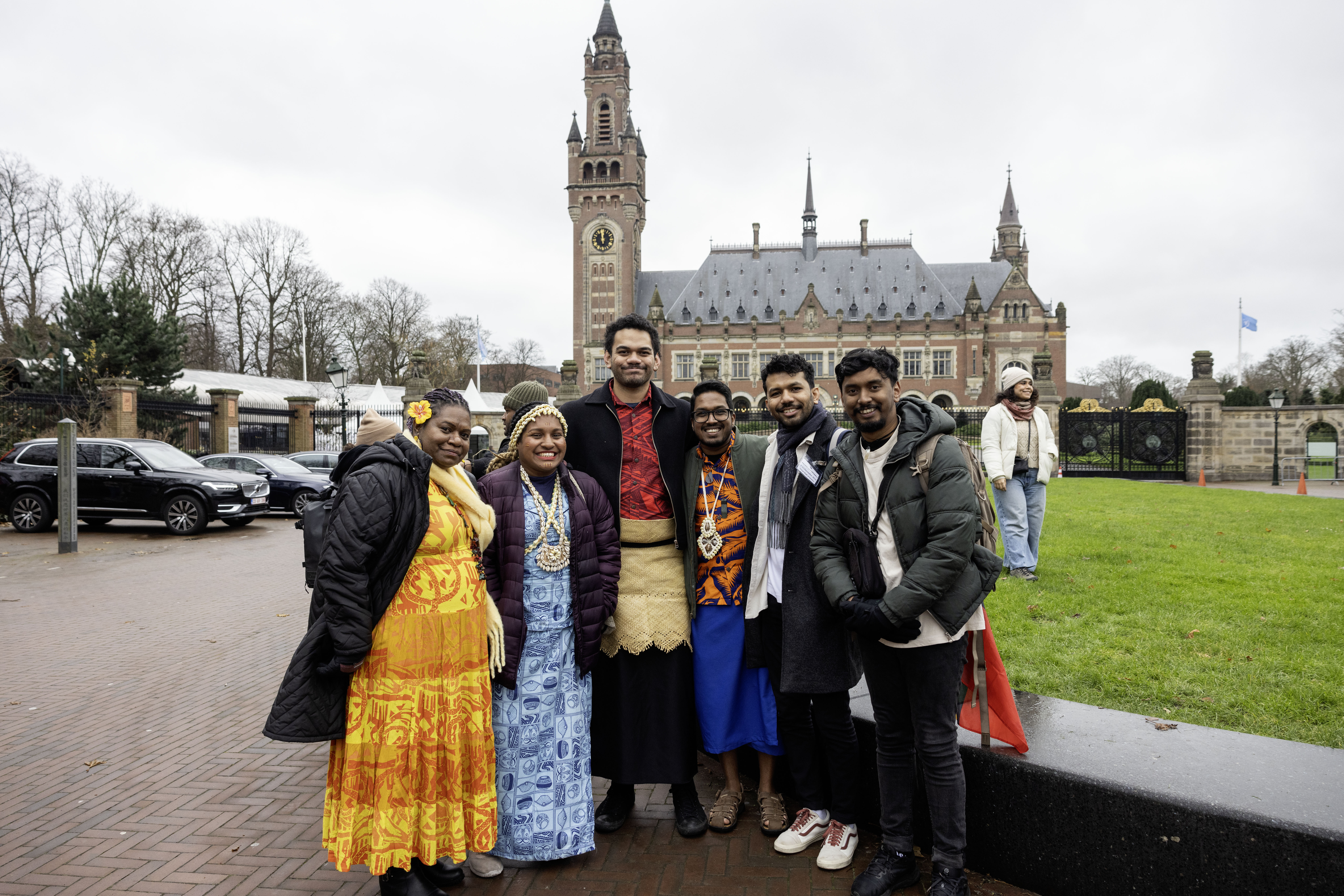
Huddled against a Dutch winter in December 2024, we stood interlinked alongside traditional knowledge holders, legal experts and youths to tell stories of climate decimation but also to call for justice at the highest court in the world. Seven months later after pleading our case, the ICJ delivered an Advisory Opinion in July 2025 that far exceeded our expectations. It clarified that countries have obligations to act under the Paris Agreement and a variety of international laws, including human rights, and customary international law. More specifically, the ICJ underscored that the right to a clean, healthy and sustainable environment is a precondition for the effective enjoyment of all other rights and therefore a priority.
Human rights have now been directly linked to the harm caused by the climate crisis and this is an invaluable determination in our collective pursuit for justice. The ICJ also made clear that legal consequences may also arise when countries breach these obligations and cause climate harm. For many countries on the frontline of the climate crisis this was a validation of what we have been saying about the climate crisis – now reaffirmed by the power of international law.
When people unite astonishing change is possible
This newfound legal clarity on state obligations must now be used as the foundation for international climate policy and action. One way to do this is by operationalizing the Advisory Opinion through a United Nations General Assembly resolution that has been put forward by Vanuatu and is currently being discussed by UN member states. This draft UN climate change resolution seeks to endorse the unanimous ruling handed down by the ICJ and explore mechanisms to bring the Court’s findings to life.
The challenge now is for the world to agree on a robust UN climate change resolution adopted with widespread support from UN member states. And we know that this is possible. Just like in the earlier phases of this campaign, we know that when people band together, astonishing, substantive change is possible.
We need everyone in the world to demand that their governments co-sponsor and vote to adopt the UN climate change resolution without diluting it – so that all people, the old, young and future generations, can live in dignity.
Vishal Prasad, director at Pacific Islands Students Fighting Climate Change.
Urgency of the draft UN climate change resolution
Here at home, climate change is not a prediction of the time to come but a truth lived intimately; a tragedy unfolding in our backyard that we are resisting, mobilizing and working to change. For us, almost everything is at stake. We are on the frontlines. Home, identity and the very fabric of our cultural being is at stake.
Around the world, human-induced climate change is increasingly showing up in unprecedented floods, wildfires, droughts, cyclical extreme heat and cold, devastating cyclones. All this is compounded by wars and decreasing commitments towards climate action. The health of all our land, air, waterways and oceans is at stake.
We need everyone in the world to demand that their governments co-sponsor and vote to adopt the UN climate change resolution without diluting it – so that all people, the old, young and future generations, can live in dignity.
Knowledge is power
Learn how you can take action against fossil fuels
People around the world are demanding the end of fossil fuels. Frontline communities are resisting and you can join them.