
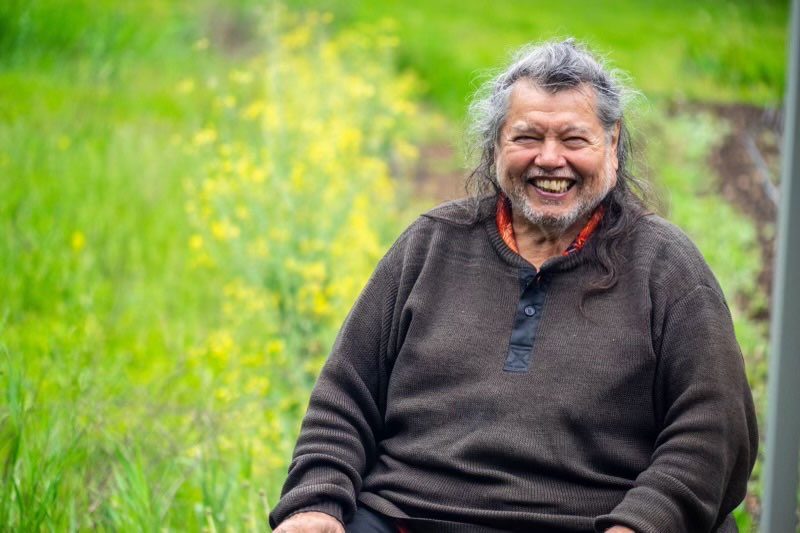


Chief Dsta’hyl (also known as Adam Gagnon), a Wing Chief of the Likhts’amisyu Clan of the Wet’suwet’en Nation, was unjustly arrested and sentenced to house arrest in 2024 for peacefully defending the land and rights of the Wet’suwet’en people from the Coastal GasLink pipeline expansion project. He was the first person to be designated an Amnesty International prisoner of conscience in Canada.
Amnesty International has called on the government of British Columbia to ensure the end of the criminalization of Wet’suwet’en and other Indigenous land defenders. Here, Chief Dsta’hyl reflects on his critical work to protect Wet’suwet’en land, rights and the environment we all depend on.
We don’t own this land. We belong to the land. We are a part of the water, the earth, the air – we are a part of everything. The land and the Wet’suwet’en are very spiritual. My mom once said that the moment you accept a Wet’suwet’en Chief’s name, you are no longer your own person. From that day on, you only act in the best interest of your people… and everything that has to do with living on the land and being a part of the land.
In the 1950s, our lands were put onto reserves and we were given English names and turned into “legal Indians” – they made it sound like they were giving us something, but they were actually taking everything away. Before, we had hundreds of thousands of caribou (reindeers) on our territory, but the government and industry that followed drove them out. There are hundreds of billions of dollars’ worth of resources underground on our territory and they want it.
Defending our land shouldn’t be a crime
For frontline Indigenous People like the Wet’suwet’en, the cost of fossil fuels is not theoretical. For years I’ve watched the Canadian government and fossil fuel companies carve their way through Wet’suwet’en territory, not just with machinery to build a liquified natural gas pipeline, but with a legal system that refuses to recognize our Indigenous law, authority, and rights.
When I first got convicted and faced house arrest for defending the Yin’tah (Wet’suwet’en land) from the pipeline construction, I went into a depression for three months because the court ruled that I couldn’t be out on the territory, doing what I was meant to do – protect the land and its wildlife. All the corporations see is an empty space, they don’t understand the land.
The (real) cost of fossil fuels
The Wet’suwet’en people have known for decades that the land is being pushed past its limits. Replanting a clear-cut forest doesn’t restore what was taken in the process of setting up the Coastal GasLink pipeline that runs through our land. It takes 60 to 70 years for new trees to mature, and even then, the ecosystems never fully return. Micro-habitats disappear. If our 22,000 square kilometers of territory were fully recognized as Wet’suwet’en land, we would decide what is extracted and what is protected and they would lose control.
The impacts of the Coastal GasLink pipeline don’t end at the construction site. Compressor stations, new pipeline infrastructure that the company wants to build on our land, will bring continuous low frequency noise and light pollution that floods what should be dark wilderness. Animals are deeply sensitive to sound and light. These are long-term harms that no environmental assessment meaningfully accounts for.
A system designed to enable extraction
During my conviction, a judge told me that Wet’suwet’en law and colonial law cannot coexist. It means the courts, which are supposed to be neutral, have already decided which laws matter and which don’t. Think about what it means for a judge to say this: it means no Indigenous person defending their land can ever expect a fair trial. It says that the laws of the people whose rights have never been extinguished will be dismissed outright.
This is not justice. It is the continuation of a system designed to enable extraction, not accountability.
In 1997, the Supreme Court of Canada’s decision in Delgamuukw affirmed the Wet’suwet’en’s hereditary governance structure and that any major project crossing our territory must receive consent from our Hereditary Chiefs. That ruling should have guided every decision about the Coastal GasLink pipeline and LNG Canada’s operations. Instead, today the government acts as if the ruling doesn’t exist.
When we raised the Delgamuukw precedent in court, the judge dismissed it as irrelevant to the injunction and instead criminalized us for defending our unceded territory. But this legal fight runs deeper than one arrest.
This is not justice.
Chief Dsta’hyl, a Wing Chief of the Likhts’amisyu Clan of the Wet’suwet’en Nation
It is the continuation of a system designed to enable extraction, not accountability.
Bulldozing our rights is not climate leadership
We are asking the courts to enforce the basic principle of good governance – something Canada routinely preaches but rarely practices when fossil fuel profits are involved. It is a political choice driven by industry pressure and the desire to access our land without our consent.
Canada cannot call itself a climate leader or a human rights defender while bulldozing Indigenous law, silencing Indigenous sovereignty, and fast-tracking fossil fuel expansion.
The land is suffering. Our people are suffering. And unless this system changes, it won’t be the corporations paying the price. It will continue to be us.
Every contribution helps to resist
Since 2019, we have been fighting a climate case against the federal government. We’ve had it stayed three times and we keep pushing to move it forward.
We have been taking the lead in resistance for many years, against colonization, against abuse of powers that governments have over Indigenous Peoples worldwide. We have lawyers working on it full time and organizations providing support.
Amnesty International has brought so much awareness to our situation; there are not enough thank yous that we can say for all of the work it has done. I used to listen to programs on CBC where people came on to talk from Amnesty and I used to listen to it all the time. Other organizations have also helped Indigenous People – different foundations making contributions to help us with our plans to reclaim our land. We need this kind of help to continue; every contribution helps to resist the colonization.
Fossil fuels are a dying industry and have to stop. The world used to use whale oil and it wasn’t until fossil fuels came along that the slaughter of whales stopped. When General Motors first came out with the electric car, the big oil industry lobbied to get rid of it. We really only need to keep trying to move forward with climate action and stay optimistic.
Every climate movement, whether through the new draft UN Climate Change resolution on the ICJ Advisory Opinion tabled by the Pacific islands or whether it’s Amnesty or the lawyers helping us, it all makes a huge difference, especially on the international front. It is our land, our law, our wildlife, our health, our governance, and our future being sacrificed so corporations can profit and governments can avoid confronting the climate crisis.
Sometimes it may feel futile but we all have to do our part for all humanity.
Every climate movement, whether through the new draft UN Climate Change resolution on the ICJ Advisory Opinion tabled by the Pacific islands or whether it’s Amnesty or the lawyers helping us… it all makes a huge difference.
Chief Dsta’hyl
Knowledge is power
Learn how you can take action against fossil fuels
People around the world are demanding the end of fossil fuels. Frontline communities are resisting and you can join them.