
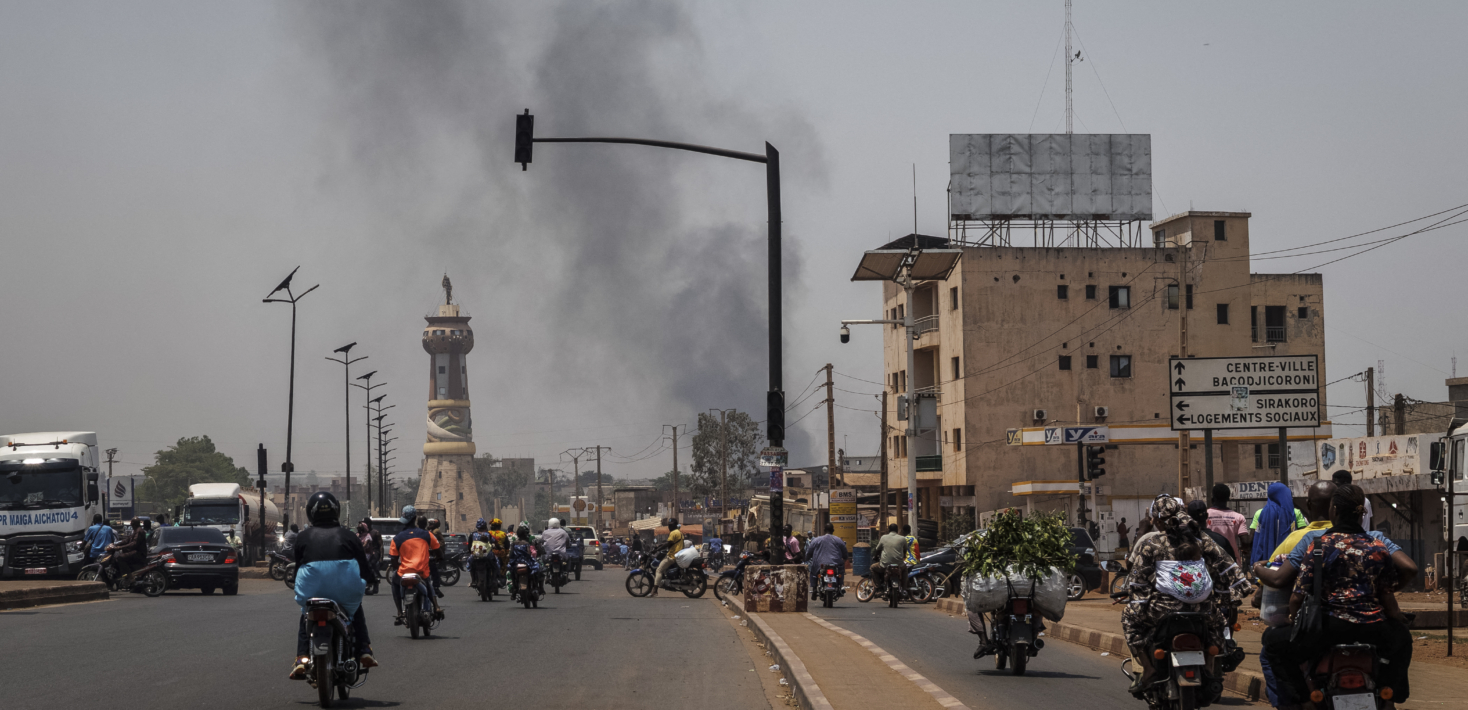


The ongoing siege of Bamako is having unacceptable consequences for civilians’ freedom of movement and may lead to serious violations of their rights to food security, health and life, Amnesty International said today, as it called on the Group for the Support of Islam and Muslims (GSIM) armed group to respect international humanitarian law and ensure the safety of civilians.
Three main roads leading to Bamako have been blocked since 28 April, after GSIM, a non-state armed group affiliated with al-Qaeda, announced a siege of the Malian capital. On 6 May, GSIM attacked a convoy of trucks carrying cargo belonging to civilian companies, including fruit, between Bamako and Bougouni. These trucks were not under military escort and were not carrying military personnel or equipment, according to information gathered by Amnesty International.
“Attacks on civilian vehicles with a civilian purpose are unlawful. Under international humanitarian law, all parties to an armed conflict must always make a distinction between civilians and combatants. Attacks directed against civilians or civilian objects, including vehicles and infrastructure indispensable to the survival of the civilian population, are prohibited” said Marceau Sivieude, Amnesty International’s Regional Director for West and Central Africa.
Sieges should not violate the economic and social rights of the civilian population.
Marceau Sivieude, Amnesty International’s Regional Director for West and Central Africa.
A siege against the rules of war
On 28 April, a GSIM spokesperson announced in an online video a siege of Bamako, starting that day. In contrast to the siege announced in September 2025, when fuel trucks supplying Bamako were exclusively targeted, the current siege appears to apply to all trucks going into the capital.
As of 15 May, at least three of the six main roads leading to Bamako and connecting it to regional ports were disrupted by attacks against incoming traffic, cutting off the capital from vital routes for the movement of goods and the supply of provisions to residents. The media and residents Amnesty International spoke to reported on rising prices for certain basic necessities.
“Sieges should not violate the economic and social rights of the civilian population. GSIM must respect the rules of international humanitarian law. They must ensure that the civilian population of Bamako still has access to adequate water, food, and other necessities,” said Marceau Sivieude.
On 5 May, the UN’s OHCHR called for an immediate end to the fighting and urged all parties to uphold international humanitarian law and international human rights law, including by ensuring protection of civilians and civilian infrastructure.
On 6 May, GSIM announced an easing of the siege and said that people seeking healthcare would be allowed to travel to Bamako. Amnesty International has not been able to verify whether this announcement is being implemented.
Unlawful and deadly attack by GSIM on convoy reported by survivor
Amnesty International spoke with the driver of a fuel truck that was targeted during GSIM’s previous siege on Bamako. In September 2025, GSIM announced its intention to block and disrupt all fuel supply towards Bamako from regional ports and attacked several incoming trucks from Dakar on the Kayes-Bamako Road. In November, GSIM announced that fuel truck drivers would be targeted and considered as combatants.
Amnesty International calls on GSIM to immediately cease all attacks targeting civilians, including indiscriminate attacks.
Marceau Sivieude, Amnesty International’s Regional Director for West and Central Africa.
On 29 January 2026, the driver was part of a fuel truck convoy under military escort that was attacked between Diboli and Kayes. Several drivers and their driver apprentices caught while fleeing were executed, according to the driver. “Twenty kilometres from Diboli, we were attacked by jihadists on motorcycles who shot at the convoy. There were more than two hundred of them,” the driver told Amnesty International on condition of anonymity.
“After the attack, three military pickup trucks arrived as reinforcements and the soldiers on board were killed by the jihadists, who then set the pickup trucks on fire. At least 12 drivers and apprentices were captured by the jihadists and held until the following day. They made them dig graves for the few jihadists who died in the ambush and then slit their throats.”
“International humanitarian law must be respected by all parties to the conflict. Amnesty International calls on GSIM to immediately cease all attacks targeting civilians, including indiscriminate attacks. We are calling on the Malian authorities to investigate these abuses as potential war crimes. Victims and survivors of crimes under international law have a right to truth, justice and reparations,” said Marceau Sivieude.
Background
On 25 April, GSIM or Group for the Support of Islam and Muslims, also known as Jama’at Nusrat al-Islam wal-Muslimin – JNIM and the Azawad Liberation Front (FLA) carried out simultaneous attacks on Bamako, Kati, Mopti, Sévaré, Gao and Kidal, targeting military camps and the residences of key Malian politicians and military. In Kati, defence minister Sadio Camara was killed along with several members of his family, after his home was targeted by a vehicle-borne improvised explosive device.
On 6 May, GSIM assailants attacked the villages of Kori Kori and Gomassagou, in Central Mali, causing ‘several losses in human life and property’ according to regional authorities, leaving at least 40 people dead and several persons unaccounted for, according to local sources contacted by Amnesty International.