


Executive summary
What is happening right now is [the] erasure of humans, trees and stones, and anything that is Palestinian, by settlers under the support of the military.
Muntasir al-Maliki, a resident of Kufr Malik
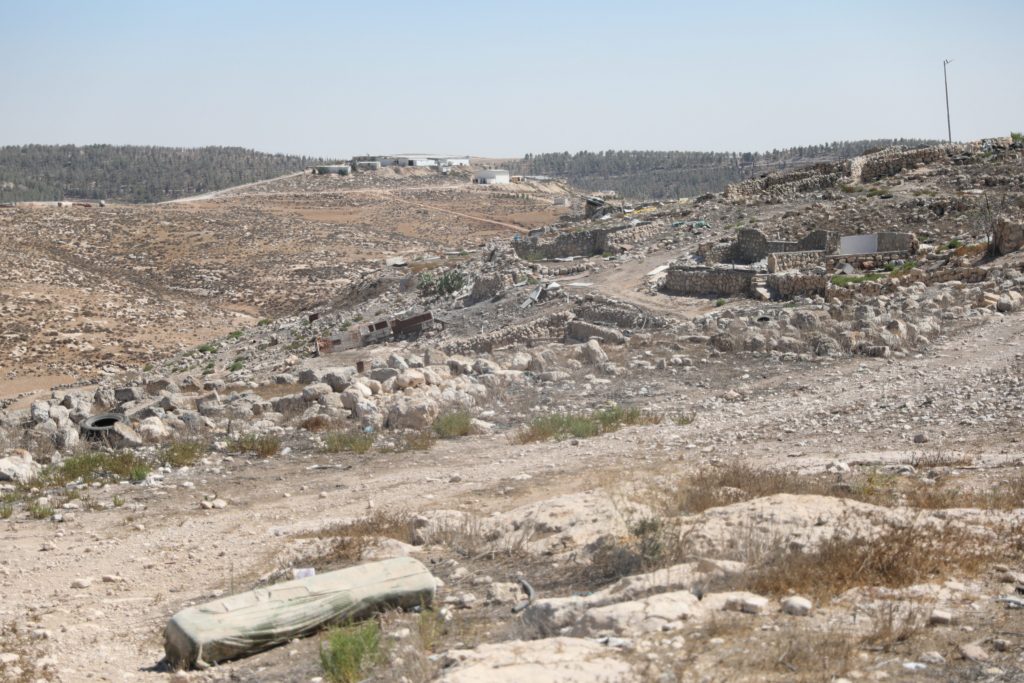
Palestinian families lived for generations in the occupied West Bank village of Khirbet Zanuta (Zanuta)*, sustaining themselves through herding, farming and dairy production. The village was designated as part of Area C under the 1995 Oslo II Accords, placing it under full Israeli military and administrative control. Today, Zanuta is being eaten away by Israeli outposts and settlements and destroyed by state-sponsored violence and terror.
Just 1km from Zanuta, Israeli settlers established an illegal outpost known as Meitarim Farm in 2021. The settlers soon began a sustained campaign of violent attacks and threats against Zanuta’s residents. They set fire to the villagers’ tents and classrooms, broke into their homes, beat them with rifles, threw stones at them, smashed their solar panels and windows, emptied their water tanks and pumped sewage onto their farmland.
The story of Zanuta reflects the fate of dozens of Palestinian Bedouin and herding communities already displaced or at imminent risk of displacement in Area C. This report lays bare the scale and severity of the ethnic cleansing campaign targeting these communities, carried out in a context of apartheid and unlawful occupation and against the backdrop of an ongoing genocide in the occupied Gaza Strip.
The report also demonstrates – contrary to what too many in the international community suggest – that the campaign is not the product of “rogue” settlers, settlers’ organizations or “extremist” government ministers. In other words, settler violence is not an aberration but an integral part of an organized state policy.
The escalating violence in Zanuta followed decades of systematic discrimination by the Israeli authorities, including constant threats of home demolitions to force them to leave, a common practice adopted by Israel to enforce its system of apartheid. Zanuta’s residents repeatedly reported settler attacks to the Israeli police, seeking protection, but no action was ever taken.
When the settlers from Meitarim Farm again raided the village on 21 October 2023, this time accompanied by Israeli forces, and threatened to harm residents if they did not leave, the community knew they had no choice but to flee.
In a rare move, in July 2024 and February 2025, Israel’s Supreme Court ordered the police and military to facilitate the community’s return and protect residents from attacks. The Israeli police and military ignored both rulings. Every attempt by residents to return was met with continued settler violence and the acquiescence of Israeli forces. Digital evidence, interviews and satellite imagery from 30 March 2025 confirm the outcome: Zanuta no longer exists – it has been forcibly depopulated and extensively destroyed.
Meanwhile, the settlers received state backing to intensify their violent campaign. In April 2025, two Israeli ministers – Bezalel Smotrich and Orit Strock – held an event at Meitarim Farm where they distributed 19 state-funded all-terrain vehicles (ATVs), cameras and night-vision equipment to settlers living in outposts in the Hebron area.
Finance Minister Bezalel Smotrich explained why:
“The heroic and pioneering settlers who live here are doing Zionism, and they need security… We are here to build with them and to settle the land...” while praising settler land seizures and emphasizing the role of ATVs in taking over Palestinian grazing land.
The report demonstrates that the ethnic cleansing campaign in Area C is state-sanctioned, state-driven and state-implemented; it seeks to accelerate the Israeli government’s annexation agenda and settlement expansion through war crimes and crimes against humanity. As such, the report’s conclusions demand that the international community fully confront and name the Israeli state-driven project, and act decisively to prevent the destruction of Palestinian communities and the annexation of the West Bank.
Amnesty International’s legal analysis
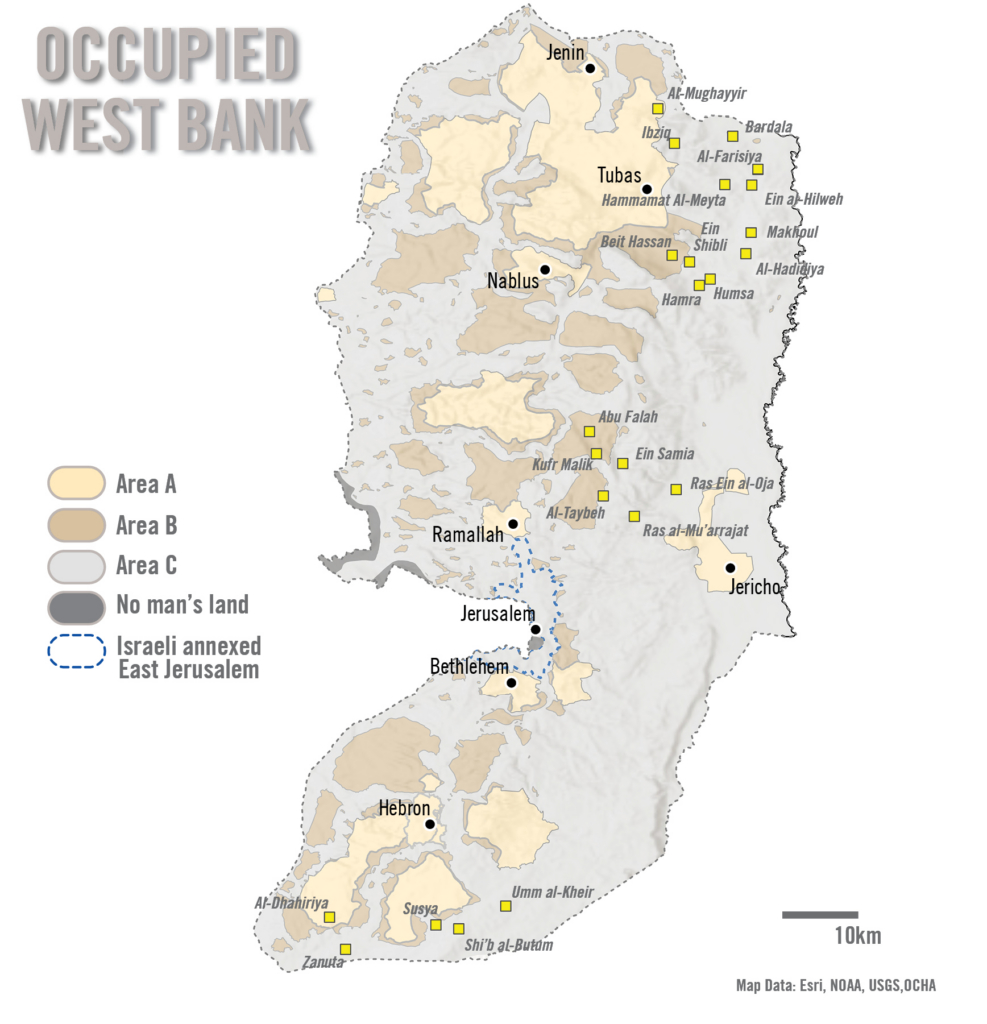
Zanuta is one of 117 predominantly Bedouin and herding Palestinian communities in the occupied West Bank that have faced either full or partial displacement due to settler attacks and related access restrictions between January 2023 and April 2026, according to the United Nations Office for the Coordination of Humanitarian Affairs (OCHA). In total, approximately 5,910 people were forced to leave their homes, leaving behind them vast, depopulated areas. Most of the affected communities lie in Area C, which comprises over 60% of the West Bank, and has been central to Israel’s territorial and demographic quest for domination for decades because of its natural resources, vital grazing and agricultural land and small Palestinian population.
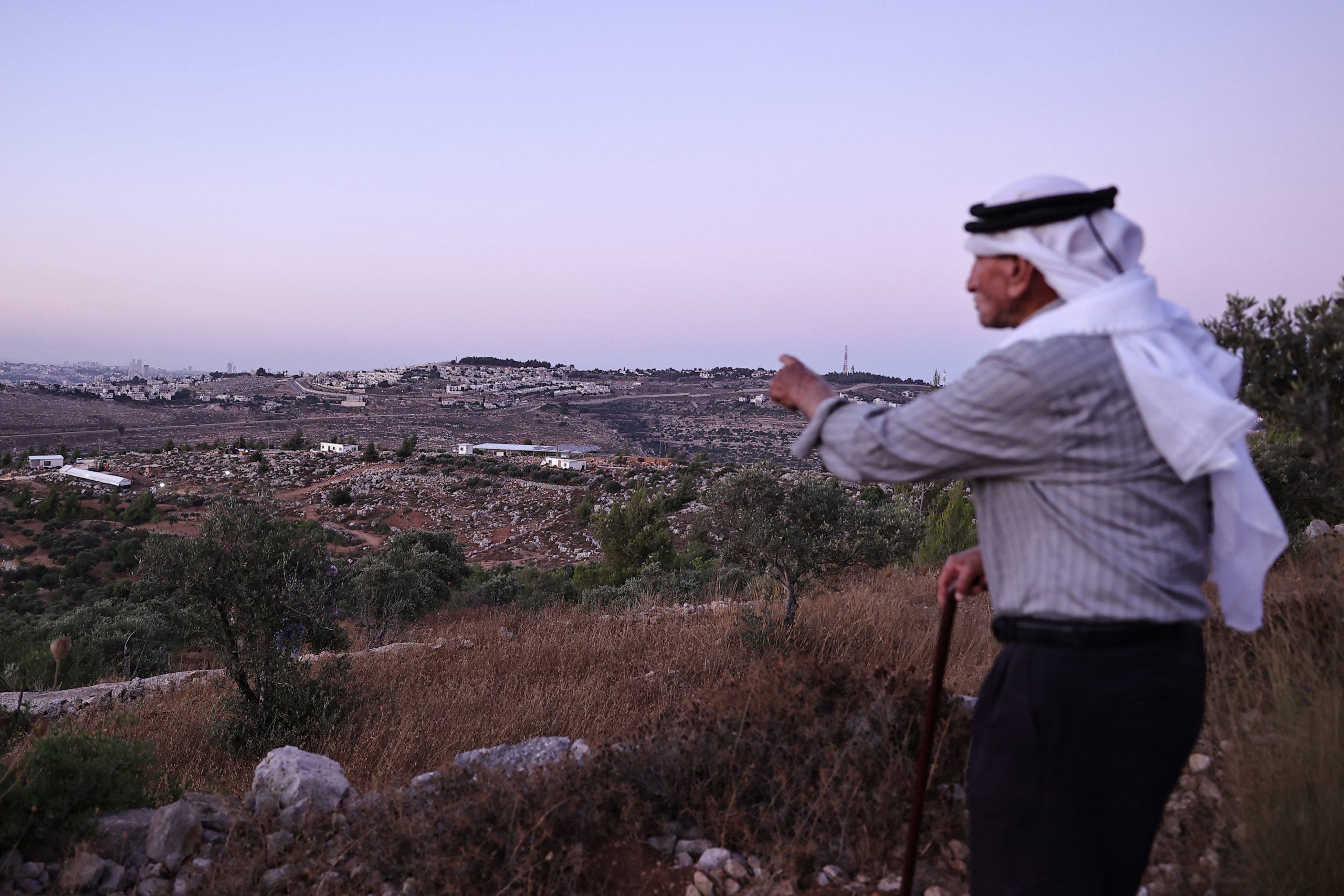
In late December 2022, Benjamin Netanyahu’s Likud party formed Israel’s 37th government in coalition with two ultra nationalist and religious political parties. While state-supported settler violence has been a growing concern over the past three decades for Palestinian communities in the West Bank, there has been an unprecedented surge in the scale and intensity of attacks since then.
Tactics became particularly aggressive after 7 October 2023 when Hamas and other Palestinian armed groups attacked southern Israel, killing approximately 1,200 people, mostly civilians, and forcibly taking 251 others to the Gaza Strip where they were held as hostages and subjected to abuses. Amnesty International found that these acts constituted war crimes and crimes against humanity.
In response, Israel launched a military offensive on the occupied Gaza Strip of unparalleled magnitude, scale and duration and inflicted catastrophic levels of destruction, displacement and starvation on Gaza’s civilian population, committing genocide against Palestinians in the Gaza Strip. While most global attention focused on Gaza, Israel intensified its abusive policies and practices against Palestinians in the occupied West Bank, with government officials openly encouraging and supporting settler attacks.
Displacement and dispossession: war crimes and crimes against humanity
Ideologically motivated Israeli settlers have terrorized Palestinian communities through repeated raids on their homes and villages, beatings, death threats demanding they leave, persistent harassment, the destruction of property and village infrastructure, cutting off access to water and electricity, and theft of their livestock and belongings. These practices deliberately intensified an already coercive environment aimed at forcibly displacing and dispossessing Palestinians, manifested in state policies of access restrictions, home demolitions and settlement expansion. Palestinians who have attempted to return have found their villages fenced off or destroyed, or have faced renewed settler attacks, harassment and intimidation, forcing them to flee again.
These settler attacks are the direct result of a state policy that integrated and enabled the settler movement’s vision of “Greater Israel”, an ideology that treats the area extending from the Mediterranean Sea to the Jordan River, including the entirety of the Occupied Palestinian Territory (OPT), as an integral part of Israel.
Senior Israeli officials in the 37th government have fully embraced this vision and explicitly encouraged, facilitated and condoned settler violence against Bedouin and herding communities as a deliberate tool of displacement with greater openness and force than their predecessors, as they pursued their goal of formally annexing the West Bank under Israeli law.
Since 1967, Israel has been enforcing its occupation through military orders and regulations. The situation in the OPT, including in Area C of the West Bank, is therefore primarily governed by international humanitarian law (including the rules of the law of occupation); and international human rights law. The same international norms apply to occupied East Jerusalem, illegally annexed by Israel since 1967, despite Israel’s attempts to separate it from the rest of the West Bank through a regime of fragmentation and legal segregation.
In this report, Amnesty International presents conclusive evidence that these violations, perpetrated between January 2023 and December 2025, amount to the war crime of unlawful deportation and transfer and the crime against humanity of forcible transfer or deportation, committed as part of a policy to ethnically cleanse Area C of the occupied West Bank by forcibly displacing Palestinian Bedouin and herding communities and expanding illegal settlements at their expense.
Amnesty International uses the term ethnic cleansing in this report to describe a deliberate pattern of conduct aimed at permanently removing Palestinian Bedouin and herding communities from specific areas of the occupied West Bank, in particular Area C. While ethnic cleansing is not recognized as an independent crime under international law, Amnesty International uses the term in line with the UN Commission of Experts on Former Yugoslavia’s definition, which describes it as “a purposeful policy designed by one ethnic or religious group to remove by violent and terror-inspiring means the civilian population of another ethnic or religious group from certain geographic areas.”
While this report covers the period between December 2022 and December 2025, these egregious crimes are ongoing and are part and parcel of Israel’s system of apartheid, as shown by Amnesty International’s continuous documentation and reporting of the situation on the ground.
Research methodology
To reach these conclusions, Amnesty International first established Israel’s intent to formalize the annexation of Area C under Israeli law and change its demographic composition, including through violations of international law, constituting war crimes and crimes against humanity. This involved extensive analysis of Israel’s historical annexation-oriented policies, government agreements, official statements by cabinet ministers, proposed and adopted legislation, and governance changes in the occupied West Bank. The organization then assessed how these policies affected Palestinians from Bedouin and herding communities, focusing on three emblematic areas in Area C that had either faced settler-driven displacement or were at risk of such displacement between 2023 and 2025:
- Zanuta in the South Hebron Hills;
- Ein Samia in the central Jordan Valley; and
- Al-Farisiya, Ein al-Hilweh, and Makhoul, a cluster of small communities in the northern Jordan Valley.
The report also draws on field and desk research into events that occurred in 22 other Bedouin and herding communities.
In total, Amnesty International interviewed 64 individuals for this report, including 45 Palestinian women and men from 12 communities, who are either displaced or facing the risk of displacement, some of them multiple times. Amnesty International also interviewed 19 lawyers, foreign and Israeli activists monitoring settler violence, Palestinian officials, journalists and Israeli and Palestinian NGO representatives. The organization rigorously verified more than 420 videos and images, and reviewed government documents, court decisions, maps, satellite imagery, UN and civil society reports, and other open-source material.
On 13 May 2026, Amnesty International shared its findings with the Israeli ministries of national security, defence, justice and finance as well as with the Attorney General. By the time of publication, it had received a response only from the military’s spokesperson’s unit. Among other things, it claimed that Israeli forces respond to settler attacks against Palestinians and their property, detaining suspects, when necessary, until the arrival of the police. It also stated that it investigates cases where forces may have failed to comply with orders or failed to intervene to stop settler violence. Evidence documented and analysed by Amnesty International demonstrates a different reality from the claims purported by the military. A copy of the response is annexed to the report.
Israel’s intent to annex Area C and remove Palestinians
Since Israel’s 1967 occupation of the West Bank, including East Jerusalem (which it illegally annexed), and the Gaza Strip, successive Israeli governments have advanced annexation plans that would allow the application of Israeli governmental power over the greatest amount of Palestinian territory while keeping minimal Palestinian presence.
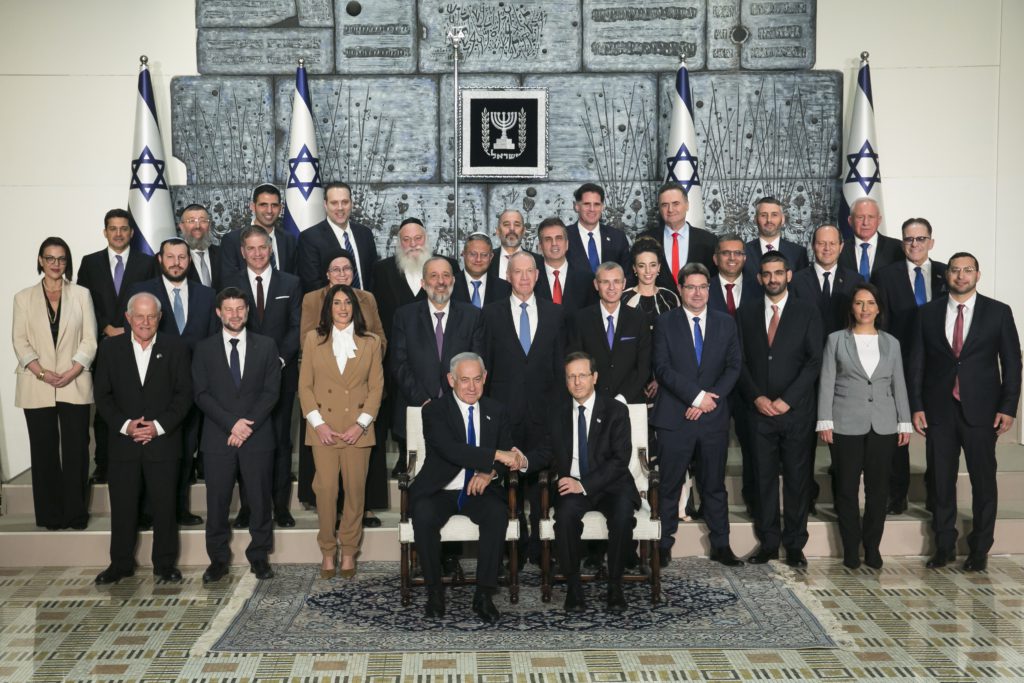
The formation of the 37th Israeli government in December 2022 marked a significant shift in both the speed and scale towards formalizing annexation measures under Israeli law. Led by Benjamin Netanyahu’s Likud party in coalition with Itamar Ben-Gvir’s Jewish Power and Bezalel Smotrich’s Religious Zionism parties, the government made the expansion of formal annexation under Israeli law of other areas of the occupied West Bank beyond East Jerusalem an explicit policy objective.
It openly embraced the settler movement’s vision of “Greater Israel” and intensified Judaization policies, which seek to maximize Jewish-Israeli control over land while restricting Palestinians to living in fragmented, densely populated enclaves to minimize their presence and curtail their access to areas of strategic importance. It also accelerated land confiscation primarily through state land declarations and expanded settlements and related infrastructure projects at an unprecedented pace. In doing so, it continued to violate core peremptory norms of international law, including the prohibition against annexation and establishing settlements in occupied territory. It also defied numerous UN Security Council and General Assembly resolutions on the illegality of settlements adopted since 1967, as well as two advisory opinions by the International Court of Justice (ICJ), most recently the July 2024 opinion that found the occupation unlawful and ordered Israel to end its presence in the OPT and dismantle all settlements.
Israeli authorities also abolished provisions of the disengagement law that had led to the evacuation of four settlements and outposts in the northern West Bank nearly two decades earlier and retroactively legalized outposts that are unauthorized even under Israeli law, increasing state funding and logistical support and facilitating private firearm licensing to their residents. Crucially, the government actively enabled a campaign of unprecedented violence by settlers to forcibly displace Palestinians from Area C.
These priorities were formalized in the coalition agreements signed between Likud and both Jewish Power and Religious Zionism as well as the government’s guiding principles. In complete violation of international law, these principles assert that the occupied West Bank is an integral part of the “Land of Israel”, commit the government to “promote and develop settlement”, and recognize “the Jewish people[’s] exclusive and undisputed right over all areas of the Land of Israel”, further entrenching Jewish Israeli domination of Palestinians.
The appointments of Itamar Ben-Gvir as national security minister with authority over the Border Police in the West Bank, and Bezalel Smotrich as finance minister and additional minister within the Ministry of Defense overseeing key units within the Israeli military responsible for implementing civil policies in the West Bank, placed prominent settlers and advocates of annexation at the centre of government decision-making.
Beyond formal agreements, public statements by senior officials – including Prime Minister Benjamin Netanyahu – reflect a coordinated and openly declared push towards annexation and Jewish demographic dominance in the West Bank, particularly in Area C.
For example, in February 2023, Prime Minister Netanyahu insisted that “construction and regulation in Judea and Samaria [the occupied West Bank] will continue according to the original planning and construction schedule, without any changes” and that there was “not, and will not be, any freeze.” In September 2025, Bezalel Smotrich announced plans to annex 82% of the West Bank, stating that the top guideline should be “maximum land, minimum Arab population”, in essence therefore to foster Jewish demographic superiority. Addressing both the Gaza Strip and the West Bank, in September 2025, Itamar Ben-Gvir called for establishing Israeli “sovereignty” and encouraging the forcible transfer of Palestinians living there: “because this is our land, and because we need to tell the whole world: ‘this is ours forever and ever’… Sovereignty, and also encouraging [Palestinian] voluntary emigration, which we should do also in Judea and Samaria.”
Expedited settlement expansion and annexation measures
Immediately after its formation, the government moved to implement the settler movement’s vision, which includes formalizing annexation, settlement expansion and accelerated land grabs – as outlined in the coalition agreements. To this end, it rapidly shifted authority over civilian affairs in the occupied West Bank from military to civilian bodies. Crucially, these measures consolidated Bezalel Smotrich’s power to make decisions affecting Palestinians in Area C. This violates international humanitarian law, which requires the occupying power to respect existing laws unless absolutely prevented from doing so.
February 2023: the Ministry of Defense established the Settlement Administration, a civilian body under Bezalel Smotrich responsible for all aspects of life in Israeli settlements in the West Bank. The new body has authority to regularize outposts and enforce planning and construction laws for both Palestinian and Israeli construction in Area C, which has led to a virtual halt of operations to dismantle structures built by settlers without official Israeli authorization.
June 2023: responsibility for settlement planning and approvals was formally transferred from the defence minister to Bezalel Smotrich in his capacity as additional minister. The decision facilitated unrestricted settlement construction in the West Bank by removing multiple layers of political and military oversight and cancelling the need for defence minister and prime minister approval. Following Donald Trump’s election as US president in November 2024, settlement approval meetings – previously held at most quarterly – were convened weekly, accelerating approval rates.
May 2024: the West Bank Military Commander authorized the appointment of a civilian deputy for civil affairs within the Civil Administration. A close associate of Bezalel Smotrich was appointed, reporting not to the head of the Civil Administration but to Smotrich directly as head of the Settlement Administration.
May 2025: Israeli authorities announced the resumption of land registration in Area C, a measure effectively designed to benefit Israeli settlers by treating all unregistered land as state land under Israeli control unless Palestinians can meet almost insurmountable evidentiary requirements to prove ownership.
February 2026: Israeli authorities re-established a new land registration mechanism that transferred authority over mapping and land measurement in unregistered areas from the Civil Administration to the Ministry of Justice. By the end of that month, Israeli authorities had seized half of the unregistered land in Area C, which accounts for 58% of the area.
The security cabinet approved additional measures to entrench Israeli control over Palestinian land. These included: repealing a Jordanian-era law which had prevented non-Palestinians from purchasing land in the West Bank without permission from Palestinian authorities; and reviving a mechanism – through a body within the Civil Administration – that enables the Israeli state to purchase land directly from Palestinians without seeking additional approval. The government also authorized simplified settlement approval procedures.
Funding settlement expansion
Since it came to power, the government exponentially increased funding to implement the settler movement’s agenda, using the Hamas-led attacks on 7 October 2023 to significantly escalate aggressive annexation-related measures and practices in the West Bank.
Substantial resources were channelled to the Settlement Division – the body mandated to plan and oversee the establishment and expansion of settlements – and major infrastructure projects; and specific settlements were designated as national priority areas under government financial aid programmes. Among the leading ministries that pumped money into the settlement enterprise were the ministries of settlement and national missions, headed by Orit Strock; defence; transportation; and agriculture.
For example, within the first three years of the government’s rule, the Ministry of Settlement and National Missions’ annual budget grew by 122%, reaching NIS 764 million (about USD 254.5 million) by 2026. In 2023, the government allocated NIS 3.5 billion (about USD 1.1 billion) to the Ministry of Transport to upgrade and develop roads for settler use in the West Bank over five years. An additional plan to strengthen and develop settlements and related infrastructure, with a budget allocation of NIS 2.75 billion (about USD 919 million), was approved in December 2025.
In addition, the government provided direct funding and equipment to unauthorized outposts. Peace Now, an Israeli organization, uncovered evidence that in 2023 the government provided 68 settler herding outposts and 33 outposts with NIS 28 million (about USD 8 million), which was used to purchase drones, vehicles, cameras, solar panels and electric gates. In July 2024, the Minister of Settlement and National Missions confirmed that her office had allocated NIS 75 million (about USD 23 million) to upgrade security infrastructure in outposts. Between April and July 2025, the government transferred at least 48 ATVs to unauthorized outposts along with night vision goggles, drones, communications equipment and generators.
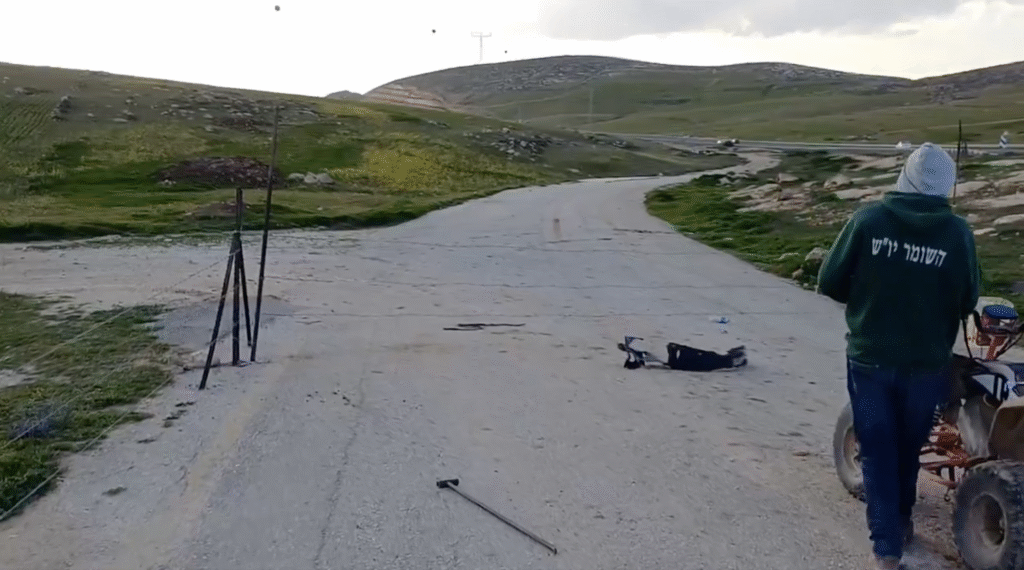
Israeli authorities also directly funded settler organizations involved in dispossessing Palestinians. For example, HaShomer Yosh, which recruits volunteers to live or engage in activities in outposts, has received at least NIS 3 million (just over USD 1 million) in government funding since 2023 despite verified videos showing its members harassing and assaulting Palestinians from Bedouin and herding communities, damaging their property, and preventing displaced Palestinians from returning home.
Surge in settlement construction
Ma’ale Adumim is an integral part of our homeland and there will be many other Ma’ale Adumims in our homeland.
Prime Minister Benjamin Netanyahu on the approval of 3,401 new housing units in Ma’ale Adumim during a visit to the settlement on 11 September 2025.
The government’s policy changes triggered an unprecedented surge in settlement construction. While the annual average between 2012 and 2022 stood at 5,443 units promoted, it rose to approximately 16,928 units per year under the 37th government. In Area C, Israeli authorities declared 25,959 dunums (around 2,596 hectares)as state land between 2023 and 2025.
Between 2023 and 2025, the government promoted plans for the construction of 50,785 settlement housing units, according to Peace Now. In 2025 alone, the Higher Planning Council approved 27,941 units, the highest annual figure ever recorded.
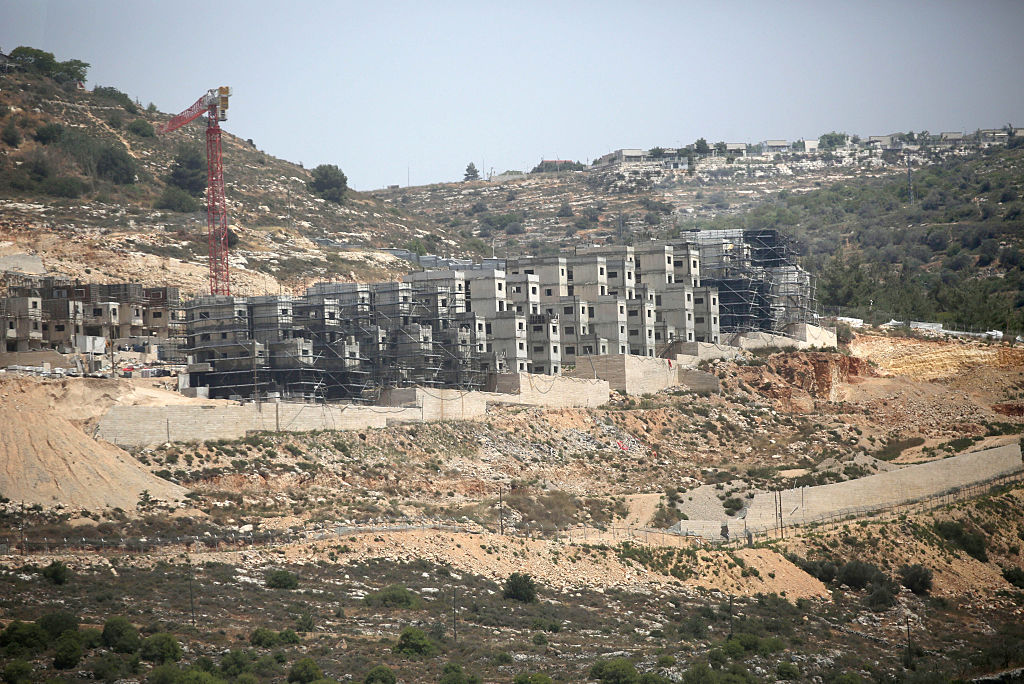
By contrast, Israel’s consolidated policy to restrict Palestinian construction and development in the West Bank – and especially Area C – intensified; in 2023 and 2024 no Palestinian housing plans were approved in Area C and permits were issued for only nine housing units.
In addition, Israeli authorities demolished 3,407 Palestinian homes and other structures between January 2023 and April 2026, displacing 2,996 people.
They also took little action against Israeli outposts established in the West Bank by Israeli civilians without state authorization, even though they are considered illegal also under Israeli law. Indeed, they dismantled only six outposts, while dozens were established and subsequently legalized. This demonstrates that unauthorized settler construction is effectively encouraged and protected by the government.
By the end of April 2026, Israeli settlers had established 363 outposts in the occupied West Bank, according to Peace Now. Of these, 212 (over 58%) were created under the 37th government, including some in Area B over which, according to the Oslo Accords, Palestinian authorities are supposed to have full administrative control. By comparison, 151 outposts were set up between 1996, when they began appearing, and 2023. They included scores of herding outposts, which are used by settlers to take over large areas of Palestinian land through grazing.
In addition, since January 2023, the Israeli authorities have retroactively legalized at least 39 outposts as settlements. Combined with government decisions to designate some settlement neighbourhoods as independent settlements, to re-establish four settlements and outposts in the northern West Bank that had been dismantled under the 2005 unilateral disengagement plan, and to declare entirely new settlements, the total number of new settlements declared by the government had reached 102 by 30 April 2026, according to Peace Now. This is by far the largest number of new settlements authorized by one government in Israel’s history.
Settler violence against Palestinians as state policy
“For almost a year, I didn’t cross the highway [Allon Road]. They [settlers] used to harass me and other shepherds, and we’d try to avoid them, but then the army started showing up and protecting them, shooting in the air.” – Ayman Suleiman, a Palestinian man displaced from Ein Samia.
With full political, legal and financial state backing, under Israel’s 37th government, settlers have intensified existing practices and adopted more aggressive tactics to displace Palestinians and seize their land. This has led to record levels of displacement, killings and injuries, property destruction and unlawful land appropriation.
Settlers use three main tactics to forcibly displace Palestinian communities:
- attacks on homes, villages and property;
- persistent harassment, threats and physical assaults; and
- systematic targeting of livelihoods by restricting access to grazing land and water sources, stealing or killing livestock, and destroying agricultural fields and crops.
Israeli authorities actively facilitate such attacks by arming settlers and allowing the army and police to support or participate in attacks. In several cases documented by Amnesty International, Palestinians who reported settler violence were themselves interrogated, fined or arrested.
Following Israel’s offensive on the Gaza Strip in response to the Hamas-led attacks on 7 October 2023, the government loosened licensing criteria for issuing private firearms licences and formed hundreds of “rapid response” units across Israel and the occupied West Bank, arming civilians to respond in situations of “terrorism” and other emergencies. Thousands of additional weapons were distributed to newly formed “regional defence battalions”, largely staffed by settlers who had been drafted into military reserves. By January 2026, more than 240,000 Israeli citizens had received firearm licences, among them Israeli settlers.
In most incidents documented by Amnesty International, settlers were armed. Even when weapons were not used, their presence fundamentally altered the nature and severity of attacks Palestinians had faced for decades, enabling settlers to destroy Palestinian property, steal livestock, and terrorize Bedouin and herding communities with unprecedented intensity.
Violent raids and physical attacks
Palestinians from herding and farming communities in Area C interviewed by Amnesty International said that settler attacks on their homes and community structures between early 2023 and late 2025 became more frequent, more intense and targeted their homes more often, leaving no place where they felt safe. They consistently reported that settlers targeted their livelihoods to force them to leave, often with the support of Israeli soldiers or representatives of settlement regional councils.
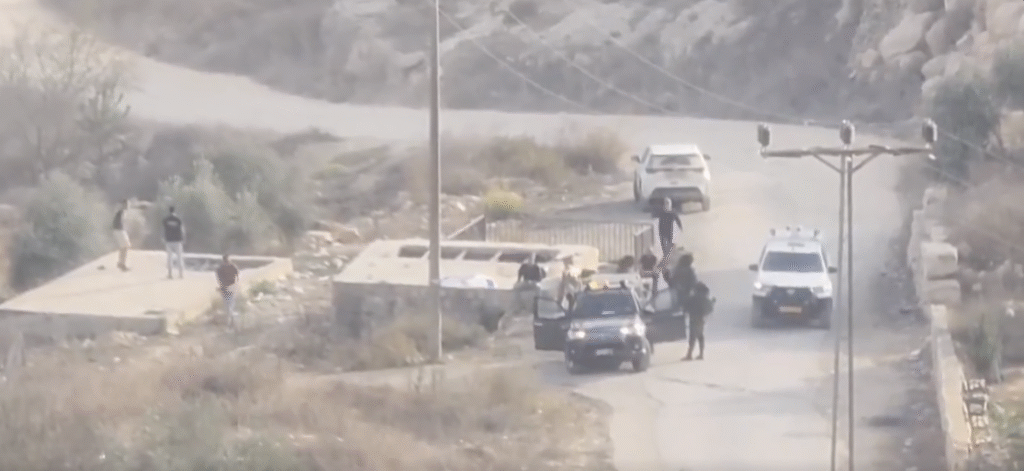
Verified footage of some of these attacks shows setters engaging in break-ins; vandalism of homes, vehicles, tents, schools, agricultural tools and tractors; destruction of water tanks, solar panels and food supplies; and arson of tents and homes. In several raids, settlers were accompanied by Israeli soldiers or settlers wearing military uniforms and directly resulted in the full or partial displacement of communities. Some videos show settlers harassing Palestinian shepherds, ramming flocks with vehicles, and stealing or attacking and in some cases killing their animals.
Several of the Palestinians interviewed, as well as four volunteers interviewed had personally experienced or witnessed physical violence by settlers. They said that settlers pushed or beat Palestinian men and at times children with their hands, sticks or rifle butts; threw stones or pointed guns and rifles at them; shot in the air to intimidate them; stabbed people with knives; and attempted to run them over with vehicles.
The attacks took place in grazing areas, in agricultural fields, inside communities and even in private homes, and were often accompanied by verbal insults, with settlers threatening to choke or shoot residents or take over their houses and explicitly ordering them to leave their communities. In addition, settlers regularly harassed Palestinians by filming them without their consent.
A shepherd from Shi’b al‑Butum in Masafer Yatta in the South Hebron Hills said that approximately three days after 7 October 2023, several armed and masked settlers arrived at his home and one threatened to kill his children if the family did not leave their home. The next day, the shepherd said, the same settler came back and pressed a rifle to his chest, kicked him in the stomach, and threatened to shoot him. This violence unfolded in the presence of his terrified daughters. On another day, he added, the same settler forced him to lie face down at gunpoint, and together with another settler covered his head with a blanket and threatened to kill him. They then destroyed the shepherd’s water tanks and electricity lines, stole agricultural equipment, and smashed his wife’s phone when she tried to film the attack.
According to OCHA, recorded Palestinian deaths at the hands of settlers rose to an annual average of eight between 2023 and 2025, compared with fewer than 1.7 per year over the preceding six years. Injuries more than tripled in the same period, including a marked increase in firearm-related injuries. More broadly, settlers carried out at least 4,575 attacks on Palestinian communities resulting in casualties and/or property damage in those three years.
Deliberate targeting of livelihoods
Settlers also deliberately destroyed Palestinian farmland and livestock. Residents of Ein Samia, Makhoul and Zanuta said that settlers routinely herded their animals on Palestinian cultivated land, damaging crops and intentionally destroying agricultural fields. Video evidence of 10 incidents corroborates these accounts and additionally shows settlers building roads and fencing off entire areas to prevent Palestinians from farming. In a particularly brutal incident, on 17 July 2025, Israeli settlers shot and stabbed 180 to 200 sheep they had stolen in Hammamat al-Meyta, a small community in the northern Jordan Valley, killing at least 120 of the sheep.
As a result of settlement expansion and sustained settler violence, Palestinians’ access to grazing areas in Area C has sharply diminished. Interviews and verified visual evidence show a sustained pattern in which settlers have exploited Palestinian Bedouin and herding communities’ dependency on livestock to force their displacement. Meanwhile, instead of investigating settler abuses, Israeli authorities and forces have used actual or threatened livestock confiscation to prevent displaced residents from returning to their homes or grazing lands.
Role of Israeli forces and authorities in settler violence
For decades, Israeli authorities and forces have condoned, failed to prevent, facilitated or directly participated in settler violence against Palestinians. Under the 37th government, this support has reached new levels.
Despite its obligations as an occupying power to protect the lives and livelihoods of the occupied population, the Israeli army has either directly participated in settler attacks or deliberately failed to intervene, indicating a policy to allow such attacks and shield perpetrators from accountability.
Amnesty International documented 14 cases in which Israeli soldiers were present during or directly involved in violent attacks by settlers. Their actions ranged from standing by as Palestinians were being assaulted to facilitating or actively joining in acts of harassment, intimidation, destruction of property or physical violence against individuals. In some cases, soldiers arrived alongside settlers, suggesting prior coordination. They also expelled shepherds from grazing areas, threatened to shoot them or confiscate their animals, conducted violent searches and prevented activists from reaching scenes of settler violence, allowing attacks to continue. These actions contributed to Palestinian residents leaving their homes.
After 7 October 2023, Israeli authorities issued thousands of settlers with firearms and uniforms, making it difficult for Palestinians to distinguish settlers from soldiers. This enabled settlers to exploit the authority associated with military attire to carry out abuses. Verified videos show that settlers who previously attacked Palestinians in civilian clothing were now doing so in uniform.
In Shi’b al-Butum in Masafer Yatta, for instance, residents reported that since September 2024 a settler from the nearby outpost Mitzpe Yair, armed with a gun and dressed in military uniform, had repeatedly entered the village to take photographs and vandalize property. Videos show a settler roaming the village, by day and night, damaging fences and gates. Although he appears armed with a rifle and in military-style clothing, he drives a civilian ATV commonly used by settlers.
State collusion with settler attacks includes arbitrary arrests and short-term detention of Palestinians, which increased sharply after 7 October 2023. Palestinians described arrests and detentions imposed for allegations such as “clashing with settlers”, based solely on settlers’ testimonies, even in cases where they said they had been the target of settler attacks, harassment or thefts, while the settlers were not investigated. Some were detained after arriving at police stations to file a complaint after having been attacked by settlers, only to be treated as suspects in the very assaults they reported.
Palestinians accused of grazing in prohibited areas, such as land designated by the Israeli authorities as “state land”, closed military zones, or land under the jurisdiction of settlement councils – all of which were designations used by Israel to unlawfully seize Palestinian lands after 1967 – were additionally subjected to heavy fines, sometimes forcing them to sell part of their livestock to pay them or pursue costly legal proceedings to appeal them.
Impunity for crimes against Palestinians
Despite a wealth of publicly available videos and victims’ and eyewitness accounts, Israeli law enforcement officials have consistently failed to conduct effective investigations and hold perpetrators of settler violence to account. According to Yesh Din, an Israeli human rights organization, in the cases it monitored between 2005 and 2025, around 94% of investigations into offences committed by Israeli civilians against Palestinians have ended without an indictment, and only 3% have led to partial or full convictions.
Most Palestinian survivors of attacks interviewed by Amnesty International said they no longer file complaints with the police because it is unlikely they will result in any action.
Measures taken by government officials have also entrenched impunity. In November 2023, National Security Minister Itamar Ben-Gvir instructed senior police officers in the West Bank to refrain from enforcing the law against extremist settlers and right-wing groups committing offences against Palestinians, according to media reports. A year later, in November 2024, Defense Minister Israel Katz announced his plan to halt using administrative detention orders against violent settlers – which have been used almost exclusively against Palestinians for decades – saying it sent a “clear message of strengthening and encouraging the settlements, which are at the forefront of the struggle against Palestinian terrorism.”
Even when settlers or settlers’ organizations have been placed under sanctions, including asset freezes and travel bans, by some foreign states, they have faced little or no repercussions in Israel, despite extensive documentation of the violence they have incited or carried out. Crucially, they have continued to engage in abuses against Palestinians.

In one emblematic case, Yinon Levi, founder of Meitarim Farm, was filmed shooting dead an unarmed Palestinian activist, Awda al-Hathaleen, in Umm al-Khair on 28 July 2025. Israeli authorities briefly arrested Yinon Levi on suspicion of involuntary manslaughter, but released him the following morning and placed him under house arrest for just three days. Videos show him subsequently returning to Umm al-Khair to harass Palestinian residents and preparing the ground for a new unauthorized outpost. At the time of writing, Yinon Levi is yet to be indicted for the killing of Awda al-Hathaleen, even though prosecutors expressed their intention to do so in February 2026. Despite video materials showing him committing abuses against residents of Umm al-Khair, Zanuta and other communities, no investigation has been opened. This reflects a broader pattern where settlers who establish unauthorized outposts face no accountability.
In the few cases where courts offered partial redress – such as ordering that displaced Palestinians be allowed to return home, as in the case of the Supreme Court’s decisions on Zanuta, or granting restraint orders against individual settlers – the Israeli police and army have consistently ignored the rulings, leaving Palestinians with no prospects of justice.
Government policies facilitating forced displacement of Palestinians
In addition to the increasing settler violence backed or condoned by the Israeli authorities, forced displacement of Palestinians is being facilitated by other Israeli government policies, including discriminatory zoning and building regulations, settlement expansion, demolitions and restrictions on access to land and water.
The community of Ein Samia, on the land of Kufr Malik in Area C, north-east of Ramallah, is a case in point. For generations the area of Ein Samia was an agricultural and herding hub relied upon by farmers and livestock owners from Kufr Malik and neighbouring villages, including Ein Samia’s Bedouin community. Over time, the area became increasingly constrained by Israeli discriminatory land appropriation measures, accompanied by the steady expansion of nearby Israeli settlements and outposts, including Kochav HaShahar settlement established less than 2km away in 1977. By April 2026, settlers had established at least 12 outposts around Kochav HaShahar, progressively surrounding Ein Samia and consolidating settler control over land and resources.
The Bedouin community, mainly shepherds, also faced decades of demolition orders under a discriminatory planning regime that made building permits virtually unattainable for Palestinians. Authorities imposed heavy fines on herders for grazing on land designated by the Israeli authorities as “state lands” and threatened to confiscate residents’ sheep.
As outposts expanded and demolitions intensified, settler violence escalated. “Rahma” (name changed for security reasons), a Palestinian woman subsequently displaced from Ein Samia, told Amnesty International:
“The settlers started coming day after day. They overturn the water tanks, harass the young men, and come both during the day and at night. We can’t breathe any more. We are never at ease, neither by night nor by day. I am an old woman – by God, I do not sleep. I stay sitting on a chair. If they come, they spare no one.”
The violence and threats confined Palestinians to a shrinking fraction of their former grazing areas, forcing them to buy feed and water, reducing milk production and income, and leading to land degradation. Following sustained daily attacks, the community was driven out of Ein Samia on 22 May 2023. Attempts to return have been halted or deterred by settler attacks, arrests, the authorities’ demolition of Ein Samia’s school, and the destruction and disruption of water supply systems.
Communities at risk
Many Palestinian communities are at critical risk of forced displacement.
In the northern Jordan Valley alone, at least 38 Palestinian herding communities – home to approximately 7,000 people – are threatened with displacement as Israel advances its annexation-related policies. The area constitutes around 75% of Tubas governorate and is overwhelmingly classified as Area C, with nearly 90% designated by Israeli authorities as state land, “closed military zones”, nature reserves and archaeological sites. Israeli authorities use these designations as grounds for issuing demolition orders against Palestinian communities and preventing Palestinian shepherds from herding. Since January 2023, Israel has declared more than 20,000 dunums (2,000 hectares) in the Jordan Valley as state land.
Settlement expansion further fragments Palestinian communities. Eight Israeli settlements and at least 19 outposts, together with expanding settler-only roads and infrastructure, confine Palestinians to shrinking enclaves and expose them to intensified settler violence and military harassment.
Palestinian communities at risk are all too aware of their possible fate. Ein al-Hilweh, a small herding community of around 50 people, faced escalating settler violence from late 2023, arrests and intimidation by Israeli forces, and an expanding presence of nearby outposts and settlements accompanied by fencing that restricted movement. In July and August 2025, Israeli forces demolished all community structures, effectively rendering the community members homeless.
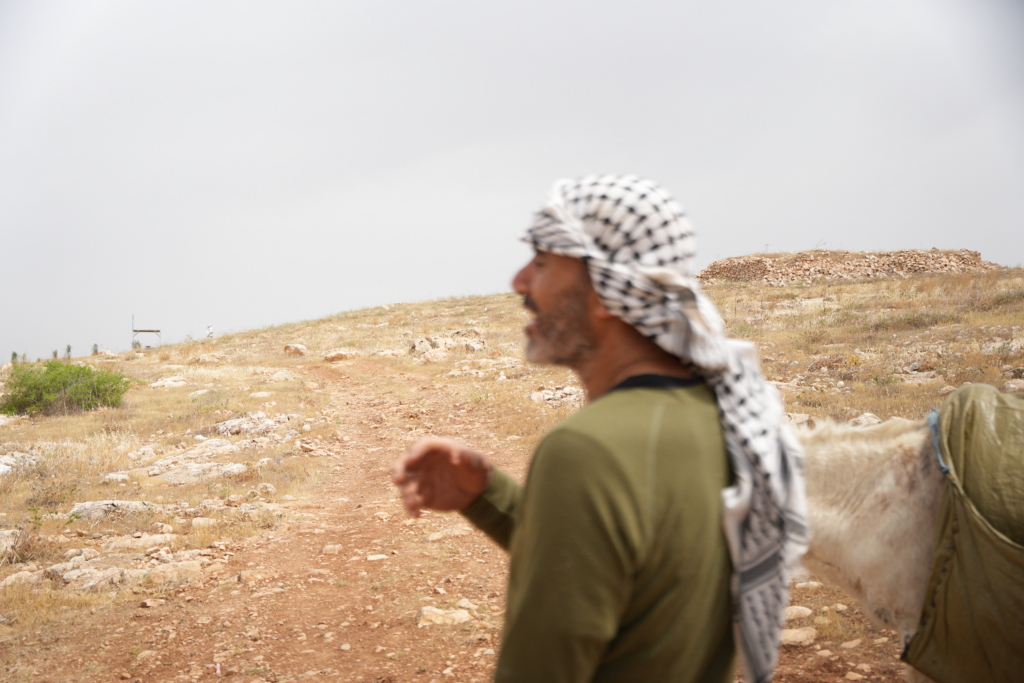
Makhoul has faced similar displacement dynamics over a longer period. Once home to dozens of families, the community was reduced to four families following the demolition of all 58 structures in 2013 and further demolitions since. Now surrounded by military bases, settlements and outposts, residents describe constant intimidation. Since late 2023, settler violence has escalated sharply, targeting livestock through assaults on shepherds, arson attacks, animal theft, vehicles driven into herds and threats against children. The community has also faced repeated settler trespass, harassment and construction near homes, alongside systematic nighttime grazing by settlers that destroys crops. Residents say they live in fear that any short absence would lead to permanent land seizure.
Conclusions and recommendations
Amnesty International’s research shows conclusively that, in the context of Israel’s unlawful occupation and its imposition of a system of apartheid against all Palestinians, and against the backdrop of an ongoing genocide in Gaza, Israeli authorities are committing serious violations of international human rights and humanitarian law in pursuit of a policy of ethnic cleansing in Area C of the occupied West Bank. This policy is implemented through the forcible displacement of Palestinian Bedouin and herding communities, acts that amount to the war crime of unlawful deportation and transfer, and the crime against humanity of forcible transfer or deportation, as well as the creation and expansion of settlements, which amount to the war crime of unlawful transfer.
In September 2024, the UN General Assembly passed a resolution demanding that Israel end its unlawful presence in the OPT within 12 months, in compliance with the ICJ’s historic opinion outlining third states’ obligations arising from Israel’s unlawful occupation of Palestinian territory. It urged states not to render aid or assistance to Israel’s unlawful presence in any diplomatic, political, legal, military, economic, commercial and financial dealings with Israel. Among other measures, it called for targeted sanctions against individuals and entities engaged in maintaining the occupation, including in relation to settler violence, an end to imports from Israeli settlements and a halt to arms transfers.
Most states have failed to take effective actions so that no aid or assistance is rendered towards Israel’s unlawful presence in the OPT and to its illegal settlements; or to cooperate to end Israel’s system of apartheid against Palestinians, and to ensure accountability for crimes under international law. Where action has been taken, it has been limited to sanctions against a small number of individual settlers known for attacking or inciting against Palestinians, some outposts they established, and several settler organizations engaged in funding, supporting or building outposts, or initiating legal cases to dispossess Palestinians.
By narrowing the focus to outposts and so-called “extremists”, these measures have mischaracterized settler violence as an aberration, rather than confronting what it truly is: a central, state-sanctioned component of an ethnic cleansing campaign that serves to entrench Israel’s system of apartheid against Palestinians, expand Israel’s control over and fragmentation of Palestinian territory and ultimately to ensure its annexation – all of which is prohibited under international law and multiple resolutions adopted by the international community.
Among many recommendations made in this report, Amnesty International is calling on:
- Third states to ban trade, investment relations and any activities that contribute to, or are directly linked to Israel’s unlawful occupation, system of apartheid and ethnic cleansing of Palestinians, in addition to banning provision of funds or any other assistance to organizations that are integral to the settlement enterprise and apartheid system. In particular, the European Union must expedite the long overdue suspension of its association agreement with Israel and suspend visa-free access to all Israeli settlers living in the OPT. To prevent further depopulation of Area C from its Palestinian Bedouin and herding communities, states must ensure their diplomatic presence actively protects these communities’ rights, including by visiting and supporting those displaced or at risk of displacement. They must use all available means at their disposal to pressure Israel to end its ethnic cleansing campaign and unlawful occupation and dismantle its system of apartheid against Palestinians.
- Third states to impose unilateral, targeted sanctions against senior Israeli officials directly implicated in Israel’s ethnic cleansing campaign, including Benjamin Netanyahu, Itamar Ben-Gvir, Israel Katz, Bezalel Smotrich and Orit Strock, and for their alleged responsibility for serious crimes under international law perpetrated against Palestinians in the West Bank including the forcible transfer of Palestinian Bedouin and herding communities, and for maintaining an unlawful occupation and the system and crime against humanity of apartheid. These measures should include travel bans, asset freezes and other targeted financial restrictions, in line with states’ obligations under international law. Targeted sanctions are a necessary and lawful response to persistent impunity and the failure of existing mechanisms to prevent ongoing war crimes and crimes against humanity.
- The Israeli authorities to immediately stop the forcible transfer of Palestinian Bedouin and herding communities in Area C of the West Bank and anywhere else in the OPT, including by dismantling all Israeli settlements and outposts, and allowing displaced Palestinians to return to their homes. Pending their return, ensure that the humanitarian needs of all displaced civilians are met, including access to water, food, shelter and healthcare, in line with Israel’s obligations as the occupying power, and provide reparation to all those whose property was unlawfully damaged, destroyed or confiscated. All Palestinian victims must receive full redress for the harm suffered, including for killings and serious injuries, and the perpetrators of these crimes must be held to account.
Scope and methodology
Scope
This report examines measures implemented since Israel’s 37th government was formed on 29 December 2022 until the end of 2025 that sought to formalize the annexation of Area C of the occupied West Bank to Israel and forcibly remove Palestinians from it.[1] It documents how a campaign of state-sponsored settler violence has significantly escalated since then, terrorizing and forcibly displacing thousands of Palestinians from Bedouin and herding communities in Area C to permanently alter its demography. It analyses Israeli laws, policies and practices within the definition of the war crime of unlawful transfer and the crime against humanity of forcible transfer to determine whether they form part of a broader policy of ethnic cleansing.
This report is the product of Amnesty International’s field and desk research carried out between February 2024 and April 2026. It builds on the organization’s human rights reporting, including its 2022 report[2] which found that Israel was committing the crime against humanity of apartheid against all Palestinians whose rights it controls and established that forcible transfer was a key component of Israel’s apartheid system.
In its findings and conclusions, this report draws on a variety of types of evidence and sources. To determine whether the waves of settler-induced displacement of Palestinians from Bedouin and herding communities in Area C between 2023 and 2025 constitute ethnic cleansing and forcible transfer, Amnesty International first assessed Israel’s intent to annex Area C and alter its demographic composition.
It did so by analysing coalition agreements that the Likud party signed with Jewish Power (Otzma Yehudit) and Religious Zionism (HaTzionut HaDatit), two religious nationalist political parties, at the time of the government’s formation. It reviewed statements by Israeli ministers and settler leaders and examined newly enacted laws and proposed bills that seek to claim Israeli sovereignty over the Occupied Palestinian Territory (OPT). It also assessed the impact of major changes in Israel’s governance structure of the occupied West Bank and the government’s actions that enabled a surge in illegal settlement and outpost expansion. This involved an extensive review of maps, court documents, government decisions, military orders, contracts, and correspondence between NGOs and Israeli authorities and officials, as well as reports by UN agencies, Palestinian and Israeli organizations.
While this report focuses primarily on the impact of Israeli actions and policies on events documented between the end of December 2022 and December 2025, it incorporates Amnesty International’s analysis of the situation on the ground until the end of April 2026. Key data on displacement, settler attacks, killings and injuries, and settlement and outpost expansion has therefore been updated up to that point.
While the research’s temporal scope was limited roughly to the first three years of the 37th government’s rule, the report finds that practices and policies implemented within this period were a continuation and escalation of those pursued by previous governments, rather than a rupture with them. It therefore references previous annexation-oriented plans and past policies where relevant.
Amnesty International assessed how these policies affected Palestinians from Bedouin and herding communities, focusing on Israeli actions that enabled and weaponized Israeli settler violence as a deliberate tool to drive forced displacement. To conduct this analysis, the organization selected three emblematic areas in Area C that had either faced displacement or were at risk of displacement as a result of settler violence between 2023 and 2025: Khirbet Zanuta (Zanuta) in the South Hebron Hills (Hebron Governorate); Ein Samia in the central Jordan Valley (Ramallah and Al-Bireh Governorate); and Al-Farisiya, Ein al-Hilweh and Khirbet Makhoul (Makhoul) (Tubas Governorate) – a cluster of small communities in the northern Jordan Valley. It also drew on field and desk research into events that occurred in 22 other Bedouin and herding communities to identify and analyse tactics employed by settlers – with the state’s backing and active support – to drive Palestinians out of Area C.
During this period, the Israeli authorities also intensified unlawful settlement expansion and forced displacement of Palestinians in occupied East Jerusalem. However, these violations are beyond the scope of this report.
Methodology
Between February 2024 and September 2025, Amnesty International researchers carried out 10 field visits to 10 communities in Area C whose residents had either been entirely displaced or were at risk of displacement. They included: Al-Farisiya, Al-Hadidiya, Ein al-Hilweh and Makhoul in the northern Jordan Valley; Ein Samia, Ras al-Mu’arrajat and Ras Ein al-Oja in the central Jordan Valley; and Shi’b al-Butum, Susya and Zanuta in the South Hebron Hills. In addition, Amnesty International visited three locations to which displaced families had moved, including Khirbet Abu Falah (Abu Falah), east of Al-Taybeh, and Kufr Malik both in the Ramallah and al-Bireh Governorate, and Al-Dhahiriya in the Hebron Governorate. Some of the interviews were conducted in Bardala, a village in the northern Jordan Valley located near communities at risk of displacement.
Overall, the research team interviewed 45 Palestinians who had either been displaced or were at risk of displacement (27 men and 18 women). The interviews focused on the impact of Israel’s annexation and settlement expansion policies as well as settler-perpetrated violence and land grabs. Some individuals were interviewed twice. Between October 2025 and February 2026, researchers conducted follow-up interviews by phone with some individuals identified during field visits to complement missing information. All interviews with Palestinian victims and witnesses were held in Arabic with no interpretation. Some names of displaced Palestinians interviewed for this report have been withheld for security reasons, or to protect their wishes; they are referred to by pseudonyms. On first mention, pseudonyms are indicated using the following convention: “pseudonym” (name changed for security reasons). Certain identifying details have also been omitted to preserve anonymity.
Amnesty International also interviewed nine lawyers, experts, journalists, activists, NGO workers and Palestinian officials to gather additional evidence, analysis and context. These interviews were conducted in person and over the phone. In addition, Amnesty International conducted in-person and phone interviews with 10 foreign and Israeli protective presence volunteers, who seek to protect Palestinians in Area C through their presence and monitoring. These included five International Solidarity Movement (ISM) volunteers, two volunteers from the Jordan Valley Activists group, and three independent volunteers. They provided information about incidents of settler violence, the use of unlawful force by Israeli forces and other violations against Palestinians that they directly witnessed in Masafer Yatta in the South Hebron Hills and in the northern Jordan Valley. The volunteers also shared dozens of videos they or other activists filmed that showed various incidents described in interviews. Some volunteers reported facing physical violence or direct threats by settlers, but as these abuses fall outside the scope of this research, they are not reflected in this report.
Amnesty International analysed 423 videos and images that were either directly shared with the organization or identified and collected from Facebook, Instagram, Telegram, TikTok, X and YouTube. The analysis incorporated videos from organizations and volunteer groups such as ISM, B’Tselem (the Israeli Information Center for Human Rights in the Occupied Territories), Jordan Valley Activists, Al-Haq (a Palestinian human rights organization) and Machsom Watch (a group of Israeli women volunteers who document Israeli violations and settler abuses). The organization reviewed images and videos documenting incidents of settler violence and violations by Israeli forces in the communities mentioned above, as well as in 15 other communities in Area C. These included: Al-Qabboun, Ein Shibli, Hammamat al-Meyta (Al-Meyta), Hamra, Khirbet al-Safi (Al-Safi), Khirbet Beit Hassan (Beit Hassan), Qaryut, Qawawis, Ras al-Ein Askara, Umm al-Kheir, Wadi al-Fari’a, Wadi al-Rakhim, Wadi Fukin, Wadi Tiran and Widady al-Tahta. The Digital Verification Corps, Amnesty International’s university network conducting digital investigations into human rights violations globally, assisted with the video verification. Students from the University of Essex, Bard College Berlin and University of California, Berkeley contributed to this research. All collected material was catalogued and preserved for analysis and future access.
Each video and photograph underwent a rigorous verification process. As a preliminary step, researchers used reverse image and video search tools to determine whether the material had appeared online prior to the incidents under investigation and to assess potential misattribution or reuse from unrelated contexts. Amnesty International made every effort to trace and reference the original source of each video or photograph. In most cases, this report cites the original source; where the original source was unavailable, the earliest accessible posting was referenced. The team then sought to determine where a video or photograph had been taken, a verification procedure known as geolocation. This involved cross-referencing visible landmarks, terrain, architecture, street signs, and other features with satellite imagery and publicly available ground-level photography. This process ensured that documented incidents had occurred in the occupied West Bank and allowed researchers to pinpoint specific locations.
Amnesty International also sought to establish when a video was filmed, a process known as chronolocation. This included analysing timestamps, sun position and shadow angles. Where possible, these findings were corroborated with other sources, including testimonies from eyewitnesses present during certain events, to verify the sequence of events. Amnesty International also analysed satellite imagery to examine the construction and expansion of settlements and outposts, roads and other related infrastructure in and around Ein Samia, Zanuta and the northern Jordan Valley, and to corroborate interview accounts describing the destruction of Palestinian homes and other structures. High resolution satellite imagery from 2022 and 2023 was compared to imagery from 2025 to verify changes on the ground. Lower resolution imagery was then used to pinpoint major changes since the formation of the 37th government.
In addition, Amnesty International analysed visual content to determine whether abuses against Palestinians were perpetrated by Israeli settlers or state actors. In many videos, settlers were easily identifiable: they appeared in civilian clothes, sometimes displaying the logo of a settler organization; they identified themselves as belonging to specific settlements or outposts; or they were identified as such by the activists or residents who filmed them, or by interviewees. The presence of Israeli police and army was identified by cross-checking their uniforms, insignia and equipment visible in the footage against verified reference imagery and official sources. However, Amnesty International could not independently verify claims in some videos that men fully or partially dressed in military uniforms were settlers. In these cases, it relied on the knowledge of residents or activists who recorded the footage and sought corroboration from interviewees, noting whenever it was unable to attribute responsibility for specific acts.
All visual evidence was corroborated with eyewitness testimonies or triangulated with other open-source material and validated against credible reports from civil society organizations and media outlets to ensure accuracy and reliability. Having reviewed their methodologies, Amnesty International drew on the work of several organizations to provide a broader picture of Israel’s practices and pattern of violations. For data on outposts and settlements, the report relies on the public reporting and data provided directly to Amnesty International by Peace Now, an Israeli organization monitoring settlement construction and expansion, and Kerem Navot, an Israeli organization researching Israeli land policy in the West Bank. For figures on casualties and settler attacks, the report relies on the UN Office for the Coordination of Humanitarian Affairs (OCHA), which has tracked Palestinian and Israeli fatalities and injuries occurring in the context of the occupation since 2008. Data on Israeli investigations into settler violence has been drawn from public reports by Yesh Din, an Israeli human rights organization, which has been monitoring investigations into such acts since 2005.
All amounts in NIS were converted to USD using the exchange rate at the time of writing and therefore reflect exchange rate fluctuations since 2023.
On 13 May 2026, Amnesty International shared its findings with the Israeli authorities including the Minister of National Security, Minister of Defense and Attorney General, with copies of its letters sent to the Minister of Justice and Minister of Finance. By the time of publication, it had received a response only from the Ministry of Defense. Key points related to specific cases were incorporated in relevant sections. A copy of Amnesty International’s letter addressed to the Minister of Defense, as well as the full response from the military’s spokesperson’s unit, are included in an annex to this report.
Acknowledgements
Amnesty International is deeply grateful to all individuals who participated in or assisted with the research and provided information.
In particular, Amnesty International would like to thank all Palestinians who shared their experiences despite enduring extreme levels of daily violence and harassment, displacement or the threat of displacement and profound uncertainty about their future. The organization acknowledges how difficult it has become for Palestinians living under Israel’s unlawful occupation and system of apartheid to believe that reports by human rights organizations can bring any meaningful change. Still, they continue to document the violations committed against them, including their own displacement. They welcomed Amnesty International into their homes, showed their increasingly shrinking lands despite the risks posed by settlers and the Israeli army and responded to repeated requests for information and clarifications.
Amnesty International is also grateful to the human rights defenders and solidarity activists who shared information, videos and photographs. Many of the areas visited have been part of Amnesty International’s campaigning and documentation for years, yet the scale and brutality of violations Palestinians face remain shocking.
* An earlier version of the executive summary mistakenly referred to Zanuta’s residents as “Bedouins”.
Background: Israel’s policies
They want livestock owners to lose their flocks and become workers for them. They want to destroy the Palestinian economy so that we become a burden on society.
Rasheed al-Khudeiri, northern Jordan Valley
Since Israel captured the West Bank, including East Jerusalem, and the Gaza Strip in June 1967, and subjected Palestinians to a brutal military occupation, successive Israeli governments, regardless of their position on the political spectrum, have consistently pursued and enabled a policy of Jewish settlement creation and expansion. By the end of 2023, Israeli settlers in East Jerusalem, which Israel illegally annexed in 1967, and the rest of the occupied West Bank[3] had reached approximately 773,000 people[4] compared with approximately 3.3 million Palestinian inhabitants in the same area.[5]
Settlers now make up approximately 18% of the West Bank’s population. By the end of April 2026, there were 163 official settlements in the West Bank, including in East Jerusalem,[6] along with 363 unauthorized outposts including herding outposts.[7]
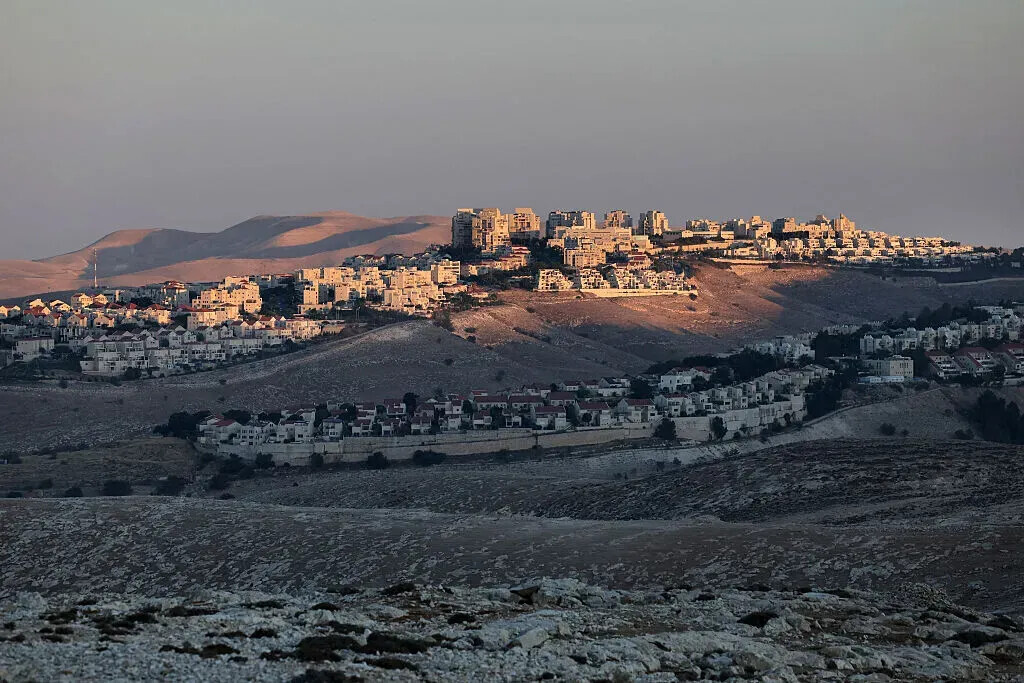
Many settlements are as large as towns or cities. They are built by the state exclusively for Jewish Israelis and have their own masterplans and government allocated budgets. They are run by municipalities, local or regional councils, depending on their size.
Meanwhile, outposts are settlements established by Israeli citizens, often through violent means, initially without official authorization, and in contravention of Israeli law. In practice, however, they have the backing of senior government and military officials, with Israeli authorities often connecting them to services such as water and electricity.[8] Many official Israeli settlements in the West Bank started as unauthorized outposts and were legalized retroactively.
Regardless of their status under Israeli law, all settlements and outposts contravene the fundamental rules of international humanitarian law, which prohibits the “transfer [by the Occupying Power of] parts of its own civilian population into the territory it occupies”[9] and the “extensive destruction and appropriation of property, not justified by military necessity and carried out unlawfully and wantonly.”[10] These acts amount to war crimes under the Rome Statute of the International Criminal Court (ICC).[11]
Strategic importance of Area C
The vast majority of settlers in the West Bank excluding East Jerusalem – an estimated 540,327 people[12] – live in illegal settlements and outposts in Area C, a predominantly rural area, which remained under full Israeli administrative and military control following the signing of the Oslo Accords between the Palestine Liberation Organization and Israel between 1993 and 1995.[13]
Area C comprises over 60% of the West Bank. [14] It is located mainly in the eastern part of the territory, along the Jordan Valley, as well as around Palestinian towns and cities in the western, central and southern parts. It is crucial to the West Bank’s territorial contiguity and development of urban centres. It also holds most of the territory’s grazing and agricultural land.[15]
The Jordan Valley illustrates the strategic significance of Area C for Israel’s territorial ambitions. Sparsely populated, agriculturally fertile and rich in water springs, it covers about 30% of the West Bank; nearly 90% of the Jordan Valley is designated as Area C.[16]
Already in 1967, then Minister of Labour Yig’al Allon proposed annexing it to Israel, along with areas south of Jericho, and land around Greater Jerusalem. The Allon Plan, as it became known, was designed to exclude areas densely populated by Palestinians from the territory Israel would annex, while ensuring Jewish presence through the construction of settlements and military bases in those areas. Although it was never formally accepted, it has shaped Israeli settlement policy in general, and in the Jordan Valley in particular.[17]
Palestinian Bedouin and herding communities
Roughly 300,000 Palestinians live in Area C.[18] For decades, Israel’s exclusive control over law enforcement in the area, combined with its discriminatory planning and construction policies,has subjected them to systematic discrimination.[19]
Palestinians from Bedouin and herding communities, totalling an estimated 35,000 people,[20] are particularly affected, with Israel routinely violating their right to an adequate standard of living, health, education, and water and sanitation.[21] Many are originally from the Negev/Naqab desert in the south, from where they were displaced during the 1948 war that led to the establishment of Israel, and became refugees in the West Bank.[22]
Following Israel’s occupation in 1967, these Palestinian communities, which are deeply connected to the land and rely on livestock rearing and dairy production for their livelihoods, have faced repeated waves of uprooting, forced urbanization and unlawful Israeli restrictions on access to grazing land and freedom of movement. Together with Israel’s refusal to acknowledge and respect the generations-old concept of communal and tribal landownership as well as the separation of Bedouin communities from their extended tribes in the Negev/Naqab, these factors have prevented them from exercising their semi-nomadic lifestyle. Today, an entire way of life is under threat.
Apartheid
In 2022, Amnesty International published a report showing that Israel’s massive seizures of Palestinian land and property across the OPT and Israel, carried out for the benefit of Israel’s Jewish population, were a key component of the system of apartheid that Israel imposes on all Palestinians whose rights it controls.[23] In Area C, these seizures are enabled through: the designation of lands as “state lands” and their virtually exclusive allocation for the establishment and expansion of Jewish settlements; seizures for military or “security” needs; seizure orders for “public” use; the takeover through absentee property orders of lands whose owners were displaced as a result of the conflict in 1967; and Israel’s overall discriminatory urban planning and zoning regime. This system is maintained by serious human rights violations and crimes under international law against Palestinians, including forcible transfer, which Amnesty International found amounts to the crime against humanity of apartheid, as defined in the Rome Statute of the ICC and the Apartheid Convention.[24]
The report highlighted how Israeli policies and practices, carried out in a widespread and systematic manner to assert Jewish dominance and control, created unbearable conditions for Palestinian communities in Area C by either coercing their displacement or placing them at grave risk of such displacement, amounting to an organized governmental policy of forcible transfer. Key components of this policy include: discriminatory zoning and building regulations that force Palestinians in Area C to build without permits (which are almost impossible to obtain due to Israel’s discriminatory policies) and consequently result in repeated home demolitions by Israeli authorities; land appropriation policies supported by the judiciary; and the intentional denial of essential services like electricity, water and sanitation, and access to schools and healthcare centres. These patterns are intensified by harassment and attacks from settlers and Israeli security forces carried out with near-total impunity.
Amnesty International determined that these policies and actions constitute the crime against humanity of deportation or forcible transfer in violation of international law, as provided in the Rome Statute of the ICC. It also concluded that policies of unlawful deportation or transfer in Area C, which are carried out neither for military necessity nor the protection of the population of the occupied territory, constitute war crimes under the Rome Statute.
Intensified oppression of Palestinians
Since its formation in late December 2022, the 37th government has intensified the oppression of Palestinians, with policies and practices becoming particularly aggressive in the aftermath of the Hamas-led attacks of 7 October 2023. On that day, Hamas and other Palestinian armed groups attacked civilian and military targets in southern Israel, killing approximately 1,200 people, mostly civilians, and forcibly taking 251 others to the Gaza Strip where they were held as hostages and subjected to abuses. In its 2025 report, Amnesty International found that these acts constituted war crimes and crimes against humanity.[25]
Genocide against Palestinians in the Gaza Strip
In response to the 7 October 2023 attacks by Hamas and other Palestinian armed groups, Israel launched a military offensive on the occupied Gaza Strip of unparalleled magnitude, scale and duration compared to any previous assaults on the tiny coastal enclave. Israel inflicted catastrophic levels of destruction, displacement and starvation on Gaza’s civilian population, and committed genocide against Palestinians in the Gaza Strip.[26] By the end of April 2026, the Gaza-based Ministry of Health had recorded at least 72,599 fatalities in the Gaza Strip in addition to 172,411 other people injured, since 7 October 2023.[27] These figures included 818 people who were killed and 2,301 others who were injured since a so-called ceasefire was declared on 10 October 2025.[28]
Although the intensity of Israeli attacks decreased since then, Israel continued to carry out daily air strikes, gunfire and shelling. In November 2025, Amnesty International conducted a legal and factual analysis finding that despite the so-called ceasefire, Israeli authorities were still committing genocide against Palestinians in the occupied Gaza Strip, by continuing to deliberately inflict conditions of life calculated to bring about their physical destruction, without signalling any change in their intent.[29]
While global attention focused on Israel’s atrocities in Gaza, Israel intensified its abusive policies and practices against Palestinians in the occupied West Bank.
Unlawful killings, abuses in detention and displacement in the West Bank
Between 1 January 2023 and 30 April 2026, Israeli forces had killed 1,231 Palestinian men, women and children in the West Bank, including East Jerusalem, according to OCHA.[30] Most were killed with live ammunition with the majority of attacks occurring after the Hamas-led attacks on 7 October 2023 when senior Israeli officials and public figures repeatedly incited violence against Palestinians and made statements calling for, or justifying, genocidal acts against Palestinians in the Gaza Strip.[31] Indeed, the UN Office of the High Commissioner for Human Rights (OHCHR) reported that between 7 October 2023 and 17 October 2025, 1,001 Palestinians had been killed in the West Bank, including East Jerusalem, accounting for 43% of all Palestinians killed in the same territory since 2005.[32] Many, including children, were killed in circumstances indicating Israeli forces’ systematic use of unlawful lethal force, while “unarmed, and not involved in any violence”; not posing any threat;[33] or in the context of protests and arrests operations.[34] At least 331 cases raised “serious concerns of extrajudicial executions.”35
Meanwhile, between January 2023 and April 2026, Palestinians killed 66 Israeli men, women and children in the West Bank including East Jerusalem, among them 42 civilians.[35] Most of these killings were the result of individual attacks by Palestinians carried out in, or just outside, settlements or at checkpoints. The military wings of Hamas and Palestinian Islamic Jihad claimed responsibility for some of these deadly attacks and regularly praised the attackers. The Israeli Military’s Central Command reported a 78% drop in violent Palestinian attacks and an 86% drop in attacks involving use of firearms in 2025 compared to 2024.[36]
In parallel, Israeli authorities tightened already stringent movement restrictions, and stepped up the use of administrative detention, torture and other ill-treatment against thousands of Palestinian detainees, while denying the International Committee of the Red Cross (ICRC) access to places of detention.[37]
The Israeli authorities also intensified unlawful policies and practices leading to the forced displacement of Palestinians in the occupied West Bank.
According to data recorded by OCHA, around 14,890 Palestinians were displaced across Area C and East Jerusalem between January 2023 and the end of March 2026 as a result of demolitions, restrictions on access to grazing land and growing settler violence.[38]
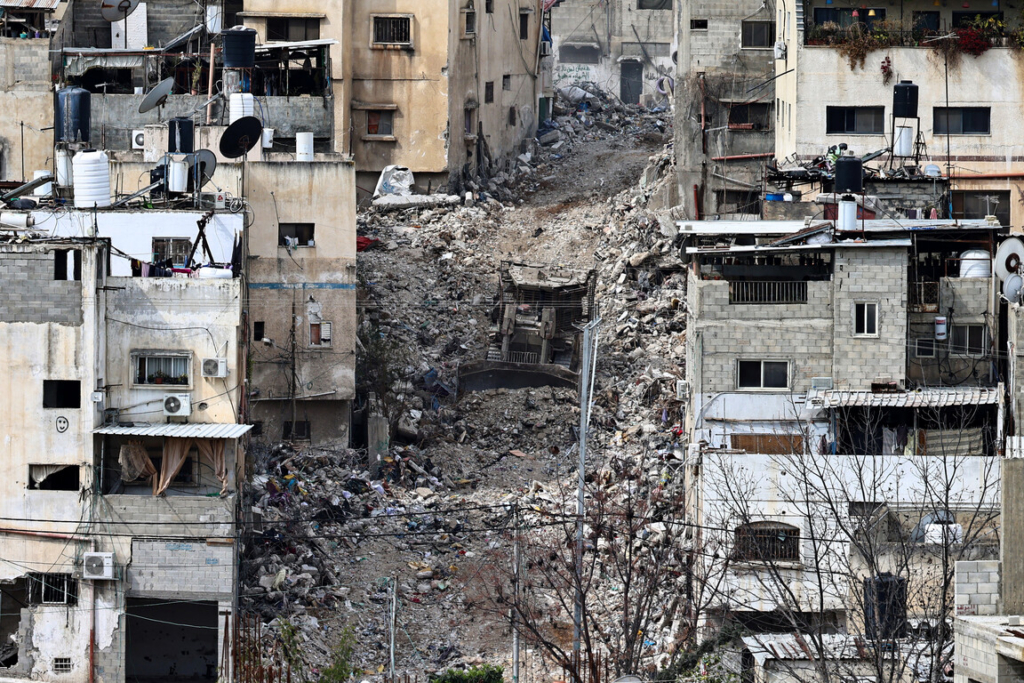
In other parts of the West Bank, displacement was driven primarily by Israeli military operations, with more than 33,000 Palestinians displaced in 2025 by military operations in Jenin, Nur Shams and Tulkarem refugee camps.[39] The Israeli military subsequently blocked access to the camps,[40] and denied internally displaced residents the right to return to their homes, even after military operations had ended, triggering the longest and most significant wave of displacement in the West Bank since the 1967 war.[41]
In East Jerusalem, the Israeli authorities intensified settlement expansion and construction, carried out record levels of home demolitions and forced evictions, and further deepened the separation between Palestinians in East Jerusalem and the rest of the West Bank, amid rising repression of residents’ civil and political rights. Between 1 January 2023 and 30 April 2026, the Israeli authorities demolished 805 Palestinian structures, including homes, shops and other structures, displacing at least 2,040 people, according to OCHA.[42] These demolitions were the direct result of Israel’s sweepingly discriminatory planning policies which systematically deny Palestinians building permits. Silwan has been one the most heavily targeted neighbourhoods for forced evictions and demolitions, with 28 Palestinian families forcibly evicted from one of its quarters, Batn al-Hawa, between 7 October 2023 and March 2026.[43]
In addition, two major plans for new settlement construction were advanced: the Atarot plan, which envisions 9,000 housing units for Ultra-Orthodox Jews in a settlement between Ramallah and East Jerusalem, and the Sheikh Jarrah plan to demolish the neighbourhood of Umm Haroun and build an Israeli settlement on its ruins.[44]
Unlawful occupation
In July 2024, the International Court of Justice (ICJ) issued a landmark advisory opinion declaring that Israel’s occupation of the OPT is unlawful and that its discriminatory laws and policies against Palestinians in the OPT violate the prohibition on racial segregation and apartheid.[45] The opinion stated that Israel is obligated to end its unlawful presence in the OPT, cease immediately all new settlement activities, evacuate all settlers and make reparation for the damage caused.
The Court also found that all states are obliged not to recognize the situation arising from the unlawful presence of Israel in the OPT as legal and not to render aid or assistance in maintaining the illegal situation created by Israel’s continued presence in the OPT.[46]
Under international humanitarian law, occupation of a territory during a conflict is meant to be temporary. The occupying power is required to administer the territory in the interest of the occupied population and to preserve as much as possible the situation that existed at the beginning of the occupation, including by respecting existing laws and refraining from introducing demographic changes and tampering with the territorial integrity of the occupied territory.
Israel’s occupation has failed to align with these basic principles of international humanitarian law. The duration of Israel’s occupation – spanning more than half a century – coupled with the authorities’ illegal official annexation of occupied East Jerusalem and de facto annexation of large swathes of the West Bank through land confiscation and settlement expansion, provide clear evidence that Israel’s intention is for the occupation to be permanent and for the benefit of the occupying power and its own citizens.
The Gaza Strip remains occupied even after the withdrawal of Israeli forces and removal of settlers in 2005 as Israel has retained effective control over the territory and its population, including through the control of its borders, territorial waters, airspace and population registry. Since 2007, Israel has enforced an illegal blockade that has severely restricted the movement of people and goods in and out of Gaza and has devastated Gaza’s economy. Meanwhile, major Israeli offensives on Gaza have killed and injured thousands of civilians and destroyed much of Gaza’s infrastructure and housing. Since October 2023, Israel has significantly tightened its effective control of the Gaza Strip, including by expanding the “buffer zones” and operationally controlling over 55% of the Strip’s territory.[47]
In the West Bank, including occupied East Jerusalem, Palestinians routinely face excessive use of force, unlawful killings, arbitrary arrest, administrative detention, forced displacement, home demolitions, confiscation of land and natural resources, and denial of fundamental rights and freedoms. Israel’s multi-layered closure system, fortified by mass surveillance, physical barriers, including an illegal wall/fence, hundreds of checkpoints and roadblocks, and an arbitrary permit regime, has curtailed Palestinians’ freedom of movement and perpetuated their disenfranchisement.
annex the land, remove Palestinians
Since its occupation of the OPT in 1967, Israel has consistently implemented policies aimed at establishing and maintaining control over the West Bank, in order to facilitate land grabs and push Palestinians out.
Following its establishment in 1948, Israel had introduced most of the tools and the legal infrastructure of land grabs used to dispossess Palestinians who fled due to the conflict as well as those who stayed as Palestinians citizens of Israel. Over the following decades, Israel relied on the same legal infrastructure to seize Palestinian lands in the OPT.[48]
Successive Israeli governments, regardless of their political orientation – albeit with varying degrees of intensity – have advanced plans to annex parts of the OPT that would allow the application of Israeli governmental power over the greatest amount of territory while confining Palestinians to densely populated enclaves to minimize Palestinian presence, in line with Israel’s Judaization policy, which dates back to Israel’s creation in 1948.[49]
Israel’s annexation project started with occupied East Jerusalem, and was then extended to other parts of the West Bank, focusing primarily on Area C. Immediately after the 1967 war, Israel illegally annexed East Jerusalem and subjected it to Israeli civil laws, incorporating it – together with 64km2 of surrounding Palestinian villages – into the boundaries of the Israeli municipality of Jerusalem.[50] This annexation was enshrined in 1980 through a Basic Law.[51]
Across the rest of the West Bank, Israel has, over the years, de facto annexed large swathes of land through the creation and expansion of settlements and the establishment of military zones and natural reserves, among other measures. These policies were grounded in Israel’s long-standing rejection of the application of international humanitarian law to the OPT, asserting that the territory is disputed.[52] However, it had delayed the formal, de jure annexation of the West Bank (excluding East Jerusalem) – whether in whole or in part – due to international pressure and internal political divisions as well as security concerns and demographic considerations.
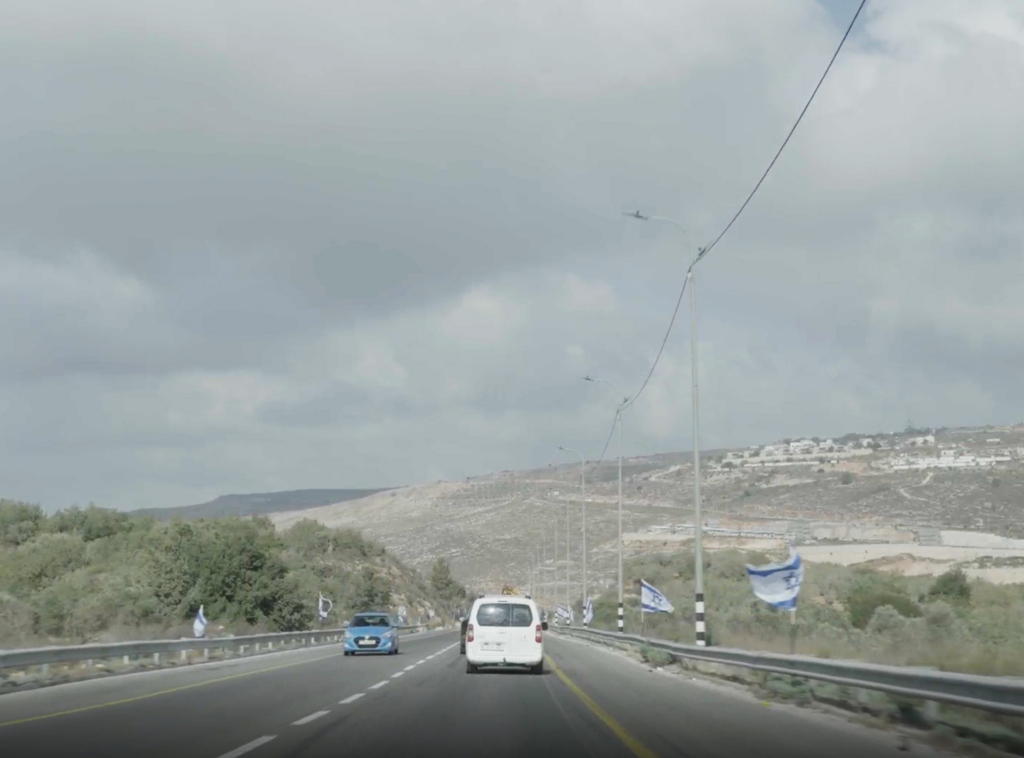
The formation of the 37th government in December 2022 marked a significant shift in both the speed and scale of formal annexation measures.
The preceding government, led by Naftali Bennett and Yair Lapid from 2021 to 2022, had also intensified policies aimed at reshaping the West Bank’s demography, ensuring Jewish hegemony and dispossessing Palestinians of their land. Yet, in rhetoric at least, it maintained that it was bound by the status quo.
By contrast, the government led by Benjamin Netanyahu, Bezalel Smotrich and Itamar Ben-Gvir made the expansion of formal annexation under Israeli law of other areas of the occupied West Bank beyond East Jerusalem an explicit policy objective.
The government openly adopted the settler movement’s vision of “Greater Israel,” which treats the West Bank as an integral part of Israel,[53] claiming religious and historical rights.[54]
It intensified Judaization policies, accelerated land grabs, especially through state land declarations, which reached levels unseen since the signing of the Oslo Accords, oversaw a sharp surge in settlement expansion,[55] increased financial and logistical support to settlements, and actively encouraged and enabled a brutal settler violence campaign to forcibly displace Palestinians from Area C.[56] In addition, it further entrenched the long-standing system of impunity enjoyed by settlers who commit offences against Palestinians, turning it into a state policy.[57] All of these actions were aimed at altering the West Bank’s demographic composition to the advantage of further Israeli land grabs.
The prohibition of annexation under international law
Annexation is a unilateral act by which a state asserts its sovereignty over the territory of another state, with the intent to exercise permanent control over it.[58] It usually involves the acquisition of territory by threat or use of force and constitutes a flagrant violation of international law.[59] Annexation of an occupied territory – whether in part or whole – is at odds with the temporary nature of occupation[60] and is without legal effect under international law.[61] As a result, it does not affect the rights and protections under international humanitarian law afforded to “protected persons” in occupied territory.[62]
In its July 2024 advisory opinion on the legality of Israel’s occupation of the OPT, the ICJ listed several Israeli policies and practices in occupied East Jerusalem and Area C of the West Bank that “amount to annexation of large parts” of the OPT as they are designed to “remain in place indefinitely and to create irreversible effects on the ground” and aim to extend Israel’s claim of sovereignty. These include, among others, the maintenance, construction and expansion of settlements and associated infrastructure; the exploitation of natural resources; and the extensive application of Israeli domestic law in the West Bank.[63] The court considered that other unlawful policies and practices such as the transfer of Israel’s own nationals into settlements in the occupied West Bank, including East Jerusalem, have also altered the territory’s “physical character, legal status, demographic composition and territorial integrity”.[64]
The 37th government agreements: adopting the settler movement’s vision
On 29 December 2022, Benjamin Netanyahu’s Likud party signed coalition agreements with the political parties Jewish Power and Religious Zionism.[65] The agreements not only embed settler priorities into state policy, but also direct greater resources towards the settlement enterprise than previous agreements, accelerating the realization of the settler movement’s vision.
This was clearly articulated in the government’s guiding principles, adopted on the same day, which assert that the occupied West Bank, referred to as “Judea and Samaria”, is an integral part of the “Land of Israel” where the government will “promote and develop settlement.”
By recognizing “the Jewish people[’s] exclusive and undisputed right over all areas of the Land of Israel”, the guiding principles thereby further[66] entrench Jewish Israeli domination of Palestinians.[67]
The coalition agreement between Likud and Religious Zionism[68] lays out a comprehensive strategy to expand and entrench Israeli settlements in the occupied West Bank, including East Jerusalem. Central to this vision is the intensification and acceleration of formal annexation under Israeli law, the legalization of unauthorized settler outposts, and the creation of a new governmental body – the Settlement Administration[69] under the Ministry of Defence – to institutionalize and streamline services to settlements.
The agreement also calls for reversing previous disengagement policies that led to the evacuation of four settlements in the northern West Bank in 2005,[70] signalling a clear intent to reclaim and reinforce Israeli presence in areas from which settlers had been removed. While the language of the agreements occasionally gestures at improving conditions for both Jewish and Palestinian communities, in practice the measures adopted overwhelmingly prioritize settler interests, including infrastructure development, financial incentives, and land use regulations aimed at curbing Palestinian access and expansion.
Likud’s agreement with Jewish Power[71] emphasizes security, infrastructure development such as roads, and claims of sovereignty as tools to further consolidate control over parts of the occupied West Bank. It also includes provisions to amend the Disengagement Law to allow settlers to enter and stay in an area in the northern West Bank from which they had been evacuated in 2005, legalize long-standing outposts, and support settler farming initiatives both politically and materially, and implement agricultural strategies – such as planting olive trees in Area C – to prevent Palestinian land use.
The agreement notably also proposes extending a 2008 amendment to the Penal Code,[72] known as the “Dromi Law”[73] – which shields individuals using firearms against intruders from facing criminal responsibility – to police stations, military bases and other military zones in Area C, effectively sanctioning lethal force against Palestinians in areas declared off-limits by the Israeli military.
In December 2022, as part of this agreement, Prime Minister Benjamin Netanyahu appointed Itamar Ben-Gvir, leader of Jewish Power, as the national security minister, giving him authority over the Israel Border Police operating in the West Bank, including in East Jerusalem.
Bezalel Smotrich, leader of Religious Zionism and co-founder of the settler organization Regavim that openly seeks to expel Palestinians from Area C by lobbying Israeli authorities to demolish Palestinian homes,[74] was appointed minister of finance. He was given an additional, specially created position of a “minister within the Ministry of Defense,” tasked with overseeing the Coordination of Government Activities in the Territories (COGAT) [75] and the Civil Administration.[76]
Both ministers are themselves settlers with long-standing records of publicly advocating for the expansion of settlements, annexation of Palestinian land, and the extension of Israeli sovereignty over the West Bank and Gaza Strip.[77]
No longer operating from the political margins, under these new portfolios they were granted decision-making powers that allow them to advance the settler movement’s agenda laid out in these political agreements and translate it into official policy; to take steps to formalize annexation, expand settlements and intensify demographic and territorial changes in the occupied West Bank, aligned with Judaization policies in violation of core principles of international humanitarian law applicable to situations of military occupation.
Officials call for annexation and ensuring a Jewish majority
Statements made by Israeli government officials since January 2023 reflect a coordinated and brazenly pushed towards further annexing Area C of the occupied West Bank while pursuing a Jewish demographic hegemony.
Amnesty International has analysed below examples of such statements made by Prime Minister Benjamin Netanyahu, Minister of Finance Bezalel Smotrich, Minister of Settlement and National Missions of Israel Orit Strock, Minister of National Security Itamar Ben-Gvir and Minister of Defense Israel Katz, among others.
These statements explicitly call for settlement expansion, legalization of unauthorized outposts, financial backing to settlers, greater monitoring and surveillance of “unlicensed” Palestinian construction, changes to the West Bank’s demography and the pursuit of the extension of Israeli sovereignty over the occupied territory.
Taken together, these statements confirm Israel’s intent to formally annex Palestinian land in Area C while integrating Jewish settlements, increasing the Jewish Israeli population in the West Bank and minimizing the Palestinian presence. The language used by these decision-makers frames these actions as both ideological and security imperatives, often invoking religious or historical claims to justify policies that violate international law.
Already in February 2023, both Prime Minister Netenyahu and Minister of Finance Smotrich had vowed not to freeze the construction and expansion of settlements at any point.[78] That same month, Minister of Settlement and National Missions Orit Strock, a member of Religious Zionism and a settler, said the government would support Israelis who establish outposts: “when governments send settlers to settle in the land and they cling to it in conditions that are not conditions for the State of Israel, the governments must back them up.”[79] Orit Strock also announced that the government would be doubling the budgets to regional settlement councils to monitor Palestinian construction in Area C. She framed this as part of “the battle over Area C” to “protect” Israel “from hostile takeover”.[80]
This reflects a long-standing policy that aims to reduce Palestinian presence and territorial contiguity in the area by preventing construction through any means, including discriminatory planning and building policies, surveillance and the enforcement of demolition orders against Palestinian property built without permits. Under Israel’s apartheid system, such permits are almost impossible to obtain, rendering most Palestinian structures vulnerable to demolitions. In this context, expanding monitoring and surveillance of Palestinian construction in Area C, including by operating drones over Palestinian villages and deploying settler-led patrols, is often followed by petitions to courts and pressure on the Civil Administration to issue or enforce demolition orders. Exploiting a deeply discriminatory enforcement system, increased monitoring, surveillance and legal pressure signals an intent to increase demolitions of Palestinian structures as a way to coerce Palestinian displacement and consolidate Israeli control on the ground.
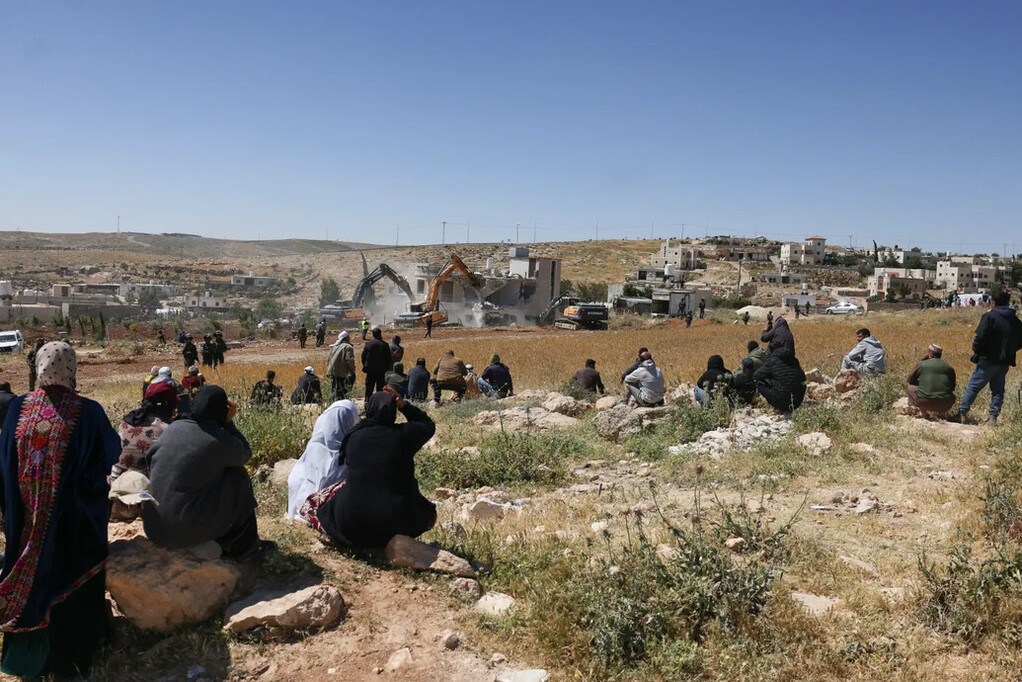
The election of Donald Trump as US president in November 2024 encouraged several Israeli government officials to signal that they would push for the formal annexation of the West Bank in 2025.[81] Shortly thereafter, Bezalel Smotrich stated that 2025 would be “the year of sovereignty in Judea and Samaria,”[82] while Minister of Agriculture Avi Dichter recognized that Donald Trump’s election provided the right moment “to apply Israeli sovereignty in Judea and Samaria.”[83] Minister of Energy and Infrastructure Eli Cohen said that Israel was already “preparing the ground for annexation.”[84]
In May 2025, Defense Minister Israel Katz visited Sa-Nur, an area in the northern West Bank where a settlement was dismantled in 2005 as part of Israel’s unilateral disengagement from Gaza.[85] The visit followed a cabinet decision to approve the construction of 22 new settlements, including rebuilding Sa-Nur, where Israel Katz had served as a paratrooper and fought against its evacuation in 2005. [86] He defied the threat of international sanctions stating: “This is a clear message to [French president Emmanuel] Macron and his friends – they will recognize a Palestinian state on paper, and we will build the Jewish-Israeli state here on the ground”, affirming that the government would continue to build an Israeli state in Area C.
In August 2025, Prime Minister Benjamin Netanyahu attended a ceremony organized by the Binyamin Regional Council to celebrate the establishment of 17 new settlements within the council area, which is in the central West Bank, which by then already encompassed 36 settlements.[87] He stated that the government is “building and holding on to parts of [the] homeland,” signalling an intent to retain permanent control over parts of the West Bank.[88] Two weeks later, in a ceremony celebrating the approval of a plan to construct 3,401 housing units in the settlement of Ma’ale Adumim as part of the E1 project in the occupied West Bank near East Jerusalem, Benjamin Netanyahu added: “Ma’ale Adumim is an integral part of our homeland and there will be many other Ma’ale Adumims in our homeland.”[89]
In September 2025, Minister of National Security Itamar Ben-Gvir attended the “Sovereignty Conference” organized by the Israel National News (Arutz Sheva), and the Shomron Regional Council in a settlement in the northern West Bank. In an interview with the media outlet, he made his political agenda of pursuing formal annexation – in other words, formalizing Israeli sovereignty over Palestinian land in the West Bank – and encouraging Palestinians to leave the territory blatantly clear:
“We need to establish sovereignty… We are a right-wing government, we were elected, among other things, for this… We need to establish sovereignty… because this is our home, because this is our land, and because we need to tell the whole world: ‘this is ours forever and ever.’ We have another year for this government and now is the time. Sovereignty, and also encouraging [Palestinian] voluntary emigration, which we should do also in Judea and Samaria… If we change the concept and understand that this is our state and our land, everything will be simpler. We did it in the prisons, in establishing the emergency response teams, in demolishing homes in the Negev, in establishing the National Guard, in the arms reform, and now I want Netanyahu to do it with sovereignty and encouraging emigration.”[90]
Also in September 2025, Minister of Finance Bezalel Smotrich revealed plans to annex 82% of the West Bank to prevent the establishment of a Palestinian state and to foster Jewish demographic hegemony.[91] In a video clip posted by a reporter for Israeli Channel 14 who attended the event, Smotrich said he rejects “partial sovereignty” and calls for “applying [Israeli] sovereignty over all the land [of the West Bank on which Israeli settlement blocs are built], except for Arab population concentrations,” in line with Israel’s long-standing policy of achieving and maintaining Jewish demographic hegemony in areas under its control. Media circulated an official map bearing the Settlement Administration’s logo, stating the pledge: “maximum land, minimum Arab population.”[92] A year earlier, he had publicly vowed to “bring a million settlers” to the West Bank in response to the State of Palestine’s efforts to strengthen its international recognition.[93]
Some of these statements were made to increase popularity, political votes or to appease the coalition parties’ political base. Others reflect some differences between coalition parties. But what is consistent is the overall annexationist drive, which was largely translated into cabinet decisions and concrete actions on the ground.
The existence of other motives behind the timing or tone of some of these statements does not negate their annexationist intent. In fact, some of them were made during events to celebrate new settlements.
Annexation-oriented laws and bills
Between January 2023 and November 2025, coalition and other ultranationalist parties introduced 43 annexation-oriented bills, including new laws or amendments to existing laws.[94]
The proposals seek to further extend the application of Israeli civil laws to Israeli settlers in the West Bank, annex territory, retroactively regularize outposts, transfer administrative powers or restructure governance away from the existing military framework. They reflect a broader political agenda to entrench Israeli presence and exercise of governmental powers in the occupied West Bank, in direct contravention of international law and the rules of military occupation, in particular of its temporary nature.
Twenty-four bills explicitly seek to establish de jure annexation under Israeli law over parts of the West Bank by extending Israeli civil law and jurisdiction to settlement “blocs” or the entire West Bank. These blocs include Center Binyamin,[95] “Heart of Samaria”,[96] “Western Samaria”,[97] Modi’in,[98] Greater Hebron,[99] Ma’ale Adumim,[100] and Ariel,[101] along with adjacent outposts, industrial and commercial zones, archaeological sites, roads and all state land in between. Several bills also propose to annex parts of the West Bank such as the southern West Bank,[102] Greater Jerusalem,[103] and the Jordan Valley,[104] and one calls for the annexation of the entire West Bank.[105]
At least eight other bills aim to extend Israeli claims of sovereignty or legal jurisdiction over the West Bank without explicit reference to annexation. These include two bills to amend the Governance and Law Ordinance, which propose that all Knesset (Israel’s parliament) legislation be automatically applied to the West Bank via military orders.[106] Currently, Israeli civil and criminal law applies to settlers and settlements in the West Bank through an emergency regulation, which was adopted shortly after the 1967 occupation and must be renewed every five years by the Knesset.[107] Its application is on a personal rather than territorial basis, meaning it applies to settlers as individuals rather than the entirety of the West Bank. Even before the formation of the 37th government, there had been failed attempts to amend legislation in a way that makes the application of Israeli civil and criminal law automatic throughout the West Bank.
Other bills propose to regularize all unauthorized outposts,[108] formally rename the West Bank “Judea and Samaria,”[109] and declare national parks in occupied territories,[110] which would grant Israeli ministries powers over land administration. Two additional bills[111] seek to extend religiously inspired civil law based on Jewish religious principles to the occupied West Bank.
Six bills focus on shifting administrative authority or granting political leverage to Israeli institutions. The Settlement Division Bill, for example, proposes transferring land administration powers from the Civil Administration to the Settlement Division, which is known for promoting settlement expansion.[112] The electrical grid bill mandates the connection of unauthorized outposts to Israeli infrastructure, effectively legitimizing them.[113] The draft law on preventing “the takeover of Area C by residents of the Palestinian Authority” seeks to consolidate Israeli control over Area C by deterring Palestinian construction there.[114] It proposes to deny entry or work permits to Israel for any Palestinian who engages in unlicensed construction or lives in a house built without a permit. Since such permits are almost impossible to obtain, the provision would apply to most of Area C’s residents. Three other bills propose extending the powers of the Israeli Antiquities Authority, local councils and civil courts to the occupied West Bank.[115]
In March 2023, the Knesset passed an amendment that repealed provisions in the Disengagement Law,[116] allowing settlers to return to areas in the northern West Bank that were evacuated in 2005.[117] The immediate impact of adopting the bill became clear just two months later when the Custodian of Government and Abandoned Property, a body within the Civil Administration that oversees state land, granted planning permission on the lands belonging to the Palestinian town of Burqa near Nablus in the northern occupied West Bank, thus authorizing the establishment of an outpost where Homesh settlement had been located prior to 2005.[118] In May and December 2025, the Israeli cabinet authorized the establishment of 22 and 19 new settlements respectively, four of them in the locations of settlements evacuated as part of the 2005 disengagement plan, including Homesh.[119]
By April 2026, the amendment to the Disengagement Law was the only government proposal that had been enacted into law. However, the flood of bills introduced during this period reflects the approach and intent of the government to accelerate formal annexation.
Because legislative processes are often lengthy, entail parliamentary oversight and are open to civil society participation during committee deliberations, the Israeli government resorted to introducing key policy changes through decisions by the national security cabinet. Such decisions include, for example, the announcement of the settlement of land title process, the establishment of new settlements and measures related to the purchase of Palestinian land.[120] Only a limited summary of these decisions is made public, with key issues kept confidential under the pretext of protecting national security, raising serious concerns over the lack of transparency and any kind of oversight.[121]
Implementing the settler movement’s vision: new government measures towards annexation and settlement expansion
From the outset, the 37th government has acted in alignment with the settler movement’s vision, which seeks to formalize the annexation of the West Bank and expand settlements to establish and maintain Jewish demographic hegemony – as set out in coalition government agreements and reflected in official statements.
The government very quickly moved towards implementing this agenda and sharply intensified its annexation by restructuring key administrative and legal frameworks to create a new Settlement Administration, transferring powers to officials ideologically aligned with the settler movement’s vision, making it almost impossible for Palestinians to register their lands, exponentially increasing funding to settlements and outputs, removing long-standing checks on settlement planning and all but ending outpost dismantlement.
Together, these steps marked a significant acceleration in Israel’s de facto annexation of the occupied West Bank in breach of international law, including international humanitarian law, which requires the occupying power to respect existing laws unless absolutely prevented from doing so.[122]
Concentrating powers in the hands of dedicated Settlement Administration
Since 1981, all civilian matters for Jewish settlers and Palestinians in the West Bank (excluding occupied East Jerusalem) had been overseen by the Civil Administration, a military unit within COGAT.[123] The Civil Administration, which was established with the objective of separating security and civilian operations in the occupied territory, has powers over administrative matters for Palestinians in the OPT, including the population registry; travel and work permits; archaeology and nature reserves; natural resources management; agriculture; trade and industry; and environmental protection.[124]
In February 2023, then Minister of Defense Yoav Gallant and Bezalel Smotrich in his capacity as additional minister, signed a memorandum of understanding that granted Smotrich authority over all civilian matters in the occupied West Bank, including land designation and planning, while Gallant retained control over security issues.[125]
The memorandum established the Settlement Administration, a body directly under Bezalel Smotrich, staffed with civilians and tasked with managing all aspects of life in Jewish settlements.[126]
Yehuda Eliyahu, the co-founder of Regavim and one of Bezalel Smotrich’s closest allies, was appointed to head the new body.[127] Although the Civil Administration continued to be in charge of administrative matters for Palestinians in the West Bank (excluding East Jerusalem), the Settlement Administration was given authority to regularize outposts, and enforce planning and construction laws for both Palestinian and Israeli construction in Area C, leading to a virtual halt of operations to dismantle illegal structures built by settlers.[128] This determined policies for herding outposts and for improved access to government services and infrastructure for settlers only.
The implementation of the settler movement’s vision was further advanced on 29 May 2024, when the Israeli Military Commander of the West Bank signed a military order allowing the head of the Civil Administration, a military officer, to appoint a civilian deputy for civil affairs and delegate their powers to them.[129] The same day, Hillel Roth, a close associate of Bezalel Smotrich, was appointed to the role, and granted broad administrative powers ranging from land management, planning and construction to the management of archaeological sites and nature reserves.[130] Crucially, instead of answering to the Head of the Civil Administration, he became subordinate to the head of the Settlement Administration. Given that the head of the Settlement Administration reports to the Ministry of Defense – and Bezalel Smotrich as the additional minister within it – this step further tightened Smotrich’s control over Area C.[131] In December 2024, Bezalel Smotrich was recorded speaking to Civil Administration officials about his plans to shut down the Civil Administration for good in preparation for official annexation.[132]
A land registration system and relaxed sale restrictions to accelerate Palestinian expropriation
In May 2025, Israel’s security cabinet announced the resumption of land registration in Area C, a process known as “settlement of land title”, which was meant to bypass attempts by the Palestinian authorities to conduct their own land registration process. Given the broader context of Israel’s apartheid system and past experience in occupied East Jerusalem, where almost no land has been registered to Palestinians since the process began in 2018,[133] the decision raised concern that it was intended to primarily benefit Jewish Israeli settlers.[134]
The land registration process imposes almost insurmountable evidentiary burdens on Palestinians, requiring proof of ownership such as inheritance records some of which may date back to the Ottoman era, full ownership records, survey maps and proof of continuous cultivation over decades. In practice, the system treats all unregistered land in the West Bank as state land – that is land under Israeli control – unless Palestinian owners prove otherwise.[135]
Even in the extremely rare cases where such documentation exists, the Israeli Civil Administration may still decide to seize the land, through a military order concerning “abandoned property”, by claiming it is “absentee property” if some owners reside outside the OPT.[136]
Based on this decision, in February 2026, the Israeli government allocated more than NIS 244 million (around USD 78.72 million) to establish a new land registration mechanism in Area C, transferring authority over land registration from the Civil Administration to the Ministry of Justice.[137]
Under this mechanism, authority over mapping and land measurement in unregistered areas is transferred to Israel’s Ministry of Construction and Housing, thereby extending the power of this civil authority over Area C.[138] Nearly 58% of the land in Area C is unregistered, and by February 2026, Israeli authorities had already seized half of this unregistered land through state land declarations.[139]
In February 2026, the security cabinet repealed a Jordanian-era law restricting foreign purchase of lands in the occupied territory to allow non-Palestinians – including settlers and foreign companies – to directly purchase land without a transaction permit from the competent Palestinian authorities. It also revived an Israeli government mechanism enabling the state, through the Custodian of Government and Abandoned Property, to purchase land directly from Palestinians without seeking any approval from the competent authorities. The measures also authorized the extension of Israeli law enforcement powers to areas A and B which are under the administrative control of Palestinian authorities.[140]
Simplified settlement approvals procedures
In June 2023, the Israeli government formally transferred responsibility for all settlement planning and approvals from then Minister of Defense Yoav Gallant to Bezalel Smotrich in his new role as additional minister in the defence ministry.[141]
The decision removed multiple layers of political and military approval for any new settlement construction and expansion in the occupied West Bank, requiring government authorization only at the initial planning stage. It cancelled the need for the defence minister’s approval and prime minister’s consent for settlement expansion and granted Bezalel Smotrich full control over subsequent approvals, thereby significantly easing the process for settlement construction and expansion in the West Bank.
Following Donald Trump’s election as US president in 2024, settlement construction approval meetings, previously held “at most quarterly”, started taking place weekly, resulting in accelerated approval rates.[142]
Increased funding to settlements
The coalition agreements signed ahead of government formation laid the ground for increased funding to realize the settler movement’s vision in the West Bank. In 2023, the government allocated extensive funds to the Settlement Division, the body mandated with planning and overseeing the establishment and expansion of settlements.[143] It also approved the funding of major infrastructure projects for the benefit of settlements and listed specific settlements as areas of national priority[144] in the government’s financial aid programme.
The Israeli authorities immediately implemented these measures. Between 2023 and 2025, government funding for settlements in the West Bank significantly increased, both in base budget allocations and through coalition funds, directly approved by the government rather than the Knesset.[145]
In December 2023, the Knesset’s Finance Committee approved the transfer of NIS 110 million (USD 37.8 million) to the Ministry of Settlement and National Missions as part of the additional budget for 2023. Of this amount, NIS 75 million (USD 23 million) was allocated for upgrading the security infrastructure of “young settlements,” a term that Israeli authorities use to refer to unauthorized outposts.[146]
The Committee additionally approved NIS 32 million for funding COGAT activities intended for the preservation of archaeological sites, rehabilitation of a national park and measures to monitor unlicensed construction by Palestinians in Area C, demolish structures and remove Palestinian residents.[147]
In early 2025, the Ministry of Settlement and National Missions received a base budget of approximately NIS 123 million (USD 37.6 million), following the first reading of the 2025 budget law in December 2024.[148] This allocation was substantially augmented in March 2026 when the Finance Committee approved a transfer to the ministry of NIS 268 million (USD 82 million) in coalition funds, underscoring the growing use of political agreements to channel additional resources into settlement-related activities, often with limited transparency or oversight.[149]
This brought the total budget allocated to the Ministry of Settlement and National Missions for 2025 to almost NIS 391 million (approximately USD 135 million) when the budget law was finally approved.[150]
In March 2026, Israeli news platform Calcalist reported that the Ministry of Finance had been required to disclose a full list of budgets that were funnelled into the Ministry of Settlement and National Missions following an official request by Knesset member Orit Farkash HaChohen.[151] According to the report, data shared by the finance ministry showed that the Ministry of Settlement and National Missions’ budget had reached NIS 764 million (USD 254.5 million) by 2026, representing a 122% increase in its annual budget within three years of the government’s rule.[152]
In addition, broader infrastructure investments surged. In 2023, the government allocated more than NIS 3.5 billion (about USD 1.2 billion) to the Ministry of Transport for the implementation of a five-year plan that seeks to upgrade and develop roads for settler use in the West Bank, including by-pass roads.[153] In August 2023, the minister of transport said that the plan reflected the government’s priorities, which sees “Judea and Samaria as the heart of the State of Israel, where investment is needed just like anywhere else in the country”.[154]
Accordingly, in 2025, nearly NIS 918 million (USD 281 million) was approved for road and infrastructure projects aimed at connecting settlements and outposts with each other and with Israeli cities, according to media reports.[155] In December that year, the government adopted a five-year plan to strengthen and develop settlements and related infrastructure, allocating NIS 2.75 billion (USD 919 million) for the programme.[156]
Increased funding to unauthorized outposts
The Israeli government rarely provides a detailed breakdown that clearly distinguishes between funding for settlements and outposts or categorizes spending by purpose. Much of the publicly available information comes from watchdog organizations such as Peace Now, or media reports based on leaks, or Knesset committee disclosures.[157] Additionally, there is often a time lag between budget authorization, actual disbursement, and the retroactive legalization of outposts, which makes it difficult to determine the government’s actual funding of outposts. Some expenditure is indirect. This includes grants to local authorities, infrastructure projects serving both recognized settlements and outposts, or allocations via the Settlement Division of the World Zionist Organization.[158]
Despite this lack of transparency, available evidence indicates that since 2023 government ministries have continued to provide direct financial and material support to these outposts, even though extensive publicly available reporting shows that many serve as bases from which settlers carry out violent attacks against Palestinians. For example, Peace Now uncovered evidence that in 2023 the government provided 101 outposts, including 68 herding outposts with a total of NIS 28 million (USD 8 million).[159] The money was used to purchase drones, vehicles, cameras, solar panels and electric gates, according to the NGO. As mentioned above,[160] in December 2023, the Knesset approved the transfer of NIS 75 million (USD 23 million) for “security components” of outposts, as part of coalition funds for 2024.[161] In July 2024, the minister of settlement and national missions confirmed that the funds had indeed been allocated[162] for upgrading the security of “young settlements” in coordination with the Ministry of Defense. This was distributed across herding outposts (NIS 38.78 million – USD 11.65 million), outposts (NIS 24.79 million – USD 7.37 million), roads (NIS 7.7 million – USD 2.36 million) and public buildings (NIS 4.55 million – USD 1.521 million).[163]
Between April and July 2025, the government transferred at least 48 all-terrain vehicles (ATVs) to unauthorized outposts along with night vision goggles, drones, communications equipment and generators among other things, during ceremonies held at both a settlement and an outpost, attended by ministers Bezalel Smotrich and Orit Strock.[164]
Official information published by Guidestar, the Ministry of Justice’s online platform listing registered NGOs, shows that different ministries have provided direct funds to settler organizations such as HaShomer Yosh and Artzenu, both of which are known for recruiting volunteers to live in outposts and engage in violence against Palestinians in Area C to dispossess them of their land.[165]
For example, HaShomer Yosh[166] received NIS 748,745 (approximately USD 230,000) in governmental funding in 2024 and NIS 1,198,799 (around USD 380,000)[167] in 2023. Meanwhile, in 2024, Regavim, the organization co-founded by Bezalel Smotrich, received NIS 397,006 (around USD 126,000) in state allowances and support from local authorities, as well as another NIS 366,000 (about USD 126,239) in 2023.[168]
A surge in illegal settlement and outpost construction
The simplification of settlement approval procedures and the transfer of powers to civilian officials appointed by Bezalel Smotrich and serving the settler movement’s vision has triggered an unprecedented surge in the approval of settlement construction.
Between 2023 and 2025, Israeli authorities declared 25,959 dunums (around 2,596 hectares) in Area C as “state land,”[169] representing around half of all such designations since the Oslo Accords.[170]
According to Peace Now’s monitoring, between 2023 and 2025, plans for the construction of 50,785 settlement housing units were promoted by the government.[171] Throughout 2025, the Higher Planning Council of the Civil Administration approved a total of 27,941 housing units in illegal settlements, an all-time record.[172]
On average, between 2012 and 2022, the government promoted 5,443 units per year. Under the 37th government, this has risen to an average of around 16,928 units per year, about three times the annual average of the previous decade.[173]
In stark contrast, in 2023 and 2024, the Civil Administration approved no plans for the construction of Palestinian housing units in Area C, and issued only nine construction permits.[174] More broadly, Palestinians in Area C received fewer than 200 building permits between 2009 and 2025.[175] This systemic denial of planning rights is compounded by the demolition of 3,407 Palestinian structures in Area C, which led to the displacement of 2,996 individuals between January 2023 and 30 April 2026.[176] The denial of building permits and home demolitions are key features of Israel’s system of apartheid against Palestinians.
By 21 December 2025, the government had also approved 69 new settlements, according to a statement released by Bezalel Smotrich on X in which he boasted that this constituted “an unprecedented effort.”[177] This included the approval of new settlements, the retroactive legalization of some unauthorized outposts, the transformation of neighbourhoods in settlements into independent settlements and the re-establishment of four outposts in the northern West Bank that had been dismantled under the disengagement plan in 2005.[178]
In April 2026, Israeli media revealed that the Israeli security cabinet decided in late March 2026 to establish 34 new settlements in the West Bank, including some located in Area A and B.[179] Reports indicated that the cabinet took the decision during Israel’s war with Iran and Lebanon that started in February and March that year, and had kept it secret to avoid pressure from the US administration. Of the newly declared settlements, 10 are unauthorized outposts that were legalized, while 24 are entirely new settlements. This marks the largest number of settlements ever approved in one decision, raising the number of new settlements declared by the government since January 2023 to 102.[180]
According to Peace Now, by the end of April 2026, Israeli settlers had established 363 outposts including herding outposts in the West Bank.[181] Of these, 212 were created under the 37th government, compared with 151 outposts set up between 1996 and 2022.[182]
Between 7 October 2023 and September 2025, settlers paved approximately 240 new roads to facilitate movement between outposts and settlements while separating Palestinian communities and restricting Palestinians’ access to water and other resources.[183]
In its response to Amnesty International’s letter, the military’s spokesperson’s unit said that its forces had started “confiscating property and equipment” belonging to Israeli settlers involved in abuses against Palestinians, “as well as evacuating illegal outposts, from which most civilians involved in such incidents originate”. It did not provide, however, any concrete examples of such actions.[184]
Evidence suggests that the Civil Administration virtually stopped enforcing laws on unauthorized Israeli construction against settlers after the authority to approve demolitions was transferred to the Settlement Administration.[185] In 2024, in a dangerous development, settlers established at least seven outposts in Area B, where the Oslo Accords grant Palestinian authorities full administrative control.[186] In a departure from past policies, the Civil Administration took almost no action to dismantle them.[187] Since January 2023, the Israeli authorities had dismantled only six unauthorized settler outposts in the West Bank, according to press reports.[188] Compared with dozens of outposts that were not dismantled, and dozens that were legalized, this exception only proves the rule that the unauthorized construction of outposts is not only overlooked by Israeli authorities, but actively encouraged and protected.
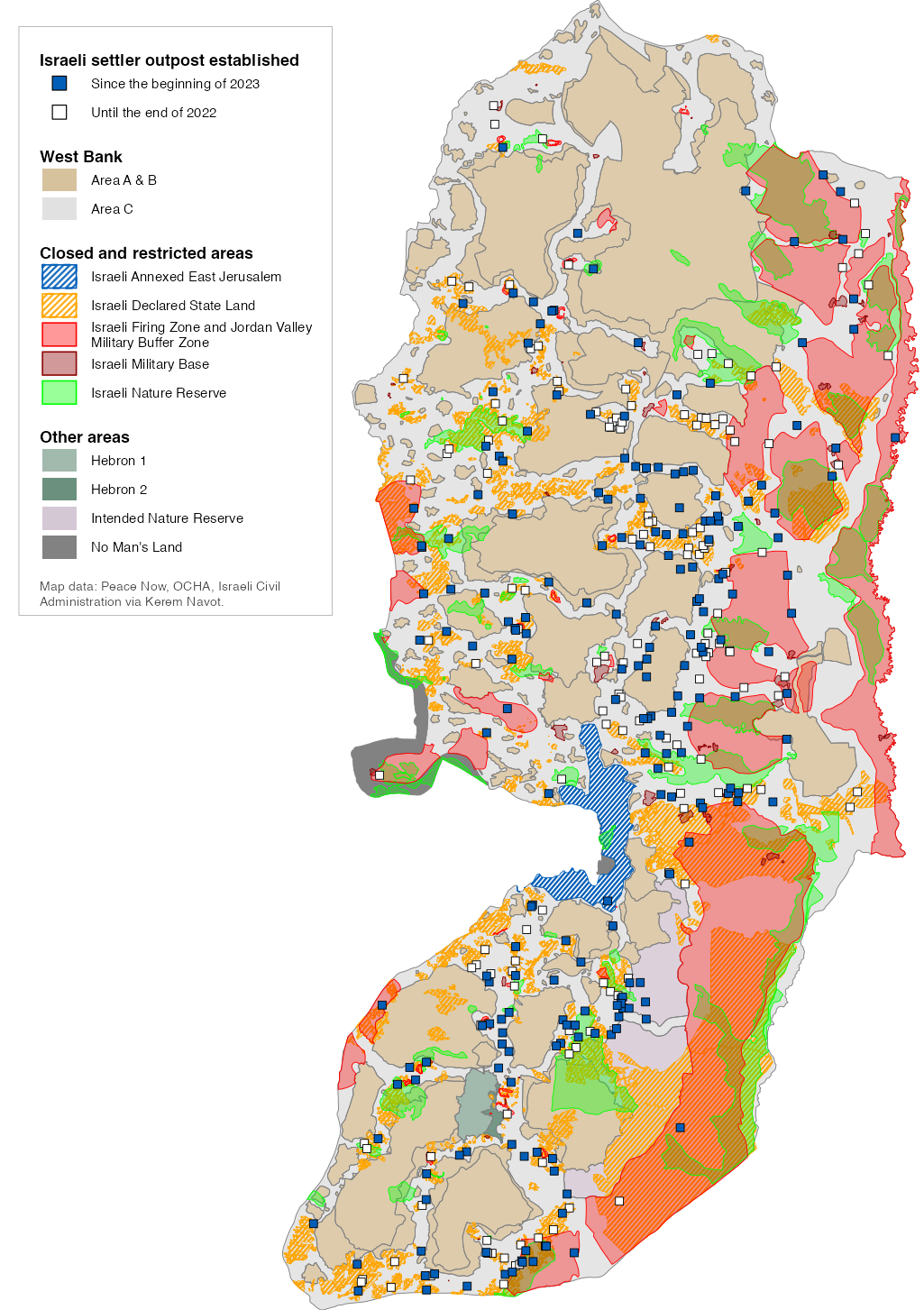
Settler outposts in numbers
Settler outposts, which are built without formal Israeli authorization, are, like all other settlements in the OPT, illegal under international law. They began appearing in 1996 during Benjamin Netanyahu’s first term as prime minister, with peak numbers of approximately 20 outposts established annually in 1998, 2001 and 2003, according to Peace Now.[189] The establishment of outposts, then designed as a tool to circumvent the prohibition on creating new settlements under the Oslo Accords,[190] stopped in 2005 after the unilateral disengagement plan, but resumed in 2012 under Benjamin Netanyahu’s new government. Outpost growth surged in 2018 and 2019, coinciding with the US administration’s declaration that settlements were not illegal under international law, and Benjamin Netanyahu’s repeated calls for the West Bank’s annexation. Numbers rose sharply again in 2023 after the formation of the 37th government and accelerated further following 7 October 2023.
According to Peace Now, by 30 April 2026, a total of 68 outposts had been retroactively authorized, more than half (39) since January 2023.[191]
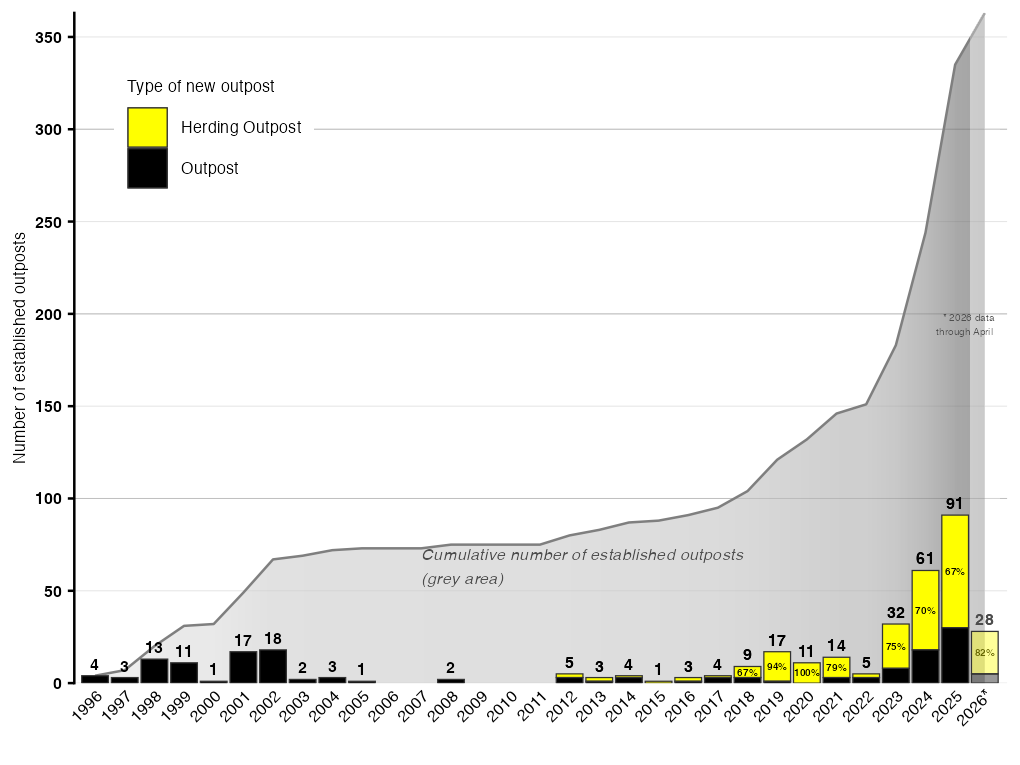
Settler violence as state policy
For almost a year, I didn’t cross the highway [Allon Road]. They [settlers] used to harass me and other shepherds, and we’d try to avoid them, but then the army started showing up and protecting them, shooting in the air.
Ayman Suleiman, Kufr Malik, 28 August 2025.
The clear government policy and actions to intensify and accelerate annexation have directly encouraged and legitimized violence by Israeli settlers. With full political, legal and financial backing from the Israeli authorities and often direct support from Israeli forces on the ground, settlers intensified their long-standing tactics to displace Palestinians and seize their land, adopting a more aggressive and visible approach. Israeli authorities failed to uphold their obligations as an occupying power to hold perpetrators of settler violence to account, and instead actively participated in or enabled settler violence to displace Palestinian communities.
This surge in settler violence since the 37th government’s formation drove record levels of displacement, killings and injuries, property destruction and land grabs. Between January 2023 and December 2025, Israeli settler violence and access restrictions led to the displacement of around 15.5% of the total Palestinian population in Area C, estimated at around 35,000. [192]
Amnesty International interviewed 44 displaced Palestinian men and women – or those at risk of displacement – from 10 Bedouin and herding communities in Area C – Al-Farisiya, Al-Hadidiya, Ein al-Hilweh, Ein Samia, Makhoul, Shi’b al-Butum, Susya, Ras al-Mu’arrajat, Ras Ein al-Oja and Zanuta – between February 2024 and September 2025. The men and women consistently attributed their displacement to the repeated waves of settler violence which they said was actively supported by Israeli soldiers or the police.
The organization also conducted interviews with 10 foreign or Israeli volunteers, known as protective presence volunteers, who monitored violations in these areas. It additionally analysed patterns of settler violence documented in 247 videos and images in these areas and reviewed reports by other human rights organizations or activists. Based on the evidence compiled by Amnesty International, settlers employed three main tactics to instil terror and drive Palestinians from Bedouin and herding communities out of their homes:
- they attacked Palestinian villages, homes and other property;
- they persistently harassed, threatened or physically assaulted residents; and
- they targeted livelihoods and means of subsistence by restricting or blocking access to grazing areas, contaminating water sources by cutting pipelines or emptying water tanks, stealing and killing livestock, and destroying agricultural fields and crops.
Instead of preventing and investigating these abuses in line with their obligations under international law, the Israeli authorities actively encouraged them by distributing weapons to settlers, while the Israeli army and police supported or facilitated attacks; at times, soldiers directly participated in the violence. Palestinians who reported the violence were themselves interrogated, fined and, in some cases, arrested.
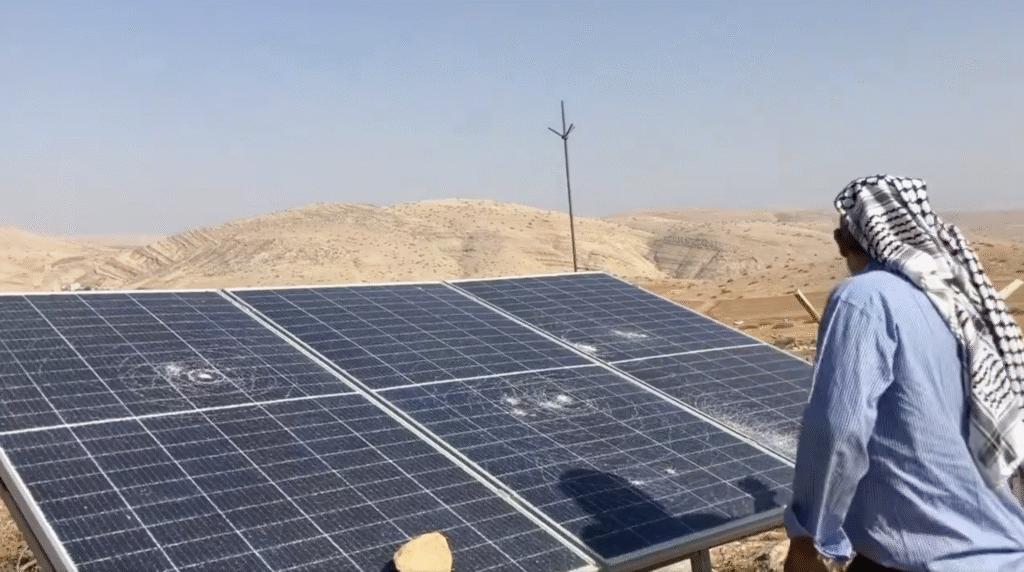
In the few cases where courts provided at least partial redress through decisions allowing the return of displaced residents, provisional orders prohibiting further demolitions or the removal of temporary structures, or restraining orders to prevent individual settlers from harassing Palestinians, the Israeli police and army consistently failed to implement them.
The documented cases provide illustrative examples of how settler violence operates in parallel with administrative measures that restrict access to land and property, and with the direct involvement of the Israeli army. These practices are reinforced by a discriminatory approach to law enforcement that prioritizes measures undermining Palestinians’ ability to remain on their land and enjoy their fundamental rights. These discriminatory policies are part of Israel’s system of apartheid against Palestinians.[193]
Israel’s obligations to prevent settler violence under international law
Under international humanitarian law and international human rights law, Israel is obligated to protect against, prevent, investigate and prosecute acts of violence against the occupied population.
This obligation stems from the responsibilities of the occupying power to “ensure, as far as possible, public order and safety” set forth in Article 43 of the Hague Regulations, as well as the obligation, established in Article 27 of the Fourth Geneva Convention, to ensure that the protected population “shall at all times be humanely treated, and shall be protected especially against all acts of violence or threats thereof.” The Commentary on Article 27 explains that the obligation to protect, like the obligation to treat humanely, applies at “all times”, and clarifies that the occupying power is obliged “not only to refrain from harming protected persons but also to exercise due diligence in preventing them from being harmed by others, including private individuals.”[194]
The obligation to exercise due diligence in protecting protected persons means an obligation to protect Palestinians in the OPT from violence, threats, intimidation and attacks on their livelihoods and property by settlers, whose very presence in the occupied territory violates international humanitarian law.[195] As the occupying power, Israel should never have allowed – let alone facilitated, encouraged and legitimized – the settlement of its population in the occupied territory. It has an obligation to dismantle the settlements and remove the settlers from the OPT.
Under international human rights law, Israeli authorities are required to respect, protect and fulfil Palestinians’ human rights, including, inter alia, their rights to life,[196] to freedom from torture and other ill-treatment,[197] to work,[198] and to an adequate standard of living.[199] Israel’s failure to use the means at its disposal to protect Palestinians from settler violence is a blatant breach of its obligations. Israeli authorities and their different organs and agents operating in the OPT also have an obligation to refrain from participating in or assisting violent acts by settlers. The ICJ and UN treaty monitoring bodies have repeatedly made clear that Israel’s obligations under international human rights law apply in the OPT.[200]
Exponential increase in settler violence leading to displacement
Settler violence has been steadily rising for years,[201] and escalated following the formation of the 37th government.
According to OCHA, between 2020 and 2024 there was a nearly sevenfold increase in settler-related attacks on Palestinian Bedouin and herding communities that resulted in casualties, property damage or both. These incidents rose from about 50 in 2020 to approximately 330 in 2024.[202] Settler violence surged further after the start of Israel’s offensive in the Gaza Strip, with OCHA recording an average of four attacks by settlers every day between 7 October 2023 and 30 September 2025.[203] This trend intensified again in the first three months of 2026, when global attention was focused on hostilities that erupted across the Middle East after the United States of America (USA) and Israel launched joint attacks against Iran on 28 February. OCHA documented an average of six settler attacks per day during this period.[204]
Between January 2023 and 30 April 2026, OCHA recorded the forced displacement of at least 5,910 Palestinians as a result of Israeli settler violence and related access restrictions across the West Bank. These individuals came from 117 predominantly Bedouin and herding communities across Area C.[205] With a total population estimated at 35,000, this means that around 17% of Palestinians from Bedouin and herding communities in Area C were displaced.[206] At least 45 of affected communities were fully depopulated.[207]
The Ramallah and Al-Bireh Governorate in the central West Bank experienced the highest levels of displacement linked to settler violence, accounting for 41% of all displaced persons that OCHA documented, followed by the Hebron Governorate and the Jordan Valley area that spans four governorates.[208]
Meanwhile, thousands of other Palestinian Bedouin and herding communities remain at risk of forced displacement as state-backed settlers continue to terrorize residents across Area C.
Government proactively arming settlers
Following the Hamas-led attacks in southern Israel on 7 October 2023, the Israeli authorities expanded the civilian military apparatus in and around Israeli settlements in the West Bank. The Ministry of National Security adopted new regulations to ease criteria for issuing private firearms licences, prompting 41,000 applications from Israeli citizens across Israel and the West Bank in nine days.[209]
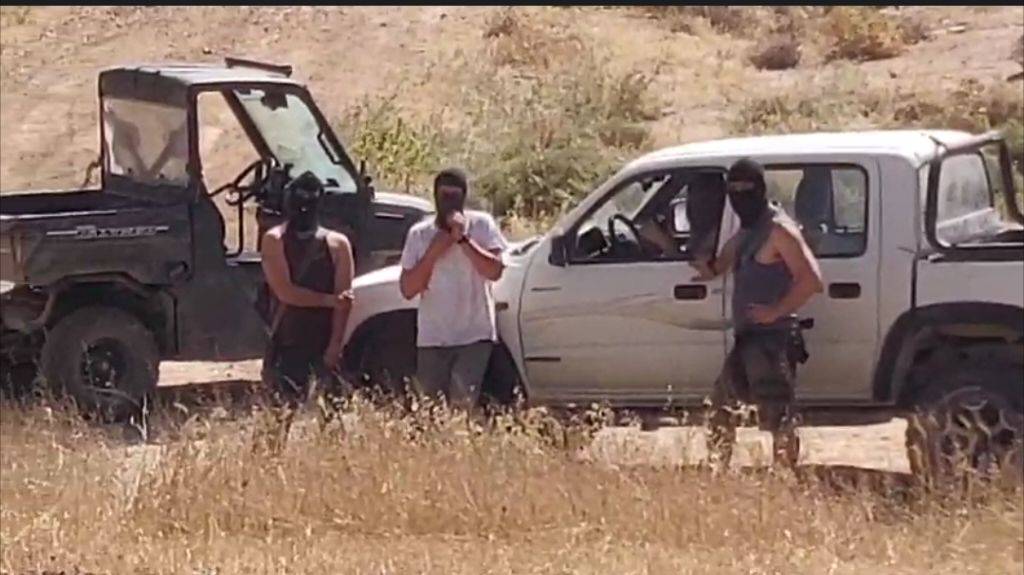
By January 2026, more than 240,000 firearm licences had been issued according to a statement by Itamar Ben-Gvir.[210] Issued over a little more than two years, this corresponded to an annual average of approximately 89,000 licences – a 15-fold increase compared to the annual average of 8,000 licenses prior to the policy change.
This chapter demonstrates the immediate impact of these policies, which have resulted in a sharp increase in settler abuses involving firearms. In most incidents documented by Amnesty International, settlers were armed. Even if arms were not used, their presence fundamentally altered the nature of attacks that Palestinians had endured for years. Every act of harassment, however small, perpetrated by armed assailants carried an explicit threat to life, preventing Palestinians from defending themselves. This enabled settlers to destroy Palestinian property, steal livestock, and terrorize Bedouin and herding communities with unprecedented intensity. Ultimately, the presence of arms was a key factor in compelling entire communities to flee their homes so rapidly, further undermining their ability to withstand settler violence and harassment.
In October 2023, the Ministry of National Security announced that it would form civilian “rapid response squads” under the authority of the Border Police and the Israel Police across Israel and the West Bank.[211] Priority was given to establishing such squads in Israeli towns and cities near the border with the West Bank and Gaza Strip, major urban centres, including cities with mixed Jewish and Palestinian populations, but also in parts of the West Bank. In July 2025, the Israeli police inaugurated Yatar, a primary response unit comprised of Israeli settlers residing in the West Bank. Its stated aim was to provide an effective emergency response in situations of “terrorism” and to strengthen settlers’ sense of security.[212] According to a statement by the Israeli police’s spokesperson’s unit, published on Jewish Power’s YouTube channel, by the time of its inauguration, 100 volunteers had already undergone training, in addition to receiving advanced combat equipment including weapons, uniforms and personal protective gear. They were also granted special policing powers.[213] During the inauguration ceremony, Minister of National Security Itamar Ben-Gvir stated that more than 1,000 emergency response teams had been established across the country, to which the new Yatar units were added. He described their creation as “changing the concept of defence to a concept of combat, war and offensive” adding that “this is the only way to win”.[214]
The Ministry of National Security and the Ministry of Defense also distributed thousands of weapons to “regional defence battalions” that were formed in the West Bank after the redeployment of many Israeli combat brigades to the occupied Gaza Strip in October 2023 and later to south Lebanon following the outbreak of an armed conflict between Israel and Hezbollah.[215] Known in Hebrew as “Hagmar” units, they are formal Israeli military formations staffed largely by settlers who have been drafted into military reserves.[216]
Although formally subordinate to battalion commanders, these units act with wide autonomy, often arriving first at incidents, in practice operating in parallel to regular Israeli military structures rather than under tight military supervision.[217] Settler soldiers within these battalions blur the line between the army and settler activity, as they hold full military authority while advancing settler objectives. Evidence shows that these battalions have been involved in armed attacks against Palestinian civilians.[218]
Under the new regulations, eligibility was broadened so that anyone aged over 21 who has completed one year of combat service, two years of military service, or – for women – one year of national or civic service may apply for a firearms licence, provided they can show residence or employment in an eligible area or regular academic attendance. [219] This replaces the previous requirement of completing full military or national service. The updated criteria also extend eligibility to active police volunteers with relevant service, retired volunteers, retired firefighters and volunteers from rescue organizations.
Eligible areas where applying for firearms licences is permitted, are those deemed to warrant civilian access to firearms on security grounds, based on police assessments. The full list has not been made public to Amnesty International’s knowledge, but such localities are known to include Israeli settlements in the West Bank. For example, in January 2026, Itamar Ben-Gvir added 18 Israeli settlements – some of which were retroactively authorized outposts – to the list of approved localities.[220]
The eligibility of settlers, many of whom may have participated in violence against Palestinians, to apply for personal firearms licences exposes Palestinians to additional security risks particularly since key procedural safeguards were loosened. The previous requirement for in-person interviews was replaced by telephone checks, which were in practice very brief, and often conducted by staff with minimal training to process the large amount of applications, according to an expert review submitted to the Knesset in February 2024.[221] The requirement for the police and the Ministry of Health[222] to determine an applicant’s general fitness as well as for the police to ensure that no impediments exist to granting the licence “on grounds of public safety and security” remained. However, in practice, the system moved towards database screening rather than an individual risk assessment.[223]
These minimal checks were insufficient to exclude those involved in abuses against Palestinians in a context where settler violence against Palestinians is pervasive. While the exact number of firearms distributed to settlers is unknown, Itamar Ben-Gvir personally oversaw the distribution of rifles to settlers in some cases.[224]
Violent raids against communities
Attacks against homes, private property and infrastructure
Between January 2023 and December 2025, settlers carried out at least 4,575 attacks on Palestinian communities resulting in casualties and/or property damage, destroyed or damaged around 69,000 trees or saplings, and at least 2,200 cars belonging to Palestinians.[225]
Amnesty International interviewed 20 individuals who described attacks, between January 2023 and the end of August 2025, on homes and other community structures in Al-Hadidiya, Ein al-Hilweh, Hammamat al-Malih and Khirbet Ibziq (Ibziq) in the northern Jordan Valley; in Al-Qabboun, Ein Samia, Ras al-Mu’arrajat and Ras Ein al-Oja in the central Jordan Valley; and in Susya and Zanuta in the South Hebron Hills.[226]
According to interviewees, these attacks occurred during the day and at night, and involved settlers raiding communities, wandering around or breaking into homes, threatening residents and telling them to leave, and beating them with their hands or rifles. Interviewees reported that settlers also vandalized cars, tents and schools; damaged or destroyed water tanks, solar panels and food supplies; and vandalized or stole agricultural tools and tractors.
In some cases, settlers were accompanied by Israeli soldiers or were themselves dressed in military uniforms.[227] In nine cases documented by Amnesty International, these attacks directly led to the full or partial displacement of communities.
In one example, 10 families[228] fled from Al-Qabboun, an area west of Ramallah, following a raid on 10 August 2023 in which a large group of settlers and soldiers stormed their houses, threw food out of fridges, emptied water tanks and shouted at residents to leave the area.[229]Prior to the incident, members of one family reported facing regular harassment by settlers who would break into and occupy their home, especially on weekends, intimidating them and sometimes driving utility vehicles around their house to scare them.[230]
Members of the family told Amnesty International that they had filed several complaints with the police but received no response; the attacks continued, ultimately leading them to leave the community in August 2023. Al-Qabboun comprised only 12 families prior to the displacement.
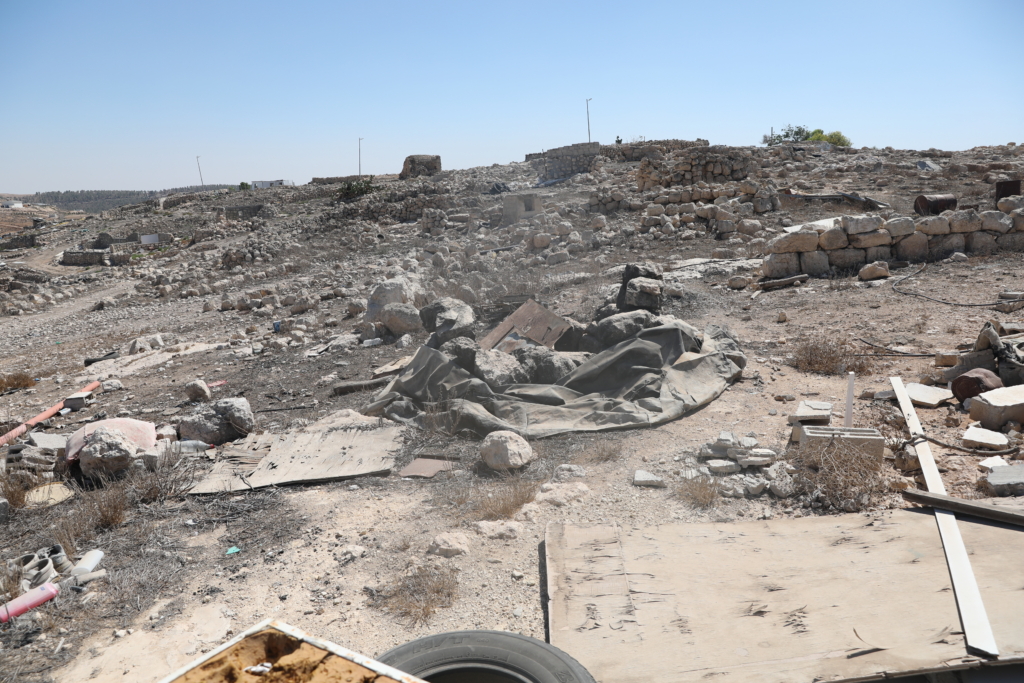
Following 7 October 2023, according to residents from Ras al-Mu’arrajat, Susya and Zanuta, attacks became more frequent and intense, and their homes were targeted more often, leaving residents with nowhere they felt safe.
Zanuta residents told Amnesty International that days after the 7 October 2023 Hamas-led attacks in southern Israel, settlers started breaking windows of their homes, entered their houses at night, and beat children with rifle butts.[231] Similarly, in Ras al-Mu’arrajat, settlers attacked the community for days, breaking into homes and smashing solar panels, according to victims and eyewitnesses.[232] In Susya, residents reported almost daily harassment in early 2024, with settlers driving around their homes, throwing rocks at night, and threatening to seize their houses.[233]
Amnesty International verified 38 videos documenting settler attacks on property in Palestinian villages across the South Hebron Hills and the northern Jordan Valley between January 2023 and December 2025. These videos show attacks on homes, including through demolitions, partial destruction and vandalism that resulted in broken windows and the scattering of personal belongings. Videos show tents and residential structures with visible fire damage and burn marks. Palestinian residents reported that the fires were caused by settlers.
In one illustrative case, on 25 July 2025, Nasser Shritah’s family home in Susya was set ablaze.[234] According to Nasser Shritah’s account published by Machsom Watch, two masked men arrived at night, set fire to the house, which was empty at the time, and fled.[235] The family, which included two parents and seven children, were sleeping in a nearby building. Videos of the aftermath analysed by Amnesty International show a burned kitchen interior and damage to walls, windows and the roof.
In addition, videos filmed in Al-Farisiya, Ein Samia and Susya document the destruction of or damage to water systems. Others show damage to solar energy systems in Al-Farisiya and Zanuta.
Amnesty International also verified videos that show the demolition of and damage to schools in Zanuta, Ein Samia and Al-Safi in Masafer Yatta, among other locations.
Physical attacks, threats and harassment
Since the government’s formation, settler violence became both more severe and more lethal.
Of the 1,277 Palestinians OCHA reported killed in the West Bank between January 2023 and the end of March 2026,[236] settlers killed 31 – all of them using firearms.[237] In the cases of a further 14 Palestinians reported to be killed during this period, the exact identity of the Israeli perpetrators remains disputed, meaning OCHA was unable to determine whether they were killed by settlers or the Israeli army.[238]
Although the Israeli army is responsible for the vast majority of known Palestinian deaths, the documented rate of Palestinians killed by Israeli settlers in the West Bank increased to more than four times during the first three years of the coalition government’s rule (2023-2025) compared with the previous six years (2017-2022). According to OCHA data, Israeli settlers killed eight Palestinians annually on average between 2023 and 2025, compared to fewer than 1.7 recorded deaths annually in the preceding six years.[239]
Similarly, OCHA reports more than a threefold increase in the annual rate of Palestinian injuries caused by settler attacks per year since the beginning of the 37th government compared to the period between 2017 and 2022.[240] OCHA data also indicates a sharp rise in injuries resulting from firearms.[241] Other injuries were caused by physical assaults, stone throwing, knife and other attacks.[242]
Most of these killings and injuries occurred after 7 October 2023, when anti-Palestinian incitement and advocacy of hatred by Israeli officials and influential public figures increased sharply [243] and criteria for issuing firearms regulations were expanded.
Amnesty International interviewed 21 Palestinian residents and four protective presence volunteers who reported personally experiencing or witnessing physical violence by settlers. These assaults involved settlers pushing or beating Palestinians with their hands, sticks or rifle butts, throwing stones or pointing guns and rifles at them, shooting in the air, knife stabbings and attempts to run people over with vehicles.
The attacks took place in grazing areas, in agricultural fields, inside communities and even in private homes. They were often accompanied by verbal insults, with settlers threatening to choke or shoot residents or take over their houses and explicitly ordering them to leave their communities.[244] In addition, settlers regularly harassed Palestinians by filming them without their consent. Amnesty International researchers witnessed first-hand a settler physically assaulting and threatening a Palestinian in Zanuta.[245]
In one illustrative case, a shepherd from Shi’b al-Butum described to Amnesty International a series of violent threats and assaults in October and November 2023 aimed at forcing him and his family to leave his village.[246] He reported that around three days after 7 October 2023, several armed, masked men arrived at his home in the afternoon. He said that he recognized one of them as the security guard from the nearby Avigayil settlement, after the man addressed him by his name.
According to the shepherd, the settler, who was armed with a rifle, threatened to kill his children if he did not leave the area. In a clear reference to Israel’s killing of civilians in the Gaza Strip, he said: “Did you see what we did to the children of Gaza? We’ll do the same to your children.”[247] When the shepherd asked where he should go, the settler replied: “Go to Yatta.” After the shepherd refused, the settler threw him to the ground, ordered him not to move, threatened him again and said he would return the following day.
The following day, the same settler returned, armed again, and demanded to know why he had not left. When the shepherd mockingly replied that he would leave in exchange for land in Tel Aviv, the settler placed the rifle barrel against his chest, threatened to shoot him, and then pushed him to the ground. He then pinned him down, pressed the rifle to his chest, and kicked him in the stomach in the presence of his family. The shepherd explained:
“When he put his rifle on my chest and hit me on my stomach, grabbing me, my daughters were watching and screaming.”[248]
After this incident, the shepherd said the same settler returned to Shi’b al-Butum several more times, asking about him, forcing him to hide. During one visit, the settler confronted the shepherd as he was lighting a fire near his father’s house. He ordered him to go home, after which he pointed his gun at him, and escorted him all the way back to his house.
Upon reaching his house, the settler, who was accompanied by another settler, forced the shepherd to lie face down on the ground. The shepherd complied, fearing for his life when he saw the other settler holding a small axe. The two settlers then covered his head with a blanket and threatened to kill him if he moved. They then destroyed the electricity lines and water tanks around his home, damaged belongings inside the home and stole valuable agricultural equipment. When the shepherd’s wife tried to film the incident, one of the settlers smashed her phone and removed the SIM card.
Amnesty International verified videos from 20 incidents, recorded between January 2023 and November 2025, documenting settlers physically attacking, threatening and harassing Palestinian residents in Al-Farisiya, Makhoul, Ras al-Mu’arrajat, Shi’b al-Butum, Susya and Zanuta.[249] The footage reveals a pattern of settler attacks on shepherds while they herd their animals, through verbal insults, threats involving weapons, and physical violence using sticks and stones.
The videos also show settlers trespassing onto private property and attacking residents in their homes and communal areas inside their villages or encampments. For example, videos from Susya show armed, masked settlers attacking Palestinian residents on three separate occasions in March and June 2025, throwing stones at them and their property.[250] In the June incident, several residents were injured, and one had to be hospitalized.[251]
Settlers also sexually assaulted or attempted to sexually assault Palestinian men, according to witness and victims’ testimonies published by the media and NGOs.[252]
Footage recorded by B’Tselem on 4 August 2024 shows a settler sexually harassing and implicitly threatening to rape a Palestinian man from Wadi al-Rakhim in the South Hebron Hills.[253] The footage starts by showing four settlers carrying clubs and walking towards a Palestinian family’s house.[254] Upon reaching it, they swear at family members, with one settler saying that the land, the house and a nearby well were given to him by God. After an argument breaks out, the settler sexually harasses the Palestinian owner of the house and then threatens him with rape by saying: “You look so fresh, so sweet… I’d be happy to sit with you in jail some day… You know Sde Teiman? Rape in the name of God as they say.”[255] The settler was referring a military detention facility known as Sde Teiman where just few days earlier a leaked video had shown soldiers sexually assaulting and gang-raping a Palestinian detainee.[256] According to B’Tselem, residents and international activists contacted the police during the incident, yet the police did not dispatch officers or provide any immediate intervention.
Videos analysed by Amnesty International show that, in a limited number of incidents, Palestinians responded to settlers’ physical violence and verbal threats by pushing them away, threatening them, throwing stones back at settlers who had attacked them, or by trying to stop settlers who were hitting, or on the verge of hitting, their animals with sticks, by kicking at the sticks. However, given the widespread presence of firearms since 7 October 2023, such threats and actions had little impact on settlers. In addition, according to interviewees and analysed footage, in such instances, Israeli soldiers usually arrested or threatened the Palestinians involved, while settlers responsible for the attacks and harassment were not investigated.[257]
Targeting livelihoods and means of survival
Palestinian Bedouin and herding communities in the West Bank have historically lived near water sources and grazing land; their subsistence depends entirely on livestock and is sustained by generational expertise in sheep rearing, dairy production and trade.[258] The lands in which these communities used to herd prior to Israel’s occupation of the West Bank were classified as public lands, waqf land,[259] privately owned-land and communal land.[260]
Since 1967, the Israeli authorities have further restricted these communities’ freedom of movement and access to grazing land due to land grabs and settlement expansion. Israeli authorities used a discriminatory land designation regime, which fails to respect communal or tribal landownership, to seize the land where most Bedouin and herding communities in Area C live and graze.[261] They designated public land as state land, “firing zones”, or nature reserves to facilitate its seizures, mostly for the exclusive benefit of Jewish-Israeli settlers. In general, land which is not privately registered, in whole or in part, is vulnerable to Israeli confiscation and seizures.
In August 2023, a UN-led humanitarian assessment[262] carried out across 63 herding communities with a population of around 10,000 people found a significant population decline in 24 communities (compared with 2013), as well as a widespread reduction in livestock and cultivated grazing land.[263] Around 79% of communities reported ceasing to access their land due to settler attacks, and 60% cited settlement expansion into grazing areas or land takeovers by settlers as reasons for the decrease.[264] In addition, about 64% of communities reporting administrative restrictions cited closed military area declarations as a reason for the decrease in grazing land.[265]
Displaced Palestinians interviewed by Amnesty International echoed these findings. They reported that settlers routinely harassed and threatened shepherds in open grazing areas, often physically assaulting them and stealing their livestock. These tactics were clearly intended to prevent them from accessing grazing areas and depriving entire communities of their livelihoods, ultimately forcing them to leave, thereby allowing settlers to take over their land.[266]
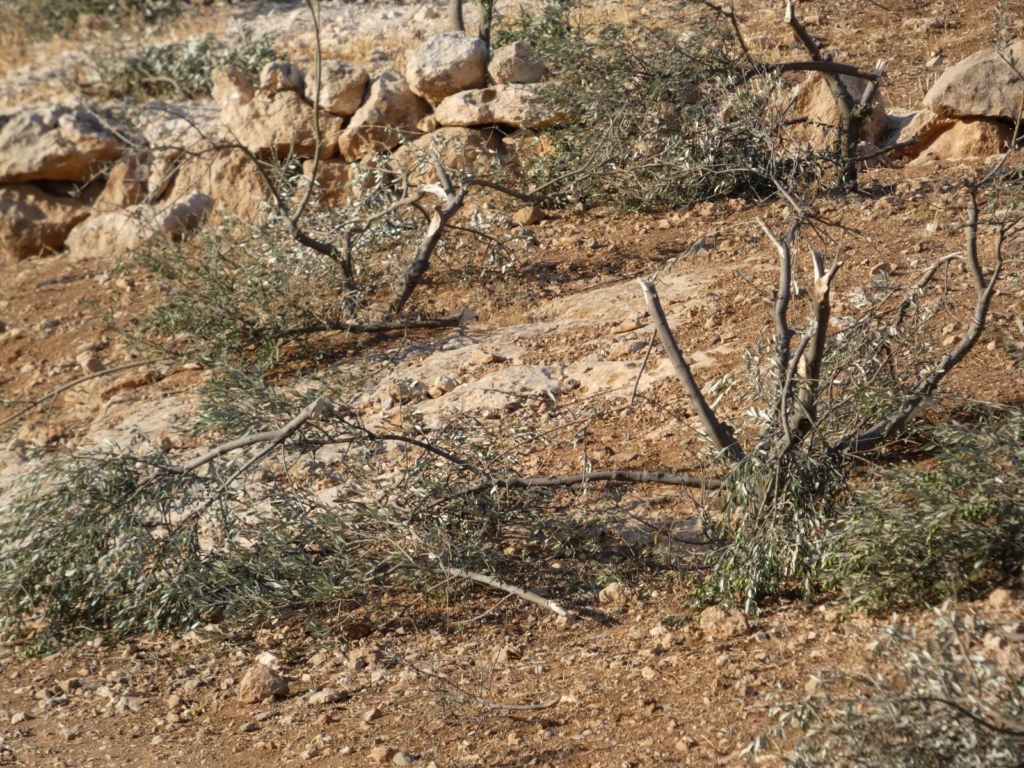
At the same time, settlers routinely grazed their herds on Palestinian cultivated lands, damaging crops and deliberately destroying agricultural fields. As a result, Palestinians were banned by settlers, soldiers, or both from accessing their land to cultivate soil or harvest their crops.
Interviewees also reported that Israeli soldiers often supported such assaults,[267] and representatives from settlement regional councils[268] at times contributed to the harassment of Palestinians. In the cases documented by Amnesty International, these local authorities imposed harsh and unjust penalties on Palestinian shepherds for grazing in areas that fall within the settlement councils’ jurisdiction.
The police consistently failed to investigate the settler violence against Palestinians and instead initiated punitive measures against Palestinians, including arrests, confiscation of livestock and heavy fines.[269]
Amnesty International analysed 56 videos and images that show a disturbing pattern of settler abuse, including harassment of Palestinian shepherds in grazing areas where Israeli settlers assert control over land, deliberate ramming of Palestinian-owned flocks with vehicles, and physical attacks that injure the animals, forcing them to scatter across the hills. In several cases, animals belonging to Palestinians were stolen, and sometimes stabbed or killed.
In addition, Amnesty International found that settlers sought to deprive Palestinians of their livelihoods by deliberately destroying farmland.
Residents of Ein Samia, Makhoul and Zanuta reported that settlers routinely let their animals graze on Palestinian cultivated land, damaging crops and intentionally destroying agricultural fields.[270] Video evidence from 10 incidents in Bardala, Ein Samia, Shi’b al-Butum and Susya corroborates witness accounts, showing settlers herding or driving flocks[271] onto land visibly being cultivated, damaging or destroying crops including olive and fruit trees, and building roads and/or fencing off entire areas to prevent Palestinians accessing farmland.[272]
Israeli herding outposts
Israeli herding outposts in the West Bank are settler outposts that also function as farms where settlers raise animals and graze them in open areas. Like other outposts, they are illegal under Israeli law, in addition to being illegal under international law. These “farms” are a strategic tool for dispossessing Palestinian herding communities of their land under the guise of agricultural development.[273] While “regular” outposts occupy the small pieces of land on which they are built, herding outposts take over much larger areas through grazing.
Ze’ev Hever, head of the settler organization Amana,[274] explained their purpose in a 2024 interview, saying that “the protection of open areas [in the West Bank] is Amana’s central mission.”[275] Finance Minister Bezalel Smotrich explained in December 2024 the importance of herding outposts in taking over land in the West Bank: “Farms [are] a mega-strategic tool for preserving land… You take a farmer, a thousand cows, a penny and a half of investment, you save 40,000 dunums [4,000 hectares]… I estimate that within a few months there will be a model that will allow the vast majority of farms to be regulated. The system will open the door to investing, to arranging water infrastructure, electricity, participation in grazing grants.[276]
In 2022, a report by Kerem Navot, an NGO that monitors and researches Israeli land policy in the West Bank, found that illegal settler outposts across the West Bank controlled an estimated 240,000 dunums, amounting to nearly 7% of Area C (4% of the whole West Bank).[277] By the end of 2024, settler outpost control had grown to approximately 746,000 dunums, representing 22% of Area C (13% of the West Bank), according to a joint report by Peace Now and Kerem Navot.[278] The organizations estimated that within only two-and-a-half years, Israeli settlers seized, through herding outposts, 70% of all the land they had taken since the 1990s.[279] The report revealed that the Israeli state supports herding settlers through “land allocation contracts”, which have facilitated the transfer of control over tens of thousands of dunums of land designated as Israeli military “firing zones”, nature reserves and “state land”, as well as privately owned Palestinian lands, into the hands of settler herding outposts.[280] Israel’s allocations of land to its own population illegally transferred to the occupied territory constitute a blatant violation of international law.
Rasheed Khudeiri, a farmer from Bardala in the northern Jordan Valley, who coordinates the Jordan Valley Solidarity Campaign, explained how the takeovers happen: “Herding outposts might occupy… only a few dunums each, but through grazing they take over huge areas… A settler from an outpost near Bardala practically seized 500 dunums between 2024 and 2025 by taking his cows to graze there, while at the same time preventing us from accessing this land which we depend on for our livelihood.”[281]
Restricting access to grazing areas
Grazing areas for Palestinian herding communities in Area C have almost disappeared in recent years due to illegal settlement and outpost expansion, settler violence and the declaration of closed military areas, often imposed by Israeli authorities after confrontations between Palestinians and settlers.[282]
Amnesty International interviewed eight residents who described multiple incidents of physical attacks, threats and harassment while grazing their livestock in open areas near their communities, including Al-Qabboun, Ein al-Hilweh, Ein Samia, Makhoul, Ras al-Mu’arrajat, Ras Ein al-Oja, Susya and Zanuta. In addition, nine residents described incidents in which settlers or soldiers told them they were not allowed to be in the areas where they were grazing, ordering them to leave.[283] Amnesty International documented similar incidents across the South Hebron Hills and other communities in the northern Jordan Valley. Verified videos relating to 17 incidents that occurred between January 2023 and December 2025 show settlers preventing Palestinians from accessing grazing areas in the vicinity of their communities.[284]
The tactics used include erecting fences and establishing outposts near Palestinian communities; claiming land ownership over grazing areas; driving vehicles next to or into flocks; intimidating shepherds; and involving the police and military to intervene and prevent Palestinians from herding.
Interviewees reported beatings by individual or sometimes groups of settlers with rifle butts, as well as punches, stone throwing, shots being fired in the air, stabbings and threats of shooting or choking. Several attacks caused severe injuries to Palestinian residents, including broken bones. While these incidents primarily targeted Palestinian men, Amnesty International documented at least one incident in early 2024 in Makhoul in which settlers attacked a 15-year-old boy (see below).[285] Both men and women spoke of the psychological impact of the violence, with men reporting that they feared being assaulted every time they left to graze their herds, while women said they constantly worried for the men’s safety.
According to several herders, settlers who attacked them claimed that the grazing areas had been allocated to them under Israeli law and that Palestinians have no right to enter.[286] Others said that they were given no explanation but knew from experience that venturing beyond a certain distance from their community would prompt settlers to appear and assault them.[287]
Yousef Bisharat, a 46-year-old shepherd from Makhoul, said that following 7 October 2023, he faced constant threats from settlers from surrounding settlements and outposts, particularly from a settler who established an outpost in the nearby Suweida area. He told Amnesty International:
“Every day I take a risk with my sheep, looking for good grazing. But I barely manage an hour or two before they come at me. They attack me, beat me, or even beat my children. Earlier this year, he [the settler from Suweida] attacked my son who is only 15. My mind is full of worry all the time. He knocked my boy down and said to him, in Arabic, ‘I’ll choke you.’” [288]
Yousef Bisharat said that later that day, the same settler warned him that if he ever returned to the grazing area, he would shoot him. [289]
Amnesty International analysed four videos and images posted on social media in 2023 and 2024 showing Israeli settlers targeting the flocks of a member of the Bisharat family, including incidents in which settlers injured animals, stole livestock and obstructed access to grazing land, at times with the support of soldiers and men dressed in military fatigues.[290]
Three illustrative incidents from the village of Shi’b al-Butum, home to some 300 Palestinians, in Masafer Yatta, south of Hebron, demonstrate how settlers instil fear and intimidate residents. In a video filmed on 15 March 2024, settlers are harassing a Palestinian shepherd and chasing his sheep.[291] In a second video posted on 21 July 2025, an Israeli settler is grazing his sheep around Palestinian homes and grazing areas in Shi’b al-Butum.[292] In a third video, posted on 4 August 2025, an armed Israeli settler is releasing his sheep near the home of a Palestinian resident in the same village.[293]
Shepherds across the visited areas told Amnesty International that settler harassment and attacks mean they now only graze in extremely limited areas near their communities, which do not provide enough feed for their animals, forcing them to buy fodder they cannot afford. To cope, many sell part of their herd each time they purchase feed, or slaughter their livestock early, living in a constant state of crisis, while vast green areas nearby remain inaccessible to them. One shepherd from Makhoul told Amnesty International researchers during a visit in February 2024: “Look at this land, it’s spring, the best season to graze, all that green land is so close to us but we cannot reach it…”[294]
Killing, stealing and confiscating livestock
Palestinian herding communities regard their herds as both their most valuable possession and their greatest vulnerability. Since 2023, settlers have exploited this dependency to push Palestinian communities off their land.[295]
Interviews with 18 Palestinian herders and a protective presence volunteer, together with the analysis of video evidence from 13 incidents across Area C, reveal a sustained pattern of attacks by settlers on multiple Palestinian communities involving stealing, confiscating, harming or killing their animals in order to deprive them of their main source of income and thereby forcibly displace them.[296]
Three incidents documented by Amnesty International show that the Israeli police and army, including the Civil Administration, have used the actual or threatened confiscation of animals to prevent displaced residents from returning to their homes or accessing grazing areas.
Between October 2023 and early 2024, residents from Ein Samia and Makhoul reported several incidents of sheep theft by settlers.[297] In July and August 2025, in two incidents reported to Amnesty International in Kufr Malik, settlers ambushed shepherds who were herding their animals in the early morning. They beat the shepherds, threatened them at gunpoint, forced them to flee, and then stole the animals. Both incidents resulted in the theft of entire herds, including around 200 sheep in one case. Although the owner reported the incident to the police, he received no response, with no indication of any follow-up or action taken.[298]
Ayman Abd al-Jalil described how a group of settlers stole his entire herd of nearly 80 sheep while they were grazing near the village of Kufr Malik on 8 July 2025:
“I took the animals out to pasture alone, on the hill behind us, when I saw them. They [the settlers] were already there as if they were waiting. There were six settlers, two of them armed and pointing handguns at me. They tried to catch me, and if I hadn’t managed to escape, I don’t know what they would have done. I fled for my life, and they took my sheep. I couldn’t do anything.”[299]
Amnesty International also documented four incidents in which settlers deliberately harmed, attempted to kill or killed animals. Three of the incidents occurred near Makhoul or on private Palestinian land near Zanuta between July 2023 and January 2025. They involved settlers deliberately running over sheep with their vehicles and throwing stones at them, according to interviewed residents.[300] A verified video dated 21 July 2023 corroborates testimonies from residents interviewed in Makhoul. It shows individuals identified by residents as settlers driving an ATV into a flock of sheep as they were being led by a Palestinian shepherd back from pasture along a dirt road near the village.[301]
In the fourth, most brutal incident, on 17 July 2025, Israeli settlers deliberately shot and stabbed 180 to 200 sheep in Al-Meyta, a small community in the northern Jordan Valley, killing at least 120. An ISM[302] volunteer who reached the area at night together with other foreign and Israeli activists acting to protect the community, recounted to Amnesty International that by then a group of 20 to 30 settlers had raided the home of a family. They seized their entire flock of around 300 sheep. The volunteer said that Israeli soldiers prevented her and the other volunteers from approaching the scene.
Throughout the night, however, she told Amnesty International that she saw at least six military jeeps stationed near the community. When the army left, at around 4 or 5am, she was able to enter the community to find the family’s belongings scattered around their encampment. When she walked through the open areas around the site together with other volunteers and members of the family, they saw at least 120 dead sheep killed by stabbing or gunshots; around 60 others were injured.[303] Amnesty International analysed 40 videos and images shared by ISM volunteers related to the incident in Al-Meyta showing animals in barns and open fields with stab wounds and visible blood. In some cases, the animals were not moving, suggesting that the injuries were fatal.[304]
Additional footage from other areas in the northern Jordan Valley such as Al-Farisiya as well as in the South Hebron Hills, including Zanuta and three villages in Masafer Yatta, show settlers driving through flocks of sheep[305] and geese,[306] kicking grazing animals,[307] harassing livestock,[308] physically attacking Palestinian shepherds with sticks and stones,[309] and attempting to seize sheep from a Palestinian family, claiming ownership of the animals.[310]
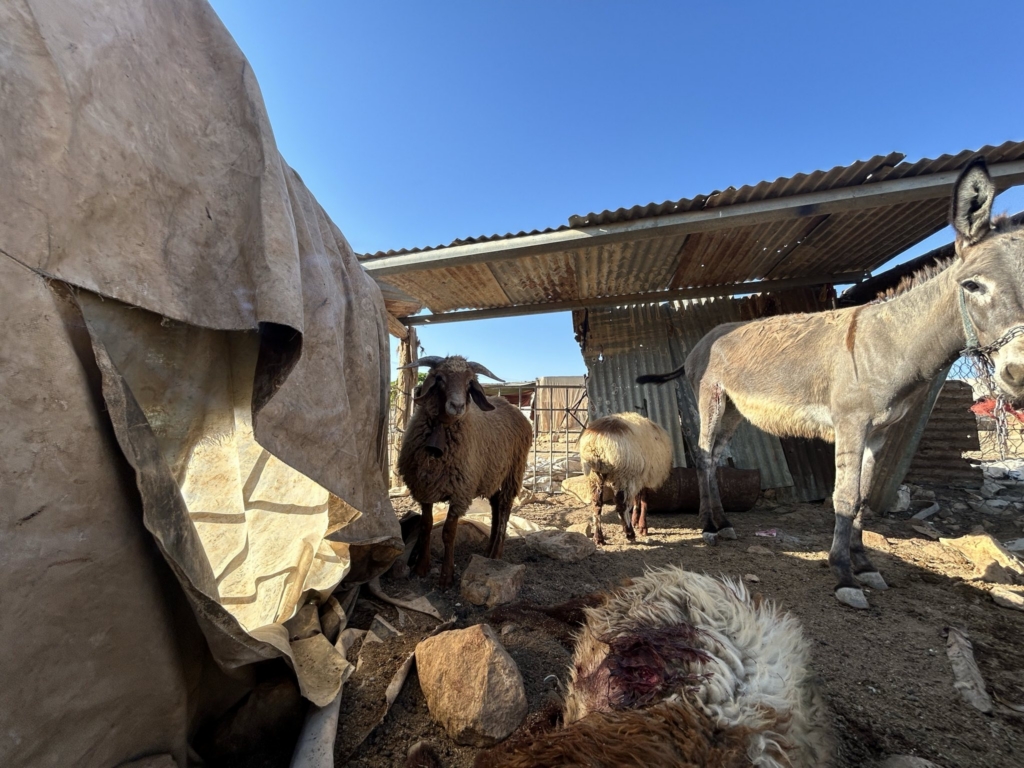
Three documented incidents in Ein al-Hilweh, Ein Samia and Ras al-Mu’arrajat between May 2023 and early 2024 point to the Israeli authorities’ use of livestock confiscation as a means to coerce the displacement of Palestinians. This is corroborated by the reporting of other organizations; for example, B’Tselem recorded 61 incidents of settlers harming or stealing animals in communities at risk of forcible transfer between January 2023 and December 2025.[311]
In Ras al-Mu’arrajat, Israeli police arrived at a Palestinian herder’s home with settlers who marked several of his sheep with Israeli seals and then took them without explanation.[312]
In addition, the Civil Administration and settlers threatened Palestinian herders with seizure of their livestock to pressure them into leaving. In Ein Samia, a herder left in May 2023 after the Civil Administration warned that his sheep would be taken if he continued living in a cave following the demolition of his home.[313]
Targeting livelihoods through accusations of theft
Amnesty International documented cases in the central Jordan Valley and south Hebron Hills where settlers harassed Palestinian herding communities by accusing them of stealing sheep to justify their violent raids and the confiscation of animals, sometimes alongside Israeli soldiers or Israeli police. Six interviewees from Ein Samia, Ras Ein al-Oja, Ras al-Mu’arrajat, and Zanuta described at least four incidents between 2023 and 2025,[314] in which settlers raided their communities, arguing that they were responding to a theft.
In these instances, the Israeli police arrived either at the outset of the incident alongside the settlers, or later in response to calls from them or from the accused residents. In all cases, the police response resulted in punitive measures against the Palestinians, including arresting those accused by settlers, confiscating their sheep, issuing fines, or raiding their homes. Some individuals said that they experienced several or all of these measures.
Palestinians were subjected to these measures without any legal process or conclusive evidence, solely based on settlers’ claims that they had stolen their sheep. The fact that similar accounts were independently provided by residents in four different locations suggests a pattern of settlers harassing Palestinians through accusing them of theft.
For example, in February 2024, a group of armed settlers in ATVs and on horseback, raided Ras Ein al-Oja.[315] According to interviews with four residents, the settlers arrived at the family’s home accompanied by a military vehicle carrying soldiers, claiming that a specific sheep had been stolen. The accused Palestinian shepherd reported that they remained at the location for about four hours, accusing him of theft and refusing to leave.
When the police eventually arrived, the shepherd pointed out the sheep’s Palestinian ownership mark attached to its ear, explained its health condition, and mentioned the previous owner’s name to prove his ownership. After the police and the settlers refused to accept his arguments, the shepherd said that he became fearful for the community’s security, particularly since the settlers were armed with rifles: “I realized they were here to kill,” he said, and eventually offered to give up the sheep:
“I said to the police officer: ‘You know what? How about I just give up this sheep? This sheep is ours, and we can do without it. Just make these people leave us alone… We don’t want to lose anyone.’”
When his brother volunteered to bring the sheep, a settler struck him on the back of the head with a rifle butt. According to the shepherd, the settlers took the sheep, and the police arrested him, interpreting his agreement to give it up as a confession of theft. Two witnesses from the community said that settlers stayed behind and physically assaulted several residents, including a woman whom they violently pushed, causing her leg to break.[316] The shepherd was detained for three hours and was released on bail of NIS 1,000 (approximately USD 320) on the charge of stealing the sheep.[317]
Role of Israeli forces and authorities in settler violence
When the settlers saw that a big number of people came to defend the village, they retreated behind the soldiers who stepped in and started shooting at us.
Muntasir al-Maliki, Kufr Malik.[318]
For years, Israeli authorities and forces have failed to prevent, and have condoned, facilitated or directly participated in settler violence against Palestinians. Under the 37th government, this support has reached new levels.
In response to Amnesty International’s letter to the Ministry of Defense seeking information on whether the Israeli military takes any measures to protect Palestinian Bedouin and herding communities from acts of violence and harassment by Israeli settlers, the army spokesperson’s unit made it clear that its law enforcement actions were primarily intended to protect Israeli civilians even if its mission is to ensure security for all. It stated: “The IDF’s [Israel Defense Forces] mission is to ensure the security of all residents of Judea and Samaria [West Bank], Palestinians and Israelis alike, and to operate to thwart terrorism and enforce law and order throughout Judea and Samaria to protect the security of Israeli civilians.”[319]
The army’s spokesperson’s unit also affirmed that forces respond to settler attacks against Palestinians and their property, detaining suspects, when necessary, until the arrival of the police, and stated that: “Upon receiving any report regarding friction between Israelis and Palestinians or incidents involving an attack by an Israeli civilian, IDF forces are dispatched to the scene. In every incident involving friction or assault, IDF soldiers are expected to act to disperse those involved and restore order in the area, including in cases of violence or attempts to expel shepherds, and they handle irregular incidents in accordance with procedures”.[320]
Evidence documented and analysed by Amnesty International demonstrates a different reality from the claims purported by the Ministry of Defense.
Participation in and facilitation of attacks
Israeli military forces often appear at the scene of settler attacks, sometimes arriving together with the settlers or after attacks have begun. Their involvement ranges from inaction, when they do nothing to protect Palestinians under attack, to facilitating or actively participating in the attacks.[321]
Settler violence has intensified and its impact increased due to the Israeli military’s supportive and complicit role. Displaced Palestinians told Amnesty International that the military’s presence during attacks contributed to their decision to leave.
Amnesty International spoke to 14 Palestinian residents who described 13 incidents where Israeli soldiers were either present or participated in attacks against individuals or communities in Al-Hadidiya, Al-Meyta, Ibziq and Ein al-Hilweh in the northern Jordan Valley; Ein Samia, Ras al-Mu’arrajat, Ras Ein al-Oja in the central Jordan Valley; and in Zanuta, south of Hebron. They said Israeli soldiers arrived in grazing areas to expel Palestinian shepherds with no explanation and, at times, threatened to shoot them or to confiscate their animals.[322]
In three documented cases, Israeli soldiers arrived at the scene of settler attacks and stood by, allowing settlers to assault Palestinians.[323] In Ras Ein al-Oja, for example, in early 2024, soldiers fired bullets in the air from a distance, while settlers were attacking a Palestinian home and stealing a sheep, effectively allowing them to proceed undeterred. A resident explained: “Instead of pushing the settlers away from us or arresting them, they fired shots into the air.”[324]
In four other cases, soldiers raided communities together with the settlers, suggesting prior coordination. Based on interview accounts, their presence served as a form of support, either from a distance or by directly shielding settlers from any potential Palestinian self-defence or retaliation during assaults.
For example, a family from Ein al-Hilweh told Amnesty International that during a raid on their home in 2023, before the October escalation, soldiers came together with the settlers but did nothing to stop them from vandalizing the property. Instead, the soldiers removed the family from the house, telling them to “relax” while settlers destroyed the family’s belongings, including laundered clothes, mattresses, plates and cooking pots, and spilled the family’s oil and flour.[325]
Video evidence analysed by Amnesty International corroborates interview accounts. For example, in an incident on 19 July 2024, video footage recorded by Al-Haq’s field researcher shows a group of masked settlers attacking members of the Najjar family as they sat outside their home in Shi’b al-Butum.[326] The settlers beat family members with sticks, causing a man and a woman to fall on the ground. Throughout the assault a Palestinian man can be heard screaming in Hebrew “soldier, soldier,” apparently calling for protection. Only when a couple of small stones are thrown towards the settlers, a soldier intervenes. As the settlers leave, the soldier fires a shot into the air and points his firearm at Palestinian residents.[327] Another clip from the same video filmed just before the attack shows the same soldier accompanying masked settlers, as they walk up a hill towards the Palestinian house, armed with sticks. Instead of stopping them, the soldier allows them to wander around the house intimidating residents.
Members of the family told Amnesty International that settlers had falsely accused them of taking their sheep while grazing but failed to provide any evidence to substantiate their claims.[328] A 62-year-old woman and her 38-year-old nephew required medical treatment for injuries from this attack.
In response to Amnesty International’s letter[329] enquiring about the case, the spokesperson’s unit of the Ministry of Defense replied that a soldier came to the area after an Israeli citizen reported that “he had been attacked and that several sheep had been stolen from him.” The unit claimed that “stones were thrown at the soldier, and in response a suspect apprehension procedure was carried out, including one warning shot fired into the air. One Palestinian suspect was apprehended and transferred to the Israel Police for further handling.” The response made no mention of the fact that the soldier accompanied the settlers to the house despite the fact that they were clearly masked and carrying sticks, effectively enabling the attack, nor did it reference any investigation into the soldier’s actions.[330]
Video evidence also documents soldiers standing by or facilitating attacks in which settlers disrupted or damaged Palestinian water and electricity infrastructure, including in incidents filmed in the village of Umm al-Kheir in 2024 and 2025.[331] In a video published on 4 July 2024, a group of settlers are cutting the village’s access to the water supply while a soldier stands next to them, looking at his phone, without intervening.[332] In additional videos posted on 15 September 2025, soldiers are standing by as bulldozers cut water and electricity lines, resulting in Palestinian residents being deprived of access to water in the village.[333]
Israeli soldiers have also abused sweeping powers they enjoy under Israeli military orders to enter private Palestinian homes at any hour without a judicial warrant if they have reason to suspect the premises are or have been used to harm security or public order.[334] In two documented cases, they carried out violent searches without explanation, threatened and intimidated residents, and barred them from using grazing areas near a settlement.
Residents experienced these searches as harassment aimed at pushing them off their land. An older woman in Al-Hadidiya told Amnesty International that on 10 October 2023, a group of Israeli soldiers entered her family’s shelter as they were chasing young Palestinian men nearby.[335] One of the soldiers pushed her forcefully in the chest and pointed his firearm at her after she picked up a metal pipe to defend herself. Another soldier then threatened her in Arabic, saying, “Be careful around me, I’m crazy”. Before leaving, the soldiers warned the family never to graze their animals next to the nearby settlement of Ro‘i and then told them to leave the area. When the woman asked where they should go, the soldier replied: “Go to Jordan.” Shortly after this incident the woman was hospitalized twice due to cardiac distress.[336]
Three other interviewees described incidents in which soldiers actively blocked residents or protective presence volunteers from reaching scenes of settler violence in order to allow it to continue.[337]
In Zanuta, a Palestinian resident told Amnesty International that in early 2025, soldiers prevented him and international volunteers from accessing farmland where settlers were assaulting Palestinian farmers, even though the farmers had secured approval and security coordination from the Israeli authorities to harvest that day. The group had intended to monitor the situation, but the soldiers stopped them, claiming that foreigners were not allowed in Zanuta, citing a court ruling that restricts access for non-residents.[338] Although the ruling was meant to stop settler harassment, it was enforced only against foreign volunteers, while settlers were allowed to continue their attack on farmers.
Blurred lines: settlers or soldiers?
Following 7 October 2023, the line between the Israeli army and settlers, which was already ambiguous, became increasingly blurred, as a result of Israel’s decision to equip thousands of settlers with military firearms and uniforms.[339] This made it virtually impossible for Palestinians to distinguish settlers from soldiers, further undermining their rights. At the same time, it allowed settlers to leverage the power and legitimacy of military uniforms to commit abuses against Palestinians.
Between 2023 and 2025, Yesh Din documented a series of violent attacks against Palestinians carried out by settlers in uniform involving: members of regional defence battalions abusing their authority while on military duty, off-duty members of regional defence battalions acting outside official capacity, settlers in uniform operating on their own initiative, setters who are members of emergency response teams and civilian security coordinators who lead such emergency response teams in settlements.[340]
The report noted that the policy of arming and distributing uniforms to settlers effectively shields perpetrators of abuses against Palestinians from accountability and oversight. In the rare cases where complaints are filed, the military can claim that the perpetrated actions cannot be investigated or prosecuted by the Military Advocate General because they were not carried out during military activity.[341] Meanwhile, the police can refuse to investigate settlers’ actions on the grounds that they were perpetrated by soldiers, and therefore do not fall under its jurisdiction.
Palestinian residents of herding communities told Amnesty International that after 7 October 2023, the same violent settlers who had for years been attacking them in civilian clothes were now attacking them in military uniforms.[342]
Muntasir al-Maliki, a resident of Kufr Malik, said that he saw a settler dressed in a uniform taking part in an attack on 14 April 2024 in his village.[343] Footage verified by Amnesty International shows a man in military uniform kicking a kneeling man and then detaining him. Another video shows the detained man – identified by a local activist as Palestinian – being placed into a civilian car by a group of men also dressed in military uniforms. Throughout the incident, the men in uniforms are accompanied by an armed individual, wearing plain clothes, who appears to be an Israeli settler. Al-Maliki said:
“What is happening right now is [the] erasure of humans, trees and stones, and anything that is Palestinian, by settlers under the support of the military. These attacks are systematic and have the support and protection of the army. There were also settlers in army uniforms among the attackers.”[344]
One illustrative case concerns two consecutive night-time raids on a family in Ibziq in August 2025. A protective presence volunteer told Amnesty International that at around 9pm on 20 August, eight heavily armed people dressed in army uniforms arrived in an ATV, stormed the family’s tent, refused to identify themselves, and repeatedly asserted in a threatening tone that they were “the army”, “the law”, and could “do whatever they wanted.” They stayed inside for about 20 minutes, with at least two of them filming the family the entire time. They forced all family members – about 20 people, including a pregnant woman and two children – to gather in one section and sit on the floor, refusing to give a teenage girl sufficient time to cover her hair. They checked the family members’ identity documents and began scattering the family’s belongings, claiming to be conducting a security search. The volunteers said that the men’s behaviour, their refusal to identify themselves and the fact that they arrived in ATVs (which are often used by settlers) made the family question whether they were settlers or soldiers.
The next evening, another armed and uniformed group claiming to be soldiers arrived again at around 9pm. The volunteer said that at least one individual was part of the group from the previous night. Even though the men arrived in ATVs without licence plates, the fact that they were wearing helmets – something the family said uniformed settlers do not usually wear – made them think the group might actually be soldiers. In addition, one of the men had a Hebrew title or name sewn onto his uniform, giving residents the impression that he may be holding a rank. However, the group again refused to explain its presence. One mocked the Italian volunteers and repeatedly threatened them, saying, “We are not a pizza army, we do whatever we want.” The men checked the volunteers’ phones; deleted recordings and any images or videos related to the army’s conduct in the area and repeatedly ordered the family not to host the volunteers. They also photographed a 16-year-old boy without explanation or the family’s consent. Before leaving, they vowed they would come back.
Already shaken by weeks of settler harassment, the family feared the raids were meant to punish them for hosting volunteers. Yet, they were also afraid to send the volunteers away and face another incursion alone because they did not know who was harassing them.
In another case that illustrates the close cooperation between settlers and the military, Ayman Bani Owda, a 43-year-old Palestinian human rights defender and grassroots activist from Tammoun in the Tubas Governorate, was stopped by two Israeli settlers on 17 November 2025.[345] He had just arrived in Fasayil, a community in the Jordan Valley, to document settler abuses against shepherds aimed at coercing their displacement.
After stopping him, the settlers called the Israeli army to arrest him. A civilian security coordinator from a nearby settlement first detained Ayman Bani Owda before transferring him to police custody. He was then held at the Samra military base where he was interrogated over vague allegations of “incitement”. On 14 December 2025, an Israeli military court confirmed a six-month administrative order against him. Ayman Bani Owda’s case also highlights growing reprisals against Palestinian human rights defenders who document violations and abuses by the Israeli army and settlers.
Several videos verified by Amnesty International show men partially dressed in military uniforms present at, or participating, in attacks against Palestinians across the areas investigated by the organization. In one example, on 19 February 2023, a video shows an altercation between Yousef Bisharat,[346] a shepherd, and a settler in pastureland near Makhoul.[347] According to B’Tselem’s documentation, the incident occurred after the settler, who was accompanied by an armed soldier, started chasing Yousef Bisharat and his son while they were grazing their sheep. Throughout the incident the settler is accompanied by a fully uniformed and armed soldier and two men dressed in military trousers, one of whom is armed. B’tselem identified the two partially uniformed men as soldiers.[348] The settler is using abusive language and is ordering Yousef Bisharat to leave the area with his flock. When he refuses, and responds with similar language, raising his stick towards the settler, a man dressed in military trousers and a T-shirt accuses him of stealing his food, and says that if he returns, he will receive “a bullet between the legs.”
In Shi’b al-Butum in Masafer Yatta, residents reported facing incessant vandalism, threats and harassment by armed settlers from the nearby outpost of Mitzpe Yair and the settlement of Avigayil, a former outpost that was retroactively authorized in 2023.[349] They said that since September 2024 a settler from Mitzpe Yair, armed with a gun and dressed in military uniform, had repeatedly entered the village to take photographs and vandalize property.[350] Videos filmed by residents and shared with Amnesty International corroborate these accounts. They show a settler roaming the village, by day and night, filming and damaging fences and gates, both with his hands and vehicle. He appears armed with a rifle, is dressed in military-style clothing, but drives a civilian ATV, commonly used by settlers.[351]
Other footage from Shi’b al-Butum also shows the blurred lines between settlers and soldiers. In one video, an armed man in military-style clothing walks around a Palestinian house after he arrives in the community in a civilian car.[352] In another video, two men seemingly dressed in military-style clothing patrol the village on foot. Yet, both use civilian items: one wears a regular sun hat while the other carries an ordinary backpack.[353] A third video shows a man in plain clothes driving through Shi’b al-Butum in a white, apparently civilian, car filming the home of a resident and the person recording the video.[354] He says in Hebrew, “I am a soldier”, after which he repeats in English: “I am a soldier and I want to [take a] picture [of] this and you have to move. If you don’t move, you overrun the law, you understand me?”
Additional videos, filmed from the window of a home show a group of men wearing green military-style trousers, including one armed with a rifle and another wearing a sweatshirt with the name of “Artzenu”, an organization known for supporting outposts, accompanying Israeli soldiers as they apparently question a group of Palestinians and check the documents of two activists.[355]
Arbitrary arrests and fines
Following 7 October 2023, Israeli arrests and short-term detention of Palestinians without charge surged dramatically.[356] In at least 12 interviews carried out by Amnesty International in Al-Hadidiya, Al-Qabboun, Ein al-Hilweh, Ein Samia, Ras Ein al-Oja, Shi’b al-Butum and Zanuta, Palestinians described experiencing or witnessing arbitrary arrests, detentions and fines imposed by the Israeli military, police or representatives of settlement regional councils in connection with settler violence.
They reported witnessing or being personally detained at the site of settler attacks, in grazing areas or inside their communities, on accusations of grazing in prohibited areas; stealing sheep; or “clashing with settlers” based solely on settlers’ testimonies, even when they said they were the target of settler harassment, while the settlers were not investigated and allowed to walk free. Some Palestinians were detained after arriving at police stations to file a complaint against settler violence, only to be interrogated and treated as suspects in the very assaults they sought to report. Amnesty International’s research corroborates the findings by UN agencies and other organizations on this pattern of abuse.[357]
In the documented cases, Palestinians were held in police stations for interrogation between four and 12 hours and released on bail amounts ranging from NIS 1,000 to 1,500 (USD 320 to 480).
Those accused of grazing in prohibited areas, such as state or settlement land, or land under the jurisdiction of settlement councils, were additionally subjected to heavy fines, sometimes exceeding NIS 100,000 (USD 32,100). These amounts far exceed the means of Palestinian shepherds and farmers. Interviewees said that they were forced either to sell part of their livestock to pay the fines or pursue costly legal proceedings to appeal them.
Most felt that the police’s role was only to punish them, and stated that, as a result, they had stopped filing complaints. They also reported changing their daily routines, taking their animals to graze late at night or at dawn to avoid encounters with settlers. Some had decided to leave their homes altogether.
In one emblematic case, members of the Daraghmeh family from Ein al-Hilweh told Amnesty International that in December 2023 and January 2024 they experienced two major livestock confiscations by the Jordan Valley Regional Council.[358] On 25 December 2023, settlers attacked shepherds herding their flock and drove about 80 cows to Hemdat settlement, where a Jordan Valley Regional Council inspector confiscated 19 animals on the grounds that they were “stray animals” under local bylaws.[359] The family was required to pay NIS 49,000 (USD 15,300) to retrieve the livestock, while the theft of the remaining part of the flock was not acknowledged.[360] Qadri Daraghmeh told Amnesty International that even though they reported the theft of the remaining 61 cows to the police, the case was never investigated.[361] The family’s lawyer corroborated their account.
The second assault by settlers occurred on the evening of 7 January 2024 with more devastating consequences. Settlers attacked the family again, and representatives of the Jordan Valley Regional Council who accompanied them confiscated 48 cows.[362] Members of the Daraghmeh family who witnessed the incident told Amnesty International that a settler repeatedly beat the father, Qadri, who required medical treatment as a result. The following day, when Qadri attempted to file a complaint at the Binyamin police station, a police officer mocked him, questioned his presence in Area C, accused him of provoking the attack by taking his cattle to the area, and told him that settlers have a homeland and rights too.[363] Instead of registering the complaint, the police officer detained Qadri for 12 hours, and released him only after he paid bail of NIS 1,500 (approximately USD 470) and signed a pledge not to enter the grazing area for 15 days.
The settlement council demanded NIS 143,910 (approximately USD 46,500) for the livestock to be returned, claiming the family had grazed on Hemdat land.[364] In March 2024, the Israeli NGO Yesh Din, along with representatives of the Jordan Valley Solidarity Campaign, helped the Daraghmeh family petition the Israeli Supreme Court,[365] arguing that in occupied territory, Israeli local councils do not have the authority to confiscate livestock or demand release fees. In October 2025, the Supreme Court confirmed that settlement councils lacked such authority.[366] Despite losing the case, the Jordan Valley Regional Council has refused to return the seized animals. The council also refused to pay the court-imposed costs (NIS 20,000 NIS, approximately USD 6,880), claiming that it is entitled to offset expenses incurred in maintaining the animals, and that these are the subject of further litigations.[367] By December 2025, the family had still not recovered their livestock or received any other compensation.[368]
Israel’s response to settler attacks: impunity and active support
As an occupying power, Israel is under the obligation to ensure “public order and civil life in the occupied territory”, which encompasses the responsibility of taking effective measures to protect the lives and livelihoods of the occupied population.[369] Additionally, under Article 27 of the Fourth Geneva Convention, the occupying power must protect the occupied population against acts of violence and threats.
In Area C of the occupied West Bank, where Israel exercises full control over all aspects of Palestinians’ lives, Israel’s human rights obligations fully apply, which include granting Palestinians, whose rights or freedoms have been violated, access to effective remedy, regardless of the capacity in which these violations have been committed.[370]
Israeli courts have, in some cases, ordered measures in favour of Palestinian communities subjected to settler violence and harassment, granting restraining orders against violent settlers or injunctions ordering their removal from Palestinian-owned lands. However, these have usually been administrative decisions, often ignored by the settlers while Israeli forces failed to enforce them.[371]
Long-standing systemic impunity for settler violence
Over the past decades, Israeli law enforcement officials have consistently failed to hold perpetrators of settler violence to account. They systematically fail to identify suspects or collect evidence, despite a wealth of publicly available videos and victims’ and eyewitness accounts.[372] This effectively shields settlers from legal consequences and affords them impunity.
Investigations into settler abuses are rare, and when they do occur, they rarely lead to arrests, let alone prosecutions. According to Yesh Din, in the cases monitored by the NGO between 2005 and 2025, around 94% of investigations into offences committed by Israeli civilians against Palestinians in the West Bank have ended without an indictment, most of them closed due to investigative failure. Only 3% of investigations have led to partial or full convictions.[373] In its 2024 Advisory Opinion, the ICJ concluded that “Israel’s systematic failure to prevent or punish attacks by settlers against the life or bodily integrity of Palestinians” is inconsistent with its obligations under international law.[374]
The pervasive impunity has contributed to the normalization of ideologically motivated violence, which seeks to displace Palestinians with the ultimate goal of annexing Palestinian territory. Although settler attacks have grown more severe and frequent since 2023, most victims interviewed by Amnesty International said they no longer file complaints with the police. This reluctance is directly connected to the Israeli police’s track record of failure to investigate, mistrust in the system [375]or instances where some of those who filed complaints were themselves treated as suspects.[376]
While Israeli authorities had in the past few decades sought to create at least a semblance of accountability for abuses by settlers and soldiers,[377] statements and decisions by senior officials in the 37th government have openly encouraged settler attacks and entrenched impunity as state policy.
For example, in March 2023, Finance Minister Bezalel Smotrich called for the Palestinian town of Huwara, near Nablus, “to be wiped out”, saying that “the state of Israel should do it.”[378] He made this statement days after settlers had attacked Huwara and neighbouring Palestinian villages, torching dozens of Palestinian cars, homes and orchards, throwing rocks at residents and beating them with metal bars. One Palestinian was killed and around 400 others were injured in the attacks. Meanwhile, six Israeli settlers suspected of involvement were released from custody.[379]
In November 2023, National Security Minister Itamar Ben-Gvir instructed senior police officers in the West Bank to refrain from enforcing the law against extremist settlers and right-wing groups committing offences against Palestinians, according to media reports.[380] In November 2025, the Israeli news outlet N12 News reported that it acquired data showing a 70% drop in the number of cases opened by the Israeli police against Israeli settlers for attacking Palestinians in the West Bank since Itamar Ben-Gvir assumed the position of national security minister, even though the period witnessed an unprecedented rise in such attacks.[381] N12 News also reported that in reaction to the news, Itamar Ben-Gvir said: “The days of police using the Hilltop Youth as a punching bag are over… I’m proud that the Israel Police stopped harassing Hilltop Youth,” in a reference to Israeli youths residing in outposts in the West Bank and known for engaging in violence against Palestinians.[382]
In November 2024, Defense Minister Israel Katz announced his plan to halt the use of administrative detention orders against violent settlers.[383] In a statement quoted by the media, he said his decision aimed to “convey a clear message of strengthening and encouraging the settlements, which are at the forefront of the struggle against Palestinian terrorism,” thereby clearly expressing his support to settlers engaged in violence against Palestinians.[384]
This plan was implemented in January 2025, when Israel Katz released all five Israeli settlers held in administrative detention ahead of an expected prisoner exchange agreed as part of a ceasefire with Hamas in the Gaza Strip.[385]
Emblematic cases of settlers enjoying impunity for abuses against Palestinians
Even when settlers or settlers’ organizations have been placed under sanctions by some foreign states, they have faced little to no repercussions inside Israel, despite extensive documentation of, and public reporting on, the violence they have incited or carried out.
A clear example is Yinon Levi, founder of the Meitarim Farm outpost near Zanuta in the South Hebron Hills.[386] He has been repeatedly identified by Palestinian residents, Palestinian, Israeli and international activists, and media and human rights organizations as a leader of violent acts, including physical assault, intimidation and property destruction, against Palestinian communities in the South Hebron Hills.[387] Amnesty International has verified footage from eight incidents in Susya, Umm al-Kheir, Wadi Tiran and Zanuta in which he is either committing abuses or is present while they occur.[388]
In April 2024, the European Union (EU) sanctioned Yinon Levi under its Global Human Rights Sanctions Regime, citing his involvement in “actions creating an atmosphere of fear in the West Bank”, including attacks on Palestinians, theft of property and violent threats.[389] That same year, he was also sanctioned by Australia, Belgium, Canada, France, Japan, Monaco, United Kingdom (UK), and the USA under their respective human rights sanctions frameworks for his role in orchestrating or participating in settler violence.[390] Although US President Donald Trump lifted all sanctions against him and all other sanctioned settlers and settlers’ organizations in January 2025, sanctions by other states remained in place.[391]
However, these measures did not appear to deter Yinon Levi from continuing to lead and participate in violence aimed at displacing Palestinians, with documented incidents on 28 July and 4 August 2025.
One of the most glaring examples of the consequences of long-standing settler impunity is the killing of Awda al-Hathaleen, a Palestinian human rights defender and teacher from Umm al-Kheir, a village in Masafer Yatta in the South Hebron Hills. On 28 July 2025, Yinon Levi was captured on video shooting and killing Awda al-Hathaleen in Umm al-Kheir. Based on visual evidence, including videos filmed by Awda al-Hathaleen and other residents, witness testimonies and information gathered by local human rights organizations, Amnesty International reconstructed the sequence of events leading to his killing, and identified the moment when Yinon Levi shot Awda al-Hathaleen.
Early in the morning on 28 July 2025, Israeli settlers began carrying out earthworks with a Hyundai excavator in preparation for setting up new roads and caravans in an area adjacent to Umm al-Kheir designated as state land.[392] Among those present was Yinon Levi, who had apparently been contracted by settlers from Carmel, a nearby settlement, to build a new road and set up caravans for a new outpost.[393] According to B’Tselem, when the work was completed, the excavator driver attempted to leave through a fenced-off olive grove belonging to Umm al-Kheir’s residents. When they saw the excavator heading towards the grove, several young Palestinian men blocked its path, shouting for the driver to stop. After the driver continued, at least one man threw stones at the excavator’s front window. At this point, the excavator struck one of the residents, Ahmad al-Hathaleen, on the head with its hammer, knocking him to the ground.[394] During the incident, Palestinian residents also damaged a car belonging to one of the settlers involved in the excavation.[395]
According to eyewitnesses and video evidence, Yinon Levi then arrived at the scene, wielding a handgun.[396] Palestinian residents confronted him, which led to an argument and a brief physical altercation. One of the videos shows Yinon Levi firing two gunshots in different directions, towards the crowd whose voices can be heard, even though most of the people are not visible in the footage.[397] Another video, filmed by Awda al-Hathaleen from the basketball court about 40m away, captures the first shot.[398]
It shows Yinon Levi pointing his gun at the camera and firing, while a group of young Palestinian men and a couple of women confront him, some recording the scene on their phones. The camera then appears to fall to the ground, briefly showing a basketball backboard sideways before the footage cuts out. A sound consistent with another gunshot can be heard, followed by shouting and a child’s cry.[399] Another video shows a man in the basketball court, identified as Awda al-Hathaleen, collapsing immediately after the first gunshot. [400] The distance and the presence of a fence between them clearly indicates that Awda al-Hathaleen – who was unarmed – did not pose a threat to Levi at the time.
Shortly after the shooting, Israeli soldiers arrived.[401] According to eyewitnesses interviewed by Amnesty International, they started deploying stun grenades.[402] Video evidence shows Yinon Levi, in the presence of Israeli soldiers, pointing at people gathered in the yard across the community centre. The soldiers are then seen entering the yard and arresting individuals. According to B’Tselem, 21 people, including activists, were arrested.[403] Among those arrested were also relatives of Awda al-Hathaleen.[404]
Yinon Levi, who was arrested that evening on suspicion of involuntary manslaughter, was held for only one night in a detention facility. The following morning, a judge from the Jerusalem Magistrate’s Court ordered his release citing a lack of evidence that the shots fired by Yinon Levi caused Awda al-Hathaleen’s death and noting that his claims of self-defence were supported by two witnesses.[405] Yinon Levi was placed under three days house arrest under the supervision of his wife and sister-in-law from which he was released on 1 August 2025.[406] Meanwhile, in the week after Awda al-Hathaleen’s killing, Israeli military and police forces entered Umm al-Kheir almost every night, arresting six other residents.[407]
Soon after Yinon Levi’s release, videos show him returning to Umm al-Kheir with tractors to continue the earthworks near the village.[408] Lower-resolution satellite imagery analysed by Amnesty International shows that a large area immediately south of Umm al-Kheir had already been cleared by 2 August 2025. Between 26 and 27 August, new structures consistent with caravans began to appear. On 12 October 2025, the Jerusalem District Court issued a temporary order prohibiting settlers from inhabiting the caravans and from carrying out any additional construction work.[409] Israeli security forces failed to enforce the order, and settlers continued to expand the outpost, including during the same week that the order was issued.[410] By 30 January 2026, high resolution satellite imagery shows a short road leading to the structures to be newly paved, indicating that the Israeli authorities not only allowed settlers to establish the outpost, but also enable it to become more permanent over time. The structures appear to be consistent with an outpost.
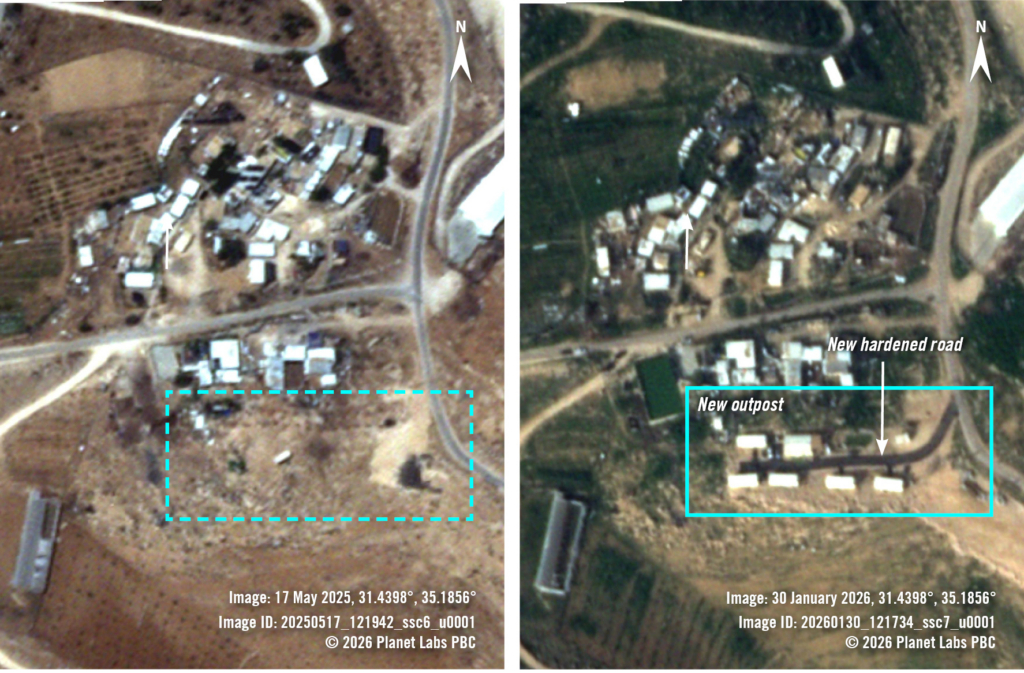
In the weeks that followed Yinon Levi’s release from house arrest, he continued to harass Palestinian residents[411] by filming them and wandering in the village’s vicinity, including while settlers cut-off Umm al-Kheir’s electricity and water supplies.[412]
It was only seven months later that Israeli prosecutors announced their intention to charge Yinon Levi with reckless manslaughter for the killing of Awda al-Hathaleen, according to a statement published by the media.[413] However, by 15 May 2026, he had yet to be indicted. Awda al-Hathaleen’s lawyer told Amnesty International that although the prosecution had decided to indict Yinon Levi pending a hearing, no hearing date had been scheduled.[414]
According to eyewitness accounts and videos verified by Amnesty International, Yinon Levi has also been involved in harassing and physically assaulting Palestinians, trespassing on their land and attacking their livestock in Wadi Tiran and Zanuta in June and August 2024. Interviewees from Zanuta described him as leading and orchestrating the violence, stating that his role was instrumental in coercing the entire community to leave.[415]
In another example of Israeli government support for, and impunity afforded to, Israeli settlers who attack Palestinians, Moshe Sharvit, who established the unauthorized outpost known as “Tirza Valley Farm” or “Moshe’s Farm” in 2020,[416] has since then led a violent harassment campaign against Palestinian communities in the northern Jordan Valley, blocking their attempts to return to their homes or access their farmland.[417] He has continued with this violence despite sanctions by the EU, Canada, Japan and the UK, imposed between February and July 2024, for his involvement in serious human rights abuses.[418] Tirza Valley Farm was also placed under sanctions by the EU, Canada and the UK throughout 2024.[419]
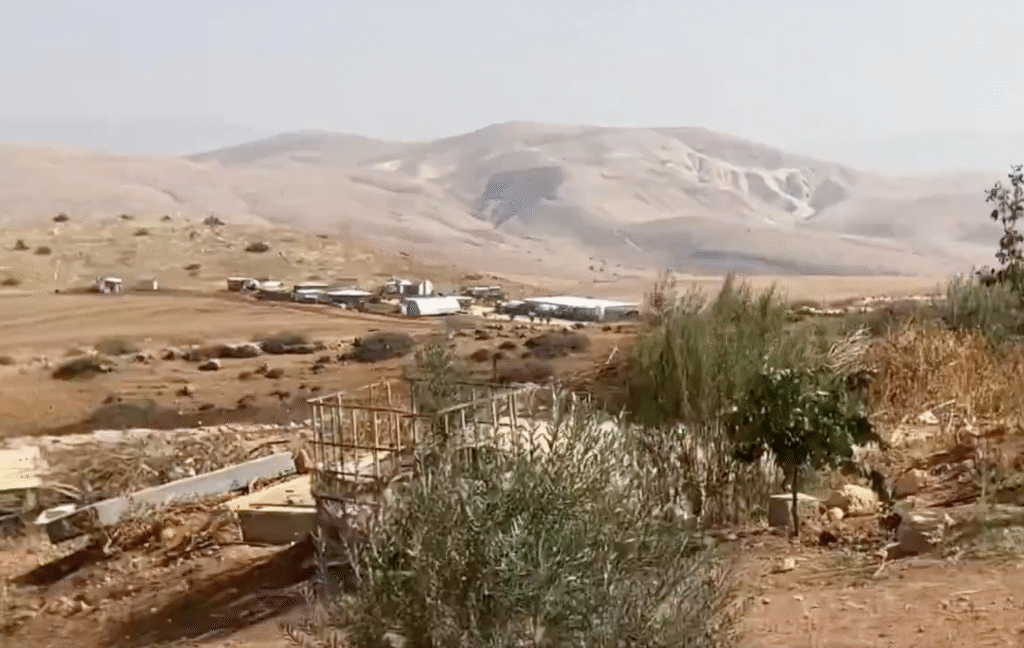
In the year that Moshe Sharvit was placed under international sanctions, he was invited by Israel’s Ministry of Settlement and National Missions to participate in an event with other settlers and government officials to discuss the expansion of agricultural outposts in the West Bank. An NIS 75 million (USD 23 million) initiative to fund security and surveillance equipment for outposts was launched at the event.[420]
In October 2023, Moshe Sharvit’s actions contributed to the displacement of Palestinian residents from the community of Ein Shibli.[421] For example, an older woman, who lived near the outpost, said in video interviews posted online that Moshe Sharvit threatened to burn her house down and kill her if she did not leave.[422] Her husband said that a group of five settlers, including Moshe Sharvit, beat him with sticks on his head and back, as a result of which he needed hospital treatment.[423] When the couple attempted to return to their home in March 2024, they were blocked by two settlers in a vehicle, at a metal barrier that had been erected by Moshe Sharvit, according to Palestinian residents. [424] Israeli soldiers who arrived at the scene stood next to the settlers, failing to intervene to facilitate the family’s return.
Amnesty International verified 21 videos that show Moshe Sharvit involved in many other incidents throughout 2023, 2024, 2025 and 2026 in which he prevented Palestinian farmers in the northern Jordan Valley from herding, obstructed their access to agricultural land and attacked or harassed their livestock.[425] In at least one incident documented on video involving the harassment of Palestinian farmers in July 2025, he is carrying a handgun.[426]
Some of the videos verified by Amnesty International show Moshe Sharvit engaging in acts of violence against Palestinians and their property in the presence of the Israeli army. In addition, in at least one video, a soldier is referring to Moshe Sharvit as the authority over access to land and pasture in the area.[427]
Despite extensive evidence and efforts by Israeli NGOs to stop the abuses, Israeli authorities have failed to investigate illegal acts perpetrated by Moshe Sharvit, or to dismantle his outpost. On 22 May 2024, Peace Now and Jordan Valley Activists petitioned the Israeli Supreme Court to compel the state to enforce long-standing demolition orders against the illegal outpost.[428] The petition noted that since its establishment, the outpost had served as a hotspot for violence and daily harassment targeting nearby Palestinian herding communities, leading some families to flee. In July 2025, the Israeli Supreme Court rejected the petition.[429]
Meanwhile, in March 2025, the Jerusalem Magistrate’s Court issued a restraining order against Moshe Sharvit prohibiting him from approaching a Palestinian family near Beit Hassan following repeated threats and trespassing on private property.[430] In June 2025, the Association of Civil Rights In Israel (ACRI) and Bimkom, Israeli NGOs, petitioned the Israeli Supreme Court on behalf of 12 Palestinian farmers from Wadi al-Fari’a, claiming that Moshe Sharvit had prevented them from reaching their farmland since October 2023.[431] The petition demanded that the Israeli military authorities remove Moshe Sharvit from the West Bank, declare the farmland a closed military zone for Israelis unless invited by Palestinian residents, and protect farmers while they work. The petition argued that Moshe Sharvit repeatedly violated the restraining order while the police refused to enforce it. It also noted that Israeli soldiers routinely told Palestinian farmers to accept access restrictions imposed by Moshe Sharvit or expelled them from their land at the settler’s request, often claiming that the area was “closed” without providing any written orders.
As of 30 April 2026, the Israeli Supreme Court had not made a final decision in the case. However, on 11 March 2026, the court issued an interim injunction ordering the Military Commander in the West Bank and the Civil Administration to remove Moshe Sharvit, or anyone acting on his behalf, from the “land at the centre of the petition”, namely the Palestinian-owned agricultural plots in Wadi al-Fari’a.[432]
ACRI submitted an additional notice to the court on 10 April 2026 stating that, despite the interim order, Moshe Sharvit has continued to destroy and damage the petitioners’ agricultural land, alongside other acts of intimidation and violence.[433] These include entering home yards, damaging property, throwing stones, harassing residents at night and issuing threats to forcibly expel the families. The notice further states that uniformed soldiers have not only continued to enable the violence but have, at times, directly participated in attacks. According to the filing, they have accompanied and joined Moshe Sharvit in incidents of harassment and intimidation against Palestinians in their homes or fields, arbitrarily detained them at his request, and stood by while he destroyed their property. The notice asked the court to order the military commander to take immediate measures to prevent soldiers from assisting or cooperating with Sharvit, to investigate their actions, to remove Moshe Sharvit from the area and to provide effective protection to Palestinian residents.
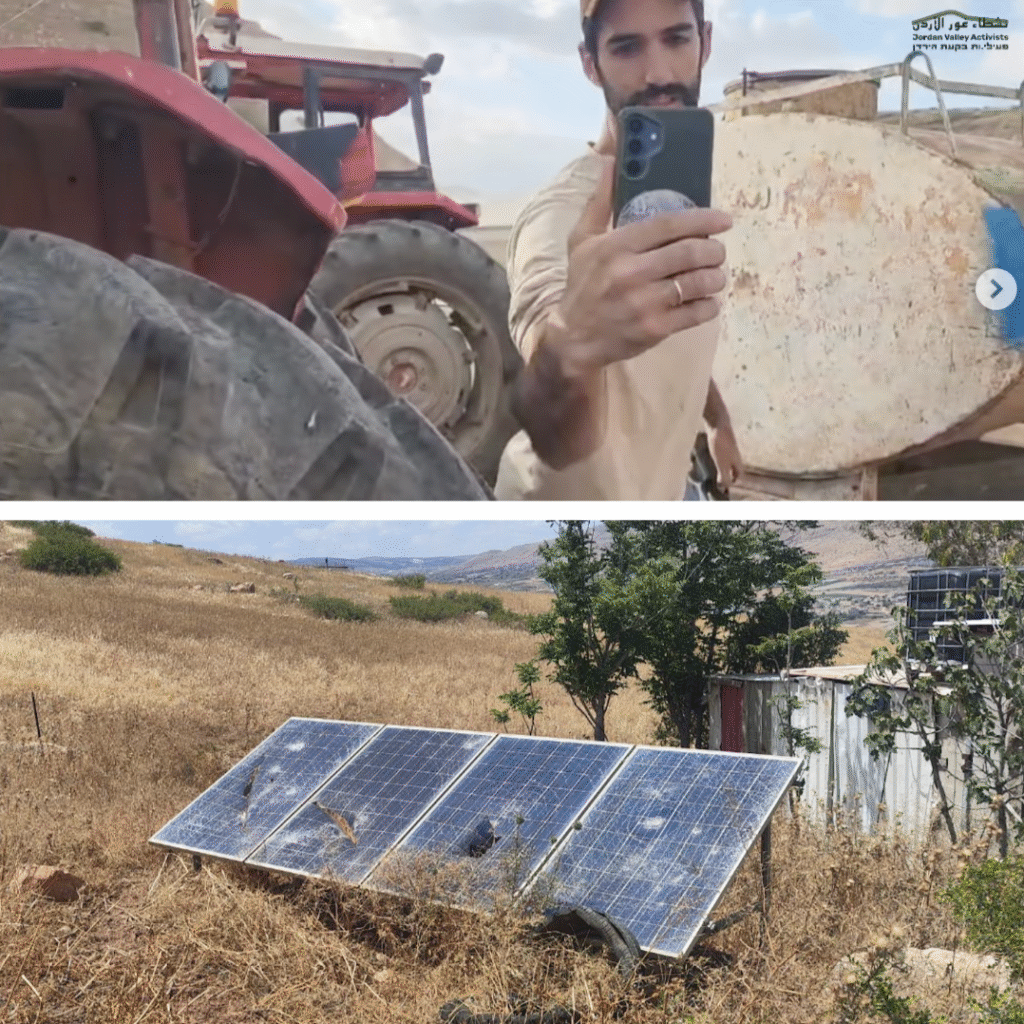
Video evidence shows that settlers continued to harass Palestinian communities in the areas around Hamra and Wadi al-Fari’a, despite these court orders.[434] On 15 April 2026, activists reported that Moshe Sharvit and other settlers harassed members of the Palestinian community in Hamra for several hours.[435] Police and military forces subsequently arrived and briefly arrested Palestinians on allegations of harassing the settlers. Those detained were released later the same evening. Another video filmed by Jordan Valley Activists on 25 April 2026 shows Moshe Sharvit and two other men walking around the Palestinian community of Hamra.[436]
According to Peace Now, Moshe Sharvit’s outpost, Tirza Valley Farm, was established in late 2020, around 1.5km southeast of the Hamra settlement. In 2021, the Civil Administration ordered all structures to be demolished, yet the outpost – which is illegal under both international and Israeli law – has continued to expand. It now includes residential buildings, a flock of sheep, and a guest lodge and event area.[437] The farm’s website states that the lodge can host up to 100 visitors and offers air-conditioned tents, sanitary facilities, a kitchen, a pool and a suite built inside a truck.[438]
Government support to settler organizations: the case of Hashomer Yosh
Across the occupied West Bank, settler organizations are leading efforts to dispossess Palestinians of their land and coerce their displacement while simultaneously increasing Jewish presence. With full backing by state institutions, they achieve their aims by exploiting laws that are inherently discriminatory against Palestinians.[439] They initiate eviction proceedings, push courts for the implementation of demolition orders against Palestinian homes and other structures, and orchestrate relentless campaigns of violence against Palestinians.[440]
Hashomer Yosh is one such organization.[441] It attracted international attention through its role in establishing outposts and the relentless engagement of its members and volunteers in acts of violence against Palestinians, many of them captured on camera.
Yet, despite clear evidence of serious abuses, there have been no known investigations into their actions. The Israeli government has continued to provide financial support to the organization while international sanctions appear not to have stopped its illegal actions against Palestinians in the West Bank.
Hashomer Yosh was established in 2013 with the stated aim of reinforcing Jewish presence in “agricultural areas” in the West Bank by providing “support to [Israeli] farmers” and “protecting state land”. In practice, this has meant fundraising and recruiting volunteers to set up illegal outposts in Area C while preventing Palestinian development, agriculture, grazing and mere presence.[442] By 2024, the organization had nine staff and 720 volunteers.[443]
Hashomer Yosh features on its website 26 illegal outposts it claims to support, including Tirza Valley Farm.[444] Video evidence verified by Amnesty International shows several incidents in Zanuta and other areas of Masafer Yatta and across the Jordan Valley in which settlers, wearing T-shirts displaying Hashomer Yosh’s logo, are harassing or physically assaulting Palestinian residents or damaging their property. Amnesty International identified Yinon Levi and Moshe Sharvit among the perpetrators of these attacks.
Three images and one video posted on X on 23 November 2022 show Yinon Levi wearing a sweatshirt displaying the logo of Hashomer Yosh while driving a bulldozer and demolishing a school in Masafer Yatta, in the presence of Israeli army personnel and the Civil Administration.[445] In a separate incident posted on X on 9 September 2024, Yinon Levi, again wearing a Hashomer Yosh T-shirt, is harassing Palestinian shepherds and seizing sheep from their flock in Zanuta while Israeli police officers are present.[446]
Two additional videos posted on X on 14 February 2024 show three settlers wearing sweatshirts with the Hashomer Yosh logo erecting fencing around Zanuta.[447] The fencing enabled the settlers to control movement in and out of the village, preventing Zanuta’s 250 residents from returning to their homes or land after they were forcibly displaced.[448]
The US administration cited the fencing-off of Zanuta as a basis for imposing sanctions on Hashomer Yosh in August 2024, before the Trump administration reversed the decision in January 2025.[449] According to the Associated Press, Hashomer Yosh provided volunteers to Meitarim Farm outpost, which was placed under sanctions earlier in 2024.[450]
On 15 October 2024, the UK government also designated Hashomer Yosh under its sanctions regime, stating that the organization “provides financial services, funds, economic resources, goods or technology while knowing, or having reasonable cause to suspect, that these may contribute to acts of cruel, inhuman or degrading treatment.”[451]
Meanwhile, the Israeli authorities have not only failed to prevent, investigate and punish these abuses, they have allowed Hashomer Yosh to openly fundraise in Israel and accept donations for its unlawful activities, in addition to providing direct state financial support.[452] Official financial records published by the Israeli Ministry of Justice show a substantial increase in the organization’s financial capacity since 2018.[453] Its annual income rose from NIS 1,669,013 (about USD 552,700) in 2019 to NIS 5,103,838 (about USD 1.7 million) in 2020, and NIS 7,252,149 (about USD 4.2 million) in 2022. According to the same official data, the organization reported revenues of NIS 5,551,283 (about USD 1.84 million) in 2024, of which state support and allowances included NIS 1,471,945 (about 512,250).[454] Of this total, NIS 748,745 (about USD 250 000) constituted support from the Ministry of Agriculture and Food Security and the Ministry of Environmental Protection.[455] Although there was a drop in state funding, in 2025 Hashomer Yosh received NIS 500,000 (about USD 168,000) from the Ministry of Agriculture and Food Security to achieve its goal of “increasing the scope of assistance activities to farmers and volunteer groups” that year.[456] In total, Hashomer Yosh has received at least NIS 10.3 million (about USD 3.2 million) in Israeli government funding since 2018, including at least NIS 3 million (about USD 1 million) since 2023.[457] The actual total may be higher because the Ministry of Justice’s financial records do not include information about possible transfers by some ministries such as the Ministry of Defense.
In addition, government ministers have provided their political support to Hashomer Yosh’s activities that have facilitated outpost growth and further dispossessed Palestinians. They did so by meeting with the organization’s staff and volunteers, and participating in their activities in the West Bank, even after Hashomer Yosh was subjected to sanctions by some states.[458] For example, in June 2024, Hashomer Yosh published a Facebook post in which it thanked Agriculture Minister Avi Dichter for “listening, for the joint thinking, and for the resources dedicated to supporting agricultural volunteering” following a meeting with him and other Israeli groups. In the meeting, Hashomer Yosh briefed the minister about the “amazing” growth of herding outposts, and stressed the need for increasing budgets to support volunteers to cover their costs.[459] In another Facebook post, in March 2025, Hashomer Yosh thanked the Minister for Diaspora Affairs and Combating Antisemitism Amichai Shikli for his participation in a tour of the grazing areas around the Keshuala Farm outpost overlooking Wadi Fukin, west of Bethlehem, to discuss security concerns raised by settlers.[460] According to the post, the minister subsequently held a roundtable discussion with settlers during which he expressed support for the residents and indicated his intention to assist them.
Forced displacement: three case studies
The settlers came in the middle of the night. They threw stones at our homes while our children were sleeping. They took photos of our sheep. They drove into our sheep the day before. I felt afraid for my children. I wouldn’t leave Ein Samia for the world if I knew I could keep my family and herd safe.[461]
Muhammad Ka’abneh, head of the Bedouin community of Ein Samia, explaining why his family was forced to leave after a series of nightly raids.
To illustrate how the government has used illegal outpost growth, settlement expansion, discriminatory planning and zoning policies, combined with a sustained settler violence campaign to terrorize Palestinians in Area C and drive them out of their homes, Amnesty International investigated events since 2023 in five communities: Ein Samia in the central Jordan Valley; and Zanuta in the South Hebron Hills, both of which were fully displaced in 2023; and a cluster of small communities in the northern Jordan Valley that have faced increased pressure and risk of displacement since 2023. The communities at imminent risk of displacement as described below are Al-Farisiya, Ein Al-Hilweh and Makhoul.
Ein Samia
“The settlers started coming day after day. They overturned the water tanks, harassed the young men, and come both during the day and at night. We can’t breathe any more. We are never at ease, neither by night nor by day. I am an old woman—by God, I do not sleep. I stay sitting on a chair. If they come, they spare no one.”
“Rahma” – mother of 14, displaced from Ein Samia
Ein Samia is a natural spring in Al-Qabboun meadow, located on Kufr Malik land in Area C, north-east of Ramallah.[462] For generations, farmers and livestock owners from Kufr Malik relied on the water source and fertile land, often spending extended periods in the area tending to their flocks and fields.[463]
In the early 1980s, a Bedouin community, which later became known as the Ein Samia Bedouin community, settled in the area following repeated forced displacements by the Israeli military. They were first displaced from the Negev/Naqab in southern Israel shortly after Israel’s creation in 1948, when Israel ethnically cleansed hundreds of Palestinian towns and villages in what is known to Palestinians as the nakba (catastrophe); then from Ras Ein al-Oja, and after that, from Ras al-Mu’arrajat.[464] Similar to other Bedouin communities in the West Bank, many of whom are 1948 refugees, and due to Israeli restrictions on movement and access to grazing land, the Ein Samia community was forced over the years to give up on its semi-nomadic lifestyle. Instead, community members remained in one location where they found grazing land and water sources. They settled in the area in agreement with the Palestinian landowners from Kufr Malik, attracted by the grazing land and the nearby water source.[465]
Ein Samia became a vibrant area over four decades, developing close bonds with the nearby villages. It consisted of 37 families, totalling approximately 200 people, while dozens of farmers and livestock owners from Kufr Malik and other villages continued to work or reside in the area. [466] As one livestock owner from Kufr Malik said:
“In summer evenings, the atmosphere was festive. There would be hundreds of us in Ein Samia. Families having barbeques, others collecting herbs. People from Al-Mughayyir, Al-Mazra’a al-Sharqiyya, Yatta would all be there working the land and herding, or simply enjoying a picnic.”[467]
“Salman” (name changed for security reasons), another resident, explained how starkly this contrasts with the community’s new reality:
“Last Friday, [23 February 2024], the Israeli settlers brought their children to play in the field where we used to take our kids to breathe and play in the spring. Today, it’s the settlers who go there and play. They tell you: absolutely forbidden.”
Growth of illegal settlements and outposts
The land on which Ein Samia was established is hemmed in by an Israeli designated nature reserve and a military “firing zone” to the east and southeast – where Palestinian construction is prohibited – and the Allon Road to the west. This left no room for further development for the community.
The Israeli settlement, Kochav HaShahar, which was illegally established in 1977, sits atop a hill less than 2km south of Ein Samia. Over the years, the Israeli authorities have expanded it significantly, allowing its population to grow to more than 2,600 people by May 2024.[468]
In parallel, since 1999, Israeli settlers set up at least seven unauthorized outposts with roads connecting directly to Kochav HaShahar, increasing Jewish presence and control of resources in the area.[469] By 2023, there were 10 outposts in the wider area surrounding Ein Samia; this number grew to 12 in 2026. Satellite imagery analysed by Amnesty International in October 2025 shows outposts to the north, south, west and east of Kochav HaShahar, with the closest located less than 1km from Ein Samia, sitting on the hillside overlooking the Palestinian community. Two more outposts surround Ein Samia on hills to the north and east, both less than 1.5km away, with the most recent one constructed in 2025. Satellite imagery clearly shows the expansion of most other outposts with new roads and structures appearing between 2023 and 2025.
In December 2025, Israel’s security cabinet decided to legalize one of the outposts in the area as a new settlement, called Kochav HaShahar North, as part of a move to establish 19 new settlements in the West Bank.[470] Satellite imagery examined by Amnesty International showed that new land clearing at the Mizpe Kramim North outpost had already begun in April 2025, before the December 2025 decision to legalize Kochav Hashahar North. As of 8 February 2026, imagery shows over 10 new permanent looking structures and a hardened road. Based on the shifts visible in imagery, this is suspected to be the location of the new settlement, Kochav Hashahar North.
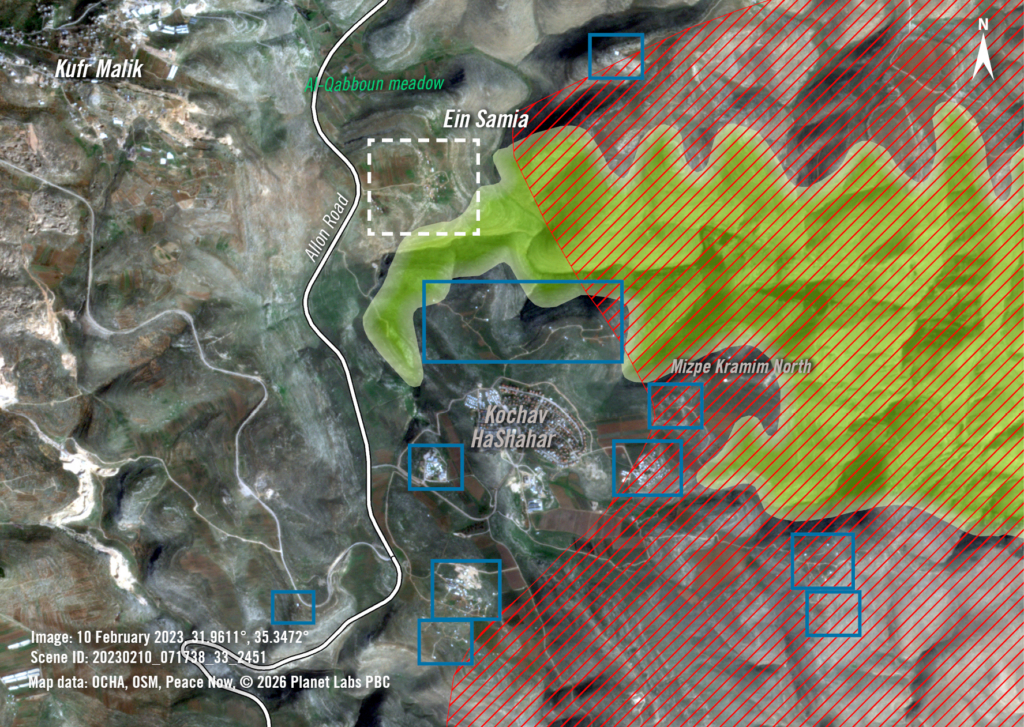

Ein Samia spring and wells have long sustained farming in Al-Qabboun meadow and supplied water to 19 Palestinian communities.[471] The meadow, spanning 2-3km, has been essential to the agricultural self-sufficiency of several Palestinian communities in addition to Ein Samia, including the village of Kufr Malik.
The communities cultivated crops including vineyards, za’tar (herbs), olive groves, chamomile, wheat, barley, clover, lemons, avocados and guavas, in addition to vegetables such as cauliflowers, cabbages, eggplants and peppers.[472] The meadow has also served as a green grazing area for livestock.[473]
The expansion of Kochav HaShahar and its surrounding outposts has severely restricted Palestinian access to farming, grazing areas and water sources.[474] While settlers move freely throughout the area, Palestinians are restricted from using roads and paths surrounding the settlement and outposts, limiting their access to the spring.
They have also suffered from the land appropriation for the construction and use of settlements and outposts. At the same time, escalating settler attacks, which started in 2019, have confined Palestinian shepherds and Bedouins to a fraction of the grazing land, with settler shepherds gradually extending their control over the territory.
By June 2022, according to Kerem Navot, herding settlers had effectively established full control over the Ein Samia area, herding there freely, while preventing Palestinian shepherds from accessing it.[475]
Today, Israeli settlers prevent Palestinians from accessing the meadow through intimidation and violence, leading to its extensive degradation. Interviewees from Kufr Malik told Amnesty International that settlers from nearby outposts routinely attack farmers and shepherds who access the area. Muntasir al-Maliki, a resident from Kufr Malik, who used to herd his sheep in the hills between Kufr Malik and Ein Samia, explained:
“They [the settlers] don’t provide a legal claim [why Palestinians should not be there], they simply start beating, throwing stones and shooting.”[476]
The economic impact has been significant. Palestinian livestock owners told Amnesty International in interviews that they now have to buy feed and water for their shed-confined sheep, which produce less milk.
“Hilmi,” a 59-year-old displaced livestock owner, said his income has been so reduced that he has considered selling his sheep:
“I have to borrow money in order to buy feed and water for my sheep. It’s so costly that I have considered selling my herd 50 times, but I cannot. This is the only profession I know.”[477]
Demolition orders, restrictions on grazing, and fines
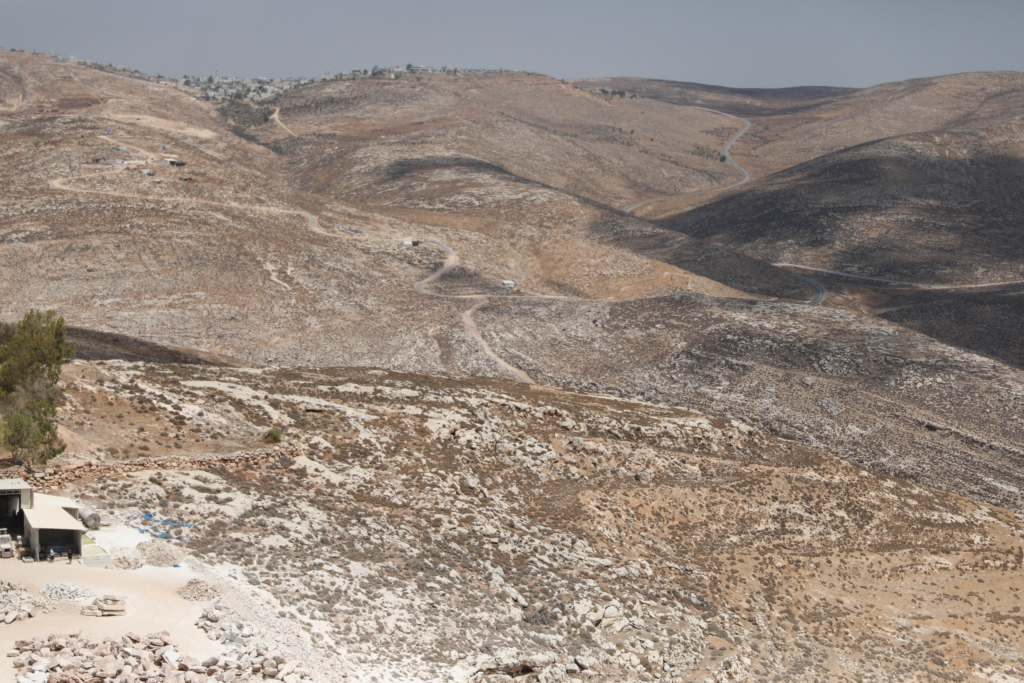
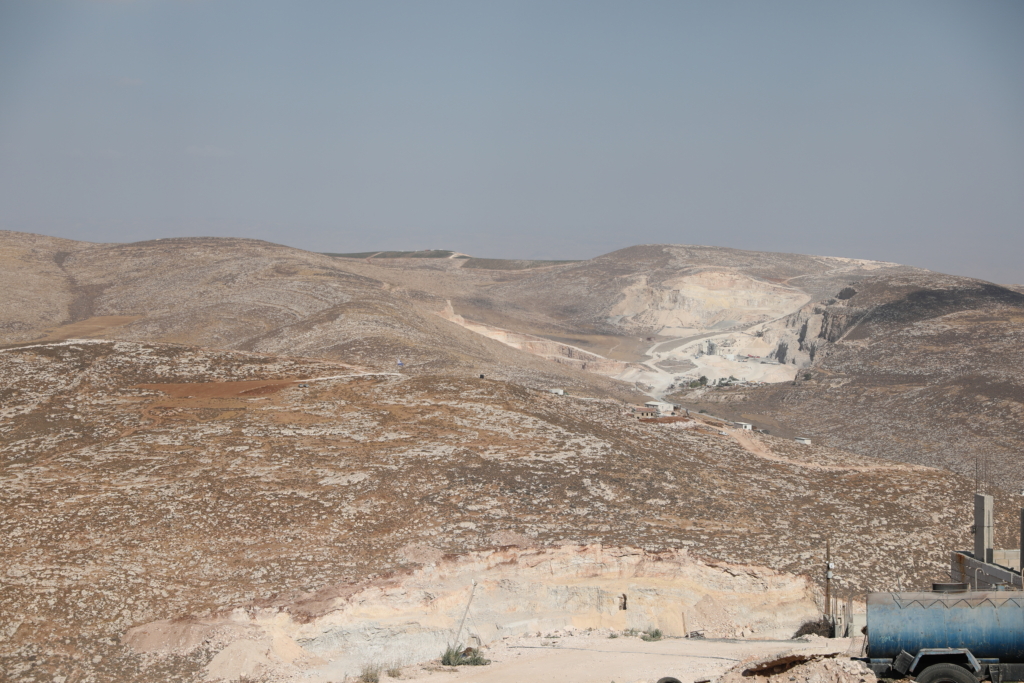
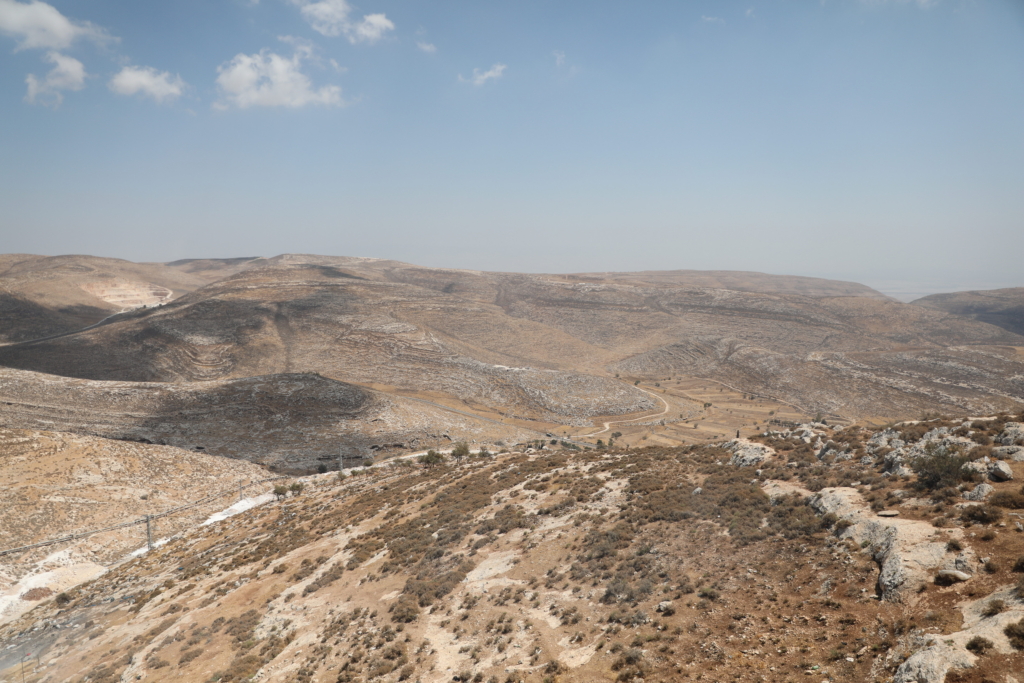
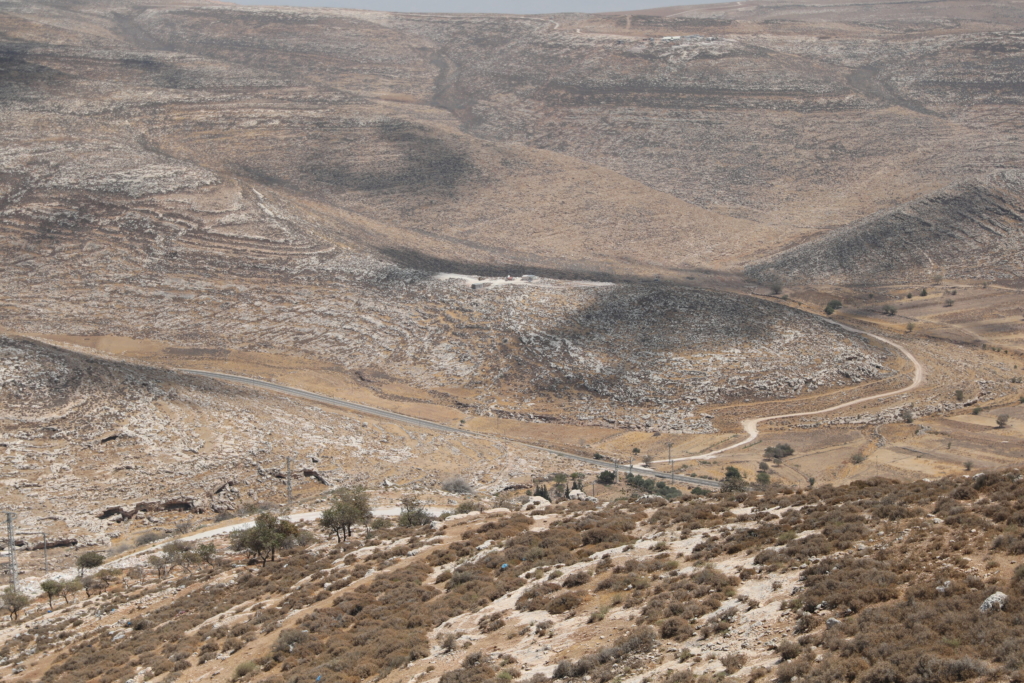
Four images of the landscape surrounding Ein Samia which show roads and outposts recently built by settlers, including in the proximity of Palestinian quarries. 28 August 2025. © Amnesty International
In addition to restrictions on herding and grazing, the Bedouin community in Ein Samia has long faced demolition orders for unlicensed building.
These orders are issued by the Civil Administration based on discriminatory Israeli planning policies, which make it virtually impossible for Palestinians to obtain building permits.[478] According to the Jerusalem Legal Aid and Human Rights Center, which assists the community with legal services, the Civil Administration issued 31 such demolition orders between 1995 and 2025,[479] leading to the demolition of 18 structures since 2019, the most recent just four months before the community’s forced displacement in May 2023.[480]
In addition, the Civil Administration and Israeli police frequently imposed fines and bail fees as high as NIS 20,000 (around USD 6,000) against herders for grazing on land designated by the Israeli authorities as state lands, and threatened to confiscate residents’ sheep.[481] Not only did these fines impose a huge financial challenge to an already impoverished and marginalized community, they also deterred shepherds from returning to their usual grazing areas, forcing them to find alternatives.
“Salman” (name changed for security reasons), a resident from Ein Samia, described how his relatives were assaulted by settlers and received a huge fine from the Israeli Civil Administration for grazing in a restricted area:
“They attacked my cousin’s family, beat him and his wife up, and arrested his sons for allegedly grazing in forbidden areas. He had to pay 20,000 shekels (USD 6,000) to bail his sons out. People don’t have these amounts of money.”
Settler violence and forced displacement
As unauthorized outposts expanded and demolition threats mounted, settler violence also intensified. Eight residents displaced from Ein Samia told Amnesty International that settler attacks had escalated drastically in recent years, becoming regular in 2019.[482] They involved physical assaults inside the village and in grazing areas, threats to use violence, harassment, vandalization and destruction of property, and theft of sheep and goats. Interviewees said that settlers came in large groups, sometimes in their dozens, often accompanied by Israeli military forces.[483]
On 22 May 2023, the Bedouin community decided to leave Ein Samia after being subjected to a series of daily attacks by settlers, enabled by Israeli security forces, in which settlers vandalized and stole property, threw stones, intimidated residents by flying drones and taking pictures, entering and driving around the encampment, and attempting to seize their animals. Only two families of livestock owners from Kufr Malik remained in their tents in Ein Samia. In May 2024, after a year of relentless violence, they also fled.
A mother of 14 children who fled Ein Samia to the outskirts of Kufr Malik told Amnesty International that in May 2023, settlers started attacking the community every day, emptying water tanks on the ground, threatening youths and assaulting people in their homes.[484] “Khalil,” a father of seven children, described how on 15 May 2024 settlers raided his family’s tents, taking all their property. He said:
“They dismantled our tents and stole them, the poles, the shades, everything! They took my water tank and trolley and stole my brother’s car and chased us out of there across the highway.”[485]
According to another resident, settler violence created far more fear in the community than the years-long pressure by the Civil Administration. He explained:
“When the Civil Administration used to demolish our homes, we used to find shelter in caves and manage, but when the settlers started attacking us, we did not feel safe at all. I decided to leave because I feared for my family, myself and my sheep.”[486]
Amnesty International analysed 33 videos that had been posted on X, Instagram, YouTube and Facebook between 1 January 2023 and 1 September 2025, documenting the displacement of Palestinian residents from Ein Samia in May 2023, settler attacks and damage to critical infrastructure in the lead up to, and aftermath of, the displacement. The videos also show the expansion of settlements and military infrastructure around Ein Samia.
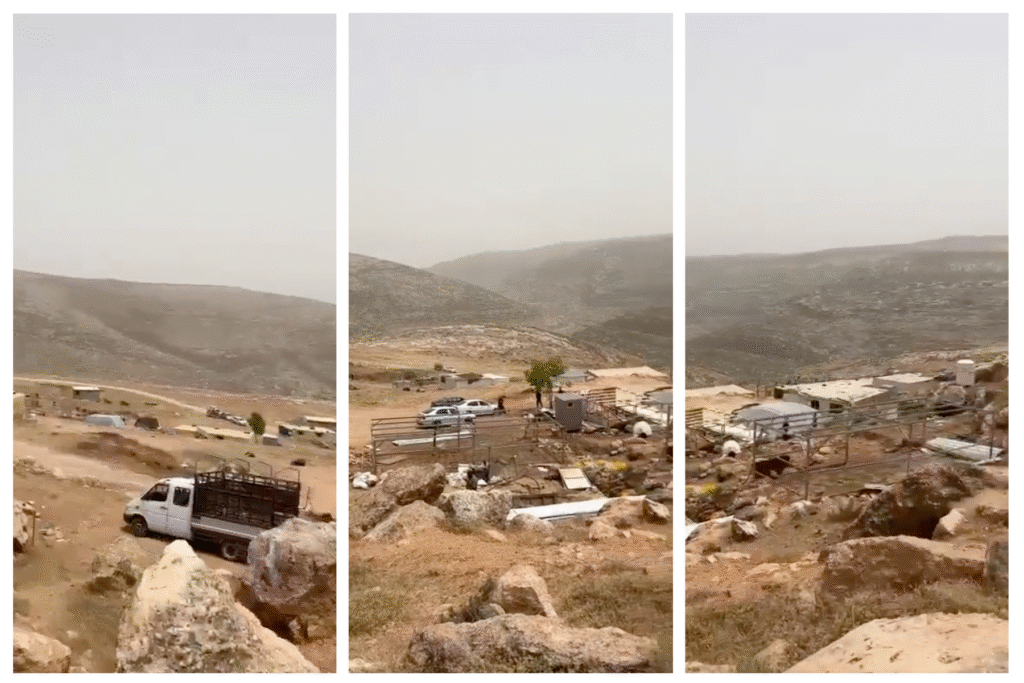
Six videos verified by Amnesty International show residents packing their belongings, dismantling their homes, loading them onto trucks and collectively leaving the area.[487]
They were forced to relocate to the outskirts of Ramallah villages such as Kufr Malik, Al-Mughayyir, Abu Falah and Al-Taybeh, or to the Nuwei’meh area in Jericho.[488] Meanwhile, fewer Palestinian farmers from Kufr Malik tried accessing the pastureland out of fear of settler attacks.
Preventing the community’s return
Since the forced displacement from Ein Samia, both the Israeli authorities and settlers have taken steps to prevent the community from ever returning.
In August 2023, three months after almost the entire community was forcibly displaced, the Israeli Civil Administration demolished Ein Samia’s school[489] after the Israeli Supreme Court rejected the community’s fourth appeal against the demolition order in April 2023.[490] A verified video posted on X on 17 August 2023 shows a bulldozer demolishing the school’s metal structure just days before the start of the new school year.[491]
The community had built the school in January 2022 using EU funding, which they hoped would help them secure a building permit and protect them from displacement.[492] However, the Israeli authorities rejected the permit request on the spot, according to the community’s lawyer.[493] For many residents, the school’s demolition was a reason not to even attempt to return.
Interviewees told Amnesty International that in cases where residents returned to cultivate the land, they faced renewed settler attacks and arrests by the Israeli military. For example, in 2024, Israeli soldiers arrested an 83-year-old Palestinian woman in Ein Samia while she was picking her za’tar crops, telling her she was banned from cultivating her land.[494]
In addition, since 2024, Ein Samia’s wells have suffered increased settler attacks.[495] CCTV footage published by Palestinian media and verified by Amnesty International shows a man in a balaclava and green clothes trespassing in the Ein Samia water station around midnight on 13 July 2025.[496]
Seven days later, the Jerusalem Water Undertaking, a Palestinian organization, announced that it was forced to halt operations due to escalating attacks by Israeli settlers on critical infrastructure. According to the agency, it had lost all technical and administrative control over the water system following direct assaults on pumping equipment, communication systems, electrical networks and surveillance cameras.[497] Recurring attacks by settlers on the Ein Samia water station have interrupted and at times halted the water supply to almost 100,000 Palestinians in around 20 communities.[498]
Settler attacks on the Ein Samia water station continued throughout 2026. CCTV footage from the Jerusalem Water Undertaking shows multiple incidents, including a settler damaging a water pipe on 27 January; settlers breaking into the Ein Samia pumping station on 7 February and damaging offices and equipment; and on 11 February, a settler using what appears to be pepper spray against Palestinian workers.[499]
Continued settler violence and violations by the army after displacement: attacks against Kufr Malik
Settler violence extends beyond Palestinian Bedouin and herding communities to occupied East Jerusalem, as well as built-up villages and towns across areas A and B of the West Bank.[500] Among other abuses in these areas, settlers have assaulted Palestinian residents, causing injuries and deaths;[501] torched homes, cars and other property; uprooted olive trees; and blocked roads.[502]
After settlers forcibly expelled the Ein Samia community in May 2023, and terrorized farmers and shepherds from Kufr Malik into avoiding the water spring, farmland and grazing areas, the attacks did not stop. Kufr Malik residents reported that settlers continued to attack them and steal their sheep, often in collaboration with the Israeli army, while they were herding just outside their village. They said the violence was clearly intended to prevent both them and the Ein Samia community from accessing and using the land, much of which lies in Area C.
One resident recounted his experience of an assault against him in July 2025:
“For almost a year, I didn’t cross the highway [Allon Road]. They [the settlers] used to harass me and other shepherds, and we’d try to avoid them, but then the army started showing up and protecting them, shooting in the air and harassing us. On 8 July 2025, I was herding my sheep in the mountain when six settlers – two of them armed — attacked me. I escaped miraculously. If they had caught me, they’d have beaten me up or worse… They took all my 80 sheep, and I couldn’t protect my herd no matter how hard I tried. I’m left with nothing but a few sheep and goats that I didn’t have with me on that day.”[503]
Settlers also attacked residents in Kufr Malik itself, signalling a new level of audacity. The village is in Area B, which is under Palestinian civil authority and Israeli security control, and until then had not been as severely impacted by settler attacks. Israeli forces not only failed to protect Kufr Malik’s residents, but also joined the attack, using apparently unlawful force, killing and injuring Palestinians.
On 23 June 2025, the Israeli military shot and killed 14-year-old Ammar Hamayel from Kufr Malik while he was with a friend close to a bypass road near Al-Hara al-Fauqa (the upper neighbourhood).[504] Kufr Malik residents told Amnesty International that two days later in the same neighbourhood, in the evening, Israeli settlers started throwing grenades at Palestinian homes and torching them.[505] Video evidence corroborates witness accounts. In a video recorded around 7:40pm in the southern part of the village, the person filming is shouting, “They set the houses on fire… call the fire brigade” as at least one structure appears to be on fire and thick smoke rises from two or more directions.[506] In another video filmed around the same time, further along the same road, plumes of smoke and flames rise from the direction of a house.[507] Several Palestinian men are gathered along the street. Then, an armed man comes into view at the far end of the street and moves into a firing position. Gunfire is heard, prompting the Palestinian men to scatter and take cover. Two other videos filmed on nearby streets around the same time show two cars burning and residents running.[508]
According to the residents interviewed by Amnesty International, Israeli soldiers were initially standing by and watching. They said that soon after, the soldiers joined the attack and started firing tear gas and live ammunition at the residents.[509] Muntasir al-Maliki, who was present during the events explained:
“When the settlers saw that a big number of people came to defend the village, they retreated behind the soldiers who stepped in and started shooting at us. They killed three young men. One of them, Murshid, was trying to put out the fire that the settlers started in his home and to evacuate his mother and children when a soldier shot him. Muhammad was shot in the back, Lutfi in the chest. There was shooting and tear gas everywhere.”[510]
A video filmed around 7:50pm, approximately 300 metres from the locations of the fires, which was verified by Amnesty International, shows a Shaldot David armoured vehicle commonly used by the Israeli army, a truck and a red car on a road leading to Road 449.[511] Eight men in black tops, with their heads covered, stand near three uniformed soldiers who are moving around the vehicles. At least one soldier appears to be raising a handheld object towards an off-screen target, followed by what sounds like a gunshot. At one point, someone is heard shouting in Arabic, “He’s shooting to hit!”
In another video, filmed later that evening inside Kufr Malik, close to the mosque, Israeli forces are firing tear gas unlawfully into a residential area, where there was no visible presence of any individuals on the streets or of violence.[512] The video shows Israeli soldiers using Venom, a multiple-barrel grenade launcher mounted on vehicles, which does not allow precise aiming, as required by UN guidance on the use of less lethal weapons,[513] and is known for delivering excessive quantities of chemical irritants that can result in serious injuries and, in some cases, death.[514]
At least 10 people were injured during the events,[515] with several of them sustaining gunshot wounds. Three men aged between 18 and 35 were killed: Lutfi Tarshan, Muhammad Ibrahim and Murshid Hamayel.[516] In an official statement, the Israeli army said it intervened in Kufr Malik, together with police forces, to stop confrontations between Palestinian and Israeli citizens that involved stone throwing after Israelis had set property on fire. The military justified the use of live ammunition by claiming that several individuals “fired from deep inside the village and threw stones at the forces” prompting it to respond.[517]
Amnesty International could not identify any firearms or other weapons among Palestinian residents in the publicly available footage. The only incident captured on camera showing Israeli soldiers firing what appears to be gunshots occurred close to Road 449, which is around 300m from the village. This undermines the army’s claim that they were responding to shots fired from “deep within the village”. One video shows a group of Palestinian men throwing stones at Israeli military vehicles after they entered the village near Road 449, later that night.[518] However, under international human rights law and standards, lethal force can only be deployed when there is an imminent threat to life; its use is not a proportionate response to stone-throwing.
Zanuta, South Hebron Hills
“The settlers were armed and kept attacking us. We were the last family there. Everyone else had left, so we had to leave as well, for the safety of our children and livestock. We were afraid, it was terror.”[519]
Adel al-Till, a Palestinian man displaced from Zanuta
Between 27 October and 1 November 2023, all residents of Zanuta packed up their belongings and fled the village where their ancestors had settled in the 19th century.[520] They fled after a series of violent raids by settlers from a nearby outpost, which started after 7 October 2023. Before the expulsion, Zanuta was home to some 250 residents, including around 100 children.[521] It comprised 36 homes and several dozen sheep shacks and chicken pens.
Zanuta lies in Area C at the edge of the West Bank, in the hills south-east of Hebron. It was built on an archaeological site on privately owned Palestinian land belonging to residents of the nearby city of Al-Dhahiriya as well as several families from Zanuta.[522] Israeli authorities designated as state land the vast open areas surrounding Zanuta that were historically used for grazing and farming by the village’s shepherds, while allowing farming activity by settlers there*.[523]
Four settler outposts stretch within 3km from the village, the closest of which is Meitarim Farm, located less than 1km away, in the Meitarim Industrial Zone, according to satellite imagery analysis. There are also two settlements in the vicinity, including Tene Omarim to the west and Shim’a to the north-east. Both settlements, established in the 1980s, are within the jurisdiction of the Har Hevron Regional Council,[524] whose headquarters are within the Meitarim Industrial Zone. According to its website, the Har Hevron (Mount Hebron) council provides services to 22 settlements, including settler outposts, south of Hebron.[525]
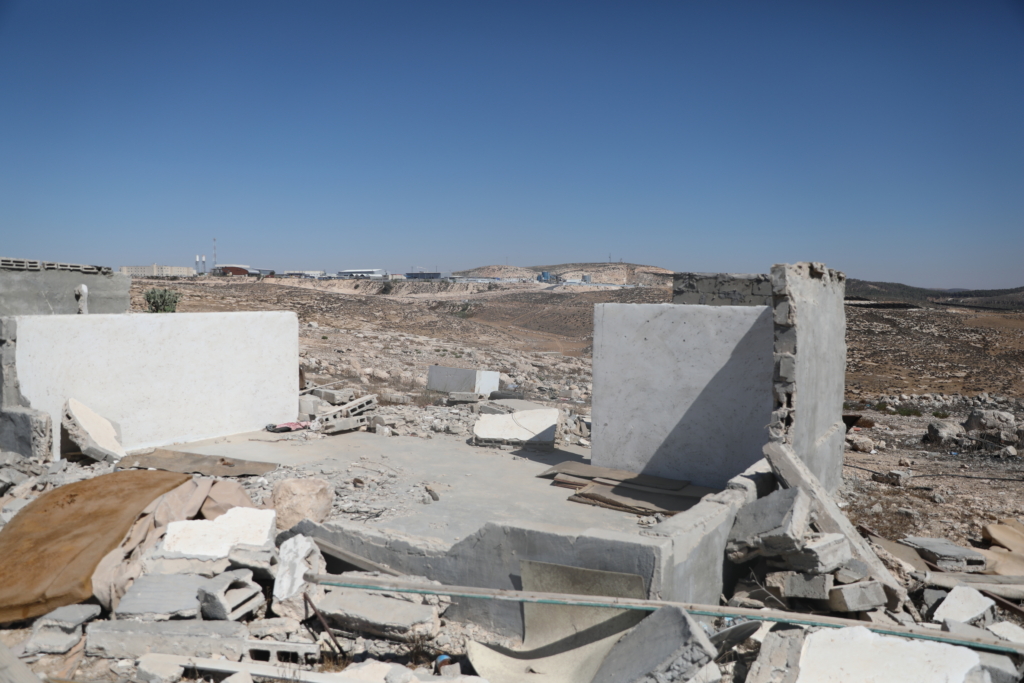
For decades, Zanuta’s residents lived in caves in the village, onto which they built stone entrances. They relied on livestock herding, dairy production and agriculture. In the 1980s, they began erecting tents and building stone houses and temporary tin structures. In 2007, the Civil Administration issued demolition orders against most structures in the village on the basis that they were built without permits.[526] Israel’s apartheid regime makes such permits nearly impossible for Palestinians to obtain, and in this case the lack of an Israeli master plan for the area made them even more unattainable.
Zanuta’s residents appealed the demolition orders, marking the start of a long legal battle for their right to remain on the land. From 2011, pressure on Zanuta intensified due to the settler organization Regavim’s[527] petitions to implement the demolition orders.[528] These petitions cited the area’s designation as an archaeological site as grounds to displace the community and prevent any construction. By October 2023, there were standing demolition orders against most homes, as well as the caravans used by the village council and clinic.[529]
In 2021, the Har Hevron Regional Council signed a contract with Yinon Levi entrusting him to establish a farm inside the Meitarim Industrial Zone which falls under the council’s jurisdiction. The aim behind the farm was clear: to seize surrounding areas designated as state land by Israel, and prevent Palestinians from using them. The contract clarified that the farm was to “maintain presence in the area and thereby assist in preserving state lands and preventing unauthorized takeovers of surrounding lands.”[530]
This marked the beginning of a prolonged and steadily intensifying wave of settler attacks against Palestinians in Zanuta. The severity of these attacks and Yinon Levi’s leading role in them were grounds for an asset freeze and travel ban imposed by some foreign states against him and the illegal outpost of Meitarim Farm which he founded.[531] Meanwhile, the contract between the Har Hevron Regional Council, Yinon Levi and Meitarim Farm has remained unchanged, with the council publicly expressing its support to Yinon Levi even after he was placed under sanctions.[532]
Adel al-Till, a Palestinian displaced from Zanuta, told Amnesty International that soon after establishing his farm, Yinon Levi started blocking Palestinian shepherds while herding, telling them they could not herd on state lands: “Since Levi put his first trailer and brought the first few sheep, his farm has been expanding. Now he has around 200 sheep and many people working in the farm.”[533]
Amnesty International carried out two visits to locations where displaced Zanuta residents had fled, and interviewed four men and two women, some of them more than once. The research team also visited Zanuta itself. All six interviewees reported personal experience of settler violence. Amnesty International also interviewed a lawyer from Haqel, the organization representing Zanuta residents in their legal proceedings, and reviewed court documents, videos, maps and satellite imagery.
According to interviewees and video evidence,[534] Yinon Levi and other settlers from Meitarim Farm repeatedly harassed Zanuta’s residents by grazing their sheep on the village’s agricultural lands,[535] causing extensive damage to crops, with no measures taken by Israeli law enforcement officials to prevent these incursions despite repeated complaints by residents. Zanuta’s lawyer told Amnesty International that between 2021 and 2023, Haqel helped the community submit 11 complaints to the Israeli police, to which they received no replies.[536]
*This sentence has been amended for clarity to indicate that Israeli authorities permitted settlers to carry out farming activities in the areas surrounding Zanuta.
Surge in settler attacks following 7 October 2023
Following 7 October 2023, settlers intensified their violence and started attacking people inside the village. According to one resident, “Yinon Levi came with many others, some of them armed, and sowed terror among the community.” He explained that tactics by settlers changed overnight from harassing residents while they were grazing animals outside the village, which they had experienced since 2021, to attacks inside the village with armed settlers shooting in the air and taking away the sheep of Palestinian shepherds.[537]
Amnesty International analysed 42 videos and images posted on X, Instagram, YouTube and Facebook between 1 January 2023 and 1 September 2025 that document physical attacks and other forms of settler violence against the community. The visual evidence shows the demolition of, and damage to, homes and community structures, as well as water wells and solar panels that are indispensable to the community’s survival. The videos also contain evidence of attacks on residents while tending their animals, including stealing flocks and obstructing grazing in surrounding areas. In several videos, Israeli police officers or soldiers are present but take no action to prevent settlers from harassing or harming Palestinians or their animals.
Zanuta residents told Amnesty International that settler attacks had already been increasing during the first nine months of the coalition government’s rule. However, following 7 October 2023, the frequency and severity of the attacks escalated dramatically, with incidents occurring almost daily. Residents described how settlers set fire to property, such as tents and classrooms in the village school, broke into their homes, beat them with rifles and deliberately pumped sewage onto their farmland. They said that the horror was relentless. “Marwa,” a mother of two, described a night-time raid in the days that followed 7 October 2023 in which settlers assaulted her children:
“Settlers attacked us at our home more than once after 7 October 2023. Once, Yinon Levi broke our door and beat our children with their rifles. He broke the windows as we were sleeping.”[538]
Then, on 21 October 2023, settlers from Meitarim Farm, accompanied by Israeli forces, raided the village, threatened to harm residents and demanded that they all leave.[539] The next day, the community sent a letter to the Israeli police, demanding protection from settlers and expressing fear of displacement.
Once again, there was no reply and no action by the Israeli police, and settler attacks continued. According to B’Tselem, on 23 and 24 October, settlers trespassed into people’s homes in the village, threw stones at residents, smashed solar panels and windows, and emptied water tanks.[540] Verified videos and images from 27 October show Zanuta’s residents loading their belongings onto trucks and other vehicles, dismantling their homes, and leaving the village.[541]
By 1 November, the entire community had left out of fear for their safety. Residents displaced from Zanuta sought refuge in Al-Dhahiriya and surrounding areas, where they were still living at the time of publication despite numerous attempts to return.
Blocked attempts to return
Following the community’s expulsion, there was a series of attacks seemingly aimed at rendering the village uninhabitable so that residents would be unable to return. On 20 November 2023, unknown individuals set fire to classrooms in Zanuta’s school.[542] The head of the village council told Amnesty International that following the incident, the council contacted the Israeli police who arrived and collected fingerprints. Yet, by February 2026, despite several enquiries, the community had still received no updates on the case.[543] When the council head went to the police station to ask about progress, he received a dismissive answer from an officer, who he reported as saying, “They don‘t disclose the identity of the thief to everyone who has their things stolen.”[544]
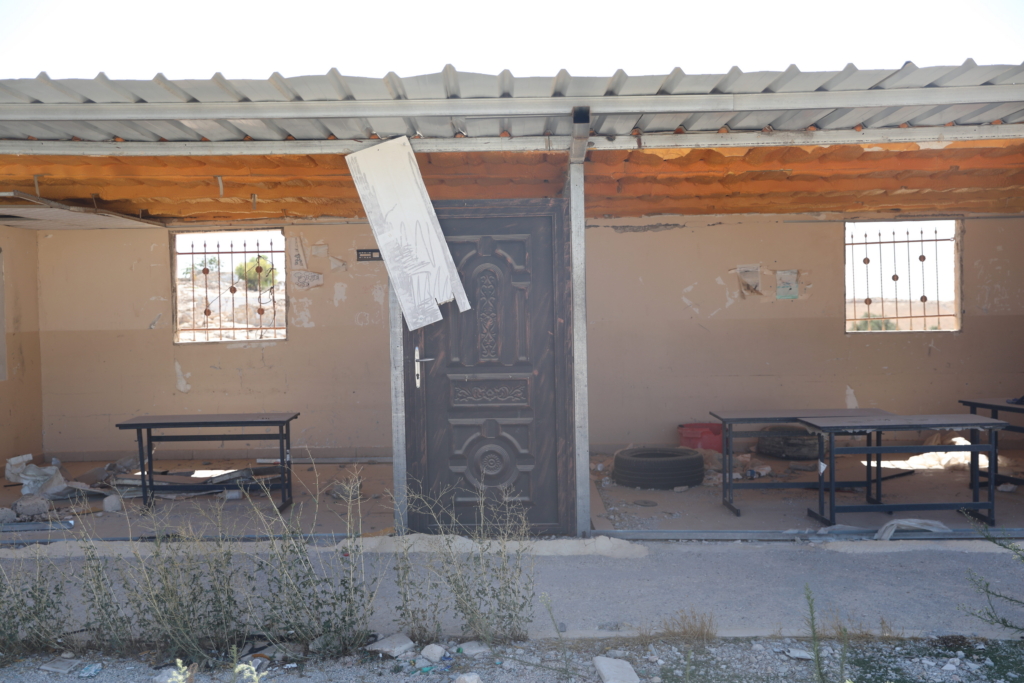
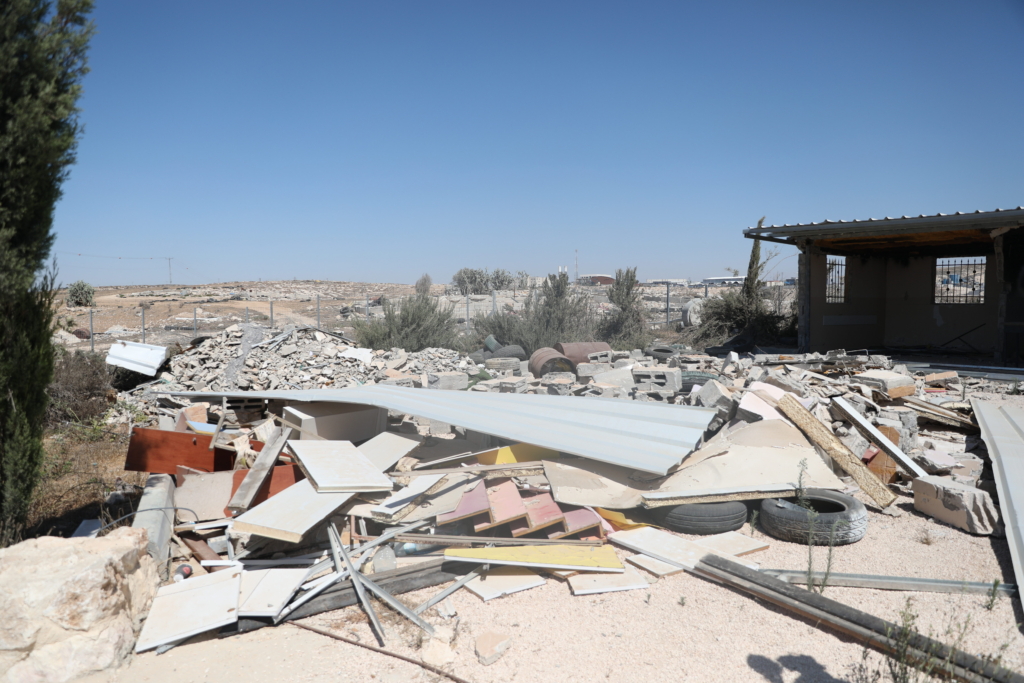
The school in Zanuta after settlers vandalized it, 28 August 2025. © Amnesty International
On 29 November 2023, scores of residents returned to Zanuta with international and Israeli volunteers to mark the international day for solidarity with the Palestinian people and work together to repair the damaged school. The village council head told Amnesty International that settlers, soldiers and Civil Administration officials had arrived and forced them to leave.[545]
Images posted on social media indicate that the demolition of the school and other structures, including the Zanuta village council, continued throughout December 2023 and during the first eight months of 2024.[546] Images posted in 2025 show rubble surrounding the remaining structures, including extensive damage to the solar panels that provide electricity to the village.[547]
Meanwhile, the community’s attempts to return to the village through legal remedies also failed, even after obtaining a court decision in its favour.
In November 2023, Zanuta’s residents submitted a petition to the Israeli Supreme Court demanding that they be allowed to return. In February 2024, while residents were still awaiting the court’s decision, settlers began erecting a fence along Route 60, effectively blocking access to the village from the main thoroughfare.[548] Verified videos show men wearing green sweatshirts bearing the logo of Hashomer Yosh[549] building the fence.[550] Photos and satellite imagery also show a new road on the hills above Zanuta, and new roads and structures in Meitarim Farm.[551]
On 29 July 2024, the Israeli Supreme Court accepted the community’s petition and stated that the Israeli police and military forces have an obligation not only to arrive as soon as possible at the scene when Palestinians report settler attacks, but also to act to protect residents. The court noted that in its reply to the petition, the state had admitted that the police are not doing enough.[552]
The court also ordered the police and military to facilitate the return of Zanuta’s displaced residents, coordinate with the community the timing of their return,[553] and protect them from settler violence.[554] However, it reasserted its 2017 ruling that prevents the construction of new structures in Zanuta, allowing residents merely to return to pre-existing structures. [555]
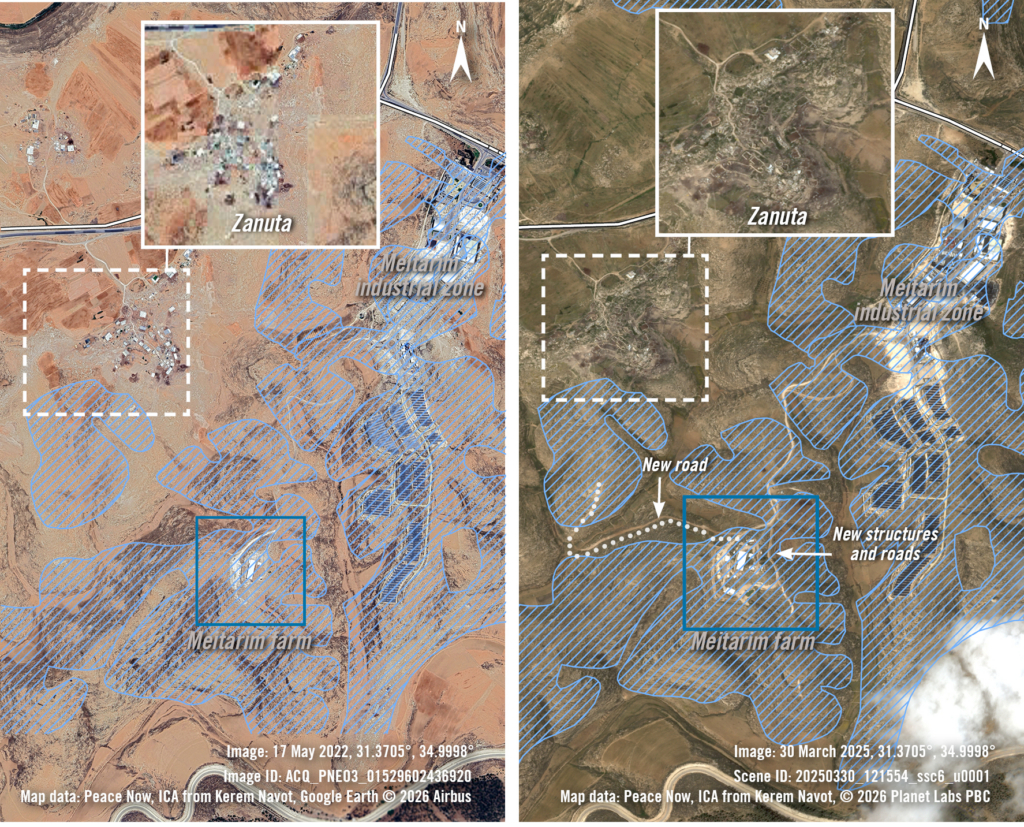
Despite the decision, the destruction of the remaining homes in Zanuta continued. Undeterred, dozens of Palestinian men and boys from the community took their sheep and goats and returned to the village on 21 August 2024.
Residents told Amnesty International that the atmosphere was festive that day. As the head of the village council put it: “It was like a wedding. We went back with our sheep. Happiness was great and it felt like the happiest day of our lives.”[556] Police forces and representatives of the Civil Administration were present in Zanuta on the day after the community had notified them of their plan to return.
However, settler harassment and violence resumed within days. According to three men who returned in August 2024, settler attacks took place every day until all the returnees fled again on 25 September 2024. The men told Amnesty International that settlers drove cars into their herds and spilled the water from their tanks. When residents called the police, they were merely told to submit a complaint. When they did so, they received no response.[557]
Community members who had returned to their homes also reported that during the first three weeks, the Civil Administration came repeatedly and confiscated any tents put up by the returnees, claiming that they were considered illegal constructions.[558]
Verified videos from 24 August 2024 show Yinon Levi and another settler trespassing on private property, entering residential areas in the village and harassing Zanuta returnees as they are grazing their animals. In the footage, they are filming residents and their possessions from a short distance.[559] The videos clearly show the settlers guiding Israeli soldiers and police officers around Zanuta and pointing out structures they claimed the returnees had built without permits.[560] Interviewees explained that they had sought to adapt their partially destroyed homes for reuse, but had not built any new structures.[561]
In the days that followed, Yinon Levi and other settlers continued to harass the villagers.[562] A video from 31 August 2024 shows him kicking their animals and riding a horse that thundered into the flock, sending the sheep darting in all directions.[563] Other videos show how settlers continuously harassed the residents by driving through their land and properties, filming them with mobile phones, and preventing their animals from grazing on surrounding hills.[564]
The vast majority of returnees eventually decided to flee Zanuta following a violent theft attempt on 25 September 2024 during which a Palestinian resident was injured. “Kamil” described the events:
“There were only 13 of us left, 10 residents and three international volunteers. And we had our herd with us. On 25 September, around 6am, a group of four settlers, one of them riding a horse, and a car with two Israeli soldiers came to us. The man on the horse went to the sheep shack and caused havoc. They wanted to steal our sheep. When the volunteers asked the soldiers for help, they refused to do anything. We had to fight them away to protect our herd. One settler hit me on my head with a stick and I was injured.”
He told Amnesty International that they called the police and although police officers came and took a photo of his injury, they did not open any investigation.[565]
On 6 January 2025, after repeated incidents in which the Israeli army and police failed to facilitate their return to Zanuta, in violation of the court’s order, the community submitted a request to the Israeli Supreme Court to determine that the army and police were in contempt of the court.[566] On 3 February 2025, the court reaffirmed its ruling allowing the community to return. It ordered the Israeli army, police and Ministry of Defense to facilitate the residents’ return by 16 February 2025. It also instructed them to remove trespassing settlers and granted residents permission to repair structures that had been destroyed.[567] Satellite imagery from 30 March 2025, analysed by Amnesty International, shows no structures in the village. Together with video and interview accounts, the imagery points to Zanuta’s total depopulation, including through extensive destruction.
Soon afterwards, the community repaired the school, but settlers vandalized it again on 27 April 2025.[568] The community interpreted this incident as a clear threat that settlers would not allow their return despite their legal victory.
Fayez al-Till told Amnesty International that throughout this period settlers from Meitarim Farm expelled him from the Zanuta area on several occasions when he tried to access the village with Israeli or foreign activists who were monitoring settler abuses. On 1 September 2025, he accompanied two Amnesty International researchers and a photographer on a research trip to Zanuta. The group was stopped by three Israeli men who arrived in an ATV. They were dressed in plain clothes, and two of them were armed. Although they did not wear military uniforms, they claimed to be soldiers and behaved as if they held official authority. They demanded to see identity cards from the team and ordered Amnesty International researchers to leave the area. During the encounter, one of the men violently pinched Fayez al-Till’s arm, calling him a “troublemaker.” Fayez al-Till recognized two of the men as settlers from Meitarim Farm.
By December 2025, most of Zanuta’s residents felt unwilling to risk the safety of their children and livelihoods, so remained displaced. One manexplained:
“[W]e insist on going back, but not with our children and sheep at risk! We can endure other losses: unjust arrests, fines, even the contamination of water wells – we’ve lived through all of that for years. But if they steal our sheep, what is left? Without any guarantee of protection from these settlers, these court decisions mean nothing.”[569]
Israeli authorities’ response to Zanuta’s displacement and continued support to Meitarim Farm
On 23 May 2026, the Israeli military’s spokesperson’s unit replied to Amnesty International’s letter enquiring about any measures taken to implement the decisions issued by the Supreme Court to facilitate the return of Zanuta’s residents and to protect them from settler attacks. It stated that “Khirbet Zanuta is a Palestinian outpost that was established unlawfully on a site with significant historical value” and emphasized the military’s intention to enforce building regulations and demolish Palestinian structures. In doing so, not only did it reaffirm its rejection of the application of international humanitarian law to the occupied West Bank, but also showed that it would continue to ignore the Supreme Court’s decision of 3 February 2025, which allows the community to repair structures that had been destroyed.[570]
The military’s spokesperson’s unit maintained that its forces “would be prepared to maintain order and security” for Palestinian residents should they decide to return to the area and that it had “secured and coordinated [Zanuta’s residents] return”. It clarified that “since then IDF troops have operated to maintain security and order in the area in cooperation with the Israel Police, which is the body responsible for handling complaints regarding law violations by Israelis”. However, it failed to provide any examples of concrete measures taken to prevent settler violence or protect Palestinians as they faced assaults and acts of harassment after attempting to return to Zanuta. In fact, interview accounts indicate that Israeli soldiers refused to intervene on at least one occasion – during a theft attempt by settlers on 25 September 2024 – and that together with settlers and Civil Administration officials, soldiers had forced some residents to leave Zanuta on 29 November 2023 after they came back to repair the school.
On 13 May 2026, Amnesty International sent a letter to the Ministry of National Security with a list of questions regarding any criminal investigations into abuses perpetrated by Israeli settlers across the West Bank, including in Zanuta, but did not receive a reply.
To Amnesty International’s knowledge, there have been no investigations into the well-documented abuses committed against Palestinians from Zanuta by Yinon Levi and other settlers from Meitarim Farm. Instead, they continued to enjoy strong political and financial backing from the government despite their role in forcibly displacing Zanuta’s entire Palestinian population and preventing them from returning.
In an illustrative example of such support, in April 2025, Finance Minister Bezalel Smotrich and Settlements and National Missions Minister Orit Strock attended a ceremony in Meitarim Farm where they handed over 19 state-funded ATVs to illegal outposts in the South Hebron Hills for stated “security purposes”, despite evidence that settlers had used such vehicles to harass and injure Palestinians, harm their animals or destroy farmland.[571] After the ceremony, during which Yinon Levi was present, according to The Times of Israel,[572] Bezalel Smotrich publicly praised settlers’ land grabs, framing this practice as part of a shared national project. In a video of the event, he explained the importance of seizing land through grazing, saying that ATVs were a necessary tool to achieve this: “The heroic and pioneering settlers who live here are doing Zionism, and they need security… and they are not second-class citizens. We are here to build with them and to settle the land.”[573]
Meanwhile, the head of the Har Hevron Council stated that there were 25 outposts in the area, each of them controlling 5,000 to 10,000 dunums of land and thanked both Bezalel Smotrich and Orit Strock for their “partnership” in enabling these land seizures. Orit Strock asserted: “We’re what you’d call combat support. You’re the real fighters for the land of Israel”.
Communities at risk of forcible transfer
“We face constant harassment by the settlers, but we will not give in. It’s about our love for our land and for our work. The land is our identity, and if we are forced out of it, we’ll die. Just like fish if taken out of water.”
Najiyyah Bisharat, Makhoul herding community[574]
Across Area C, scores of Palestinian Bedouin and herding communities face the risk of displacement as Israel advances its annexation plans.[575] These communities live in open areas where they have historically found water sources and grazing land for their flocks. In the northern Jordan Valley alone, there are 38 such communities, home to approximately 7,000 people.[576] For years, Amnesty International has campaigned against Israeli threats to forcibly evict some of them, calling on the Israeli authorities to rescind demolition and expulsion orders, return confiscated property, and end state and settler harassment.[577]
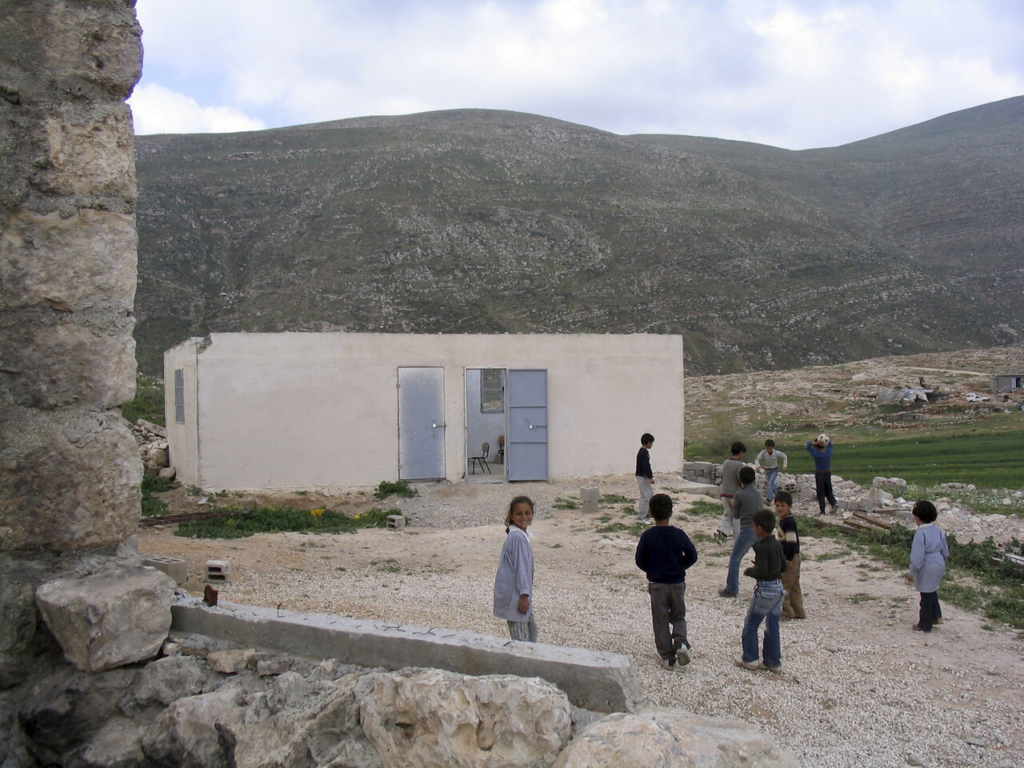
The northern Jordan Valley is located within the Tubas Governorate, which covers approximately 410km², of which 320 km² are categorized as Area C.[578]
Almost 90% of the northern Jordan Valley area has been designated by Israel as state land, closed military zones, including “firing zones”, nature reserves or archaeological sites, making them inaccessible to Palestinians.[579] Israeli authorities use these classifications as grounds for issuing demolition orders against Palestinian communities, and preventing shepherds from herding in open areas. Since January 2023, the Israeli government has classified more than 20,000 dunums (around 2,000 hectares) in the Jordan Valley as state land.[580]
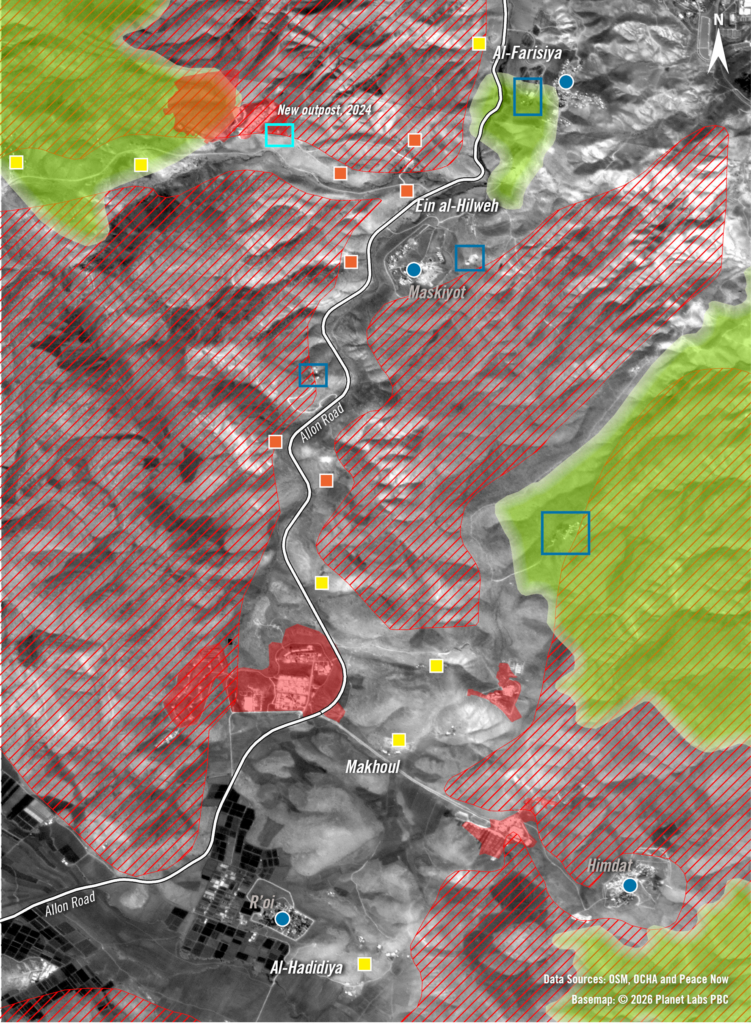
Like other parts of Area C, the northern Jordan Valley has seen a drastic expansion of Israeli settler presence and increasing state-backed settler violence aimed at displacing its Palestinian residents. By April 2026, at least 19 new settler outposts have been set up in this area,[581] most of which are herding outposts that take over huge portions of land through grazing, despite the small size of their residential areas. According to documentation by the Tubas Governorate and B’Tselem, between 7 October 2023 and 31 December 2025, settler violence led to the total or partial displacement of at least nine communities in the northern Jordan Valley, affecting at least 435 people, including 207 children.[582] The area has seen a further intensification in settler attacks since early 2026.[583]
Between February 2024 and September 2025, Amnesty International visited four communities in the northern Jordan Valley that have been under the constant threat of forced displacement: Al-Farisiya – Naba’ al-Ghazal (Al-Farisiya), Al-Hadidiya, Ein Al-Hilweh and Makhoul. Amnesty International interviewed 11 residents of these communities in person, as well as an official in the Tubas Governorate in charge of monitoring settlement activity in the northern Jordan Valley, in addition to five protective presence activists, and five representatives of human rights organizations that work in the area. The team also reviewed maps, satellite imagery and official Israeli documents.
In addition to unauthorized outposts, nine settlements[584] housing approximately 4,000 settlers,[585] sever northern Jordan Valley communities from each other.[586] Combined with other Israeli apartheid practices, including the restrictive and discriminatory land allocation regime, settlement and outpost expansion make Palestinians in the northern Jordan Valley even more vulnerable to the effects of settler violence and attacks and harassment by the Israeli military, directly threatening their livelihoods.
Ein al-Hilweh
Ein al-Hilweh is a small community of 13 families – some 50 people, including 20 children – whose roots go back to the nearby town of Tammoun (Tubas Governorate). The families moved to Ein al-Hilweh over 100 years ago in search of grazing land and water springs.[587] According to Mahdi Daraghmeh, head of the Madarib al-Malih local council, under whose jurisdiction Ein al-Hilweh falls, the residents are livestock owners who depend heavily on the nearby water spring to sustain their animals. All families live in tents, some with concrete floors, or in tin houses on land owned by the Latin Patriarchate of Jerusalem.[588]
Brothers Qadri and Fathi Daraghmeh were born in Ein al-Hilweh, andalong with their families, have lived there for more than 60 years. Qadri Daraghmeh told Amnesty International that after 7 October 2023, settlers intensified attacks, repeatedly targeting their properties and livestock, while the Israeli army escalated its use of arrests and demolitions.[589] Other residents reported that settlers have thrown stones at their homes, threatened to set them on fire if they refuse to leave, and beaten shepherds while they were out with their animals, or prevented them from entering grazing areas.[590] Images found online, as well as those shared with Amnesty International by residents, show visible damage to the homes and animal shelters in the community.
Qadri Daraghmeh explained how these combined measures are designed to terrorize them and force them from their land:
“By God, my health is deteriorated – I mean, they destroyed me. First, they took 60 heads of cattle from me. Second, there’s 49,000 shekels [about USD14,000 at the time] I must pay to get my cows back, not to mention car rental and transportation costs. Third, they took 48 more heads of cattle and imprisoned my sons for 20 days before releasing them. My sons are without hope, my wife is without hope, everyone is fed up and wants to leave.”[591]
In 2023 and 2024, B’Tselem documented at least five settler attacks against the Daraghmeh family.[592] These included incidents in which settlers herded their livestock on the family’s land and assaulted family members tending their own herds. In one incident, reported to have occurred on 13 April 2024 at around 9pm, approximately 15 settlers armed with clubs entered Ein al-Hilweh.[593] Residents fled and watched from afar as settlers entered their tents, rummaged through their belongings, smashed two solar panels, poured dirt into a tractor’s filter, and set one of the tents on fire. Fathi Daraghmeh extinguished the blaze although part of the tent had already burned. The settlers also entered a sheep pen, drove the flock out, and forced it roughly 5km away from the community.Amnesty International analysed 15 images which depict the interiors of several homes, with beds overturned, kitchen supplies scattered across the floor and furniture disarranged.[594] Visible burn marks are present on what appears to be a tent, and damage to solar panels is also evident.
“Layla,” Qadri’s wife, interviewed in February 2024, said that she feared that settlers would eventually expel them from the area:
“I’m afraid! I watch my sons being beaten and humiliated. I see how they do not dare sleep inside the shack for fear of settler attacks during the night. I’m afraid that we’ll be forced to leave like others. If I do, it’s out of fear for my sons.”[595]
Residents and activists interviewed by Amnesty International believed that settlers responsible for the documented attacks come from nearby illegal outposts and settlements of Rotem and Maskiyot. In 2020, settlers set up new structures on a hill next to a road leading to the Maskiyot settlement, on the opposite side of Allon Road, directly across from the Daraghmeh family home.[596] According to the satellite imagery analysis, new buildings were established in 2023 in the area. In March 2025, activists filmed settlers as they were setting up a structure on a hill above the community’s tent, where they had placed a large Israeli flag.[597] Instead of dismantling the structures, the Israeli authorities allowed them to expand. Two verified videos, posted on X and Instagram on 30 May 2025, show a group of settlers constructing a new fence on the hills above and across the Daraghmeh family properties, further fortifying the land controlled around the outposts and restricting residents’ access to their farmland.[598]
In 2025, the pressure on the Palestinian community increased after the Israeli authorities started implementing demolition orders for the first time in a decade, on the grounds that the existing structures were built without permits.[599] On 24 July 2025, a team from the Civil Administration, accompanied by military and police forces, demolished some of the structures in Ein al-Hilweh, including homes and cattle sheds. Residents told Amnesty International that they were left without a roof over their heads as the Civil Administration prevented them even from putting up tents.[600] Two verified videos, posted on X on 24 July 2025, document a civilian bulldozer demolishing structures within the community.[601] At least two Israeli soldiers are visible in the footage during the demolitions.
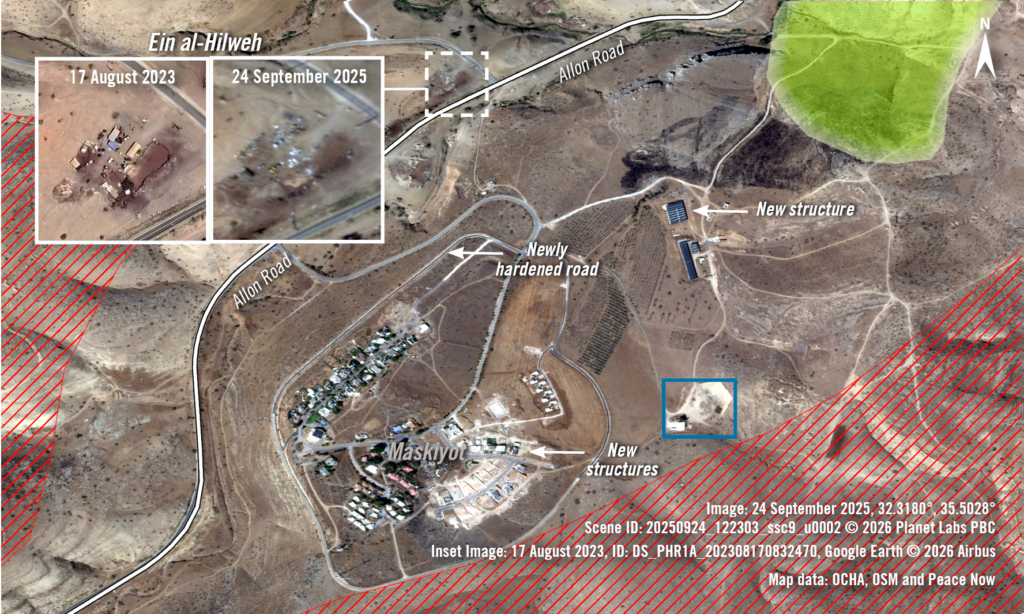
On 21 August 2025, the Israeli authorities demolished structures belonging to the Daraghmeh family.[602] According to the Jordan Valley Activists, at approximately 7am, Israeli soldiers accompanied by a representative of the Civil Administration used a civilian bulldozer to demolish Qadri Daraghmeh’s family compound, including their home and cowshed, as well as the cowshed belonging to his brother Fathi.[603] In total, 23 structures were destroyed, leaving the family without shelter.[604] A verified video from 21 August 2025, posted on Instagram, shows the aftermath of the demolition with all structures reduced to rubble.[605]
The Israeli military continued to harass the community in the weeks that followed. According to Qadri Daraghmeh’s relatives and activists who witnessed and filmed some of the events, heavily armed soldiers carried out night-time raids. They threatened and intimidated the family, and arrested Qadri Daraghmeh several times.[606] In a video posted on Instagram on 30 September 2025, Israeli soldiers blindfolded a male member of the Daraghmeh family, after they forced him to sit on the ground, in the middle of the night.[607] Activists and family members reported that three relatives were arrested on accusations of illegal construction after they attempted to erect makeshift tents and temporary shelters so they could remain in Ein al-Hilweh.
Makhoul
Makhoul is another Palestinian herding community that has endured multiple demolitions by the Civil Administration over the past decades. The largest was in 2013, when authorities demolished all 58 structures, including homes and animal sheds. Almost 50 people were left homeless.[608] While some 20 families left following the demolitions, others decided to stay and rebuild.
Further demolitions by the Israeli authorities displaced more families in the years that followed.[609] Today, Makhoul comprises only four families. It is surrounded by two military bases, Bke’ot and Peles; two settlements, Himdat and Ro’i, housing approximately 550 settlers;[610] and two settler outposts – Um Zuka, established in 2016,[611] and Goshen Farm, established in 2018.[612]
The proximity of these sites to the Palestinian community resulted in frequent and coordinated attacks, with documented cases of settlers harassing residents, threatening them, physically assaulting them and targeting their livestock. Amnesty International interviewed two residents who expressed their constant fear of settler violence. They said they felt compelled to organize nightly shifts to guard their homes and livestock, often sitting outside in harsh weather conditions. They said that settlers could show up in their community at any time, day or night.
Livestock, a primary source of their livelihoods, has been severely affected. The interviewees said that settler violence aimed at intimidating them and harming their animals increased significantly after 7 October 2023. They described settler attacks, including physical assaults on shepherds outside their communities, burning grazing areas to deprive flocks of food, attempts to steal their livestock, threats to shoot them if they herded in open areas, torching tents, driving vehicles into herds, and killing animals.[613] The reduced grazing space has led to a decline in milk production, causing financial loss and hardship in the Palestinian herding community.[614] The two interviewees said they risk physical assault when attempting to herd in areas with better grass, often staying only briefly before settlers attack them. Settlers also targeted children with physical violence and death threats.[615] Yousef Bisharat, a father of 10, reported that settlers had beaten him and his sons on different occasions as they herded their animals near their community.[616] He described one incident:
“The settler beat my 15-year-old son as he was herding. He knocked him down, leaned on him pressing him to the ground and told him that he’d choke him if he saw him there again. Herding has become a risky venture for us.”
Video evidence corroborates interview accounts. Amnesty International analysed 98 videos and images provided by activists documenting 12 incidents in Makhoul from 23 February to 11 November 2025.[617] The footage shows groups of settlers, some armed, arriving in Makhoul, trespassing on the community’s property on foot and in vehicles, and harassing the residents. The videos further document settlers bringing various equipment and erecting fences and makeshift tents in Makhoul’s immediate vicinity; and show settlers harassing and filming activists; several videos also show them harassing grazing animals.
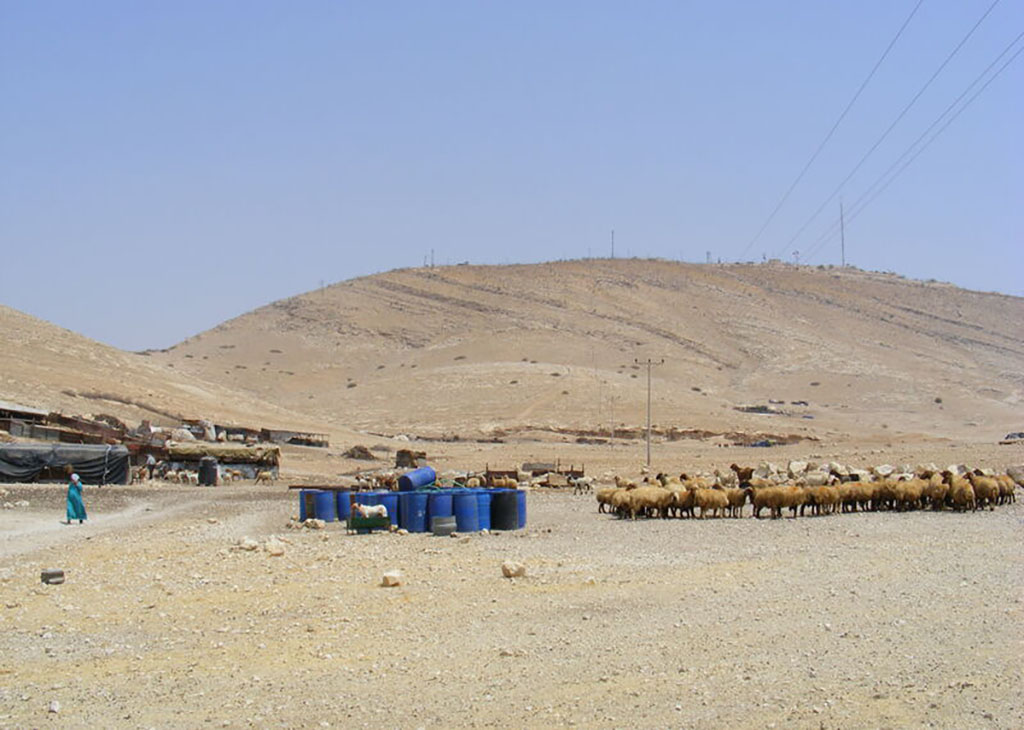
From 1 January 2023 until 1 October 2025, B’Tselem recorded 11 incidents involving settlers against Makhoul’s residents.[618] These included the theft of animals from Palestinian residents, injury to livestock, obstruction of grazing, and vandalism of property. In two incidents filmed on video and posted on Facebook in July and September 2023, settlers are harassing Palestinian shepherds grazing alongside the main road.[619] In another incident, on 26 October 2024, a video posted on Facebook and verified by Amnesty International shows settlers driving into the sheep and harassing the shepherd.[620]
Makhoul residents told Amnesty International that a settler, identified as a resident of the Gil’ad Farm outpost, regularly leads large herds of cattle onto Palestinian agricultural land, destroying crops and grazing fields. These incursions often occur overnight, leaving fields devastated by morning. Such actions are seen as part of a broader strategy to create adverse living conditions that undermine the community’s ability to sustain themselves and eventually lead to displacement. Yousef Bisharat expressed the community’s fears: “If we go anywhere even for a week, we won’t be allowed to return. It’ll all be gone.”[621]
Al-Farisiya
Al-Farisiya is a small community whose residents have historically relied on herding and dairy production for income. Established by families originating from nearby Tubas long before Israel’s occupation in 1967, it once consisted of dozens of households. Its population has steadily decreased over the last three decades due to apartheid policies and settler violence, and today only four families remain.[622]
The community is almost entirely encircled by Israeli settlements – Mehola to the north, Shadmot Mehola to the east, and Rotem to the southeast, where approximately 1,650 settlers reside.[623] Several settler outposts are also situated nearby – Tene Yarok,[624] Maskiyot/Beintayim Farm,[625] Maskiyot North[626] and Maskiyot South.[627] Giv’at Sal’it, which was established as an outpost in 2002, was legalized by the Israeli government in 2012 as a neighbourhood of Mehola.[628]
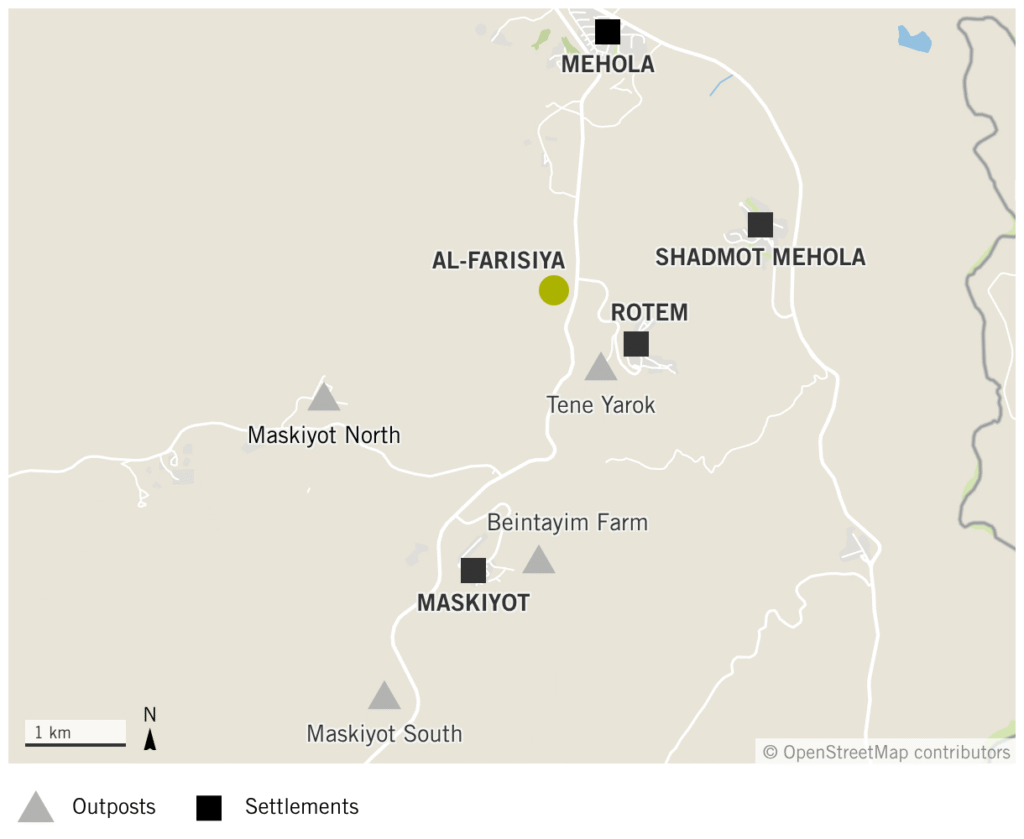
In addition, Israeli authorities have declared the village itself, along with extensive areas to the south, north and west of the village, as a military “firing zone”.[629] In 2020, the Civil Administration declared the land stretching between the settlements of Rotem and Maskiyot, within which Al-Farisiya is located, as a nature reserve (see figure 30 above).[630] These restrictions have severely affected the community’s ability to sustain its livelihood, particularly through herding and agriculture. According to B’Tselem, nearby land has been placed under the jurisdiction of surrounding settlements, effectively preventing Al-Farisiya’s residents from accessing grazing areas.[631]
In interviews with Amnesty International, community members reported that settler violence drastically escalated after 7 October 2023, forcibly displacing six families by December 2025.[632] Residents reported that settlers restricted their movement in and out of the community, physically assaulted shepherds in open grazing areas and other residents in their homes, and destroyed property. One woman described her constant fear:
“My children go to school outside the community. Every time they leave, I’m afraid for their safety because of the settlers. My husband herds our flock nearby, and every time he goes, I’m afraid they would attack him. Two months ago, they stabbed my brother-in-law as he was herding. Life is tough here.”[633]
Between 1 January 2023 and 20 November 2025, B’Tselem documented at least 27 incidents of settler violence in Al-Farisiya.[634] These incidents include physical and verbal assaults, obstruction of herding and grazing, destruction of property, trespassing, threats against residents demanding that they leave and theft of livestock.[635] Analysis of 48 videos and images – posted online or provided to Amnesty International by residents and activists – corroborates these reports. The verified material shows settlers herding on land belonging to Palestinian farmers, constructing fences and watchtowers, trespassing on residential properties, destroying surveillance cameras, damaging animal shelters and residential structures, vandalizing water systems and preventing residents from herding.
A verified video posted on X on 15 November 2024 by local activists shows damage to solar panels. With the Israeli authorities refusing to connect the community to the electrical power grid and water network, these panels are the only source of electricity for residents in Al-Farisiya.[636] In July 2024, Israeli activists documented an attack in which settlers poured water out of water tanks.[637] During a period of extreme heat in August 2025, with temperatures exceeding 40°C, the water tanks serving the community were emptied again and multiple water pipes were severed.[638]
There were also incidents where the Israeli army destroyed Palestinian property, supporting an apparent land inspector of the Jordan Valley Regional Council[639] who was harassing Palestinian residents by entering their private property without authorization; and banning a Palestinian farmer from cultivating land. A video posted on X by the Jordan Valley Activists shows an Israeli soldier throwing a large rock at an electronic device to destroy it and then pulling out the cables. [640] The incident occurred during the night of 18 September 2024. Two photos taken in the following days show the aftermath – the monitoring device rendered inoperative, with cables protruding from the ground next to the fence.[641]
Verified videos posted on X show Israeli soldiers preventing a Palestinian resident of Al-Farisiya from ploughing land adjacent to the Alon Road on 5 January 2024 because of accusations by the Jordan Valley Regional Council’s land inspector that the farmer was cultivating land where he was “not permitted.”[642] The farmer maintains that the land is owned by Palestinians. According to the Jordan Valley Activists, the farmer was handcuffed, blindfolded and arrested without a warrant; he was released after eight hours but his tractor was confiscated. Another verified video posted on X on 26 November 2024 shows the same land inspector, armed and accompanied by Israeli police officers, inside the community of Al-Farisiya.[643] He is trespassing on private property and entering residential structures without permission. The footage also shows a police officer accompanying him and entering a tent without providing any reason for the search.
In their interviews with Amnesty International, residents repeatedly identified a settler called Didi Amosi and his son as the main perpetrators of violence and harassment. Protective presence volunteers, who have also been attacked by settlers in Al-Farisiya, confirmed this information.[644]
Didi Amosi claims the land on which the community has been living for generations as his own, herding his flock in the agricultural fields.[645] In 2012, he established Tene Yarok, a herding outpost that has since received funding from the Israeli Ministry of Agriculture[646] and support from the settler organization Hashomer Yosh, including through online fundraising and the provision of “volunteers.”[647] Didi Amosi previously served as a security officer at the Rotem settlement and, in a rare move by Israeli authorities, was reprimanded by the military in 2020 for assaulting a member of the Jordan Valley Activists.[648]
Activists identified both Didi Amosi and his son in multiple videos. Amnesty International corroborated these identifications using additional verified footage, documenting various instances of violence in which both settlers were involved in harassment, trespassing, and the illegal construction and expansion of outposts.
For example, in a video posted on X on 15 July 2024, Didi Amosi is standing on a hill overlooking Al-Farisiya, telling the person filming that he intends to build an outpost.[649] Several months later, verified videos show groups of settlers, including his son, constructing initial structures on the same hill, less than 200m from the village.[650] The settlers then built a fence, effectively encircling parts of Al-Farisiya.[651] In a verified video filmed on 24 June 2025, his son is drilling into the ground approximately 50m from Palestinian homes, expanding the fence line, as an activist tries to stop him.[652]
In September 2024, the Magistrate’s Court of the Jerusalem District issued a six-month restraining order banning Didi Amosi’s son from being within 30m of Al-Farisiya after he persistently harassed a Palestinian shepherd.[653] However, it allowed him to drive his ATV while passing near the community.[654] The order, which was subsequently extended until December 2025, appeared to have limited effect: he continued to intimidate and harass Palestinians[655] while Israeli police failed to investigate reported incidents and ensure residents’ protection.[656] Videos and documentation by human rights organizations indicate that Didi Amosi’s son and other settlers have frequently used the structures on the hill to intimidate residents and prevent animals from grazing.[657] They often drove their vehicles into the village or surrounding grazing areas.[658]
On the night of 26 March 2025, video footage shows Didi Amosi’s son and at least two other settlers sitting or standing beside an ATV displaying an Israeli flag on a hill adjacent to the village. After one of them drove the ATV into the community,[659] activists staying overnight to protect residents contacted the police. According to an activist interviewed by Amnesty International, police arrived, questioned both them and the settlers, recorded their ID numbers, and left.[660] For the next two-and-a-half hours, the settlers remained on the hill while activists monitored their actions from the village. Later, an armed settler entered the village. When activists attempted to prevent him from entering further, the settler struck three of them with a rifle.[661] According to the activist, the army arrived the next morning. Instead of investigating the settlers, however, the police arrested one of the activists for assaulting the settlers.[662]
Similar practices continued through to December 2025, with videos showing Didi Amosi, his son and other armed settlers grazing their animals near the community or directly on Palestinians’ lands, driving into Al-Farisiya or into a herd of cows owned by Palestinian shepherds, and physically attacking and harassing the residents of Al-Farisiya and Ein al-Hilweh.[663]
The cases of Ein Samia, Zanuta and the cluster of communities in the northern Jordan Valley form part of a pattern, which has intensified since 2023, of systematic discriminatory practices against Palestinian communities in Area C, including through aiding and abetting violent attacks by settlers which aim at destroying these communities and driving Palestinians out of their homes.
violations of international law
The situation in the OPT is primarily governed by two branches of international law: international humanitarian law (including the rules of the law of occupation); and international human rights law. International criminal law is also relevant as certain serious violations can constitute war crimes or crimes against humanity.
Amnesty International has previously concluded that Israel has imposed an institutionalized regime of oppression and domination of the Palestinian population for the benefit of Jewish Israelis – a system of apartheid – wherever it has exercised control over the enjoyment of Palestinians’ rights: across Israel and the OPT and with regard to Palestinian refugees. The segregation is conducted in a systematic and highly institutionalized manner through laws, policies and practices, all intended to prevent Palestinians from claiming and enjoying equal rights to Jewish Israelis within Israel and the OPT. This oppression and domination have been cemented by a legal regime that controls (by negating) the rights of Palestinian refugees residing outside Israel and the OPT to return to their homes.
The report also concluded that inhuman/inhumane acts committed by Israel against Palestinians with the intent to maintain this system form part of a systematic and widespread attack directed against the Palestinian population and amount to the crime against humanity of apartheid.[664] In the OPT, this has involved forcible transfer, administrative detention, torture, unlawful killings and the denial of basic rights and freedoms, including through draconian movement restrictions.[665]
Building on these findings, Amnesty International’s research and analysis determined that since the formation of the 37th government in December 2022 and throughout the period covered by this report, up to December 2025, Israel has committed serious violations of international human rights law and international humanitarian law in the context of an ethnic cleansing campaign targeting Palestinian Bedouin and herding communities in Area C. These violations include the war crime of unlawful deportation and transfer and the crime against humanity of deportation or forcible transfer of population.
Although this report has focused on a three-year period, past reporting by Amnesty International has established that these violations and crimes were committed by Israel in the OPT in previous years.[666]
Forcible transfer
Crime against humanity
The Rome Statute of the ICC lists “deportation or forcible transfer” as a crime against humanity and defines it as the “forced displacement of the persons concerned by expulsion or other coercive acts from the area in which they are lawfully present, without grounds permitted under international law.”[667] Forcible transfer occurs when there is displacement within the territory of one state, whereas deportation presumes displacement beyond state borders.[668] As with other crimes against humanity, the Rome Statute requires the crime to be committed “as part of a widespread or systematic attack directed against any civilian population, with knowledge of the attack”, pursuant to or in furtherance of a state or organizational policy.[669]
The definition of forcible transfer under the Rome Statute encompasses not only situations of forced displacement by expulsion or use of physical force but also those where people are compelled to leave their area of residence through other coercive means.[670] The ICTY has clarified that coercion in the context of forcible transfer can include “fear of violence, duress, detention, psychological oppression or abuse of power”[671] as well as the imposition of adverse living conditions, such as cutting off water, electricity and telephone services, harassment, arrests and house searches, that make it impossible for those targeted to remain in their places of residence.[672] Crucially, the absence of a “genuine choice” and real consent given “voluntarily” are central to determining whether a transfer is forcible.[673]
For individual acts of deportation or forcible transfer to be considered crimes against humanity, they must be perpetrated in the context of a widespread or systematic attack directed against a civilian population with knowledge of the attack and as part of state or organizational policy. An attack does not need to be both widespread and systematic. “Widespread” is determined by the number of victims or magnitude of the acts[674] or the “multiplicity of victims.”[675] “Systematic” means that the acts of violence have been committed in an organized manner and that it is unlikely that they are merely random events. Courts have commonly held the “systematic” threshold to be met when there are “[p]atterns of crimes – that is the nonaccidental repetition of similar criminal conduct on a regular basis.”[676]
As detailed in this report and in its 2022 research into Israel’s system and crime against humanity of apartheid, Amnesty International finds that the contextual elements of crimes against humanity have been met in relation to Israel’s conduct in the occupied West Bank.
War crime
In addition, the deportation or transfer of all or parts of the population of the occupied territory within or outside the occupied territory is a war crime.[677] International humanitarian law strictly prohibits “individual or mass forcible transfers, as well as deportations of protected persons from occupied territory” regardless of the motive.[678] The total or partial temporary evacuation of an area is permissible only for the protection of civilians or for “imperative military reasons.” However, the occupying power must transfer back the evacuees immediately after the end of hostilities and ensure their shelter in safe and adequate conditions until then.[679]
As noted by the ICJ, evacuations that are “of a permanent or indefinite character” violate the prohibition of forcible transfer. The ICTY also found that the absence of arrangements to return evacuees back to their places of residence combined with the fact that their homes had been destroyed further substantiates that the conduct of the occupying power contravened the prohibition of forcible transfer.[680]
The ICJ has concluded that “Israel’s policies and practices are contrary to the prohibition of forcible transfer of the protected population under the first paragraph of Article 49 of the Fourth Geneva Convention.[681]
Ethnic cleansing
While ethnic cleansing is not a legal term, the UN Commission of Experts on Former Yugoslavia defined it as “a purposeful policy designed by one ethnic or religious group to remove by violent and terror-inspiring means the civilian population of another ethnic or religious group from certain geographic areas.” [682]
The commission listed coercive means by which ethnic cleansing is carried out. These include: “mass murder, torture, rape and other forms of sexual assault; severe physical injury to civilians; mistreatment of civilian prisoners and prisoners of war; use of civilians as human shields; destruction of personal, public and cultural property; looting, theft and robbery of personal property; forced expropriation of real property; forceful displacement of civilian population.”[683]
The commission also described ethnic cleansing as a policy conducted to further a political doctrine through acts of violence designed “to instil terror in the civilian population” to “cause them to flee and never to return.” It also noted that the departure of a population before violent acts can take place is indicative of an ethnic cleansing policy and clarified that an ethnic cleansing campaign can be carried out by non-state actors.
Amnesty International’s research shows that Israel’s government is pursuing a policy of ethnic cleansing of large parts of the West Bank, through the commission of war crimes and crimes against humanity both directly through its own forces and through support for violent attacks by settlers. Other organizations including UN bodies have reached similar conclusions.[684]
Legal conclusions
The evidence presented in this report demonstrates that Israel has persisted in its policy of forcible transfer, which it has been committing as part of its unlawful occupation of the OPT and as a component of the crime against humanity of apartheid.
Such illegal conduct, while not new, has been implemented with unprecedented intensity and pace since the end of December 2022, in a widespread and systematic manner, combined with other serious violations, including unlawful killings, arbitrary detention, destruction and appropriation of property, and pillage.
The 37th Israeli government and its agents have made clear their intent to formally annex the West Bank under Israeli law, which remains null and void as in contravention of international law, and reshape its demographic composition by transferring parts of its Jewish population into the occupied territory, particularly in Area C.
This is evidenced through government agreements, statements by Israeli cabinet ministers, proposed and newly adopted legislation, and cabinet decisions, including those relating to the transfer of powers in the West Bank from military to civilian authorities.
In just three years since its formation, the government fast-tracked approvals for settlement construction and expansion, including by removing checks and bureaucratic processes, and significantly increased funding and infrastructural development for both settlements and outposts. Since then, it has brought to a complete halt enforcement against settlement construction, reversing the already limited demolitions of unauthorized outposts, allowing them to multiply at an unprecedented speed, and moved to formalize many by regularizing their status and providing funding for security and other infrastructure.
The government has displayed complete defiance towards the ICJ advisory opinion of July 2024 that found the occupation unlawful and requested Israel to bring it to an end.[685]
The institutional backing for the settler movement’s agenda of formal annexation and settlement expansion was reinforced by high-profile visits from Israeli cabinet ministers and repeated public declarations by government officials expressing support for settlement expansion as a national priority, to settler organizations and individual settlers, including those accused of publicly documented violent acts.
Meanwhile, thousands of Palestinians from herding and Bedouin communities have been coerced into fleeing their homes after an unprecedented surge in state-sanctioned settler violence since 2023. Palestinian residents of these communities were terrorized by ideologically motivated Israeli settlers through repeated armed raids on their homes and villages, violent beatings, threats to kill them if they do not leave, persistent harassment that continued in some cases even after their displacement, the destruction of their property and their villages’ infrastructure that denied them water and electricity, and theft of livestock and belongings. Israeli soldiers and police were often present and either stood by, enabling the violent assault to take place, or at times actively participated in them, while increased government arming of settlers has often blurred the lines between armed settlers and security forces.
All these practices intensified an already coercive environment with the deliberate intent to displace Palestinian communities in Area C, to take over their land and bar them from returning to their homes. Those who attempted to return found their villages fenced off or destroyed by settlers or faced repeated settler attacks and harassment that the army consistently failed to stop and the police failed to investigate. This pushed them to flee again, even on the rare occasion when they secured the right to return through Israeli courts. Effectively, these policies and practices have rendered the areas in which communities have lived for generations uninhabitable.
While these acts were perpetrated by Israeli settlers, they were not isolated cases. This violence is the result of a deliberate state policy that integrated the settler movement’s vision of “Greater Israel”, which treats the West Bank as an integral part of Israel, with the clear purpose of displacing as many Palestinians as possible while expanding Israeli governmental powers over Palestinian land.
Settler violence against Bedouin and herding communities was encouraged, facilitated, condoned, and used as a deliberate tool of displacement by senior Israeli officials. This is reflected in government policies to arm settlers; the unwillingness to protect Palestinians and to investigate and prosecute the offences committed against them by settlers; and the continued financial, logistical, legal and political support to unauthorized outposts and settlers’ organizations involved in the dispossession of Palestinians through coercive means.
The Israeli army either participated in or deliberately failed to protect Palestinians from settler violence despite widely available evidence of abuses, indicating a policy to allow such attacks and a failure to punish the perpetrators.
In the few cases where courts provided at least partial redress through decisions allowing the return of displaced residents, provisional orders prohibiting further demolitions or the removal of temporary structures, or restraining orders to prevent individual settlers from harassing Palestinians, the Israeli police and army consistently failed to implement them.
By the time the government came to power, Palestinian Bedouin and herding communities in Area C were already particularly vulnerable to the effects of settler violence and Israeli army attacks due to long-standing impunity granted to state and non-state actors’ violations and the forcible transfer policies that Israel has implemented against Palestinians across the OPT since 1967. These policies involved actual or threatened demolitions on the grounds of lack of building permits arising from a discriminatory zoning and building regime; land appropriation facilitated and legitimized by a supportive judiciary; and the deliberate creation of a coercive environment through the denial of essential services, as well as previous attacks and harassment by settlers and security forces. In its 2024 advisory opinion, the ICJ affirmed that Israeli settler violence against Palestinians coupled with a failure of the Israeli state to “prevent or to punish it effectively and its excessive use of force against Palestinians contributes to the creation and maintenance of a coercive environment against Palestinians.”[686]
Israel’s annexation policies and their application to Palestinian Bedouin and herding communities in Area C have involved the crime against humanity of deportation or forcible transfer in violation of fundamental rules of international law, as provided in the Rome Statute.
Within Area C, policies of unlawful deportation or transfer, which are carried out neither for military necessity nor for the protection of the population of the occupied territory, also constitute war crimes under the Rome Statute.
By uprooting Palestinian communities and deliberately allowing the destruction of their homes and belongings, forcing them into displacement and preventing them from returning to their communities, the Israeli authorities also committed a host of human rights violations. These include violations of the right to an adequate standard of living, including the right to adequate housing;[687] the right to education, particularly for children;[688] the right to work[689] and right to health.[690] These rights are enshrined in the International Covenant on Economic, Social and Cultural Rights, which Israel ratified in 1991, and the International Convention on the Elimination of all Forms of Discrimination, which prohibits segregation and apartheid and which Israel ratified in 1979.
International legal obligations on third states
Most states have done little or nothing to stop Israel’s ethnic cleansing of Palestinians in Area C of the occupied West Bank despite their legal obligations to act to bring an end to Israel’s unlawful occupation and cruel apartheid system and to ensure that those responsible for war crimes and crimes against humanity are investigated and prosecuted.
In September 2024, the UN General Assembly passed a resolution demanding that Israel end its unlawful presence in the OPT within 12 months, in compliance with the ICJ’s historic opinion outlining third states’ obligations arising from Israel’s unlawful occupation of Palestinian territory.
The resolution called on states “not to render aid or assistance in maintaining the situation created by Israel’s presence” in the West Bank and Gaza Strip in any diplomatic, political, legal, military, economic, commercial and financial dealings with Israel. It urged them “to implement sanctions, including travel bans and asset freezes, against natural and legal persons engaged in the maintenance of Israel’s unlawful presence in the Occupied Palestinian Territory, including in relation to settler violence,” among a series of measures aimed at ensuring states’ compliance with their obligations under international law.[691] Such measures included refraining from trade or economic dealings that further entrench Israel’s occupation or where Israel purports to act on behalf of the OPT; refusing to recognize Israel’s unlawful presence in the OPT through diplomatic missions, including by establishing embassies in occupied East Jerusalem; ending imports from Israeli settlements; halting the transfer of arms, munitions and related equipment to Israel; and supporting accountability efforts.
Despite this, the little action that has been taken by states to stop ethnic cleansing and violations in the OPT has been on a much narrower basis, focusing on sanctioning individual settlers, extremist settler organizations and outposts. [692]
For example, in 2024, the EU imposed sanctions against nine Jewish settlers for establishing outposts in the occupied West Bank and committing serious human rights abuses against Palestinians, and against five settler entities, including two outposts and one organization known for settler violence.[693] It failed to sanction any government official or entity responsible for Israel’s settlement and forcible transfer policy, or any major settler organizations known for dispossessing Palestinians of their land and property or directly building and expanding settlements and outposts.[694]
The EU also failed to sanction or even politically isolate Israel’s Prime Minister, who is wanted by the ICC on charges of war crimes and crimes against humanity in the occupied Gaza Strip.
It was not until mid-2025 that some states, including Australia,[695] Canada, New Zealand, Norway Slovenia[696] and the UK, imposed sanctions against ministers Bezalel Smotrich and Itamar Ben-Gvir over their repeated incitement “of extremist violence” against Palestinians in the West Bank and calls for their displacement.
While this was a welcome step, by taking action against these ministers alone, the measures were inadequate and failed to acknowledge that forcible transfer is a long-standing policy and a pillar of Israel’s apartheid system against all Palestinians whose rights it controls and that it predates the 37th government.
In a rare exception, in July 2025, 13 states from Africa, Asia, the Caribbean, the Middle East and South America committed, in a joint statement during the Hague Group convening, to undertake “an urgent review of all public contracts, in order to prevent public institutions and public funds… from supporting Israel’s illegal occupation.” [697] The joint statement called for universal jurisdiction mandates to ensure justice for all victims in the OPT and prevent the provision or transfer of arms, munitions, military fuel and related equipment, to make sure that they do not enable or facilitate the commission of genocide, war crimes and crimes against humanity, among other measures.[698]
Meanwhile, EU member states repeatedly failed to suspend the EU-Israel Association Agreement following an EU Commission review in June 2025, prompted primarily by Israel’s conduct in the Gaza Strip, which found “indications” that Israel is breaching its human rights obligations under Article Two of the agreement.[699]
Frustrated by the EU’s inaction, several member states began adopting unilateral measures. In July 2025, Slovenia[700] announced a ban on the import, export and transit of weapons to and from Israel. A month later, it declared a ban on the import of goods from Israeli settlements.[701] While it took steps to enforce the ban on weapons transfer, by April 2026, it had yet to take action to implement a ban on imports from Israeli settlements.[702]
In September 2025, Spain adopted a decree banning the purchase and sale of arms, ammunition and military equipment to Israel, transit through Spanish ports for all ships carrying fuel for Israeli forces, and imports of products originating in Israeli settlements. It also restricted advertising of goods or services from Israeli settlements.[703] This followed a strict policy that Spain had been applying since October 2023, when it halted the issuance of new sale licences for defence equipment and stopped authorizing exports of any equipment that could be used for “riot control.”[704]
Meanwhile, the governments of Belgium, Ireland and the Netherlands have committed to adopt bans on imports of goods originating from Israel’s illegal settlements.[705]
Such measures could have a real impact on Israel’s conduct in the OPT and help end crimes under international law and ethnic cleansing, but only if they are enforced consistently and, critically, if other states follow suit.
These measures are not voluntary political actions; third states have legal obligations to ensure respect for international humanitarian law,[706] not render aid or assistance to Israel’s unlawful occupation and illegal settlements or to other serious violations, and to cooperate to bring Israel’s unlawful occupation to an end.[707]
Conclusions and recommendations
Conclusions
Amnesty International’s research found conclusive evidence that between December 2022 and December 2025, Israel committed serious violations of international human rights and humanitarian law in pursuit of a policy to ethnically cleanse Area C of the occupied West Bank by forcibly displacing Palestinian Bedouin and herding communities. These violations include the war crime of unlawful deportation and transfer and crime against humanity of forcible transfer or deportation.
Amnesty International’s continuous monitoring of the situation on the ground indicates that these violations are ongoing. While many of these violations started significantly before the 37th government took power, their acceleration and intensification since then demand that the international community fully confront and name the Israeli state-driven project and act decisively to prevent the destruction of Palestinian communities and the annexation of the West Bank.
Most states have remained passive in the face of this egregious and ongoing violation of the rights of Palestinians, even as the Israeli government’s intent and actions towards formal annexation under Israeli law of large swathes of the West Bank have been defiantly broadcast by state officials. Where action has been taken, it has been largely limited to imposing sanctions on individual Israeli settlers known for carrying out or inciting attacks against Palestinian Bedouin and herding communities and villages, along with some settler organizations and outposts established by these settlers; and the leaders of Jewish Power and Religious Zionism parties labelled as “extremists.” By placing the focus on outposts and those that founded them, these measures have framed settler violence as an issue of isolated “extremists” or “extremist ministers” rather than addressing what it truly is: a core component of a state-sanctioned ethnic cleansing campaign through the crime against humanity of forcible transfer and other crimes.
However, this report exposes how settlers have acted with the Israeli state’s full support and protection as they implemented a national project to expel Palestinians from their communities to seize land and annex ever larger areas of the occupied West Bank.
The very few tangible measures taken by third states have singularly failed to recognize that the forcible transfer of Palestinians in the West Bank is a long-standing component of Israeli government policy and a central part of Israel’s system of apartheid established over decades. Treating Israel’s annexation policies, its campaign of ethnic cleansing and the forcible transfer of Palestinians as the work of a few extremist ministers and individual settlers is counterproductive and ignores the evidence of clear state policy and intent presented in this report.
In light of this research and compelling evidence from other human rights organizations and UN agencies, Amnesty International concludes that in order to stop Israel’s systematic violations of Palestinians’ rights, states must confront the structural drivers of Israel’s violations and crimes in the OPT and impose political, economic and diplomatic costs on Israel for maintaining an unlawful occupation and entrenching a system of apartheid.
As long as states – particularly those with influence over Israel – fail to do this, the forced displacement, settlement construction, annexation of land and daily abuses of other human rights will continue unabated, with further tragic consequences for the Palestinian people.
Continuing to grant Israel impunity for its plethora of violations and atrocity crimes against Palestinians and its overall institutionalized regime of domination and oppression has global ramifications for the already poor standing of international law and the rules-based order.
Recommendations
In light of its findings and the international community’s failure to uphold its legal obligations to cooperate to bring Israel’s violations of international law to an end, Amnesty International is making the following recommendations:
To third states
Amnesty International calls on all states to abide by their international obligations and take all available measures at their disposal to pressure Israel to end its unlawful occupation, dismantle its system of apartheid against Palestinians, and end all violations perpetrated as part of this system. This includes all states with influence over Israel, including allies such as the USA, the UK, Germany and other EU member states, but also other states with diplomatic, political and economic relations with Israel or those seeking to establish them, such as Arab states – especially members of the Gulf Cooperation Council – as well as African and American states.
Among others, states should:
- Impose targeted sanctions, including travel bans and asset freezes, against Benjamin Netanyahu, Bezalel Smotrich, Itamar Ben-Gvir, Israel Katz and Orit Strock as Israeli officials directly implicated in Israel’s imposition on Palestinians in the occupied West Bank of an ethnic cleansing campaign and forcible transfers, and maintaining an unlawful occupation and the system and crime of apartheid.
- Take steps to ban trade, investment relations or any form of aid, cooperation or financial assistance that contribute to, or are directly linked to Israel’s unlawful occupation, system of apartheid and ethnic cleansing of Palestinians. These include:
- Passing or amending legislation and regulations, and/or implementing existing legislation and regulations, with a view to preventing the provision of any kind of assistance, including through political, diplomatic, economic or other measures, to Israel’s ethnic cleansing and forcible transfer policies, unlawful occupation or apartheid.
- Taking steps to prevent trade, funding and investment that may aid or assist in the maintenance of, or contribute to, or be directly linked to, Israel’s system of apartheid or unlawful occupation of the Palestinian territory, including through:
- Banning trade with, and investment in, Israeli settlements;
- Banning trade and cooperation with entities implicated in the establishment and maintenance of illegal settlements, outposts and their associated regime as well as Israel’s apartheid system and related violations such as forcible transfer perpetrated with the intention to maintain it. This encompasses state institutions, including government ministries among them the ministries of agriculture, settlement and national missions, defence, transport and finance; and
- Banning the direct or indirect provision of funds, economic resources or any other form of assistance to all Israeli organizations that are integral to the settlement enterprise and apartheid system. This includes organizations that build, develop and fund – including through fundraising campaigns – Israeli settlements and outposts in the West Bank, including in East Jerusalem. It also covers organizations that exploit inherently discriminatory laws against Palestinians to initiate eviction proceedings or push for the enforcement of demolition orders against their structures, or those that recruit volunteers to help build or expand unauthorized outposts or engage in acts aimed at ethnically cleansing Palestinians from Area C or other parts of the OPT;
- Regulating companies domiciled in their jurisdiction in a manner to prevent these companies from contributing to or being directly linked to the unlawful occupation, apartheid and ethnic cleansing, including by prohibiting companies’ operations in settlements or trade in Israeli settlements’ goods, or with companies either domiciled in settlements or otherwise implicated in the development or sustainability of settlements in the OPT.
- Banning all exports that may be used by Israel or private enterprises, including charitable and non-profit organizations, operating within Israel and/or in the OPT, to entrench Israel’s unlawful occupation, apartheid or ethnic cleansing.
- Ban, with immediate effect, the direct and indirect supply, sale or transfer to Israel of all arms, military material and security equipment, including related technologies, parts and components, technical assistance, training, financial or other assistance. This includes prohibiting the transit and transshipment of these goods through their jurisdictions (ports, airports, airspace or territory) bound for Israel.
- Ban, with immediate effect, the direct and indirect supply, sale or transfer, including transit and transshipment, to Israel of all surveillance equipment, as well as any artificial intelligence, cloud infrastructure and other information technology equipment, software and hardware, especially the materials and services used to support surveillance, policing, security or military activities by Israel. This includes all related technologies, parts and components, technical assistance, training, and financial or other assistance.
- Urgently act to bring an end to and pursue fair and effective justice and individual criminal accountability for the war crime and crime against humanity of forcible transfer or deportation perpetrated in the context of Israel’s ethnic cleansing campaign against Palestinians in the occupied West Bank since the end of 2022. This should include exercising domestic, universal or other forms of extraterritorial criminal jurisdiction, removing any statute of limitations or other legal or policy barriers to investigating and prosecuting international crimes, and ensuring that no personal or functional immunity from prosecution or amnesty is granted for such crimes.
- Where sufficient evidence exists, ensure that competent authorities conduct criminal investigations and prosecutions in civilian courts. This applies to individuals within states’ jurisdiction, based on the principles of universal jurisdiction and the nationality of both perpetrators and victims, including cases of dual nationality. This should encompass potential perpetrators who may reasonably be suspected of responsibility for crimes, including as members of the Israeli army or settlers. In addition, proactively cooperate with other states who have opened national-level investigations.
- Ensure that diplomats based in Israel and the OPT actively address Israel’s violations of Palestinians’ rights, including by visiting and supporting displaced communities and communities at risk of displacement.
To the European Union
- Review all agreements, research exchanges and trade relations with Israel, and suspend the EU-Israel Association Agreement based on Israel’s breach of its human rights clause (Article 2), in order to ensure that it does not directly or indirectly contribute to Israel’s unlawful occupation and crimes under international law.
- Use the EU’s economic leverage as Israel’s largest trading partner to pressure it to dismantle its apartheid regime and end its unlawful occupation, policy of ethnic cleansing and ongoing violations in the OPT.
- Take steps to ban trade, investment relations, or any form of aid, cooperation or financial assistance that contribute to, or are directly linked to, Israel’s unlawful occupation, system of apartheid and ethnic cleansing of Palestinians. These include taking steps to prevent trade, funding and investment that may aid or assist in the maintenance of, or contribute to, or be directly linked to, Israel’s system of apartheid, unlawful occupation of the Palestinian territory or ethnic cleansing, to align the EU’s trade relations with Israel with international law, including through:
- An EU-wide total ban on all imports and exports of goods and services from and to Israel’s illegal settlements in the OPT as well as investments therein, as a step towards aligning the EU’s trade relations with Israel with international law under the EU’s Common Commercial Policy;
- Banning trade and cooperation with entities implicated in the establishment and maintenance of illegal settlements, outposts and their associated regime, as well as Israel’s apartheid system and related violations such as forcible transfer perpetrated with the intention to maintain it. This encompasses state institutions, including government ministries, among them the ministries of agriculture, settlement and national missions, defence, transport and finance;
- Banning the direct or indirect provision of funds or economic resources to all Israeli organizations that are integral to the settlement enterprise and apartheid system. This includes organizations that build, develop and fund – including through fundraising campaigns – Israeli settlements and outposts in the West Bank, including in East Jerusalem. It also covers organizations that lead activities to dispossess Palestinians by exploiting inherently discriminatory laws against Palestinians to initiate eviction proceedings or push for the enforcement of demolition orders, or those that recruit volunteers to help build and expand unauthorized outposts or engage in acts aimed at ethnically cleansing Palestinians from Area C or other parts of the OPT.
- Impose targeted sanctions, including travel bans and asset freezes against Benjamin Netanyahu, Bezalel Smotrich, Itamar Ben-Gvir, Israel Katz and Orit Strock as Israeli officials most directly implicated in Israel’s ethnic cleansing campaign in the occupied West Bank and forcible transfer, and maintaining the unlawful occupation and system and crime of apartheid Israel imposes on Palestinians in the occupied West Bank.
- End the exemptions for visa-free travel to the EU for Israeli settlers: by granting visa-free access to the EU to Israeli citizens living in illegal settlements and outposts in the OPT, but requiring visas for Palestinians living in the OPT, the EU and its member states are contributing to Israel’s system of apartheid against Palestinians. Providing visa-free access to settlers also violates the obligation not to recognize as legal the situation arising from the unlawful presence of Israel in the OPT, as per the ICJ Advisory Opinion of July 2024, and the EU’s own differentiation policy.
To the Israeli authorities
- Immediately stop the forcible transfer of Palestinian herding and Bedouin communities in Area C of the West Bank and anywhere else in the OPT.
- Immediately allow displaced Palestinians to return to their homes in the West Bank, including in Area C. Pending their return, ensure that the humanitarian needs of all displaced civilians are met, including access to water, food, shelter and healthcare, in line with Israel’s obligations as the occupying power.
- Immediately stop the destruction of houses, land and other properties without absolute military necessity as prescribed by international humanitarian law. Anyone whose property has been unlawfully destroyed without adequate prior notification and the effective opportunity to challenge the decision before a court of law should receive reparation and be allowed, where possible, to rebuild their property in the same place.
- End the unlawful occupation of the West Bank, including East Jerusalem, and the Gaza Strip, in line with the advisory opinion issued by the ICJ on 19 July 2024. Dismantle all Israeli settlements and outposts and their associated infrastructure that have been unlawfully built on Palestinian land in the OPT; and relocate all settlers outside of the OPT.
- End the system of apartheid against Palestinians by dismantling measures of discrimination, segregation and oppression currently in place against the Palestinian population.
To the Office of the Prosecutor of the International Criminal Court
- Consider the commission of the crime against humanity of deportation or forcible transfer and the war crime of unlawful deportation and transfer of Palestinian herding and Bedouin communities in Area C in the ongoing investigation into the situation in the State of Palestine.
- Ensure that the ongoing situation of apartheid forms a critical and explicit contextual element to the whole investigation into the situation in the State of Palestine, including any investigations into the crimes under international law identified in this report.
- Undertake urgent and effective outreach to affected communities and conduct public information activities concerning the Office of the Prosecutor’s ongoing investigation into the situation in the State of Palestine.
Annex 1: Amnesty International’s letter addressed to Minister of Defense Israel Katz
Annex 2: Email response from the Israel Defense Forces’ Spokesperson’s Unit to Amnesty International’s letter
From: IDF International Press Desk <[email protected]>
Sent: 23 May 2026 10:08
To: Philip Luther <[email protected]>
Subject: Re: Amnesty International letter offering right of reply by 28 May 2026
The IDF’s mission is to ensure the security of all residents of Judea and Samaria, Palestinians and Israelis alike, and to operate to thwart terrorism and enforce law and order throughout Judea and Samaria to protect the security of Israeli civilians.
When there is suspicion that troops did not adhere to IDF orders, the incidents are thoroughly examined, and in appropriate cases disciplinary measures are taken by commanders or a criminal investigation is opened to clarify the circumstances. This also applies to cases where there is suspicion that troops stood by without intervening, contrary to IDF directives and values. In cases involving suspected violations of the law by Israeli civilians, the primary body responsible for handling such allegations is the Israel Police.
In accordance with procedures, upon receiving any report regarding friction between Israelis and Palestinians or incidents involving an attack by an Israeli civilian, IDF forces are dispatched to the scene. In every incident involving friction or assault, IDF soldiers are expected to act to disperse those involved and restore order in the area, including in cases of violence or attempts to expel shepherds, and they handle irregular incidents in accordance with procedures.
When troops encounter cases of law violations by Israeli civilians, including violent incidents or incidents in which actions are directed against Palestinians or their property, the troops are required to act to stop the violation and, if necessary, detain or apprehend the suspects until police arrive at the scene.
In addition, there is an inter-agency team composed of the IDF, ISA, Israel Police, and Border Police that operates to address the phenomenon of law violations by Israeli civilians in the area and improve the operational response. As part of these efforts, the IDF has begun a process of confiscating property and equipment belonging to Israeli civilians involved in these incidents, as well as evacuating illegal outposts, from which most civilians involved in such incidents originate. In accordance with situational assessments, forces are positioned in advance in known friction areas in order to reduce incidents and prevent escalation.
The IDF operates in cooperation with the Israel Police and other security bodies, and in relevant cases joint investigations are also conducted, with the goal of enforcing the law and bringing those involved in violent incidents to justice.
Troops of Defense Area Units (‘Hagmar’ in Hebrew) fulfill [sic] a significant role in protecting Israeli civilians living in the area and operate within a defined and limited area of responsibility. In many cases, Hagmar unit troops have prevented attacks and saved lives. Hagmar unit troops are subject to IDF directives and the relevant procedures. In cases of deviation, the incidents are reviewed and handled in accordance with the findings.
Due to needs that have arisen in recent months, all brigades are conducting reinforcement of protocols, procedural clarifications, and training sessions. In addition, over the past week, Hagmar positions have been reduced in accordance with the reduction of forces in the sector.
Regarding the incidents mentioned in the letter:
Regarding Shi’b al-Butum, on July 19, 2024, a report was received regarding friction between an Israeli shepherd and Palestinians, during which the shepherd reported that he had been attacked and that several sheep had been stolen from him. Following the report, a soldier arrived in the area in order to find the sheep. During the activity, stones were thrown at the soldier, and in response a suspect apprehension procedure was carried out, including one warning shot fired into the air. One Palestinian suspect was apprehended and transferred to the Israel Police for further handling.
On September 4th, a report was received regarding an assault on Palestinians by several Israeli civilians in Khalet a-Daba, in the Judea Brigade area. Upon receiving the report, IDF and Israel Police forces were dispatched to the scene. Upon arrival in the area, no suspects were identified. The IDF is aware of the claim regarding several injured Palestinians. The case was transferred to the Israel Police for further handling.
Khirbet Zanuta is a Palestinian outpost that was established unlawfully on a site with significant historical value.
Following the outbreak of the war, the residents of the illegal outpost left their homes after being removed by Israelis living in the area.
In proceedings conducted by the residents before the High Court of Justice, the State informed the court that the area in question is not a military exclusion zone under the law, and that should the Palestinian residents return to the area, the IDF would be prepared to maintain order and security for them and for the area as a whole. At the same time, regional authorities emphasized the illegality of the construction at the site and their intention to enforce building regulations there in accordance with the law and previous statements submitted to the court in earlier proceedings on the matter.
When the Palestinian residents returned to the outpost, IDF troops secured and coordinated their return, and since then IDF troops have operated to maintain security and order in the area in cooperation with the Israel Police, which is the body responsible for handling complaints regarding law violations by Israelis.
In cases of violence, the relevant authorities may be contacted and the matter will be examined.
The IDF is unaware of the claim regarding expulsions from the village of Khirbet Zanuta carried out by IDF troops.
Regarding the incidents in Ibziq and Al-Hadidiya, the IDF is unaware of the allegations.
OTR
It should be noted that the Military Police Criminal Investigation Division and the Israel Police hold parallel authority to investigate a soldier who committed an offense during military service. In accordance with the policy established by the Deputy State Attorney, cases in which a soldier commits an offense against a resident of Judea and Samaria outside the scope of his duties are investigated by the Israel Police and handled within the civilian law enforcement system.
Foreign Media Desk
Spokesperson’s Unit
Israel Defense Forces
Footnotes
[1] Area C covers the majority of the West Bank and is under full Israeli military and administrative control, including land registration, planning and zoning. It is the area where most settlement construction is based.
[2] Amnesty International, Israel’s Apartheid Against Palestinians: Cruel System of Domination and Crime Against Humanity (Index: MDE 15/5141/2022), 1 February 2022, https://www.amnesty.org/en/documents/mde15/5141/2022/en
[3] Until Israel’s unilateral withdrawal from the Gaza Strip in 2005, 21 settlements existed there with a population of approximately 8,000 settlers. Most were subsequently moved into settlements in the West Bank. Since 7 October 2023, some Israeli government officials have openly called for the re-establishment of settlements in Gaza.
[4] According to Yesha Council, the settler population in the West Bank, excluding East Jerusalem, reached 540,327 in January 2026. Yesha Council, “Population report 2026”, on file with Amnesty International. According to Peace Now, the number of Israeli settlers in East Jerusalem stood at approximately 233,000 in 2023. Peace Now, “Jerusalem Population”, https://peacenow.org.il/en/settlements-watch/settlements-data/jerusalem (accessed on 2 June 2026). In addition, several hundred settlers live in the heart of the Old City of Hebron in an area known as H2, hugely impacting the rights of its Palestinian residents. United Nations General Assembly (UNGA), Report: Israeli Settlements in the Occupied Palestinian Territory, Including East Jerusalem, and the Occupied Syrian Golan, 25 September 2025, UN Doc. A/80/399.
[5] According to the Palestinian Central Bureau of Statistics (PCBS), more than 3.4 million Palestinians live in the West Bank. PCBS, Population, https://www.pcbs.gov.ps/en (accessed on 21 April 2026).
[6] According to Peace Now, by April 2026, there were 148 settlements in the West Bank excluding East Jerusalem. This figure does not include outposts legalized as settlements since 2023. Peace Now, “Settlements and Outposts Peace Now 12.2025”, https://docs.google.com/spreadsheets/d/1Hs_JdYPEs4oXs09zG3Hd4tWBpYo0ImkJ6WuXAEgMi0U/edit?gid=0#gid=0, (accessed on 3 June 2026). In addition, by the end of 2023, there were 15 Jewish settlements in East Jerusalem. See Peace Now, “Jerusalem Population”, https://peacenow.org.il/en/settlements-watch/settlements-data/jerusalem (accessed on 2 June 2026).
[7]Peace Now, “Settlements and Outposts Peace Now 12.2025”, https://docs.google.com/spreadsheets/d/1Hs_JdYPEs4oXs09zG3Hd4tWBpYo0ImkJ6WuXAEgMi0U/edit (accessed on 3 June 2026).
[8]Amnesty International, Israel’s Apartheid Against Palestinians (previously cited), p. 142.
[9]Fourth Geneva Convention Relative to the Protection of Civilian Populations in Time of War (1949), Article 49, para. 6.
[10] Fourth Geneva Convention, Article 147, para. 6.
[11] Rome Statute of the International Criminal Court (Rome Statute), Article 8(2)(a)(iv) and Article 8(b)(viii).
[12] Yesha Council, “Population report 2026” (previously cited).
[13] The Oslo Accords also established Areas A and B where the newly created Palestinian Authority obtained varying degrees of control. Area A, which accounts for only 18% of the West Bank, has since been under full Palestinian control. In Area B, which comprises 22% of the West Bank, Palestinian authorities maintain full administrative control but share security control with Israel. These areas included Palestinian towns and villages where 90% of the Palestinian population lived at the time. Israel and the Palestine Liberation Organization, Israeli Palestinian Interim Agreement on the West Bank and the Gaza Strip, 28 September 1995, https://www.un.org/unispal/document/auto-insert-185434
[14] Al-Haq, “Establishing guidelines to determine whether the legal status of ‘Area C’ in the Occupied Palestinian Territory represents annexed territory under international law”, 17 July 2020, establishing-guidlines-executive-summary-1638858249.pdf, p.4.
[15] UN Office for the Coordination of Humanitarian Affairs occupied Palestinian territory (OCHA), “Area C humanitarian response plan fact sheet”, August 2010, https://www.ochaopt.org/sites/default/files/ocha_opt_area_c_humanitarian_response_plan_fact_sheet_2010_09_03_english.pdf
[16] B’Tselem, The Jordan Valley, https://www.btselem.org/jordan_valley
[17] Avi Shlaim, The Iron Wall, Israel and the Arab World, 2000, pp. 256-258.
[18] The most recent estimate of the Palestinian population in Area C was carried in 2013 through an OCHA-led inter-agency assessment. OCHA, Area C: Vulnerability Profile, 5 March 2014, https://www.ochaopt.org/content/spotlight-area-c-vulnerability-profile
[19] Amnesty International, Israel’s Apartheid Against Palestinians, (previously cited) p. 157.
[20] Office of the UN High Commissioner for Human Rights (OHCHR), “State of Palestine: Israel’s Discriminatory Administration of the Occupied West Bank, Including East Jerusalem”, 6 January 2026, https://www.ohchr.org/sites/default/files/documents/countries/israel/infographics-israel-discriminatory-administ.pdf
[21] United Nations Country Team, Common Country Analysis for the Occupied Palestinian Territory, November 2022, https://palestine.un.org/sites/default/files/2023-08/United%20Nations%20Common%20Country%20Analysis%20for%20the%20Occupied%20Palestinian%20Territory.pdf, p. 102.
[22] In addition to becoming refugees in the West Bank, many other Palestinians from Bedouin communities were internally displaced in 1948 and remained in the Negev/Naqab in the newly created Israeli state. Resource Center for Palestinian Residency and Refugee Rights (Badil), “Ongoing Israeli colonial expansion: Forcible transfer of Palestinian Bedouin and refugee communities”, 21 August 2025, https://badil.org/press-releases/16109.html
[23] Other components of Israel’s system of oppression and domination include territorial fragmentation; the denial of economic and social rights; and legal segregation and control through restrictions on the right to political participation, movement, measures that disrupt family life, and the denial of nationality and residence. For a more detailed analysis, see Amnesty International, Israel’s Apartheid Against Palestinians (previously cited).
[24] International Convention on the Suppression and Punishment of the Crime of Apartheid. Other inhuman or inhumane acts examined by Amnesty International include administrative detention, torture, unlawful killings, serious injuries and the denial of basic rights and persecution.
[25] Amnesty International, Targeting Civilians: Murder, Hostage-Taking and Other Violations by Palestinian Armed Groups in Israel and Gaza (Index: MDE 15/0282/2025), 11 December 2025, https://www.amnesty.org/en/documents/mde15/0282/2025/en
[26] Amnesty International, ‘You Feel Like You Are Subhuman’: Israel’s Genocide Against Palestinians in Gaza (Index: MDE 15/8668/2024), 5 December 2024, https://www.amnesty.org/en/documents/mde15/8668/2024/en; Amnesty International, “Israel’s systematic destruction of high-rise buildings must be investigated as war crimes of wanton destruction and collective punishment”, 12 May 2026, https://www.amnesty.org/en/latest/news/2026/05/israel-opt-israels-systematic-destruction-of-high-rise-buildings-must-be-investigated-as-war-crimes-of-wanton-destruction-and-collective-punishment
[27] OCHA, “Reported impact snapshot”, 29 April 2026, https://www.ochaopt.org/content/reported-impact-snapshot-gaza-strip-29-april-2026
[28] Palestine News and Info Agency (Wafa), “Gaza death toll rises to 72,594 amid ongoing Israeli attacks”, 28 April 2026, https://english.wafa.ps/Pages/Details/169885
[29] Amnesty International, “Israel’s genocide against Palestinians in Gaza continues unabated despite ceasefire”, 27 November 2025, https://www.amnesty.org/en/latest/news/2025/11/israels-genocide-against-palestinians-in-gaza-continues-unabated-despite-ceasefire
[30] OCHA, Data on Casualties, https://www.ochaopt.org/data/casualties (accessed on 11 May 2026), “Palestinian fatalities”.
[31] Amnesty International, ‘You Feel Like You Are Subhuman’ (previously cited).
[32] OHCHR, “UN Human Rights in Occupied Palestinian Territory: 1001 Palestinians killed in West Bank since 7 October 2023 – one in five are children”, 17 October 2025, https://www.un.org/unispal/document/ohchr-press-release-17oct25
[33] OHCHR, “UN Human Rights in Occupied Palestinian Territory: 1001 Palestinians killed in West Bank since 7 October 2023 – one in five are children” (previously cited).
[34] Amnesty International, “Shocking spike in use of unlawful lethal force by Israeli forces against Palestinians in the occupied West Bank”,5 February 2024, https://www.amnesty.org/en/latest/news/2024/02/shocking-spike-in-use-of-unlawful-lethal-force-by-israeli-forces-against-palestinians-in-the-occupied-west-bank; Human Rights Watch, “West Bank: Israeli forces’ unlawful killings of Palestinians”, 8 May 2024, https://www.hrw.org/news/2024/05/08/west-bank-israeli-forces-unlawful-killings-palestinians
[35] OHCHR, “UN Human Rights in Occupied Palestinian Territory: 1001 Palestinians killed in West Bank since 7 October 2023 – one in five are children” (previously cited).
[36] Israeli Army Spokesperson, כך נראתה שנת 2025 בפיקוד המרכז – במספרים [“This is what 2025 looked like in Central Command — in numbers”], 19 January 2026, https://www.idf.il/328784 (in Hebrew).
[37] Amnesty International, “Horrifying cases of torture and degrading treatment of Palestinian detainees amid spike in arbitrary arrests”, 8 November 2023, https://www.amnesty.org/en/latest/news/2023/11/israel-opt-horrifying-cases-of-torture-and-degrading-treatment-of-palestinian-detainees-amid-spike-in-arbitrary-arrests
[38] OCHA, “West Bank| Monthly snapshot: casualties, property damage and displacement”, 21 April 2026, https://www.ochaopt.org/content/west-bank-monthly-snapshot-casualties-property-damage-and-displacement-march-2026
[39] “West Bank | Monthly snapshot: casualties, property damage and displacement”, 31 March 2026, https://www.unocha.org/publications/report/occupied-palestinian-territory/west-bank-l-monthly-snapshot-casualties-property-damage-and-displacement-31-march-2026
[40] United Nations Satellite Centre, Comprehensive Damage Assessment and Security Analysis of Tulkarm, Nur Shams and Jenin Refugee Camps in Tulkarm and Jenin Governorates, West Bank, Occupied Palestinian Territory, 6 November 2025, https://unosat.org/static/unosat_filesystem/4216/OCHA-CBPF-OPT-034_UNOSAT_CE20231007PSE_WestBank_RefugeeCamps_CDA_SA_20251016.pdf
[41] Palestinians were also displaced from Jenin refugee camp in December 2024 as a result of an operation launched by Palestinian security services. OCHA, “Humanitarian situation update #339 | West Bank”, 12 November 2025, https://www.ochaopt.org/content/humanitarian-situation-update-339-west-bank
[42] OCHA, Breakdown of Data on Demolition and Displacement in the West Bank, https://tinyurl.com/2e5bvv5n (accessed on 11 May 2026).
[43] UN Palestine, “Escalating forced evictions in Batn al‑Hawa, Silwan: 16 families removed in one week”, 27 March 2026, https://palestine.un.org/en/312611-escalating-forced-evictions-batn-al%E2%80%91hawa-silwan-16-families-removed-one-week
[44] Peace Now, “The government promotes the plans in Atarot and Sheikh Jarrah”, 11 January 2025, https://peacenow.org.il/en/atarot-and-um-haroun
[45] Amnesty International, “ICJ opinion declaring Israel’s occupation of Palestinian territories unlawful is historic vindication of Palestinians’ rights”, 19 July 2024, https://www.amnesty.org/en/latest/news/2024/07/icj-opinion-declaring-israels-occupation-of-palestinian-territories-unlawful-is-historic-vindication-of-palestinians-rights
[46] International Court of Justice (ICJ), Legal Consequences Arising from the Policies and Practices of Israel in the Occupied Palestinian Territory including East Jerusalem, advisory opinion, 19 July 2024.
[47] Amnesty International, “Israel’s systematic destruction of high-rise buildings must be investigated as war crimes of wanton destruction and collective punishment” (previously cited).
[48] Amnesty International, Israel’s Apartheid Against Palestinians (previously cited).
[49] Amnesty International, Israel’s Apartheid Against Palestinians (previously cited).
[50] Amnesty International, “Israel/OPT: 10 things you need to know about ‘annexation’”, 2 July 2020, https://www.amnesty.org/en/latest/news/2020/07/israelopt-10-things-you-need-to-know-about-annexation
[51] State of Israel, Basic Law: Jerusalem, Capital of Israel, passed on 30 July 1980, https://main.knesset.gov.il/activity/legislation/laws/pages/lawprimary.aspx?t=lawlaws&st=lawlawsbasic&lawitemid=2000045 (in Hebrew), Article 1. An English translation is available at: State of Israel, Knesset, Basic-Law: Jerusalem the Capital of Israel, 2022, https://m.knesset.gov.il/EN/activity/documents/BasicLawsPDF/BasicLawJerusalem.pdf
[52] State of Israel, Ministry of Foreign Affairs, “Israel, the conflict and peace: answers to frequently asked questions – updated December 2009”, 30 December 2009,
https://www.gov.il/en/pages/faq_peace_process_with_palestinians_dec_2009#D1-Occupied
[53] “Greater Israel” refers to an ideology that treats the area extending from the Mediterranean Sea to the Jordan River, including the entirety of the OPT as an integral part of Israel.
[54] International Crisis Group, Sovereignty in All but Name: Israel’s Quickening Annexation of the West Bank, 9 October 2025, https://www.crisisgroup.org/rpt/middle-east-north-africa/israelpalestine/252-sovereignty-all-name-israels-quickening-annexation-west-bank
[55] Peace Now, “30 years after Oslo – The data that shows how the settlements proliferated following the Oslo Accords”, 11 September 2023, https://peacenow.org.il/en/30-years-after-oslo-the-data-that-shows-how-the-settlements-proliferated-following-the-oslo-accords
[56] B’Tselem, State Business: Israel’s Misappropriation of Land in the West Bank through Settler Violence, November 2021, https://www.btselem.org/sites/default/files/publications/202111_state_business_eng.pdf, p. 6.
[57] For details and emblematic cases, see section 5.6: “Israel’s response to settler attacks: impunity and active support”.
[58] ICJ, Legal Consequences Arising from the Policies and Practices of Israel in the Occupied Palestinian Territory, advisory opinion (previously cited), para. 158.
[59] Charter of the UN, Article 2, para. 4.
[60] The Hague Regulations, Article 43.
[61] ICJ, Legal Consequences of the Construction of a Wall in the Occupied Palestinian Territory, Advisory Opinion, 2004, para. 87.
[62] Fourth Geneva Convention, Article 47.
[63] The ICJ also considered the “proclamation of Jerusalem as Israel’s capital [and] the comprehensive application of Israeli domestic law in East Jerusalem” as acts of annexation. ICJ, Legal Consequences Arising from the Policies and Practices of Israel in the Occupied Palestinian Territory, Including East Jerusalem, advisory opinion (previously cited), para. 173.
[64] ICJ, Legal Consequences Arising from the Policies and Practices of Israel in the Occupied Palestinian Territory, advisory opinion (previously cited), para. 252.
[65] Likud and Jewish Power, הסכם קואליציוני לכינון ממשלה לאומית [“Coalition agreement to form a national government”], 28 December 2022, on file with Amnesty International (in Hebrew); Likud and Religious Zionism, הסכם קואליציוני לכינון ממשלה לאומית [“Coalition agreement to form a national government”], 28 December 2022, on file with Amnesty International (in Hebrew).
[66] In 2018, Israel passed the “nation state law” (formally known as Basic Law: Israel – The Nation State of the Jewish People), which defined Israel as the nation state of the Jewish people and constitutionally entrenched inequality and discrimination against non-Jews. State of Israel, Basic Law: Israel – The Nation State of the Jewish People, passed on 19 July 2018, 20_lsr_504220.pdf
An English translation is available at: State of Israel, Knesset, Basic Law: Israel – The Nation State of the Jewish People, 2018, knesset.gov.il/laws/special/eng/BasicLawNationState.pdf
[67] Adalah, “New Israeli government’s guidelines”, 1 October 2023, https://www.adalah.org/uploads/uploads/Guiding_principles_government.pdf
[68] Likud and Religious Zionism, הסכם קואליציוני לכינון ממשלה לאומית [“Coalition agreement to form a national government”] (previously cited).
[69] The Settlement Administration was established in February 2023. See section 4.4.1: “Concentrating powers in the hands of dedicated Settlement Administration”.
[70] The four settlements in the West Bank include: Ganim, Kadim, Sa-Nur and Homesh. The agreement also calls for the reversal of disengagement policies in the Gaza Strip. State of Israel, Ministry of Foreign Affairs, The Cabinet Resolution regarding the Disengagement Plan, 6 June 2004, https://www.gov.il/en/pages/the-cabinet-resolution-regarding-the-disengagement-plan-6-jun-2004
[71] Likud and Jewish Power, הסכם קואליציוני לכינון ממשלה לאומית [“Coalition agreement to form a national government”] (previously cited).
[72] State of Israel, Knesset, The Penal Code, 1977, https://tinyurl.com/4j47kuma (in Hebrew).
[73] See also: Jerusalem Post, “‘Dromi Law’ passes final reading in Knesset plenum”, 24 June 2008, https://www.jpost.com/israel/dromi-law-passes-final-reading-in-knesset-plenum
[74] See also State of Israel, Ministry of Finance, Bezalel Smotrich, 31 May 2022, (updated on 13 July 2023), https://www.gov.il/en/pages/minister.
For more details about Regavim’s activities, see section 6.2: “Zanuta, South Hebron Hills”.
[75] COGAT is a unit within the Israeli military responsible for implementing civil policies in the West Bank, excluding East Jerusalem, and the Gaza Strip and for coordination with the Palestinian authorities [Coordination of Government Activities in the Territories. The Civil Administration is the military unit responsible for Israel’s civil policy in the West Bank, excluding East Jerusalem. See: Government of Israel, The Civil Administration in Judea and Samaria, https://www.gov.il/en/departments/civil_authority_in_judea_and_samaria
[76] State of Israel, Basic Law: The Government, 27 December 2022, Gov_Docs_gov37_basic37.pdf (in Hebrew); Israel’s Prime Minister’s Office, “PM Netanyahu, Defense Minister Gallant and minister in the Defense Ministry Smotrich sign document of understandings”, 23 February 2023, https://www.gov.il/en/pages/event-understanding230223
[77] SBS News, “Who are Ben-Gvir and Smotrich, the Israeli ministers sanctioned by Australia?”, 11 June 2025, https://www.sbs.com.au/news/article/who-are-ben-gvir-and-bezalel-smotrich-the-israeli-ministers-sanctioned-by-australia/7c1q8nrzv
[78] Benjamin Netanyahu, X post: בניגוד לציוצים, הבנייה וההסדרה ביהודה ושומרון יימשכו בהתאם ללו״ז התכנון והבנייה המקורי, ללא שום שינוי. אין ולא תהיה שום הקפאה [“Contrary to tweets, construction and regulation in Judea and Samaria will continue according to the original planning and construction schedule, without any changes. There is not, and will not be, any freeze”], 26 February 2023, https://x.com/netanyahu/status/1629913024998907906; Bezalel Smotrich, X post: אין לי מושג על מה דיברו או לא דיברו בירדן [“I have no idea what they did or did not talk about in Jordan”], 26 February 2023, https://x.com/bezalelsm/status/1629882672305655809
[79] Israel News, השרה סטרוק: המתיישבים יצאו בשליחותנו להעמיק את האחיזה בשטח [“Minister Strock: the settlers went out on a mission in our name in order to deepen our grip to the land”], 14 February 2023, https://tinyurl.com/59dz4jkx
[80] Arutz Sheva, יוכפל התקציב למעקב אחר בנייה פלסטינית. השרה סטרוק: שומרים על הארץ שלנו מפני השתלטות עוינת [“Budget to monitor Palestinian construction to be doubled. Minister Strock: We’re protecting our land from hostile takeover”], 4 April 2023, https://www.inn.co.il/news/597547
[81] International Crisis Group, Sovereignty in All but Name (previously cited).
[82] Bezalel Smotrich, X post: 2025 – שנת הריבונות ביהודה ושומרון [“2025 the year of sovereignty in Judea and Samaria”], 11 November 2024, https://x.com/bezalelsm/status/1855974693078962367?s=20
[83] Arutz Sheva, השר דיכטר לראשי מועצת יש”ע: הגיע הזמן להחלת הריבונות בשטחי יו”ש [“Minister Dichter to heads of Yesha Council: It’s time to apply sovereignty to Judea and Samaria”], 23 March 2025, https://www.inn.co.il/news/664652
[84] Israel 365 News, “Israeli Leaders Push for Sovereignty in Judea and Samaria, Citing Security and Peace”, 3 December 2024, https://israel365news.com/398336/israeli-leaders-push-for-sovereignty-in-judea-and-samaria-citing-security-and-peace
[85] The Israeli disengagement from Gaza in 2005 was a unilateral move by Israel to withdraw its military presence and dismantle all Israeli settlements in the Gaza Strip, as well as four settlements in the northern West Bank.
[86] Times of Israel, “Defense minister confirms government approval of 22 new West Bank settlements”, 29 May 2025, https://www.timesofisrael.com/defense-ministry-confirms-government-approval-of-22-new-west-bank-settlements
[87] These 17 are part of the 22 settlements declared in May 2025. See: Peace Now, “The Cabinet decided on the establishment of 22 New settlements in the West Bank”, 29 May 2025, https://peacenow.org.il/en/cabinet-decision-22-settlements
[88] Channel 14, לקראת החלת ריבונות ביו”ש? נתניהו: נבנה ונאחז בחלקי מולדתנו [“Towards sovereignty in Judea and Samaria? Netanyahu: we will build and hold on to the parts of our homeland”], 27 August 2025, https://www.youtube.com/watch?v=9nR9AZvW2N4
[89] Israel’s Prime Minister, שידור חי: רה”מ נתניהו בטקס חתימת הסכם גג במעלה אדומים [“Live: Prime Minister Netanyahu in ceremony of signing roof agreement in Ma’ale Adumim”], 11 September 2025, https://www.youtube.com/watch?v=YILM0nXbdoI&t=2292s; The Times of Israel, “‘There will be no Palestinian state’: Netanyahu signs plan for E1 settlement expansion”, 11 September 2025, https://www.timesofisrael.com/there-will-be-no-palestinian-state-pm-signs-plan-cementing-e1-settlement-expansion
[90] INN, השר בן גביר לנתניהו: לא מחכים לאירופה – ריבונות היא צו השעה [“Ben-Gvir to Netanyahu: ‘Don’t wait for Europe. Sovereignty is the order of the day’”], 15 September 2025, https://www.inn.co.il/news/678932
[91] Channel 14, סמוטריץ’ חושף את מפת הריבונות: סיפוח 82% מהשטח ביו”ש [“Smotrich reveals the sovereignty map: annexing 82% of the land”], 3 September 2025, https://www.c14.co.il/article/1311351
[92] JDN, מקסימום שטח על מינימום אוכלוסייה: זו מפת הריבונות ביו”ש [“Maximum land and minimum population: this is the map of sovereignty in Judea and Samaria“], 3 September 2025, https://www.jdn.co.il/news/2473708
[93] Al Jazeera English, “Israel’s Smotrich promises ‘a million’ new settlers under expansion plan”, 28 June 2024, https://www.youtube.com/watch?v=jzMcFWIuCeA
[94] Yesh Din, Annexation Legislation Database, https://www.yesh-din.org/en/legislation/ (accessed on 3 June 2026).
[95] The bill lists 15 settlements: Beit El, Adam, Kochav Ya’akov, Tell Tzion, Psagot, Migron, Givat Assaf, Ofra, Amona, Ma’ale Levona, Shilo, Shvut Rachel and Eli. Michel Buskila, Bill: Center Benyamin Bloc – 2023, proposed on 2 January 2023, https://main.knesset.gov.il/activity/legislation/laws/pages/lawbill.aspx?t=lawsuggestionssearch&lawitemid=2197187
[96] The bill lists 13 settlements: Karnei Shomron, Kedumim, Itamar, Bracha, Elon Moreh, Yizhar, Ma’ale Shomron, Shavei Shomron, Einav, Sebastia, Homesh, Sa-Nur, Gannim and Kadim. Michel Buskila, Bill: Heart of Samaria Bill – 2023, proposed on 2 January 2023, https://main.knesset.gov.il/activity/legislation/laws/pages/lawbill.aspx?t=lawsuggestionssearch&lawitemid=2196996
[97] The bill lists 10 settlements including Bet Arye, Ofarim, Elkana, Oranit, Alfei Menashe, Sha’arei Tikva, Etz Efrayim, Sal’it, Avne Hefetz, Alei Zahav and Tzofim. Michel Buskila, Bill: Western Samaria Bill – 2023, proposed on 2 January 2023, https://main.knesset.gov.il/activity/legislation/laws/pages/lawbill.aspx?t=lawsuggestionssearch&lawitemid=2197191
[98] The bill lists 16 settlements including Modi’in Illit, Har Adar, Giv’at Ze’ev, Givon Hahadasha, Bet Horon, Mevo Horon, Nili, Na’ale, Mattityahu, Hashmonaim, Kfar HaOranim, Talmon and its neighbours Dolev, Nahaliel, Ateret and Neve Tzuf. Michel Buskila, Bill: Heart of Modi’in Bloc – 2023, proposed on 2 January 2023, https://main.knesset.gov.il/activity/legislation/laws/pages/lawbill.aspx?t=lawsuggestionssearch&lawitemid=2196993
[99] The bill lists Kiryat Arba and settlements in the Mount Hebron Regional Council. Michel Buskila, Bill: Hebron and Its Daughters Bill – 2023, proposed on 2 January 2023, https://main.knesset.gov.il/activity/legislation/laws/pages/lawbill.aspx?t=lawsuggestionssearch&lawitemid=2197060
[100] Avigdor Liberman and others, Bill: Applying sovereignty over Ma’ale Adumim – 2025, proposed on 9 June 2025, https://main.knesset.gov.il/apps/legislation/main/bills/2231986
[101] Eleven settlements are listed in the Ariel bloc including Ariel, Immanuel, Revava, Barkan, Yaqir, Nofim, Bruchin, Kfar Tapuah, Rechelim, Nofei Nehemia and Kiryat Netafim. Michel Buskila, Bill: Ariel Bloc – 2023, proposed on 2 January 2023, https://main.knesset.gov.il/activity/legislation/laws/pages/lawbill.aspx?t=lawsuggestionssearch&lawitemid=2197194
[102] At least two bills list 11 settlements as part of the southern West Bank area: Carmel, Susiya, Beit Yatir, Ma’on, Tene Omarim, Otniel, Ma’aleh Hever, Beit Hagai, Avigayil, Shani and Livneh. See for example: Limor Son Har-Melech, Bill: Negev Development Authority (Amendment: Negev Definition), proposed on 1 April 2024, https://main.knesset.gov.il/activity/legislation/laws/pages/lawbill.aspx?t=lawsuggestionssearch&lawitemid=2210285
[103] The bill lists the following settlements: Beitar Illit, Ma’ale Adumim, Giv’at Ze’ev, Mevaseret Zion, Gush Etzion, Efrat, Kfar Adumim, Alon, Nofei Prat, Kedar, Ma’ale Mikhmas and Mitzpe Yeriho. Zeev Elkin, Bill: Applying Israeli Sovereignty Over Greater Jerusalem, proposed on 27 February 2023, https://main.knesset.gov.il/activity/legislation/laws/pages/lawbill.aspx?t=lawsuggestionssearch&lawitemid=2201433
[104] Four bills propose to annex the Jordan Valley including all areas controlled by Israeli settlements and unauthorized outposts within it, industrial zones serving them, archaeological sites and access roads. See for example: Dan Illouz and others, Bill: Applying Israeli Sovereignty over the Jordan Valley, proposed on 20 May 2024, https://main.knesset.gov.il/activity/legislation/laws/pages/lawbill.aspx?t=lawsuggestionssearch&lawitemid=2217080
[105] Dan Illouz, Bill: Applying Israeli Sovereignty over Judea and Samaria Regions, proposed on 29 March 2023, https://main.knesset.gov.il/activity/legislation/laws/pages/lawbill.aspx?t=lawsuggestionssearch&lawitemid=2202971
[106] Avichay Avraham Buaron, Bill: Amendment of the Law and Administration Ordinance (Legislation in the Area by Order), proposed on 26 July 2023, https://main.knesset.gov.il/activity/legislation/laws/pages/lawbill.aspx?t=lawsuggestionssearch&lawitemid=2208797
[107] State of Israel, Knesset, Law to Extend the Emergency Regulations (Judea and Samaria – Jurisdiction and Legal Aid), 5727-1967.
[108] For example, Tzvi Sukkot, Bill: Communities and Neighborhoods Undergoing Regularisation – 2024, proposed on 11 April 2024, https://main.knesset.gov.il/activity/legislation/laws/pages/lawbill.aspx?t=lawsuggestionssearch&lawitemid=2222508
[109] Simcha Rothman, Bill: Correction of Terms in Legislation Bill (Judea and Samaria) – 2024, proposed on 12 September 2024, https://main.knesset.gov.il/activity/legislation/laws/pages/lawbill.aspx?t=lawsuggestionssearch&lawitemid=2224619
[110] Danny Danon, Bill: National Parks, Nature Reserves, National Sites and Memorial Sites Law (Amendment)- 2023, proposed on 6 March 2023, main.knesset.gov.il/Activity/Legislation/Laws/Pages/LawBill.aspx?t=lawsuggestionssearch&lawitemid=2198091
[111] For example: Nissim Vaturi, Bill: Land Transactions (Observance of the Sabbatical Year) (Amendment – Applying the law to Judea and Samaria) – 2023, proposed on 27 February 2023, https://main.knesset.gov.il/activity/legislation/laws/pages/lawbill.aspx?t=lawsuggestionssearch&lawitemid=2199754
[112] Mishel Buskila, Bill: World Zionist Organization –- Jewish Agency for Israel Status Law (Amendment) – 2023, proposed on 20 February 2023, https://main.knesset.gov.il/activity/legislation/laws/pages/lawbill.aspx?t=lawsuggestionssearch&lawitemid=2201417
[113] Mishel Buskila, Bill: Connecting Houses in Young Settlements to the Electrical Grid – 2023, proposed on 20 February 2023, https://main.knesset.gov.il/activity/legislation/laws/pages/LawBill.aspx?t=lawsuggestionssearch&lawitemid=2201442
[114] Sharren Haskel, Bill: Preventing Palestinian Authority Residents from Taking Over Area C – 2023, proposed on 2 January 2023, https://main.knesset.gov.il/activity/legislation/laws/pages/lawbill.aspx?t=lawsuggestionssearch&lawitemid=2196806
[115] Amit Halevi, Bill: Israel Antiquities Authority (Amendment – Power of the Israel Antiquities Authority in Judea and Samaria) Bill – 2023, proposed on 13 February 2023, https://main.knesset.gov.il/activity/legislation/laws/pages/lawbill.aspx?t=lawsuggestionssearch&lawitemid=2200570
[116] The Disengagement Plan Implementation Law (2005) regulated Israel’s withdrawal of all military and civilian presence from the occupied Gaza Strip, as well as the dismantling of four Israeli settlements in the northern West Bank. See: UN Peacemaker, “The Disengagement Plan – General Outline”, 18 April 2004, https://peacemaker.un.org/sites/default/files/document/files/2024/05/israeloptdisengagementplan2004.pdf; https://main.knesset.gov.il/activity/legislation/laws/pages/lawbill.aspx?t=lawsuggestionssearch&lawitemid=2198761
[117] State of Israel, Knesset, “Knesset Plenum passes bill to change name of Disengagement Plan Implementation Law, repeal clauses banning Israelis from entering or staying in evacuated areas in northern Samaria”, 21 March 2023, https://main.knesset.gov.il/en/news/pressreleases/pages/press21323q.aspx
[118] Israel Defense Forces, The Civil Administration,הודעה על מתן הרשאה לתכנון על ידי הממונה על הרכוש הממשלתי והנטוש [“Notice on granting permit to plan by the Custodian of Government and Abandoned Property”], 21 December 2023, https://tinyurl.com/3cezje8n
[119] Peace Now, “Israel’s security cabinet decided to establish 19 new settlements”, 15 December 2025, https://peacenow.org.il/en/israels-security-cabinet-decided-to-establish-19-new-settlements; Times of Israel, “Construction masterplan for formerly-evacuated West Bank settlement gets preliminary ok”, 1 January 2026, https://www.timesofisrael.com/construction-masterplan-for-formerly-evacuated-west-bank-settlement-gets-preliminary-approval/
[120] For more details about these decisions, see section 4.4: “Implementing the settler movement’s vision: new government measures towards annexation and settlement expansion”.
[121] Unlike primary legislation, cabinet decisions are not subject to a parliamentary vote. In cases of conflict, they can be overridden by primary legislation. As administrative decisions, they are subject to judicial review by the Israeli Supreme Court. Under international law, however, Israel is not authorized to implement either its primary legislation or its cabinet decisions and government bylaws in the occupied West Bank, unless necessary for the protection of the protected population, as stipulated under Article 43 of the Hague Regulations.
[122] Hague Regulations, Article 43.
[123] Amnesty International, Israel’s Apartheid Against Palestinians (previously cited), p. 79.
[124] State of Israel, Government, המנהל האזרחי ביהודה ושומרון ]”The Civil Administration in Judea and Samaria”], gov.il/he/departments/civil_ administration_in_judea_and_samaria/govil-landing-page;
Yesh Din, “Through the lens of Israel’s interests: The Civil Administration in the West Bank”, December 2017, s3-eu-west-1.amazonaws.com/files.yesh-din.org/Minhal+Ezrahi/ YeshDin+-+Haminhal+-+English.pdf
[125] Israel’s Prime Minister’s Office, ראש הממשלה, שר הביטחון והשר במשרד הביטחון חתמו על מסמך הבנות באשר לחלוקת האחריות במשרד הביטחון [“The Prime Minister, Minister of Defense and the minister at the Ministry of Defense signed an MOU regarding the division of responsibilities at the Ministry of Defense”], 23 February 2023, https://www.gov.il/he/pages/event-understanding230223
[126] Israel’s Prime Minister’s Office, ראש הממשלה, שר הביטחון והשר במשרד הביטחון חתמו על מסמך הבנות באשר לחלוקת האחריות במשרד הביטחון [“The Prime Minister, Minister of Defense and the minister at the Ministry of Defense signed an MOU regarding the division of responsibilities at the Ministry of Defense”] (previously cited); Israel’s Minister of Defense and the Additional Minister at Israel’s Ministry of Defense, Memorandum of Understanding and the Division of Responsibilities between the Minister of Defense and the Additional Minister at the Ministry of Defense, 23 February 2023, https://ynet-pic1.yit.co.il/picserver5/wcm_upload_files/2023/02/23/SkylTh4As/______________________.pdf (in Hebrew); Breaking the Silence, Memorandum of Understanding and Division of Powers and Responsibilities between the Minister of Defense and the Additional Minister in the Ministry of Defense (Unofficial translation), 23 February 2023, https://www.breakingthesilence.org.il/inside/wp-content/uploads/2023/02/Galant-Smotrich-agreement-eng.pdf; State of Israel, Government Order no. 168: Approval of the appointment of the head of the Settlement Administration (Regulation of Civil Services in Judea and Samaria) in the Ministry of Defense, 23 February 2023; Peace Now, “Annexation under the radar: The establishment of the Settlement Administration under Minister Bezalel Smotrich”, 1 July 2023, https://peacenow.org.il/en/annexation-under-the-radar-the-establishment-of-the-settlements-administration-under-minister-bezalel-smotrich-report
[127] Haaretz English, “This Pro-settler NGO has been shaping Israeli policy for years. Now, it’s in control”, 27 April 2023, https://tinyurl.com/45yuhnfj
[128] Breaking the Silence, The Silent Overhaul: Changing the Nature of Israeli Control in the West Bank, 2024, https://www.breakingthesilence.org.il/inside/wp-content/uploads/2024/09/The-Silent-Overhaul-Full-Report.pdf, p. 8.
[129] Israel Defense Forces, Order no. 2196, 29 May 2024, https://tinyurl.com/nhatz7ar (in Hebrew); Yesh Din, “HCJ petition: repeal the transfer of powers to Deputy Head of the Civil Administration”, 1 October 2024, https://www.yesh-din.org/en/hcj-petition-repeal-the-transfer-of-powers-from-the-head-of-the-civil-administration-to-his-deputy-which-means-the-annexation-of-the-west-bank
[130] Israel Defense Forces, Order no. 947: The Establishment of the Civil Administration (Judea and Samaria), 1981; Letter of appointment and delegation of powers to the Deputy Head of the Civil Administration for Civil Affairs, on file with Amnesty International; Israel Defense Forces, Order no. 2196 (previously cited).
[131] International Crisis Group, Sovereignty in All but Name (previously cited).
[132] Ynet, בביקור במנהל האזרחי אמר סמוטריץ’ כי הוא פועל לסגור אותו: דיברתי עם נתניהו [“In a visit to the Civil Administration, Bezalel Smotrich said he was working to shut it down: I spoke with Netanyahu”], 5 December 2024, https://www.ynet.co.il/news/article/bkldluke1e
[133] Bimkom, “Israel moves to resume West Bank land registration: a precursor to annexation and land grab”, 15 February 2026, solt_c_eng_2026.pdf
[134] See also OHCHR, “Israeli security cabinet’s decision to resume land registration in Area C of the occupied West Bank is deeply troubling”, 14 May 2025, https://palestine.un.org/en/294287-israeli-security-cabinet%E2%80%99s-decision-resume-land-registration-area-c-occupied-west-bank
[135] Norwegian Refugee Council, A Guide to Housing, Land and Property Law in Area C of the West Bank, February 2012, https://www.nrc.no/globalassets/pdf/reports/a-guide-to-housing-land-and-property-law-in-area-c-of-the-west-bank.pdf
[136] Israel Defense Forces, Order no. 58: Abandoned Properties (Private Property) (Judea and Samaria), 5727-1967. Available in English on: The Nakba Files, “Military order 58: Abandoned properties” https://nakbafiles.org/nakba-casebook/military-order-58-abandoned-properties (accessed on 3 June 2026).
[137] Peace Now, “Government approves West Bank land settlement, allocates NIS 244 million for a process entailing the dispossession of thousands of Palestinians”, 15 February 2026, https://peacenow.org.il/en/government-decision-land-registration
[138] In January 2026, the Israeli Supreme Court rejected a petition submitted by four Israeli NGOs against the cabinet’s decision. The court justified its decision stating that the resumption of land registration had yet to be implemented, and that the petition was premature. See: Israel, HCJ, Yesh Din et al. v. The Ministerial committee on National Security Affairs (Security Cabinet), Ruling, 27 January 2026, on file with Amnesty International.
[139] Peace Now, “Government approves West Bank land settlement, allocates NIS 244 million for a process entailing the dispossession of thousands of Palestinians”, (previously cited). For more information about state land declarations see Kerem Navot, Blue and White Make Black: The Work of Blue Line Team in the West Bank, December 2016, cdb1a7_04c9fe5f2c954d17953d9c5114041962.pdf
[140] Peace Now, “The cabinet approves a series of decisions to take control of land and strip powers from the Palestinian Authority”, 8 February 2026, https://peacenow.org.il/en/cabinet-land-decisions
[141] Government of Israel, Amendment to decision no. 150, 18 June 2023, https://img.haarets.co.il/bs/00000188-cd9d-da0c-a78a-ffff60e20000/97/17/5a428b70481593aed5e440c29562/memshala.pdf; See also Peace Now, “Israeli government assigns sole responsibility for West Bank settlement planning process to Minister Smotrich”, 18 June 2023, https://peacenow.org.il/en/israel-transfers-west-bank-settlements-planning-responsibility-to-minister-smotrich-cancels-defense-ministers-involvement
[142] Israel Policy Forum, “The quiet surge in West Bank settlements”, 10 June 2024, https://peacenow.org.il/en/at-least-seven-outposts-established-in-palestinian-controlled-area-b
[143] The Settlement Division is a unit within the World Zionist Organization that operates under the Israeli government’s authorization and funding to plan and support settlement projects. Under Israeli law, the government is allowed to delegate powers to the Settlement Division. See State of Israel, Law: The Status of WZO and Jewish Agency of Israel, 1952, https://www.nevo.co.il/law_html/law01/281_001.htm
[144] Yesh Din, “Policy paper: what Israel’s 37th government’s guiding principles and coalition agreements mean for the West Bank, January 2023”, 1 February 2023, https://tinyurl.com/yww27t78
[145]According to Breaking the Silence, following its formation, the government allocated NIS 620 million (approximately USD 197 million) of coalition funds to settlements in 2023 and 2024. Although funds were cut by NIS 140 million (approximately USD 48 million) following Israel’s offensive in the Gaza Strip launched in October 2023, settlements received an additional NIS 530 million (approximately USD 168 million) in 2024 through new budget allocations. See: Breaking the Silence, The Silent Overhaul (previously cited). See also Israel Policy Forum, “The quiet surge in West Bank settlements” (previously cited); Globes, “2025 budget bill gives Ben-Gvir extra NIS 2b”, 4 December 2024, https://iglob.es/?en1495951
[146] State of Israel, Knesset, “Finance Committee approves NIS 110 million transfer, including NIS 90 million in cash, to Ministry of Settlement and National Missions”, 31 December 2023, https://main.knesset.gov.il/en/news/pressreleases/pages/press311223e.aspx
[147] State of Israel, Knesset, “Finance Committee approves NIS 110 million transfer, including NIS 90 million in cash, to Ministry of Settlement and National Missions”, (previously cited).
[148] This amount was authorized when the 2025 Budget Law passed its first reading at the Knesset in December 2024. See: State of Israe, Knesset, Bill: 2025 Fiscal Year Budget, Bill for First Reading, 16 December 2024, https://main.knesset.gov.il/activity/legislation/laws/pages/lawbill.aspx?t=lawsuggestionssearch&lawitemid=2224903
[149] Haaretz, “Israeli Government Transfers Millions in Coalition Funds to Ministry in Charge of West Bank Settlements”, 17 March 2025, https://www.haaretz.com/israel-news/2025-03-17/ty-article/.premium/israeli-govt-transfers-millions-in-coalition-funds-to-ministry-in-charge-of-settlements/00000195-a4bf-dee5-a195-fdbfc9cd0000?fromLogin=success
During a Finance Committee meeting on 17 March 2025 concerning the 2025 budget, member of Yesh Atid party Vladimir Beliak stated that, according to a document from the prime minister’s office, coalition funds allocated to the Ministry of Settlement and National Missions increased from NIS 217 million (approximately 74.7 million) to NIS 268 million (USD 82 million). See: State of Israel, Knesset, “Protocol No. 623 Meeting of the Finance Committee”, 17 March 2025, main.knesset.gov.il/activity/legislation/laws/pages/lawbill.aspx?t=lawsuggestionssearch&lawitemid=2224903
[150] See: Knesset, 2025 Fiscal Year Budget Law, 22 April 2025, https://fs.knesset.gov.il/25/law/25_lsr_6956734.pdf
[151] Calcalist, בדיקת האוצר חושפת: כך זורמים מיליארדים למשרד של אורית סטרוק – אחרי אישור התקציב [“Check by finance ministry reveals: this is how billions are funneled into Orit Strook’s ministry”], 22 March 2026, https://www.calcalist.co.il/local_news/article/hjap00h6511e
[152] Calcalist, בדיקת האוצר חושפת: כך זורמים מיליארדים למשרד של אורית סטרוק – אחרי אישור התקציב [“Check by finance ministry reveals: this is how billions are funneled into Orit Strook’s ministry”] (previously cited).
[153] Israel’s Ministry of Transport and Road Safety, בשורה ענקית לתושבי יו”ש [“Huge news for the residents of Judea and Samaria”], 9 August 2023, https://www.gov.il/he/pages/09-08-2023
[154] Yossi Dagan, head of the Samaria Regional Council, praised the launch of the construction of a by-pass road around the village of Al-Lubban as “a significant tool for reaching the goal of one million residents in Samaria”, echoing Bezalel Smotrich’s public commitment to double the West Bank’s settler population. Israel’s Ministry of Transport and Road Safety, בשורה ענקית לתושבי יו”ש [“Huge news for the residents of Judea and Samaria”] (previously cited).
[155] Times of Israel, “NIS 918 million allocated to West Bank roads in ‘de facto sovereignty’ move”, 24 July 2025, https://www.timesofisrael.com/liveblog_entry/nis-918-million-allocated-to-west-bank-roads-in-de-facto-sovereignty-move
[156] Israel’s Prime Minister Office, “קידום תוכנית לחיזוק ופיתוח יישובים ולפיתוח תשתיות ביהודה ושומרון” [“Promoting a plan to strengthen and develop infrastructure in Judea and Samaria”], 4 December 2025, https://www.gov.il/he/pages/dec3559-2025
[157] This includes, for instance, the Knesset’s finance committee.
[158] Peace Now, “Billions for settlements in the 2024 budget”, 22 February 2024, https://peacenow.org.il/en/billions-for-settlements-in-the-2024-budget;
Peace Now, “The government approved millions to farm outposts”, 5 February 2024, https://peacenow.org.il/en/the-government-approved-millions-to-farm-outposts;
Peace Now, “The Israeli government financed 68 illegal farms with NIS 15 million”, 23 July 2024, https://peacenow.org.il/en/government-funds-for-farms; The Settlement Division helps establish illegal settlements with full governmental funding. See: Peace Now, “Settlement Division continues to finance illegal projects”, 27 May 2019, https://peacenow.org.il/en/settlement-division-continues-to-finance-illegal-projects
[159] Peace Now, “The Israeli government financed 68 illegal farms with NIS 15 million” (previously cited).
[160] See section 4.4.4: “Increased funding to settlements”
[161] State of Israel, Knesset, ועדת הכספים אישרה את ההעברה למשרד ההתיישבות [“Finance Committee approved transfer to settlement ministry”], 31 December 2023, https://main.knesset.gov.il/news/pressreleases/pages/press31.12.23.aspx
See also Peace Now, “Billions for settlements in the 2024 budget” (previously cited).
[162] Associated Press (AP), “Israeli government quietly sends millions to unauthorized West Bank settler outposts”, 23 July 2024, https://www.ap.org/news-highlights/spotlights/2024/israeli-government-quietly-sends-millions-to-unauthorized-west-bank-settler-outposts
[163] Peace Now, “The Israeli government financed 68 illegal farms with NIS 15 million” (previously cited).
[164] The Times of Israel, “Government gifts state-financed ATVs to illegal settlement outposts for security”, 6 April 2025, https://www.timesofisrael.com/government-gifts-state-financed-atvs-to-illegal-settlement-outposts; The Times of Israel, “Government gifts more ATVs to illegal West Bank outposts to ‘deepen control’ of territory”, 30 July 2025, https://www.timesofisrael.com/government-gifts-more-atvs-to-illegal-west-bank-outposts-to-deepen-control-of-territory
See also a video from one of the events: Kivsa_schora, Instagram post, “Smotrich posted this video from an event”, 6 April 2025, https://www.instagram.com/reels/DIGZ5oNNVhg
[165] Guidestar, השומר יו”ש – ארגון השמירה ביהודה ושומרון [“Hashomer Yosh – the Judea and Samaria guarding organization”], https://www.guidestar.org.il/organization/580575629 (accessed on 14 May 2026), “Overview”; Guidestar, שיבת ציון לרגבי אדמתה [“The Return of Zion to its Land‘s Roots”], https://www.guidestar.org.il/organization/580556306/govsupport, (accessed on 14 May 2026), “Overview”.
[166] For more details, see section 5.6.3 “Government support to settler organizations: the case of Hashomer Yosh”.
[167] Guidestar, השומר יו”ש – ארגון השמירה ביהודה ושומרון [“Hashomer Yosh – the Judea and Samaria guarding organization”] https://www.guidestar.org.il/organization/580575629/finances (accessed on 14 May 2026), “Financial data”.
[168] Guidestar, רגבים [“Regavim”] https://www.guidestar.org.il/organization/580460319/finances (accessed on 14 May 2026), “Financial data”.
[169] Peace Now, State Land Declarations List, https://tinyurl.com/4szpuz6s (accessed on 14 January 2026).
[170] European Union, Office of the European Union Representative (West Bank and Gaza Strip, UNRWA), 2024 Report on Israeli Settlements in the Occupied West Bank, including East Jerusalem: Reporting Period January – December 2024”, 14 August 2025, https://tinyurl.com/fdxtdkrh
[171] Peace Now, Construction in Settlements – Settlement Watch, https://peacenow.org.il/en/settlements-watch/settlements-data/construction (accessed on 14 May 2026), “Construction”.
[172] Peace Now, “Advancement of 248 housing units in the West Bank”, 21 October 2025, https://peacenow.org.il/en/advancement-of-248-housing-units-in-the-west-bank. The figures include the approval of the E1 settlement plan to build some 3,400 housing units between Jerusalem and Ma’ale Adumim settlement in the occupied West Bank, in a move that will divide the West Bank in two and further isolate East Jerusalem, if implemented. See: Middle East Eye, “Amnesty International says Israel’s E1 settlement ‘flagrant violation’ of international law”, 21 August 2025, https://www.middleeasteye.net/live-blog/live-blog-update/amnesty-international-says-israels-e1-settlement-flagrant-violation
[173] Peace Now, “Advancement of 248 housing units in the West Bank” (previously cited); Peace Now, Construction in Settlements – Settlement Watch, https://peacenow.org.il/en/settlements-watch/settlements-data/construction https://peacenow.org.il/en/settlements-watch/settlements-data/construction (accessed on 14 May 2026), “Construction”.
[174] Peace Now, Construction in Settlements – Settlement Watch, https://peacenow.org.il/en/settlements-watch/settlements-data/construction (accessed on 14 May 2026), “Construction”.
[175] Peace Now, Construction in Settlements – Settlement Watch, https://peacenow.org.il/en/settlements-watch/settlements-data/construction (accessed on 14 May 2026), “Construction”.
[176] OCHA, Breakdown of Data on Demolition and Displacement in the West Bank, https://tinyurl.com/2e5bvv5n (accessed on 11 May 2026).
[177] Bezalel Smotrich, X post:הקבינט אישר את ההצעה שהעלתי יחד עם ידידי שר הביטחון ישראל כ”ץ להכריז ולהסדיר 19 יישובים חדשים! [“The Cabinet confirmed the plan that I submitted with my friend, the Minister of Defense, Israel Katz, to declare and regulate 19 new settlements!”], 21 December 2025, https://peacenow.org.il/en/at-least-seven-outposts-established-in-palestinian-controlled-area-b
According to Peace Now, one of these settlements, Givat Harel, was counted twice in government declarations, and the total number of newly approved settlements by 21 December 2025 stood at 68, and not 69. See: Peace Now, “Cabinet decision on the establishment of 34 new settlements”, 9 April 2026, https://peacenow.org.il/en/at-least-seven-outposts-established-in-palestinian-controlled-area-b
[178] BBC, “Israel approves 19 new settlements in occupied West Bank”, 21 December 2025, https://www.bbc.com/news/articles/cqjg18xe0wwo
[179] i24 News, חשיפה: הקבינט אישר בחשאי הקמת עשרות יישובים חדשים ביו”ש, בצה”ל הסתייגו [“Exposure: The Cabinet secretly approved the establishment of dozens of new settlements Sin Judea and Samaria, the IDF had reservations”], 9 April 2026, https://www.i24news.tv/he/news/news/defense-news/artc-6cd86408
[180] Peace Now, Settlements Decided by the Cabinet, https://docs.google.com/spreadsheets/d/14co5BALh3RDJ9HwcXylSlCPZUXQ7D-vb6UwYvcLXAXg/edit?gid=0#gid=0 (accessed on 11 May 2026).
While media reported that the total number of settlements declared by the 37th government by April 2026 was 103, this number includes one settlement, Givat Harel, that was announced twice, making a total of 102.
[181]Peace Now, Settlements and Outposts Peace Now 12.2025, https://docs.google.com/spreadsheets/d/1Hs_JdYPEs4oXs09zG3Hd4tWBpYo0ImkJ6WuXAEgMi0U/edit (accessed on 3 June 2026).
[182] Peace Now, Construction in Settlements – Settlement Watch, https://peacenow.org.il/en/settlements-watch/settlements-data/construction (accessed on 14 May 2026).
[183] OHCHR, Thematic Report: Israel’s Discriminatory Administration of the Occupied West Bank, Including East Jerusalem, 7 January 2026, https://www.un.org/unispal/wp-content/uploads/2026/01/20260105-Thematic-Report_Israels-discriminatory-administration_formatted.pdf, p. 19.
[184] Israel Defense Forces, Spokesperson’s Unit, email response to Amnesty International’s letter addressed to Minister of Defense Israel Katz, offering the right of reply, 23 May 2026. See annex 2 for the full response to Amnesty International’s letter.
[185] UNGA, “Israeli settlements in the Occupied Palestinian Territory, including East Jerusalem, and the Occupied Syrian Golan”, 12 September 2024, https://www.un.org/unispal/document/israeli-settlements-in-opt-including-east-jerusalem-and-the-occupied-syrian-golan-sg-report-12sep24
[186] Peace Now, “At least seven outposts established in Palestinian-controlled Area B”, 22 December 2024, https://peacenow.org.il/en/at-least-seven-outposts-established-in-palestinian-controlled-area-b
[187] Peace Now, “At least seven outposts established in Palestinian-controlled Area B” (previously cited).
[188] Ynet,20 מבנים פונו במאחז, לוחמת ספגה אגרוף: “השן נשברה” | תיעוד [“Structures evacuated in an outpost, a combatant was punched: “broke a tooth” | “Documentation”], 17 November 2025, https://www.ynet.co.il/news/article/ry6axv00lwg (in Hebrew); Kan, כוחות הביטחון פינו מאחז באזור שכם – עשרות ישראלים התפרעו ביו”ש [“Security forces evicted an outpost near Nablus – dozens of Israelis rioted in Judea and Samaria”], 4 December 2024, https://tinyurl.com/4cx43fv4 (in Hebrew); i24 News,אחרי הפינוי בגוש עציון – מאחז חדש הוקם באישור המועצה [“After the eviction in Gush Etzion, a new outpost was established with the local council’s authorization”], 20 November 2025, https://www.i24news.tv/he/news/news/local/artc-75593def (in Hebrew); Kan, המנהל האזרחי פינה מאחז בגוש עציון: יצאו ממנו מתקפות נגד פלסטינים [“The Civil Administration evicted an outpost in Gush Etzion: attack against Palestinians came from it”], 25 December 2025, https://www.kan.org.il/content/kan-news/defense/983637/ (in Hebrew); The Times of Israe, “Israeli forces dismantle West Bank outpost near where 2 Palestinians said shot dead”, 5 March 2026, https://www.timesofisrael.com/israeli-forces-dismantle-settler-outpost-near-village-where-2-palestinians-said-shot-dead
[189] Peace Now, Settlement Watch, https://peacenow.org.il/en/settlements-watch/settlements-data/population (accessed on 25 May 2026), “Population”.
[190] While the Oslo Accords prohibited the establishment of new settlements by the Israeli authorities, Israel has allowed the construction of settler outposts by its citizens without official authorization, placing them outside the official settlement framework.
[191] Peace Now, Settlements Decided by the Cabinet, https://docs.google.com/spreadsheets/d/14co5BALh3RDJ9HwcXylSlCPZUXQ7D-vb6UwYvcLXAXg/edit?gid=0#gid=0 (accessed on 11 May 2026); See for example, the cabinet’s decision adopted in February 2023, which legalized nine outposts: Israel’s Prime Minister’s Office, Ministerial Committee on National Security Affairs (State Security Cabinet) decision No. B/6, 12 March 2023, https://www.gov.il/he/pages/dec6b-2023
[192] OHCHR, Thematic Report: Israel’s Discriminatory Administration of the Occupied West Bank, Including East Jerusalem (previously cited), p. 25. The exact population of Palestinian and herding communities in the West Bank is unknown; different organizations have estimated it at between 30,000 and 40,000 over the years. See for example United Nations Development Programme (UNDP), Resilience Series, Bedouins in the Occupied Palestinian Territory, March 2017, https://www.undp.org/sites/g/files/zskgke326/files/2022-11/internal-_resilience_series_-_bedouins_in_the_opt.pdf
[193] Amnesty International, Israel’s Apartheid Against Palestinians (previously cited); Human Rights Watch, Separate and Unequal, Israel’s Discriminatory Treatment of Palestinians in the Occupied Palestinian Territory, 19 December 2010, https://www.hrw.org/report/2010/12/19/separate-and-unequal/israels-discriminatory-treatment-palestinians-occupied
[194] ICRC 2025 Commentary on the Fourth Geneva Convention, Article 27 para. 2263.
[195] Fourth Geneva Convention, Article 49(6); Rome Statute, Article 8(2)(b)(viii).
[196] International Covenant on Civil and Political Rights (ICCPR), Article 6, para. 1.
[197] ICCPR, Article 7.
[198] International Covenant on Economic, Social and Cultural Rights (ICESCR), Article 6.
[199] ICESCR, Article 11.
[200] ICJ, Legal Consequences Arising from the Policies and Practices of Israel in the Occupied Palestinian Territory, Including East Jerusalem, advisory opinion (previously cited), paras. 100-101; ICJ, Legal Consequences of the Construction of a Wall in the Occupied Palestinian Territory, advisory opinion (previously cited), paras 110-113;
UN Human Rights Committee, General Comment 31: The Nature of the General Legal Obligation Imposed on States Parties to the Covenant, 26 May 2004, UN Doc. CCPR/C/21/Rev.1/Add.13, para. 10.
[201] Al-Haq, Urgent Appeal on Intensified Violence and Attacks Against Palestinians by Colonial Settlers, 14 April 2022, https://www.alhaq.org/cached_uploads/download/2022/04/14/urgent-appeal-on-intensified-violence-against-palestinians-by-colonial-settlers-14april2022-1649947426.pdf
[202] OCHA, “Humanitarian situation update #268 | West Bank”, 27 February 2025, https://www.ochaopt.org/content/humanitarian-situation-update-268-west-bank
[203] OHCHR, Thematic Report: Israel’s Discriminatory Administration of the Occupied West Bank, Including East Jerusalem (previously cited), p. 23.
[204] OCHA, “OPT: Humanitarian situation report | 2 April 2026”, 2 April 2026, https://www.unocha.org/publications/report/occupied-palestinian-territory/opt-humanitarian-situation-report-2-april-2026
[205] OCHA, “Humanitarian situation report |7 May 2026”, 8 May 2026, https://www.ochaopt.org/content/humanitarian-situation-report-7-may-2026; OCHA, “Humanitarian situation report |15 May 2026”, 15 May 2026, https://www.ochaopt.org/content/humanitarian-situation-report-15-may-2026#escalating-settler-violence-and-attacks-on-livelihoods
[206] The exact population of Bedouin and herding communities in the West Bank is unknown, with estimates varying between 30,000 and 40,000 over the years. In January 2026, OHCHR cited data estimating the total population at 35,000. OHCHR, Thematic report: Israel’s Discriminatory Administration of the West Bank, Including East Jerusalem (previously cited), p. 25; UNDP, Resilience Series: Bedouins in the Occupied Palestinian Territory (previously cited).
[207] OCHA, “Humanitarian situation report 7 May 2026”, 8 May 2026, https://www.ochaopt.org/content/humanitarian-situation-report-7-may-2026
For a list of communities recorded by OCHA as fully or partially displaced between 2023 and 2025, see OCHA, “West Bank – the impact of settler attacks”, 27 April 2026, https://www.ochaopt.org/content/west-bank-impact-settler-attacks-january-2023-december-2025
Other organizations have provided varying counts of the number of communities that were fully or partially displaced. These variations stem primarily from different definitions or classifications of communities approaches adopted by these organizations. For example, B’Tselem lists 79 communities – primarily in Area C, but also in areas A and B – affected by displacement between January 2023 and mid-March 2026. Of these, 63 communities were fully displaced and 16 were partially displaced. B’Tselem, “Area C communities forcibly transferred under cover of Gaza war”, https://www.btselem.org/settler_violence_updates_list?importance=1, (accessed on 25 May 2026).
[208] OCHA, “Humanitarian situation update #350 – West Bank”, 23 December 2025, https://www.un.org/unispal/document/ocha-humanitarian-situation-update-350-west-bank/
[209] The data provided by the Knesset does not distinguish between Israeli citizens in Israel and the West Bank. State of Israel, Knesset, “National Security Committee approves regulations easing requirements for receiving firearm license; 41,000 applications for licenses submitted since start of the warfare”, 16 October 2023, https://main.knesset.gov.il/en/news/pressreleases/pages/press161023r.aspx
[210] Itamar Ben Gvir, Telegram Post: 20 שנה אחרי הגירוש: השר בן גביר מאשר רישיונות נשק ליישוב שא-נור שפונה
[“20 years after the displacement: Minister Ben-Gvir approves gun licences for the evacuated settlement of Sa-Nur”], 21 January 2026, https://t.me/bengvir/6311 (in Hebrew).
[211] Within only three weeks, the ministry announced that it had formed more than 700 such squads across the country. Israeli Police, מעל 700 כיתות כוננות חדשות הוקמו ברחבי הארץ [“Over 700 new rapid response (civil defense) units have been established across the country”], 1 November 2023, https://www.gov.il/he/pages/police_01-11-23_conenut (in Hebrew).
[212] Jewish Power, הוקמה יחידת הית”ר – יחידת תגובה ראשונית במחוז ש”י [“Yatar unit was established – a rapid response unit in the Judea and Samaria district”], 10 July 2025, (in Hebrew); Israel Police Spokesperson Unit, הקמת היתר 8.7.25 [“Establishment of Yatar, 8 July 2025”], 8 July 2025, dropbox.com/scl/fi/ln27m20ezcnrn9syp6atd/08.07.25.mp4?dl=0 (in Hebrew).
[213] Jewish Power, הוקמה יחידת הית”ר – יחידת תגובה ראשונית במחוז ש”י [“ Yatar unit was established – a rapid response unit in the Judea and Samaria district”] (previously cited); Israel Police Spokesperson Unit, הקמת היתר 8.7.25 [“Establishment of Yatar unit, 8 July 2025”] (previously cited).
[214] Israel Police Spokesperson Unit, הקמת היתר 8.7.25 [“Establishment of Yatar, 8 July 2025”] (previously cited).
[215] OHCHR, The Human Rights Situation in the Occupied West Bank Including East Jerusalem 7 October – 20 November 2023, 27 December 2023, https://www.ohchr.org/sites/default/files/documents/countries/palestine/2023-12-27-Flash-Report.pdf, p. 15.
[216] Haaretz, “Israel’s army drafted and armed thousands of settlers. Accounts of their violence are piling up”, 17 January 2024, https://www.haaretz.com/israel-news/2024-01-17/ty-article-magazine/.premium/israels-army-drafted-thousands-of-settlers-accounts-of-their-violence-are-piling-up/0000018d-12e7-d260-aded-b7efddbe0000
[217] Haaretz, “Israel’s army drafted and armed thousands of settlers. Accounts of their violence are piling up”, (previously cited).
[218] The Israeli military conducted investigations into several incidents involving violent acts by soldiers from the regional defence battalions and subsequently restricted their operations to settlements, reducing their numbers to approximately 1,000 by May 2024. However, abuses by regional battalions have continued. ACLED, Civilians or Soldiers? Settler Violence in the West Bank, 10 June 2024, https://acleddata.com/report/civilians-or-soldiers-settler-violence-west-bank; Guardian, “Settler-only IDF units functioning as ‘vigilante militias’ in West Bank”, 30 January 2026, https://www.theguardian.com/world/2026/jan/30/settler-only-idf-units-functioning-as-vigilante-militias-in-west-bank; OHCHR, Israel’s Discriminatory Administration of the Occupied West Bank, Including East Jerusalem (previously cited).
[219] Israel’s Ministry of Justice, תקנות כלי הירייה (תנאי סף ותבחינים לקבלת רישיון פרטי לכלי ירייה והוראות נוספות), התשפ”ד – 2023 [“Firearms Regulations (Eligibility Conditions and Criteria for Granting a Private Firearm Licence and Additional Provisions), 2023”], 18 October 2023, (previously cited), https://www.gov.il/BlobFolder/service/issue_firearms_license_to_a_private_individual/he/FirearmsRegulations.pdf; State of Israel, Knesset, “National Security Committee approves regulations easing requirements for receiving firearm license; 41,000 applications for licenses submitted since start of the warfare”, 16 October 2023, https://main.knesset.gov.il/en/news/pressreleases/pages/press161023r.aspx
[220] Itamar Ben Gvir, Telegram Post: 20 שנה אחרי הגירוש: השר בן גביר מאשר רישיונות נשק ליישוב שא-נור שפונה [“20 years after the disengagement: Minister Ben-Gvir approves gun licences for the evacuated settlement of Sa-Nur”] (previously cited).
[221] State of Israel, Knesset, היבטים ברישוי כלי ירייה פרטי בישראל [“Aspects of licensing private firearms in Israel”], 13 February 2024, https://fs.knesset.gov.il/globaldocs/MMM/17835c95-a583-ee11-815f-005056aac6c3/2_17835c95-a583-ee11-815f-005056aac6c3_11_20433.pdf
[222] Israel’s Ministry of Health, “Health eligibility for licensed firearms possession”, 3 February 2026, https://me.health.gov.il/en/mental-health/information-and-updates/prevention-of-suicide/legal-aspects/firearm-health-qualification/
[223] State of Israel, Knesset, היבטים ברישוי כלי ירייה פרטי בישראל [“Aspects of licensing private firearms in Israel”] (previously cited).
[224]Middle East Eye, “Israel’s National Security Minister handing out weapons to settlers”, 13 October 2023, https://www.youtube.com/watch?v=Q-K6KXqC_vk; Middle East Monitor, “Security Minister Itamar Ben-Gvir arms Israeli settlers in occupied West Bank”, 24 October 2023, https://www.middleeastmonitor.com/20231024-security-minister-itamar-ben-gvir-arms-israeli-settlers-in-occupied-west-bank/
[225] OCHA, “West Bank – The impact of settler attacks | January 2023 – December 2025”, 27 April 2026, https://www.ochaopt.org/content/west-bank-impact-settler-attacks-january-2023-december-2025
[226] Interviews in person with: “Aisha” (name changed for security reasons), 11 February 2024, Al-Hadidiya; two residents of Ras Ein al-Oja, 18 February 2024, Ras Ein al-Oja; three displaced residents from Ein Samia, 2 March 2024, Kufr Malik; Muntasir al-Maliki, 2 March 2024, Kufr Malik; “Anwar” (name changed for security reasons), 2 March 2024, Al-Taybeh; “Ayat“ (name changed for security reasons), 5 March 2024, Susya; four displaced residents from Zanuta, 5 March 2024, Al-Dhahiriya; ISM protective presence volunteer ”Farah“ (name changed for security reasons), 31 July 2025, Jerusalem; two displaced residents from Ein Samia, 28 August 2025, Kufr Malik; two ISM protective presence volunteers, 27 August 2025, northern Jordan Valley; three displaced residents from Zanuta, 1 September 2025, Al-Dhahiriya.
[227] See section 5.5 “Role of Israeli forces and authorities in settler violence” for details of soldiers’ participation in settler attacks against Palestinian communities.
[228] B’Tselem, Rolling list: Ethnic cleansing of Palestinian communities and lone families in the West Bank, (last updated 16 March 2026), https://www.btselem.org/settler_violence_updates_list?importance=1&page=1
[229] Interview in person with “Salman” (name changed for security reasons), 2 March 2024, Kufr Malik; interview in person with three residents of Ras Ein al-Oja, 18 February 2024, Ras Ein al-Oja; AP News, “Three small Palestinian villages emptied out this summer, residents blame Israeli settler attacks”, 24 August 2023, https://apnews.com/article/israel-settlers-bedouin-palestinians-displacement-shepherds-9207aa17efcaf9fda58793a847f7e560
[230] Interview in person with “Salman”, 2 March 2024, Kufr Malik.
[231] Interview in person with “Marwa” (name changed for security reasons), 5 March 2024, Al-Dhahiriya; interview in person with Fayez a-Till, 5 March 2024, Al-Dhahiriya.
[232] Interview in person with “Anwar”, 2 March 2024, Al-Taybeh.
[233] Interview in person with “Ayat”, 5 March 2024, Susya.
[234] TRT World, “Illegal Israeli settlers set fire to Palestinian home in Hebron”, 25 June 2025, https://www.trtworld.com/video/f478dc66e98a; Anadolu English, X post: “A Palestinian family narrowly escapes death when extremist Israeli settlers set fire to their home in the village of Susiya, south of Hebron, in the occupied West Bank”, 25 June 2025, https://x.com/anadoluagency/status/1937948913513664607
TrueX, X post: “They burned the house to force us to leave, but we are staying.” These are the words of the homeowner whose house was burned by settler militias tonight in the village of Susiya in Masafer Yatta, south of Hebron”, 25 June 2025, https://x.com/1usty_Justice/satatus/1937838111662149745
[235] Machsom Watch, “Settlers burned down a house in Susiya”, 25 June 2025, https://tinyurl.com/4ej5fh7m
[236] OCHA, Data on Casualties, https://www.ochaopt.org/data/casualties (accessed on 11 May 2026), “Palestinian Fatalities”.
[237] OCHA, email to Amnesty International, 6 May 2026, on file with Amnesty International.
[238] OCHA, Data on Casualties, https://www.ochaopt.org/data/casualties (accessed on 11 May 2026), “Palestinian Fatalities”.
[239] OCHA, Data on Casualties, https://www.ochaopt.org/data/casualties (accessed on 11 May 2026), “Palestinian Fatalities”.
[240] Palestinian injuries resulting from settler attacks increased from an average of 149 per year between 2017 and 2022, to an annual average of 522 between January 2023 and December 2025. Data for the first three months of 2026 (343 injuries) indicates a further rise in the rate of Palestinian injuries caused by settler attacks. Given that OCHA data includes only injuries requiring medical care at a clinic or hospital, or by paramedics at the site of the incident, the real number of injuries is likely to be higher. OCHA, email to Amnesty International, 7 May 2026, on file with Amnesty International.
[241] Between 2017 and 2022, OCHA recorded an average of 6.6 Palestinian injuries per year caused by settlers’ use of live ammunition (40 injuries over six years). By contrast, between January 2023 and December 2025, there was an average of about 36.3 known cases per year (109 Palestinian injuries over three years), representing more than a fivefold increase in the annual rate of such injuries. In the first three months of 2026 alone, settlers injured 22 Palestinians with firearms suggesting also a further rise in settler-induced injuries caused by firearms. OCHA, email to Amnesty International, 7 May 2026, on file with Amnesty International.
[242] OCHA, email to Amnesty International, 7 May 2026, on file with Amnesty International.
[243] Amnesty International, ‘You Feel Like You Are Subhuman’ (previously cited), p. 33.
[244] Incidents of physical violence occurring in grazing areas are outlined see section 5.4 “Targeting livelihoods and means of survival”.
[245] Incident described in section 5.2 “Zanuta”.
[246] Interview in person with Khalil Jabareen, 5 March 2024, Shi’b al-Butum.
[247] Interview in person with Khalil Jabareen, 5 March 2024, Shi’b al-Butum.
[248] Interview in person with Khalil Jabareen, 5 March 2024, Shi’b al-Butum.
[249] Al-Haya.ps, Facebook post: الأغوار- خربة مكحول [“Jordan Valley – Khirbet al-Makhoul”], 20 September 2023, https://www.facebook.com/watch/?v=680116677435244; Video recorded by a resident in Zanuta, on file with Amnesty International; Ajplusarabi, Facebook post: تحت حماية قوات الاحتلال [“Under the protection of Israeli occupation forces”], 4 March 2025, https://www.facebook.com/watch/?v=1456753735305585; B’Tselem, مستوطنون يعتدون على فلسطينيين ونشطاء في خربة سوسيا [“Settlers assault Palestinians and activists in Khirbet Susya”], 27 March 2025, https://www.youtube.com/watch?v=4lm3F42NKVk; Pal post, Facebook Post: مستوطنون تحت حماية القوات [“Settlers, under the protection of the [Israeli] forces”], 10 May 2025, https://www.facebook.com/watch/?v=662038166632020 ; B’Tselem, X post: “This morning, Monday, 17 March 2025”, 17 March 2025, https://x.com/btselem/status/1901643408612958658; Al-Haq, X post: “Hours after the ICJ delivered its Advisory Opinion”, 20 July 2024, https://x.com/alhaq_org/status/1814720851880587265?s=20; Nir Hasson, X post: “This morning, an attack by 8 masked settlers”, 17 March 2025, https://x.com/nirhasson/status/1901548085727146035; Kivsa Shchora, X post: “Harsh settler attack this morning”, 24 July 2025, https://x.com/masafering/status/1948329315587756082; Colonization and Wall Resistance Commission (CWRC), Facebook post:الآن، جيش الاحتلال يقوم بالاستيلاء على مواد بناء [“Now, the Israeli occupation forces are confiscating construction materials”], 26 July 2023, https://www.facebook.com/wallresistance/videos/990885948823841; Palestine TV, Facebook post:مستوطنون يعتدون على المواطنين [“Settlers assault residents”], 27 January 2023, https://tinyurl.com/yy9fjuy2https://tinyurl.com/66pvreb7; Alarabiya Palestine, Facebook post: مستوطنون يقتحمون خربة مكحول [“Settlers break into Khirbet Makhoul”], 26 October 2024, https://www.facebook.com/reel/1518673918780741; Jordan Valley Activists, Instagram post: “Nighttime harrassment”, 4 September 2025, https://www.instagram.com/p/DOMdQ5UjRNa/; Hamza Howidy, X post: “Armed Israeli settlers launched a violent attack last night”, 21 June 2025, https://x.com/HowidyHamza/status/1936423801971220726; Younis Tirawi, X post: “Farsiya, Jordan Valley, West Bank”, 10 September 2023, https://x.com/ytirawi/status/1700650552793727485; Jordan Valley Activists, X post: “Settlets Invasion and Attack”, 29 March 2025, https://x.com/JVActivists/status/1905873650080796804 ; Supressed News, X post: “A scene documenting the attack”, 11 March 2025, https://x.com/SuppressedNws/status/1899439604647723319
[250] B’Tselem, X post: “This morning, Monday, 17 March 2025” (previously cited); Supressed News, X post: “A scene documenting the attack” (previously cited); Nir Hasson, X post: ”This morning, an attack by 8 masked settlers” (previously cited); Kivsa Shchora, X post: אתמול בערב: עוד מתקפה של מתנחלים [“Last night: another settler attack”], 29 June 2025, https://x.com/masafering/status/1939550427998982399?s=20;
Andrey X, X post: “NOW: Israeli settlers attack Susya”, 29 June 2025, https://x.com/the_andrey_x/status/1939357544893272457?s=20
[251] B’Tselem, X post: “This morning, Monday, 17 March 2025” (previously cited).
[252] Norwegian Refugee Council (NRC), West Bank: “Sexualized violence drives Palestinian displacement”, 20 April 2026, https://www.nrc.no/news/2026/west-bank-sexualised-violence-drives-palestinian-displacement; Haaretz, “Cigarette burns, batings, attempted sexual assault: Settlers and soldiers abused Palestinians”, 21 October 2023, https://tinyurl.com/t2y6us8t
Haaretz, “Israeli settlers sexually assaulted Palestinian man in Jordan Valley, witnesses say”, 16 March 2026, https://tinyurl.com/3bh6dfht
[253] B’Tselem, “South Hebron Hills: Settler Shem Tov Luski sexually harasses Palestinian and implicitly threatens rape”, 25 August 2024, https://www.youtube.com/watch?v=a6hgofoJAMo
[254] B’Tselem, “South Hebron Hills: Settler Shem Tov Luski sexually harasses Palestinian and implicitly threatens rape” (previously cited).
[255] B’Tselem, “South Hebron Hills: Settler Shem Tov Luski sexually harasses Palestinian and implicitly threatens rape” (previously cited).
[256] Al-Jazeera, “Israeli far-right politicians protest arrest of soldiers suspected of abuse”, 29 July 2024, https://www.aljazeera.com/news/2024/7/29/israeli-far-right-politicians-protest-arrest-of-soldiers-suspected-of-abuse
[257] For further information on impunity for settler abuses, see section 5.6 “Israel’s response to settler attacks: impunity and active support”.
[258] For further details, see section 3.1.1 “Palestinian Bedouin and herding communities”.
[259] Under Islamic law, waqf is an endowment by which an institution holds property for charitable purposes, often as the result of a donation by an individual or group.
[260] Interview by audio call with expert on property and Ottoman law, 26 May 2026.
[261] Palestine Studies, Bedouin Communities in Greater Jerusalem: Planning or Forced Displacement?, Spring 2016, https://www.palestine-studies.org/en/node/198347
[262] OCHA, “Displacement of Palestinian herders amid increasing settler violence”, 21 September 2023, https://www.ochaopt.org/content/displacement-palestinian-herders-amid-increasing-settler-violence
[263] OCHA, “Displacement of Palestinian herders amid increasing settler violence” (previously cited).
[264] Direct actions by the Israeli authorities such as the confiscation of herds and destruction of animal shelters were reported in a small number of communities. OCHA, “Displacement of Palestinian herders amid increasing settler violence” (previously cited).
[265] OCHA, “Displacement of Palestinian herders amid increasing settler violence”, (previously cited).
[266] See, for example, Kerem Navot and Peace Now, The Bad Samaritan: Land Grabbing by Settlers Through Grazing, December 2024, Peace Now The Bad Samaritan: Land Grabbing by Settlers Through Grazing
Haaretz, “Israeli settlers aren’t content with expelling Palestinian shepherds, they also steal their sheep”, 1 May 2024, https://tinyurl.com/4ne6t2f4
[267] See section 5.5 “Role of Israeli forces and authorities in settler violence”.
[268] Elected administrative bodies that govern Israeli settlements and control agricultural lands, infrastructure and civil affairs.
[269] See section 5.5.3 “Arbitrary arrests and fines”.
[270] Interviews in person with: Yousef Bisharat, 11 February 2024, Makhoul; two displaced residents from Zanuta, 5 March 2024, Al-Dhahiriya; Muntasir al-Maliki, 2 March 2024, Kufr Malik; Muhammad Ka’abneh, 12 February 2024, Abu Falah.
[271] See, for example, B’Tselem, “Israeli settler drives on cultivated Palestinian land, scattering flock, Widady, South Hebron Hills”, 16 April 2023, https://www.youtube.com/watch?v=mHVSOzbbllY
[272] Shanna Messaoudi, X post: Un groupe de colons juifs a déraciné environ 150 pousses d’oliviers [“A group of Jewish settlers uprooted approximately 150 olive saplings”], 30 June 2025, https://x.com/Shanna__Bylka/status/1939606742708740339; Al-Jazeera Egypt, Facebook post: لا يذرون حجرًا ولا شجرًا [“They spare neither stone nor tree”], 30 June 2025, https://www.facebook.com/watch/?v=655017630908893; Yehuda Shaul, X post: “Breaking: Just now in Shi’b al-Butum”, 3 January 2023, https://x.com/YehudaShaul/status/1610264254086529024; Kivsa Shchora, X post: “150 olive trees were cut down last night”, 24 July 2025, https://x.com/masafering/status/1949524838458036626?s=20; Palestine News, X post: “Israeli settlers cut down fruit trees”, 5 June 2023, https://x.com/DayPal_official/status/1665798504210477056; Anna Lippman, Instagram post: “Another relentless attack on the village of Susya”, 24 July 2025, https://www.instagram.com/p/DMhFF1bNwYh/?img_index=2; Youth of Sumud, Instagram post: “Today Israeli extremists settlers raided the village”, 25 August 2025, https://www.instagram.com/p/DNySXrR0B7h/?img_index=1;;Jordan Valley Activists, Instagram post: “Settlers graze cattle on”, 8 February 2026, https://www.instagram.com/reel/DUgSUYJDTpy/?igsh=NWo2MzVrejc3MHoy; Jordan Valley Activists, Instagram post: “Yesterday, upon arriving to harvest his olives, 75-year-old Sultan Rashed Sawafta from Bardala found his olive grove in a shocking state”, 15 October 2025, https://www.instagram.com/reel/DP1Ie4EDK_b/?igsh=MW1jd3d2dTl3Z2EydA%3D%3D;
Video filmed by a resident in Ein Samia, on file with Amnesty International.
[273] Kerem Navot, The Wild West: Grazing, Seizing and Looting by Israeli Settlers in the West Bank, May 2022, a76eb4_9d3dee006d0e4decac505bf432bbd56e.pdf
[274] According to their website, Amana is “the settlement movement of Gush Emunim [and] was established in 1978 with the primary goal of developing communities in Judea, Samaria, The Golan Heights, The Galilee, The Negev and Gush Katif [the settlement in the Gaza Strip that was evacuated in 2005]. This goal includes not only the establishment of communities and their supportive industries and social services but their continued maintenance and development.” For further details, see: Amana – The Settlement Movement, https://web.archive.org/web/20111022014657/https://www.amana.co.il/Index.asp?CategoryID=101&ArticleID=166; “About Us”; Amana, https://amana.co.il ,(accessed on 3 June 2026), “About Us”.
[275] Haaretz,ממשלת נתניהו לא סתם מאפשרת את הטרור היהודי בגדה. היא מממנת אותו. תחקיר [“Netanyahu’s government is not merely allowing Jewish terrorism in the [West] Bank. It is funding it. Investigation”], 10 October 2024, https://www.haaretz.co.il/magazine/2024-10-10/ty-article-magazine/.highlight/00000192-70ab-d292-a392-78bfa8210000
[276] Ynet, בביקור במנהל האזרחי אמר סמוטריץ’ כי הוא פועל לסגור אותו: דיברתי עם נתניהו [“During a visit to the Civil Administration, Smotrich said that he is working to shut it down: I spoke with Netanyahu”], 5 December 2024, https://www.ynet.co.il/news/article/bkldluke1e
[277] Kerem Navot, The Wild West, (previously cited), p.17.
[278] Peace Now and Kerem Navot, The Bad Samaritan (previously cited), p. 20.
[279] Peace Now and Kerem Navot, The Bad Samaritan (previously cited), p. 20.
[280] Peace Now and Kerem Navot, The Bad Samaritan (previously cited), p. 23.
[281] Interview in person with Rasheed Khudeiri, activist with the Jordan Valley Solidarity Campaign, 27 August 2025, Bardala.
[282] OCHA, “Displacement of Palestinian herders amid increasing settler violence”, (previously cited).
[283]Interviews in person with “Hilmi” (name changed for security reasons), 2 March 2024, Kufr Malik; Yousef Bisharat, 11 February 2024, Makhoul; “Rawda” (name changed for security reasons),10 February 2024, Al-Farisiya; Fayez al-Till, 1 September 2025, Al-Dhahiriya; two displaced residents from Ein Samia, 28 August 2025, Kufr Malik; “Ayat” (name changed for security reasons), 5 March 2024, Susya; four displaced residents from Zanuta, 5 March 2024, Al-Dhahiriya; three residents of Ein al-Hilweh, 10 February 2024, Ein al-Hilweh; three displaced residents from Ein Samia, 2 March 2024, Kufr Malik.
[284] Al-Quds Channel, Facebook post:مســتوطنون يطلقون أغنامهم وسط مساكن الأهالي في قرية راس عين العوجا البدوية شمال مدينة أريحا [“Settlers herd their sheep between residents’ homes in Bedouin village of Ras Ein al-Oja north of Jericho”], 19 April 2024, https://www.facebook.com/watch/?v=2717878508602048; Osama Makhamrh, Facebook post: مستوطنون يطاردون رعاة الاغنام في تل ماعين [“Settlers chase away shepherds in Tal Ma’een”], 23 April 2025, https://www.facebook.com/watch/?v=706343985291131; Al-Jazeera – Palestine, Facebook post: مستوطنون يهاجمون المزارعين في مسافر يطا جنوب الخليل [“Settlers attack farmers in Masafer Yatta south of Hebron”], 15 March 2025, https://www.facebook.com/watch/?v=2777001549145646 Video recorded by protective presence volunteers on 29 February 2024 in Ein Samia, on file with Amnesty International; Mistaclim, X post: “A routine in the kingdom of evil and crime”, 29 February 2024, https://x.com/Mistaclim/status/1763208859269636453; Jordan Valley Activists, Instagram post: “Ein al-Hilweh, Jordan Valley”, 30 March 2025, https://www.instagram.com/reel/DKRuvMytzrz/?igsh=YW1wZGs1cWltZGFs; Jordan Valley Activists, X post: “Multiple sanctioned settler #Moshe_Sharvit did not manage to sabotage the olive harvest”, 29 October 2024, https://x.com/JVActivists/status/1851272898926809473?s=20; Eye on Palestine, Instagram post: “Israeli settlers attack Palestinian shepherd in Susya village in Masafer Yatta, southern Hebron”, 11 March 2025, https://www.instagram.com/reel/DHDrO0Mq4Ty/?igsh=MTlucXFtemtrNmszcA%3D%3D; Jordan Valley Activists, Instagram post: “Invasion to Palestinian lands”, 24 December 2025, https://www.instagram.com/reel/DSpqLazDEKQ/?igsh=bzBxc3poamNxcnR6 Jordan Valley Activists, Instagram post: “Al-Farisiya – Today at 07:10, the Al-Farisiya herds began their way to the pasture”, 20 November 2025, https://www.instagram.com/reel/DRSoNcIDV4N/?igsh=MWpyeGRsbXF6NThqZw%3D%3D; Video recorded by the International Solidarity Movement (ISM) on 26 December 2024 in Al-Farisiya, shared with Amnesty International; Jordan Valley Activists, Instagram post: “Yesterday, Didi Amosi from the illegal outpost of Tene Yarok Farms expelled a herd of cows”, 25 September 2025, https://www.instagram.com/p/DPCdh_mDTwV; Jordan Valley Activists, Facebook post: “Trespassing – Yesterday around 1pm, settler Gilad Amosi from the ‘Tene Yarok’ illegal outpost farm brought his herd to a Palestinian field”, 9 January 2025, https://tinyurl.com/4rh8bpm6; Video recorded by a resident in Shi’b al-Butum, on file with Amnesty International.
[285] Interview in person with Yousef Bisharat, 11 February 2024, Makhoul.
[286]Interviews in person with two displaced residents from Zanuta, 5 March 2024, Al-Dhahiriya.
[287] Interviews in person with: Muntasir al-Maliki, 2 March 2024, Kurf Malik; three displaced residents from Ein Samia, 2 March 2024, Kufr Malik; three residents of Ein al-Hilweh, 10 February 2024; Yousef Bisharat, 11 February 2024, Makhoul; Ayman Suleiman, 28 August 2025, Kufr Malik; “Noha” (name changed for security reasons), 5 March 2024, Al-Dhahiriya; Fayez al-Till, 1 September 2025, Al-Dhahiriya.
[288] Interview in person with Yousef Bisharat, 11 February 2024, Makhoul.
[289] B’Tselem, “Israeli settlers and solders drive away Palestinian father and sons grazing flock in pastureland”, 22 February 2023, https://www.youtube.com/watch?v=eLpfwtQlyNg; B’Tselem, “Khallet Makhoul, Jordan Valley: Israeli settler rams ATV into sheep belonging to Palestinians, injuring some”, https://www.btselem.org/node/215187 (accessed on 25 March 2025); B’Tselem, “Khallet Makhoul, Jordan Valley: Israeli settlers harassed a Palestinian shepherd”, https://www.btselem.org/node/216943 (accessed on 25 March 2025); B’Tselem, “Khallet Makhoul, Jordan Valley: Israeli settlers stole a horse from Palestinians”, https://www.btselem.org/node/216907 (accessed on 25 March 2025); Palestine News, X post: “Even animals are not spared from Israeli occupation barbarism”, 21 July 2023, https://x.com/DayPal_official/status/1682404287744188416?s=20; Quds News Network, X post: “The man in the photo is Yousef Besharat”, 26 October 2025, https://x.com/QudsNen/status/1982342162583876048?s=20
[290] For further details, see sections 5.5.2 “Blurred lines: settlers or soldiers?” and 6.3.2 “Makhoul”.
[291] ISM, X post: “March 15 – settlers from nearby illegal settlements came to harass Palestinian shepherds”, 16 March 2024, https://x.com/ISMPalestine/status/1769042110009794973
[292] Al-Jarmaq News, X post: “An Israeli settler releases his sheep around citizens’ homes in Shaab al-Butum”, 21 July 2025, https://x.com/Aljarmaqnetnews/status/1947238008500953285
[293] Al-Jarmaq News, X post: “Watch | An armed Israeli settler releases his sheep around the home of Palestinian Mohammad Jabareen”, 4 August 2025, https://x.com/Aljarmaqnetnews/status/1952282078994645276
[294] Interview in person with Yousef Bisharat, 11 February 2024, Makhoul.
[295] Haaretz, “Israeli settlers aren’t content with expelling Palestinian shepherds” (previously cited).
[296] These communities included Al-Farisiya, Makhoul, Al-Meyta and Ein al-Hilweh in the northern Jordan Valley; Ras Ein al-Oja, Kufr Malik, Ein Samia and Ras al-Mu’arrajat in the central Jordan Valley; and Shi’b al-Butum and Zanuta south of Hebron.
[297] Interviews in person with: “Hilmi” (name changed for security reasons), 2 March 2024, Kufr Malik; Yousef Bisharat, 11 February 2024, Makhoul; Muhammad Ka’abneh, 12 February 2024, Abu Falah.
[298] Interview in person with: “Khalil” (name changed for security reasons), 28 August 2025, Kufr Malik; Interview in person with Ayman Suleiman, 28 August 2025, Kufr Malik.
[299] Interview in person with Ayman Suleiman, 28 August 2025, Kufr Malik.
[300] Interviews in person with Yousef Bisharat, 11 February 2024, Makhoul; three displaced residents from Zanuta, 1 September 2025, Al-Dhahiriya.
[301] Palestine News, X post: “Even animals are not spared from Israeli occupation barbarism” (previously cited).
[302] ISM refers to the International Solidarity Movement. See Glossary.
[303] Interview in person with ISM protective presence volunteer “Farah”, 31 July 2025, Jerusalem.
[304] Videos recorded by ISM on 17 July 2025 at Al-Meyta, shared with Amnesty International.
[305] Jordan Valley Activists, X post: “Daily, yes, daily harassment and attacks”, 15 August 2024, https://x.com/JVActivists/status/1823987651621364023
[306] Eye on Palestine, Instagram post: “Once again, Israeli settlers deliberately run over a goose in the village Mufagara in Masafer Yatta”, 22 April 2025, https://www.instagram.com/reel/DIwOZPqqpj-/?igsh=MThkNzVzdjR5NzMwOA%3D%3D
[307] Quds News Network, X post: “Watch | An Israeli settler stormed Palestinian lands in the village of Zanuta”, 8 September 2024, https://x.com/QudsNen/status/1832808515397673331; Yehuda Shaul, X post: “On Saturday, four settlers, among them Yinon Levi and Ely Federman, who are both under sanctions, arrived at the village to harass the residents”, 25 August 2024, https://x.com/YehudaShaul/status/1827712927635513632?s=20; B’Tselem, “Zanutah: Palestinian community driven from homes again despite Israeli undertaking before High Court”, 21 September 2024, https://www.youtube.com/watch?v=RVwyVrAQtrU&t=4s;
Video recorded by a resident in Zanuta, on file with Amnesty International.
[308] Eye on Palestine, Instagram post: “Israeli settlers attack Palestinians shepherd in Susya village in Masafer Yatta”, 11 March 2025, https://www.instagram.com/reel/DHDrO0Mq4Ty/?igsh=MTlucXFtemtrNmszcA%3D%3D; Eye on Palestine, Instagram post: “Israeli settlers chase and attack Palestinian shepherd in the village of Tuba in Masafer Yatta”, 15 March 2025, https://www.instagram.com/reel/DHN57-5KmpN/?igsh=MXdhdG9jZzliYnM4dQ%3D%3D
[309] Eye on Palestine, Instagram post: “Israeli settlers chase and attack Palestinian shepherd in the village of Tuba in Masafer Yatta” (previously cited).
[310] Mohammad Hesham, X post: “These are scenes from the settlers rampage on Al-Fakhit village in my community Masafer Yatta”, 9 November 2025, https://x.com/M7mdHuraini/status/1987558080054267984?s=20; Kivsa Shchora, X post: 1/3 אתמול, סדרת תקיפות ברחבי מסאפר יטא [1/3 [“Yesterday, a series of attacks in Masafer Yatta”], 10 November 2025, https://x.com/masafering/status/1987826975503720939?s=20
[311] B’Tselem, Settler Violence Updates List, https://www.btselem.org/settler_violence_updates_list (accessed on 1 June 2026).
[312] Interview in person with “Ramiz” (name changed for security reasons), 2 March 2024, Al-Taybeh.
[313] Interview in person with “Hilmi” (name changed for security reasons), 2 March 2024, Kufr Malik.
[314] Interviews in person with: Muntasir al-Maliki, 2 March 2024, Kufr Malik; “Ramiz” (name changed for security reasons), 2 March 2024, Al-Taybeh; Fayez al-Till, 1 September 2025, Al-Dhahiriya; Mohammad Ka‘abneh, 12 February 2024, Abu Falah; two residents of Ras Ein al-Oja, 18 February 2024, Ras Ein al-Oja.
[315] Interviews in person with four residents of Ras Ein al-Oja, 18 February 2024, Ras Ein al-’Oja.
[316] Interviews in person with two residents of Ras Ein al-Oja, 18 February 2024, Ras Ein al-Oja.
[317] Interviews in person with four residents of Ras Ein al-Oja, 18 February 2024, Ras Ein al-Oja.
[318] Interview in person with Muntasir al-Maliki, 28 August 2025, Kufr Malik.
[319] Israel Defense Forces, Spokesperson’s Unit, email response to Amnesty International’s letter addressed to Minister of Defense Israel Katz, offering the right of reply (previously cited).
[320] Israel Defense Forces, Spokesperson’s Unit, email response to Amnesty International’s letter addressed to Minister of Defense Israel Katz, offering the right of reply (previously cited).
[321] OCHA, “Humanitarian situation update #305”, 16 July 2025, https://www.ochaopt.org/content/humanitarian-situation-update-305-west-bank; OHCHR, “Occupied West Bank: Increased Israeli violence against Palestinians must stop”, 14 November 2025, https://www.ohchr.org/en/press-briefing-notes/2025/11/occupied-west-bank-increased-israeli-violence-against-palestinians; OCHA, “Humanitarian situation update #308”, 24 July 2025, https://www.ochaopt.org/content/humanitarian-situation-update-308-west-bank; OHCHR, The human rights situation in the occupied West Bank including East Jerusalem, 7 October – 20 November 2023.
[322] Interviews in person with Adel al-Till, 5 March 2024, Al-Dhahiriya; Ayman Suleiman, 28 August 2025, Kufr Malik.
[323] Interviews in person with: two residents of Shi’b al-Butum, 5 March 2024, Shi’b al-Butum; “Amina” (name changed for security reasons), 18 February 2024, Ras Ein al-Oja; ISM protective presence volunteer “Farah” (name changed for security reasons), 31 July 2025, Jerusalem.
[324] Interviews in person with two residents of Ras Ein al-Oja, 18 February 2024, Ras Ein al-Oja.
[325] Interview in person with “Layla” (name changed for security reasons), 10 February 2024, Ein al-Hilweh.
[326] Al-Haq, X post: “Hours after the ICJ delivered its advisory opinion” (previously cited).
[327] Amnesty International, “Masafer Yatta community in occupied West Bank under imminent threat of forcible transfer”, 27 February 2025, https://www.amnesty.org/en/latest/news/2025/02/israel-opt-masafer-yatta-community-in-occupied-west-bank-under-imminent-threat-of-forcible-transfer
[328] See box on “Targeting livelihoods through accusations of theft” in section 5.4.2: “Killing, stealing and confiscating livestock” for more information on how Israeli settlers use such accusations to justify raids on Palestinian residents.
[329] Amnesty International’s letter addressed to Minister of Defense Israel Katz and the IDF’s Spokesperson’s Unit’s response are both included in an annex to this report.
[330] Israel Defense Forces, Spokesperson’s Unit, email response to Amnesty International’s letter addressed to Minister of Defense Israel Katz, offering the right of reply (previously cited).
[331] Video evidence also shows settlers damaging a water basin in the village of Qaryut near Nablus. Shane Bauer, X post: “I watched young settlers seize a spring from Qaryut”, 29 February 2024, https://x.com/shane_bauer/status/1763212201006170491
[332] Freyisrael, X post: עם אפס עניין ציבורי, מתנחלים מנהלים ביממה האחרונה מסע ברברי בסטנדרטים שטרם נראו [“With zero public attention, settlers have been waging a barbaric campaign over the past 24 hours on a scale not seen before”], 4 July 2024, https://x.com/freyisrael1/status/1808796770538758377
[333] Youth of Sumud, Instagram post: “The village of Um Al Khair has been left without electricity after settlers destroyed main power line today”, 15 September 2025, https://www.instagram.com/reel/DOoV6nriJsX/?igsh=MWh0bXp1MmJ0MXRyZg%3D%3D; Green Olive Tours, Instagram post: “Today settlers cut the electrical lines and water infrastructure of Um il-Kheir”,15 September 2025, https://www.instagram.com/reel/DOobivTDJ8i/?igsh=bTB2aXdqYjdoeDV1; Ahmad Hathaleen, Instagram post: “While the settlers continue their actions and deliberately cut off the water and electricity lines, Khirbet Umm al-Khair is still without electricity or water”, 16 September 2025, https://www.instagram.com/reel/DOqYCeMCPh2/?igsh=OTRwb21jejRtbms4; Youth of Sumud; Instagram post: “Today Israeli extremist settlers under protection of Israeli occupation army destroyed electricity line that goes to Um Al-Khair village in Masafer Yatta”, 15 September 2025, https://www.instagram.com/reel/DOoBUnlCE7r/?igsh=d2preHVhaGZuOGht
[334] Israel Defense Forces, Order no. 1651: Security Provisions (Judea and Samaria), Article E, section 67, 1 November 2009, https://menarights.org/sites/default/files/2016-11/IL_Order%20regarding%20Security%20Provisions_2009_EN_0.pdf
[335] Interview in person with “Aisha” (name changed for security reasons), 11 February 2024, Al-Hadidiya.
[336] Interview in person with “Aisha”, 11 February 2024, Al-Hadidiya.
[337] Interviews in person with: Three displaced residents from Zanuta, 5 March 2024, Al-Dhahiriya; Fayez al-Till, 1 September 2025, Al-Dhahiriya.
[338] See section 6.2: “Zanuta, South Hebron Hills”.
[339] Yesh Din, “Settlers in uniform: Violence against Palestinians by Israelis in military uniforms”, 25 February 2026, https://www.yesh-din.org/en/settlers-in-uniform-violence-against-palestinians-by-israelis-in-military-uniforms
[340] Yesh Din, “Settlers in uniform: Violence against Palestinians by Israelis in military uniforms” (previously cited).
[341] Under Israel’s apartheid system, Palestinians are discouraged from reporting violations by the Israeli army given the risks that they may be treated as perpetrators and given the prevailing impunity enjoyed by Israeli soldiers.
[342] Interviews in person with Mahdi Daraghmeh, 10 February 2024, Ein al-Hilweh; Khalil Jabareen, 5 March 2024, Shi’b al-Butum.
[343] Amnesty International, “State-backed deadly rampage by Israeli settlers underscores urgent need to dismantle apartheid”, 22 April 2024, https://www.amnesty.org/en/latest/news/2024/04/state-backed-deadly-rampage-by-israeli-settlers-underscores-urgent-need-to-dismantle-apartheid
[344] Amnesty International, “State-backed deadly rampage by Israeli settlers underscores urgent need to dismantle apartheid” (previously cited).
[345] Amnesty International, “Israel/Occupied Palestinian Territory: Release Ayman Bani Owda immediately”, 13 March 2026, https://www.amnesty.org/en/documents/mde15/0813/2026/en
[346] For more details about his case, see sections 5.4.1: “Restricting access to grazing areas” and 6.3.2: “Makhoul”.
[347] B’Tselem, “Israeli settlers and soldiers drive away Palestinian father and sons grazing flock in pastureland”, 22 February 2023, https://www.youtube.com/watch?v=eLpfwtQlyNg
[348] B’Tselem, “Israeli settlers and soldiers drive away Palestinian father and sons grazing flock in pastureland” (previously cited).
[349] Interviews in person with two residents of Shi’b al-Butum, 5 March 2024, Shi’b al-Butum.
[350] Amnesty International, “Masafer Yatta community in the occupied West Bank under imminent threat of forcible transfer” (previously cited).
[351] Videos recorded by residents in Shi’b al-Butum, shared with Amnesty International in 2024.
[352] Video recorded by residents in Shi’b al-Butum, shared with Amnesty International in 2024.
[353] Video recorded by residents in Shib al-Butum, shared with Amnesty International in 2024.
[354] Video recorded by residents in Shi’b al-Butum, shared with Amnesty International in 2024.
[355] Videos recorded by residents in Shi’b al-Butum, shared with Amnesty International in 2024.
[356] OHCHR, Thematic Report: Israel’s Discriminatory Administration of the Occupied West Bank, Including East Jerusalem (previously cited), p. 15.
[357] Human Rights Council, Israeli Settlements in the Occupied Palestinian Territory, Including East Jerusalem, and in the Occupied Syrian Golan – Report of the United Nations High Commissioner for Human Rights to Human Rights Council, 1 February 2024, https://www.un.org/unispal/document/israeli-settlements-in-the-occupied-palestinian-territory-including-east-jerusalem-and-in-the-occupied-syrian-golan
[358] A local governance body of all Israeli settlements in the Jordan Valley. Jordan Valley Regional Council, “Where desert meets oasis – Agriculture, heritage & adventure”, https://www.bikathayarden.co.il/english (accessed on 3 June 2026).
[359] Interviews in person with three members of the Daraghmeh family, 10 February 2024, Ein al-Hilweh. See also Yesh Din, “HCJ petition: Jordan Valley Regional Council is acting without authority and is confiscating Palestinians’ livestock”, 10 March 2024, https://www.yesh-din.org/en/hcj-petition-jordan-valley-regional-council-is-acting-without-authority-and-is-confiscating-palestinians-livestock/
[360] Jordan Valley Regional Council, invoice addressed to Qadri Daraghmeh, 1 January 2024, on file with Amnesty International.
[361] Interview in person with Qadri Daraghmeh, 10 February 2024, Ein al-Hilweh.
[362] Interviews in person with three members of the Daraghmeh family, 10 February 2024, Ein al-Hilweh.
[363] Interview in person with Qadri Daraghmeh, 10 February 2024, Ein al-Hilweh.
[364] Interviews in person with three members of the Daraghmeh family, 10 February 2024, Ein al-Hilweh; Jordan Valley Regional Council, invoice addressed to Qadri Daraghmeh, 1 January 2024, on file with Amnesty International.
[365] Israel, HCJ, Qadri Daraghmeh and others v. the Commander of IDF in the West Bank and others, petition, on file with Amnesty International.
[366] Israel, HCJ, Qadri Daraghmeh and others v. the Commander of IDF in the West Bank and others,Ruling, 23 October 2025, on file with Amnesty International.
[367] Michael Sfard, Daraghmeh family attorney in the case, email to Amnesty International, 9 May 2026, on file with Amnesty International.
[368] Interview by audio call with Mahdi Daraghmeh, 11 December 2025.
[369] Hague Regulations, Article 43.
[370] ICCPR, Article 2, para 1.
[371] See sections 5.6.2 “Emblematic cases of settlers enjoying impunity for abuses against Palestinians” and 6.3.3 “Al-Farisiya”.
[372] Yesh Din, Law Enforcement on Israeli Civilians in the West Bank, 2005-2024, December 2024, https://www.yesh-din.org/en/data-sheet-law-enforcement-on-israeli-civilians-in-the-west-bank-settler-violence-2005-2024/; Al-Haq, Institutionalized Impunity, Israel’s Failure to Combat Settler Violence in the Occupied Palestinian Territory, 2013, https://www.alhaq.org/cached_uploads/download/alhaq_files/publications/institutionalised-impunity.pdf
[373] Yesh Din, Law Enforcement on Israeli Civilians in the West Bank (Settler Violence) 2005-2025 (previously cited).
[374] ICJ, Legal Consequences Arising from the Policies and Practices of Israel in the Occupied Palestinian Territory including East Jerusalem, advisory opinion (previously cited), para. 154.
[375] See also Yesh Din, Law Enforcement on Israeli Civilians in the West Bank (Settler Violence) 2005-2025, (previously cited).
[376] Yesh Din, Law Enforcement on Israeli Civilians in the West Bank (Settler Violence) 2005-2025, (previously cited).
[377] B’Tselem, “No accountability”, 11 November 2017, https://www.btselem.org/accountability
[378] Dan Galant, סמוטריץ’ מוחק את חווארה [“Smotrich erases Huwwara”], 7 March 2023, https://www.youtube.com/watch?v=axQ1t8Q44jQ&t=12s (in Hebrew).
[379] Amnesty International, “Impunity reigns for perpetrators of settler violence”, 3 March 2023, https://www.amnesty.org/en/latest/news/2023/03/israel-opt-impunity-reigns-for-perpetrators-of-settler-violence
[380] Mako, המסמך שהוגש לרמטכ”ל וחוות הדעת של ראש השב”כ על הוראת בן גביר [“The file submitted to the Chief of Staff and the opinion of the head of Shin Bet on Ben Gvir’s directive”], 23 November 2023, https://www.mako.co.il/tv-ilana_dayan/2023/Article-fcb9b89df8dfb81026.htm
[381] N12, הנתונים חושפים: ירידה דרמטית בפתיחת תיקי אלימות נגד מתנחלים ביהודה ושומרון | פרסום ראשון [“Data reveals: a dramatic decline in the opening of violence-related cases against settlers in Judea and Samaria | First publication”], 12 November 2025, https://www.mako.co.il/news-law/e9f61eb3e8509910/Article-2e9a28c9c896a91026.htm (in Hebrew).
[382] N12 News, רצף תקריות אלימות ביו”ש, בן גביר התגאה אחרי הפרסום: הפסיקו להתנכל לנערי הגבעות [“A series of violent incidents in the West Bank; Ben Gvir boasted following the N12 report: ‘They’ve stopped harassing the hilltop youth”], 13 November 2025, https://www.mako.co.il/news-military/be11d799e08b8910/Article-2521561dd8c7a91026.htm (in Hebrew); Jerusalem Post, “Ben-Gvir ‘proud’ of less policing of Hilltop Youth after fiery week of West Bank extremism”, 23 November 2025, https://www.jpost.com/israel-news/article-873795
[383] Ynet, “Katz halts use of administrative detention orders against West Bank Settlers”, 22 November 2024, https://www.ynetnews.com/article/b1uyv6pfje
[384] Ynet, “Katz halts use of administrative detention orders against West Bank Settlers” (previously cited).
[385] Times of Israel, “Katz releases all settlers in administrative detention, ties it to Palestinians’ release”, 17 January 2025, https://www.timesofisrael.com/katz-says-settlers-in-administrative-detention-to-go-free-ties-it-to-palestinian-release
[386] Peace Now, “The Har Hevron Regional Council stands behind one of the settlers on whom sanctions were imposed”, 14 February 2024, https://peacenow.org.il/en/har-hevron-municipality-support-illegal-outpost
See also the contract published by Peace Now: Peace Now, “The Har Hevron Regional Council stands behind one of the settlers on whom sanctions were imposed” (previously cited). For more details about his involvement in abuses against residents of Zanuta, see section 6.2 “Zanuta, South Hebron Hills”.
[387] AP, “Israeli settlers in the West Bank were hit with international sanctions. It only emboldened them”, 6 June 2024, https://apnews.com/article/us-sanctions-israeli-settlers-west-bank-palestinians-354f8b0a44b70c25bf013614b4775900; AP, “Chased away by Israeli settlers, these Palestinians returned to a village in ruins”, 8 September 2024, https://apnews.com/article/israel-palestinians-west-bank-b426fa223791d88e97bcd48d3e618081; Machsom Watch, “Zanuta – Malicious destruction of the school by the violent settler marked by President Biden, Yinon Levy”, 24 March 2024, https://www.machsomwatch.org/content_daily_report/zanuta-malicious-destruction-of-the-school-by-the-violent-settler-marked-by-president-biden-yinon-levy/; Peace Now, “The Har Hevron Regional Council stands behind one of the settlers on whom sanctions were imposed” (previously cited); B’Tselem, “Zanutah: Palestinian community driven from homes again despite Israeli undertaking before High Court” (previously cited).
[388] Yehuda Shaul, X post: “Yesterday, Saturday Aug 24, Yinon Levi and Ely Federman”, 25 August 2024, https://x.com/YehudaShaul/status/1827712914515440016; ISM, X post: “August 31 – Violent Israeli settlers attacked the community of Zanuta”, 5 September 2024, https://x.com/ISMPalestine/status/1831573069833322868; B’Tselem, X post: “In a video footage obtained by B’Tselem, filmed by al-Hathaleen himself, Levi is seen shooting at him”, 10 August 2025, https://x.com/btselem/status/1954556876265238723; Yehuda Shaul, X post: “Breaking: 2.5 hours ago a bulldozer demolished 3 water cisterns and 2 water tanks”, 16 October 2023, https://x.com/YehudaShaul/status/1713917250703360436; Kivsa Shchora, X post: ינון לוי, חמוש באקדח, ועילי פדרמן [“Yinon Levi armed with pistol and Eli Federman”], 8 June 2024, https://x.com/masafering/status/1799504165850259867; Quds News Network, X post: “Watch I An Israeli settler stormed Palestinian lands in the village of Zanuta”, 5 September 2024, https://x.com/QudsNen/status/1832808515397673331; Andrey X, X post: “Israeli settler terror against Zanuta and Anizan”, 31 August 2024, https://x.com/the_andrey_x/status/1829913919776858401; Kivsa Shchora, X post:הבוקר שוב פלש המתנחל ינון לוי לכפר זנותא [“This morning settler Yinon Levi again raided the village of Zanuta”], 9 September 2024, https://x.com/masafering/status/1833105987491803137
[389] Official Journal of the European Union, “Council implementing regulation (EU) 2024/1172 of 19 April 2024 implementing Regulation (EU) 2020/1998 concerning restrictive measures against serious human rights violations and abuses”, 19 April 2024, https://eur-lex.europa.eu/legal-content/EN/TXT/PDF/?uri=OJ:L_202401172
[390] UK, Foreign Commonwealth and Development Office, “UK sanctions extremist settlers in the West Bank”, 12 February 2024, https://www.gov.uk/government/news/uk-sanctions-extremist-settlers-in-the-west-bank; U.S. Department of State, “Sanctions on Israeli Entity and Individual”, 28 August 2024, https://2021-2025.state.gov/sanctions-on-israeli-entity-and-individual/; Open Sanctions, Yinon Levi, (accessed on 1 June 2026), https://www.opensanctions.org/entities/NK-XzyYTiLkrLvkgg36WScSED/adjacent/sanctions/
[391] U.S. Department of the Treasury, Office of Foreign Assets Control, “Termination of emergency with respect to the situation in the West Bank; West Bank-related designation removals”, 24 January 2024, https://ofac.treasury.gov/recent-actions/20250124
[392] Interview by audio call with activist Mattan Berner Kadish, present at the time of the incident, 22 April 2026; Quds News Network, X post: جرافة للمستوطنين تجري عمليات تجريف قرب مساكن الأهالي في خربة أم الخير [“A settlers’ bulldozer is carrying out land-levelling operations near residents’ homes in Khirbet Umm al-Kheir”], 28 July 2025, https://x.com/qudsn/status/1949755455364014267
[393] Interview by audio call with Mattan Berner Kadish, 22 April 2026; Peace Now, “The Civil Administration issues demolition notices for 13 structures in Umm al-Khair”, 29 October 2025, https://peacenow.org.il/en/the-civil-administration-issues-demolition-notices-in-umm-al-khair-the-civil-administration-on-tuesday-oct-28-2025-issued-demolition-notices-for-13-palestinian-structures-in-the-village-of-um
[394] Interview by audio call with two protective presence activists in Umm al-Kheir, 28 July 2025; Haaretz News, X post: סרטון המתעד את פגיעתו של אחמד הדלין בידי כלי הנדסי כבד [“A video documenting Ahmad al‑Hathaleen being struck by heavy engineering machinery”], 28 July 2025, https://x.com/haaretznewsvid/status/1949917287575659000
[395] Elhanan Gruner, X post: נשמטו לך כמה פרטים מהסיפור [“You left out some details from the story”], 28 July 2025, https://x.com/elchanangr/status/1949887507539050986
[396] Interview by audio call with activist Mattan Berner Kadish, 22 April 2026; Nadav Weiman, X post: המתנחל ינון לוי מהמאחז מיתרים [“The settler Yinon Levi from the Mitrim outpost”], 28 July 2025, https://x.com/weimanadav/status/1949854720773734459
[397] Nadav Weiman, X post: המתנחל ינון לוי מהמאחז מיתרים [“The settler Yinon Levi from the Meitarim outpost”] (previously cited).
[398] Yuval Abraham, X post: ינון לוי, המתנחל שהרג את עודה הדאלין, טען בבית המשפט שזה לא הוא [“Yinon Levi, the settler who killed Awda al‑Hathaleen, claimed in court that it wasn’t him”], 10 August 2025, https://x.com/yuval_abraham/status/1954555899315441857; B’Tselem, X post: “In video footage obtained by B’Tselem, filmed by al-Hathaleen himself, Levi is seen shooting at him” (previously cited).
[399] Yuval Abraham, X post: ינון לוי, המתנחל שהרג את עודה הדאלין, טען בבית המשפט שזה לא הוא
[“Yinon Levi, the settler who killed Awda al‑Hathaleen, claimed in court that it wasn’t him”] (previously cited); B’Tselem, X post: “In video footage obtained by B’Tselem, filmed by al-Hathaleen himself, Levi is seen shooting at him” (previously cited).
[500] Amnesty International, “Impunity reigns for perpetrators of settler violence” (previously cited).
[501] United Nations, “Statement by UN special coordinator for the Middle East peace process Tor Wennesland on attack by Israeli settlers in Huwwara”, 6 October 2023, https://www.un.org/unispal/document/statement-by-un-special-coordinator-for-the-middle-east-peace-process-tor-wennesland-on-attack-by-israeli-settlers-in-huwwara/
[502] Amnesty International, “State-backed deadly rampage by Israeli settlers underscores urgent need to dismantle apartheid” (previously cited).
[503] Interview in person with Ayman Suleiman, 28 August 2025, Kufr Malik.
[504] Defence for Children International – Palestine, “Israeli forces fatally shoot 13-year-old Palestinian boy in the back near Ramallah”, 25 June 2025, https://www.dci-palestine.org/israeli_forces_fatally_shoot_13_year_old_palestinian_boy_in_the_back_near_ramallah
[505] Interviews in person with residents of Kufr Malik, 2 March 2024, Kufr Malik.
[506] Hamdah Salhut, X post: “3 Palestinians were shot and killed by extremist Israeli settlers”, 25 June 2025, https://x.com/hamdahsalhut/status/1937966811607404948/video/4
[507] Kann- Israeli Public Broadcasting, X post: גורם ביטחוני: מתנחלים הגיעו לכפר מאלכ שליד רמאללה, שרפו מבנים וכלי רכב, התעמתו עם תושבים, וריססו גרפיטי [“Security source: Settlers arrived at the village of Al-Mughayir (near Ramallah), burned buildings and vehicles, clashed with residents, and sprayed graffiti”], 25June 2025, https://x.com/kann_news/status/1937952177068331128/video/1
[508] Kann- Israeli Public Broadcasting, X post:גורם ביטחוני: מתנחלים הגיעו לכפר מאלכ שליד רמאללה, שרפו מבנים וכלי רכב, התעמתו עם תושבים, וריססו גרפיטי [“Security source: Settlers arrived at the village of Al-Mughayir near Ramallah, burned buildings and vehicles, clashed with residents, and sprayed graffiti”] (previously cited); Hamdah Salhut, X post: “3 Palestinians were shot and killed by extremist Israeli settlers”, 25 June 2025, https://x.com/hamdahsalhut/status/1937966811607404948/video/2
[509] See also OCHA, “Humanitarian situation update 301 West Bank”, 2 July 2025, https://www.ochaopt.org/content/humanitarian-situation-update-301-west-bank
[510] Interview in person with Muntasir al-Maliki, 28 August 2025, Kufr Malik.
[511] Quds News Network, لحظة إطلاق جنود الاحتلال الرصاص بشكل مباشر على الفلسطينيين أثناء تصديهم لهجوم على قرية كفر مالك [“The moment occupation soldiers fired directly at Palestinians as they were confronting an attack on the village of Kafr Malik”], 25 June 2025, https://www.youtube.com/watch?v=UDD2G7NihkI
[512] Quds News Network, مواجهات عنيفة بين الشبان وقوات الاحتلال قرية كفر مالك شمال شرق رام الله [“Violent clashes between youths and Israeli occupation forces in the village of Kufr Malik, northeast of Ramallah”], 25 June 2025, https://www.youtube.com/watch?v=nMPHADI7GLI&t=49s
[513] OHCHR, United Nations Human Rights Guidance on Less-Lethal Weapons in Law Enforcement, 1 June 2020, https://www.ohchr.org/en/publications/policy-and-methodological-publications/united-nations-human-rights-guidance-less
[514] Amnesty International previously called for an end to the use of the Venom system in public order operations. Amnesty International, Colombia: Cali: In the Epicenter of Repression: Human Rights Violations During the 2021 National Strike in Cali, Colombia, 2021, https://www.amnesty.org/en/documents/amr23/4405/2021/en
[515] B’Tselem, “Soldiers shot and killed three young men in Kafr Malik in a joint attack with settlers”, 21 September 2025, https://www.btselem.org/firearms/20250921_soldiers_kill_three_young_men_in_kafr_malik_in_a_joint_attack_with_settlers
OCHA, “Humanitarian situation update 301 West Bank” (previously cited); interviews in person with two residents of Kufr Malik, 28 August 2025, Kufr Malik.
[516] Interviews in person with two residents of Kufr Malik, 28 August 2025, Kufr Malik.
[517] Israel Defense Forces, יומן המלחמה – 25/06 [“War Diary – 25/06”], 25 June 2025, https://shorturl.at/vQlVH
[518] Quds News Network, مواجهات عنيفة بين الشبان وقوات الاحتلال قرية كفر مالك شمال شرق رام الله [“Violent clashes between Palestinian youths and Israeli occupation forces in the village of Kufr Malik, north-east of Ramallah”] (previously cited).
[519] Interview in person with Adel al-Till, head of the Zanuta council, 5 March 2024, Al-Dhahiriya.
[520] Bimkom, חירבת זנוטא [“Khirbet Zanuta”], July 2012, https://bimkom.org/media/pages/archives/402f19658c-1768140567/opi-zanuta-c-2012-heb.pdf
[521] Interview in person with Fayez al-Till, 5 March 2024, Al-Dhahiriya.
[522] Interview by audio call with Adv. Dr. Quamar Mishirqi-Assad, Co-Director, Haqel: In Defence of Human Rights (Haqel), the organization representing Zanuta residents in their legal proceedings, 23 February 2026.
[523] Interview by audio call with Adv. Dr. Quamar Mishirqi-Assad, Co-Director, Haqel, 23 February 2026; interview in person with Fayez al-Till, 5 March 2024, Al-Dhahiriya.
[524] The Har Hevron Regional Council is one of the six regional councils which govern settlements in the occupied West Bank.
[525] Hebron Regional Council, מפת התמצאות [“Orientation Map”], https://tinyurl.com/2vnfjuya (accessed on 2 June 2026); Hebron Regional Council, היישובים [“The Settlements”], https://tinyurl.com/59p5bxen (accessed on 2 June 2026).
[526] ACRI, Cancelling Demolition Orders in Area C Village (Khirbat Zanuta Petition). https://law.acri.org.il/en/2012/07/22/khirbat-zanuta (accessed on 2 June 2026).
[527] Israel National News, “’There is a limit to what they can get away with’”, 10 April 2018, https://www.israelnationalnews.com/news/244202
[528] Regavim is an Israeli settler organization co-founded by Bezalel Smotrich that advocates the demolition of Palestinian structures in Area C and promotes illegal settlement expansion under the guise of protecting Israel’s national resources and sovereignty. Some 5% of Regavim’s funds come from local settlement councils and governmental funds. See Guidestar, רגבים [“Regavim”], (accessed on 2 June 2026); Regavim, “Introduction: Protecting Israel’s resources, reserving Israeli sovereignty”, https://tinyurl.com/37yryu94 (accessed on 2 June 2026); Haaretz, “This Pro-settler NGO has been shaping Israeli policy for years. Now, it’s in control” (previously cited).
[529] Interview in person with Fayez al-Till, 5 March 2024, Al-Dhahiriya.
[530] Contract available at: Peace Now, “The Har Hevron Regional Council stands behind one of the settlers on whom sanctions were imposed” (previously cited).
531 United Kingdom, Foreign Commonwealth and Development Office, “New UK sanctions target illegal outposts and organisations supporting extremist Israeli settlers in the West Bank”, 15 October 2024, https://www.gov.uk/government/news/new-uk-sanctions-target-illegal-outposts-and-organisations-supporting-extremist-israeli-settlers-in-the-west-bank
In 2024, the Biden administration in the USA also imposed sanctions against Israeli settlers, settlers’ organizations and outposts, accused of acts of violence against civilians in the West Bank and the destruction or seizure of property in this area. This included Yinon Levi and Meitarim Farm. However, in January 2025, the Trump administration lifted all sanctions against Israeli settlers and organizations. See U.S. Department of the Treasury, Office of Foreign Assets Control, “West Bank-related designations; transnational criminal organizations designation”, 7 November 2024, https://ofac.treasury.gov/recent-actions/20240711
U.S. Department of the Treasury, Office of Foreign Assets Control, “Termination of emergency with respect to the situation in the West Bank; West Bank-related designation removals” (previously cited).
[532] Peace Now, “The Har Hevron Regional Council stands behind one of the settlers on whom sanctions were imposed” (previously cited).
[533] Interview in person with Adel al-Till, 5 March 2024, Al-Dhayiriya.
[534] Quds News Network, X post: “Watch | An Israeli settler stormed Palestinian lands in the village of Zanuta, south of the Hebron Hills”, (previously cited); Yehuda Shaul, X post: “On Saturday, four settlers, among them Yinon Levi and Ely Federman, who are both under sanctions, arrived at the village to harass the residents”, (previously cited).
[535] According to Haqel, some of these lands are privately owned by Palestinians, and some were categorized as state lands. Interview by audio call with Adv. Dr. Quamar Mishirqi-Assad, Co-Director, Haqel, 8 October 2025.
[536] Interview by audio call with Adv. Dr. Quamar Mishirqi-Assad, Co-Director, Haqel, 8 October 2025.
[537] Interview in person with Adel al-Till, 5 March 2024, Al-Dhayiriya.
[538] Interview in person with “Marwa” (name changed for security reasons), 5 March 2024, Al-Dhahiriya.
[539] Interviews in person with four displaced residents from Zanuta, 5 March 2024, Al-Dhahiriya.
[540] B’Tselem, “Expulsion of Khirbet Zanutah community”, 1 January 2013, https://www.btselem.org/south_hebron_hills/zanutah; B’Tselem, “Settlers arrived, attacked residents with stones, smashed solar panels and windows in one home, and drained a water tank”, https://www.btselem.org/node/215406 (accessed on 2 June 2026); B’Tselem, “The community of Khirbet Zanutah, South Hebron Hills was forcibly transferred under cover of Gaza fighting”, 13 November 2023, https://www.btselem.org/video/20231113_community_of_khirbet_zanutah_south_hebron_hills_was_forcibly_transferred_under_cover_of_gaza_fighting#full
[541] Yehuda Shaul, X post: “Breaking: As we speak, the community of Khirbet Zanuta (South Hebron Hills) is packing up their village and leaving their lands as a result of settler terrorism”, 28 October 2023, https://x.com/YehudaShaul/status/1718273191376756973; Yehuda Shaul, X post: “In this video you can see the trucks leaving the land with the village’s belongings,” 28 October 2023, https://x.com/YehudaShaul/status/1718273202223243280; Yehuda Shaul, X post: “Israeli Jewish terrorists, mainly from the nearby unauthorized outpost of Meitarim Farm”, 28 October 2023, https://x.com/YehudaShaul/status/1718273194639945734
[542] Yehuda Shaul, X post: “Yesterday, a few classrooms in the school Khirbet Zanuta (South Hebron Hills) were damaged in a fire”, 21 November 2023, https://x.com/YehudaShaul/status/1726953517439697084
https://www.moe.edu.ps/show-violation/31
[543] Interview by audio call with Adv. Dr. Quamar Mishirqi-Assad, Co-Director, Haqel, 23 February 2026.
[544] Interview in person with Fayez al-Till, 1 September 2025, Al-Dhahiriya.
[545] Interview in person with Fayez al-Till, 1 September 2025, Al-Dhahiriya.
[546] Francesca Mannocchi, X post: “Few days ago Israeli settlers demolished the village of Zanuta in the Occupied Palestinian Territory”, 6 December 2023, https://x.com/mannocchia/status/1732427848030290061; Activestills, X post: “Severe damage to the elementary school and homes in ethnically cleansed village of Zanuta, in the southern West Bank”, 17 December 2023, https://x.com/activestills/status/1736507881074098525
[547] German Representative in Ramallah, X post: “Shocked by the level of destruction in Masafer Yatta and surrounding villages in Area C”, 29 May 2025, https://x.com/GerRepRamallah/status/1928024783230255411
[548] Yehuda Shaul, X post: “After expelling residents from Khirbet Zanuta, settlers came and fenced the area of the village”, 15 February 2024, https://x.com/YehudaShaul/status/1827712930357338407
[549] For details about Hashomer Yosh, see box on Israeli herding outposts in section 5.4: “Targeting livelihoods and means of survival”.
[550] Yehuda Shaul, X post: “Please also pay attention to the fact that many of the settlers who fenced off Khirbet Zanuta are wearing branded sweatshirts of Hashomer Yosh” (previously cited).
[551] Norway in Palestine, X post: “Visiting the South Hebron Hills, we saw how the situation has worsened during the war”, 7 March 2024, https://x.com/NorwayPalestine/status/1765735061318496608
[552] Israel, HCJ, Nawajaa and others v. IDF Commander in the West Bank and others, Ruling, 29 July 2024, on file with Amnesty International.
[553] Israel, HCJ, Nawajaa and others v. IDF Commander in the West Bank and others, Ruling, 29 July 2024, on file with Amnesty International, para. 14.
[554] Israel, HCJ, Nawajaa and others v. IDF Commander in the West Bank and others, Ruling, 29 July 2024, on file with Amnesty International, para 16.
[555] Israel, HCJ, Battat and others v. Subcommittee for Building Supervision and others, Decision, 27 September 2017.
[556] Interview in person with Fayez al-Till, 1 September 2025, Al-Dhahiriya.
[557] Interviews in person with three displaced residents from Zanuta, 1 September 2025, Al-Dhahiriya.
[558] Interviews in person with three displaced residents from Zanuta, 1 September 2025, Al-Dhahiriya.
[559] Yehuda Shaul, X post: “Yesterday, Saturday Aug 24, Yinon Levi and Ely Federman, from the Meitarim Farm, both under sanctions, came together with other settlers to harass residents of Zanuta who returned to their village last Wednesday”, 25 August 2024, https://x.com/YehudaShaul/status/1827712914515440016; Yehuda Shaul, X post: “Ely Federman, walked into sheep pens and took photos, as if he was monitoring and documenting illegal construction, despite the land being private property”, 25 August 2024, https://x.com/YehudaShaul/status/1827712930357338407
Yehuda Shaul, X post: “As you can see in this video. The villagers are sleeping out in the open, there are mattresses and blankets on what used to be a floor, and Ely Federman is there taking photos”, 25 August 2024, https://x.com/YehudaShaul/status/1827712932865863897; Video recorded by a resident in Zanuta, 24 August 2024, on file with Amnesty International.
[560] Yehuda Shaul, X post: “Instead of kicking out the settlers from the community, or at least ordering them to leave the private lands and structures of the community residents”, 25 August 2024, https://x.com/YehudaShaul/status/1827712946031767579
[561] Interviews in person with three displaced residents from Zanuta, 1 September 2025, Al-Dhahiriya.
[562] B’Tselem, “Zanutah: Palestinian community driven from homes again despite Israeli undertaking before High Court” (previously cited).
[563] ISM, X post: “August 31- Violent Israeli settlers attacked the community of Zanuta, Southern West Bank, twice during the morning”, 5 September 2024, https://x.com/ISMPalestine/status/1831573069833322868; Andrey X, X post: “Israeli terror settlers against Zanuta and Anizan”, 31 August 2024, https://x.com/the_andrey_x/status/1829913919776858401
[564] Videos recorded by residents in Zanuta, shared with Amnesty International in March 2024.
[565] Interview in person with “Kamil” (name changed for security reasons), 1 September 2025, Al-Dhahiriya.
[566] Interview by audio call with Adv. Dr. Quamar Mishirqi-Assad, Co-Director, Haqel, 8 December 2025.
[567] Israel, HCJ, Nawajaa and others v. IDF Commander in the West Bank and others, Ruling, 29 July 2024, on file with Amnesty International.
[568] Interviews in person with three displaced residents from Zanuta, 1 September 2025, Al-Dhahiriya; Yehuda Shaul, X post: “Yesterday, a few classrooms in the school in Khirbet Zanuta (South Hebron Hills) were damaged in a fire”, 21 November 2023, https://t.co/Uo9YimmxUp
[569] Interview in person with “Haleem” (name changed for security reasons), 1 September 2025, Al-Dhahiriya.
[570] Israel Defense Forces, Spokesperson’s Unit, email response to Amnesty International’s letter addressed to Minister of Defense Israel Katz, offering the right of reply (previously cited).
[571] Eyes on Palestine, X post: “The Israeli government continues its support of the settlers”, 4 April 2025, https://x.com/EyeonPalestine/status/1908174886456991929
[572] Times of Israel, “Government gifts state-financed ATVs to illegal settlement outposts for security” (previously cited).
[573] Kivsa Shchora, Instagram post: “Smotrich published this video from an event where the Ministry of Settlement and National Infrastructure, headed by Orit Strook, distributed rangers, cameras, and night vision equipment to 25 outposts (farms) in the Har Hebron Regional Council”, 6 April 2025, https://www.instagram.com/reels/DIGZ5oNNVhg
[574] Interview in person with Najiyya Bisharat, 10 February 2024, Makhoul.
[575] OCHA, “Humanitarian situation update 310 West Bank”, 31 July 2025, https://www.unocha.org/publications/report/occupied-palestinian-territory/humanitarian-situation-update-310-west-bank
[576] CWRC, email to Amnesty International, 5 March 2026, on file with Amnesty International.
[577] Amnesty International, “Israel/OPT: Hadidiya and Humsa hamlets”, 5 December 2009, https://www.amnesty.org/en/documents/mde15/026/2009/en; Amnesty International, “Israel/OPT: Families without homes”, 22 June 2011, https://www.amnesty.org/en/documents/mde15/028/2011/en;
Amnesty International, “Israe/OPT Further information: Israeli army destroys homes for sixth time”, 8 July 2013, https://www.amnesty.org/en/documents/mde15/012/2013/en
[578] CWRC, email to Amnesty International, 5 March 2026, on file with Amnesty International.
[579] Interview by audio call with Mo’taz Bisharat, official in the Tubas Governorate in charge of monitoring settlement activity in the northern Jordan Valley, 11 December 2025.
[580] Peace Now, “The government declares 8,000 dunams in the Jordan Valley as state lands”, 22 March 2024, https://peacenow.org.il/en/the-israeli-government-declares-8000-dunams-in-the-jordan-valley-as-state-lands; Peace Now, “The Government declares 12,000 dunams in the Jordan Valley as state lands”, 3 July 2024, https://peacenow.org.il/en/state-land-declaration-12000-dunams
[581] Interview by audio call with Mo’taz Bisharat, 11 December 2025; Peace Now, Settlements and Outposts Peace Now 12.2025, https://docs.google.com/spreadsheets/d/1Hs_JdYPEs4oXs09zG3Hd4tWBpYo0ImkJ6WuXAEgMi0U/edit (accessed on 3 June 2026).
[582] Interview by audio call with Mo’taz Bisharat, 11 December 2025; B’Tselem, Settler Violence = State Violence https://www.btselem.org/settler_violence_updates_list?importance=1 (accessed on 2 June 2026).
[583] OCHA, “Humanitarian situation report | 15 May 2026”, 15 May 2026, https://www.ochaopt.org/content/humanitarian-situation-report-15-may-2026#escalating-settler-violence-and-attacks-on-livelihoods
[584] These nine settlements are: Mehola, Shadmot Mehola, Rotem, Maskiyot, Beka’ot, Ro’i, Hemdat, Hamra and Mehora. Of these settlements, two – Maskiyot and Rotem – were established as military bases in the 1980s and subsequently turned into civilian settlements. See: Peace Now, Maskiyot, https://peacenow.org.il/en/settlements/settlement80-en (accessed on 2 June 2026); Peace Now, Rotem, https://peacenow.org.il/en/settlements/settlement122-en (accessed on 2 June 2026); Peace Now, Mechola, https://peacenow.org.il/en/settlements/settlement67-en (accessed on 2 June 2026); Peace Now, Shadmot Mehola, https://peacenow.org.il/en/settlements/settlement128-en (accessed on 2 June 2026); Peace Now, Chedmat, https://peacenow.org.il/en/settlements/settlement43-en (accessed on 2 June 2026); Peace Now, Ro’i, https://peacenow.org.il/en/settlements/settlement121-en (accessed on 2 June 2026); Peace Now, Beaa’ot, https://peacenow.org.il/en/settlements/settlement23-en ( accessed on 2 June 2026).
[585] CWRC, email to Amnesty International, 5 March 2026, on file with Amnesty International.
[586] CWRC, email to Amnesty International, 5 March 2026, on file with Amnesty International.
[587] Interview in person with Mahdi Daraghmeh, 10 February 2024, Ein al-Hilweh.
[588] Interview by audio call with Mahdi Daraghmeh, 11 December 2025.
[589] Interviews in person with three members of the Daraghmeh family, 10 February 2024, Ein al-Hilweh; Interview by audio call with Mahdi Daraghmeh, 11 December 2025; Jordan Valley Activists, Instagram post: “This morning, Israeli illegal settlers destroyed and burned part of the property which belongs to a shepherd community in Eyn el Hilweh, north Jordan Valley”, 27 November 2023, https://www.instagram.com/p/C0Jf4K7Nc1o/?img_index=6
[590] Interviews in person with three residents of Ein al-Hilweh, 10 February 2024, Ein al-Hilweh.
[591] Interview in person with Qadri Daraghmeh, 10 February 2024, Ein al-Hilweh.
[592] B’Tselem, “Since 7 October, Israel has ramped up efforts to drive Palestinian shepherding communities out of the northern Jordan Valley”, 17 March 2024, https://www.btselem.org/video/202403_israel_has_ramped_up_efforts_to_displace_shepherding_communities_in_the_northern_jordan_valley_since_7_october#full; B’Tselem, “Kh. ‘Ein al-Hilweh, Jordan Valley: Israeli settlers graze cow herd in Palestinian farmland”, https://www.btselem.org/node/214877 (accessed on 2 June 2026); B’Tselem, “‘Ein al-Hilweh, Jordan Valley: Israeli settlers attack Palestinians herding cows”, https://m.btselem.org/node/214982 (accessed on 2 June 2026); B’Tselem, “Kh. ‘Ein al-Hilweh, Jordan Valley: Israeli settlers attack Palestinian shepherds with clubs”, https://www.btselem.org/node/215296 (accessed on 2 June 2026); B’Tselem, “Khirbet ‘Ein al-Hilweh, Jordan Valley: Israeli settlers entered Palestinian residents’ tents, filmed inside, and accused them of livestock theft”, https://www.btselem.org/node/216986 (accessed on 2 June 2026).
[593] B’Tselem, “Khirbet ‘Ein al-Hilweh, Jordan Valley: Israeli settlers armed with clubs invaded Palestinian residents’ tents and damaged property”, https://www.btselem.org/node/216996 (accessed on 2 June 2026).
[594] Images recorded by residents in Ein al-Hilweh, 13-14 April 2024, on file with Amnesty International.
[595] Interview in person with “Layla” (name changed for security reasons), 10 February 2024, Ein al-Hilweh.
[596] Jordan Valley Activists, Instagram post: “22.8.25 Eyn al-Hilweh”, 22 August 2025, https://www.instagram.com/p/DNrKZHzWANN
[597] Jordan Valley Activists, Instagram post: “About 50 meters from Palestinian homes in Ein el-Hilweh, settlers arrived yesterday in two vehicles with a wagon carrying construction materials and a welder and set up a shed over a bench”, 22 March 2025, https://www.instagram.com/p/DHhAFgxNWjg/?igsh=eWR5azJhNGhnbGEz
[598] Jordan Valley Activists, Instagram post: “This morning, settlers began erecting a new fence that will completely cut off Palestinian herders from their grazing lands”, 30 May 2025, https://www.instagram.com/reel/DKRuvMytzrz/?igsh=YW1wZGs1cWltZGFs; Quds News Network, X post: امتداد استيطاني مستمر.. مستوطنون يسيّجون أراض جديدة في منطقة عين الحلوة بالأغوار الشمالية [“Ongoing settlement expansion: Israeli settlers fence off new areas of land in the Ein al-Hilweh area of the Northern Jordan Valley”], 30 May 2025, https://x.com/qudsn/status/1928361728120676656
[599] OCHA, “Humanitarian situation update 318 West Bank”, 28 August 2025, https://reliefweb.int/report/occupied-palestinian-territory/humanitarian-situation-update-318-west-bank-enarhe
[600] Interview by audio call with Mahdi Daraghmeh, 11 December 2025.
[601] Jordan Valley Activists, X post: “Demolitions now in Ein Al-Hilweh”, 24 July 2025, https://x.com/JVActivists/status/1948299976703975510
Jordan Valley Activists, Instagram post: “Listen to Ruti who was in Ein Al-Hilweh during the demolitions today”, 24 July 2025, https://www.instagram.com/p/DMfFFl8NTGR
[602] Interview by audio call with Mahdi Daraghmeh, 11 December 2025.
[603] Jordan Valley Activists, Instagram post: “Demolitions in Ein el-Hilweh, August 21, 2025”, 21 August 2025, https://www.instagram.com/p/DNntrBqM5oU
[604] OCHA, “Humanitarian situation update 318 West Bank”, (previously cited).
[605] Jordan Valley Activists, Instagram post: “Demolitions in Ein el-Hilweh, August 21, 2025” (previously cited).
[606] Jordan Valley Activists, Instagram post: “27.8.25 00:40 Eyn el-Hilweh”, 27 August 2025, https://www.instagram.com/p/DN2rXe4Wpci
[607] Jordan Valley Activists, Instagram post: “The occupation army arrived again at Kadri Daraghma’s family in Ein al-Hilweh and arresting three members of the family under the pretext of illegal destruction”, 30 September 2025, https://www.instagram.com/p/DPPuAYHiM8e; Interview by audio call with Mahdi Daraghmeh, 11 December 2025.
[608] Al-Haq, “Demolitions leave Jordan Valley community of Khibert Makhul homeless”, https://www.alhaq.org/monitoring-documentation/6712.html (accessed on 26 May 2026); POICA Eyes on Palestine, “‘Ethnic Cleansing manifested in the Jordan Valley’ – The eradication of Khirbet Makhoul Bedouin community”, 22 September 2013, https://poica.org/2013/09/ethnic-cleansing-manifested-in-the-jordan-valley-he-eradication-of-khirbet-makhoul-bedouin-community (accessed on 25 May 2026).
[609] OCHA, “Four herding communities in northern Jordan Valley at imminent risk of forcible transfer”, 10 November 2017, https://www.ochaopt.org/content/four-herding-communities-northern-jordan-valley-imminent-risk-forcible-transfer
[610] Peace Now, Settlements and Outposts Peace Now 12.2025, https://docs.google.com/spreadsheets/d/1Hs_JdYPEs4oXs09zG3Hd4tWBpYo0ImkJ6WuXAEgMi0U/edit (accessed on 3 June 2026).
[611] Peace Now, Um Zuka, https://peacenow.org.il/en/settlements/settlement1069-en (accessed on 2 June 2026).
[612] Peace Now, Goshen Farm, https://peacenow.org.il/en/settlements/settlement1123-en (accessed on 2 June 2026).
[613] Interviews in person with two residents of Makhoul, 11 February 2024, Makhoul.
[614] Interviews in person with two residents of Makhoul, 11 February 2024, Makhoul.
[615] Interviews in person with two residents of Makhoul, 11 February 2024, Makhoul.
[616] Interview in person with Yousef Bisharat, 11 February 2024, Makhoul.
[617] Videos recorded by ISM from 23 February to 11 November 2025 in Makhoul, shared with Amnesty International.
[618] See, for example, B’Tselem, “Khallet Makhul, Jordan Valley: Israeli settler rams ATV into sheep belonging to Palestinians, injuring some”, https://www.btselem.org/node/215187 (accessed on 3 June 2026); B’Tselem, “Khallet Makhul, Jordan Valley: Israeli settlers vandalize livestock enclosure”, 7 August 2023, https://www.btselem.org/node/215188; B’Tselem, “At around 10:00 A.M., community resident Yusef Bsharat was grazing his flock east of his home when settlers arrived, escorted by soldier”, https://www.btselem.org/node/215747 (accessed on 4 June 2026); B’Tselem, “Khallet Makhul, Jordan Valley: Israeli settlers harassed a Palestinian shepherd”, 26 October 2024, https://www.btselem.org/node/216943, https://www.btselem.org/node/216943; B’Tselem, “Khallet Makhul, Jordan Valley: Israeli settlers stole a horse from Palestinians”, https://www.btselem.org/node/216907 (accessed on 3 June 2026); B’Tselem, “Khallet Makhul, Jordan Valley: Israeli settlers attacked a house and its occupants”, https://www.btselem.org/node/216807 (accessed on 3 June 2026).
[619] Wattan News Agency, Facebook post: فيديو: مستوطنون يعتدون على أغنام لفلسطيني في خلة مكحول في الأغوار الشمالية [“Video: Settlers attack a Palestinian’s sheep in Khallat Makhoul in the Northern Jordan Valley”], 20 September 2023, https://www.facebook.com/watch/?v=680116677435244; Alhaya.ps, Facebook post: الأغوار- خربة مكحول عصابات المستوطنين تهاجم المواطن يوسف حسين بشارات في مكان سكنه [“Jordan Valley – Khirbet Makhoul: Settler groups attack Youssef Hussein Basharat at his place of residence”], https://www.facebook.com/reel/781720016987053 (accessed on 2 June 2026).
[620] Alarabiya Palestine, Facebook post: مستوطنون يقتحمون خربة مكحول في الأغوار الشمالية، ويقومون باستفزاز المواطنين [“Settlers raid Khirbet Makhoul in the Northern Jordan Valley and provoke local residents”], https://www.facebook.com/reel/1518673918780741 (accessed on 2 June 2026).
[621] Interview in person with Yousef Bisharat, 11 February 2024, Makhoul.
[622] Jordan Valley Activists, email to Amnesty International, 22 May 2026, on file with Amnesty International; The Applied Research Institute (ARIJ) – Jerusalem, Al Farisiya Village Profile, February 2006, https://vprofile.arij.org/tubas/static/localities/profiles/105_Profile.pdf
[623] Peace Now, Settlements and Outposts Peace Now 12.2025, https://docs.google.com/spreadsheets/d/1Hs_JdYPEs4oXs09zG3Hd4tWBpYo0ImkJ6WuXAEgMi0U/edit (accessed on 3 June 2026).
[624] Peace Now, Tene Yarok Farm, https://peacenow.org.il/en/settlements/settlement1155-en (accessed on 1 June 2026).
[625] Peace Now, Beintayim Farm, https://peacenow.org.il/en/settlements/settlement1095-en (accessed on 1 June 2026).
[626] Peace Now, Maskiyut North, https://peacenow.org.il/en/settlements/settlement1258-en (accessed on 1 June 2026).
[627] Peace Now, Maskiyut South, https://peacenow.org.il/en/settlements/settlement1107-en (accessed on 1 June 2026).
[628] Peace Now, Givat Sal’it, https://peacenow.org.il/en/settlements/settlement249-en (accessed on 1 June 2026).
[629] OCHA, “The Humanitarian impact of humanitarian impact of Israeli-declared ‘firing zones’ in West Bank”, August 2012, https://www.ochaopt.org/sites/default/files/ocha_opt_firing_zone_factsheet_august_2012_english.pdf; POICA, Ecstasy vs. Siesta: Israel Ecstatic vs. International Community Siesta & the Two-State Solution RIP, https://poica.org/2014/12/ecstasy-vs-siesta-israel-ecstatic-vs-international-community-siesta-the-two-state-solution-rip (accessed on 2 June 2026).
[630] Israel Defense Forces, Order no. 363: Order to protect nature – Rotem Maskiyot, 2020, on file with Amnesty International.
[631] B’Tselem, “The village of al-Farisiyah – demolitions for alleged construction in firing zone”, 6 January 2014, https://www.btselem.org/jordan_valley/al_farisiyah
[632] Interviews in person with four residents of Al-Farisiya, 10 February 2025, Al-Farisiya; Interview by audio call with Mo’taz Bisharat, 11 December 2025.
[633] Interview in person with “Rawda” (name changed for security reasons), 10 February 2024, Al-Farisiya.
[634] These incidents occurred in a part of Al-Farisiya known as Naba’ al-Ghazal.
[635] B’Tselem, “Settler violence – state violence”, https://www.btselem.org/settler_violence_updates_list (accessed on 2 June 2026).
[636] Andrey X, X post: “Israeli settlement Rotem has a reputation of an eco-friendly paradise”,15 November 2024, https://x.com/the_andrey_x/status/1857362838295093309; +972 Magazine, “With foreign backing, Israel’s solar energy boom is powering apartheid”, 20 February 2026, https://www.972mag.com/israel-solar-power-west-bank-apartheid-green
[637] Andrey X, X post: “Farsiya in Jordan Valley is under continued pressure from settler terrorists led by Didi Amosi”, 24 July 2024, https://x.com/the_andrey_x/status/1816065557159874720
[638] Jordan Valley Activists, מתנחלים פרצו הלילה לקהילת אל-פארסייה [“Settlers broke into the al-Farsiya community overnight“], 13 August 2025, https://x.com/JVActivists/status/1955516151318081661; Jordan Valley Activists, Instagram post: “Last night settlers cut electricity and water pipes in Farsiya Naba’ Ghazal”, 14 August 2025, https://www.instagram.com/jordan_valley_activists/reel/DNUAT1EMAwF
[639] See also Al-Jazeera, “‘Like a mafia’: Israeli settlers, forces squeeze Palestinian shepherds out”, 27 January 2024, https://www.aljazeera.com/features/2024/1/27/like-a-mafia-israeli-settlers-forces-squeeze-palestinian-shepherds-out
[640] Jordan Valley Activists, X post: “18.09.24 The Occupation Forces destroyed, dismantled and confiscated cameras and internet equipment”, 21 September 2024, https://x.com/JVActivists/status/1837330097767928314
[641] Jordan Valley Activists, X post: “18.09.24 The Occupation Forces destroyed, dismantled and confiscated cameras and internet equipment” (previously cited).
[642] Jordan Valley Activists, X post: “1/7 On 5.1.24 Ahmed, a shepherd from Farsiyah went out to plow his plot located east of the Alon road and south of the access road to Rotem”,13 January 2024, https://x.com/JVActivists/status/1746252148327780823
[643] HaBloc, X post: 4\1פעילה במשמרת נוכחות מגינה מתעדת שוטר מג”ב ורכז קרקעות מטעם מועצת בקעת הירדן, שפולשים לבתי תושבים בקהילת אל-פארסיה [”An activist from the Protective Presence watch documents a Border Police officer and a land coordinator on behalf of the Jordan Valley Regional Council, who break into residents’ homes in the al‑Farsiya community”], 26 November 2024, https://x.com/HablocOrg/status/1861408861309022646; Jordan Valley Activists, Instagram post: “And who invaded immediately after the Palestinian Ministry of Agriculture visited Al-Farsiya community?”, 28 November 2024, https://www.instagram.com/jordan_valley_activists/reel/DC7TdYZN2wS
[644] Mekomit, הסלמת אלימות המתנחלים: שני פעילים הותקפו בבקעת הירדן [”Escalation in settler violence: two activists were attacked in the Jordan Valley”], 4 December 2023, https://tinyurl.com/5bhp5jvm (in Hebrew).
[645] Jordan Valley Activists, Instagram post: “Yesterday, Didi Amosi from the illegal outpost of Tene Yarok Farms expelled a herd of cows from private Palestinian land, falsely claiming that these were his fields” (previously cited); Jordan Valley Activists, Instagram post: “Israeli settlers obstruct ploughing in the times of depravation, landteft and expulsion [sic]”, 16 September 2026, https://www.instagram.com/reel/DSUi1gejXhp/?igsh=cDcybmsxa2UzaGl3; Jordan Valley Activists, Instagram post: “Invasion to Palestinian lands” (previously cited).
[646] Peace Now, “The Ministry of Agriculture funds illegal farm outposts”, 21 May 2024, https://peacenow.org.il/en/the-ministry-of-agriculture-funds-illegal-farm-outposts
[647] The organization launched a fundraising campaign in November 2023. See: Hashomer Yosh, Facebook post: גם בבקעה גם בהר [“Both in the valley and the mountain”], 15 November 2023, https://www.facebook.com/Hashomeryosh/posts/pfbid02VnuSB6cdba3p67rnfjya41mt9Q1HHHdsKKUN2UTsn5GmdU9Z3MKUxe9KhZExNUGWl?rdid=fiRp7wnuyHkrOuJU; The campaign remained active in May 2026. See: Jgive, בטחון הרועים! מגינים על רועי ישראל [“The shepherds’ security! Protecting the shepherds of Israel”], https://www.jgive.com/new/he/ils/donation-targets/110062
[648] Operations Division Advisory Officer at IDF Legal Adviser Bureau, letter to Attorney Etai Meck, 11 May 2020, on file with Amnesty International.
[649] Jordan Valley Activists, X post: “1/3 Didi Amusi, the man in the green shirt from the green Tene Yarok farm in the ‘green’ Rotem settlement”, 15 July 2024, https://x.com/JVActivists/status/1812755978149826706
[650] Jordan Valley Activists, X post: הקמת נקודת מאחז חדשה סמוך לקהילת אל-פארסיה ברגעים אלו ממש [“Establishing a new outpost near the Al‑Farisiya community at this very moment”], 1 May 2025, https://x.com/JVActivists/status/1917899949825548544
[651] The Official Account Government Communication Centre – Palestine, X post: “Israeli settlers continue land seizure”, 28 July 2025, https://x.com/pal_gcc_en/status/1949726060527993022; PalPuls, “Settlers steal land in northern Jordan Valley”, 25 June 2025, https://www.youtube.com/shorts/GxIUF1XbTS4
[652] Jordan Valley Activists, Instagram post: “Settler-invader Gilad Amosi from the illegal outpost ‘Tene Yarok Farm’ and his associates, continue errecting [sic] a stifling fence”, 29 June 2025, https://www.instagram.com/p/DLe0OkltrKE
[653] Attorney Michael Sfard, email to Amnesty International, 9 May 2026, on file with Amnesty International. See also Haaretz, בית המשפט הרחיק מתנחל מכפר פלסטיני בבקעה לאחר שהטריד את אחד מתושביו [”A court has barred a settler from a Palestinian village in the Jordan Valley after he harassed one of its residents”], 16 September 2024, https://www.haaretz.co.il/news/law/2024-09-16/ty-article/.premium/00000191-fb63-d0ab-a3bb-fff3834a0000 (in Hebrew); Zman, הרועים הפלסטינים בבקעה תחת מתקפה משולבת
ארץ המאחזים [“Palestinian shepherds in the Jordan Valley under a combined attack – The outpost land”], 2 February 2025, https://www.zman.co.il/559617 (in Hebrew).
[654] Israel, Jerusalem Magistrate’s Court, Abu Muhsin v. Amosi, Decision, 11 August 2025, on file with Amnesty International.
[655] B’Tselem, “Nab’a al-Ghazal (al-Farisiyah), Jordan Valley: Settler violated a restraining order and assaulted Palestinian shepherds in an attempt to prevent the flocks from going out to pasture; shepherds detained by additional settlers who arrived with the military”, https://www.btselem.org/node/217517 (accessed on 23 May 2026).
[656] Jordan Valley Activists, X post: “Gilad Amosi“, 26 February 2025, https://x.com/JVActivists/status/1894753038834766229
[657] B’Tselem, “Naba’ al-Ghazal (al-Farisiyah), Jordan Valley: Settler violated a restraining order and assaulted Palestinian shepherds in an attempt to prevent the flocks from going out to pasture; shepherds detained by additional settlers who arrived with the military”, https://www.btselem.org/node/217517 (accessed on 23 March 2025); B’Tselem, “Nab’a al-Ghazal (al-Farisiyah), Jordan Valley: Settlers put up a fence right next to the community to make it harder for livestock to reach pastureland”, https://www.btselem.org/node/217516 (accessed on 23 March 2025); Jordan Valley Activists, Instagram Post: “Settlers crimes“, 2 October 2025, https://www.instagram.com/reel/DPTUjbLjYkN/?igsh=Yzd4M2pvODBjbTlv; B’Tselem, “Nab’a al-Ghazal (al-Farisiyah), Jordan Valley: Settler violated a restraining order and assaulted Palestinian shepherds in an attempt to prevent the flocks from going out to pasture; shepherds detained by additional settlers who arrived with the military”, https://www.btselem.org/node/217517 (accessed on 23 May 2026); B’Tselem, “Nab’a al-Ghazal (al-Farisiyah), Jordan Valley: Settlers put up a fence right next to the community to make it harder for livestock to reach pastureland”, https://www.btselem.org/node/217516 (accessed on 23 May 2026).
[658] Jordan Valley Activists, X post: “Gilad Amosi“, 26 February 2025, https://x.com/JVActivists/status/1894753038834766229; Andrey X, Instagram post: “Settler and IOF attack on Al-Farsiya”,12 April 2025, https://www.instagram.com/reel/DIWiDjzsB4C; Jordan Valley Activists, Facebook post: “Trespassing”, 9 January 2025, https://www.facebook.com/JordanValleyActivists/posts/trespassing-yesterday-around-1pm-settler-gilad-amosi-from-the-tene-yarok-illegal/626483423382105
[659] Jordan Valley Activists, X post: “Settler invasion and attack”, 29 March 2025, https://x.com/JVActivists/status/1905873650080796804; Andrey X, X post: “Three settlers, led by Gilad Amosi, invaded the Palestinian village”,27 March 2025, https://x.com/the_andrey_x/status/1905255505154494817
[660] Interview by audio call with Andrey X, activist monitoring settler violence, 24 February 2026; Andrey X, X post: “The activists confronted the settlers”, 27 March 2025, https://x.com/the_andrey_x/status/1905255584535814150
[661] Interview by audio call with Andrey X, activist monitoring settler violence, 24 February 2026.
[662] Interview by audio call with Andrey X, activist monitoring settler violence, 24 February 2026.
[663] Jordan Valley Activists, X post: “Yesterday morning, settler Gilad Amosi from the Tene Yarok outpost farm”, 23 April 2025, https://x.com/JVActivists/status/1915063327396426030; Jordan Vallery Activists, Instagram post: “Settlers invasion, Al-Farsiyah”, 27 July 2024, https://www.instagram.com/p/C97WOO8N4pF/?img_index=4; Jordan Valley Activists, X post: “Yom Kippur Eve 2025, N Jordan Valley: settler Gilad Amosi, from an outpost near Rotem”, 1 October 2025, https://x.com/JVActivists/status/1973411822452556201; Jordan Valley Activists, Instagram post: “Today the settler Gilad Amosi from the ‘Tene Yarok’ illegal outpost farm, arrived at the pasture of A’s herds from al-Farsiya and threw a stone at A’s back”, 28 December 2025, https://www.instagram.com/reel/DS0VN-Fjd8K/?igsh=aTRrMmVkNjhnN3Jr; Jordan Valley Activists, Instagram post: “Invasion to Palestinian lands” (previously cited). “Settler Didi Amosi from the illegal outpost ‘Tene Yarok’ farm, ploughed today on private Palestinian lands in Al-Farsiya”, 24 December 2025, https://www.instagram.com/reel/DSpqLazDEKQ/?igsh=bzBxc3poamNxcnR6; Jordan Valley Activists, Instagram post: “Israeli settlers obstruct Palestinian ploughing in times of deprivation, land theft and expulsion”, 16 December 2025, https://www.instagram.com/reel/DSUi1gejXhp/?igsh=cDcybmsxa2UzaGl3; Jordan Valley Activists, Instagram post: “Today at 07:10, the Al-Farsiya herds began their way to the pasture from the opening in the illegal fence” (previously cited).
[664] Rome Statute, Article 7(2)(h).
[665] Amnesty International, Israel’s Apartheid Against Palestinians (previously cited).
[666] Amnesty International, Israel’s Apartheid Against Palestinians (previously cited).
[667] Rome Statute, Article 7(1)(d).
[668] International Criminal Tribunal for the former Yugoslavia (ICTY), Prosecutor v. Krstić, Case IT-98-33, Trial Chamber judgment, 2 August 2001, para. 521.
[669] Rome Statute, Article 7(1).
[670] International Criminal Court (ICC), Elements of Crimes, UN Doc. PCNICC/2000/1/Add.2 (2000), Article 71)(d)(2).
[671] ICTY, Prosecutor v. Stakić, Case IT-97-24, Trial Chamber judgment, 22 March 2006, para. 281; ICTY, Prosecutor v. Krnojelac, Case IT-97-25, Trial Chamber judgment, 17 September 2003, paras 229 and 233; and ICTY, Prosecutor v. Krajišnik, Case IT-00-39, Trial Chamber judgment, 27 September 2006, paras 724 and 730. See, for example, ICTY, Prosecutor v. Krstić, Case IT-98-33, Trial Chamber judgment, 2 August 2001, paras 528-530.
[672] ICTY, Prosecutor v. Krajišnik, Case IT-00-39, Trial Chamber judgment, 27 September 2006,
paras 724 and 730.
[673] ICTY, Prosecutor v. Krstić, Case IT-98-33, Trial Chamber judgment, 2 August 2001, para. 528-530. For more information, see Amnesty International, Israel’s Apartheid Against Palestinians (previously cited), p. 220.
[674] See International Criminal Tribunal for Rwanda (ICTR), Prosecutor v. Akayesu, Case ICTR-96-4, Trial Chamber judgment, 2 September 1998, para. 579; ICTY, Prosecutor v. Kordić and Čerkez, Case IT-95-14/2, Trial Chamber judgment, 26 February 2001, para. 179; ICTR, Prosecutor v. Kayishema and Ruzindana, Case ICTR-95-1, Trial Chamber judgment, 21 May 1999, para. 123.
[675] International Law Commission, Yearbook of the International Law Commission 2019, Supplement 10, UN Doc. A/74/10, paras 12 and 13.
[676] ICTY, Prosecutor v. Kunarac and Others, Case IT-96-23 and IT-96-23/1, Trial Chamber judgment, 22 February 2001, para. 429. See also ICTY, Prosecutor v. Blaškić, Case IT-95-14, Trial Chamber judgment, 3 March 2000, para. 203; ICTR, Prosecutor v. Akayesu, Case ICTR-96-4, Trial Chamber judgment, 2 September 1998, para. 580.
[677] Rome Statute, Article 8(2)(b)(viii); International Committee of the Red Cross (ICRC), Customary international humanitarian law (IHL), Rule 156.
[678] Fourth Geneva Convention, Article 49(1); ICRC, Customary IHL, Rule 129.
[679] Fourth Geneva Convention, Article 49(3); ICRC, Customary IHL, Rule 131.
[680] ICTY, Prosecutor v. Naletilić and Martinović, IT-98-34-T, Trial Chamber Judgment, 31 March 2003, para. 526.
[681] ICJ, Legal Consequences Arising from the Policies and Practices of Israel in the Occupied Palestinian Territory, advisory opinion (previously cited), paras. 146-147.
[682] United Nations Security Council (UNSC), Report of the United Nations Commission of Experts Established Pursuant to Security Council Resolution 780, (1992), 1994.
[683] UNSC, Report of the United Nations Commission of Experts Established Pursuant to Security Council Resolution 780 (previously cited).
[684] See, for example, Report of the Independent International Commission of Inquiry on the Occupied Palestinian Territory, including East Jerusalem, and Israel, A/80/337, 14 August 2025, paras. 30 & 38; OHCHR, “Settler violence drives forced displacement in the West Bank”, 29 January 2026, https://palestine.un.org/en/309094-ohchr-settler-violence-drives-forced-displacement-west-bank
[685] UNGA, Resolution: Illegal Israeli actions in Occupied East Jerusalem and the rest of the Occupied Palestinian Territory, adopted on 18 September 2024, A/RES/ES-10/24, https://docs.un.org/en/A/RES/ES-10/24
[686] ICJ, Legal Consequences Arising from the Policies and Practices of Israel in the Occupied Palestinian Territory, advisory opinion (previously cited), para. 154.
[687] ICESCR, Article 11(1).
[688] ICESCR, Article 13.
[689] ICESCR, Article 6.
[690] ICESCR, Article 12.
[691] UNGA, Resolution: Illegal Israeli actions in Occupied East Jerusalem and the rest of the Occupied Palestinian Territory (previously cited).
[692] For example, by June 2025, France imposed 59 individual sanctions against Israeli settlers for acts of violence against Palestinians in the West Bank. See France, Ministère de l’Europe et des affaires étrangères, “Israel / Palestinian Territories: Violent attack on Palestinians by West Bank settlers”, 26 June 2025, https://www.diplomatie.gouv.fr/en/country-files/israel-palestine/news/2025/article/israel-palestinian-territories-violent-attack-on-palestinians-by-west-bank
Similar sanctions were imposed by Australia, Canada, New Zealand and Norway, as well as briefly by the USA before they were reversed by US President Trump in January 2025.
[693] Official Journal of the European Union, Council implementing regulation (EU) 2024/1172 implementing Regulation (EU) 2020/1998 concerning restrictive measures against serious human rights violations and abuses, 19 April 2024, https://eur-lex.europa.eu/legal-content/EN/TXT/PDF/?uri=OJ:L%5F202401172; Official Journal of the European Union, Council implementing regulation (EU) 2024/1960 implementing Regulation (EU) 2020/1998 concerning restrictive measures against serious human rights violations and abuses, 15 July 2024, https://eur-lex.europa.eu/legal-content/EN/TXT/PDF/?uri=OJ:L%5F202401960
[694] For more information about settler organizations involved in the dispossession of Palestinians, see Amnesty International, Israel’s Apartheid Against Palestinians (previously cited); Yesh Din and Physicians for Human Rights, Displaced Communities, Forgotten Places, Israel’s Forcible Transfer of Palestinians in the West Bank (previously cited), p. 51.
[695] Joint statement by the Foreign Ministers of Australia, Canada, New Zealand, Norway and the United Kingdom on measures targeting Itamar Ben-Gvir and Bezalel Smotrich, 10 July 2025, https://tinyurl.com/3jpak6kp
[696] Government of Slovenia, 162nd Regular Session of the Government of Slovenia, 17 July 2025, https://www.gov.si/en/news/2025-07-17-162nd-regular-session-of-the-government-of-the-republic-of-slovenia (accessed on 22 May 2025).
[697] Joint statement on the Conclusion of the Emergency Conference on Palestine, Convened by the Hague Group, 16 July 2025, https://thehaguegroup.org/meetings-bogota-en
[698] Joint Statement on the Conclusion of the Emergency Conference on Palestine, Convened by The Hague Group (previously cited). The signatories of these states include: Bolivia, Cuba, Colombia, Indonesia, Iraq, Libya, Malaysia, Namibia, Nicaragua, Oman, Saint Vincent and the Grenadines, South Africa and Türkiye.
[699] Amnesty International, “‘Timid’ review of EU-Israel Association Agreement a ‘greenlight to Israel’s genocide’”, 23 June 2025, https://www.amnesty.org/en/latest/news/2025/06/eu-israel-timid-review-of-eu-israel-association-agreement-a-greenlight-to-israels-genocide; Amnesty International, “EU: Failure to Suspend EU-Israel Association Agreement Shows Contempt for civilian lives”, 21 April 2026, https://www.amnesty.org/en/latest/news/2026/04/eu-failure-to-suspend-eu-israel-association-agreement-shows-contempt-for-civilian-lives
[700] Republic of Slovenia, “The Government instructs the Ministry of Defence to strictly enforce controls on arms trade with Israel”, 31 July 2025, https://www.gov.si/en/news/2025-07-31-the-government-instructs-the-ministry-of-defence-to-strictly-enforce-controls-on-arms-trade-with-israel
[701] Reuters, “Slovenia introduces ban on imports from Israeli-occupied territories”, 6 August 2025, https://www.reuters.com/world/middle-east/slovenia-introduces-ban-imports-israeli-occupied-territories-2025-08-06
[702] Amnesty International Slovenia, “Slovenija mora izpolniti napovedi in prekiniti vsa sodelovanja z izraelskimi nezakonitimi naselbinami” [“Slovenia must meet its promises and cease all cooperation with Israeli illegal settlements”], 18 December 2025, https://www.amnesty.si/slovenija-mora-izpolniti-napovedi-in-prekiniti-vsa-sodelovanja-z-izraelskimi-nezakonitimi-naselbinami (in Slovenian).
[703] Government of Spain, Ministry of the Presidency, Justice and Relations with the Courts, “Real Decreto-ley 10/2025, de 23 de septiembre, por el que se adoptan medidas urgentes contra el genocidio en Gaza y de apoyo a la población palestina” [“Royal Decree-Law 10/2025, of 23 September, on the adoption of urgent measures against the genocide in Gaza and in support of the Palestinian population”], 24 September 2025, https://www.boe.es/diario_boe/txt.php?lang=es&id=BOE-A-2025-18831 (in Spanish).
[704] Amnesty International Spain, “España: Preocupaciones y buenas prácticas con respecto a las exportaciones de armas – nuevo informe” [“Spain: Concerns and good practices regarding arms exports – new report”], 3 March 2026, https://www.es.amnesty.org/en-que-estamos/noticias/noticia/articulo/espana-preocupaciones-y-buenas-practicas-con-respecto-a-las-exportaciones-de-armas-nuevo-informe (in Spanish).
[705] Belgium, Ministry of Foreign Affairs, “Moyen-Orient et la souveraineté palestinienne – Accord au sein du Conseil ministériel restraint” [“Middle East and Palestinian Sovereignty – Agreement Reached by the Inner Cabinet”], 5 September 2025, https://diplomatie.belgium.be/fr/actualites/moyen-orient-et-la-souverainete-palestinienne-accord-au-sein-du-conseil-ministeriel-restreint (in French); Government of Ireland, “General Scheme of the Israeli Settlements in the Occupied Palestinian Territory (Prohibition of Importation of Goods) Bill 2025”, 25 June 2025, https://www.gov.ie/en/department-of-foreign-affairs/publications/general-scheme-of-the-israeli-settlements-in-the-occupied-palestinian-territory-prohibition-of-importation-of-goods-bill-2025; Government of the Netherlands, “Dutch policy on the situation in Israel and the Palestinian Territories”, https://www.government.nl/themes/international-cooperation/israel-and-the-palestinian-territories/dutch-policy-on-the-situation-in-israel-and-the-palestinian-territories (accessed on 3 June 2026).
[706] Geneva Conventions (1949), Common Article 1.
[707] ICJ, Legal Consequences Arising from the Policies and Practices of Israel in the Occupied Palestinian Territory, advisory opinion (previously cited), para. 279.