
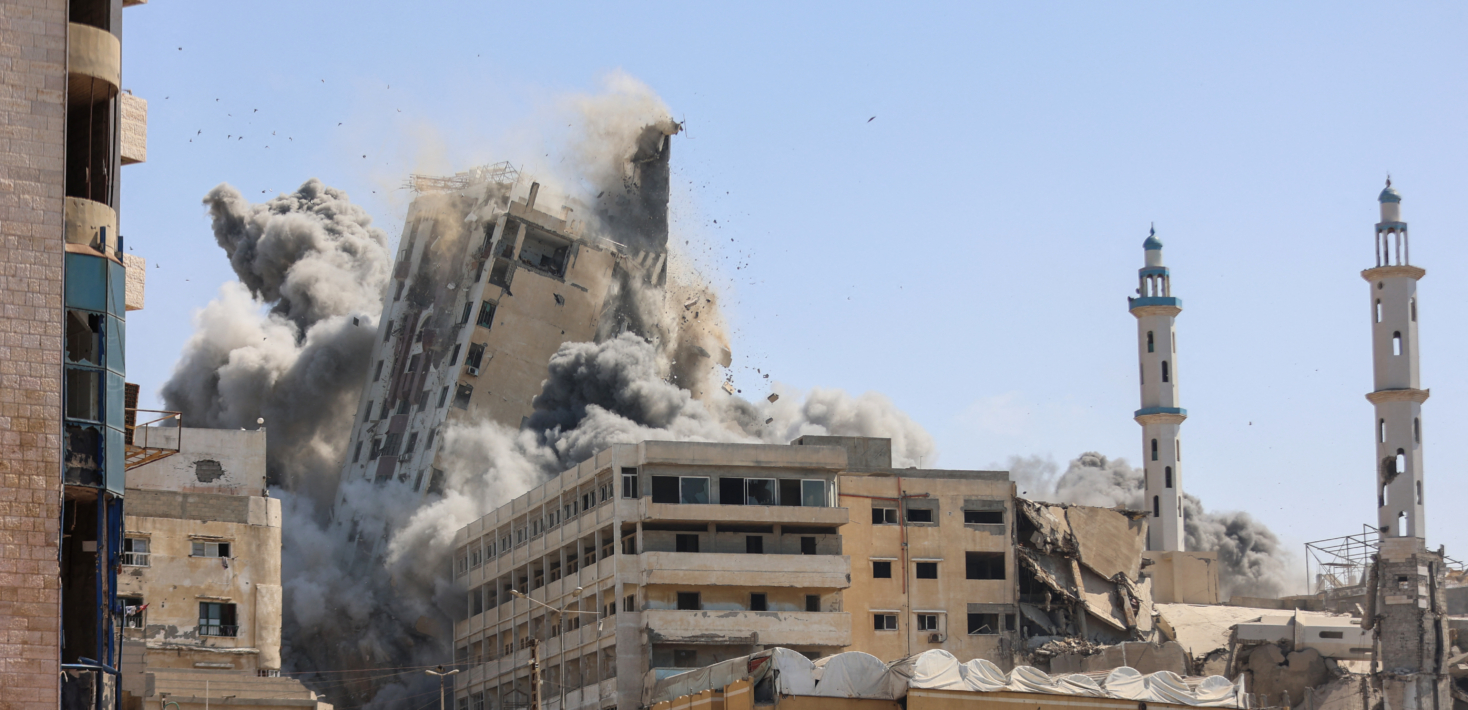


Israel’s unlawful and wanton destruction of civilian high-rise buildings continues to have devastating consequences for displaced Palestinian families in the occupied Gaza Strip, where reconstruction remains a distant dream amid ongoing genocide and air strikes despite the October 2025 so-called ceasefire, said Amnesty International today.
To illustrate the gravity of the wanton destruction that Israeli forces have wreaked on Gaza, Amnesty International today releases an investigation of the Israeli military’s levelling of at least 13 multi-storey residential and commercial buildings across Gaza City between September and October 2025. The organization found that the Israeli military severely damaged and destroyed the high-rise buildings, which housed thousands of people – many of them internally displaced – by dropping multiple bombs on each building after forcing residents to leave with almost no notice, and called them to be investigated as the war crimes of wanton destruction, collective punishment and direct attacks on civilian objects.
Statements by Israel’s Defence Minister Israel Katz in the immediate aftermath of some of the incidents of destruction offer further evidence that the buildings were not destroyed for reasons of imperative military necessity but rather to inflict collective punishment and widespread devastation on the civilian population as means of exerting political pressure on Hamas and as part of a mass forced displacement campaign.
“In the month preceding the so-called ceasefire in October 2025, Israel expanded and escalated its relentless assault on Gaza City, causing one of the worst waves of mass displacement during the genocide. A key pattern of this assault was the deliberate destruction, through aerial bombardment, of multi-storey civilian buildings, levelling the homes of thousands of civilians, and destroying makeshift camps in their vicinity. All the available evidence indicates that Israel’s destruction of these 13 high-rise buildings was not ‘rendered absolutely necessary by military operations’ and as such must be investigated as war crimes,” said Erika Guevara Rosas, Amnesty International’s Senior Director for Research, Advocacy, Policy and Campaigns.
All the available evidence indicates that Israel’s destruction of these 13 high-rise buildings was not ‘rendered absolutely necessary by military operations’
Erika Guevara Rosas, Amnesty International’s Senior Director for Research, Advocacy, Policy and Campaigns
“The destruction of these high-rise buildings in Gaza City is part of a broader pattern of relentless destruction of critical infrastructure, which, alongside repeated waves of mass displacement under inhumane conditions and the denial of life-saving humanitarian aid, had been key features of Israel’s genocide, amounting to the prohibited act of deliberately inflicting on Palestinians in Gaza conditions of life calculated to bring about their physical destruction, in whole or in part.”
Amnesty International interviewed 16 former residents and others displaced by the destruction as well as witnesses, and the organization’s Crisis Evidence Lab analysed satellite imagery and verified more than 25 videos to reveal a chilling pattern of deliberate destruction of the civilian structures by Israeli forces without requisite military necessity, as required by international humanitarian law. Amnesty International sent questions regarding the strikes and statements made to the Israeli defence ministry on 19 March 2026, but had not received a reply by the time of publication.
Amnesty International had previously documented a pattern of Israeli destruction of civilian areas between December 2023 and May 2024 without imperative military necessity during efforts to expand a “buffer zone” along the eastern perimeter of Gaza. The organization also verified through satellite imagery and video footage how Israeli forces completely razed what remained of the town of Khuza’a in southern Gaza over the course of two weeks in May 2025.
Since the so-called ceasefire in October 2025, Israeli forces have continued to carry out demolitions of homes and other buildings in areas over which they already exert full operational control east of the so-called “yellow line”. These are areas which Palestinians are prohibited from returning to and comprise more than 55% of Gaza’s total area. The boundaries of the “yellow line” are vague and constantly redrawn by the Israeli military.
“The impunity Israel has enjoyed in Gaza has given it free rein to repeat unlawful patterns elsewhere, most notably in Lebanon, where Israel’s defence minister invoked Gaza in his threats to accelerate the destruction of southern border villages. The Israeli military has already extensively destroyed thousands of civilian facilities, including homes, parks and football pitches across Lebanon,” said Erika Guevara Rosas.
The Fourth Geneva Convention prohibits collective punishments as well as the destruction of property by the occupying power “except where such destruction is rendered absolutely necessary by military operations”. International humanitarian law also prohibits attacks targeting civilian objects. “Extensive destruction and appropriation of property, not justified by military necessity and carried out unlawfully and wantonly” is a grave breach of the Fourth Geneva Convention, and a war crime. Intentionally directing attacks against civilian objects and carrying out collective punishments also are war crimes.
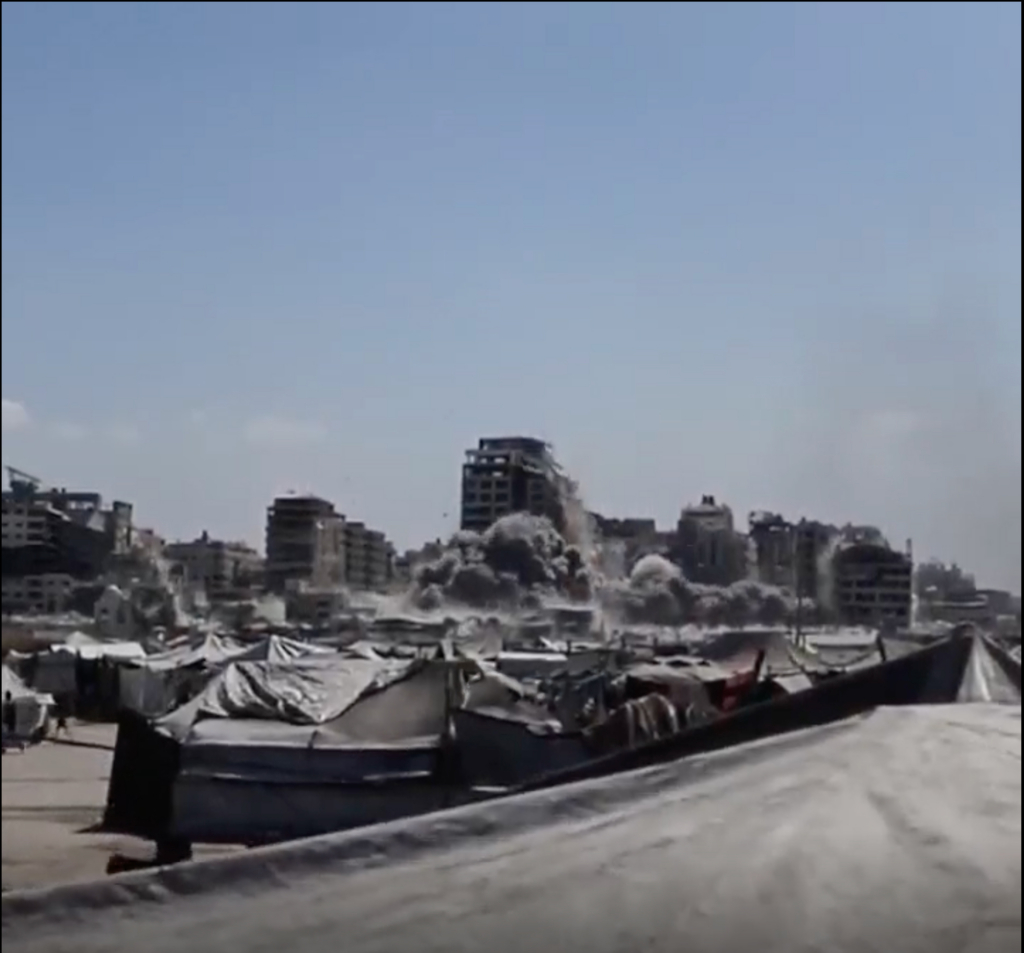
“These demolitions did not just level concrete; they reduced to rubble the homes, lives and memories of their residents, turning to ruins and dust some of Gaza City’s most distinguished urban landmarks. For Palestinians not allowed to return to their homes east of the so-called yellow lines, despite setting up their tents in the closest point possible on the other side, the ongoing bulldozing of their homes and lands have become a daily painful soundscape to a life where the fire never really ceased,” said Erika Guevara Rosas.
Officials celebrating destruction
In August 2025, Prime Minister Benjamin Netanyahu announced that Israel was accelerating military operations to pressure Hamas during ongoing ceasefire negotiations. Shortly thereafter, on 5 September 2025, the targeting of the high-rise buildings, known locally as towers, began as the Israeli army significantly escalated its military offensive to take over Gaza City.
On that same morning of 5 September, Defence Minister Katz stated on social media that “the bolt has been removed from the gates of hell” and explicitly linked the strikes to a requirement that Hamas accept Israel’s conditions.
This candid admission stands in stark contrast to Israeli forces’ usual claims – in these and many other cases without presenting any evidence – that buildings are targeted due to the presence of Hamas fighters or infrastructure.
For example, ahead of launching its tower-destruction campaign in Gaza City on 5 September, the Israeli military claimed that “in preparation for intensifying the assault against Hamas in Gaza City, the IDF, led by the Southern Command, conducted comprehensive intelligence research and identified significant Hamas terrorist activity within a wide range of infrastructure in Gaza City particularly in high-rise buildings.” The Israeli military failed to provide evidence for such claims.
In subsequent statements, Katz continued to threaten that Gaza would be destroyed if the hostages were not released and Hamas did not disarm, clearly indicating that the destruction was carried out to pressure Hamas rather than due to imperative military necessity during battlefield operations.
Today, a massive hurricane will hit the skies of Gaza City and the roofs of the terror towers will tremble
Israel Katz, Israel’s Defence Minister, in a post on his official X account on 8 September 2025
For example, on 8 September 2025, Katz posted on his official X account: “Today, a massive hurricane will hit the skies of Gaza City and the roofs of the terror towers will tremble. This is a final warning to the Hamas murderers and rapists in Gaza and in luxury hotels abroad: Release the hostages and put down your weapons – or Gaza will be destroyed and you will be annihilated.”
In other statements posted to his X account, Katz commented on the destruction of high-rise buildings and other civilian structures in a celebratory and gleeful tone and suggested that the destruction was carried out to “eliminate incitement,” which in itself cannot be considered to constitute an imperative military necessity that can justify the destruction of civilian property under international law.
For instance, on 14 September, he wrote, following an air strike on the Islamic University of Gaza: “The ‘Islamic’ university in Gaza is soaring to the heavens. Eliminating the sources of incitement and terrorism.”
He echoed this statement in a social media post celebrating the destruction of Al-Ghofari tower one day later: “The terror tower of Burj al-Ghofari crashes into the sea of Gaza. We are drowning the hotbeds of terrorism and incitement.”
“By explicitly linking the destruction of homes to political demands, the Israeli authorities, represented by the defence minister, have effectively admitted to using civilian suffering as a bargaining chip and collectively punishing the civilian population rather than carrying destruction justified due to imperative military necessity,” said Erika Guevara Rosas
No evidence of military objectives
Meanwhile, the Israeli military failed to provide sufficient evidence to substantiate their claims that the targeted towers were used by Hamas or other Palestinian armed groups for military purposes. Instead, a review by Amnesty International of the official page of the Israeli military found that a general standard comment by the Israeli military’s spokesperson was used following the destruction of each high-rise building, often failing to specify the targeted building or more specific details beyond the standard remark which reads:
“The IDF, led by the Southern Command, struck a high-rise building used by Hamas in Gaza City. Hamas terrorists had installed intelligence gathering equipment and established observation posts within the building to track IDF movements and facilitate terror operations against the State of Israel and against our forces. Prior to the strikes, measures were taken to mitigate to the extent possible the risk of harming civilians, including advance warning to the population, the use of precision-guided munitions, aerial surveillance and additional surveillance.”
Amnesty International wrote to the Israeli military on 19 March 2026 to ask what the reasons for the attacks on each of these particular buildings at the times they were attacked were and who and/or what the intended targets of these attacks were, but did not receive a reply.
The organization’s research did not find any evidence to indicate any fighters were using or staying in the buildings nor any evidence of military activity at these sites at the time the towers were destroyed, contradicting the Israeli military’s generic claims. Nor did the Israeli military present evidence that there were any other reasons that would meet the requirement that the destruction of these building was rendered absolutely necessary by military operations. While towers may hold strategic value during combat operations in urban areas, this potential future use does not rise to the legal requirement under international law of “imperative military necessity” to make the buildings’ destruction a proportional act.
Sowing panic
In most cases where high-rise buildings were destroyed, the Israeli army called one of the residents of the building they were about to bomb ordering him to warn residents or neighbours to leave the buildings at once or within a few minutes. The warnings caused mass panic, forcing thousands to flee in terror leaving behind all their belongings.
One resident, a university professor living at Mushtaha Tower 6, in the Rimal neighbourhood of Gaza City, described the terror of trying to evacuate the 76 families who lived in the building – some of whom were also hosting displaced relatives – after he received a warning call from the Israeli military.
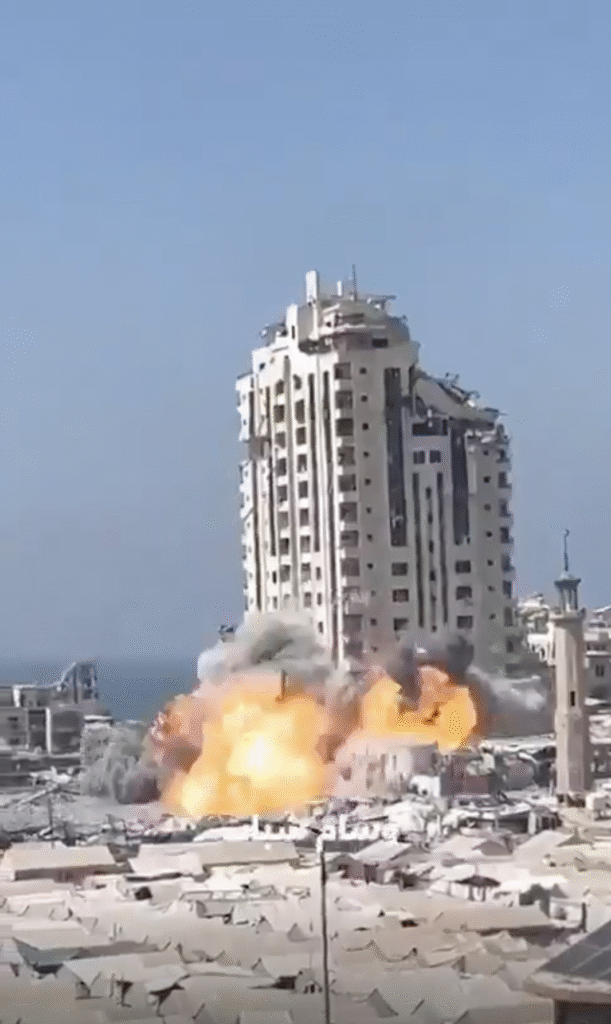
He said: “You cannot imagine how I felt and the panic which ensued… We had no time to take anything. My parents are old, my father is 85 and is unable to walk. We lived on the eighth floor and I had to get some neighbours to help carry him downstairs. My children are young, the youngest only two years and also needed to be carried.
“Once we were out, we stood outside waiting and in the end it took a long time, maybe two hours, before the building was bombed. Had we known we could have taken some things with us. But once we were out, we could not dare to go back in. It was too dangerous.”
Many families had only recently returned home from the south during the January 2025 truce to repair their damaged apartments, only to see them completely destroyed months later.
The university professor described the impact on his seven-year-old son, Ibrahim, who was beside him when he got the call warning the building would be bombed and was left traumatized:
“Now he is obsessed with the phone. He checks all the time that the phone is working because he is afraid that somebody may call once more to tell us that the place where we are staying is going to be bombed.”
An attack the following day on 6 September 2025 led to the destruction of the 15 storey al-Soussi Tower in the industrial area of the west of Gaza City.
Mariam, who was staying with relatives in one of the apartments in al-Soussi Tower said residents were given 20 minutes to leave the building before it was bombed: “Suddenly people were screaming to get out immediately…everyone scrambled to get out without any time to take anything. People were stumbling over each other in the rush to get out.”
The Israeli military’s spokesperson posted the above-mentioned standard claim at 1.28pm to justify the destruction, without specifying the building or giving further details or any evidence. The date and time of posting the comment suggests that the military was indeed referring to the Soussi Building, but Amnesty International could not verify the presence of any military targets in the vicinity.
Israel also destroyed buildings housing civil society and media infrastructure, such as the al-Roya tower, which contained the headquarters of the Palestinian Centre for Human Rights (PCHR), and the al-Ghofari Tower, Gaza’s tallest building which housed many commercial offices, including the office of the Lebanese media outlet Al Mayadeen.
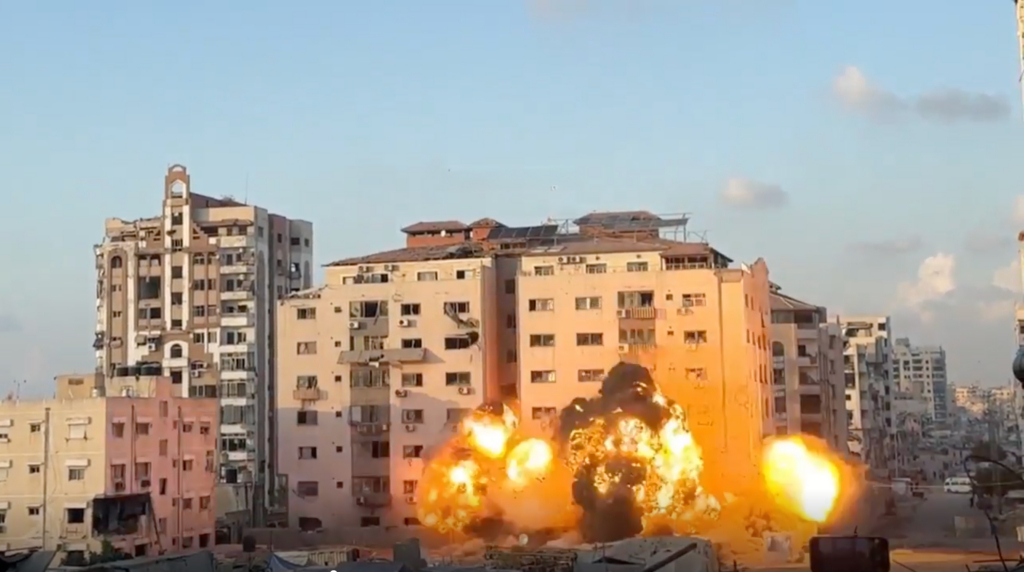
A 17-storey Italian Tower complex, a landmark building rebuilt with Italian government funds in 2023, was also destroyed on 26 September despite being empty and locked. The standard justification was posted on the Israeli military’s official page that day, again without specifying the building or offering any evidence.
A 32-year-old IT engineer who lived with his wife and three children on the fifth floor of Al-Najm building, a 10-storey building in Market Street in the al-Shati refugee camp in Gaza City, told Amnesty International that at around 6pm on 11 September, one of his neighbours shouted to the residents to get out immediately because the building would be bombed in five minutes: “I was at home with my wife and our three children, the youngest only eight months old, when the neighbours started to scream and scramble to get out of the building. There was no time to collect any of our belongings. We took our children and rushed downstairs with only the clothes on our back.”
He described how the family are now living in a tent in Khan Younis in southern Gaza in dire conditions: “Our children are sick from the rain and cold. It is especially difficult to raise a baby in such disastrous conditions. We lack everything. My other children, a six-year-old girl and a seven-year-old boy, are traumatized; we had to run away from home and they saw it bombed into rubble in front of their eyes. They don’t understand and I can’t explain it to them.”
Another resident, a 33-year-old driver and father of three, told Amnesty International that at the time of the destruction there were 16 people staying at his home as he was hosting his displaced parents, two of his brothers and their wives and five children.
Israeli officials who ordered unlawful destruction, collective punishment or acts of genocide must be held accountable
Erika Guevara Rosas
“The widespread destruction of life-sustaining infrastructure, including homes, either through bombardment or demolitions with explosives, combined with Israel’s ongoing restrictions on the entry of shelter material into Gaza and the prohibition on the return to the areas east of the yellow line, have inflicted catastrophic suffering on Gaza’s population. Israel must allow immediate, unfettered access to indispensable aid and goods, including shelter material. Israeli officials who ordered unlawful destruction, collective punishment or acts of genocide must be held accountable,” said Erika Guevara Rosas.
Background
According to the final Gaza Rapid Damage and Needs Assessment, jointly conducted by the World Bank, Eu and UN and published on 20 April, approximately 371,888 homes across the Gaza Strip – over 76% of total homes – were damaged or destroyed in the first two years of the genocide, forcing 60% of Gaza’s total population to continue living without homes in an ongoing mass displacement under inhumane, unsafe and insanitary conditions.
According to an analysis by UNOSAT, the UN Satellite Centre, based on satellite imagery collected on 22-23 September 2025, 83% of structures in Gaza City were damaged or destroyed, indicating a 37% increase compared to the assessment conducted two months prior. This reflected the escalation of the military assault on Gaza City in mid-August.