


On 11 May the EU will face a defining test of its values, principles, and commitment to human rights and international law. As public, political, and diplomatic pressure continues to mount, EU foreign ministers have a choice: continue Israel’s red-carpet treatment, or start enforcing the bloc’s red lines, which Israel has made a mockery of, particularly since October 2023.
There is no shortage of tools at the EU’s disposal to put concrete pressure on Israel but there has been a staggering deficit in political will. At a bare minimum, the EU must suspend the EU-Israel Association Agreement with its trade privileges if it is to demonstrate its seriousness about addressing the decades-long impunity Israel has enjoyed. If the EU fails to do so, it risks complicity in Israel’s ongoing genocide, unlawful occupation and apartheid.
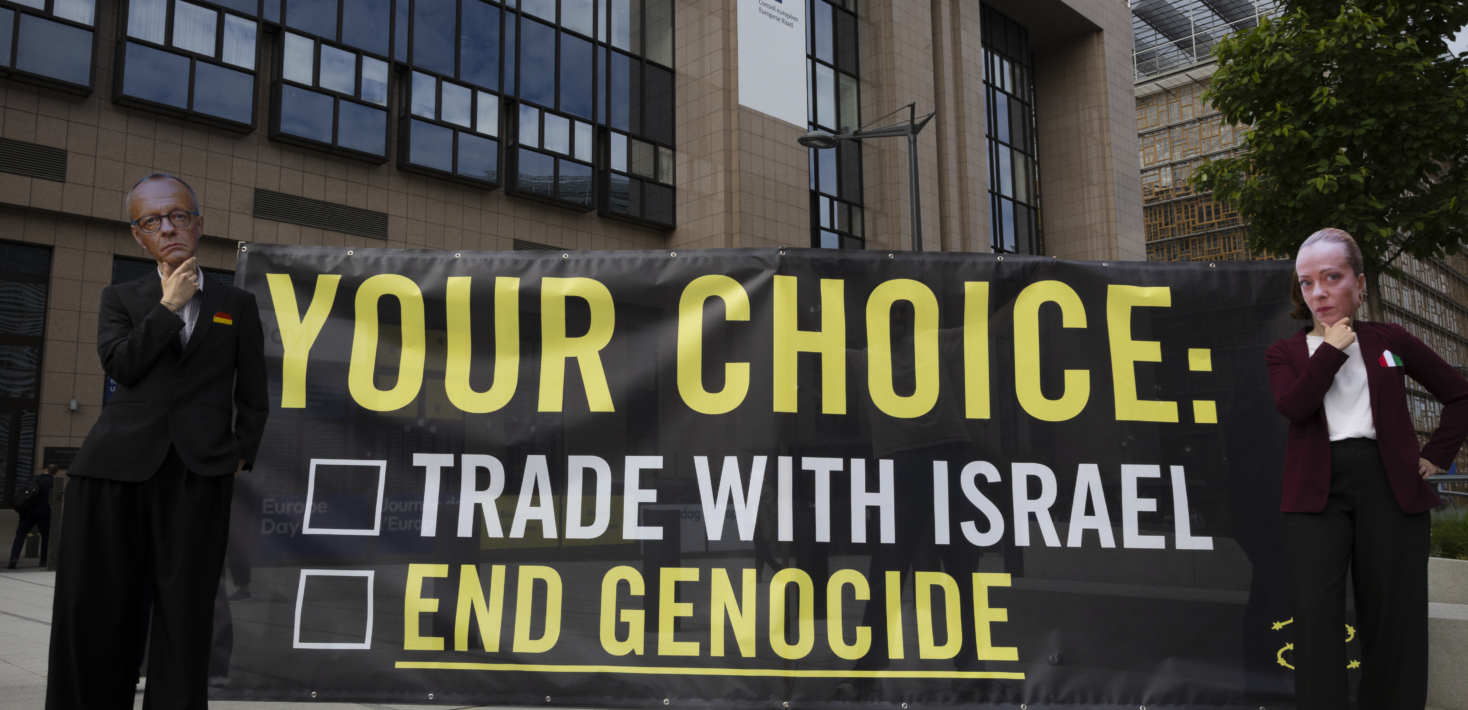
Two member states hold the key: Italy and Germany. Both play a central role in blocking the suspension of the EU trade agreement with Israel and in shielding Israel from meaningful consequences for its crimes against Palestinians. In the complex voting system among EU member states, the support of either of the two states would sway the vote towards the qualified majority needed for the partial suspension of the Agreement.
The EU–Israel Association Agreement, which entered into force in 2000, provides a legal and institutional framework for political dialogue and economic cooperation, granting Israel privileged access to EU markets. Today, the EU remains Israel’s largest trading partner; in 2024 alone, Israeli exports to the EU accounted for 28.8% of its total exports.
Israel has long been in breach of Article 2 of the Agreement, which establishes that respect for human rights is an essential element of the partnership – a fact belatedly acknowledged by the European Commission’s own review in June 2025.
In September 2025, following extensive public pressure, President of the European Commission Ursula von der Leyen proposed a partial suspension of the Agreement’s trade-related provisions, alongside targeted sanctions against extremist ministers and violent settlers. Yet even this limited and desperately insufficient proposal continues to be blocked by Germany and Italy, who hold the balance of power in the EU’s majority voting system.
Whatever is left of Europe’s credibility – having repeatedly failed to enforce its own red lines vis-à-vis Israel – is at stake. It can no longer dodge the growing accusations of double standards, particularly when compared to its principled and decisive response to Russia’s war of aggression against Ukraine. The human rights of Palestinians, so routinely trampled upon by Israel, warrant the same rigorous stance.
Escalating violations of human rights and international law
Despite the announcement of a ceasefire in October 2025, Israeli violations of international law and its genocide in Gaza continue unabated.
In the occupied Gaza Strip, during the so-called ceasefire, Israeli military operations have not ceased, killing more than 830 Palestinians, mostly civilians, and continuing to displace over 60% of the population. Most internally displaced people are living in makeshift shelters or partially destroyed buildings amid inhumane conditions, vulnerable to widespread infestations of insects and rats. Israel continues to block or restrict the entry of items indispensable to the survival of civilians, including shelter material, medical supplies, and adequate food and pesticides, along with severe restrictions on the work of humanitarian organizations.
In the occupied West Bank, including East Jerusalem, the situation has also deteriorated sharply. Since 7 October 2023, over 1,080 Palestinians, including at least 235 children, have been killed. Some 45 Bedouin and herding communities have been fully displaced since the beginning of 2023, mostly due to rising state-backed settler violence. In February 2026, the Israeli cabinet approved land registration measures advancing the de facto annexation of the West Bank, in direct violation of the International Court of Justice’s 2024 advisory opinion. On 30 March, the Knesset passed a discriminatory death penalty law, granting itself carte blanche to execute Palestinians convicted of intentional killings while stripping away the most basic fair-trial safeguards. The law triggered strong criticism and outrage in several European countries, including Germany and Italy.
Beyond the Occupied Palestinian Territory, in Lebanon, Israeli strikes since 28 February have killed some 2,700 people and displaced over one million people, while Israeli forces continue to destroy civilian infrastructure and prevent civilians from returning to their homes in southern Lebanon in clear violation of international law.
These ongoing violations reflect a pattern of impunity, enabled in part by hesitant and inconsistent European responses, limited to expressions of concern rather than concrete action. Meanwhile, European states continue selling arms to Israel, with France and Germany the continent’s top exporters in 2024, risking their own complicity in Israel’s ongoing violations. Italy too has continued to transfer arms to Israel under licenses issued before 7 October 2023. It has also failed to prevent arms transfers from other countries to Israel from transiting through Italy.
Mounting public pressure
In mid-April 2026, a European Citizens’ Initiative gathered more than 1 million signatures in a record-breaking three months. Notably, Italy was among the countries with the highest levels of participation. 2025 was a year of mass political and labour mobilization in the country – highlighting the clear gap between government policy and public sentiment.
A similar gap persists in Germany, with surveys showing that a majority of Germans do not support their government’s stance and believe that policy on the Middle East should be guided primarily by international law rather than by legally unfounded ‘reason of state’.
At the same time, more than 75 NGOs, including Amnesty International, have called on the EU to suspend the Agreement. Around 400 former diplomats, ministers, and EU officials have echoed this demand, as have UN experts.
Persistent inaction risks complicity
The Italian government’s position is particularly contradictory. While it suspended its defence cooperation agreement with Israel, it blocks the suspension of the Association Agreement.
Similarly, its recently announced support for restricting imports from Israel’s illegal settlements remains a partial measure that falls short of addressing the scale of the documented violations and cannot substitute for suspending the agreement.
Germany’s position raises equally serious concerns. While its constitutional framework enshrines a commitment to international law, and while Berlin consistently emphasizes the importance of a strong and unified European foreign policy, it is currently undermining both. By blocking consensus, Germany weakens the very unity it claims to defend. Its foreign minister dismisses suspension as “inappropriate” and insists on continued “constructive dialogue” with Israel, undermining momentum for suspending the Agreement.
After repeated rounds of dialogue, many warnings, and escalating Israeli violations without consequence, continued inaction risks complicity.
The EU has a clear obligation to suspend its trade agreement with Israel. Amnesty International is campaigning for Giorgia Meloni and Friedrich Merz to stop greenlighting Israel’s genocide, unlawful occupation and apartheid.
Millions of people around the world are demanding that their leaders act to stop Israel’s violations. Humanity must win.
Signed – Directors of all 21 Amnesty International EU offices
Ileana Bello – Director of Amnesty International Italy
Julia Duchrow – Director of Amnesty International Germany
Carine Thibaut – Director of Amnesty Belgium Francophone
Wies de Graeve – Director of Amnesty International Flanders
Stephen Bowen – Director of Amnesty International Ireland
David Pereira – Director of Amnesty International Luxembourg
Sylvie Brigot – Director of Amnesty International France
Frank Johansson – Director of Amnesty International Finland
Dávid Vig – Director Amnesty International Hungary
Esteban Beltran – Director of Amnesty International Spain
Anna Błaszczak-Banasiak – Director of Amnesty International Poland
Nataša Posel – Director of Amnesty International Slovenia
Christos Dimopoulos – Director of Amnesty International Greece
Anna Johansson – Director of Amnesty International Sweden
Vibe Klarup – Director of Amnesty International Denmark
João Godinho Martins – Director of Amnesty Portugal
Shoura Hashemi – Director of Amnesty International Austria
Dagmar Oudshoorn – Director of Amnesty International Netherlands
Rado Sloboda – Director of Amnesty International Slovakia
Nayden Rashkov – Director of Amnesty International Bulgaria
Lucie Laštíková – Director of Amnesty International Czechia