
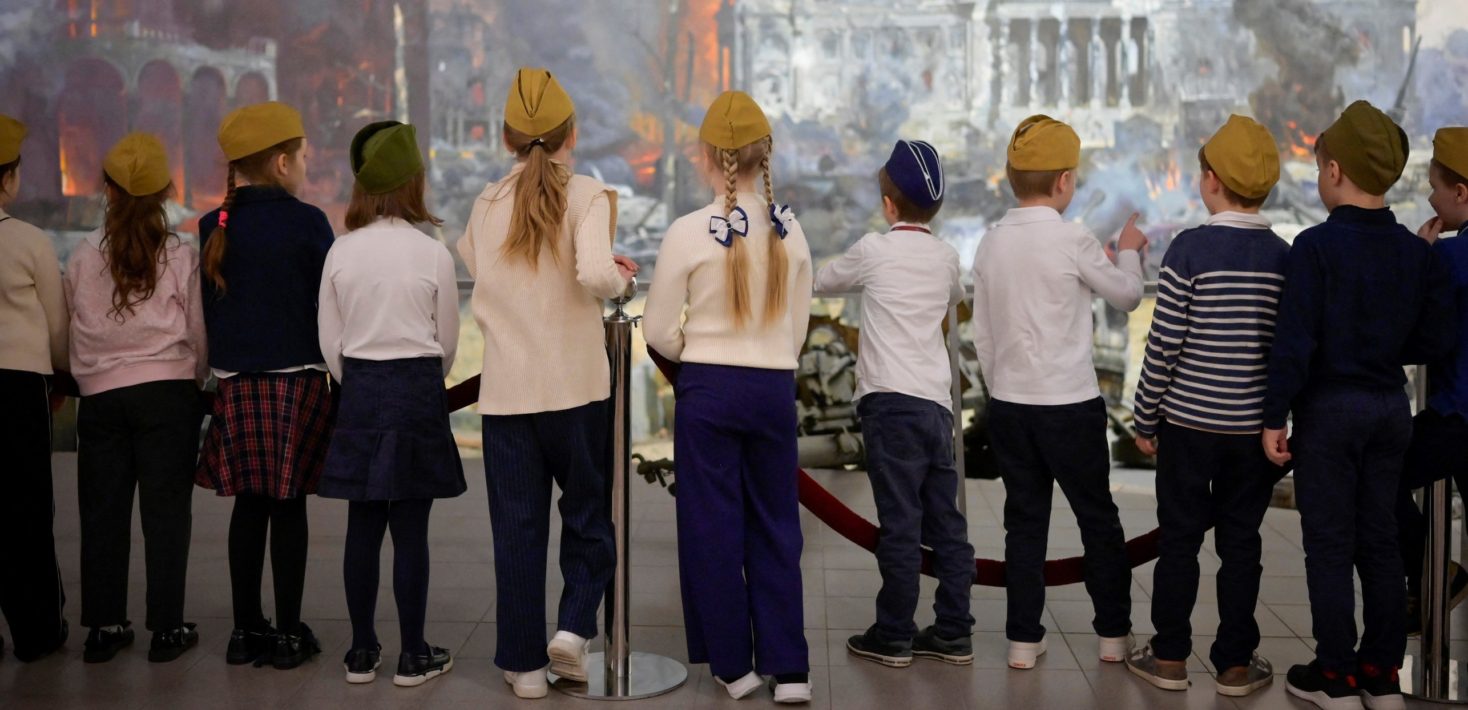


The Russian authorities are denying children their right to quality education by using propaganda-filled textbooks and lectures to indoctrinate children and justify Russia’s war of aggression against Ukraine, while suppressing free expression, independent thinking and access to information, Amnesty International said today.
A new briefing, “Only Official Sources”: Indoctrination in the Russian Educational System, documents how children across Russia and Russian-occupied Ukraine are being subjected to oppressive state ideology via a centrally controlled curriculum. It also details how teachers are instructed to monitor their students online, collect files with information about their opinions and report dissenting views on political and social issues to the authorities.
“Russian schools are being converted from temples of knowledge into factories of compliance. It is the Russian state itself which defines what children must learn about Russia, its neighbours, and the rest of the world. While using schools for political propaganda is not unique to Russia, the intensity and scale of the Kremlin’s efforts to put indoctrination at the centre of the education system are systemic,” said Marie Struthers, Amnesty International’s Director for Eastern Europe and Central Asia.
While using schools for political propaganda is not unique to Russia, the intensity and scale of the Kremlin’s efforts to put indoctrination at the centre of the education system are systemic
Marie Struthers, Amnesty International’s Director for Eastern Europe and Central Asia
“Russian textbooks present a single view of history, which justifies any decision taken in Moscow to use force against its neighbours. They portray Russia’s ongoing aggression against Ukraine as an historic necessity and a matter of national survival, while any alternative opinions are vilified as ‘hostile’ or ‘destructive’,”
One worldview, uniform teaching
Since 2023, the Russian Ministry of Education has introduced a single mandatory set of history textbooks and teaching materials which portray Russia akin to a “besieged fortress,” deny or diminish Ukrainian identity and statehood, and present all Soviet and Russian military interventions as necessary or legitimate.
Education cannot meet human rights law and standards when it is designed to deprive children of the opportunity to form their own opinions and learn independent, critical thinking at a formative age. Russia’s approach violates its obligations under a number of international human rights treaties including the Convention on the Rights of the Child, which requires education to be directed to “the development of respect for human rights and fundamental freedoms” and to prepare children for responsible life in a free society, in the spirit of “understanding, peace, tolerance, equality of sexes, and friendship among all peoples.”
Russia’s attempts to groom an obedient, unquestioning student population are reinforced through coercion, monitoring and profiling.
“Russian authorities are introducing so-called ‘profilaktika’ measures that involve not only spreading propaganda but also constant clandestine monitoring of students, both in and out of schools, including online. While it is done ostensibly to prevent ‘extremism’, ‘terrorism’ and ‘destructive ideologies’, in practice these guidelines encourage screening of children’s political, religious and personal views,” said Marie Struthers.
From safeguarding to surveillance
Schools are being encouraged to identify students and staff members whose opinions, online activity and associations express or disloyalty or susceptibility to “destructive” influences – which are so broadly defined that they include peaceful opposition and civil society groups. Among them are the late Aleksei Navalny’s Anti-Corruption Foundation, the youth protest movement Vesna and the non-existent “International LGBT movement” – an invented legal construct used to criminalize LGBTI activism, – which have all been criminalized solely for speaking up for human rights.
Even exhibiting forms of dissent not formally prohibited in Russia, such as discussing the war in Ukraine’s negative impact on living standards, may be viewed as a red flag that leads to students being labelled “at risk” with their views on the war, “traditional values” and state policy recorded and referred to school administrations, police or security services.
“Russian authorities have shown no limit to the lengths they will go to impose their deeply politicized, ideological narrative on the next generation, and to ensure those who do not comply are detected and disciplined. This violates children’s rights to privacy, freedom of expression and association, and undermines trust within schools and robs children of their individuality,” said Marie Struthers.
“A child’s mind is not the state’s property. Nonetheless, the Russian authorities appear to be treating classrooms as soil to be inspected for the first shoots of civic dissent, so that they can be uprooted before they grow.”
A child’s mind is not the state’s property. Nonetheless, the Russian authorities appear to be treating classrooms as soil to be inspected for the first shoots of civic dissent, so that they can be uprooted before they grow
Marie Struthers, Amnesty International’s Director for Eastern Europe and Central Asia
Amnesty International is calling on the Russian authorities to ensure that the school curriculum, textbooks and other educational material do not stifle or prevent free expression and free exchange of views, contain disinformation or undermine respect for human rights. Students and teachers must be given access to a broad range of sources and be able to freely discuss history and current events without fear of reprisal.
Authorities must repeal laws and regulations that punish peaceful expression or exclude dissenting voices from education; immediately stop unlawful monitoring and profiling of children and educators, destroy unlawfully collected data, provide effective remedies and reparation to those affected, and bring those responsible for violations to account.
Amnesty International also calls on the international community to raise these issues with Russian authorities in all forums; support independent civil society’s work combating propaganda and persecution in education; help those facing such persecution, including by providing them visas where necessary; and ensure that development assistance is not used to perpetuate these violations.