


Artillery attacks by Ethiopia’s military and its allied Tigray Peace Forces (TPF) that killed dozens of civilians and injured many more in the city of Alamata in the northern region of Tigray, between 26 and 28 September, must be investigated as possible war crimes, Amnesty International said today.
The organization also found that forces affiliated to the Tigray People’s Liberation Front (TPLF), put civilians in harm’s way by establishing military bases in populated residential areas, including in several schools in Alamata, prior to the outbreak of renewed fighting in the region.
The Ethiopian National Defense Forces (ENDF) and its TPF allies seized control of the strategic city of Alamata, a key supply hub for troops, food, and fuel, from the TPLF on 28 September.
“For three consecutive days, the ENDF and TPF repeatedly shelled Alamata in total disregard of the lives of its 80,000 inhabitants. The use of artillery, a weapon with wide-area effects, in densely populated neighbourhoods has a terrible impact on civilians. Indiscriminate attacks violate the rules of international humanitarian law, and these strikes must be investigated as war crimes,” said Yasmine Ahmed, Amnesty International’s Senior Director, Regional Human Rights Impact.
“For three consecutive days, the ENDF and TPF repeatedly shelled Alamata in total disregard of the lives of its 80,000 inhabitants.
Yasmine Ahmed, Amnesty International’s Regional Director for Human Rights Impact
Amnesty International investigated four incidents of artillery shelling on Alamata by the ENDF and TPF between 26 and 28 September and independently verified the deaths of 14 civilians in these attacks. Researchers interviewed 28 individuals, including survivors, witnesses, relatives of victims, humanitarian and medical personnel. Amnesty International’s Evidence Lab analysed eight videos and 17 photographs, as well as satellite imagery of the site and other open-source information.
All names and identifying details have been withheld or changed to protect interviewees who requested anonymity.
Amnesty International wrote to the ENDF, TPF, and TPLF on 27 October, requesting information about these incidents. On 17 November, the organization shared its investigation findings with the ENDF and TPF and invited their comments. ENDF and TPF had not provided a response as at the time of publication.
The use of artillery, a weapon with wide-area effects, in densely populated neighbourhoods has a terrible impact on civilians. Indiscriminate attacks violate the rules of international humanitarian law, and these strikes must be investigated as war crimes.
Yasmine Ahmed
In a four-page letter sent to Amnesty International on 18 November, the TPLF “categorically reject[ed]’’ the allegations made against it.
“While the preliminary findings acknowledge certain atrocities committed by the Ethiopian Federal Government and its forces we are deeply concerned by the allegations directed against the Tigray Security Forces [TPLF]. We categorically reject these allegations as unfounded and believe that they require further independent, impartial, and comprehensive investigation before any conclusions are drawn regarding responsibility’’ stated the letter sent by the TPLF.
Residential neighbourhoods at the mercy of ENDF and TPF Artillery shelling
Based on interviews with residents and two sources with direct knowledge of military movements during the offensive, Amnesty International identified Waja Ena Tumuga area as the main location from which ENDF and TPF forces shelled Alamata, approximately 13 kilometers south of the city. Two individuals with close knowledge of the TPF’s military capabilities told the organization that the TPF possessed artillery weaponry and participated alongside the ENDF in the operation to capture Alamata. One eyewitness saw ENDF forces moving their artillery into Waja, particularly the area that is called Ayer Marefiya.
Witnesses also told Amnesty International that the TPLF based themselves in and, in some instances, launched attacks from densely populated civilian areas in the city.
International humanitarian law requires all parties to a conflict to avoid, to the maximum extent feasible, placing military objectives within or near densely populated areas. They are also obliged to protect civilians from the effects of attacks by facilitating the evacuation of civilians from the vicinity of military objectives and giving effective warning of attacks that may affect the civilian population.
Any possible violation of international humanitarian law by TPLF through placing their forces and military objects inside densely populated neighbourhoods, does not absolve the ENDF and its allies of their obligations and can never justify the indiscriminate use of explosive weapons, such as artillery, in a densely populated area.
Yasmine Ahmed
Even though TPLF fighters possessed artillery capabilities and were actively launching artillery, it is highly unlikely that the shelling of Alamata was caused by direct shelling from their own forces within the city. While the possibility of technical failures cannot be fully dismissed, the likelihood of such a scenario is extremely low.
“Any possible violation of international humanitarian law by TPLF through placing their forces and military objects inside densely populated neighbourhoods, does not absolve the ENDF and its allies of their obligations and can never justify the indiscriminate use of explosive weapons, such as artillery, in a densely populated area,” said Yasmine Ahmed.
A medical worker, who was on duty in Alamata hospital between 26 and 28 September, told Amnesty International that almost all casualties recorded during those three days were civilians and that most of the injuries appeared to have been caused by shrapnel from explosive munitions.
Indiscriminate attacks on populated areas
One of the neighbourhoods most heavily hit by shelling was an area commonly known as the condominium area in Kebele 04, a densely populated area comprised mostly of houses and two multi-story buildings, which house hundreds of civilians and are adjacent to the single-family homes that were struck. Three eyewitnesses told Amnesty International that artillery struck five houses on 27 September at dawn, killing seven people and injuring four others.
Among those killed was Meron Sewasew, a 26-year-old mother of two, who died inside her home alongside her eight-year-old son, Markon Girmahiwot, and her older brother, Tewekel Sewasew, 33. Meron’s husband, Girmahiwot Negash [real name], said their two-year-old son was also in the house at the time of the attack but survived with minor injuries.
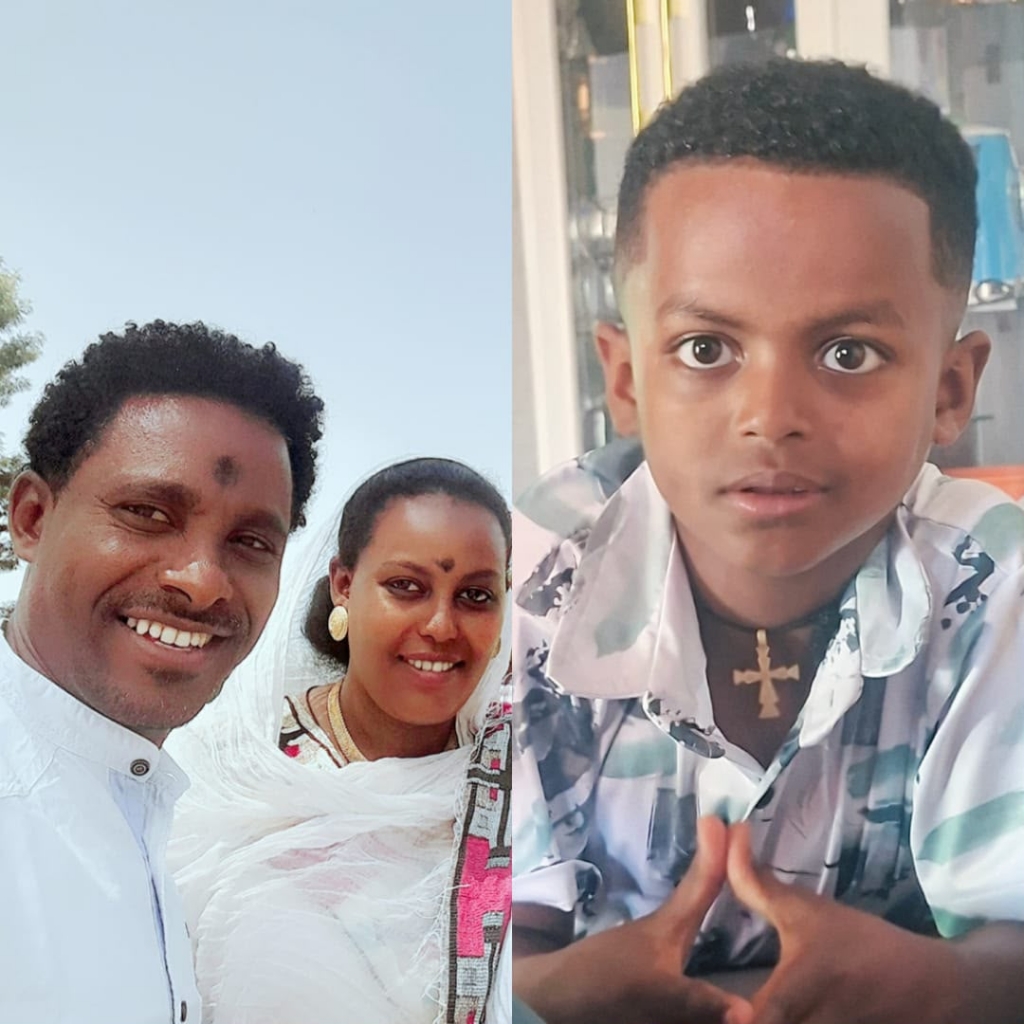
“I was away from the city for work. They were staying in the house because it was supposed to be safe from the war. She was my high school love, and our story ended too soon,” Girmahiwot said.
The same artillery attack also killed four members of a family living next door: Kumhis Kahsay, 40, and her 14-year-old child Helina Hailay, alongside Lezeu Yirga, 38, and her three-year old child.
I was away from the city for work. They were staying in the house because it was supposed to be safe from the war. She was my high school love, and our story ended too soon.
Girmahiwot
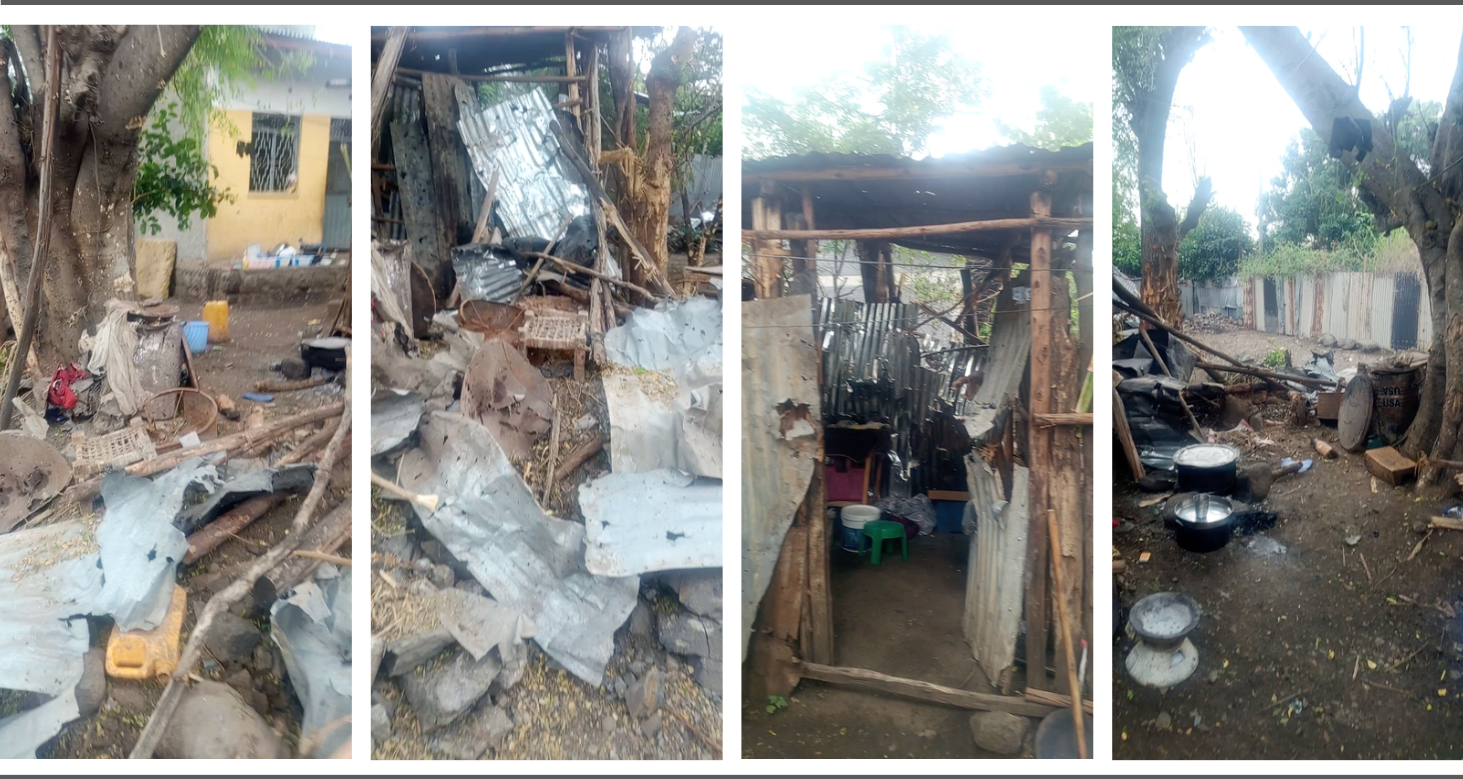
“Kumhis came from church that morning. All of the victims were outside the house doing chores. Kumhis, the older sister, was baking injera in the compound. I was inside the house. The remnants of the strike landed in the compound and struck them,” said a family member who survived the attack.
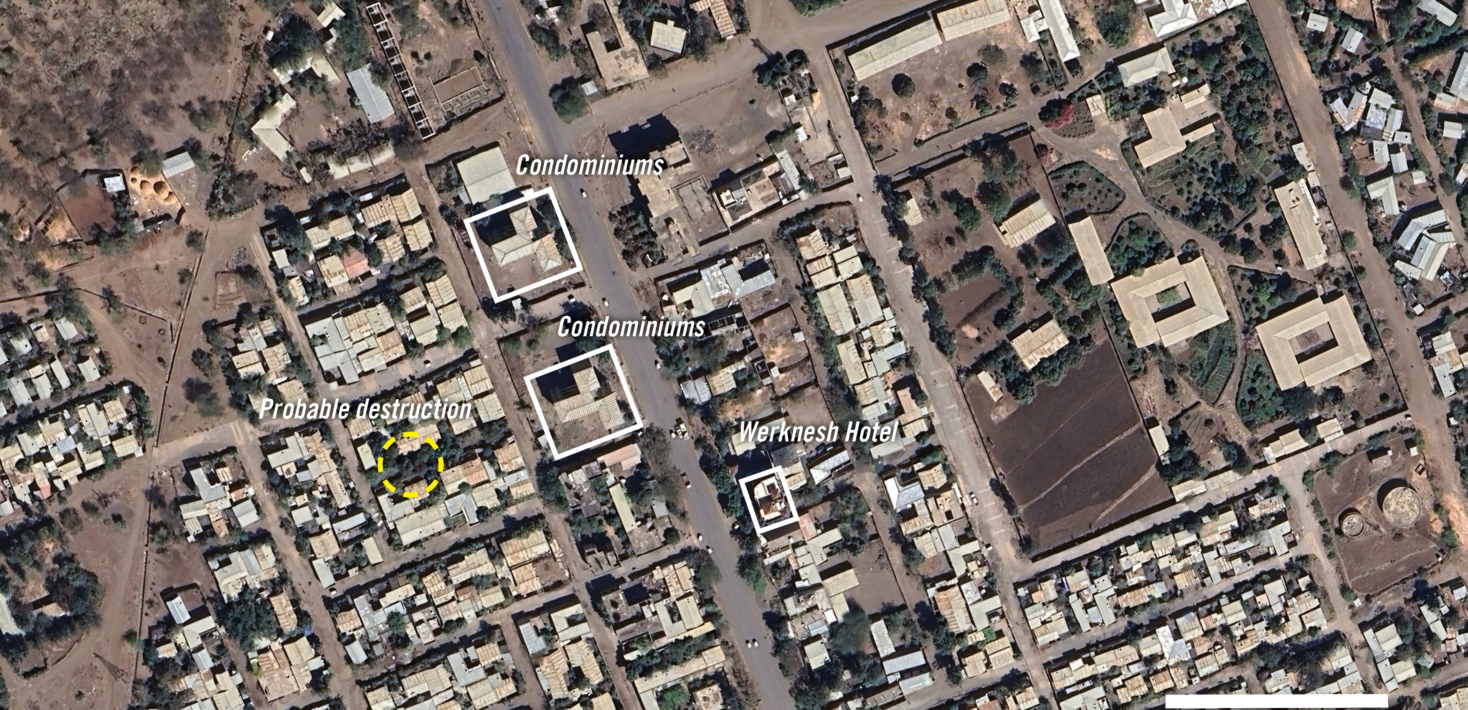
Amnesty International’s Evidence Lab verified four videos that showed damage to the two houses and one external structure within a compound located some 150 meters from Werknesh Hotel, a hotel which residents said had housed TPLF fighters.
“I saw TDF [TPLF] fighters on top of tall buildings with their weapons. They were telling us not to come closer. Some were staying at the Werknesh Hotel…. they were telling people to use a different route,” said an eyewitness who was in the area on 26 September.
Another individual who was near the hotel on the day of the attack told Amnesty International that TPLF fighters were not present near the hotel on the day of the strike. Amnesty International could not independently verify whether TPLF fighters were inside or near the hotel at the time. Three eyewitnesses said that minutes before artillery shells struck nearby residential homes, a separate strike fell just outside the hotel, causing significant damage to its exterior.
 and the Werknesh Hotel (3), where witnesses said Tigrayan fighters had stayed.](https://www.amnesty.org/en/wp-content/uploads/2026/11/Kebele-04-map.png)
The ENDF and TPF also shelled areas where residents said there was no military presence.
On 26 September, artillery hit a local bar called Nigus Shimoy at around 11am, killing at least three people, according to a survivor who was injured in the attack and one witness. The bar is located at the entrance of a bustling market in a predominantly commercial area, bordering residential neighbourhoods. The attack took place as people came out en masse to celebrate Demera, the eve celebration of Meskel (Finding of the True Cross) holiday of the Ethiopian Orthodox Christians.
I saw TDF [TPLF] fighters on top of tall buildings with their weapons. They were telling us not to come closer. Some were staying at the Werknesh Hotel…. they were telling people to use a different route.
Eyewitness
On 27 September, shelling hit a family home in another residential area, Kebele 02. Deyima Rebso, 55, was killed immediately in the attack in her home, while her husband, Ararse Yasin, 62, survived with severe injuries, according to an eyewitness. Their children, Saliha and Kedir, and grandchild, 10-year-old Sufiyan Abdulatif, also sustained serious injuries. Amnesty International’s weapons investigator identified munitions fragments recovered at the scene as consistent with an artillery round of the type fired by the ENDF and their allies.
One witness told Amnesty International that the house was the only structure to be struck in the area and that no military activity had been observed in the vicinity prior to the attack.
TPLF set up military bases in schools
Six people interviewed by Amnesty International said almost all schools in Alamata were used by TPLF fighters as military bases in the months before the outbreak of renewed hostilities. Witnesses said several schools, most of which were located close to civilian neighbourhoods, had been the site of military operations, including the launching of artillery shells after the renewed conflict began. All residents interviewed for this research said the TPLF didn’t issue any warnings or evacuation orders for residents near these locations.
On 26 September, an artillery shell struck a house in a highly populated neighbourhood known as Missionary Camp, near to Biruh Tesfa School, which had been used by the TPLF as a base. The attack, which occurred at around 6:45 pm, killed three civilians and injured four others. One witness said most of the fighters had left a week before the fighting broke out. Another saw a few fighters guarding the school in the days leading up to the strike.
Amnesty International could not independently confirm whether the school was ever attacked and whether or not the school was still harbouring fighters by the time of the strike. No damage or destruction was clearly visible in satellite imagery at the Biruh Tesfa school north of the charity compound.
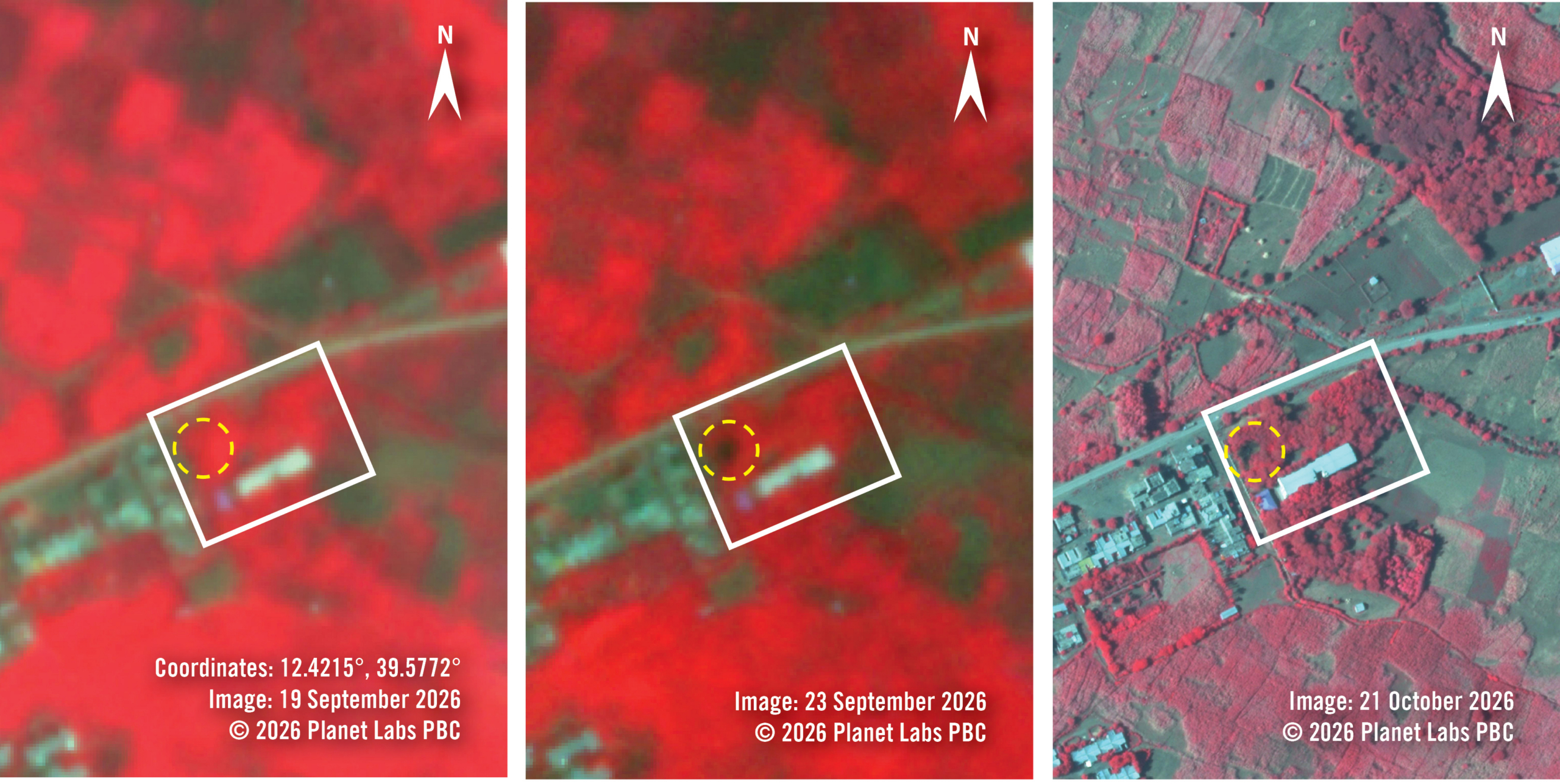
A resident living near Alamata Preparatory School, another school, said that the school was targeted by an ENDF drone strike on 22 September. He said the school had been the main site from which TPLF launched artillery strikes to defend Alamata, until they began withdrawing from the city on 28 September.
“The explosion of weapons after it was hit by drone strikes affected the city, and we also saw some remnants fly by my house. There was artillery inside the school compound. We saw the weapons burning in the school that day,” said the resident.
Satellite imagery confirms a new burn scar became visible adjacent to the school on 22 September, aligning with the reports of a drone strike. Changes in vegetation were also detected around the school between 24 September and 1 October, though high-resolution imagery is not available to confirm the reason for the changes. Higher-resolution imagery from 21 October shows the clearing in more detail, along with a burned area within the trees.
“Civilians are paying the ultimate price for the failure to hold perpetrators accountable in past and ongoing conflicts in Ethiopia. Impunity has emboldened perpetrators to carry on committing serious violations with no fear of the consequences. This must end. The UN Human Rights Council must act fast to establish an independent mechanism to investigate, identify those responsible for crimes under international law, and ensure they are held accountable,” said Yasmine Ahmed.
“Amnesty International also calls on the Ethiopian authorities to cooperate with independent international monitors, journalists, and humanitarian organizations to gain unhindered access to all conflict-impacted areas in the country.
Impunity has emboldened perpetrators to carry on committing serious violations with no fear of the consequences. This must end. The UN Human Rights Council must act fast to establish an independent mechanism to investigate, identify those responsible for crimes under international law, and ensure they are held accountable.
Yasmine Ahmed
“Considering the Ethiopian authorities’ persistent failure to ensure justice and accountability for crimes under international law, particularly where state forces themselves are alleged to have committed serious violations, urgent international scrutiny is needed. This is especially critical given the authorities’ record of suppressing independent human rights monitoring and the fact that Ethiopia is currently facing three ongoing armed conflicts, with growing risks of wider regional escalation’’ said Yasmine Ahmed.
Background
The armed conflict between the ENDF and its allies, including the TPF and other allied security and informal militia forces, and the TPLF and allies, including Amhara Fano forces and six other organized political and armed groups, erupted on 21 September 2026.
Fighting spread across three principal fronts initially: in southern Tigray, particularly the Raya Kobo Zone; western Afar (Zone 2); and the Wag Hemra Zone of the Amhara Region.
Since 21 September, the ENDF has carried out multiple aerial strikes in the southern Tigray, including in and around Alamata city.