


Content warning: This article contains descriptions of violence, including shootings, beatings, torture, sexual violence, and discrimination. It also mentions issues relating to suicide. We include these details to honour the victims and their families, who want the truth to be brought to light.
Protesters in Iran have been killed, tortured or imprisoned in the thousands for demanding their human rights and political change. The officials responsible for protest-related crimes against humanity are evading justice while survivors and relatives seeking justice are persecuted.
In late 2022, Iran was gripped by large-scale protests that became known as the Woman Life Freedom uprising. After years of painstaking investigations, Amnesty International has exposed how the Iranian authorities committed crimes against humanity to crush the uprising. Based on its extensive documentation of the crimes committed and analysis of the security forces’ command structures, Amnesty International has identified 87 officials who must be criminally investigated for their role in these crimes.
It is evident that the Iranian authorities are unwilling to pursue accountability as they rely on a state policy of lethal force to suppress dissent. As such, Amnesty International urges the international community to pursue international criminal justice for repeated mass protest killings in Iran as a matter of urgency. Impunity for these crimes exposes people in Iran to further atrocities, as seen on 8-9 January 2026 when Iranian security forces unlawfully killed thousands of protesters and bystanders. Continued inaction on international justice further entrenches the normalization of mass protest killings in Iran.
Sign the petition
Join our call on UN member states to create an international criminal justice mechanism aimed at prosecuting those implicated in crimes against humanity in Iran.
What happened at the protests in 2022?
The Woman Life Freedom uprising began on 16 September 2022 after the death in custody of a 22-year-old Kurdish woman, Zhina Mahsa Amini, at the hands of the country’s “morality” police who enforced discriminatory compulsory veiling laws.
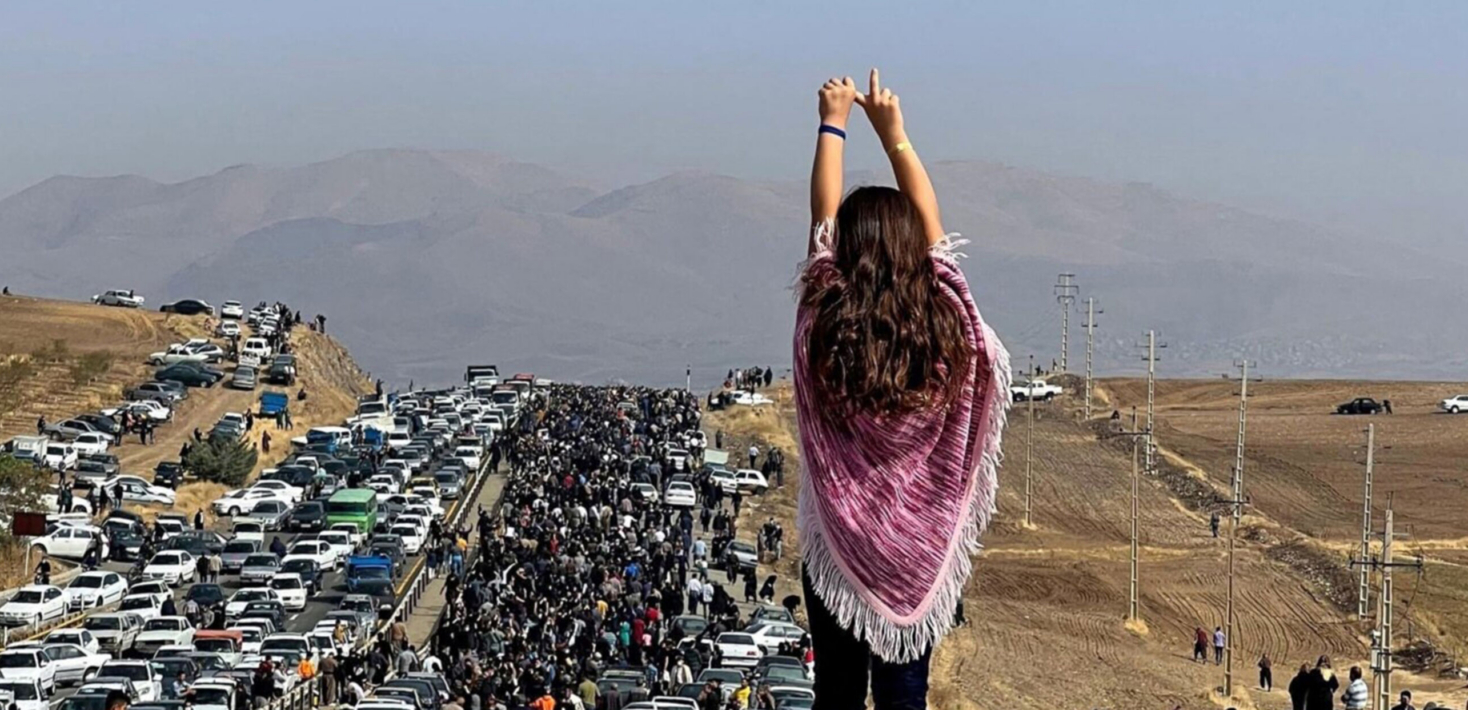
For the next three months, hundreds of thousands took to the streets peacefully protesting decades of repression, discrimination and impunity. Women and girls stood at the forefront of the protests, defying discriminatory laws that for decades enabled state violence, arbitrary detention, torture and other ill-treatment, as well as exclusion from education, employment and public spaces.
Images of women burning headscarves and protesting unveiled reverberated around the world as well as within Iran. The slogan “Woman Life Freedom” soon spread throughout Iran and globally. Authorities responded with deadly violence, with eyewitness descriptions likening the brutality to a war zone wherein security forces repeatedly and mercilessly opened fire on peaceful protesters.
Amnesty International’s investigations revealed that the authorities extensively and unlawfully used military-grade weapons and shotguns loaded with metal pellets to disperse, intimidate and punish protesters and deter others from exercising their right to peaceful assembly. Hundreds of protesters and bystanders, including dozens of children, were unlawfully killed.
Security forces subjected thousands more to arbitrary arrests, incommunicado detention, enforced disappearance, and torture or other ill-treatment. They raped and committed other acts of sexual violence, including against children. They also persecuted the bereaved families of those killed.
What crimes were committed by the Iranian authorities?
Under the Rome Statute of the International Criminal Court (ICC), certain prohibited acts qualify as crimes against humanity when “committed as part of a widespread or systematic attack directed against any civilian population”.
Amnesty International has concluded that the serious human rights violations committed by the Iranian authorities to crush the Woman Life Freedom uprising qualify as the crimes against humanity of:
- murder;
- torture;
- rape;
- sexual violence;
- enforced disappearance;
- imprisonment;
- and persecution on intersecting political, gender, ethnic and religious grounds.
These crimes were carried out as part of a widespread and systematic attack against a civilian population demanding human rights and dignity, as part of a state policy to crush the protests, punish demonstrators and create a climate of terror to deter future protests.
The crime against humanity of murder
Hundreds of protesters and bystanders were unlawfully killed in the lethal crackdown on the Woman Life Freedom uprising.
The real number of victims remains impossible to determine, but following extensive research and investigations, Amnesty International has gathered information and evidence about 377 protesters and bystanders, including 56 children, who lost their lives during the Woman Life Freedom uprising. These deaths fall into four categories:
- Killings during violent protest dispersals and in militarized areas: A total of 326 of the recorded victims were killed by security forces using firearms or other means of lethal force – most of them during protest dispersals. Others were killed by security forces in areas near protests that were ongoing or had recently occurred, or where there was a militarized presence of security forces such as armed patrols, checkpoints, roadblocks, vehicle chases, stop orders or violent raids on people’s homes or workplaces.
- Deaths in state custody: A total of 18 of the recorded victims lost their lives in state custody after they were arrested in the protest crackdowns.
- Post-custody deaths: A total of 10 individuals died after they were released from custody, with reports published by human rights defenders or journalists indicating that their deaths were prison-related, either from physical injuries sustained as a result of torture and other ill-treatment; or by suicide shortly after release.
- Suspicious deaths, often following a period of disappearance: A total of 23 of the recorded victims went missing after participating in or supporting the protests, with no information available regarding the circumstances of their arrest or abduction and eventual death. Numerous indicators suggest that state agents killed the victims.
The crime against humanity of torture
Security forces intentionally inflicted painful injuries on protesters and bystanders through unlawful use of force which amounts to torture. They used firearms such as assault rifles and machine guns, as well as prohibited weapons that should never be used in policing protests, such as shotguns loaded with metal pellets. At least 45 people were killed after security forces fired at them from close range using such shotguns. Many died from their injuries, including on occasions where security forces prevented them from getting to hospitals. Protesters and bystanders who survived were left with severe physical trauma including permanent vision loss and other life-changing injuries.
The Iranian authorities also tortured individuals in state custody. Torture methods included – but were not limited to – physical methods such as beatings and electric shocks, and psychological methods such as threats to rape or to forcibly disappear family members.
The crime against humanity of imprisonment
Tens of thousands of people, some as young as 10-years-old, were arbitrarily arrested during the uprising. Amnesty International’s evidence shows these arrests were overwhelmingly for acts protected under international human rights law, including peaceful protest, chanting, dancing, removing headscarves, writing slogans, sounding car horns, showing solidarity online and, in the case of bereaved families, seeking truth and justice.
In many cases, security forces arrested people without warrants, abducted them, tortured them, and abandoned them in remote areas. Others were eventually registered at detention facilities run by the security forces where they faced further torture and were coerced into writing false “confessions” leading to lengthy prison terms and even the death penalty.
Across all documented cases, arrests and detentions violated the right to a fair trial. Detainees were denied access to lawyers, protection from torture, timely information on charges, the right to silence, the presumption of innocence, as well as the ability to challenge the legality of their detention, adequately prepare their defence and access meaningful appeal.
The crime against humanity of rape and other sexual violence
Amnesty International documented 45 cases of rape and other forms of sexual violence of protesters or bystanders by the security forces. Acts of rape included penetration by wooden and metal batons, glass bottles, hosepipes and/or the sexual organs and fingers of agents. Some were subjected to rape by multiple agents. Acts of sexual violence were committed against women, girls, boys, and men and included physical acts of assault as well as psychological torture such as threats of rape.
Women and girls were groped and beaten, stripped of their clothes (including in front of male detainees), subjected to intrusive body searches, and held naked for hours or days in detention, sometimes in front of video cameras and in freezing conditions. Men and boys were also forcibly undressed, and some were subjected to electric shocks and other forms of torture to their genitals. They and their relatives were threatened with rape.
The crime against humanity of enforced disappearance
Authorities frequently subjected detainees to enforced disappearance for days or weeks by withholding all information about their fate or whereabouts. Some were held in official detention centres; others in unofficial sites such as warehouses, schools and residential buildings colloquially referred to by the security forces as “safe houses”.
Relatives interviewed by Amnesty International described visiting police stations, prosecution offices, Revolutionary Courts and prisons in search of their loved ones. Officials often concealed information despite knowing detainees were in custody or admitted they were detained but refused to disclose their location.
This uncertainty causes immense psychological harm to families, leaving them in anguish over whether loved ones are dead or alive.
The crime against humanity of persecution
Persecution is defined as the intentional and severe deprivation of the fundamental rights of a group, by reason of their identity (based on political, racial, national, ethnic, cultural, religious, gender or other prohibited grounds), and in connection with prohibited acts such as murder, torture, enforced disappearance and imprisonment.
All protesters and their supporters during the brutal crackdown were persecuted on political grounds; women and girls defying compulsory veiling faced persecution on political grounds intersecting with gender and religious grounds; protesters from the Kurdish and Baluchi oppressed minority communities faced persecution on political grounds intersecting with ethnicity; and the families of those killed faced persecution on political grounds.
Targeting Kurdish and Baluchi ethnic minorities
Kurdish and Baluchi victims account for 62% of the total number of recorded victims, despite constituting just 10-15% and 5% of the country’s population, respectively. Amnesty International has found that this disproportionately high toll cannot be explained by protest size alone; patterns of intentional lethal force against these communities were distinct and markedly more severe.
Amnesty International recorded the names of 106 Baluchi protesters and bystanders who were killed by security forces in Sistan and Baluchistan province during protest dispersals. Of those identified, 87 people, including 15 children, were unlawfully killed by security forces in a single day during a lethal crackdown on 30 September 2022 which has become known to Iranians as “Bloody Friday”.
The research also identified 95 Kurdish protesters and bystanders who were unlawfully killed by Iranian security forces in the provinces of Kurdistan, Kermanshah and West Azerbaijan. They comprise 79 men, three women and 13 children. In these three provinces, security forces consistently deployed military-grade firearms.
Who committed these crimes?
The planning, direction, organization and execution of the crimes against humanity committed during the Woman Life Freedom uprising was made possible by a vast, coordinated security apparatus. Amnesty International’s research concludes that the two main security forces responsible for the documented crimes were:
- The Islamic Revolutionary Guards Corps (IRGC): The IRGC branches involved included the operational divisions, the provincial Security Cohorts and various Basij battalions. These IRGC branches operated under the relevant IRGC provincial corps, overseen in turn by a regional IRGC headquarters.
- The Police Command of the Islamic Republic of Iran (known by its Persian acronym, FARAJA): Among the FARAJA branches involved were the Prevention Police, including its Assistance Cohorts, and the Special Cohorts. The Prevention Police carry out regular policing functions, including first response to protests. The Special Cohorts are deployed when protests escalate beyond the capacity of the Prevention Police to disperse.
Both of these forces operated under the General Staff of the Armed Forces, which in turn falls under the command of the Supreme Leader who is the commander-in-chief of all security forces.
Their mandates include the “sacred defence of Islam”, “protecting the achievements of the Islamic Revolution”, “expanding the rule of God’s law”, and “combating elements and movements that disrupt national security”. These forces implemented repressive strategies formulated by the Supreme National Security Council, the State Security Council and provincial and county levels councils. These strategies were enforced through orders from the minister of interior and provincial and county governors.
These broad, vaguely defined mandates patently fail to distinguish between violent acts and peaceful dissent. This gives security forces vast powers to suppress the rights to freedom of expression, association and peaceful assembly, and to use lethal force against those who criticize the ruling establishment, challenge the authority of the Supreme Leader and peacefully advocate alternative secular sociopolitical ideologies.
Who are the 87 commanders and officials Amnesty International says should be criminally investigated for crimes against humanity?
Based on detailed documentation of the security forces involved in the commission of crimes against humanity in Kurdistan, Kermanshah and West Azerbaijan provinces and in-depth analysis of their command structures, Amnesty International has identified 87 individuals who merit criminal investigations. They include 10 officials at national level and 77 other officials at regional, provincial and county level.
Amnesty International used the ‘reasonable grounds to believe’ standard of proof in identifying officials. This means that it was reasonable to believe that these individuals bear responsibility for crimes against humanity, based on the available evidence regarding the authority and control they exercised within the Iranian security forces’ command structure or their essential role in coordinating and facilitating the commission of crimes.
In naming individuals for criminal investigations, Amnesty International considered the following elements:
- the position held by the individual within the hierarchy of Iran’s security apparatus and the specific role they played based on their position;
- the authority and control exercised by the individual as a superior over subordinates;
- the acts carried out by the individual to assist, encourage or lend moral support to the perpetration of crimes against humanity, and the substantial effect that this assistance had on the commission of the crimes;
- public statements made by senior commanders of security forces and Ministry of Interior officials that encouraged or demonstrated support for agents who perpetrated crimes against humanity on the ground;
- leaked official orders that authorized or facilitated crimes against humanity; and/or
- the individual’s link to the crimes against humanity documented.
Amnesty International’s findings are not exhaustive and should not preclude consideration of the role – whether direct or indirect – of other officials it has not named in the commission of crimes.
Is there a connection between the 2022 protests and the protests in January 2026?
Yes, both episodes reflect a recurring pattern of atrocities committed by the same deadly state machinery of repression against a civilian population that has repeatedly taken to the streets to demand human rights, dignity and political change.
Systemic impunity and lack of domestic accountability routes combined with global inaction to pursue international criminal justice paved the way for the January 2026 protest massacres. These unprecedented massacres bore the same hallmarks of the crimes against humanity in 2022, but on an even more staggering scale.
Emboldened by the lack of accountability for previous deadly crackdowns on successive waves of protests, including the Woman Life Freedom uprising, Iranian authorities responded to protests that erupted on 28 December 2025 by unleashing a militarized crackdown.
On 8 and 9 January 2026, as protests spread nationwide on a scale unseen in Iran since the 1979 Revolution, Iran’s security forces used firearms on an unprecedented scale and unlawfully killed thousands of protesters and bystanders. This marked the deadliest protest crackdown in Iran in decades of Amnesty International’s research.
What risks do people in Iran face now?
People in Iran remain at risk of further protest massacres. The grievances driving repeated nationwide protests have not been addressed, making future protests likely. The authorities continue to rely on lethal force as a matter of state policy to crush dissent and have faced no consequences that would compel them to change course.
Additionally, since 28 February 2026, people in Iran have faced deadly and unlawful US and Israeli attacks. Tens of thousands of air strikes on targets in Iran have caused grave civilian harm. The strikes killed at least 1,469 civilians, including hundreds of children, between 28 February 2026 and 24 July 2026, according to official figures reported by the Iranian authorities. US and Israeli attacks have also caused extensive destruction and damage to civilian infrastructure, condemning people to deepened economic hardship and environmental harm.
On one front, people in Iran are exposed to violations of international humanitarian law and war crimes arising from unlawful US and Israeli attacks. On the other, they have been subjected to decades of brutal repression and violence by the Iranian authorities, with little redress. Additionally, authorities have used the cover of “wartime conditions” to intensify internal repression, openly threatening to carry out mass killings against protesters and dissidents, and escalating politically motivated arbitrary executions.
In this context, people in Iran are trapped between unlawful US and Israeli attacks and deadly domestic repression.
What are the unique challenges to pursing justice for these crimes in Iran’s domestic justice system?
Iran faces a crisis of impunity, whereby there are no domestic avenues for justice for crimes against humanity and other crimes under international law. Impunity is intentional and built into the country’s judicial, legal and constitutional system. This entrenchment gives perpetrators the confidence to continue their crimes, enforcing a state policy of crushing dissent through the commission of crimes under international law and other serious human rights violations.
The Iranian authorities have long refused to conduct any effective, independent, impartial, transparent and thorough investigations into these potential crimes in the context of protest repression. To sustain this, they have constructed a machinery of denial and state cover-up that activates as soon as reports of unlawful killings or torture emerge. This is subsequently reinforced by a judiciary structured to collaborate in silencing dissent and to shield officials responsible from justice.
At the constitutional level, the justice system suffers from a complete lack of independence and impartiality, as its apparatus lies under the control of the Supreme Leader and commander-in-chief. At the legislative level, oppressive laws further enable human rights violations, by criminalizing rights, authorizing the use of firearms to disperse protests, exempting security forces from criminal liability for unlawful killings resulting from such use of force, and granting jurisdiction to military courts.
This situation has enabled the recurrence of ongoing crimes under international law and other serious human rights violations. Amnesty International’s investigations have concluded that Iran’s criminal justice system is neither willing nor able to deliver justice for the crimes against humanity committed in the country.
What are the pathways to justice and accountability at the international level?
As justice and accountability are realistically out of reach at the domestic level, a meaningful approach to international justice requires robust international responses. These should include:
- Referral of the situation in Iran to the Office of the Prosecutor of the International Criminal Court (ICC) by the UN Security Council;
- Creation of an international criminal justice mechanism through the UN General Assembly, which is aimed at prosecuting those most implicated in crimes against humanity in Iran; and
- Coordinated national-level criminal investigations, based on universal or other forms of extraterritorial jurisdiction, against Iranian officials allegedly responsible for crimes against humanity and other crimes under international law, including the officials named in this report.
What you can do to help?
Survivors and relatives of victims of repeated mass protest killings in Iran deserve justice. Impunity for those crimes continues to embolden the Iranian authorities to commit further atrocities against people in Iran.
We are collecting signatures on a petition demanding the establishment of an international criminal justice mechanism for crimes against humanity in Iran. Together, we can raise a call so powerful that the international community cannot look away.
Sign the petition
Join our call on UN member states to create an international criminal justice mechanism aimed at prosecuting those implicated in crimes against humanity in Iran.