
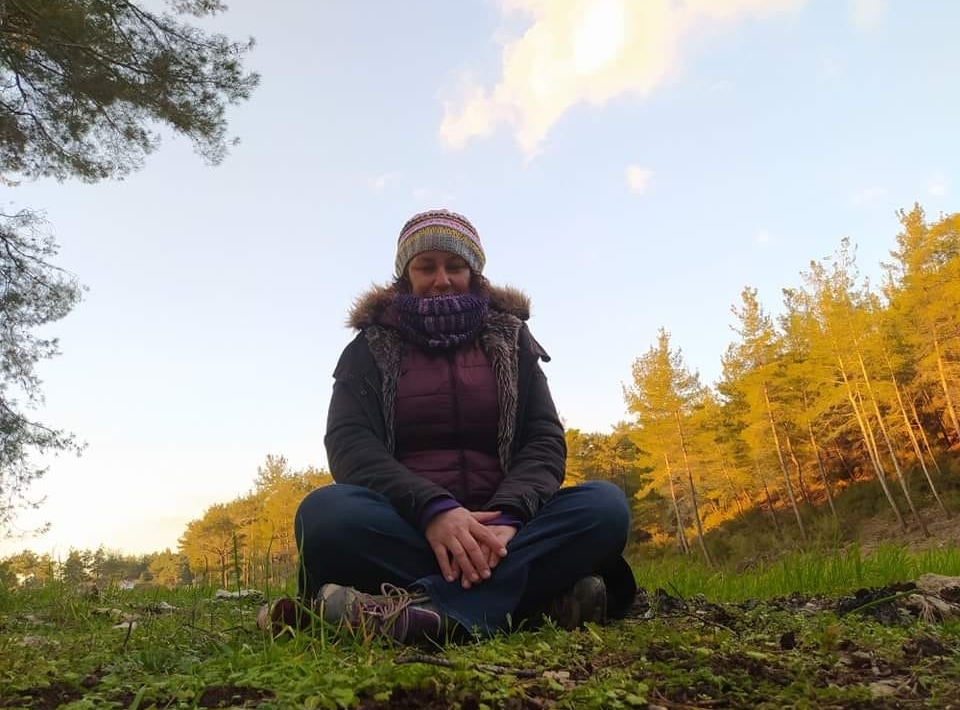


For more than a decade, Deniz Gümüşel, an environmental engineer by profession, has worked with civil society organizations documenting the environmental, health and human rights impacts of fossil fuels across Türkiye. In the last seven years, Deniz has joined local communities opposing the coal mining operations in Muğla province in south-western Türkiye, a region that hosts dozens of coal mines and three coal-fired power stations. Their struggle is intertwined with the protection of the Akbelen Forest, as a symbol of resistance against the expansion of coal mining in the region.
Like many other environmental human rights defenders (EHRDs), Deniz’s activism has come at a personal cost. Over the years, she has been subject to multiple criminal investigations and prosecutions for her peaceful environmental activism in defence of İkizköy and Akbelen Forest.
The İkizköy community’s struggle, of which Deniz was a part, delayed the cutting down of Akbelen Forest for four years, until it was destroyed in 2023. Yet they continue to resist, to protect the village’s farmland and olive groves.
My name is Deniz Gümüşel. I’m an environmental engineer. I’ve been working in the field of environmental and climate change policy for more than 25 years. My family is from Milas, Muğla, where Akbelen Forest is, so I feel that I belong to that land, even though I wasn’t raised there.
The province of Muğla has been living under the shadow of coal for nearly 45 years. Coal mining is being carried out across 5,000 hectares of land and has led to thousands of people being forced to migrate out. Research shows that pollution from the three coal power plants in Muğla caused more than 68,000 premature deaths between 1982 and 2020. So, the cost of coal is very high for the people in the region.
In 2019, locals in Muğla had begun organizing to resist coal mine expansions, and I met hundreds of them as part of my field research. I saw with my own eyes how deeply their lives were affected by coal: they were losing their health, their land, their livelihoods, their culture, their past and their future. The suffering experienced in Muğla resonated very deeply within me.
It felt like it was a responsibility – both as someone from that region, and as a citizen of the world. The cost of coal had to be lifted from the shoulders of people and nature. You carry out research, you write a report, you make policy recommendations, yet people continue to suffer. At some point you feel compelled to engage with them directly. Observing and reporting alone is not enough, you also have to stand with people and act together to make a difference. So, I tried to do whatever I could.
The struggle for Akbelen Forest
İkizköy, a village in Milas, became the heart of this resistance. Open‑pit coal mining, which began in 1979, had already carved a 15‑kilometre gash from Gökova Bay all the way to İkizköy, which led to the displacement of four villages along the way. Now the mine was about to swallow İkizköy’s settlements, farmland, and olive groves. Right in the middle of the village’s neighbourhoods was a small forest ecosystem of about 78 hectares: Akbelen. The forest fed the groundwater in the area; frankly, it was a source of life. It also served as a shield, protecting the villagers’ farmland from the mine; or at least, that was what we hoped. We believed that no one would cut down a forest for coal. However, the forest was identified for clearance as part of the mine expansion.
The fight for Akbelen began together with the people of İkizköy in 2019. If it hadn’t been for this, the forest would have disappeared that year. To protect the forest, the villagers and those of us who supported them kept a constant vigil in tents at the entrance to the forest for two years, to stop it from being cut down. Through this vigil, the numerous lawsuits we filed, the determined stance of the people of İkizköy and wide public support, we kept Akbelen Forest alive for four full years. Unfortunately, in 2023, this beautiful forest was destroyed, and the mine expanded into the land where it once stood. The company subsequently decided to expand the mine further, onto the villagers’ fields and olive groves. In 2025, a new law made it possible to uproot olive groves for coal mining. In January 2026, hundreds of plots of land in İkizköy were urgently expropriated for the mine, and the villagers’ legal challenge against this decision was rejected. Today, the people of İkizköy continue their vigil on their expropriated land, to protect their farmland and olive groves.
It may sound as if we lost the struggle. But when I went back to İkizköy last May, Akbelen Forest was still alive in the parts the mine had not yet swallowed. There were no trees, but with its shrubs, olive trees, reptiles, and fungi, the forest was continuing to live. It was trying to survive. I wholeheartedly believe that one day when this struggle is won, the forest will become green again.
I believe the meaning of life is to resist.
Deniz Gümüşel, Environmental engineer
Paying the price for speaking out
During the struggle in İkizköy, as happened to many of my friends, I too was subjected to various forms of pressure, intimidation tactics, and attempts to criminalize me. I have been subject to several ongoing investigations and legal cases during this process. Most recently, a court gave me a five-month sentence, which I have appealed. It was, in fact, the result of a peaceful protest I took part in while trying to protect Akbelen Forest. For a period of about a year and a half, I was banned from entering my family’s hometown, preventing me from seeing my family.
In January 2026 a court convicted Deniz for allegedly “preventing a public official from performing their duty”. Her conviction and five-month prison sentence are currently being appealed. As part of judicial control measures, in August 2023 she was banned for 18 months from entering Milas district, where the Akbelen Forest is located. This kept her away from the community she had stood with for years and from her parents, whom she could not visit. She was also required to sign in regularly at a police station and was banned from travelling abroad, which prevented her from taking part in international meetings where she could speak about Akbelen.
Keep defending life together
What happened to me in Akbelen is not an isolated incident. It is part of a wider pattern that many environmental defenders in Türkiye face. Environmental defenders and ecological activists are very frequently subjected to investigations. Lawsuits are brought against them. Peaceful demonstrations are forcibly suppressed. Protesters are subjected to physical harm. But they do not intimidate us because we consider this a debt we owe to life.
I believe the meaning of life is to resist. To resist injustice, to resist exploitation, to resist the plunder of nature. Fighting against this destruction is a powerful way to advocate for climate justice for everyone. Akbelen is one of the strongest examples of the ecological struggles continuing across Türkiye. What I hope for in the future is that the thrill of being organized and acting together will overcome hopelessness.
Resistance makes hope grow. Hope keeps life going. For both Türkiye and the world.
The future Deniz hopes for will not be built through more fossil fuel mines and power plants, but through collective action, coordination and solidarity across communities, and refusing to give up.
Discover more stories of environmental human rights defenders around the world who are standing up for people and the planet:
Alexandre Anderson, Brazil

Antonia Burke, Australia
Erica Njuguna, Kenya