
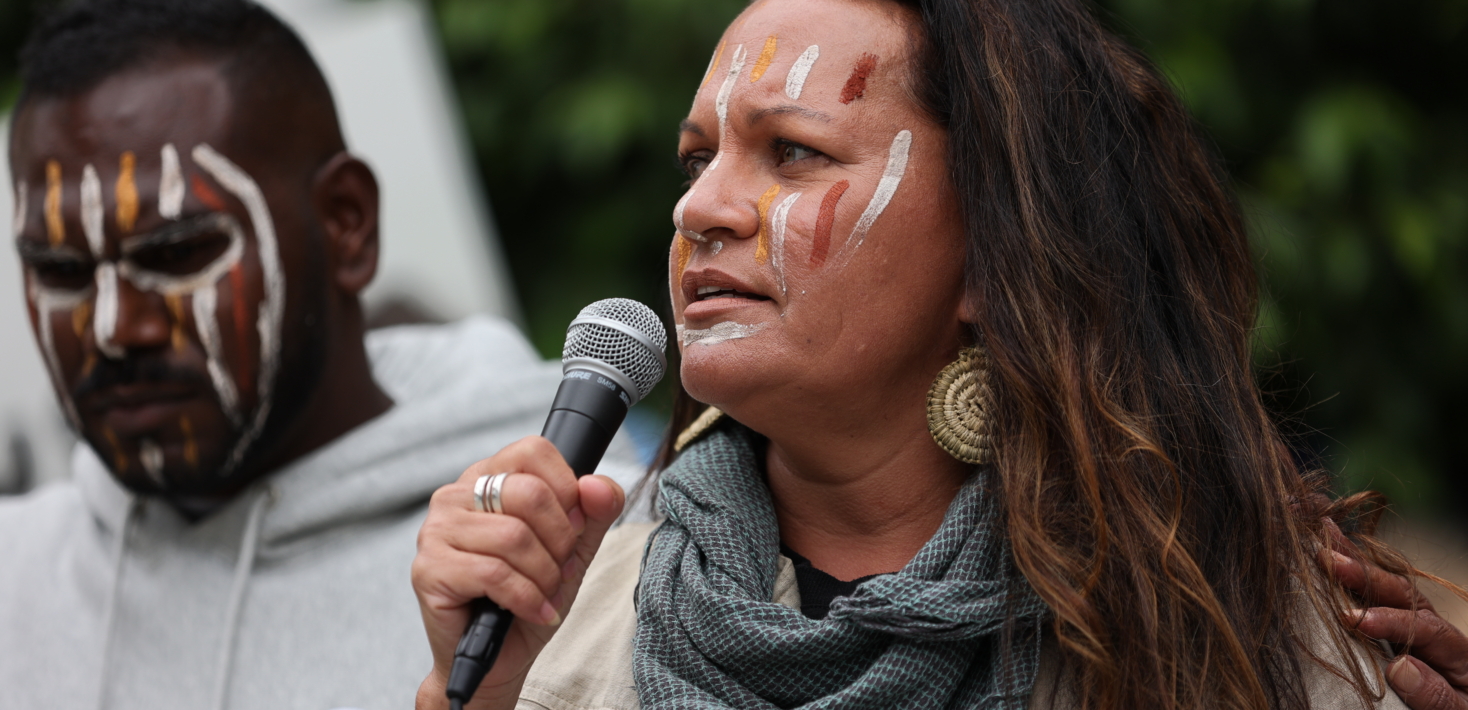


Meet Antonia Burke who is standing up for Indigenous rights in Australia
For more than a decade, Antonia Burke travelled across Australia listening to First Nations people describe the impacts of government decisions on their lives. Over the years, she heard stories of oppression, injustice and intergenerational trauma. As a First Nations woman from the Yanyuwa and Garrwa people from the Northern Territory, Antonia understands first-hand how government policies can shape lives. That understanding took on new urgency when she saw the extent of offshore oil and gas development across the Arafura and Timor Seas, waters that sustain communities, cultures and marine life across Australia, Timor-Leste, Papua New Guinea and Indonesia. First Nations people in Australia call these waters “Sea Country” – a source of identity that holds stories and songlines that have guided people for generations.
As Founder and Director of Sea of Nations, Antonia works with First Nations people and coastal communities to hold decision makers accountable for ensuring meaningful consultation and consent before decisions affecting their territories are made. Here, she shares her experience:
My name is Antonia Burke. I am an Aboriginal woman from the Northern Territory. I was born to a mother whose entire existence was impacted in a negative way by government decisions. Oppression, dominance, control, which led to intergenerational trauma, and caused a lot of pain and disempowerment for my immediate family.
Growing up knowing the story of what happened, and how it happened, instilled something inside of me that always made me want to stand up, and just do something. It created this deep sense of responsibility. And it’s this responsibility that required finding the truth and speaking out.
Working with and listening to First Nations communities across Australia, it was clear that the sicker the land or the country, the water, the air, the environment, the sicker the people are. The healthier the environment is, the healthier the people are.
“It felt like a new wave of colonization”
Whilst sitting in the Australian Government Federal Resource Minister’s office in 2022, I saw a map on the wall that showed the entire ocean in the Arafura and Timor Seas and all the way down the west coast of Australia that had been sold off to mainly international stakeholders, to be exploited for oil and gas drilling. I was the person who had to stand in front of my community and show them what the government had been planning. It set my community into a spiral, a familiar feeling of government control, dominance and oppression. People were feeling a sense of disempowerment again and it felt like a new wave of colonization.
For over 60 years, the Australian Federal Government has been drilling into the ocean in the Arafura and Timor Seas for oil and gas exploration, without telling people who live on the coastline. They only consulted with businesses like fisheries, shipping and tourism operators. Every single coastal community where First Nations people live and rely on the sea for their economy, their food source, their cultural heritage, all of them were ignored for over 60 years.
Under the law and the regulations applicable in Australia, they were supposed to consult with anyone on the coastline who would be impacted by drilling into the sea. This requirement was already in the law. They just weren’t doing it.
So, my community and, elders – had to take our own government regulator to court to say, you need to comply with your own laws.
“Let’s do this together”
They have failed to consult with people from Timor-Leste, Indonesia and Papua New Guinea, West Papua and Australia. Coastal peoples from all four countries were being ignored by everyone who lived on the coastline, so Sea of Nations stood up and said: “Let’s do this together. We should all have a right to say no, and at the very least have a right to be consulted about what the governments are planning in the sea.”
In the Arafura and Timor Seas alone, in Australian waters, there are 758 wells that have been drilled into the ocean – without consulting coastal communities. There are 51 fossil fuel leases that have been sold off.
Because of this, our home, on the Tiwi Islands is the most vulnerable place in the Timor Sea.
Everything that happens out there in the sea, we feel it first. We’re the first people that are impacted. We are the frontline.
Everything that happens out there in the sea, we feel it first.
Antonia Burke
We’re the first people that are impacted.
We are the frontline.
“What’s at stake is our very existence”
Not only this, the Federal Government and the Northern Territory Government gave approval for an oil and gas company to lay a pipeline just five kilometres off the Tiwi Islands coastline without telling Tiwi people.
What’s at stake is Tiwi peoples’ very existence.
Climate change is already creating erosion on Tiwi Islands coastlines. What Sea of Nations are resisting is further industrialisation of the Arafura and Timor Seas from the fossil fuel industry. That’s what we’re resisting. We don’t want them there.
What we are standing up for is a right for all Australians to say no. And for Island Nations to be placed into the centre of decision making when it comes to the sea that we live in.
Today, Sea of Nations has brought together coastal community leaders to stand up together, to make sure that these four governments comply with international laws.
We are doing the job of our governments. That sense of responsibility feels like trying to live life and just be a normal human being, with the added pressure of doing the government’s job.
My hope for the future (is): that whales feel safe to swim through these waters with their babies and have enough to eat; that turtles can lay their eggs and crawl back into the water and swim across the sea to the next beach without worrying about industrialization; that people who live on the coastline of the sea can maintain the wilderness of it.
My hope for the future is that transboundary laws are introduced between all four countries that share the Arafura and Timor Seas, that governments stop what they’re doing for a moment and really look at the impacts, and come up with another solution instead of developing fossil fuel projects in the seas and transition to renewables.
I truly believe that we’re going to achieve our vision of maintaining healthy seas, thriving coastal communities and strong cultures, and working together has made us so much stronger.
I truly believe that we’re going to achieve our vision of maintaining healthy seas, thriving coastal communities and strong cultures, and working together has made us so much stronger.
Antonia Burke
Antonia believes that protecting the Sea Country means ensuring that future generations inherit a clean, healthy and sustainable environment, thriving culture, and the right to decide what happens in the places they call home.
Discover more stories of environmental human rights defenders around the world who are standing up for people and the planet:
Knowledge is power
Learn how you can take action against fossil fuels
People around the world are demanding the end of fossil fuels. Frontline communities are resisting and you can join them.