


executive summary
The Israeli military has extensively destroyed and damaged civilian structures and agricultural land in southern Lebanon between 1 October 2024 and 26 January 2025.
The destruction was carried out by the Israeli military with manually laid explosives and bulldozers both before and after a ceasefire between Israel and Hezbollah that took effect on 27 November 2024, while the Israeli military had full control of the relevant areas and without apparent “imperative military necessity” – the standard required under international humanitarian law (IHL) to justify the destruction of civilian or cultural property outside the context of attacks. Amnesty International therefore concluded that these actions violated applicable rules of IHL particularly the prohibition of destruction of the property of an adversary and the prohibition of destruction of cultural property. Any such destruction should be investigated as a war crime where it was carried out intentionally or recklessly.
The visual evidence shows that Israeli troops deliberately left a trail of destruction as they moved through southern Lebanon. Among the structures affected are homes, mosques, cemeteries, roads, parks and football pitches. In one village, satellite imagery showed the Star of David, a Jewish symbol, carved into the ground.
The Israeli military justified some of the destruction saying that they were preventing future attacks, and that the civilian structures damaged or destroyed had previously been used by Hezbollah fighters, stored weapons or stood above tunnels.
In some instances, Israeli soldiers filmed themselves engaging in this destruction. Residents of the villages later watched. “Israel blew [my house] up. All of it. And they filmed the explosion,” 66-year-old Adiba Finsh, who left her village in March 2024, said. “They made a video of themselves counting from five to one, and when the explosion happened, they shouted: ‘Wow! Yay!’ I watch this video every day.”
Amnesty International’s Evidence Lab, the organization’s digital investigations team, verified 77 videos and pictures published on social media by Israeli soldiers, activists and the media between 1 October 2024 and 26 January 2025 and analysed satellite imagery to monitor areas with significant physical changes over time. The Evidence Lab also gathered statements issued by the Israeli military and Hezbollah on their official channels, as well as news reports, and analysed data collected by other organizations to develop a timeline and conduct a contextual analysis. Amnesty International also conducted interviews with 11 residents of southern Lebanon’s border villages, including local officials and municipal authorities, who described the phases of destruction and evacuations experienced in their villages. The organization also collected and verified videos and photos shared by residents and environmental activists documenting the status of houses, civilian structures, and villages before and after the destruction.
Amnesty International sent questions regarding the destruction of civilian structures and agricultural land to the Israeli authorities on 27 June 2025. At the time of publication, no response had been received.
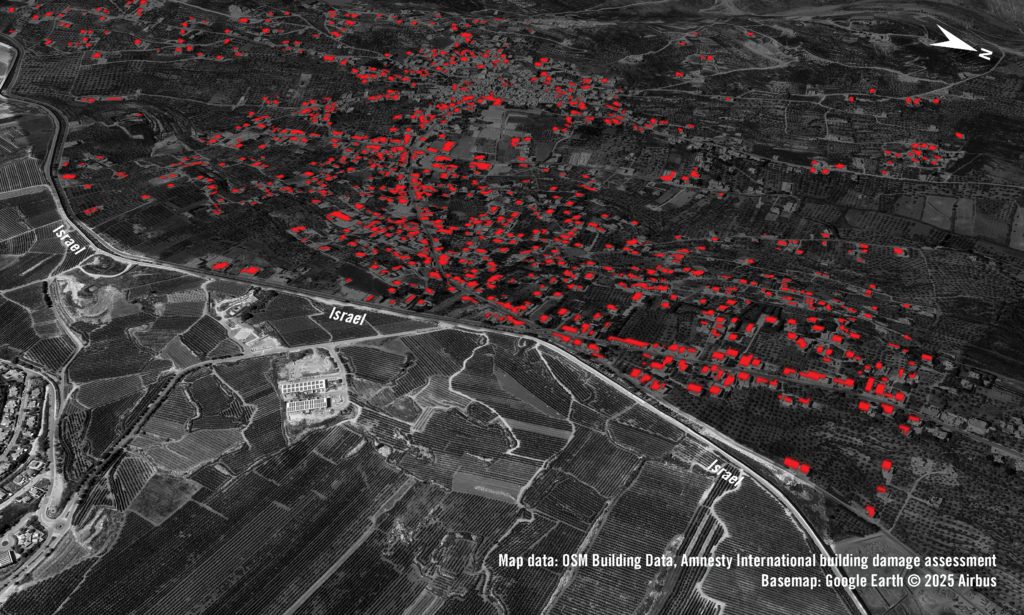
Amnesty international’s research reveals that more than 10,000 structures were heavily damaged or destroyed between October 2024 and January 2025. In three municipalities, Yarine, Dhayra and Boustane, the Israeli military heavily damaged or destroyed more than 70% of all structures. The Israeli military destroyed most of the sites when it was in control of the relevant areas, a strong indicative factor that the destruction occurred outside of active combat, and in apparent absence of imperative military necessity, as required under IHL. In two of the four months analysed, a ceasefire agreement was in effect.
Across southern Lebanon, the Israeli military made extensive use of manually laid explosives and bulldozers, which by their nature require access and area control. Visual evidence analysed by Amnesty International indicates there were no Hezbollah fighters inside the civilian structures at the time of destruction. In some cases where the Israeli military said they found weapons inside buildings, soldiers were able to move at least some of the weapons and lay them out for pictures before destroying the building that had apparently contained them. In at least one case, the Israeli military filled a tunnel with cement, showing they had viable alternatives to extensive destruction of civilian structures located nearby.
The extensive destruction of property had devastating impacts for civilians. Zeinab, who left her village Kfar Kila in late 2023 following Israeli air strikes, told Amnesty International that, months after the ceasefire went into effect, “Now, there is no one in Kfar Kila, our village is completely deserted. The villagers, including me, go to Kfar Kila only to visit the dead or re-bury our relatives who died during the war… We brought them back to our land. Only the dead returned to Kfar Kila”.
Farrah Berrou, another resident from Kfar Kila, said, “My heart is burning for the trees more than anything, because some are older than the house and have been there since my great-grandparents… Nine hundred trees, all gone… These homes and groves were the last remnants of my grandparents, which is why this is so painful for my dad and his siblings. Losing a house is like losing a family member all over again.”
Given the Israeli military’s trail of destruction, many residents of southern Lebanon have no homes to return to. The Israeli authorities should provide prompt, full and adequate reparations to victims, including individuals and communities, of violations of IHL and war crimes. Reparations should be provided to direct and indirect victims, including individuals or their family members who were harmed by Israel’s unlawful conduct, including civilian property damage and destruction which violated IHL.
The government of Lebanon should immediately explore all possible legal routes, including setting up a domestic reparation mechanism and demanding reparation from parties to the conflict. The government should also seriously reconsider providing the International Criminal Court (ICC) with jurisdiction to investigate and prosecute crimes under the Rome Statute committed on Lebanese territory.
All states, but in particular the United States, should immediately suspend all arms transfers and other forms of military assistance to Israel due to the significant risk that these weapons could be used to commit or facilitate serious violations of international law.
Methodology
This research briefing focuses on the destruction of civilian property carried out by the Israeli military using manually laid explosives and bulldozers in the context of Israel’s ground invasion of southern Lebanon, following an escalation in the armed conflict between Israel and Hezbollah in late 2024. The lawfulness of this destruction is assessed against the prohibition of destruction of an adversary’s property under IHL.
The analysis covers events from 1 October 2024, when the Israeli military launched its ground invasion of southern Lebanon, through 26 January 2025, which marked the initial deadline for parties to the conflict to take a number of steps agreed upon in a 27 November 2024 ceasefire deal. Any damage or destruction of civilian property resulting from Israeli air strikes or Hezbollah rockets prior to the ground invasion falls outside the scope of this analysis. Spatially, the analysis covers the 26 municipalities in southern Lebanon that sit along the Israeli border, with a focus on Kfar Kila, Maroun el Ras, Odeisseh, Aita Ash Shaab and Dhayra as case studies due to the level of evidence available. As such, the figures presented are limited to this timeframe and geographic area and should not be interpreted as a comprehensive assessment of the destruction of civilian property in southern Lebanon.
To determine the applicable IHL rules and assess the lawfulness of the damage and destruction of civilian property by the Israeli military, Amnesty International first examined whether the Israeli military had control over the areas in question at the time of destruction. To establish the existence and level of such control, the organization employed a range of indicators, including the movement and presence of troops, the conduct of soldiers on the ground, the method and scale of destruction, available armed conflict data and public statements made by parties to the conflict. Based on this analysis, researchers assessed whether the destruction occurred during or outside the context of an attack (active combat) as defined under IHL.[1] This distinction enabled the organization to apply the appropriate IHL rules, particularly in evaluating whether the destruction had to be assessed against the legal principles governing attacks (distinction, proportionality and precaution) or, outside active combat, the prohibition of destruction of an adversary’s property and the ensuing standard of imperative military necessity.
To assess the existence of imperative military necessity in a given case, Amnesty International analysed both the tactical objectives articulated by Israel, particularly destroying Hezbollah infrastructure, including tunnels, weapons caches and defensive fighting positions, and the broader, strategic goals articulated by Israel.[2] At the beginning of the operation, the Israeli military stated its overall objective was to “repel the threat posed by Hezbollah and enable the residents of the north of Israel safely to return to their homes”.[3] To conduct its assessment, Amnesty International relied on public statements by both the Israeli government and Hezbollah, the method and scale of destruction, the conduct of soldiers on the ground and remote sensing analysis of the aftermath of destruction.
While the organization is not in a position to assess whether all these structures were damaged or destroyed unlawfully, it analysed in detail destruction of property carried out in five villages, with a view to considering both broad patterns and specific cases of such destruction. To this end, the organization conducted a detailed analysis of five villages where up to 71% of the structures were damaged or destroyed, using a broad range of visual evidence and testimony to assess the extent to which such vast destruction may have been lawful or unlawful. In relation to these villages, the organization focused on both damage to specific civilian structures and broader patterns of destruction.
Amnesty International’s Evidence Lab, the organization’s digital investigations team, verified 77 videos and pictures published on social media by Israeli soldiers, activists and the media between 1 October 2024 and 26 January 2025. The Evidence Lab used a variety of digital verification methods to confirm the authenticity and relevance of the videos. To establish where and when a video or image was taken, it compared it with satellite imagery, ground-level photographs and other publicly available information, matching features such as buildings, trees or streets and checking weather patterns or shadows. Arms experts examined videos, photos and satellite imagery to assess the type of explosives used and whether the damage and destruction was consistent with manually laid explosives rather than aerial bombardment or indirect fire.
Amnesty International analysed satellite imagery to monitor areas with significant physical changes over time using change detection algorithms that were reviewed and refined by a remote sensing analyst. Initially, Sentinel-2 imagery was used to flag areas with possible damage. When higher resolution imagery became accessible, the organization conducted a detailed assessment of municipalities along Lebanon’s southern border to document all the structures that appeared heavily damaged or destroyed between 26 September 2024 and 30 January 2025. Using a change detection algorithm[4] and newly mapped open-source building footprint data[5], the organization created a dataset of buildings that were heavily damaged or destroyed during this timeframe. The results were then carefully reviewed and refined by the analyst who manually corrected errors and verified the findings. To estimate the scale of destruction, the organization calculated the percentages of heavily damaged or destroyed structures relative to the total number of structures identified in each municipality. As noted above, the percentages presented here exclude structures that were damaged or destroyed as a result of attacks that occurred before the Israeli military’s ground invasion of southern Lebanon. Therefore, the estimates presented here are conservative, particularly if compared to results from a possible field-based battle damage assessment.
Amnesty International gathered statements issued by the Israeli military and Hezbollah on their official channels, as well as news reports, and compared open-source data on troop movements in southern Lebanon with satellite imagery and ground footage, to understand the context of the damage and destruction in each village. While the researchers made every effort to corroborate the statements issued by both the Israeli military and Hezbollah, they were unable to verify the veracity of the claims by the parties to the conflict in many instances. Without access to the affected areas, the organization was unable to independently verify many of the Israeli military’s claims regarding the existence of tunnels and other military infrastructure allegedly used by Hezbollah in southern Lebanon.
Amnesty International analysed data collected by Armed Conflict Location and Event Data (ACLED) for the villages of Kfar Kila, Maroun el Ras, Odeisseh, Aita Ash Shaab and Dhayra between 1 October 2024 and 26 January 2025, and corroborated the data with reports from Lebanese media and authorities. ACLED[6] is a database that collects information derived from a wide range of local, regional, and national sources on the type, scale, location, and timing of events related to armed conflicts, political violence, and protest events globally. This data was used to provide additional context for the analysis and to highlight the approximate timeline of some of the damage and destruction. Researchers also analysed daily reports from the Institute for the Study of War covering the war in Lebanon[7] between 29 September 2024 and 27 January 2025.
Amnesty International conducted interviews with 11 residents of southern Lebanon’s border villages between November 2024 and March 2025, including local officials and municipal authorities, who described the phases of destruction and evacuations experienced in their villages. The organization also collected and verified videos and photos shared by residents and environmental activists documenting the status of houses, civilian structures, and villages before and after the destruction.
Amnesty International sent questions regarding the destruction of civilian structures and agricultural land to the Israeli authorities on 27 June 2025. At the time of publication, no response had been received.
background
Israel and Hezbollah have fought multiple armed conflicts. After a 33-day conflict in 2006, the UN Security Council unanimously approved Resolution 1701,[8] intended to end the hostilities between Israel and Hezbollah and to create the conditions for a permanent ceasefire through the creation of a buffer zone controlled by the Lebanese army and UN peacekeeping forces, namely the United Nations Interim Force in Lebanon (UNIFIL). The buffer zone extended from the Litani River in Lebanon, which is around 29 km from the border with Israel, to the Blue Line, a 120 km line demarcating Israeli and Lebanese territory that was set by the UN in 2000 for the purpose of confirming the withdrawal of Israeli forces, who had been occupying parts of southern Lebanon since 1978. Resolution 1701 mandated that only UNIFIL and the Lebanese army could deploy in this buffer zone, meaning that Hezbollah’s fighters would need to withdraw north of the Litani River and that Israeli forces would need to completely withdraw from Lebanon. The resolution also required the disarmament of Hezbollah and other armed groups in Lebanon.
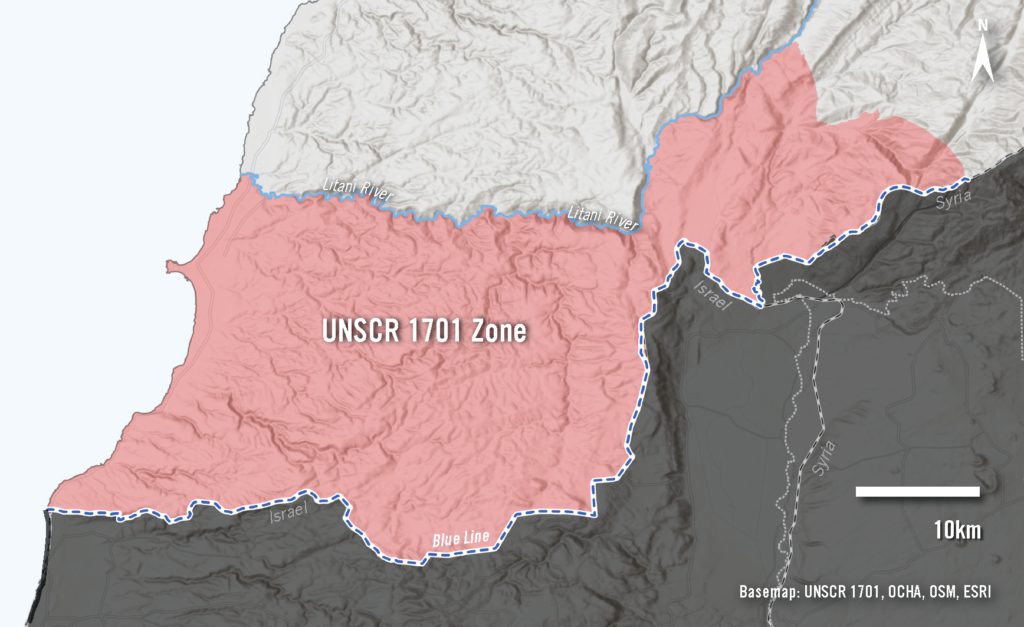
Neither Israel nor Hezbollah fully implemented the terms of Resolution 1701. Notably, Hezbollah and other armed groups did not withdraw from southern Lebanon and significantly increased their military capabilities, and Israel did not fully withdraw from Lebanon’s territory, continuing to occupy the northern part of the Ghajar village, the Shebaa Farms and the Kfarchouba hills. Israel routinely violates Lebanon’s air and maritime borders.
On 7 October 2023, Hamas and other Palestinian armed groups based in the occupied Gaza Strip attacked Israel, killing some 1,200 people, over 800 of them civilians, and taking 250 hostages.[9] Israel responded by launching a military offensive in Gaza that, at the time of writing, had killed more than 56,000 people.[10] [11]Amnesty International has concluded that Israel has committed and is continuing to commit genocide against Palestinians in Gaza.
On 8 October 2023, Hezbollah launched rockets toward Israel, which it referred to as a “war of support”. The Israeli military responded with air strikes in Lebanon. Over the following months, Hezbollah continued to launch rockets and missiles at Israel and the Israeli military carried out attacks in Lebanon.
In September 2024, the hostilities sharply escalated, with the Israeli military launching “Operation Northern Arrows,” with a significant increase in the scale and speed of its attacks in Lebanon. On 1 October 2024, Israel started a ground invasion of southern Lebanon.
Since October 2023, Amnesty International has reported on the fighting’s impact on civilians, including from the Israeli military’s use of white phosphorous, indiscriminate simultaneous mass explosions targeting electronic devices, attacks on journalists, health facilities, ambulances and paramedics, and unlawful air strikes against civilians and civilian objects, as well as on Hezbollah’s repeated firing of unguided rockets into populated civilian areas in Israel. Amnesty International has previously called for attacks by both Israel and Hezbollah to be investigated as war crimes.[12]
At the time of writing, the hostilities between Israel and Hezbollah have caused more than 4,100 deaths in Lebanon and 129 in Israel.[13]
On 27 November 2024, Israel and Lebanon agreed to a ceasefire deal brokered by the United States and France.[14] Under the terms of the deal, Hezbollah and Israel both agreed not to carry out military attacks against each other. The deal reiterated the provisions of UN Security Council Resolution 1701, requiring Hezbollah to withdraw from areas south of the Litani River and giving the Lebanese army the sole authority to deploy troops in southern Lebanon. Israel would have 60 days to withdraw from Lebanese territory. An international mechanism was set up to monitor implementation of the agreement, assess whether any violations had occurred and assist in enforcement.[15]
The armed conflict in Lebanon triggered mass displacement, including as a result of the Israeli military’s evacuation orders. Between 1 October and 12 November 2024, the Israeli military issued 17 evacuation orders to 205 villages in southern Lebanon.[16] According to the orders, residents were prohibited from heading south until the Israeli military informed them that the conditions were safe enough for them to return to their homes.
Two days after the ceasefire was announced in late November, the Israeli military prohibited residents from moving back to villages located south of a line that extended roughly parallel to Lebanon’s southern border but ranged from 3 to 11 kilometres into Lebanese territory and said that “anyone who moves south of this line puts himself in danger”.[17] Sixty-two Lebanese villages fell within this zone. At least 57 civilians were killed while trying to reach villages in southern Lebanon during the first 60 days of ceasefire, according to the UN Office of the High Commissioner for Human Rights (OHCHR).[18]
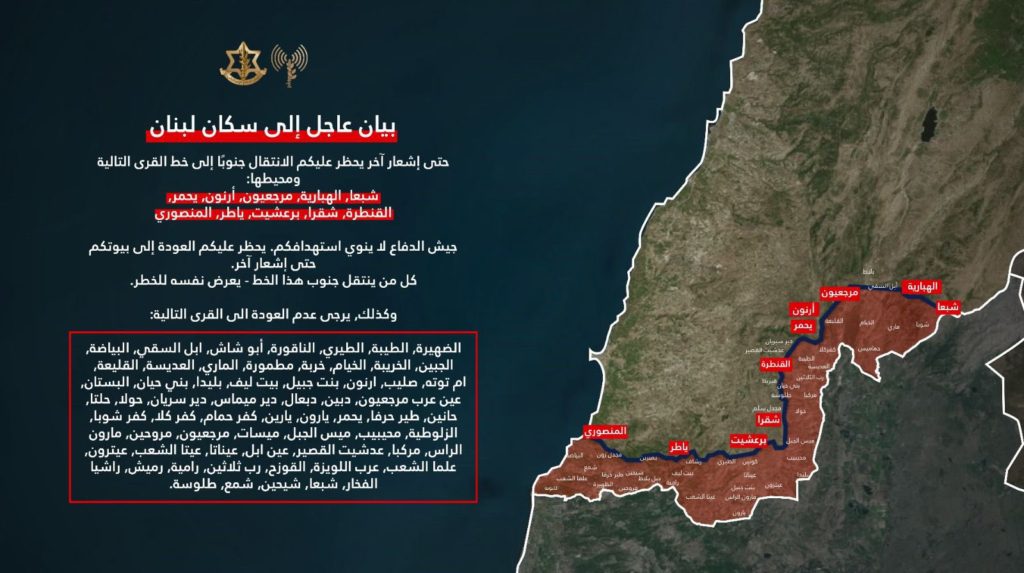
Originally scheduled to end on 26 January 2025, the ceasefire was extended until 18 February. At least 24 persons were killed and 120 were injured while trying to access villages that were still under the Israeli military’s control between the two dates.[19]
On 18 February, Israel announced it had “transferred responsibility for the areas in southern Lebanon to the Lebanese Army”, but that it would “continue to maintain and temporarily control several command posts within southern Lebanon.”[20] These five “strategic” vantage points lay within the broader area in southern Lebanon where Amnesty International identified extensive destruction of civilian property and structures.[21]
On 27 February, Israeli Defence Minister, Israel Katz, said that Israeli forces were “staying indefinitely” in a buffer zone on the border with Lebanon, describing their presence as “situation-dependent”.[22]
In parallel, the Israeli military have continued to conduct air strikes in southern Lebanon, as well as in Beirut’s southern suburbs, targeting what they described as Hezbollah military locations and personnel. As of 15 April 2025, the Office of High Commissioner said that at least 71 civilians, including 14 women and nine children, had been killed as a result of Israeli military operations in Lebanon since the ceasefire came into effect on 27 November 2024.[23]
legal framework
IHL applies in situations of armed conflict and is binding on all parties. It is comprised of rules whose central purpose is to limit, to the maximum extent feasible, human suffering in times of armed conflict.
Destruction during an attack
When a party to the conflict carries out an attack, as defined by IHL,[24] the core principles of distinction, proportionality and precautions apply. In the context of an attack, the lawfulness of any resulting damage to or destruction of a civilian object[25] is to be assessed against these core principles.
The principle of distinction dictates that “[t]he parties to the conflict must at all times distinguish between civilian objects and military objectives. Attacks may only be directed against military objectives. Attacks must not be directed against civilian objects”.[26] Civilian objects are “all objects that are not military objectives”.[27] In turn, military objectives are “those objects which by their nature, location, purpose or use make an effective contribution to military action and whose total or partial destruction, capture or neutralisation, in the circumstances ruling at the time, offers a definite military advantage.”[28] Direct attacks on civilian objects constitute war crimes.[29]
An ostensibly civilian object may lose its immunity from attack if and for such time that it qualifies asa military objective,[30] provided the attack complies with the principles of proportionality[31] and precaution.[32] These principles also apply when a civilian object does not itself qualify as a military objective but is located in the proximity of a military objective, and it may be damaged or destroyed as a consequence of the attack on such military objective. In particular, indiscriminate and disproportionate attacks are prohibited and may amount to war crimes.[33]
Destruction outside of an attack
When a party to the conflict carries out an act of hostility outside the context of an attack, that is outside “combat action”,[34] IHL prohibits “[t]he destruction… of the property of an adversary… unless required by imperative military necessity”.[35]International jurisprudence has confirmed that, “[a]s a rule, destruction carried out before fighting begins or after fighting has ceased cannot be justified by military necessity,”[36] “simple” military necessity being a lower standard than “imperative”, as discussed below.An important indicative factor that destruction has occurred outside the context of an attack is when such property is under the control of the destroying party at the time of destruction.[37]
This prohibition protects property which has a civilian character, meaning which does not qualify as a “military objective”.[38] The property in question can be moveable or immoveable, private or public.[39] It must belong to the “adversary”, which includes civilians “not aligned to or supportive of the [destroying] party or its objectives.”[40]
According to the ICC, “[d]estruction entails acts such as setting ablaze, demolishing, or otherwise damaging property”. Moreover, “badly damaged property may be akin to partial destruction and thus fall under the definition of destruction. This, however, will require a case-by-case assessment in respect of the facts of the case”.[41]
Imperative Military Necessity
While destruction of property of an adversary outside the context of an attack is prohibited, IHL provides for an exception in cases of “imperative military necessity.” International jurisprudence has interpreted the notion of “military necessity” based on the definition provided in Article 14 of the Lieber Code of 1863:[42] “Military necessity… consists of the necessity of those measures which are indispensable for securing the ends of the war, and which are lawful according to the modern law and usages of war”.[43] The ICC has clarified that “only ‘imperative’ reasons of military necessity, where the perpetrator has no other option in this regard, could justify acts of destruction which would otherwise be proscribed by this provision.”[44] Any military advantage sought through the destruction of property “must be definite and cannot in any way be indeterminate or potential”.[45]
“Imperative” thus means that a party to the conflict has “no other option” to accomplish its specific military goal(s) than destroying a given civilian property. The “imperative” threshold in IHL implies a high standard of justification for such destruction,[46] which must be “compelling” and “assessed on a case-by-case basis”.[47] It requires urgency and inevitability,[48] meaning that destruction of civilian property must be the only feasible means to achieve a specific goal based on military necessity. In Amnesty International’s view, the “imperative military necessity” standard does not allow for extensive destruction of civilian property on the basis of broad or abstract strategic goals such as deterrence, prevention of future attacks, or long-term economic weakening of the adversary: “[t]here must be some reasonable connection between the destruction of property and the overcoming of the enemy forces”.[49]
The International Criminal Tribunal for the former Yugoslavia has interpreted the exception of military necessity as requiring a case-by-case assessment of each property to be destroyed, with no broad caveat for destroying entire areas or population centres generally based on this exception:
… after the fighting has ceased, destruction can in principle no longer be justified by claiming ‘military necessity’. A different situation arises if a military attack is launched against a settlement from which previously, due to its location and its armed inhabitants, a serious danger emanated for the inhabitants of a neighbouring village who are now seeking to remove this danger through military action. It may be the case that, after such a settlement has been taken, destruction of houses occurs in order to prevent the inhabitants, including combatants, to return and resume the attacks. A submission that such destruction is covered by ‘military necessity’ will be entertained on a case-by-case basis. Except for the rare occasions in which such preventive destruction could arguably fall within the scope of ‘military necessity’, the principle must be upheld that the destruction of civil settlements, as a rule, is punishable as a war crime.[50]
In many of the cases of destruction of civilian property documented by Amnesty International in this briefing, there was no apparent imperative military necessity, as property destruction was not the only option available to the Israeli military, to justify the demolitions. In addition, the prior military use of civilian structures does not in itself justify the destruction of the property of an adversary, let alone excuse the wholesale destruction of entire villages and agricultural land. Creating a buffer zone within Lebanon through the extensive destruction of civilian property cannot be justified under the imperative military necessity standard. Moreover, finding weapons inside civilian property does not in itself “constitute a militarily justifiable reason to destroy them.”[51]
Israel’s stated goals of its military operations in southern Lebanon, and thus stated military necessity at the strategic level, were to “repel the threat posed by Hezbollah and enable the residents of the north of Israel safely to return to their homes”.[52] Implied in this statement appears to be an objective to prevent future attacks, which in some cases seems to have been translated into the destruction of locations from which previous attacks were launched from. While pursuing such a military goal would not per se contravene IHL, it does not make the destruction of Lebanese property lawful generally, nor does it absolve Israel of the legal requirement to justify each destruction of property individually, on a case-by-case basis, against the standard of “imperative military necessity”.
Destruction of the property of an adversary, when carried out outside the context of an attack and in absence of imperative military necessity, constitutes a war crime under customary IHL[53] and the Rome Statute.[54] Neither Lebanon nor Israel are parties to the Rome Statute of the International Criminal Court, and the Court currently lacks jurisdiction to prosecute war crimes occurring in Lebanon. The Court could however be granted jurisdiction, for example either by Lebanon, through accession to the Rome Statute or acceptance of jurisdiction, or through a UN Security Council referral.[55] The destruction of property does not need to be “extensive” in order to be a war crime.[56]
Destruction of cultural property
IHL provides for special protection of cultural property. Under IHL, “[s]pecial care must be taken in military operations to avoid damage to buildings dedicated to religion, art, science, education or charitable purposes and historic monuments unless they are military objectives”, and “[p]roperty of great importance to the cultural heritage of every people must not be the object of attack unless imperatively required by military necessity”.[57]
Moreover, IHL prohibits the “… destruction or wilful damage done to institutions dedicated to religion, charity, education, the arts and sciences, historic monuments and works of art and science”.[58] It is prohibited to direct “any act of hostility” against cultural property, unless required by imperative military necessity.[59]
IHL also prohibits the use of property of great importance to the cultural heritage of every people for purposes which are likely to expose it to destruction or damage, unless imperatively required by military necessity.[60]
Making cultural property the object of attack, when it does not qualify as a military objective, constitutes a war crime under customary IHL and the Rome Statute.[61]
Reparations
Under IHL, “[a] state responsible for violations of IHL is required to make full reparations for the loss or injury caused”.[62]
The UN Basic Principles and Guidelines on the Right to a Remedy and Reparation for Victims of Gross Violations of International Human Rights Law and Serious Violations of International Humanitarian Law also enshrine the duty of states to provide effective remedies to victims, including reparation. Reparations may take the form of restitution, compensation, rehabilitation, satisfaction and/or guarantees of non-repetition.[63]
The right to an effective remedy for victims of human rights violations is also enshrined in multiple international treaties, including Article 2(3) of the International Covenant on Civil and Political Rights (ICCPR), Article 8 of the Universal Declaration of Human Rights, Article 6 of the International Convention on the Elimination of All Forms of Racial Discrimination (ICERD), Article 14 of the Convention Against Torture (CAT) and Article 39 of the Convention on the Rights of the Child (CRC).
extensive destruction
The Israeli military carried out extensive destruction across vast swathes of southern Lebanon.
On 23 September 2024, when the Israeli military launched Operation Northern Arrows, they stated their goals were to “repel the threat posed by Hezbollah and enable the residents of the north of Israel safely to return to their homes”.[64] Israel repeatedly claimed that the damaged and destroyed structures had previously been used by Hezbollah fighters, stored weapons or stood above tunnels. On 1 October 2024, they said their forces had begun “conducting localized, limited, targeted raids based on precise intelligence against Hezbollah terrorist targets and infrastructure in southern Lebanon”.[65]
However, a careful analysis showed that the trail of destruction that Israeli forces left in southern Lebanon does not appear limited, localised or targeted. Satellite imagery analysis shows that civilian property was laid to waste on a massive scale. Most of the destruction was carried out by manually laid explosives and bulldozers while the Israeli forces were in control of the areas. Videos verified by Amnesty International show Israeli soldiers manually laying explosives inside homes, tearing apart roads and football pitches, and bulldozing parks and religious sites. In some videos, soldiers filmed themselves celebrating the destruction by singing and cheering.
Residents of destroyed villages told Amnesty International that the scale was vast and included many civilian structures. Hussein Youssef, Deputy Mayor of Tayr Harfa, said:[66]
“We expected to see destruction and devastation, but never on the scale we saw. For example, we could have imagined a house being destroyed because of Israel’s claim that there were fighters hiding in it. But the trees? Fruitful and non-fruitful trees, that was unimaginable. Electricity – not a single pole remained. The village’s Husseiniya [Shia Muslim building], built thanks to individual donations in the 1960s, was burned and demolished.”
Amnesty International analysed satellite imagery of the 26 municipalities along the Lebanese border with Israel and found that almost all of them suffered damage or destruction between late September 2024 and late January 2025. During this time, the municipalities of Yarin, Dhayra and Boustane, in Tyre district, were the most affected, with over 70% of their buildings destroyed. Seven other municipalities had more than half of their structures destroyed across the 26 municipalities. In total, Amnesty International counted 10,803 structures severely damaged or destroyed within the four-month period. While the organization is not in a position to assess whether all these structures were damaged or destroyed unlawfully, in the following section it analyses in detail destruction of property carried out in five villages, with a view to considering both broad patterns and specific cases of such destruction.
Along Lebanon’s southern border, only a very few villages were spared. Rmaysh, in Bint Jbeil district, had less than 1% of its over 2,200 structures damaged. In Aalma ash-Shaab, in Tyre district, some 5% of the structures were likely damaged by Israeli air strikes, but no further destruction was registered after the Israeli military’s ground invasion in October 2024. Rmaysh and Aalma ash-Shaab are known Christian villages. Two other municipalities with less than 20% destruction, Btaychiyeh and Ras En-Naquora, were home to UNIFIL bases. The UNIFIL bases, which did not appear to have sustained any damage, make up roughly half the structures in Btaychiyeh and Ras En-Naquora.
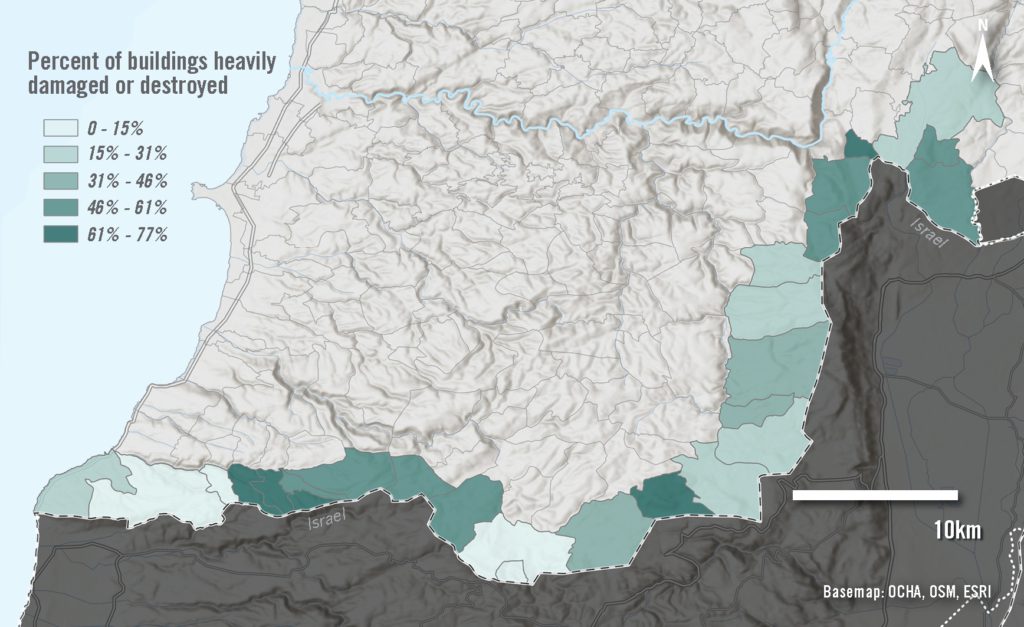
Satellite imagery shows that more structures along the border with Israel were destroyed compared to those further away. Most of the destroyed villages have a Shia Muslim majority population. Only two municipalities were spared, both known for being majority Christian.
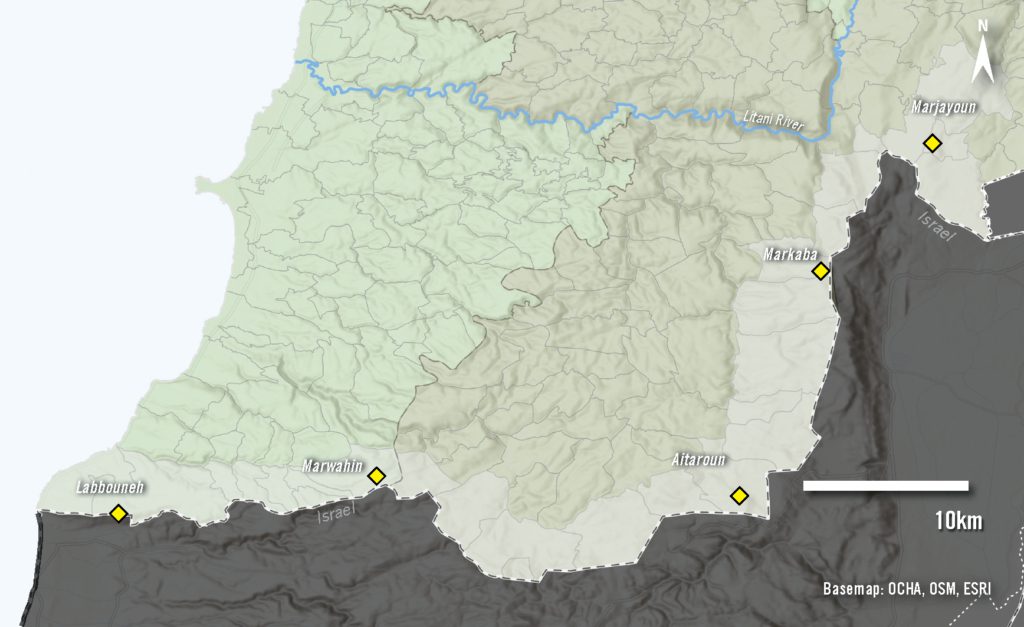
By overlaying the map of destroyed structures with the areas where the Israeli military advanced, the impact left in the municipalities along the border is evident. The map created by Amnesty below shows buildings that were severely damaged or destroyed over the period of analysis in red and the areas of Israeli advances on the ground in yellow.[67]
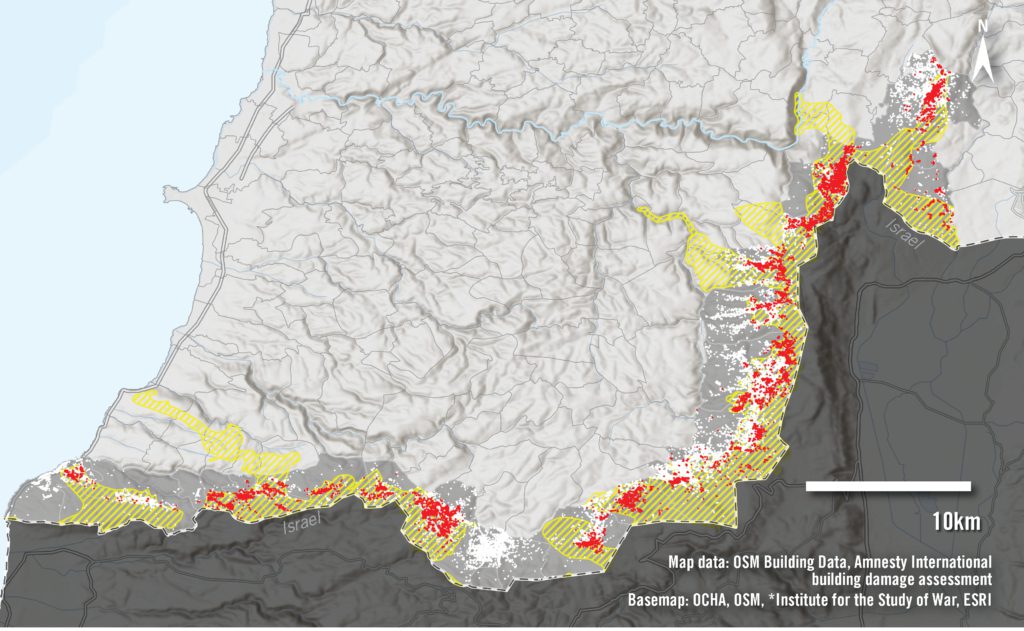
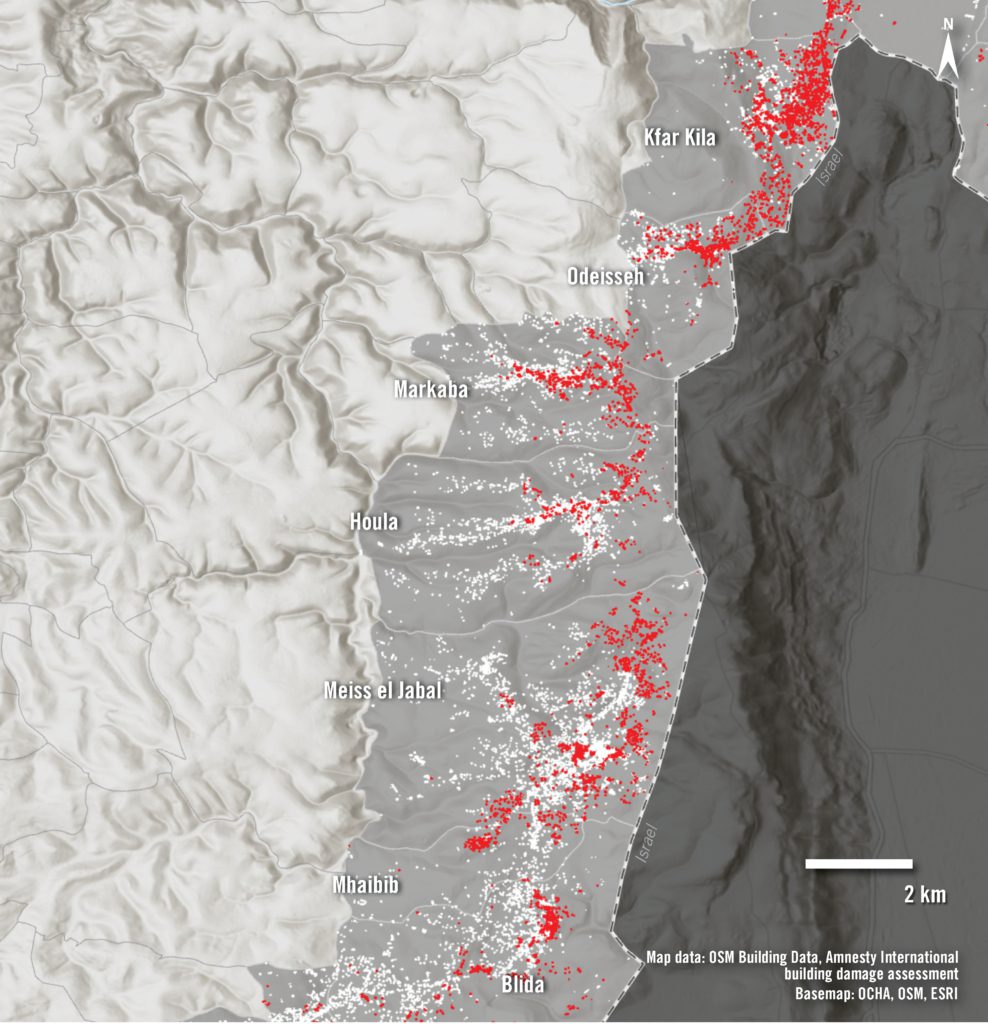
The data shows that the destruction is generally concentrated in the structures closer to the border, especially in the south-eastern districts. The pattern is evident in the distribution of destruction in the border municipalities of Nabatieh district, as shown in the map below:
Agricultural land was also heavily impacted. A United Nations Development Programme (UNDP) impact assessment, undertaken between 5 and 15 December 2024, found that 58% of the agricultural assets in Nabatieh district had been destroyed, followed by 52% in Tyre and 33% in Bint Jbeil, between October 2023 and November 2024. According to the report, the damage “is expected to have profound and long-lasting consequences given the vital role these affected areas play in agriculture and food production”.[68]
Villages laid to waste
Kfar Kila
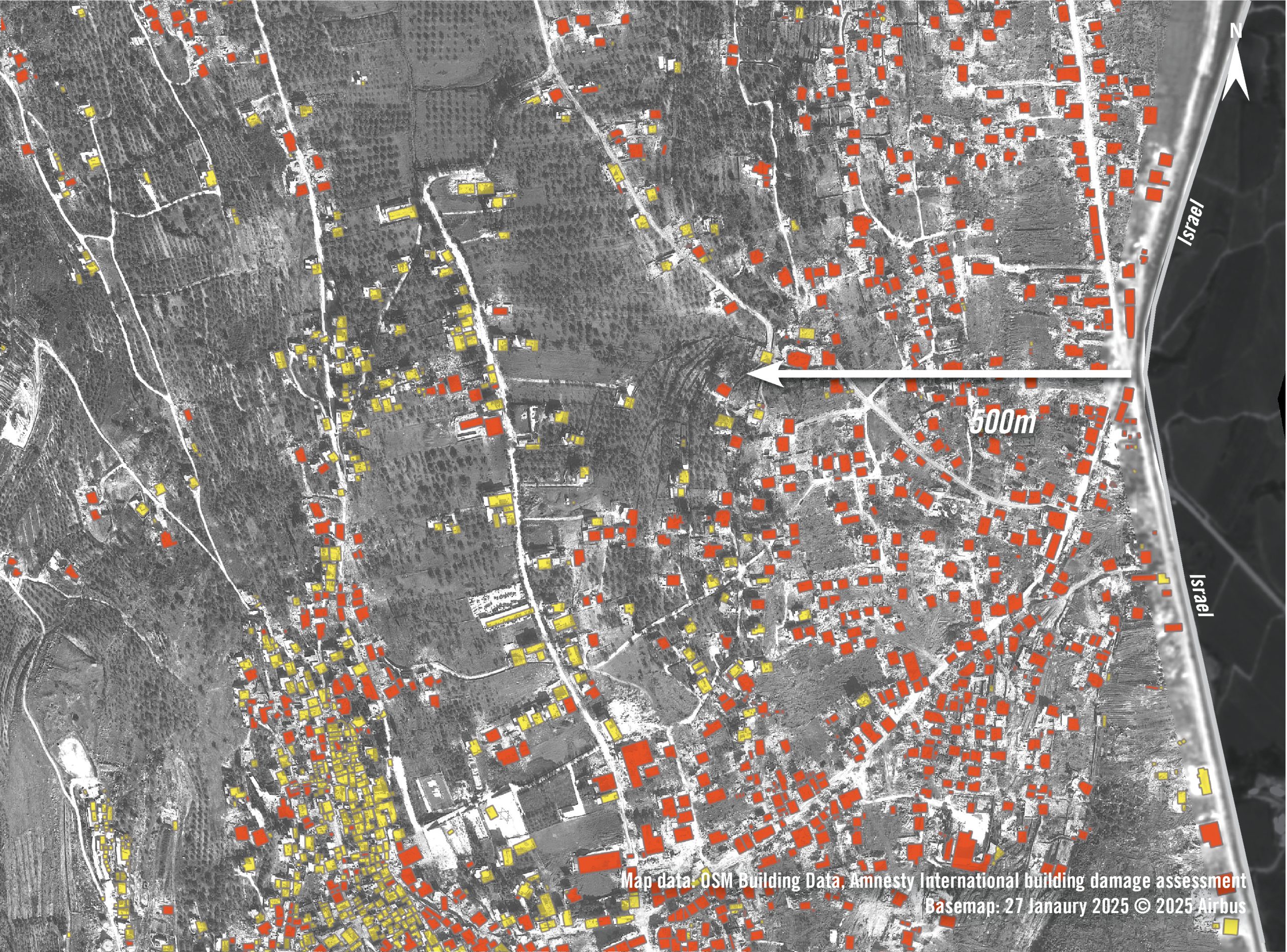
The village of Kfar Kila sits along the Israeli border, less than one kilometre from the Israeli town of Metula and is home to some 10,000 people.[69] Over 1,300 structures, or 52% of the total structures in the municipality, and 133 acres of orchards, were heavily damaged or destroyed between 26 September 2024 and 27 January 2025, according to satellite imagery.[70] In total, a stretch of buildings and orchards between 300 and 500 meters wide along the Israeli border was almost completely razed. Lebanese media reported on 29 demolitions by manually laid explosives or bulldozing carried out by the Israeli military in the period analysed, resulting in the destruction of houses, roads, olive crops and a football field, with 26 of these demolitions taking place after the ceasefire in Lebanon took effect.[71]
The Israeli military entered Kfar Kila between 30 September and 2 October 2024. Low resolution imagery shows tracks, likely created by heavy Israeli military vehicles, across the border into the municipality. Hezbollah said they had attacked Israeli forces in and around Kfar Kila with artillery shells, rockets and missiles between 2 October and 23 November 2024, with windows of several days without attacks in between.[72] Israeli journalists visited the village on 28 October and on 16 December, and the Israeli military Chief of Staff on 16 November, indicating that they had at least partial control of the area during those dates and considered it safe enough to bring civilians and a high-ranking official there.[73]On 29 October 2024, the Institute for the Study of War said that “Israeli forces appear to have at least partially secured Kfar Kila, given the presence of Israeli journalists.”[74]
While the Israeli military did not include Kfar Kila on its list of 205 villages that it ordered residents to evacuate from between 1 October and 12 November 2024, on 29 November, two days after the ceasefire went into effect, they listed it among the villages to which residents were not allowed to return.[75] Israeli forces continued to destroy parts of Kfar Kila into late January 2025, two months after a ceasefire agreement went into effect. On 26 January 2025, the ceasefire’s initial expiration date, Israeli soldiers fired gunshots at Lebanese civilians returning to Kfar Kila and at a journalist.[76] The Israeli military announced that its soldiers had fired shots to “remove threats in several areas where suspects were spotted approaching.”[77] Four individuals were killed, and 23 others were injured in the gunfire, according to the Lebanese Ministry of Public Health.[78]
On 1 October 2024, the Israeli military said a 100-meters long tunnel was found under a civilian home, and on 5 October they said a Hezbollah commander had been killed in the Kfar Kila region.[79] On 28 October 2024, the Israeli military published a compilation of videos filmed in the town, including several demolitions using manually laid explosives.[80] The post said “the 769th brigade identified and destroyed dozens of underground infrastructures, hundreds of war tools, enemy documents, launchers and terrorist equipment.”
On 14 November 2024, the Israeli military published a video showing evidence of tunnels and weapons allegedly found in Kfar Kila.[81] The accompanying text included an infographic of the town “depicting the locations of Hezbollah’s terrorist infrastructure”.[82] The illustration included dozens of structures marked in red. By comparing the infographic with ground footage and satellite imagery, it is clear that the destruction in Kfar Kila goes far beyond the buildings where the Israeli military claimed to have found Hezbollah’s infrastructure.

In early November, Israeli soldiers destroyed a soccer field. A video published on social media and verified by Amnesty International’s Evidence Lab shows a soldier tearing it apart with an excavator.[83] Satellite imagery shows the damage occurred between 5 and 6 November 2024. Nearby, satellite imagery shows that a large Star of David, a Jewish symbol, was carved into a parking area, further evidence of the unnecessary nature of the destruction.
Satellite imagery shows a football field and a parking area in Kfar Kila on 24 October 2024 (left). On 6 November 2024, satellite imagery shows the football field has been damaged and a Star of David is visible in the parking area (right).
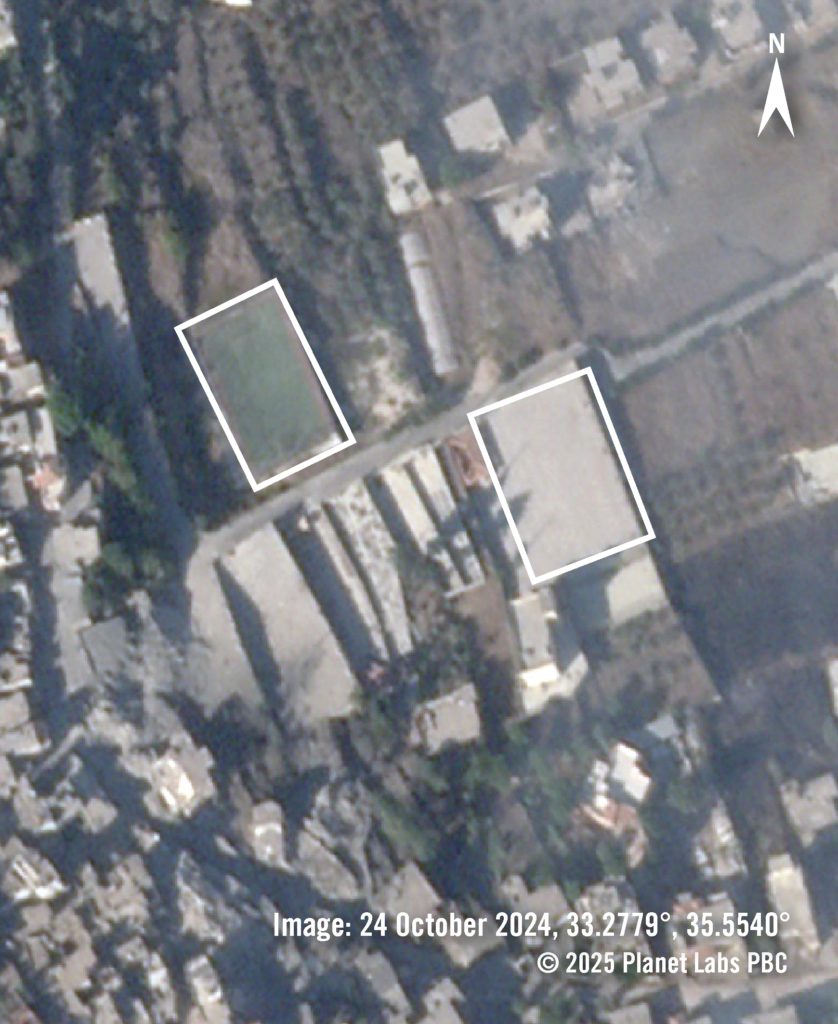
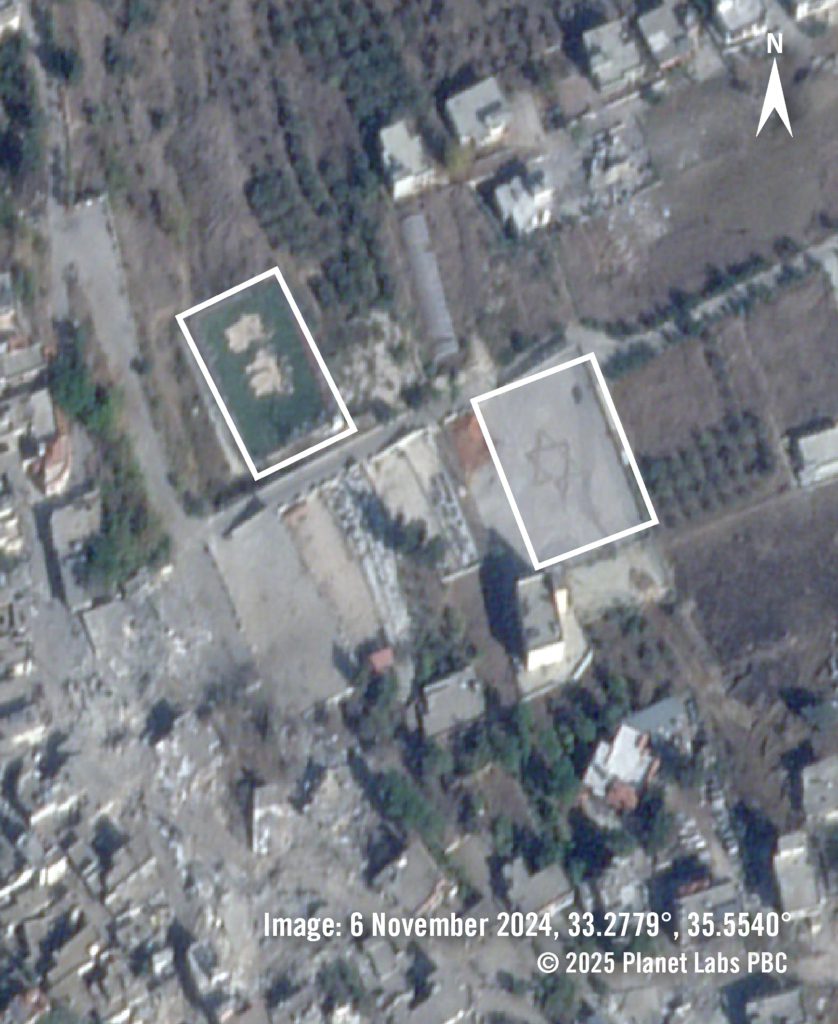
The Israeli military was in control of Kfar Kila when it destroyed the soccer field. Furthermore, Amnesty International’s investigation has not yielded evidence that the soccer field was itself a military objective or that any military objectives, such as tunnels, could be present in its proximity as suggested by the bulldozing of the surface of the recreational space. Neither could the organization find how such destruction could be justified based on “imperative military necessity”. Destroying civilian property in apparent absence of imperative military necessity constitutes a violation of the prohibition of destruction of the property of an adversary under IHL and may amount to a war crime if committed intentionally or with recklessness.
The extensive destruction of property in Kfar Kila had devastating impacts for civilians from the village. Zeinab, a woman from Kfar Kila, who left it in late 2023 following Israeli air strikes, along with the vast majority of its people, returned to visit Kfar Kila in late November 2024 for the first time since fleeing. She said:[84]
“I saw what I cannot describe. I can’t describe the massive destruction, the total devastation of Kfar Kila. I couldn’t find my house, or any houses! I found rubble, destruction, and rocks on the ground.
We were not able to recognize the village’s landmarks. The village’s features have changed. None of us recognized their homes, unless there was a particular tree next to it still standing, an electric pole left, or something from the foundation of the house that distinguishes it. Almost everything was on the ground. The few houses that remain standing are completely burned.
We returned to the village, but it was a difficult, sad return. We couldn’t stay; we returned to leave it again.
There are no houses, no electricity, no water, no basic necessities of life; it’s not that we cannot permanently return, we cannot even spend a day in the village”.
In April 2025, Zeinab told Amnesty International that “now, there is no one in Kfar Kila, our village is completely deserted. The villagers, including me, go to Kfar Kila only to visit the dead or re-bury our relatives who died during the war and were buried temporarily in another village (“Wadiha”). We brought them back to our land. Only the dead returned to Kfar Kila”.
Farrah Berrou, another resident from Kfar Kila, told Amnesty International that her grandparents’ three-storey home, which had been built in 1973, had been destroyed, along with the homes of all her relatives, their orchards and groves, the graves of her relatives, and a mosque that her family had helped build.[85]
“My heart is burning for the trees more than anything, because some are older than the house and have been there since my great-grandparents… We also had an avocado grove right on the border facing the wall that dad had planted during the pandemic. Nine hundred trees, all gone… These homes and groves were the last remnants of my grandparents, which is why this is so painful for my dad and his siblings. Losing a house is like losing a family member all over again.”
Upon returning to Kfar Kila, Ali Yehya, another resident of the village, found that the graves of his grandparents, uncle and other relatives had been bulldozed.[86] Ali Yehya showed Amnesty International a video of the destroyed cemetery and said: [87]
“What targets [would be] in the cemetery? We wouldn’t have accepted that anyone disturbed the resting place of our loved ones. The whole village, full neighbourhoods, were blown up. The war in Kfar Kila was not about targets; it was about removing Kfar Kila and us from existence.”
Israel appears to have violated IHL in its sweeping destruction of Kfar Kila. Some of the destruction in Kfar Kila could have been the result of Israeli air strikes before the ground invasion, of missiles launched by Hezbollah, or exchanges of fire while Israeli forces were on the ground. In these cases, the destruction would be lawful only if the attacks complied with the principles of distinction, proportionality and precaution. However, most of the destruction in Kfar Kila that Amnesty International documented was carried out through manually laid explosives and bulldozers after the Israeli military was in control of the village and appears to have taken place outside the context of an attack. As such, in order to comply with IHL, each destruction of civilian property would have to be justified based on imperative military necessity, which requires an individualized, case-by-case assessment of whether such standard is met.
As mentioned above, Amnesty International considered the Israeli military’s stated strategic objectives of “repelling the threat of Hezbollah and allowing civilians from northern Israel to safely return to their homes”. However, in the organization’s view, extensive destruction of civilian property in order to prevent an opposing party from launching attacks in the future does not meet the “imperative military necessity” standard under IHL. In fact, the latter requires an individualized, case-by-case assessment of whether destroying each specific property is required to fulfil a specific military goal. Notably, in light of its impact on civilians, “imperative military necessity” does not allow for a blanket justification for the destruction of all civilian property in a certain area.
Even when the Israeli military claimed that its motivations were tactical and focused on destruction of military infrastructure, Amnesty International’s investigation demonstrated that the destruction of civilian property vastly exceeded the scope of even the significant amount of Hezbollah infrastructure that Israel claimed existed in the village. The organization could not verify the veracity of Israel’s claims. For some of the destroyed buildings, the Israeli military claimed that the fact that Hezbollah may have used some of these buildings in the past justified their destruction.[88] Under IHL, past use of a building by an opposing party to the conflict does not in itself render such a building a military objective which can be the object of attack. This is due to the fact that the military advantage such destruction would offer cannot be considered “definite”, which under IHL is one of the requirements to qualify a civilian object as a military objective.[89]
To the extent that the Israeli military’s claims regarding the existence of Hezbollah tunnels, weapons caches and other military infrastructure in or around densely populated areas are true, Hezbollah may have in its own turn violated IHL, particularly the obligation to “take all feasible precautions to protect the civilian population and civilian objects under their control against the effects of attacks”.[90] Under IHL, Hezbollah must, to the extent feasible, avoid locating military objectives in or around densely populated areas.[91] Nevertheless, even in cases where Hezbollah has unlawfully located military objectives in civilian areas, Israel remains bound to conduct attacks in compliance with IHL. The location of a military objective near civilian objects does not absolve Israel from its obligations under IHL, namely the principle of distinction, proportionality and precaution.
In some cases, the Israeli military appeared to have had clear alternatives to such large-scale destruction. For example, some of the videos showed several weapons allegedly found in the town neatly displayed on a table. This indicates that, at least in some cases, the Israeli military had the feasible alternative to remove military objectives, such as weapons, rather than destroying the buildings in which these were allegedly found.
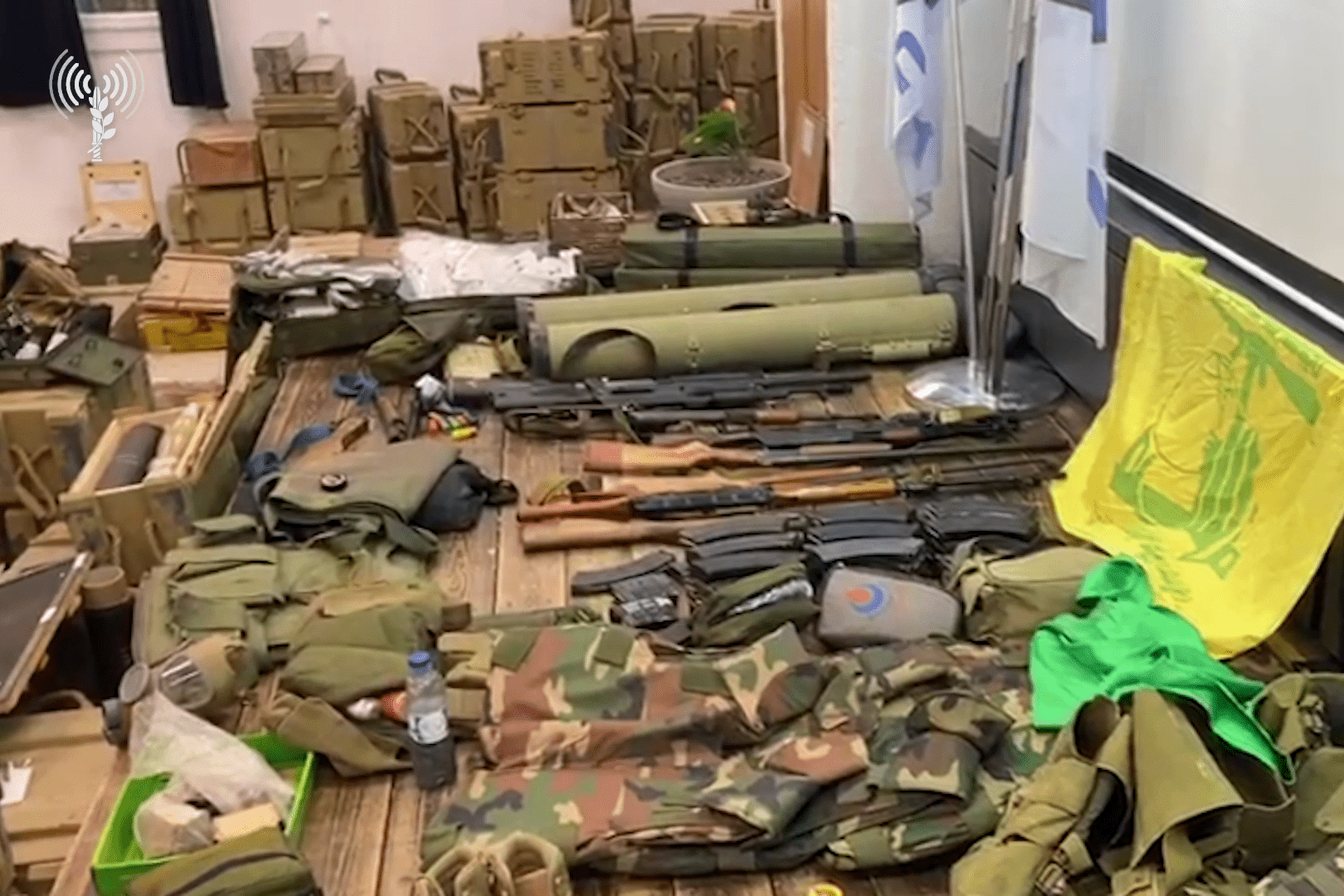
Overall, the evidence suggests that the Israeli military has violated the rule prohibiting the destruction of the property of an adversary in Kfar Kila. Such destruction should be investigated as a war crime wherever it was carried out intentionally or recklessly.
Maroun el Ras
In Maroun el Ras, 700 structures, or 67% of the total structures in the municipality, were destroyed or heavily damaged between 29 September 2024 and 30 January 2025, according to high resolution satellite imagery analysed by Amnesty International. Many of the structures were heavily damaged or destroyed in the first weeks of the Israeli ground invasion, followed by more destruction in November and December 2024. The Israeli military continued to destroy parts of Maroun el Ras into late January 2025, two months after a ceasefire agreement went into effect. Lebanese media reported on 12 demolitions by manually laid explosives or bulldozing carried out by the Israeli military in the period analysed, resulting in the destruction of houses, roads and a mosque, and the setting of a home on fire, with nine of these incidents taking place after the ceasefire in Lebanon took effect.[92]
The Israeli military issued an evacuation order to Maroun el Ras on 1 October 2024.[93] Satellite imagery shows that the Israeli military entered the municipality between 30 September and 3 October. Hezbollah said their fighters used explosive devices to target Israeli soldiers trying to enter the town on 3 and 4 October, targeted an Israeli tank with a guided missile in the outskirts of Maroun el Ras on 5 October, and clashed with Israeli soldiers in the area on 9 October 2024.[94] On 8 October 2024, a video published on social media and verified by Amnesty International showed soldiers raising the Israeli flag on what remained of the “Iranian garden“, a recreational area in the outskirts of Maroun el Ras.[95]On 9 October, the Israeli military stated that they had “eliminated the [Hezbollah] commander of the Maroun el Ras area and damaged the enemy’s launch and raid capabilities.”[96]
Between 2 and 19 November, Hezbollah said their fighters targeted Israeli soldiers in Maroun el Ras with rockets, missiles and drones, indicating that the attacks were being launched from a distance. By 6 November, satellite imagery shows the presence and operations of Israeli construction vehicles, not just combat vehicles, in the centre of Maroun el Ras, suggesting the area was stabilized and in control of the Israeli military. On 10 November, the Israeli military said they had destroyed an “underground terrorist complex located 1.5 kilometres from the border”.[97]On 29 November, two days after the ceasefire went into effect, the Israeli military listed Maroun el Ras among the villages to which residents were not allowed to return.[98] On 3 December, Lebanese media reported heavy bursts of gunfire were heard coming from Maroun el Ras towards the neighbouring town of Bint Jbeil.[99] On 26 January 2025, the ceasefire initial expiration date, Israeli soldiers fired gunshots at Lebanese civilians returning to Maroun el Ras and at a news crew.[100] The Israeli military announced that its soldiers had fired shots to “remove threats in several areas where suspects were spotted approaching.”[101] Ten individuals were injured in the gunfire, according to the Lebanese Ministry of Public Health.[102]
Among the structures destroyed in the first weeks following the Israeli ground presence in Maroun el Ras was the “Iranian garden”, which included a replica of Jerusalem’s al Aqsa Mosque, a soccer field and a playground. One video published on social media on 8 October 2024 and verified by Amnesty International showed soldiers raising the Israeli flag on what remained of the garden.[103] Videos published in the following days showed a bulldozer destroying the garden’s vegetation and lighting poles and an excavator demolishing a statue in the garden.[104]
In a document published on 11 October 2024 and likely shared with commanders as part of an educational program,[105] the Israeli military described the destruction of the Iranian garden as “a significant operational, symbolic and mental achievement.”[106] According to the document, the garden “was built with direct funding from the president of Iran” and “contained many symbols that represented the Iranian opposition to the existence of the State of Israel, and the ambition to conquer it with the help of Hezbollah forces”. It stated that the garden was “a symbol of resistance for Hezbollah and the Iranian government.”
An Amnesty International researcher visited the park in 2017 and 2020. She described it as a place where families gathered to enjoy time outdoors:[107]
“There were slides and games where kids could play, spaces for families to go on picnics, a green field for different sport games, a replica of the Dome of the Rock, and some cool architectural structures with water as you walk through. My favourite part was the observation tower where we all eagerly climbed to see the other side of the border from above and take some photos together.”

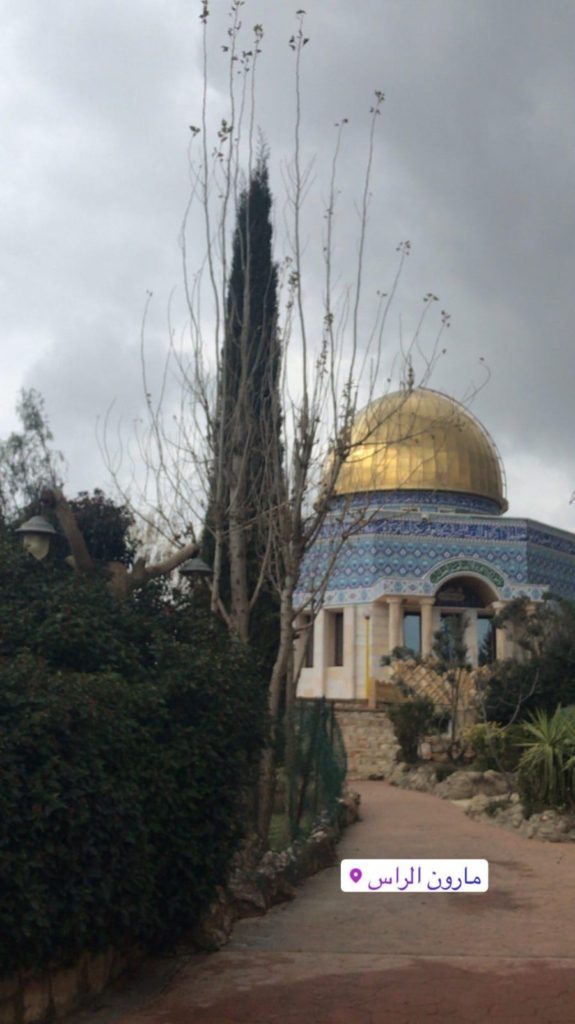
The destruction of the Iranian garden by the Israeli military did not occur in the context of an attack in IHL terms and, in any case, Amnesty International could not find any indications that the garden was itself a military objective; nor did the Israeli military allege the presence of any military objectives in or nearby the garden. The Israeli military instead referred to the destruction of the symbols of “Iranian opposition to the existence of the State of Israel” as being “a significant operational, symbolic and mental achievement”.[108] Symbols of this kind cannot per se qualify as military objectives under IHL. Similarly, based on Israel’s own explanation of the incident, the destruction of the Iranian garden – a civilian property – cannot be justified in accordance with the “imperative military necessity” standard. Based on the available evidence, the destruction of the Iranian garden appears to have violated the rule prohibiting the destruction of the property of an adversary under IHL and should be investigated as a war crime.
After the destruction of the garden, which was on the outskirts of the village, the Israeli military continued to destroy structures in Maroun el Ras, including into late December.
On 10 November, the Israeli military published a video showing officers filling a tunnel found near a cemetery in Maroun el Ras with cement.[109] This demonstrates that, at least in some cases, the Israeli military had viable alternatives that allowed it to destroy underground infrastructure without causing unacceptable destruction above the ground. Satellite imagery showed trucks and a grey pool of cement in the area on 5 November 2024.
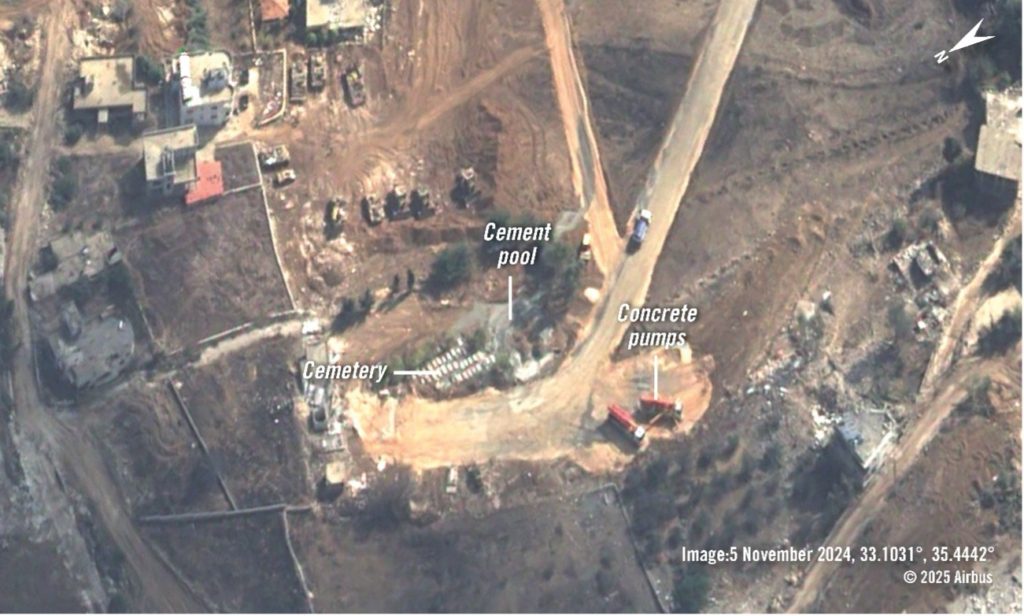
The text in Hebrew says: “Sealing the underground infrastructure”.
However, although the Israeli military filled the tunnel with cement, they also appeared to damage and destroy civilian property within its vicinity while in control of the area. The cemetery near the tunnel, for example, appeared partially destroyed. Buildings adjacent to the site were destroyed sporadically over the following weeks, with the last large building near the site being destroyed between 16 and 19 December 2024, according to satellite imagery. Although the tunnel is a clear military objective, its destruction and the destruction of the civilian property around it happened outside the context of an attack. The destruction of the tunnel – as an inherent military objective – could be justified based on “imperative military necessity”. However, the question arises whether the continued damaging or destruction of civilian property in areas already under the Israeli military’s control could be justified under the “imperative military necessity” standard, which requires that such destruction be the only option available to achieve a specific military goal, in this case the destruction of the tunnel. The Israeli military did not respond to Amnesty’s letter asking what reason, if any, the military had for: (i) its extensive destruction in Maroun el Ras generally; and (ii) its continued destruction of civilian property in the area near where the tunnel had been found and filled, specifically.
The Israeli military appears to have violated IHL during its extensive destruction of Maroun el Ras, much of which occurred after the end of active fighting in the area. While IHL does not prohibit the destruction of selected civilian property outside the context of an attack if carried out based on “imperative military necessity”, this does not automatically allow the destruction of whole areas where such property is located. The IHL rule prohibiting the destruction of the property of an adversary requires that the applicability of the exception of “imperative military necessity” be demonstrated for each destruction; the Israeli military failed to provide this evidence. In one of the few cases of destruction in which the Israeli military publicly explained the military goals pursued through it, that of the Iranian garden, the explanation could not support a claim that “imperative military necessity” justified such destruction, as its purely symbolic nature is not enough to justify the destruction of such civilian property based on this standard.
Odeisseh
Satellite imagery shows that Odeisseh, another village built mostly along the Israeli border, suffered heavy destruction. First, structures on the outskirts near the Israeli border were razed between 3 and 8 October 2024. Then, the centre of the village and more structures in the outskirts were destroyed between 12 October and 7 November 2024, including a mosque and a cemetery. The Israeli military continued to destroy parts of Odeisseh into mid-January 2025, almost two months after the ceasefire agreement went into effect and while it was in full control of the area. In total, over 580 structures, or 52% of the structures in the municipality, were heavily damaged or destroyed between 26 September 2024 and 27 January 2025, according to satellite imagery. Lebanese media reported on four demolitions by manually laid explosives carried out by the Israeli military during the period analysed, two of them taking place after the ceasefire in Lebanon took effect.[110]
Images published by the Israeli military on 2 October 2024 and geolocated by Amnesty International showed soldiers inside a building in Odeisseh near the Israeli border.[111] Hezbollah said their fighters had clashed with Israeli forces trying to enter the town on 2 and 15 October. Between 16 and 24 October, and again on 14 November, Hezbollah said their fighters had targeted Israeli forces in Odeisseh with artillery shells, rockets and guided missiles, indicating that the attacks were launched from a distance. The Israeli military did not make any public statements regarding attacks or destruction in the village.
While the Israeli military did not include Odeisseh among the 205 villages that it ordered residents to evacuate from between 1 October and 12 November 2024, on 29 November, two days after the ceasefire went into effect, they listed it among the villages to which residents were not allowed to return.[112] On 26 January 2025, the ceasefire initial expiration date, Israeli soldiers fired gunshots at Lebanese displaced civilians returning to Odeisseh, before handing over the area to the Lebanese Armed Forces. The Israeli military announced that its soldiers had fired shots to “remove threats in several areas where suspects were spotted approaching.”[113] Two individuals were killed, and 16 others were injured in the gunfire, according to the Lebanese Ministry of Public Health.[114]
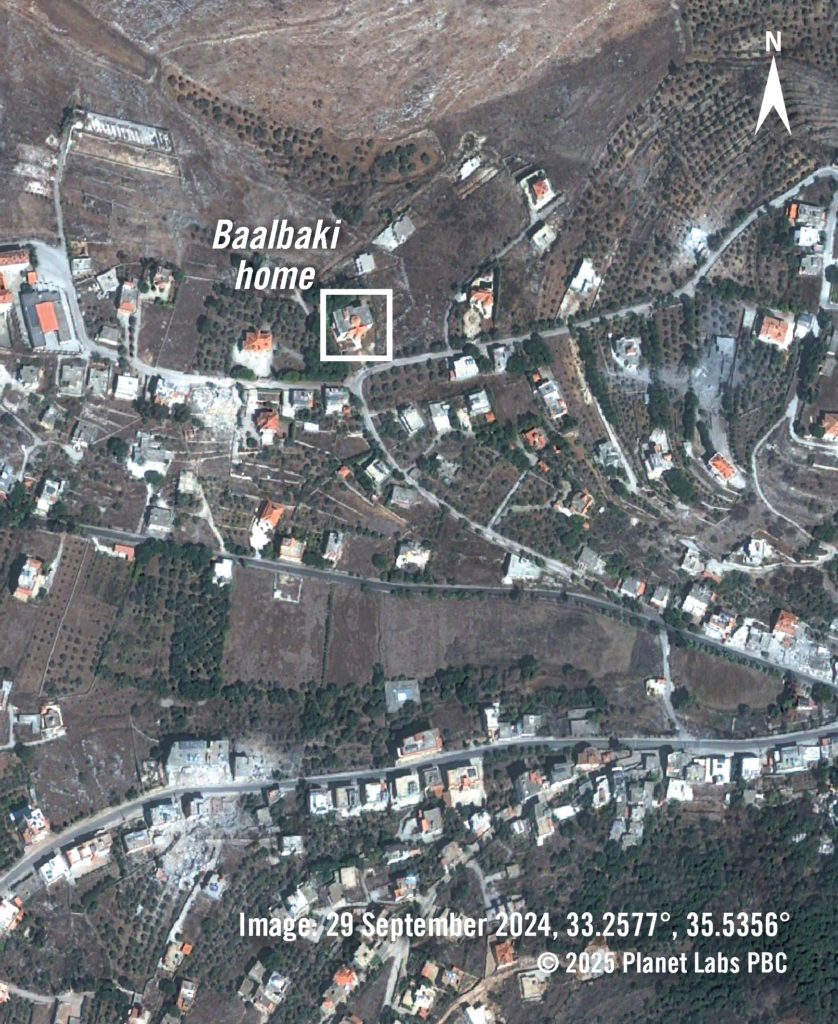
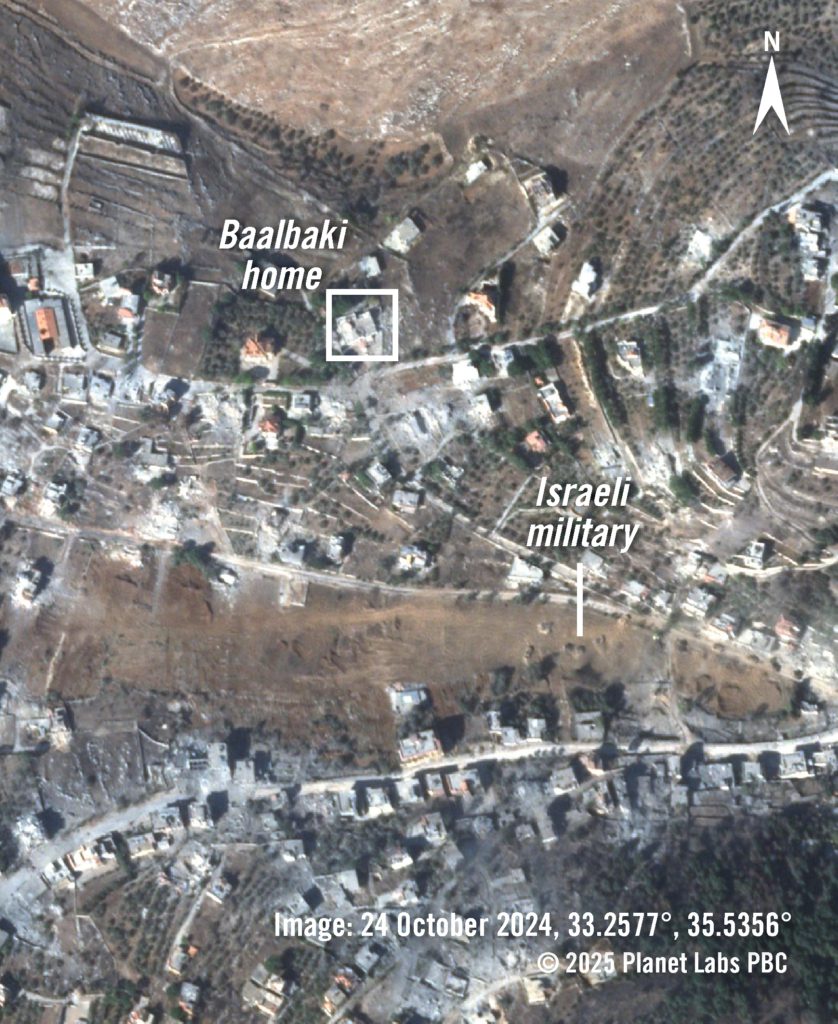
Eight videos were published on social media on 27 November 2024 showing the demolition of dozens of buildings by manually laid explosives in the village.[115] One of these buildings was Lubnan Baalbaki’s family home.[116]
Satellite imagery from 29 September 2024 (left) shows the Baalbaki home in Odeisseh. Imagery from 24 October 2024 (right) shows the home has been destroyed. The Israeli military is visible less than 250 meters away. Lower resolution imagery (not shown) confirms the home was destroyed between 21 and 23 October 2024.
“I watched the video several times, [thinking] ‘maybe it’s not our house, maybe not all of it…’ But the satellite images confirmed that the house that was destroyed is ours… I went through a mixture of feelings. It made me question the meaning of life, as it crumbled in front of me: I felt how cheap it is, not because it is a house, stones and columns, but it was the collection of all these memories, all these intimate relationships.”
On 18 February 2025, Baalbaki’s sisters were able to check on the house. Though the building had been demolished, the graves of their parents remained intact.[117]
“Our parents [were] buried in the garden of the house. Of course, their graves were the first thing we were afraid for… I started with mourning my memories and family life and ended up realizing that is bigger than just our house and lives; it is our entire village. An integrated environment that developed over hundreds of years, before becoming what it was. Even if we rebuild the house, it will be hard to rebuild its organic context.”
Satellite imagery shows that Baalbaki’s home was destroyed between 21 and 23 October 2024 along with a dozen other structures and over 5 acres of orchards in its surroundings. Drone footage published by the Israeli military captured the building’s collapse in a series of demolitions using manually laid explosives. On 24 October, satellite imagery shows Israeli armoured vehicles positioned approximately 350 metres from Baalbaki’s destroyed house. He told Amnesty International that he was not aware of any military activity or potential targets around the house.
Amnesty International found that Israel’s destruction of the Baalbaki’s home, as well as the neighbouring homes, occurred as part of a controlled demolition outside of an attack. This means that the destruction of these homes is to be assessed against the IHL rule prohibiting the destruction of the property of an adversary unless there was “imperative military necessity”.
Though there were reports of missile and rocket fire, the Israeli military appeared to be in control of the area in Odeisseh where the demolished homes were located, and where the destruction persisted with the use of manually laid explosives and razing. Unless the Israeli military could prove imperative military necessity justified each of these destructions, such acts would violate IHL. Amnesty International wrote to the Israeli military seeking information on what basis, if any, they carried out such extensive destruction in the village. The Israeli military did not reply.
Aita Ash-Shaab
The village of Aita Ash-Shaab, home to some 12,000 people,[118] suffered heavily from the Israeli military’s ground invasion. Satellite imagery shows that over 1,000 structures, or 48% of the total structures in the municipality, were heavily damaged or destroyed between 26 September 2024 and 30 January 2025.
Satellite imagery shows new roads entering from Israel on the border just south of the village between 11 and 13 October 2024. Then, vast areas of the village appear razed between 13 and 25 October, including four mosques. The demolitions continued in waves, with the latest destruction happening between 14 and 18 January 2025, more than six weeks after a ceasefire went into effect. Lebanese media reported on 17 demolitions by manually laid explosives or bulldozing carried out by the Israeli military during the period analysed, resulting in the destruction of houses and roads, with 14 of these incidents taking place after the ceasefire in Lebanon took effect.[119]
The Israeli military issued an evacuation on 12 October 2024.[120]Hezbollah said fighters had clashed with Israeli soldiers and had launched rockets and missiles toward Israeli forces in the surroundings of Aita Ash-Shaab between 13 and 26 October.[121] On 29 October, the Israeli military said the Hezbollah commander of the Aita Ash-Shaab region had been arrested.[122]Isolated clashes, gunfire and artillery shelling were also reported on 7 November, 6, 26 and 27 December 2024.[123]
On 29 November, two days after the ceasefire went into effect, the Israeli military listed Aita Ash-Shaab among the villages to which residents were not allowed to return.[124] On 26 January 2025, the ceasefire’s initial expiration date, Israeli soldiers fired gunshots at Lebanese displaced families returning to Aita Ash-Shaab, before handing over the area to the Lebanese Armed Forces. The Israeli military announced that its soldiers had fired shots to “remove threats in several areas where suspects were spotted approaching.”[125] One individual was injured in the gunfire, according to the Lebanese Ministry of Public Health.[126]
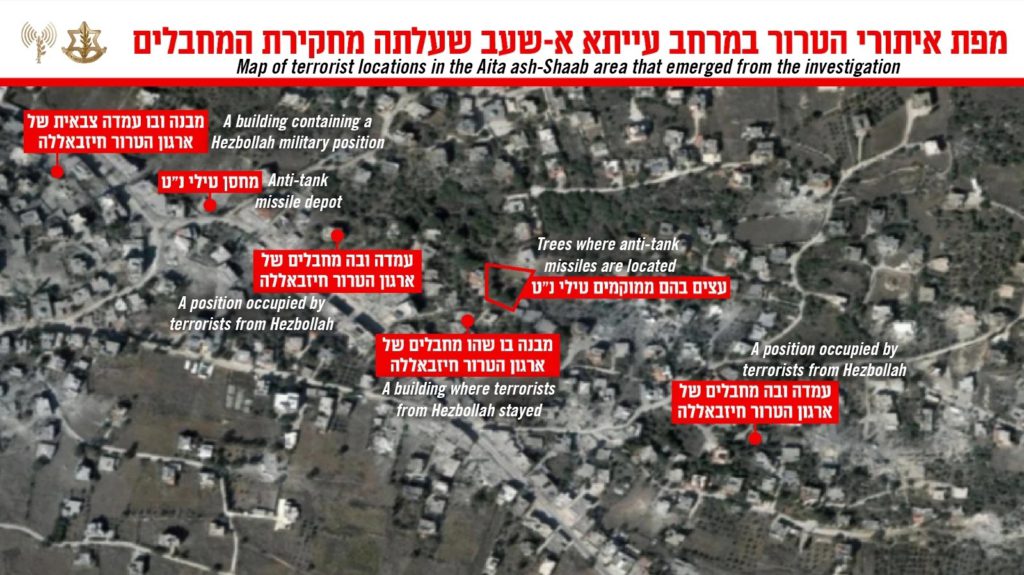
On 29 October, the Israeli military published maps of locations in the town that Hezbollah fighters allegedly used for military purposes.[127] One map showed four locations north of the town where fighters allegedly were based and two locations where antitank missiles were allegedly hidden. Amnesty International used this map to geolocate the positions and investigate the timeline of their destruction. Satellite imagery analysis shows that out of the four buildings allegedly used by Hezbollah as military positions or where its fighters were located, one was destroyed in an air strike before the ground invasion, two were heavily damaged or destroyed between 28 September and 24 October 2024, and one is apparently still standing at the cut-off date of this research, 30 January 2025. One location of alleged anti-tank missiles was targeted by an air strike before the Israeli ground invasion in October 2024 and the other was still standing on 30 January 2025. Numerous buildings surrounding the “trees where antitank missiles are located”, as labeled on the graphic, were destroyed between 10 and 30 January 2025.
Another map showed several “terrorist locations” as red dots spread over the village, but did not specify what each one of them meant.
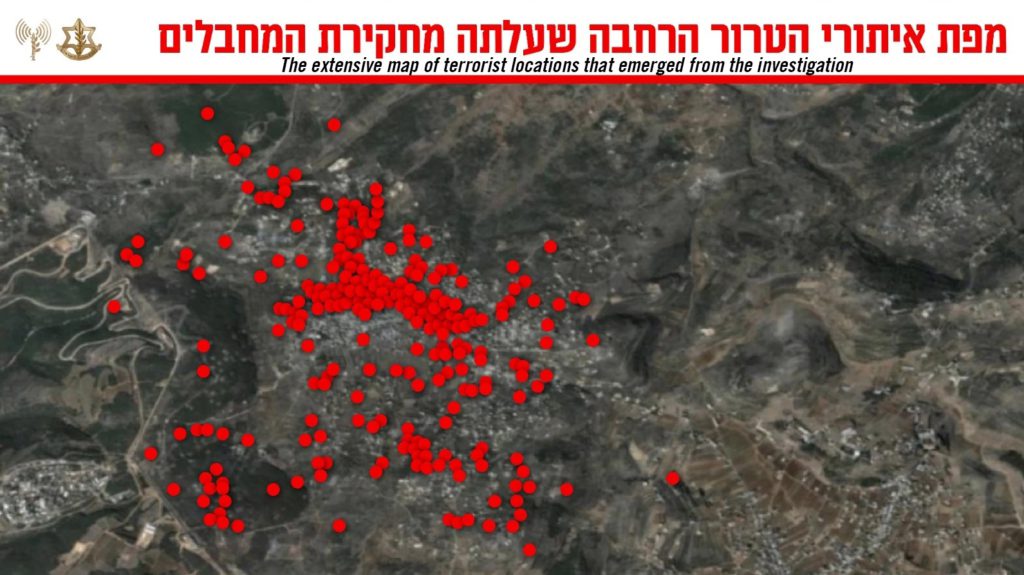
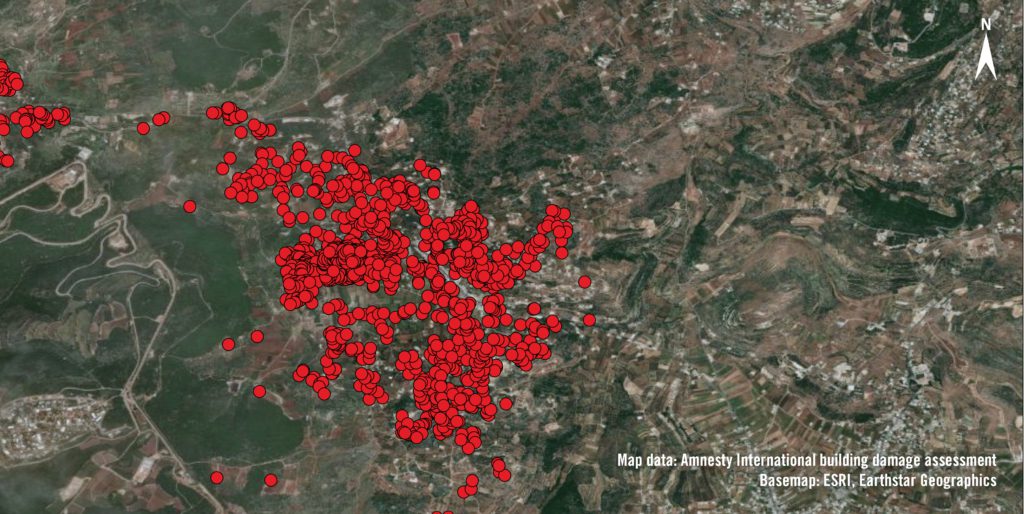
A comparison between the alleged military objectives and the actual extensive destruction of structures in the village shows clusters of destruction in areas which were not located in the vicinity of any alleged military objective.
The digital evidence analysed by Amnesty International showed Israeli soldiers at ease while carrying out the demolitions and apparently in firm control of the area. One video published on a soldier’s private social media account on 23 October 2024 showed troops jumping and singing in Hebrew the verse “may your village burn” as excavators tore down buildings.[128] Another video, published on 22 October, showed the Israeli flag raised on a water tank, one of the few structures still standing in the town.[129] Satellite imagery shows the water tank was toppled between 10 and 27 January 2025.
Aita Ash-Shaab’s mayor, Hajj Muhammad Srour, told Amnesty International that almost all of the village’s homes were destroyed.[130]
“My house is on the ground, it doesn’t exist anymore. My family and I, we visit the previous locations of our lives and then we leave before dark. Only about 12 families, less than 50 people, are now living in the village, in the houses that haven’t been destroyed.”
He added that all places of worship and the village’s seven schools have also been destroyed.
“The destruction today is indescribable and unparalleled. When you look at it, you feel that there is no purpose for it other than creating great damage, like someone trying to wreak havoc… In general, we lost all civilian property, [which] consists of homes, agricultural land, people’s livelihoods, shops, restaurants… The public squares, the places where people would meet in front of shops in every neighbourhood, the football playground for the kids and youth — all of these were fond memories. They’re all gone.”
While locations where fighters are present, or weapons are stored, may qualify as military objectives under IHL, the previous use of a building by a party to the conflict – be it as operational command and control centres, housing, or storage – does not automatically render a civilian object a military objective. To this end, the attacking party must demonstrate that the destruction of a civilian object offers a “definite military advantage”,[131] which cannot be indeterminate or potential.[132]
Some of the structures in the town were destroyed through air strikes before the ground invasion. However, the Israeli military destroyed a further 1,000 buildings between the 26 September 2024 and 30 January 2025, many of them with manually laid explosives and bulldozing while in control of the areas in question. The visual evidence analysed by Amnesty international demonstrates that the destruction carried out in Aita Ash-Shaab by the Israel military far exceeds the locations where it alleged military objectives were present. Outside of an attack, the destruction of civilian property must be based on “imperative military necessity” in order not to be prohibited under IHL. While the limited information published by the Israeli military did not allow Amnesty International to undertake a detailed verification of whether and in what respect the destroyed structures could have qualified as military objectives under IHL, the destruction appears to be excessive compared to the alleged military objectives identified publicly by Israel and, in the absence of other factors contributing to imperative military necessity, would be unlawful. The “imperative military necessity” standard requires that destruction of civilian property be compelling and exceptional, and any such destruction should be investigated as a war crime where it was carried out intentionally or recklessly.
Dhayra
On 30 October 2024, an Israeli journalist published videos allegedly showing “the explosion of an entire village in Lebanon that was a gathering place for terrorists”.[133] Amnesty International’s Evidence Lab verified that the village in question was Dhayra. Between 4 October 2024 and 30 January 2025, 264 buildings, or 71% of all the municipality’s structures, were destroyed. Almost 45 acres of agricultural land and native vegetation were also razed between the village and the Israeli border. Another 15 acres of orchards were razed further from the border. Lebanese media reported on five demolitions by manually laid explosives or bulldozing by the Israeli military during the period analysed, resulting in the destruction of houses and toppling trees, with four of these incidents taking place after the ceasefire in Lebanon took effect.[134]
On 13 October, the same journalist had published a video showing the use of manually laid explosives to destroy the Ahel El-Quran mosque, on the outskirts of Dhayra.[135] Satellite imagery confirms the mosque and several structures near the Israeli border were destroyed between 11 and 13 October, which indicates the Israeli military had control of at least a part of the municipality by then. Peacekeepers stationed at a UNIFIL post near Dhayra said Israeli soldiers had fired at them on 22 October. The Israeli military stated they were not aware of the incident, according to local media[136] and did not make any other public statements about their activities in the village. Hezbollah stated their fighters had fired rockets at Israeli soldiers in the outskirts of Dhayra on 23 and 27 October. [137]
While the Israeli military did not include Dhayra among the 205 villages that it ordered residents to evacuate from between 1 October and 12 November 2024, on 29 November, two days after the ceasefire went into effect, they listed it among the villages to which residents were not allowed to return.[138] Israeli forces continued to destroy parts of Dhayra into mid-January 2025, almost two months after a ceasefire agreement went into effect. On 26 January 2025, multiple units of the Lebanese Armed Forces were deployed to Dhayra following the withdrawal of the Israeli military, according to Lebanese media.[139]
Two other videos show different mosques closer to the centre of the village being blown up by manually laid explosives.[140] In one of them, soldiers laugh and sing a Jewish prayer as the Noble Messenger mosque, the village’s oldest mosque, disappears before their eyes: “For you will remove the government of the wicked from the land.”[141] Satellite imagery confirms that two mosques, along with several other structures, were destroyed in Dhayra between 23 and 25 October.
Satellite Imagery from 4 October 2024 (left) and 30 January 2025 (right) show the destruction of Dhayra. Highlighted are the locations of the three mosques that were filmed being blown up by Israeli soldiers.
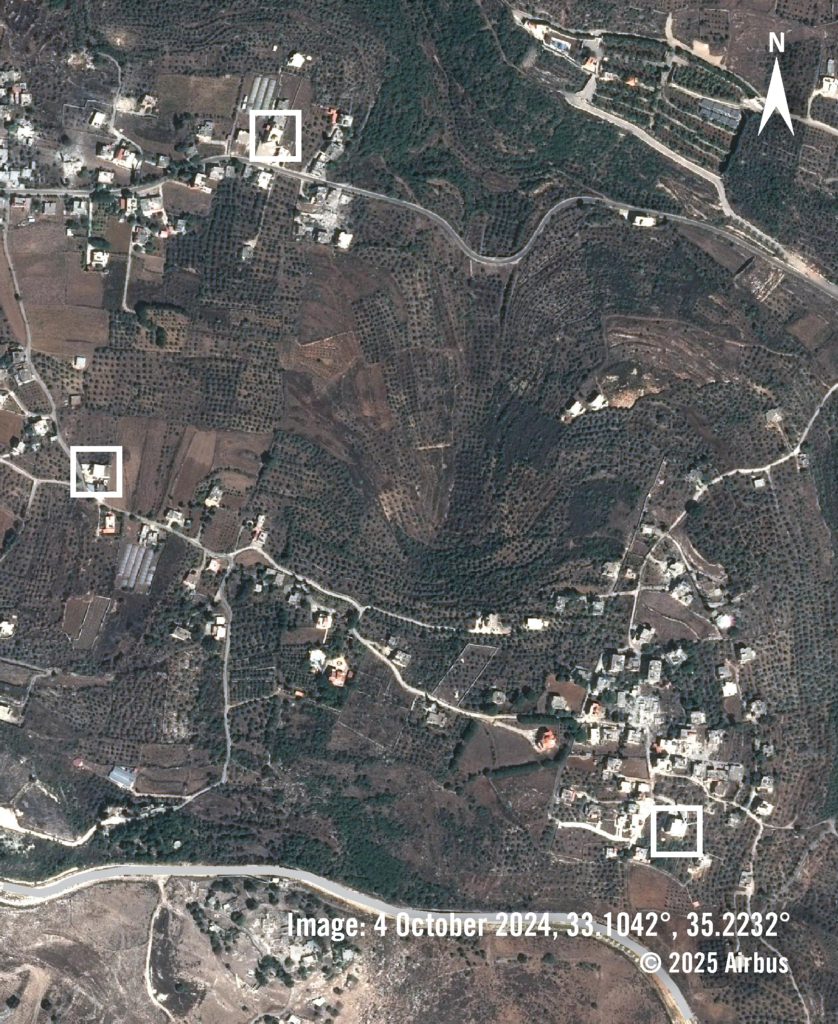
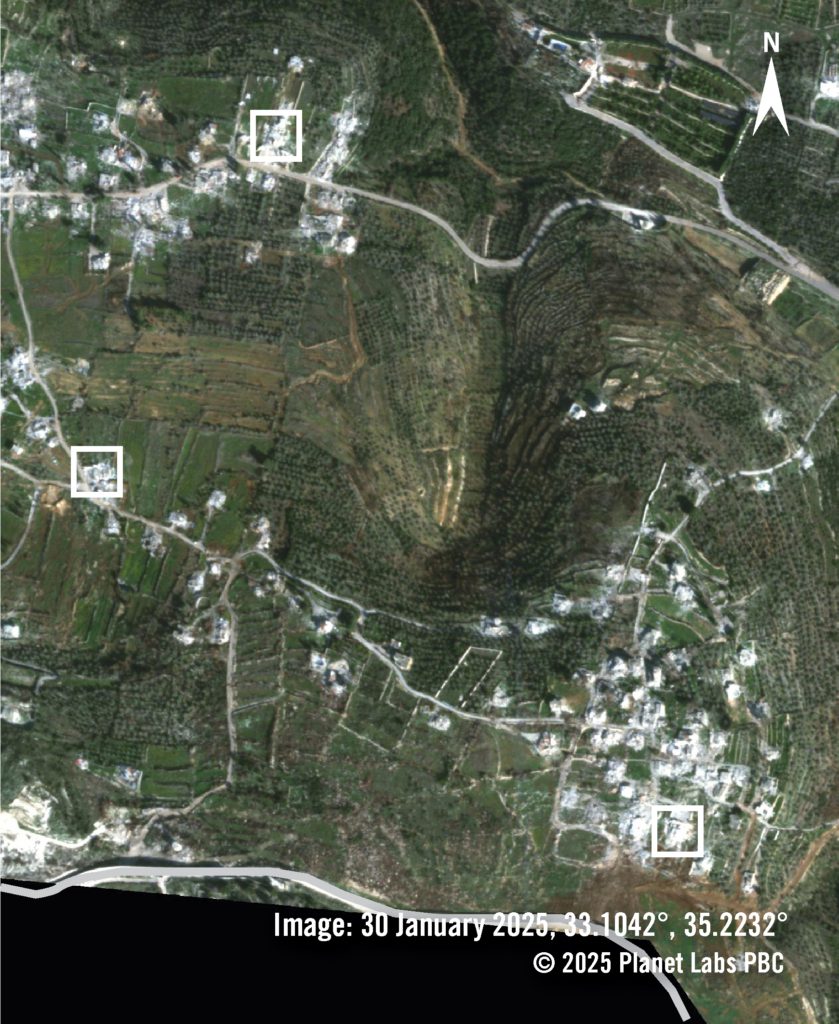
Among the structures that Israeli forces destroyed in Dhayra were the homes of 66-year-old Adiba Finsh and of her six sons:[142]
“Israel blew it up. All of it. And they filmed the explosion. Even the houses we saw them, they filmed it, they made a video of themselves counting from five to one, and when the explosion happened, they shouted: ‘Wow! Yay!’
I watch this video every day. And each time I tell the man ‘yaying’: yes, what an accomplishment! It didn’t cost you effort and money to build it.”
Adiba Finsh told Amnesty International that she left the village in March 2024, as it was not safe for her and her family to stay because of Israeli air strikes.
“Before the war, our village didn’t have military posts. When the war started, we stayed in our village while the valleys were being bombed. During the first six months, we never saw anyone other than the villagers, no fighters, no visitors, nothing: only us, alone, in our village. We were able to stay in our land for six months, until the Israelis pressured us to leave when they started bombing the heart of the town, so we left.
I can’t tell what happened after we left. We don’t know who entered the houses or who left them. Then they demolished the houses, and with them all the stories. I can only confirm that in the first six months of the war, I never saw military signs or activity in our village.”
When they were able to go back to visit the village at the end of November 2024, she said that none of the family’s seven homes or the crops they cultivated were left standing.
“Before the war, we grew tobacco, we planted vegetables in front of our houses for our meals, and we made bread using our own wheat. We lived happily and comfortably. The tobacco season covered our needs from one year to the next. We were happy in our homes, our land, and our livelihood, and we appreciated what we had. My family doesn’t own a large plot of land; we have around seven donums of land [around 7,000 square meters], on which we built our houses and grew olives, producing 50 gallons of olive oil per year. They destroyed it, and then they bulldozed our house, and they bulldozed the olive trees. You can’t identify the houses anymore.”
As in other villages along Lebanon’s southern border with Israel, the Israeli military appeared to have carried out extensive destruction of civilian property in Dhayra outside the context of an attack and in apparent absence of imperative military necessity. This would make such destruction a violation of the IHL rule prohibiting the destruction of the property of an adversary.
In the videos showing the destruction of mosques in Dhayra, the Israeli military appears in control of the area and soldiers seem at ease, indicating there was no active fighting. Amnesty International has not identified any public statements by the Israeli military claiming that the mosques qualified as military objectives at the time of their destruction, nor that their destruction served an imperative military necessity. The destruction of mosques outside the context of an attack and absent imperative military necessity violates the IHL rule prohibiting the destruction of cultural property, which includes religious institutions, and may amount to a war crime when carried out intentionally or recklessly. In a letter to the Israeli military, Amnesty International inquired what, if any, military purpose was served by blowing up the three mosques in Dhayra. The Israeli military did not respond.
recommendations
To the Israeli authorities
- Respect all applicable obligations under IHL, including:
- outside the context of attacks, refrain from destruction of civilian and cultural property unless required by imperative military necessity; and,
- in the context of attacks, strictly abide by the principles of distinction, proportionality and precaution.
- Allow all residents of southern Lebanon to safely return to their homes and properties and provide prompt, full and adequate reparations to victims, including individuals and communities, of violations of IHL and war crimes. Reparations should include restitution, compensation, rehabilitation, reconstruction, satisfaction and/or guarantees of non-repetition. Reparations should be provided to direct and indirect victims, including individuals or their family members who were harmed by unlawful conduct, including civilian property damage and destruction which violated IHL. Reparations, including in the form of compensation, should also be made to local civilian authorities, including municipal authorities, educational institutions and public and private healthcare providers for damage caused by unlawful conduct on their premises.
To the Lebanese government
- Invite the UN Special Rapporteur on truth, justice and reparation to conduct a country visit and recommend measures that Israel, Hezbollah and the government of Lebanon can take to uphold victims’ right to justice, truth and reparation.
- Consider working with UN institutions to request the creation of a registrar of damages, which is a body set up to document, register and assess harms resulting from serious violations of international law.
- Explore all possible legal routes, including setting up a domestic reparation mechanism and demanding reparation from parties to the conflict to fulfil the right to reparation of victims for harms resulting from serious violations of international law.
- Seriously reconsider providing the International Criminal Court (ICC) with jurisdiction to investigate and prosecute crimes under the Rome Statute committed on Lebanese territory since October 2023, including by acceding to the Rome Statute and making a declaration under Article 12(3) accepting the Court’s jurisdiction from October 2023.
To all States, especially the United States
- Immediately suspend all arms transfers and other forms of military assistance to Israel due to the significant risk that these weapons could be used to commit or facilitate serious violations of international law.
Footnotes
[1] See section “Legal Framework” below.
[2] Establishing precise definitions of the “tactical” and “strategic” levels of an armed conflict has been challenging for centuries. In general, actions conducted by small units, such as individual attacks and battles, are considered as belonging to the tactical level, while the strategic level concerns the overall national policy and theatre strategy. Andrew S. Harvey, “The Levels of War as Levels of Analysis,” Military Review, November – December 2021, https://www.armyupress.army.mil/Portals/7/military-review/Archives/English/ND-21/Harvey-Levels-of-War-1.pdf
Notably, both levels of an armed conflict may be considered when determining military necessity. Echoing a broadly held consensus, the United States Law of War Manual states: “Thus, military necessity may consider the broader imperatives of winning the war and not only the demands of the immediate situation.” Department of Defense Law of War Manual, updated July 2023, https://media.defense.gov/2023/Jul/31/2003271432/-1/-1/0/DOD-LAW-OF-WAR-MANUAL-JUNE-2015-UPDATED-JULY%202023.PDF, pg. 57.
[3] Israel Defence Forces, X post: “IDF Spokesperson RAdm. Daniel Hagari exposing Hezbollah’s way of firing missiles from civilian homes, and how the IDF plans on dismantling it” 23 September 2024, https://x.com/IDF/status/1838081162129940615
[4] See ArcGIS Pro, ESRI, “Detect pixel value change”, https://pro.arcgis.com/en/pro-app/latest/help/analysis/image-analyst/pixel-value-change-detection.htm (accessed 10 July 2025).
[5] See Humanitarian OpenStreetMap Team, “Filling OSM buildings data gaps for recovery in Lebanon”, 7 January 2025, https://www.hotosm.org/updates/filling-osm-buildings-data-gaps-in-lebanon
[6] Armed Conflict Location & Event Data Project (ACLED), “ACLED Codebook, 2025”, accessed 17 June 2025, www.acleddata.com
[7] Institute for the Study of War, “Iran Updates”, 17 October 2023, https://www.understandingwar.org/backgrounder/iran-updates
[8] S/RES/1701(2006) Resolution 1701 (2006) / adopted by the Security Council at its 5511th meeting, on 11 August 2006 https://digitallibrary.un.org/record/581053?v=pdf
[9] Amnesty International, “You feel like you are subhuman”: Israel’s genocide against Palestinians in Gaza (Index: MDE 15/8668/2024), 5 December 2024, https://www.amnesty.org/en/documents/mde15/8668/2024/en, p. 56.
[10] UN Office for the Coordination of Humanitarian Affairs (OCHA), “Reported impact snapshot | Gaza Strip (25 June 2025)”, 25 June 2025, https://www.ochaopt.org/content/reported-impact-snapshot-gaza-strip-25-june-2025
[11] In December 2024, Amnesty International published a report in which it concluded that “Israel, through its policies, actions and omissions against Palestinians in Gaza following 7 October 2023, committed and is committing genocide”.
[12] Amnesty International, “Lebanon: Evidence of Israel’s unlawful use of white phosphorus in southern Lebanon as cross-border hostilities escalate” 31 October 2023, https://www.amnesty.org/en/latest/news/2023/10/lebanon-evidence-of-israels-unlawful-use-of-white-phosphorus-in-southern-lebanon-as-cross-border-hostilities-escalate; Amnesty International, “Lebanon: Deadly Israeli attack on journalists must be investigated as a war crime”, 7 December 2023, https://www.amnesty.org/en/latest/news/2023/12/lebanon-deadly-israeli-attack-on-journalists-must-be-investigated-as-a-war-crime; Amnesty International, “Lebanon: Establish international investigation into deadly attacks using exploding portable devices”, 20 September 2024, https://www.amnesty.org/en/latest/news/2024/09/lebanon-establish-international-investigation-into-deadly-attacks-using-exploding-portable-devices; Amnesty International, “Israel/Lebanon: Branches of Hezbollah-affiliated financial institution not military targets”, 22 October 2024, https://www.amnesty.org/en/latest/news/2024/10/israel-lebanon-branches-of-hezbollah-affiliated-financial-institution-not-military-targets; Amnesty International, “Lebanon: Israeli air strikes that killed at least 49 civilians further evidence of war crimes”, 12 December 2024, https://www.amnesty.org/en/latest/news/2024/12/lebanon-israeli-air-strikes-that-killed-at-least-49-civilians-further-evidence-of-war-crimes; Amnesty International, “Israel: Hezbollah’s use of inherently inaccurate weapons to launch unlawful attacks violates international law”, 20 December 2024, https://www.amnesty.org/en/latest/news/2024/12/israel-hezbollahs-use-of-inherently-inaccurate-weapons-to-launch-unlawful-attacks-violates-international-law; Amnesty International, “Lebanon: Israeli attacks on health facilities, ambulances and paramedics must be investigated as war crimes”, 5 March 2025, https://www.amnesty.org/en/latest/news/2025/03/lebanon-israeli-attacks-on-health-facilities-ambulances-and-paramedics-must-be-investigated-as-war-crimes
[13] [MISSING SOURCE]Reference for deaths in Lebanon until December 2024: Ministry of Public Health, “4047 شهيدًا و16638 جريحًا الحصيلة الإجمالية المحدثة للعدوان الإسرائيلي”
[“4,047 martyrs and 16,638 wounded is the updated total toll of the Israeli aggression”] 4 December 2024,https://moph.gov.lb/ar/Media/view/77347/4047-شهيدًا-و16638-جريحًا-الحصيلة-الإجمالية-المحدثة-للعدوان-الإسرائيلي-
Reference for deaths in Lebanon since December 2024: L’Orient Today, “Series of violent Israeli strikes on Nabatieh, Israeli army claims Hezbollah members targeted”, 21 April 2025, https://today.lorientlejour.com/article/1456787/series-of-violent-israeli-strikes-on-nabatieh-israeli-army-claims-hezbollah-members-targeted.html
Reference for deaths in Israel: Times of Israel, “Six months after ceasefire, some in north are slow to recover as fears of new fight lurk”, 30 May 2025 https://www.timesofisrael.com/six-months-after-ceasefire-some-in-north-are-slow-to-recover-as-fears-of-new-fight-lurk
[14] L’Orient Today, “Full text of the cease-fire agreement between Lebanon and Israel”, 26 November 2024. https://today.lorientlejour.com/article/1437074/full-text-of-the-cease-fire-agreement-between-lebanon-and-israel.html
[15] MTC4L, “Lebanon: Italian-led Military Technical Commitee starts its first operational and training activities”, 30 August 2024, https://www.esercito.difesa.it/en/News/Pagine/Italian-led-Military_Technical_Commitee.aspx; L’Orient Today, “Who is in the cease-fire ‘monitoring committee’ and what does it do?”, 2 December 2024, https://today.lorientlejour.com/article/1437793/who-is-in-the-cease-fire-monitoring-committee-and-what-does-it-do.html; USCENTCOM, “MG Jasper Jeffers arrives in Beirut to Serve as Co-Chair for the Implementation and Monitoring Mechanism of the Cessation of Hostilities”, 29 November 2024, https://www.centcom.mil/MEDIA/PRESS-RELEASES/Press-Release-View/Article/3981254/mg-jasper-jeffers-arrives-in-beirut-to-serve-as-co-chair-for-the-implementation
[16] Seventeen evacuation orders posted on the platform X by IDF’s Spokesperson for the Arab Media, Avichay Adraee, between 1 October and 12 November 2024, available at: https://x.com/AvichayAdraee/status/1856306749973643296; https://x.com/AvichayAdraee/status/1855915816455111095; https://x.com/AvichayAdraee/status/1851901867250381234
https://x.com/AvichayAdraee/status/1851600426791035123; https://x.com/AvichayAdraee/status/1851209006955761708
https://x.com/AvichayAdraee/status/1850483168232554777; https://x.com/AvichayAdraee/status/1847202231113674760
https://x.com/AvichayAdraee/status/1845763386891522301; https://x.com/AvichayAdraee/status/1845418298873180302
https://x.com/AvichayAdraee/status/1845026806874644945; https://x.com/AvichayAdraee/status/1856306749973643296
https://x.com/AvichayAdraee/status/1843233523735388367; https://x.com/AvichayAdraee/status/1842866906841170108
https://x.com/AvichayAdraee/status/1842085055947997517; https://x.com/AvichayAdraee/status/1841777706259906945
https://x.com/AvichayAdraee/status/1841360300970226003; https://x.com/AvichayAdraee/status/1841045108537294975
[17] Avichay Adraee, IDF’s Spokesperson for the Arab Media, X post: يان #عاجل إلى سكان #لبنان [“Urgent message to the people of #Lebanon”], 29 November 2024, https://x.com/AvichayAdraee/status/1862363097601826888 (in Arabic).
[18] OHCHR, “Israel must stop killing civilians returning to their homes in South Lebanon: UN experts”, 13 February 2025. https://www.ohchr.org/en/press-releases/2025/02/israel-must-stop-killing-civilians-returning-their-homes-south-lebanon-un
[19] OHCHR, “Israel must stop killing civilians returning to their homes in South Lebanon” (previously cited).
[20] Avichay Adraee, IDF’s Spokesperson for the Arab Media, X post: #عاجل: لقد هزم #حزب_الله ومني بضربة قوية جدا وأعيد سنوات طويلة إلى الوراء [“#Urgent: #Hezbollah has been defeated and has suffered a very strong blow, setting it back many years”],18 February 2025, https://x.com/AvichayAdraee/status/1891871556994728307
[21] Alma Research and Education Center, “Israel Remains in Five Key Areas in Southern Lebanon as a Response to Potential Restoration of Hezbollah’s Attack Capabilities”, 18 February 2025, https://israel-alma.org/israel-remains-in-five-key-areas-in-southern-lebanon-as-a-response-to-potential-restoration-of-hezbollahs-attack-capabilities
[22] France 24, “Israeli troops ‘staying indefinitely’ in Lebanon border buffer zone, defence minister says”, 27 February 2025, https://www.france24.com/en/middle-east/20250227-israeli-troops-staying-indefinitely-in-lebanon-border-buffer-zone-defence-minister-says
[23] OHCHR, “Israeli operations in Lebanon continue to kill civilians”, 15 April 2025, https://www.ohchr.org/en/press-briefing-notes/2025/04/israeli-operations-lebanon-continue-kill-civilians
[24] Additional Protocol I, Article 49(1): “‘Attacks’ means acts of violence against the adversary, whether in offence or in defence.” See also ICRC, Commentary to Additional Protocol I, 1987, para. 1880: “the term ‘attack’ means ‘combat action’”. This definition of attacks also applies in non-international armed conflicts. See ICRC, Commentary to Additional Protocol II, 1987, para. 4783.
[25] Reference to “civilian objects” owes to the fact that this briefing focuses on destruction of property. These principles also apply to attack involving civilians and the civilian population.
[26] ICRC, Customary IHL Study, Rule 7.
[27] ICRC, Customary IHL Study, Rule 9.
[28] ICRC, Customary IHL Study, Rule 8.
[29] ICRC, Customary IHL Study, Rule 156.
[30] ICRC, Customary IHL Study, Rule 10.
[31] ICRC, Customary IHL Study, rule 14: “Launching an attack which may be expected to cause incidental loss of civilian life, injury to civilians, damage to civilian objects, or a combination thereof, which would be excessive in relation to the concrete and direct military advantage anticipated, is prohibited.”
[32] ICRC, Customary IHL Study, rule 15: “In the conduct of military operations, constant care must be taken to spare the civilian population, civilians and civilian objects. All feasible precautions must be taken to avoid, and in any event to minimize, incidental loss of civilian life, injury to civilians and damage to civilian objects.”
[33] ICRC, Customary IHL Study, Rules 11-12, 14 and 156.
[34] ICRC, Commentary to Additional Protocol I, 1987, para. 1880; ICRC, Commentary to Additional Protocol II, 1987, para. 4783.
[35] ICRC, Customary IHL Study, rule 50. This rule derives from Article 23(g) of the 1907 Hague Regulations IV, which enjoys customary status. See ICJ, Legal Consequences arising from the Policies and Practices of Israel in the Occupied Palestinian Territory, including East Jerusalem, Advisory Opinion, 19 July 2024, para. 96.
[36] ICTY, Prosecutor v. Mladic, Trial Chamber I, Judgment, 22 November 2017, para. 3257. See also ICTY, Prosecutor v. Naletilic and Martinovic, Trial Chamber, Judgment, 31 March 2003, para. 589; ICTY, Prosecutor v. Oric, Trial Chamber II, Judgment, 30 June 2006, para. 588.
[37] J. Lovitky, Understanding the Distinction Between Property Destruction Governed by Hague Article 23(g) and the Rules Governing Attacks, Articles of War, 6 November 2024.
[38] ICC, Prosecutor v. Katanga, Trial Chamber II, Judgment, 7 March 2014, para. 892.
[39] ICC, Prosecutor v. Katanga, Trial Chamber II, Judgment, 7 March 2014, para. 892.
[40] ICC, Prosecutor v. Ongwen, Trial Chamber IX, Judgment, 4 February 2021, para. 2776. See also ICC, Prosecutor v. Katanga, Trial Chamber II, Judgment, 7 March 2014, para. 892; O. Triffterer and K. Ambos, Rome Statute of the International Criminal Court. A Commentary, 2016, p. 568, para. 970.
[41] ICC, Prosecutor v. Katanga, Trial Chamber II, Judgment, 7 March 2014, para. 891.
[42] Instructions for the Government of Armies of the United States in the Field (Lieber Code), 24 April 1863.
[43] ICTY, Prosecutor v. Kordić and Čerkez, Appeals Chamber, Judgement, 17 December 2004, para. 686; ICC, Prosecutor v. Katanga, Trial Chamber II, Judgment, 7 March 2014, para. 894. However, see also ICTY, Prosecutor v. Strugar, Trial Chamber II, Judgment, 31 January 2005, para. 295, where “military necessity” was interpreted more narrowly by equating it to the definition of “military objectives” under IHL.
[44] ICC, Prosecutor v. Katanga, Trial Chamber II, Judgment, 7 March 2014, para. 894. See also ICC, Prosecutor v. Ntaganda, Trial Chamber vi, Judgment, 8 July 2019, para. 1164.
[45] ICC, Prosecutor v. Katanga, Trial Chamber II, Judgment, 7 March 2014, para. 893.
[46] ICC, Prosecutor v. Ntaganda, Trial Chamber vi, Judgment, 8 July 2019, para. 1098.
[47] ICC, Prosecutor v. Ongwen, Trial Chamber IX, Judgment, 4 February 2021, para. 2779.
[48] US Military Tribunal in Nuremberg, The Krupp Trial, 1947–1948, United Nations War Crimes Commission Law Reports, Vol. X, p. 136: “[w]hat was intended merely [under Article 23(g) of the Hague Regulations] was to authorize the seizure or destruction of private property only in exceptional cases when it was an imperative necessity for the conduct of military operations…”.
[49] US Military Tribunal in Nuremberg, The Hostages case, Trial of Wilhem List and Others, Law Reports of Trials of War Criminals, Vol. VIII, 1949, p. 66: “It is lawful to destroy railways, lines of communication or any other property that might be utilised by the enemy. Private homes and churches even may be destroyed if necessary for military operations. It does not admit of wanton devastation of a district or the wilful infliction of suffering upon its inhabitants for the sake of suffering alone.”
[50] ICTY, Prosecutor v. Oric, Trial Chamber II, Judgment, 30 June 2006, para. 588.
[51] ICTY, Prosecutor v. Kordic and Cerkez, Appeals Chamber, Judgement, 17 December 2004, para. 575.
[52] Israel Defence Forces, X post: “IDF Spokesperson RAdm. Daniel Hagari exposing Hezbollah’s way of firing missiles from civilian homes, and how the IDF plans on dismantling it”, 23 September 2024, https://x.com/IDF/status/1838081162129940615
[53] ICRC, Customary IHL, Rule 156; K. Dörmann, War Crimes under the Rome Statute, Max Planck Yearbook of United Nations Law, 2003, p. 345.
[54] Rome Statute, Articles 8(2)(b)(xiii) and 8(2)(e)(xii).
[55] Rome Statute, Articles 12(3) and 13(b).
[56] ICC, Prosecutor v. Katanga, Trial Chamber II, Judgment, 7 March 2014, para. 896. In contrast see Rome Statute, Article 8(2)(a)(iv)): “Extensive destruction and appropriation of property […] carried out unlawfully and wantonly” (emphasis added).
[57] ICRC, Customary IHL, Rule 38.
[58] ICRC, Customary IHL, Rule 40(A).
[59] Convention for the Protection of Cultural Property in the Event of Armed Conflict, Article 4.
[60] ICRC, Customary IHL, Rule 39.
[61] ICRC, Customary IHL, Rule 156; Rome Statute, Rome Statute, Articles 8(2)(b)(ix) and 8(2)(e)(iv).
[62] ICRC, Customary IHL, Rule 150. See also Hague Convention IV, Article 3; Additional Protocol I, Article 91; Rome Statute, Article 75.
[63] Basic Principles and Guidelines on the Right to a Remedy and Reparation for Victims of Gross Violations of International Human Rights Law and Serious Violations of International Humanitarian Law, adopted and proclaimed by UNGA Resolution 60/147 of 16 December 2005, UN Doc. A/RES/60/147, Principles 19-23.
[64] Israel Defense Forces, X post: “IDF Spokesperson RAdm. Daniel Hagari exposing Hezbollah’s way of firing missiles from civilian homes, and how the IDF plans on dismantling it” (previously cited).
[65] Israel Defense Forces, X post: “In accordance with the decision of the political echelon, a few hours ago, the IDF began limited, localized, and targeted ground raids based on precise intelligence against Hezbollah terrorist targets and infrastructure in southern Lebanon”, 1 October 2024, https://x.com/IDF/status/1840890054819864776
[66] Interview by phone with Hussein Youssef, Deputy Mayor of Tyre Harfa, 21 March 2025.
[67] Shapefiles of areas of Israeli advances provided by Institute for the Study of War and AEI’s Critical Threats Project, on file with Amnesty International
[68] United Nations Development Programme (UNDP), From Crisis to Recovery: Local Authorities Confronting Post-War Realities in Lebanon, January 2025, www.undp.org/sites/g/files/zskgke326/files/2025-01/rapid_impact_assessment_report_of_union_of_mun_jan21.pdf
[69] Civil Society Knowledge Centre, “Kfar Kila Village Profile”, December 2010, https://civilsociety-centre.org/sites/default/files/vpr/kfarkilavillageprofile_revised1.pdf
[70] More destruction occurred before 26 September 2024, likely from air strikes – this destruction was not considered in this analysis.
[71] Based on Lebanese media reports reviewed by Amnesty International covering 29 demolition incidents between 2 October 2024 and 26 January 2025. Documentation of source material held on file by Amnesty International.
[72] Nine Statements published on Hezbollah’s official Telegram channel between 2 October and 23 November 2024, available at:
https://t.me/mmirleb/7515; https://t.me/mmirleb/8003; https://t.me/mmirleb/8020; https://t.me/mmirleb/8070; https://t.me/mmirleb/8122; https://t.me/mmirleb/8398; https://t.me/mmirleb/8599; https://t.me/mmirleb/8770; https://t.me/mmirleb/8911
[73] Institute for the Study of War, “Iran Updates”, 29 October 2024, https://www.understandingwar.org/backgrounder/iran-update-october-29-2024; IDF, הרמטכ”ל בכפר כילא: “נמשיך לתקוף בעומק ולפגוע בחיזבאללה מאוד קשה” [“The Chief of Staff in Kfar Kila: ‘We will continue to attack in depth and hit Hezbollah very hard’”], https://www.idf.il/249003 (in Hebrew); Doron Kadosh, X post: 2/ נקודה ראשונה בסיור – כפר כילא [“2/ First point on the tour – Kfar Qila…”], https://x.com/Doron_Kadosh/status/1868704095634436115 (in Hebrew).
[74] Institute for the Study of War, “Iran Update (October 29, 2024)” (previously cited).
[75] Avichay Adraee, IDF’s Spokesperson for the Arab Media, X post: يان #عاجل إلى سكان #لبنان [“Urgent message to the people of #Lebanon”] (previously cited).
[76] Women Journalists Without Chains, “Condemnation of Israeli Attacks on Lebanese Civilians and Journalists”, 30 January 2025, https://wjwc.org/news-en/condemnation-of-israeli-attacks-on-lebanese-civilians-and-journalists
[77] Avichay Adraee, IDF’s Spokesperson for the Arab Media, X post: #عاجل: في وقت سابق اليوم قامت قوات جيش الدفاع التي تعمل في منطقة جنوب لبنان بإطلاق النار بهدف إبعاد وازالة تهديدات في عدة مناطق تم رصد مشتبه فيهم يقتربون منها [“#Urgent: Earlier today, IDF forces operating in the southern Lebanon area opened fire to deter and remove threats in several areas where suspects were spotted approaching.”], 26 January 2025, https://x.com/AvichayAdraee/status/1883472108165923009 (in Arabic).
[78] Ministry of Public Health, Lebanon, “Final Result of the Israeli Enemy’s Attacks Yesterday”, 27 January 2025, https://www.moph.gov.lb/en/Media#/en/Media/view/77767/final-result-of-the-israeli-enemys-attacks-yesterday
[79] IDF, כך נראית הפעילות בלבנון – ממצלמות הגוף של הלוחמים [“This is what the activity in Lebanon looks like – from the fighters’ body cameras”], 1 October 2024, https://www.idf.il/אתרי-יחידות/יומן-המלחמה/כל-הכתבות/הפצות/כך-נראית-הפעילות-בלבנון-ממצלמות-הגוף-של-הלוחמים; IDF, Telegram post: צה”ל חיסל מפקד פלוגה במרחב כפר כילא בארגון הטרור חיזבאללה, שהיה אחראי לירי הנ”ט לכפר יובל ממנו נהרגו ברק איילון ואמו מירה ז”ל [“The IDF eliminated a company commander in the Kfar Kila area of the Hezbollah terrorist organization, who was responsible for the anti-tank fire on the village of Yuval, from which Barak Ayalon and his mother Mira, the late, were killed.”], 6 October 2024, https://t.me/idf_telegram/12204
[80] IDF, Telegram post: כוחות צה״ל משמידים את תשתיות הטרור של חיזבאללה בכפר כילא: חטיבה 769 איתרה והשמידה עשרות תשתיות תת-קרקעיות, מאות אמצעי לחימה, מסמכי אויב, משגרים וציוד של מחבלי יחידת ׳כוח רדואן’ [“IDF forces destroy Hezbollah’s terrorist infrastructure in the village of Qila: Brigade 769 located and destroyed dozens of underground infrastructure, hundreds of weapons, enemy documents, launchers and equipment belonging to terrorists from the ‘Radwan Force’ unit.”], 28 October 2024, https://t.me/idf_telegram/13166 (in Hebrew).
[81] IDF updates, מיקומי תשתיות הטרור של חיזבאללה | את”צ [“Locations of Hezbollah’s terrorist infrastructure | IDF”, 14 November 2024, https://www.youtube.com/watch?v=1oeDRh_5qEo (in Hebrew).
[82] IDF, בלב מרחב אזרחי בכפר כילא: תיעודים של תשתיות טרור, משגרים ואמל”ח של חיזבאללה בדרום לבנון [“In the Heart of Civilian Space in the Village of Qila: Documentation of Hezbollah’s Terror Infrastructure, Launchers, and Weapons in South Lebanon”], 14 November 2024, https://www.idf.il/אתרי-יחידות/יומן-המלחמה/כל-הכתבות/הפצות/תיעודים-של-תשתיות-טרור-משגרים-ואמל-ח-של-חיזבאללה-בדרום-לבנון
[83] אבו עלי אקספרס [“Abu Ali Express”], video post on its Telegram channel: הלבנונים מתלוננים: צה”ל מנצל את הפסקת האש כדי להמשיך ולהרוס את הכפרים בדרום לבנון. [“The Lebanese complain: The IDF is taking advantage of the ceasefire to continue destroying villages in southern Lebanon.”], 29 November 2024, on file with Amnesty International, https://t.me/abualiexpress/82663 (in Hebrew).
[84] Interview by phone, 6 April 2025.
[85] Interview by phone with Farrah Berrou, resident of Kfar Kila, 3 December 2024.
[86] Interview by phone with Ali Yehya, resident of Kfar Kila, 28 March 2025
[87] Video posted on Facebook by Ali Yehya on 21 March 2025, held on file by Amnesty International, https://www.facebook.com/reel/1695579094699091
[88] IDF, בלב מרחב אזרחי בכפר כילא: תיעודים של תשתיות טרור, משגרים ואמל”ח של חיזבאללה בדרום לבנון [“In the Heart of Civilian Space in the Village of Qila: Documentation of Hezbollah’s Terror Infrastructure, Launchers, and Weapons in South Lebanon”], 14 November 2024, https://www.idf.il/אתרי-יחידות/יומן-המלחמה/כל-הכתבות/הפצות/תיעודים-של-תשתיות-טרור-משגרים-ואמל-ח-של-חיזבאללה-בדרום-לבנון
[89] ICRC Customary IHL Study, rule 8; Additional protocol I, Article 52(2); ICRC, Commentary to Additional protocol I, 1987, paras 2024 and 2028: “destruction, capture or neutralization must offer a ‘definite military advantage’ in the circumstances ruling at the time. In other words, it is not legitimate to launch an attack which only offers potential or indeterminate advantages… In the case of Article 52 there must be a definite military advantage for every military objective that is attacked”. See also ICC, Prosecutor v. Katanga, Trial Chamber II, Judgment, 7 March 2014, para. 893.
[90] ICRC Customary IHL Study, rule 22.
[91] ICRC Customary IHL Study, rule 23.
[92] Based on Lebanese media reports reviewed by Amnesty International covering 12 demolition incidents between 3 October and 29 December 2024. Documentation of source material held on file by Amnesty International.
[93] Avichay Adraee, IDF’s Spokesperson for the Arab Media, X post: #عاجل | بيان عاجل لسكان #جنوب_لبنان في القرى التالية [“#Urgent | Urgent statement to the residents of #South_Lebanon in the following villages”], 1 October 2024, https://x.com/AvichayAdraee/status/1841045108537294975 (in Arabic).
[94] Four posts by Hezbollah’s official channels on Telegram on 3, 4, 5 and 9 October 2024, respectively: https://t.me/mmirleb/7545, https://t.me/mmirleb/7590, https://t.me/C_Military1/61481; https://t.me/C_Military1/61415
[95] Kann News, X post: תיעוד: רגעי הנפת דגל ישראל במארון א-ראס שבלבנון [“Documentation: Moments of the Israeli flag being raised in Maroun a-Ras, Lebanon”], 8 October 2024, https://x.com/kann_news/status/1843649920982757858 (in Hebrew).
[96] IDF, אוגדה 36 ממשיכה לפעול בעוצמה בדרום לבנון. צפו בתיעודים [“Division 36 continues to operate vigorously in southern Lebanon. Watch the documentation”], 9 October 2024, https://www.idf.il/אתרי-יחידות/יומן-המלחמה/כל-הכתבות/הפצות/אוגדה-36-ממשיכה-לפעול-בעוצמה-בדרום-לבנון-צפו-בתיעודים (in Hebrew).
[97] Avichay Adraee, IDF’s Spokesperson for the Arab Media, X post: #عاجل بعد سبعة أيام من العملية الخاصة [“#Urgent Seven days after the special operation”], 10 November 2024, https://x.com/AvichayAdraee/status/1855653521171132909 (in Arabic).
[98] Avichay Adraee, IDF’s Spokesperson for the Arab Media, X post: يان #عاجل إلى سكان #لبنان [“Urgent message to the people of #Lebanon”], 29 November 2024 (previously cited).
[99] Channel Nabatieh, Telegram post: رشقات نارية كثيفة يطلقها جيش الإحتلال الإسرائيلي من مارون الراس بإتجاه بنت جبيل [“Heavy gunfire was fired by the Israeli occupation army from Maroun al-Ras towards Bint Jbeil”], 3 December 2024, https://t.me/channelnabatieh/107988
[100] WJWC, “Condemnation of Israeli Attacks on Lebanese Civilians and Journalists” (previously cited).
[101] Avichay Adraee, IDF’s Spokesperson for the Arab Media, X post: #عاجل: في وقت سابق اليوم قامت قوات جيش الدفاع التي تعمل في منطقة جنوب لبنان بإطلاق النار بهدف إبعاد وازالة تهديدات في عدة مناطق تم رصد مشتبه فيهم يقتربون منها [“#Urgent: Earlier today, IDF forces operating in the southern Lebanon area opened fire to deter and remove threats in several areas where suspects were spotted approaching.”], 26 January 2025 (previously cited).
[102] Ministry of Public Health, Lebanon, “Final Result of the Israeli Enemy’s Attacks Yesterday” (previously cited).
[103] Kann News, X post: תיעוד: רגעי הנפת דגל ישראל במארון א-ראס שבלבנון [“Documentation: Moments of the Israeli flag being raised in Maroun a-Ras, Lebanon”], 8 October 2024 (previously cited).
[104] Saher_News_24_7, X post: השמדת פארק איראן ופסל קאסם סלימאני במרון אל-ראס – דרום לבנון על ידי כוחותינו שמתקדמים טוב מאוד בדרום לבנון [“The destruction of the Iran Park and the statue of Qassem Soleimani in Maron al-Ras – South Lebanon by our forces, who are making very good progress in South Lebanon.”], 9 October 2024, https://x.com/Saher_News_24_7/status/1843964835702374802; Itay Blumenthal, X post: תיעוד: לוחמי גדוד ההנדסה 605 בחטיבה 188 השמידו את פסלו של קאסם סולימני שהוצבה ב”טיילת איראן” במארון א-ראס בדרום לבנון [“Documentation: Fighters from the 605th Engineering Battalion in the 188th Brigade destroyed the statue of Qassem Soleimani that was placed on the “Iran Promenade” in Maroun a-Ras in southern Lebanon.”], 9 October 2024, https://x.com/ItayBlumental/status/1844124121548153215
[105] The document included the logo of the Israeli military’s Education and Youth Corps program: IDF, חיל החינוך והנוער [“Education and Youth Corps”], accessed 17 June 2025, https://www.idf.il/אתרי-יחידות/חיל-החינוך-והנוער (in Hebrew).
[106] IDF, כאן ועכשיו [“Here and Now”], 11 October 2024, https://www.idf.il/media/cnsomrhp/כאן-ועכשיו-דגל-ישראל-בטיילת-האיראנית-במארון-א-ראס.pdf
[107] Interview in person, 20 November 2024.
[108] IDF, כאן ועכשיו [“Here and Now”] (in Hebrew) (previously cited).
[109] עדכוני צה”ל [“IDF Updates”], איטום התשתית התת קרקעית | את”צ [“Waterproofing the underground infrastructure | ATC”], 10 November 2024, https://www.youtube.com/watch?v=Mwfge7K6NYU (in Hebrew).
[110] Based on Lebanese media reports reviewed by Amnesty International covering four demolition incidents between 2 October 2024 and 24 January 2025. Documentation of source material held on file by Amnesty International.
[111] IDF, תיעוד ראשון של חטיבת הקומנדו והצנחנים בדרום לבנון [“First documentation of the Commando and Paratrooper Brigade in South Lebanon”], 2 October 2024, https://www.idf.il/235688 (in Hebrew).
[112] Avichay Adraee, IDF’s Spokesperson for the Arab Media, X post: يان #عاجل إلى سكان #لبنان [“Urgent message to the people of #Lebanon”], 29 November 2024 (previously cited).
[113] Avichay Adraee, IDF’s Spokesperson for the Arab Media, X post: #عاجل: في وقت سابق اليوم قامت قوات جيش الدفاع التي تعمل في منطقة جنوب لبنان بإطلاق النار بهدف إبعاد وازالة تهديدات في عدة مناطق تم رصد مشتبه فيهم يقتربون منها [“#Urgent: Earlier today, IDF forces operating in the southern Lebanon area opened fire to deter and remove threats in several areas where suspects were spotted approaching.”], 26 January 2025 (previously cited).
Ministry of Public Health, Lebanon, “Final Result of the Israeli Enemy’s Attacks Yesterday” (previously cited).
[115] Amir Tsarfati, Telegram post: “All the ‘innocent’ homes of south Lebanese civilians that were discovered as terror bases of Hezbollah are being obliterated!”, 27 October 2024, https://t.me/beholdisraelchannel/43305; Ofer Inbar, X post: אבדנו חבר לנשק, פינינו פצועים, מצאנו אמלח בכמויות מטורפות, וכשחזרנו אתמול ארצה זה מה שקרה… [“We lost a comrade in arms, we evacuated the wounded, we found salt in crazy quantities, and when we returned to Israel yesterday, this is what happened…”], 27 October 2024, https://x.com/oferinbarpr/status/1850406828791804357 (in Hebrew).
[116] Interview by phone with Lubnan Baalbaki, a civilian from Odeisseh, 5 December 2024.
[117] Interview by phone with Lubnan Baalbaki, a civilian from Odeisseh, 28 April 2025.
[118] Civil Society Knowledge Centre, “Aita Chaab Village Profile”, December 2010, https://civilsociety-centre.org/sites/default/files/vpr/aitachaabvillageprofile.pdf
[119] Based on Lebanese media reports reviewed by Amnesty International covering 14 demolition incidents between 13 October 2024 and 23 January 2025. Documentation of source material held on file by Amnesty International.
[120] Avichay Adraee, IDF’s Spokesperson for the Arab Media, X post: بيان عاجل إلى سكان #جنوب_لبنان [“Urgent statement to the residents of #South_Lebanon”], 12 October 2024, https://x.com/AvichayAdraee/status/1845026806874644945 (in Arabic).
[121] Eight posts on Hezbollah’s official Telegram channel between 13 and 26 October 2024, available at: https://t.me/mmirleb/7861; https://t.me/mmirleb/7906; https://t.me/mmirleb/7961; https://t.me/mmirleb/8360; https://t.me/mmirleb/8067; https://t.me/mmirleb/8138; https://t.me/mmirleb/8173; https://t.me/mmirleb/8256https://t.me/mmirleb/8138; https://t.me/mmirleb/8173; https://t.me/mmirleb/8256
[122] IDF, לוחמי גולני עצרו את מפקד מרחב עייתא א-שעב של חיזבאללה [“Golani fighters arrested the commander of Hezbollah’s Aita al-Shaab region”], 29 October 2024, https://www.idf.il/אתרי-יחידות/יומן-המלחמה/כל-הכתבות/הפצות/לוחמי-גולני-עצרו-את-מפקד-מרחב-עייתא-א-שעב-של-חיזבאללה (in Hebrew).
[123] Aitaroun Media Platform, Telegram post: عاجل | اشتباكات بالأسلحة الرشاشة بين المقاومة وجنود العدو خلال الساعات الماضية على أطراف بلدة عيتا الشعب عند محاولة العدو التسلل الى الاراضي اللبنانية [“Urgent | Clashes with machine guns between the resistance and enemy soldiers over the past hours on the outskirts of the town of Aita al-Shaab as the enemy attempted to infiltrate Lebanese territory.”], 7 November 2024, https://t.me/Aitarounmediaplatform/56199; Aitaroun Media Platform, Telegram post: عاجل | الوكالة الوطنية : أطلق العدو فجراً نيران رشاشاته الثقيلة في اتجاه الاحراج المتاخمة لبلدات الناقورة وجبل اللبونة وعلما الشعب وطيرحرفا والضهيرة وعيتا الشعب [“Urgent | National News Agency: The enemy opened heavy machine gun fire at dawn in the direction of the forests adjacent to the towns of Naqoura, Jabal Labbouneh, Alma al-Shaab, Tayr Harfa, Dahyrieh and Aita al-Shaab.”], 11 November 2024, https://t.me/Aitarounmediaplatform/57103; Al-Akhbar News, العدو يواصل استهداف المعابر الحدودية مع سوريا [“The enemy continues to target border crossings with Syria.”], 6 December 2024, https://www.al-akhbar.com/lebanon/815189/العدو-يواصل-استهداف-المعابر-الحدودية-مع-سوريا ; Channel Nabatieh, Telegram post: اولي:
العدو استهدف بلدة عيتا الشعب بقذيفة مدفعية [“First: The enemy targeted the town of Aita al-Shaab with an artillery shell”], 26 December 2024, https://t.me/channelnabatieh/109989; Channel Nabatieh, Telegram post: تفجيرات إسرائيلية في الناقورة [“Israeli bombings in Naqoura”], 27 December 2024, https://t.me/channelnabatieh/110099
[124] Avichay Adraee, IDF’s Spokesperson for the Arab Media, X post: يان #عاجل إلى سكان #لبنان [“Urgent message to the people of #Lebanon”], 29 November 2024 (previously cited).
[125] Avichay Adraee, IDF’s Spokesperson for the Arab Media, X post: #عاجل: في وقت سابق اليوم قامت قوات جيش الدفاع التي تعمل في منطقة جنوب لبنان بإطلاق النار بهدف إبعاد وازالة تهديدات في عدة مناطق تم رصد مشتبه فيهم يقتربون منها [“#Urgent: Earlier today, IDF forces operating in the southern Lebanon area opened fire to deter and remove threats in several areas where suspects were spotted approaching.”], 26 January 2025 (previously cited).
[126] Ministry of Public Health, Lebanon, “Final Result of the Israeli Enemy’s Attacks Yesterday” (previously cited).
[127] IDF, לוחמי גולני עצרו את מפקד מרחב עייתא א-שעב של חיזבאללה [“Golani fighters arrested the commander of Hezbollah’s Aita al-Shaab region”] (previously cited).
[128] Video published on Instagram on 23 October 2024 on an Israeli soldier’s private account, on file with Amnesty International.
[129] עמית סגל [Amit Segal], video posted to Telegram, 22 October 2024, https://t.me/amitsegal/39118
[130] Interview by phone with Muhammad Srour, Mayor of Aita Ash-Shaab, 21 March 2025.
[131] ICRC Customary IHL Study, rule 8: Additional Protocol I, Article 52(2).
[132] ICRC, Commentary to Additional protocol I, 1987, paras 2024 and 2028; ICC, Prosecutor v. Katanga, Trial Chamber II, Judgment, 7 March 2014, para. 893: “‘military advantage’… must be definite and cannot in any way be indeterminate or potential”.
[133] Amit Segal, Telegram post: “The explosion of an entire village in Lebanon that was a gathering place for terrorists”], 30 October 2024, https://t.me/amitseg/1041; Amit Segal, Telegram post: “Another angle to the crazy explosion”, 30 October 2024, https://t.me/amitseg/1043; MarioLeb79, X post: “BirdsEye View Matmoura Dhayra Village”, 30 October 2024, https://x.com/MarioLeb79/status/1851667756468310379
[134] Based on Lebanese media reports reviewed by Amnesty International covering 5 demolition incidents between 27 October and 26 January 2025. Documentation of source material held on file by Amnesty International.
[135] Amit Segal, Telegram post: “On October 9, 2023, a terrorist squad from the village of A-Dahria in Lebanon infiltrated Israel.”, 13 October 2024,
https://t.me/amitseg/518
[136] Times of Israel, “IDF says it is unaware of incident in which UNIFIL claims troops fired at post”, 25 October 2024, https://www.timesofisrael.com/liveblog_entry/idf-says-it-is-unaware-of-incident-in-which-unifil-claims-troops-fired-at-post
[137] الإعلام الحربي – التغطية الإخبارية [“War Media – News Coverage” – Hezbollah], Telegram post: دعماً لشعبنا الفلسطيني الصامد في قطاع غزة وإسناداً لمقاومته الباسلة والشريفة، ودفاعًا عن لبنان وشعبه، استهدف مجاهدو المقاومة الإسلامية عند الساعة 07:40 من مساء يوم الاربعاء 23-10-2024، تجمعًا لجنود وآليات العدو الإسرائيلي عند اطراف بلدة الظهيرة بصلية صاروخية. [“In support of our steadfast Palestinian people in the Gaza Strip, in support of their valiant and honorable resistance, and in defense of Lebanon and its people, the Islamic Resistance fighters targeted, at 7:40 pm on Wednesday, October 23, 2024, a gathering of Israeli enemy soldiers and vehicles on the outskirts of the town of Al-Dhuhra with a rocket salvo.”], 23 October 2024, https://t.me/C_Military1/63597 (in Arabic) ; الإعلام الحربي في المقاومة الإسلامية [“War media in the Islamic Resistance” – Hezbollah], Telegram post: دعماً لشعبنا الفلسطيني الصامد في قطاع غزة وإسناداً لمقاومته الباسلة والشريفة، ودفاعًا عن لبنان وشعبه، استهدف مجاهدو المقاومة الإسلامية عند الساعة 04:20 من بعد ظهر يوم الأحد 27-10-2024 تجمعًا لجنود العدو الإسرائيلي جنوبي بلدة الضهيرة بصلية صاروخية. [“In support of our steadfast Palestinian people in the Gaza Strip, in support of their valiant and honorable resistance, and in defense of Lebanon and its people, the Islamic Resistance fighters targeted, at 4:20 PM on Sunday 10/27/2024, a gathering of Israeli enemy soldiers south of the town of Al-Dhuhayrah with a rocket salvo.”], 27 October 2024, https://t.me/mmirleb/8411 (in Arabic).
[138] Avichay Adraee, IDF’s Spokesperson for the Arab Media, X post: يان #عاجل إلى سكان #لبنان [“Urgent message to the people of #Lebanon”], 29 November 2024 (previously cited).
[139] Annahar, الجيش اللبناني يدخل 18 بلدة جنوبية وتبقى 14 أخرى محتلة… ما هي؟ [“The Lebanese army enters 18 southern towns, while 14 others remain occupied… What are they?”], 26 January 2025, https://www.annahar.com/Lebanon/Politics/190450/الجيش-اللبناني-يدخل-18-بلدة-جنوبية-وتبقى-14-أخرى-محتلة-ما-هي
[140] YINONEWS, Telegram post: עד הסוף! קרדיט: מתן תעסן וחטיבה 646 [“Until the end! Credit: Matan Taasen and Brigade 646”], 24 October 2024, https://t.me/yinonews/27080 (in Hebrew); Amit Segal, Telegram post: פיצוץ מסגד ותשתיות טרור [“Mosque bombing and terrorist infrastructure”], 1 November 2024, https://t.me/amitsegal/39465 (in Hebrew).
[141] YINONEWS, Telegram post: עד הסוף! קרדיט: מתן תעסן וחטיבה 646 [“Until the end! Credit: Matan Taasen and Brigade 646”] (previously cited).
[142] Interview by phone with Adiba Finsh, Dhayra civilian resident, 25 March 2025.