
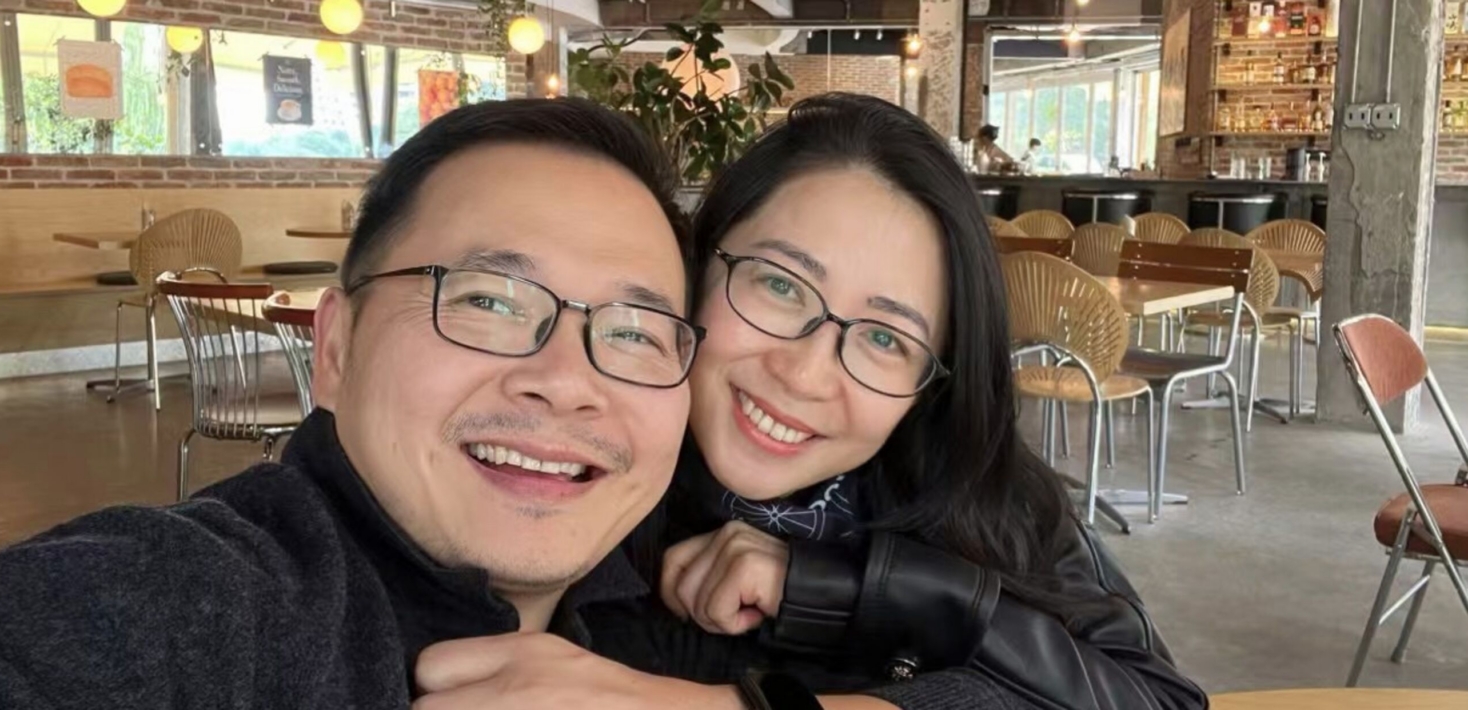


On 9 October 2025, Pastor Wang Lin was taken away by police during a crackdown on Zion Church. Zion Church is a “house church” – in other words, one of the primarily protestant churches in China that operate independently of the state-approved religious system and therefore lack official registration. Wang Lin’s case highlights ongoing concerns about religious freedom for independent Christian communities in China. In the months that followed Wang’s arrest, his wife Su Ziming and their young son and daughter endured constant surveillance and harassment, restrictions on their ability to leave China, and prolonged family separation. Today, Su and her children live in the United States, while her husband remains detained in China.
Here, Su tells Amnesty International how the crackdown changed the course of her family’s life and describes the wider repression faced by China’s “house churches” and its faith-based communities.
How did your husband end up a faith leader?
Before becoming a pastor, Wang Lin worked as a lawyer. In 2006, after he became a Christian, he left the legal profession, enrolled in seminary, and spent several years in the US pursuing theological studies. We returned to China at the end of 2017 and Wang Lin became a faith leader at Beijing Zion Church.
As a pastor, his greatest joy came from being with others.
In 2018, the Chinese authorities shut down Beijing Zion Church. What happened next?
After the shutdown, many members were driven out of Beijing by authorities through harassment, including coerced evictions, or concerns about their jobs. A congregation that had once worshipped together found itself scattered across the country.
During the COVID-19 pandemic, believers stayed connected through Zoom services and online Bible studies. Gradually, the church became a network spanning multiple provinces rather than a single congregation based in Beijing.
And did the authorities allow this?
No! At the same time this network developed, surveillance and repression intensified.
I think the authorities have tried for a long time to bring house churches fully under their supervision.
When house churches refuse government control and wish to exercise their beliefs freely, the governments see this as a problem. And they’re not afraid to use trumped up charges under existing criminal law to solve that problem. At the end of the day, whatever charges they use, their ultimate goal is to crush the church and make it disappear.
What are some of the tactics used by the authorities to target the Zion Church?
In the case against Zion Church, authorities accused church leaders of receiving “fraudulent proceeds”, treating believers’ tithes and offerings as unlawfully obtained funds. They also characterized church training programmes and seminary courses were deemed as engaging in “illegal business activities.” My husband Wang Lin has been charged on both counts.
I think the charges against Zion Church reflect a broader trend in recent years. While some church leaders, like many human rights defenders, are prosecuted on national security charges, authorities have increasingly used charges such as “fraud” and “illegal business operations” to target the normal actions and management of the institutions and communities themselves.
What activities are being targeted with these allegations?
In the Zion case, the authorities have defined believers’ voluntary offerings as money obtained through fraud. They see it as money that was obtained from people through deception. And as to the theology courses, this was a discipleship training programme within the church. It was never intended to make money. I don’t think this was about actually finding problems with our financial activities; it was aimed at faith communities themselves.
What’s been the impact of these allegations?
A lot of human rights activists, and very high-profile church leaders, face serious criminal charges like “inciting subversion of state power”. But a lot of damage can be done with these ordinary or more “minor” criminal prosecutions. Not least because it affects the ability of parishioners and believers to exercise their right to freedom of religion.
These charges not only stigmatize normal religious activities but also obscure the broader issue of freedom of religion. By treating voluntary offerings as “fraudulent proceeds” and church training programmes as “illegal business activities”, the authorities are effectively criminalizing the peaceful exercise of religious freedom, making it easier to target church leaders and entire faith communities.
What about the family members of those targeted – how has it affected you and your family?
Even before my husband’s arrest, we were living under immense pressure. We had to move repeatedly, we’d get evicted for no reason, we couldn’t finalize a contract to buy our own home.
Wherever we went, it seemed like someone was watching.
The most painful thing was seeing our children unable to
Su Ziming
get an education.
Obviously, this had an effect on our children, too. But the most painful thing was seeing our children were unable to get an education. One afternoon, a teacher packed up all of our children’s books and supplies and sent them home. My son asked: “Mom, why do we always have to take our things home?” Even he had begun to realise that this was not the first time our family had faced such disruption. How can I explain?
It’s terrible that in China today, simply because of their father’s work, my children don’t have the right to go to school.
And so, you decided to leave?
Yes. When I tried to leave with our two children in November 2025, we were stopped after entering the airport in Shanghai. The airport security took me aside and escorted me to an interview room; they said I was under an exit ban. They refused to show me any legal documents to justify their actions until hours later – at around 4 in the morning, when I copied down the details of the restriction. Our children were there and saw everything: their mother confronting a room full of police officers.
Following sustained international attention and pressure, the authorities eventually lifted the exit ban, allowing us to leave China. But I know this experience has taken an emotional toll on our children. Even here safe in the US, the trauma remains. They often ask: “What if you get arrested too?” It’s a question no mother ever wants to answer.
Why have you and other family members decided to go public with this case and the challenges facing Christians, among many faith communities, in China?
There have been other church cases that received little public attention over the years, and we have heard reports that people detained then were subjected to abuse and mistreatment. Another house church leader, Yang Rongli, was sentenced to 15 years in prison on fraud charges. But we think that if a case becomes internationally known, authorities often become more cautious in how they treat those in custody.
This would be important for the family members of Zion Church, but also to other house churches and believers facing persecution because of their faith. You – international NGOs, governments, the media, the UN – your voices can be the strongest support.
Would you like to share a message for your husband?
Our children and I will stand with you. I will always believe in you. And no matter if you get sentenced, or for how long, our children and I will wait for you.
Amnesty International continues to document the ways in which human rights defenders and others, including faith-based leaders, are targeted with punitive measures by the authorities – and the ways this extends to their family members, despite them not being accused of any crime themselves. Amnesty is concerned about the new Entry-Exit Regulations and the risk that they codify a persistent use of de facto travel and exit bans to constrain freedom of movement for activists and their families.