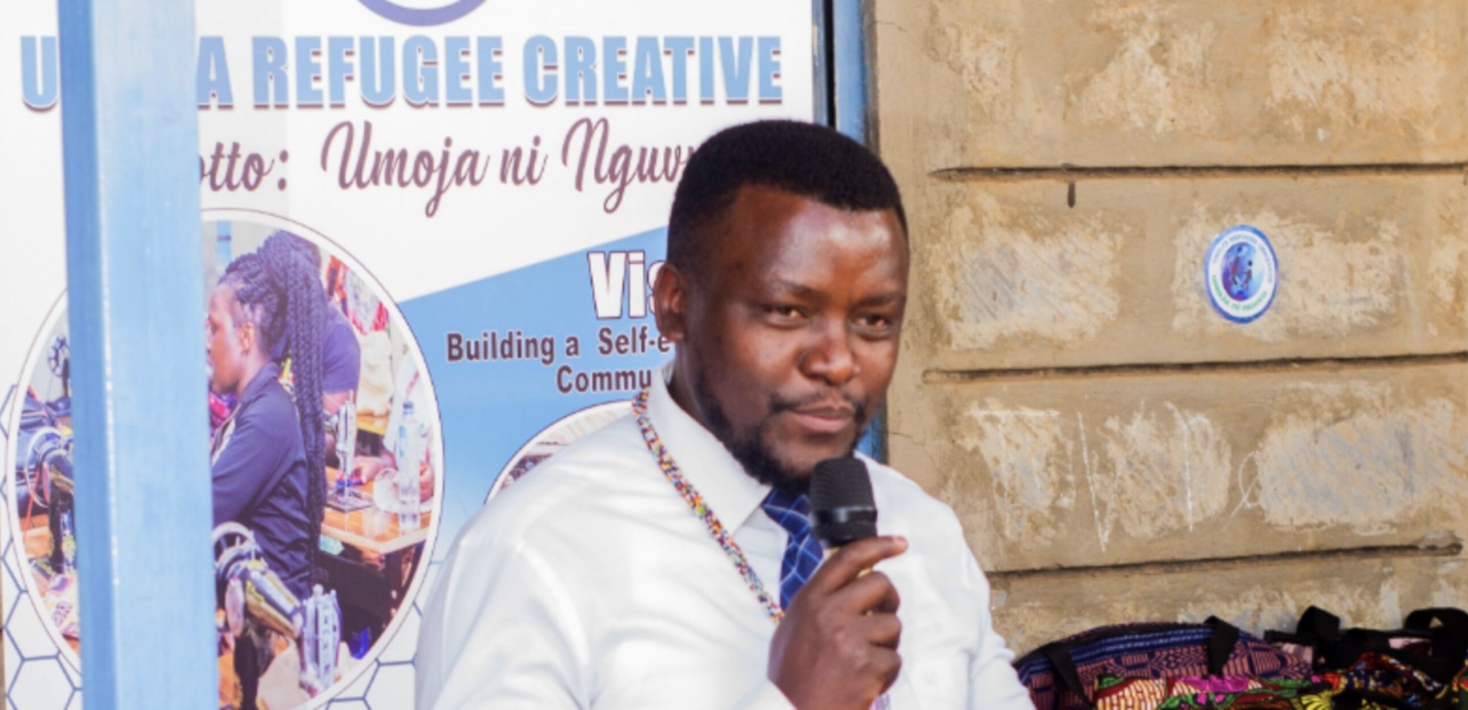


Jonas Ndayisenga, co-founder and Executive Director of Umoja Refugee Creative in Kenya, knows all too well what it takes to survive. He first fled Burundi with his mother and young siblings at age three, survived the Rwanda genocide and moved on to Tanzania where he started his primary schooling before moving back to Burundi, only to flee violence again as a young man in 2015. Struggling to find work as a refugee in Kenya, he founded a community organization that now provides training and creates opportunities for hundreds of people. This is his story.
My name is Jonas Ndayisenga. I’m a refugee from Burundi and have been living in Nairobi, Kenya, for 11 years. I fled political violence targeted at young protesters. I was with my parents, who suggested I should leave when the violence escalated, and a few days later, the government came and raided our house.
When I first arrived in Nairobi in 2015, I had just finished a bachelor’s in hospitality and hotel management. I tried to get work, but everything was very difficult in this big city. So, I did an extra course and then started working as a cook. But the jobs I was able to get would pay me less than people who were working under me, because they were citizens and I wasn’t.
Many refugees face issues in terms of access to dignified jobs and being able to contribute to policy making and influence how things are decided.It was then that I had the idea of starting the Umoja Refugee Creative. The inspiration came from the need to do something that would actually help our community and bring people solutions for the long term.
Shared experiences
We mostly work in and around Nairobi, focusing on three main pillars: livelihoods, mental health, and advocacy.
We offer training courses, including in crafts, creative arts and digital skills such as graphic design, filmmaking and storytelling, AI use and social media management. We also provide training on entrepreneurship and financial literacy and connect people with financial institutions that can help them access support, loans and so on. We also work with a team of psychologists, mostly volunteers, who offer support and awareness activities, including on gender-based violence.
Our biggest focus is on socio-economic inclusion. We are working to make sure refugees can get the right to access dignified work, including by making it easier to access work permits in Kenya, which is a big barrier for many.
Being an organization led by refugees, we understand what people have gone through and are going through, be it while they are migrating or when they are trying to make a life in their new home. People really go through a lot.
Being a refugee
I never planned to come to Kenya. I first left for Kampala (the capital of Uganda) but a family friend who was supposed to help me just switched his phone off after I arrived. I was stranded for three days sleeping on the streets there, it was very tough. I only had a phone and through my Facebook account I was able to contact a guy who was living in Nairobi that we had hosted at home for a while and he helped me.
But that was not the first time I had to flee my home.
The first time I became a refugee I was three years old. It was 1993, the president of Burundi Melchior Ndadaye, had been assassinated and the fight between the Tusi and Hutu tribes triggered a very violent war.
It was really bad. I remember as a young boy seeing people’s houses burning, people running in all directions, screaming.
Our dad was working far away and we didn’t have a phone so we couldn’t reach him. We fled with our mum and I remember we didn’t know what to do so we only moved at night and during the day we used to hide in bushes. We were very hungry as we never had enough food.
When we reached the Kanyaru/Kagera River dividing Rwanda and Burundi in the north there were already many people there. Some were charging people to move them on boats. We didn’t have any money, so my mum had to sell some nice clothes my dad had bought her to get onto one of the boats. All I remember is the people and many dead bodies in the river. Those are memories that never really go away.
We lived in a camp in Rwanda for a few months. There were thousands of people in the camp, living in small, bowed structures covered with cartons, sacks and sheets. Before the UN agencies started distributing blankets and utensils, there was a lot of diseases linked to lack of hygiene; people dying because there were no hospitals. Luckily our father had survived the atrocities in Bujumbura and found us in the camp. It was a miracle seeing him coming from the sunset horizon in the very dirty and rough pathways of the camp.
But then the genocide started.
We fled to Tanzania and lived in a camp there for a while where I did my primary school before we were able to go back home in Burundi in around 2002. Things were stable for a little bit there, and I was able to finish secondary school and university in 2015.
What I lived through really gives me the experience to try and help others. I know what it feels like to be a refugee, seeking asylum and how change can happen.
Most of the time, when people see a refugee, they just see that label, a status. But behind every refugee community member and leader there is a whole story and a whole experience that is often invisible.
A beacon of hope
Umoja Refugee Creative has become a beacon of hope for many in the community. I see the impact we have in helping people’s mindsets resetting, having self-acceptance, rebuilding themselves, we always start with that. This is why mental health is such as important pillar of our work.
I remember the story of one girl we worked with. She was born in Kenya as a refugee, and she did primary school but her parents had issues with documentation so she was not able to continue to university and she had given up. But we worked with her to encourage her and helped her to continue with her studies, with the documentation, and she got a scholarship. She is now able to look after her family. That is what really matters, that is what brings us real joy.
Umoja Refugee Creative has become a beacon of hope for many in the community. I see the impact we have in helping people’s mindsets resetting, having self-acceptance, rebuilding themselves, we always start with that.
Jonas Ndayisenga.
We have also started a new training on social entrepreneurship and economics for positive change, things like ethical leadership.
Most of the people we have trained with have either secure jobs or started their own business or initiatives that have had an impact in their lives and in their communities.
My advocacy focuses on ensuring that all those who work on refugee issues do it while making sure that their programming is refugee-centred and community owned. Refugee led organizations like Umoja Refugee Creative have proven that localization is the way to a dignified life and meaningful impact for refugees and hosts.
There are many ways in which human rights organizations like Amnesty International can support our work. Helping bring visibility to what we do, helping us connect with potential partners and donors who can contribute to our work and collaborating in advocacy and other areas, building quality and impactful partnerships, grants and meaningful capacity strengthening are some of the ways in which real support can happen.