
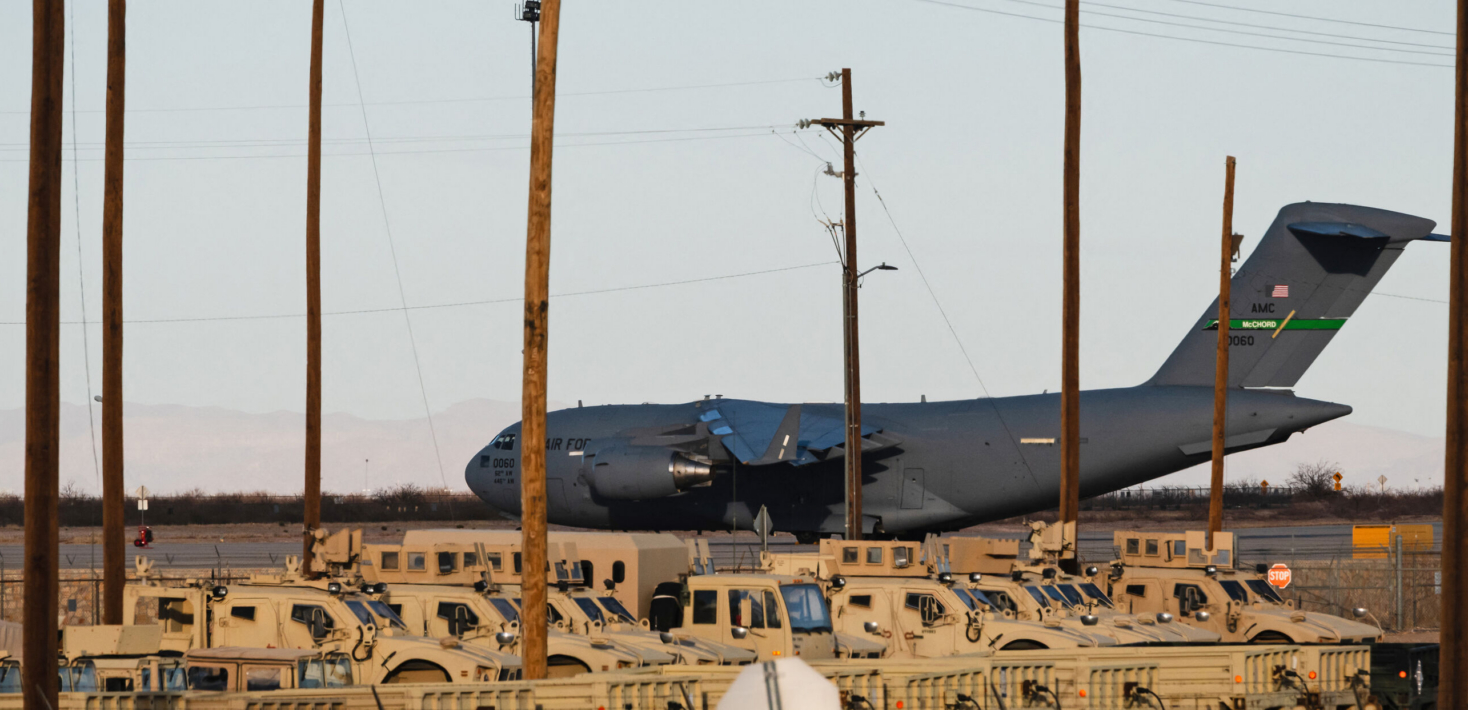


Since February 2025, the United States has significantly expanded its policy to send people it wants to remove from its territory to countries that they are not from and have no connection to. While this practice is not new, the Trump administration has been doing this in ways that are increasingly discriminatory and violate fundamental rights.
The second Trump administration has so far concluded new agreements with more than 30 countries for the removal of third country nationals (for updated figures, see Third Country Deportation Watch). The Migration Policy Institute estimates that around 15,000 people were removed to third countries between January and December 2025 alone – 13,000 of them to Mexico. Many of them have been arbitrarily detained in the country of destination.
This policy is unlawful, as it violates the due process guarantees that people are entitled to before removal. Additionally, in many cases it is placing thousands at risk of human rights violations in the country they are sent to. Amnesty International experts answer some of the key questions to understand why this policy must be repealed.
What are “third country removals” and how do they work?
Third country removals send people that the United States wants out of its territory to countries other than their own, even if people have never been there before, have no connections in the country, and don’t speak the language. Some of the individuals removed are arbitrarily detained in the country of destination and many struggle to access independent legal support. All find themselves in an extremely precarious and stressful situation, far from their usual support networks.
What countries has the US signed agreements with so far?
At the time of writing, at least 30 countries have concluded agreements with the US. These include twelve African states that have received or agreed to receive third country nationals from the US: Cabo Verde, Cameroon, Central African Republic, Democratic Republic of the Congo (DRC), Equatorial Guinea, Eswatini, Ghana, Liberia, Rwanda, Sierra Leone, South Sudan, and Uganda. In the Americas, the US has similar agreements with at least fifteen countries: Antigua and Barbuda, Belize, Costa Rica, Dominica, Dominican Republic, Ecuador, El Salvador, Guatemala, Guyana, Honduras, Mexico, Panama, Paraguay, St. Kitts and Nevis and St. Lucia. The US has also concluded similar agreement with countries in other regions, including Kosovo, Poland, and Uzbekistan.
Are all agreements the same?
This is a tricky one. While some of the agreements the US has signed have been published following Freedom of Information Act (FOIA) requests, many remain secret.
What we do know is that some of the agreements involve countries agreeing to receive individuals who the US wants out of its territory, until they are repatriated. Most of these agreements result in arbitrary detention. Others involve countries agreeing to receive people seeking asylum in the US and allowing them to seek international protection there (Safe Third Country/Asylum Cooperative Agreements). These agreements often result in the repatriation of people who had been granted protection from repatriation in the United States. And some agreements (or what has been happening) appear to combine both elements.
Are third countries getting paid for this?
Some agreements expressly mention financial payments. For example, the government of Eswatini agreed to accept up to 160 third country nationals removed from the US, in exchange for $5.1 million “to build its border and migration management capacity”. The government of Rwanda agreed to accept up to 250 third country nationals removed from the US, in exchange for $7.5 million. The agreement between the US and Equatorial Guinea involves a $7.5 million payment to the government of Equatorial Guinea, according to media reports.
Other agreements do not expressly mention financial payments, but they are part of broader political negotiations characterized by asymmetrical power. Media reports have revealed some of the political context of the agreement between the US and Cameroon.
Are countries being pressured to sign deals?
This is difficult to tell for sure. What we know, however, is that these agreements are an asymmetrical form of partnership in the context of mounting pressures created by the US government’s abrupt, chaotic and sweeping suspension of US foreign aid, and the imposition of trade tariffs and visa restrictions.
For example, after signing their respective third-country removals agreements, Liberia, Rwanda, and Uganda managed to secure US investments into their health sector under the US government’s America First Global Health Strategy. The US and the Democratic Republic of the Congo (DRC) signed a similar health cooperation agreement.
As part of its negotiations with the US, the government of South Sudan raised several matters, including the lifting of individual sanctions imposed on South Sudanese government officials, the visa restrictions affecting South Sudanese nationals and US investments in the country.
Is it legal for the United States to remove people to third countries?
International law imposes strict limits on states’ ability to transfer people to other countries. These limits guarantee that people are not sent to danger and that due process is followed. The US government has brazenly violated the right to due process and undermined the rule of law by unlawfully removing people, with callous disregard to the risk that they may be then sent back to danger.
In many cases, the US government has removed people who the US had granted some protection, including from torture. Individuals have been removed while their cases where still being heard in court. What’s more, changes in the procedure required under US law before someone is sent to a third country has made it extremely difficult for individuals to meaningfully challenge their removal.
People have the right not to be transferred to a country where they would be at real risk of human rights violations, such as torture or enforced disappearance (what is called the principle of non-refoulement). They also have the right not to be transferred to a country where they would not be protected from refoulement (i.e. countries from which there could be an onward transfer into danger). States have an obligation to give non-nationals a meaningful opportunity to challenge the transfer on the grounds that it would put them at risk of serious human rights violations.
In addition to the specific human rights violations concerning their removal, the US government has treated the people affected with callousness and disdain. Some people have not been told where the US government was taking them until they were on the planes. Others have been threatened with removal to two different countries on opposite sides of the world. People on these removal flights are shackled, and some have even been detained in cruel conditions like shipping containers. The psychological suffering caused by the actions of the US government amounts to cruel, inhuman or degrading treatment and may amount to torture in specific cases.
How are third country removals linked to ICE violence and migration enforcement in the US?
The US government’s mass detention and deportation machine has resulted in serious human rights violations. Nearly all federal law enforcement agencies have been deputized to engage in civil immigration enforcement. Masked agents have seized migrants, asylum seekers, refugees, and US citizens; armoured vehicles are patrolling streets; and agents have targeted areas near schools, faith centres, hospitals, and other previously prohibited areas for immigration enforcement.
The mass immigration detention system has expanded. It holds thousands of people, including families with small children, in overcrowded, inhumane facilities, sometimes on military bases and new state-funded detention facilities such as “Alligator Alcatraz”, in the state of Florida.
What is the underlying issue here? What lies behind the ICE violence and the third country removals?
This is not only a migration enforcement issue, but a rule of law issue and a racial justice issue, as migrants and refugees are often racialized in the United States.
The US government is terrorizing not only migrants in their communities, forcing them to live in fear – but also anyone who is presumed to be a migrant or refugee. Mass detention and unlawful removals tear families apart, traumatize communities, and waste billions in taxpayer money. Their expansion is part of a broader, calculated campaign to dehumanize migrant communities.
The US government’s migration policy is rooted in racism, built on false criminalizing narratives, and maintained through fear.
What is Amnesty International calling for?
The US government should stop sending people to countries where they risk being arbitrarily detained and/or sent back to danger in their country of origin. All those removed to third countries should be readmitted into the United States and provided full reparation.
The receiving countries should immediately release all individuals who have been arbitrarily detained and ensure access to a fair and efficient asylum process.
All other nations should deny the US government’s cruel and inhumane mass deportation campaign any form of facilitation, cooperation or tolerance. They should denounce the removals as unlawful and condemn in the strongest terms their xenophobic and racialized impacts.