
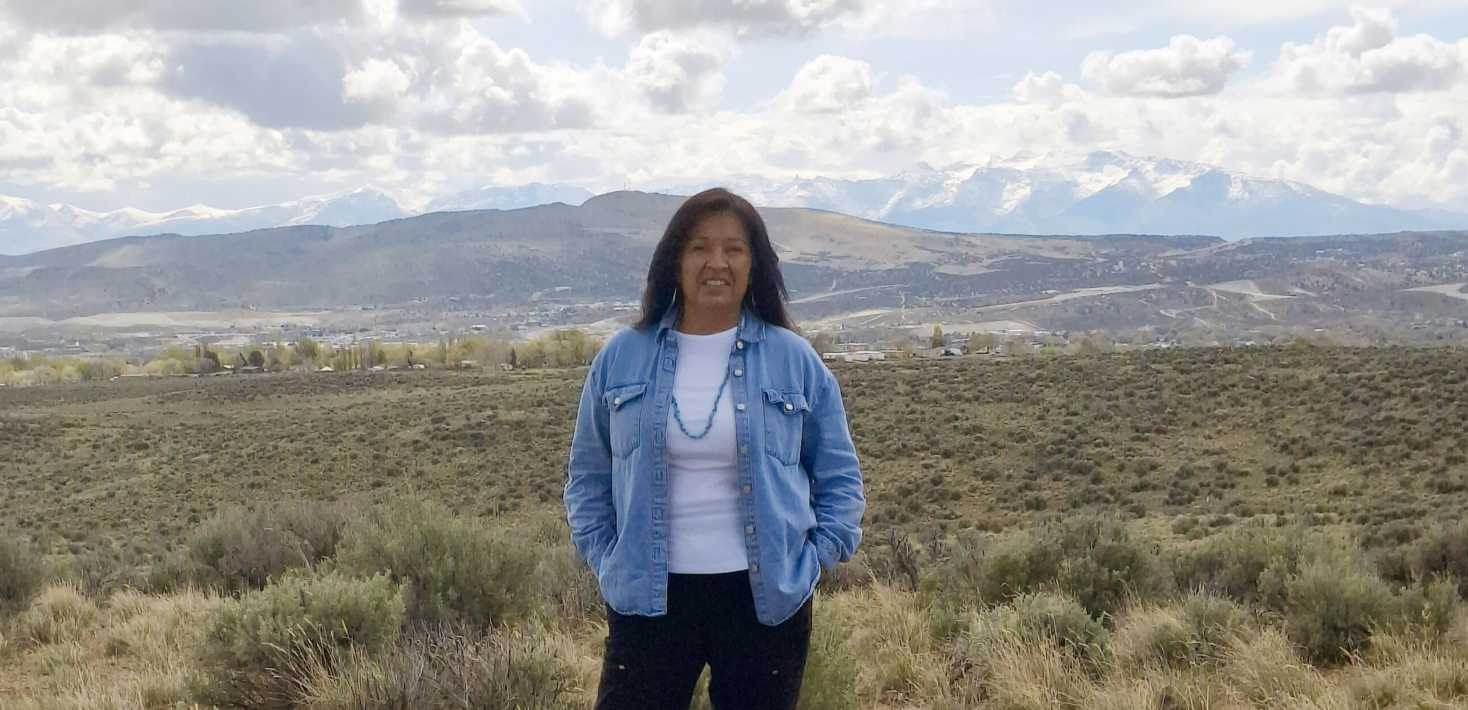


Fermina Stevens, 57, is a member of the Te-Moak Tribe of Western Shoshone. She was born and raised in Elko, Nevada, USA. Nevada’s stunning landscape of mountain ranges and valleys has been home to Indigenous Peoples for thousands of years. As Executive Director of the Western Shoshone Defense Project, Fermina works to defend her ancestral lands from the negative impacts of mining, which started over 200 years ago.
Here she tells Amnesty International why lithium mining threatens her community, and how it has become emblematic of the way the US government continues to ignore the rights of the Western Shoshone, despite an 1863 treaty that recognizes the community’s vast territory.
Northeastern Nevada, historically, is a gold mining area. I was a kid in the 1980s when I first noticed a gold boom in Elko. The gold mines are about 20 to 30 miles away. Since then, a lot of people have come into town and the town itself has grown.
We didn’t have a Walmart, for instance, before the boom. There has been an influx of people who work the mines, who may not share our community values. It’s hard to get them to understand the negative effects of mining when they really don’t want to hear about it because it affects their jobs and they see it as a threat to their livelihoods.
Over the years, there’s been a lot of backlash from non-Indigenous people. Because it’s a small town, you don’t want to rock the boat so much. But at the same time, we have to share our concerns about the negative effects of mining whether they like it or not, because it’s the reality we’re living in.
It hasn’t been very long since this lithium boom started, it’s only been about five years since we started hearing about critical minerals and mining for lithium. There’s one active lithium mine in central Nevada. But we have two proposed lithium mines closer to Elko – less than 100 miles from the town – that will be starting up in the next one to two years, possibly.
I haven’t heard too much about those mines and their status, but we anticipate they will take up a large amount of our ancestral land.
Our trees will be destroyed
When these mine companies come in, they start doing a lot of tree cutting. A lot of those trees are the pinyon trees which hold our pine nuts, a very valuable food source traditionally. Over the past few thousand years, pine nuts have been the staple of our sustenance.
Water, of course, is always an issue. Lithium mining requires much more water than gold mining. This concerns us, especially when we’re in a drought and living in the driest state.
It’s the cumulative effect of these mining projects that we worry about, because the state of Nevada is just riddled with gold mines, not just current, but previous ones. We know that there’s a lot of pollution in the ground and in the water. Mining started in Nevada around the 1840s – that’s almost 200 years of mining. Any continued extraction is going to have an effect. Lithium mining exacerbates what’s already been done in the past.
Protecting Shoshone territory
The Western Shoshone Defense Project was started by two Western Shoshone elders, Carrie and Mary Dann. They challenged the requirement to pay for a permit for their cattle to graze on land that’s recognized as ours by the 1863 Ruby Valley Treaty of Peace and Friendship.
This treaty, signed by tribal chiefs and the US federal government, recognizes Western Shoshone territory. While it granted certain rights and privileges to the US government, such as the right to explore for minerals, it did not cede any land to the US government, and our community didn’t give up our sovereignty over this territory.
This land is ours – whether people like it or not. We’re trying to protect the land and its resources for future generations.
Fermina Stevens
Within 10 years of this treaty being signed, one of the original signing chiefs went to Washington DC because he knew that the United States wasn’t upholding their end of the bargain on this treaty.
We aren’t being consulted on our land
The Defense Project is still trying to get the US government to respect this treaty and our land rights. We brought our case to theInter-American Commission on Human Rights and the U.N. Committee on the Elimination of Racial Discrimination. Both determined that the human rights of the Western Shoshone were being violated by the US government.
An example of this is the lack of proper consultations about mining activities with the federal government. The United States government has an obligation to consult with the Tribes because we have sovereignty over this territory. But the government isn’t upholding its end of the deal when they send corporations in to carry out the consultations for them, or in lieu of them.
This land is ours – whether people like it or not. We’re trying to protect the land and its resources for future generations. We’re thinking 40, 60, 80 years from now. Will we even be able to practise our spirituality because of the poisoning that is happening to our land and to the water?
A shared Earth and a shared humanity
Humanity to me means that we’re all related, in some way, shape, or form. We might not be related through blood, but we’re related through kinship, not only in our families or communities, but with the Earth. Humanity, to me, is sharing the one thing that we all have in common, and that’s Mother Earth and what she provides for us.
As humans, we need to come together and open our minds and our hearts to what is real. With all the chaos and confusion that is happening politically today, the one thing that is real is the Earth.
And that’s where we need to find common ground.
Amnesty International has released the report, “We’re here to protect Mother Earth: Indigenous Rights and Nevada’s Lithium Boom” focusing on three massive lithium mining projects in Nevada and the impact it is having on Indigenous Peoples.