

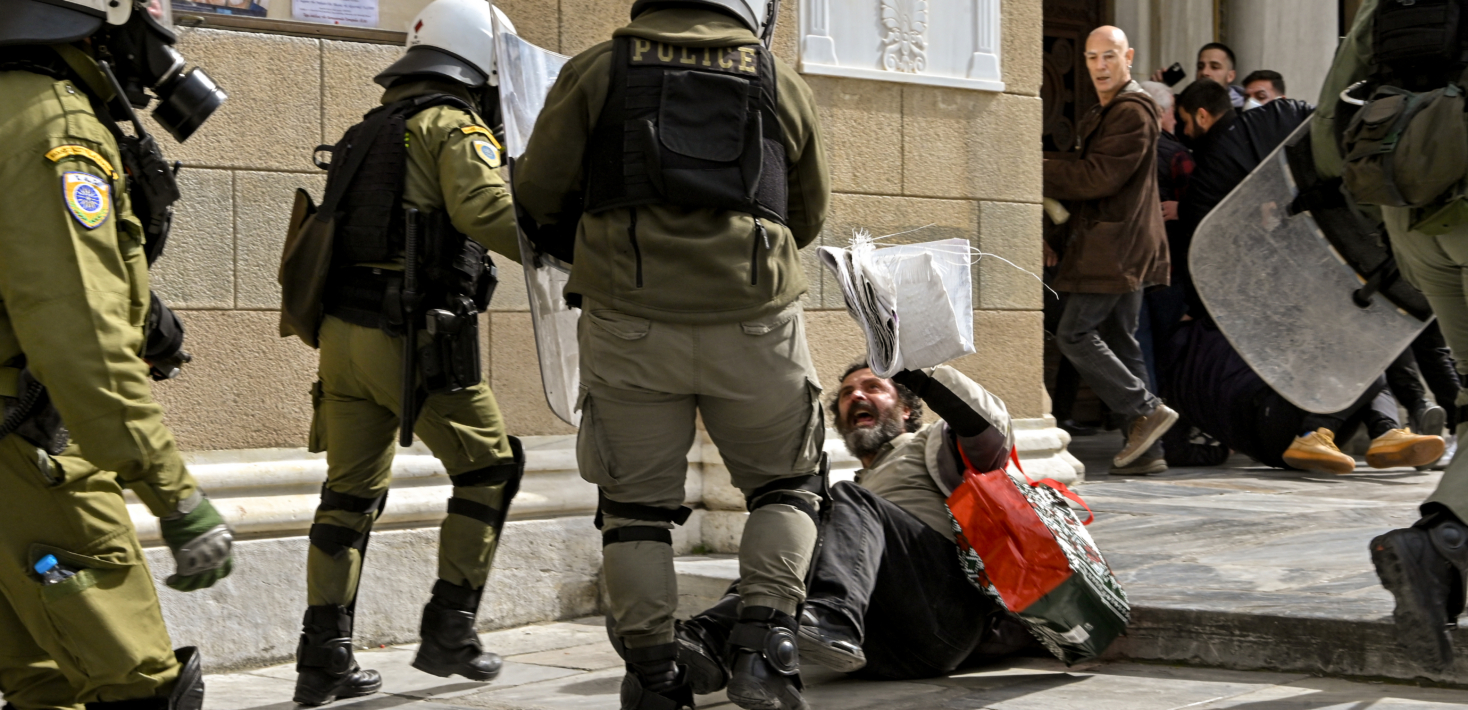


In early 2025 photojournalist Marios Lolos was covering a demonstration in Athens about the Tempi rail tragedy when a police officer threw a stun grenade in his direction. It hit the left side of his head, exploding next to him. The impact resulted in him suffering permanent hearing loss and a head injury.
“Had it exploded in front of my head and not a little bit later, we wouldn’t be speaking at the moment,” Lolos tells me, his voice thick with emotion.
The veteran journalist and former president of the Greek Press Photo Union believes that the stun grenade was thrown at him intentionally. Footage verified by Amnesty International corroborates his testimony and suggests that he was deliberately targeted.
Had the stun grenade exploded in front of my head and not a little bit later, we wouldn’t be speaking now
Marios Lolos, journalist and stun grenade survivor
Lolos’ experience is far from unique. In fact, it is part of a wider pattern in which the right to freedom of peaceful assembly in Greece is being blatantly violated both in law and in practice. Journalists frequently find themselves in the firing line alongside peaceful protesters who are arbitrarily detained, criminalized, and subjected to unlawful use of force by police. The physical and psychological injuries they suffer can be life changing.
Marios Lolos’ testimony – along with over fifty of others – is included in a new report published by Amnesty International today. Our research finds that these disturbing abuses are underpinned by protest legislation that fails to comply with international and regional standards, and a persistent culture of impunity for abuses by law enforcement officials policing demonstrations.
The report, based on two years of research, includes a series of testimonies describing how Greek police deployed stun grenades often directly at peaceful protesters and journalists, above their heads or at their feet, or at times lobbing them into dense crowds.
Stun grenades are also known as a disorientation, distraction or pyrotechnic devices, “flash-bangs”, percussion or concussion grenades. They are designed to surprise, temporarily disorientate and blind people through intense exposure to sound and light, among other effects.
The use of stun grenades, which are military grade devices, routinely cause burns to victims, hearing loss or damage, as well as other blast and fragmentation injuries. Their use against crowds of protesters can spark panic and stampede and they have been known to start fires.
The type of stun grenade deployed by the Greek police emits a sound intensity of 170 decibels – louder than a jet engine at close quarters. In May 2022, student Giorgos Mavros suffered a perforated eardrum, hearing loss, a head injury as well as wounds and burns after police deployed stun grenades during a peaceful student demonstration in Thessaloniki. When I interviewed him this year, he told me that “the sensation was as if I had been struck by a large iron bar”. Four years on, he is still suffering from the physical and psychological fallout from the injury. He told me how he gets anxious and fearful at the sound of loud bangs and he has largely stopped taking part in protests.
The type of stun grenade deployed by the Greek police emits a sound intensity of 170 decibels – louder than a jet engine at close quarters
Amnesty International verified footage of police unlawfully using stun grenades in October 2025 next to a café where people were sitting outside. It came just after police had dispersed a protest in Athens. Bystanders were caught up in the chaos.
The report also documents the unlawful use of batons by officers striking peaceful demonstrators, chasing protesters in so-called “baton charges”, and beating individuals already under police control. It documents the harmful misuse of chemical irritants and water cannon on protesters, as well as the unlawful use of force during arrest and/or detention and by police motorbike units.
Despite their suffering, victims often struggle to get justice. Perpetrators often go unpunished, while investigations that are opened can take years to conclude. There are many other factors that can hamper accountability, such as flawed disciplinary investigations, the inability of criminal investigations to find perpetrators, some judicial rulings that risk legitimizing unlawful force and the failure of public order police to display identification numbers. At the same time, Greece’s police oversight mechanism (EMIDIPA), lacks sufficient staff and resources to undertake more of its own investigations.
Faced with these challenges, Marios Lolos is sceptical about his chances of getting justice for his injury, despite lodging a complaint with EMIDIPA and a criminal investigation having been initiated. The police have also launched a disciplinary investigation into the incident. But Lolos has been here before. In 2012 his skull was broken and he sustained life-threatening head injuries when a riot police officer beat him with a baton during anti-austerity demonstrations. Although administrative courts confirmed the state was responsible for his injuries, not a single officer has been held accountable despite disciplinary and criminal investigations. His experience of police impunity is mirrored by that of many of his colleagues.
The harm inflicted by Greek police in their unlawful use of force in protests, combined with shocking levels of impunity for police abuses, threaten to have a chilling effect on the right to peaceful protest, yet Lolos and other victims refuse to be stunned into silence.
Military-grade devices have no place in the policing of protests in Greece or anywhere in the world
Nevertheless, participating in or reporting on peaceful protests should not require people to run the gauntlet or risk life and limb. Protest laws in Greece must be reformed and abusive policing practices and impunity must end. The use of stun grenades should be reserved only for high-risk special operations, such as hostage situations. They must be banned for use in the policing of demonstrations and other public assemblies. Military-grade devices have no place in the policing of protests in Greece or anywhere in the world.
Kondylia Gogou, Amnesty International’s Regional Researcher for Europe.
This artice was first published here by EU Observer.