
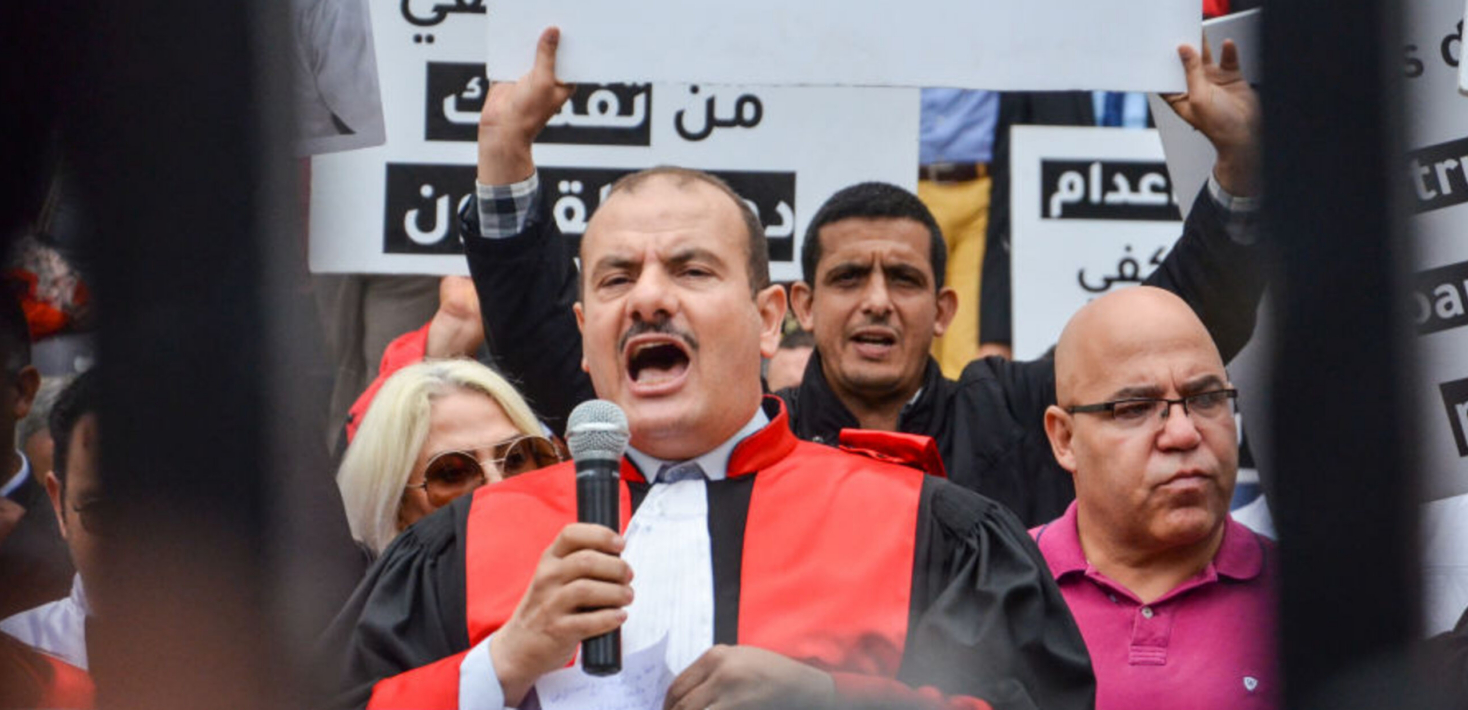


Judges in Tunisia who spoke out against Kais Said and his government’s attacks on judicial independence continue to face reprisal and harassment for exercising their right to freedom of expression and defending the rule of law, Amnesty International said today, ahead of the trial of Anas Hmedi, judge at the Monastir Court of Appeal and president of the Tunisian Judges Association on baseless charges of “obstructing freedom to work” scheduled for 26 March.
“Anas Hmedi is a courageous judge who refused to be silent and stood up for the independence of the judiciary and against executive interference. His prosecution and relentless abuse of the criminal justice system to target and harass him constitute reprisals for exercising his rights to freedom of expression, peaceful assembly and association, and for speaking out for his profession. Judge Anas Hmedi’s case is a stark illustration of the ongoing reprisals faced by judges who dare to speak out,” said Sara Hashash, Deputy Regional Director for the Middle East and North Africa at Amnesty International.
“Judges must be able, individually and collectively, to participate in public debate on the organization, functioning, and independence of the judiciary without fear of intimidation, harassment, or criminal prosecution. The authorities must immediately drop all charges against Judge Anas Hmedi since they stem solely from the peaceful exercise of his human rights.”
Judges must be able… to participate in public debate on the organization, functioning, and independence of the judiciary without fear of intimidation, harassment, or criminal prosecution.
Sara Hashash, Deputy MENA Director
Since 2022, Hmedi, President of the Tunisian Judges’ Association (Association des Magistrats Tunisiens, AMT), has faced arbitrary disciplinary and criminal proceedings in reprisal for the association’s work challenging attacks on the independence of the judiciary, as well as an online defamation campaign by pro-president Facebook pages. He has been very vocal in defending judicial independence, often appearing in the media and making public statements in civil society events in defense of AMT’s positions. If convicted, he risks a sentence up to three years in prison.
After the summary dismissal of 57 magistrates on 1 June 2022 by President Kais Saied, the AMT, together with other judges’ associations, led a nationwide four-week strike to protest these arbitrary dismissals. Following the strike, as head of the AMT, Anas Hmedi was summoned for questioning four times between July and August 2022.
Trial on unfounded obstruction charges
In October 2022, following a decision to lift his immunity from the High Judicial Council at request of the prosecution, the deputy prosecutor at the Monastir Tribunal of First Instance opened a criminal investigation against Hmedi in relation to his alleged “incitement” of other judges of the Monastir Tribunal to go on strike in June and July 2022.
He is being prosecuted under Article 136 of the Penal Code, for “obstructing freedom to work” a charge frequently use[HM1] d to deter or punish those participating in strikes and social protest.
The case was repeatedly transferred during the investigative stage before Hmedi was eventually referred to trial and indicted without ever being interrogated by the investigative judge, undermining his fair trial rights including the right to a defense.
Hmedi is also facing criminal charges in a separate investigation, though this has not yet reached the trial stage. In December 2025, the AMT issued a statement denouncing the incarceration of human rights lawyer, Ayachi Hammami, who had represented many of the judges. Shortly after Hmedi warned, during an event organized by the Tunisian League for the Defense of Human Rights, about the risks of undermining fair trial guarantees and the political instrumentalization of the judiciary. He specifically referenced verdicts issued by the Tunis Court of Appeal in late 2025 against members of the political opposition.
The Public Prosecutor at the Court of First Instance in Tunis subsequently opened three investigations against him on criminal defamation-related charges, bypassing the constitutional safeguards governing criminal proceedings against judges.
Risks to the judges association AMT
Since Kais Saeid’s power grab in 2021, the AMT has documented and exposed executive interference in judicial independence, issuing statements, working with human rights organizations in defense of fair trial rights, and supporting judges facing reprisals for upholding their independence.
With the crackdown on independent associations increasing over the past two years, in January 2026, the AMT received two warnings from the Prime Ministry’s administration claiming the association was non-compliant with some provisions of Association Law Decree 88. The authorities alleged the AMT was operating outside its mandate and supporting political actors and participating in incitement alongside claims of financial and reporting irregularities. While the AMT provided the relevant documentation to refute these claims, it remains at risk of suspension and eventual dissolution, a fate shared by many human rights associations in Tunisia over the past year.
“Since President Kais Saied dissolved the High Judicial Council and dismissed judges based on vague accusations in 2022, the harassment of judges and the unlawful interference in their work has continued in a bid to stifle peaceful dissent and make accountability unattainable,” said Sara Hashash.
“The continued pursuit of proceedings against AMT and its president raises serious concerns about the misuse of the criminal justice system to target and harass individuals for their legitimate professional and human rights activities. The Tunisian authorities’ targeting of Hmedi through abusive disciplinary and criminal proceedings violates international standards and must cease immediately.
“Authorities must end the harassment of Anas Hmedi and other judges and allow them to freely exercise their rights to freedom of expression and association without fear of reprisal. They must uphold judicial independence and the rule of law.”
Background
On 1 June 2022, President Saied issued Decree-Law 2022-35, allowing him to dismiss any judge based on vague criteria and without due process. He announced the dismissal of 57 judges and prosecutors the same day, accusing them of “obstructing terrorism investigations,” “financial corruption,” and “moral corruption”.
Despite an August 2022 decision by the Tunis Administrative Tribunal ordering the reinstatement of 49 of these judges, the Ministry of Justice has not reinstated a single one. Moreover, judges and judicial institutions that have acted independently continue to face ongoing intimidation and harassment.
The AMT has publicly opposed these measures and denounced the unlawful interference of the executive. In an April 2024 statement AMT said that since August 2023, the Minister of Justice has ordered the appointment, transfer, and suspension of at least 105 judges and prosecutors through executive memos. The AMT also reported several work suspensions occurring outside any formal disciplinary process.
The AMT was founded in 1990 and has long been an outspoken association. From 2011, it became a leading voice in judicial reform, actively participated in the process of reforming the laws pertaining to the judiciary and advocated for transitional justice and accountability.
According to the UN Basic Principles on Independence of the Judiciary “judges shall be free to form and join associations of judges or other organizations to represent their interests, to promote their professional training and to protect their judicial independence”.
In January 2026, UN experts—including the Special Rapporteur on the independence of judges and lawyers—expressed grave concern at this fresh attempt to criminalize Judge Hmedi for statements made in his capacity as AMT President. The experts warned that prosecuting judges for expressing views on matters of public interest undermines the rule of law and constitutes a reprisal for the legitimate exercise of the rights to freedom of expression and association.
For more information or media requests please contact [email protected]