


1. EXECUTIVE SUMMARY
“They would come in to use me [while] the security guards stood guard at the door.”
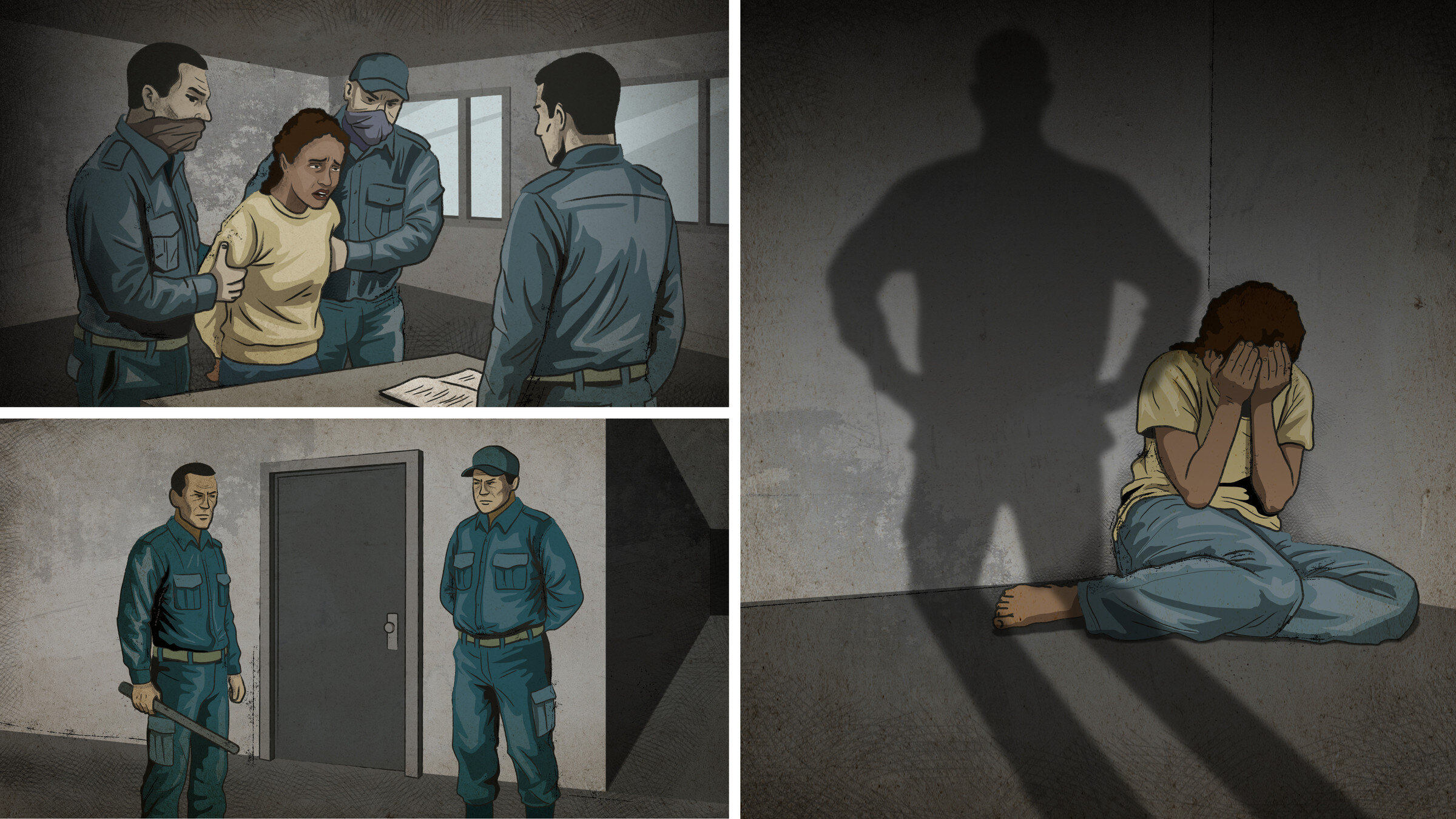
Maia (not her real name) travelled to Cambodia thinking she would be working in a hotel. She thought she would make enough money to send home to her children. She was picked up at the airport by a driver but after hours in the car, she began to worry about where she was being taken. When she arrived at the scamming compound known as “Park 8” (PV011), she immediately knew something was wrong. The car was ushered through gates with security guards checking license plates and directing traffic. They wore black uniforms, and many of them had covered their faces. When she got out of the car she was taken to an office where two guards held her by each arm and a boss told her to sign a contract.
Security guards moved Maia to her room. Wherever she went inside the compound, security guards were nearby, watching and waiting. When people caused trouble for the bosses, like not wanting to work, it was security guards who came into the room with electric shock batons and did what the bosses told them to do.
Maia was tasked with contacting US citizens to scam them. The company targeted Americans. When she didn’t meet her work targets, a security guard took her to a dark room and locked the door. When the managers came to the dark room to rape her, the door was opened by security guards who stood guard throughout the attacks.
Maia was raped three times inside the dark room. She was not the only one. Amnesty International spoke to three other survivors of Park 8 who were raped while at the site.
Maia recalled the security guards carrying shock batons and pistols; some had bigger guns. She even said that people that looked like they were in the military had come into the compound when a boss visited. When shown pictures of the Park 8 compound, she recognized the gates and buildings. And when shown pictures of security guards at the site, she identified one individual from a photograph. During the government’s July 2025 crackdown, she managed to escape when the compound bosses began fleeing.
Security Response, a company profiled in this report, provided security at the Park 8 compound.
Maia’s experience reflects a broader pattern documented throughout the scamming industry in Cambodia.
Amnesty International documented private security guards operating at all 82 scamming compounds it visited between 2024 and 2026, with survivors consistently describing compounds staffed by dozens, and sometimes hundreds, of guards who enforced confinement, prevented escape, responded to resistance and, in many cases, directly participated in torture and other serious abuses.
Amnesty International identified at least five security companies – Leap Somnang Security, Security Response, ZD Security, Dara Security (DAS) and Best Security – providing services to at least 23 scamming compounds.
Amnesty International also found links between serving members of the Royal Cambodian Armed Forces (RCAF) and the Cambodian National Police and at least 22 of the 86 scamming compounds spread across ten provinces.
Amnesty International calls for these security companies, their owners, directors and managers, potentially individual guards, and any military, police, politically connected or business actors to be investigated for their role in serious human rights abuses and other crimes under international and domestic law.
1.1 METHODOLOGY
Over the past three years, Amnesty International has investigated the scamming industry in Cambodia, identifying 86 compounds across the country, interviewing more than 150 survivors and reviewing records of more than 400 additional victims. That research led to the publication of two earlier reports: “I Was Someone Else’s Property”: Slavery, Human Trafficking and Torture in Cambodia’s Scamming Compounds (June 2025) and Falling Through the Cracks: Cambodia’s “Crackdown” on Scamming Compounds and the Victims it has Failed (June 2026).
This present report examines one of the key players in perpetrating human rights abuses in these scamming compounds: the private security companies guarding the compounds. It documents evidence identifying at least five security companies providing services to at least 23 scamming compounds, from as early as December 2021 to June 2026, spread across the country, including in the provinces of Sihanoukville, Koh Kong, Banteay Meanchey, Svay Rieng, Kampot, Tbong Khmum, Mondulkiri, Prey Veng, Takeo, and Preah Vihear. This report also examines the connections between these security companies and military personnel and police officers.
In identifying security companies operating at scamming compounds, Amnesty International relied on the following sources of information:
- Site visits to 82 of the 86 scamming compounds it had identified in its 2025 and June 2026 reports. During these visits, researchers took photographs of security guards allowing them to identify companies’ logos and uniforms and show photographs to survivors.
- Interviews with 151 survivors of scamming compounds between January 2023 and September 2026, many of whom recognised logos of security companies and described abuse by security guards.
- Geolocations of videos posted by 222 social media accounts that were confirmed to belong to guards or showed guards working at scamming compounds. Amnesty International reviewed more than 25,000 videos and pictures from these accounts between June and August 2026.
- Review of information and documents published by the companies or their staff, including corporate documents filed with the Ministry of Commerce; employment advertisements posted on company pages on Telegram, Facebook and TikTok between January 2025 and August 2026; and other information posted on company websites or their social media.
- Analysis of photographs and videos from scamming compounds to assess whether individuals depicted were current or former members of RCAF or National Police, based on uniforms, insignia, rank markings and other identifying indicators.
- Satellite imagery analysis to determine specific guard positions and other security infrastructure towers within scamming compounds.
- A wide range of secondary sources, including reports published by the UN and civil society organizations, media reports, sanctions designations and other relevant documentation.
Annex I to this report sets out a profile for each of the 23 scamming compounds linked to a known security company. Annex II to this report sets out evidence linking 19 social media accounts detailing compound presence or activity to what appear to be active members of the RCAF and police.
Amnesty International wrote to the Cambodian government, each corporate actor and named individual identified in this report to provide them with an opportunity to respond to the organization’s findings. Annex III includes the responses of the government, companies and individuals that responded to Amnesty International’s communications.
1.2 BACKGROUND
Since the Covid-19 pandemic, Cambodia became one of the major global hubs for the online scamming industry, which evolved from illicit gambling and fraud operations into a highly organized transnational criminal ecosystem. These billion-dollar operations relied heavily on trafficked workers from around the world, many of whom were lured to Cambodia through fraudulent job advertisements and then subjected to coercion, violence and exploitation. These abuses were primarily perpetrated by transnational organized criminal groups that operated across borders and recruited victims from dozens of countries. Although the fraudulent activities are criminal, they are often embedded within seemingly legitimate business structures, including licensed casinos and hotels operating in special economic zones and through registered companies, including security guard companies.
In response to growing international pressure, the Cambodian government launched a nationwide crackdown on scamming compounds in July 2025, reporting hundreds of interventions, arrests and rescues. While authorities claim to have dismantled hundreds of scam centres, deported thousands of foreign nationals and largely eradicated large-scale scam operations, Amnesty International has identified significant shortcomings in these efforts, including failures to identify trafficking victims and hold perpetrators to account, despite evidence linking many licensed casinos and prominent business figures to scamming compounds. As a result, concerns persist that scamming networks have become deeply embedded within Cambodia’s political and economic systems.
Human rights abuses persisted at scamming compounds in Cambodia, despite years of public reporting and repeated law enforcement operations, because of the role of security personnel who controlled access to compounds, prevented escape, and enforced the systems of coercion operating inside them.
1.3 ROLE OF SECURITY GUARDS
“They didn’t need any razor wire […] there were so many security guards.”
Security guards were a core component of the systems of confinement, surveillance, coercion and punishment used to deprive trafficked people of their liberty and maintain forced labour, torture, rape and, in many cases, conditions amounting to enslavement. All 82 compounds visited by Amnesty International in 2024, 2025 and 2026 employed security personnel, while survivor testimony, social media content and satellite imagery indicate that many compounds were staffed by dozens, and sometimes hundreds, of guards.
KEEPING PEOPLE INSIDE
Survivor testimony indicates that security guards controlled access to compounds, searched or screened vehicles and visitors, monitored workers’ movements, escorted people within compounds and responded to escape attempts. Many reported witnessing or experiencing guards beating people who attempted to flee.
The consequences for escape attempts could be severe. At PO21, a compound in Poipet referred to as “Blackgate”, a child survivor from Thailand said a guard beat him so severely he could not sit down. Survivors who attempted a mass escape in July 2025 reported that guards recaptured many of those who fled.
VIOLENCE, TORTURE AND OTHER ILL-TREATMENT
Security guards did not merely enforce confinement. Some survivors described them as active participants in systems of torture, rape and other ill-treatment. Survivors reported violence was commonly used to punish people who attempted to escape, resisted orders or failed to meet work targets. Gabe (not his real name), a Ugandan man, said he was tortured at PV01 (Park 8) by security guards wearing different uniforms from the perimeter guards. Gabe said he was taken to a dark room with large basins of water:
“They would make me stand in the water in my underwear for hours. Sometimes they would chain me to the pole above the water by my hands. Sometimes they would come in and just beat me for hours on end […] they would also shock me with an [electronic baton] while I was in the basin.”
Kenyangi (not her real name), a Ugandan woman, said guards stood by while her boss repeatedly raped her. Numerous survivors reported that guards directly inflicted torture and other ill-treatment, including beatings, electric shocks, isolation and prolonged detention in “dark rooms”. Kane (not his real name), a Kenyan man, described being held in a barred cell that guards carrying electric shock batons and metal poles regularly entered to beat detainees on the orders of compound managers. In one compound, Park 8, survivors reported that guards stood outside rooms while women were raped by managers and accompanied women to medical appointments following pregnancies resulting from rape.
POSSESSION OF WEAPONS
Survivor testimony, social media evidence and Amnesty International’s previous investigations indicate that security guards at scamming compounds routinely possessed and used weapons. Most of the 151 survivors interviewed by Amnesty International reported seeing guards carrying or having access to electric shock batons, which survivors consistently described as tools of intimidation, ill-treatment and punishment. A survivor of the P018 compound began to cry as she recalled the sound the electric shock batons made. Pattara (not her real name) said guards would routinely enter rooms with shock batons drawn and engaged to deter any possible resistance as they searched bags and questioned victims. She said children inside the room would cry during these periods.
More than a third of the 151 survivors interviewed reported seeing security guards or other people carrying firearms, including pistols and rifles. Survivors reported seeing weapons at nearly 20 different scamming compounds, including at facilities protected by security companies examined in this report. At Park 8, several survivors said a guard fired shots into the air after workers demanded the return of their passports. Survivors additionally reported that guards used large dogs as part of compound security operations, including along perimeter walls and, in at least one case, to pursue people attempting to escape.
1.4 SECURING A PROFIT
Although security guards were central to the operation of scamming compounds, little is known about the companies that employed and deployed them. This report profiles five companies that are linked to some of the country’s largest scamming compounds. The companies are not isolated commercial actors, rather, they are embedded within networks that connect private security providers to military personnel, police officials, politically exposed persons (PEPs) and powerful business interest, forming part of the infrastructure that enabled the industry to operate. Survivor testimony indicates that guards employed by these companies were not merely responsible for perimeter security, but in many cases directly participated in the systems of confinement, coercion and violence that sustained the scamming industry.
- Leap Somnang Security provided security services to at least 15 scamming compounds, making it the most frequently identified security provider documented in this report. Ban Sophat is believed to control Leap Somnang and publicly served as its chairman while also serving as a colonel in the RCAF. The company has been linked to several prominent figures connected to the scamming industry, including Neak Okhna Ly Kuong, who was arrested in 2026 on allegations including organized crime, money laundering and illegal recruitment for exploitation. Survivors often reported that Leap Somnang guards, who they identified by their logos, deprived them of their liberty under threat of violence and, in some cases, directly participated in acts of torture and other ill-treatment, including beatings, electric shocks, prolonged isolation and threats of death. One survivor said a guard punched him so severely that he lost multiple teeth, while another reported that guards broke his friend’s leg after he resisted. One survivor described guards entering a dark room to shock him with electric shock batons on the orders of compound managers. The evidence presented in this report also indicates that Leap Somnang personnel were deployed across multiple provinces and maintained relationships with military, police and politically connected actors.
In response to these findings, Sophat Ban denied holding any ownership, director or management role in Leap Somnang or involvement in the company’s operations or alleged abuses, stating that he had “served as an advisor to the company owner” and “did not authorize, direct or take part in any abuse of any person” and condemned “human trafficking, forced labor, confinement and violence.”
- Security Response provided security services to at least five scamming compounds, including some of the largest compounds. Evidence reviewed by Amnesty International indicates that the company maintained close links to Panda Bank and the Huione Group through shared directors and business relationships. These links were further reinforced by co-location at a building used by Panda Bank, which, while not determinative on its own, constitutes relevant contextual evidence when considered alongside other connections. These relationships are significant given allegations and sanctions linking Huione entities to money laundering and cyber-scam operations. Survivors identified Security Response guards as participating in the confinement of trafficked people and described guards carrying firearms, preventing escapes, facilitating violent regimes that supported rape and directly participating in torture and other ill-treatment, including beatings, electric shocks and prolonged restraint. The company appears to have continued operating at scamming compounds despite repeated police interventions and extensive public reporting on the sites. Taken together with its business relationships with companies accused or sanctioned in connection with the scamming industry, the company appears to have played a significant role in the wider ecosystem supporting the scamming industry.
In response to these findings, Security Response denied all allegations, stating that it operates lawfully as a registered security services provider and that neither the company nor its personnel had engaged in, authorized or been aware of any of the alleged unlawful activities at the compounds referenced by Amnesty International. While the company stated that “the company’s registered address” had since changed, the company did not specifically deny its links to Panda Bank or the Huione group.
- ZD Security provided security services to at least two scamming compounds, BS02 and BS04, both in Botum Sakor; the latter is one of the most prominent and repeatedly investigated scamming compounds, often described simply as “Long Bay”. Evidence reviewed by Amnesty International indicates that the company, formerly known as BIC Security, has links to the ZhengHeng Group and the BIC network of companies, including businesses associated with Yim Leak, the son of former Deputy Prime Minister Yim Chhaily. US authorities have sanctioned and investigated the ZhengHeng Group network for alleged scamming compound criminality and money laundering. Survivors trafficked to BS04 described torture and other ill-treatment, beatings, prolonged confinement and violence following requests for assistance from Cambodian authorities. One survivor reported being taken off-site, beaten and tied to a bed for a week after refusing to work. Others described guards carrying firearms and making escape effectively impossible. The company’s presence at a prominent scamming compound, alongside its connections to politically connected business interests and influential Chinese diplomatic and political actors, raises serious concerns regarding its role in the broader scamming compound ecosystem.
- Dara Security (DAS) provided security services to at least two scamming compounds in Sihanoukville, SI03 and SI50, both of which Amnesty International documented as sites of human trafficking, forced labour, deprivation of liberty and other serious human rights abuses. Survivors identified DAS guards as responsible for preventing people from leaving the compounds and reported that guards carried firearms and electric shock batons. Survivors from DAS-guarded compounds described torture and other ill-treatment, including beatings, electric shocks and threats of violence, while one survivor reported witnessing the suicide of a fellow trafficked worker following repeated abuse and denial of requests to return home. Another survivor from SI50 reported being subjected to electric shocks after failing to meet work targets.
- Best (Cambodia) Security Service (Best Security) provided services to at least one scamming compound, BA06 in Bavet, a site where Amnesty International documented trafficking in children and deprivation of liberty. Although Amnesty International identified only one compound linked to Best Security, the association is significant. Evidence reviewed by Amnesty International suggests that the abusive system previously documented at BA06 remained operational during the period the company provided security services. Researchers observed extensive perimeter security, guard towers and strategically positioned guard posts consistent with the confinement and monitoring of victims. The compound was also linked to entities later sanctioned by the United States for involvement in cyber-enabled scams and forced labour. Amnesty International further identified a sign outside the company’s office displaying a telephone number associated with Deputy Police Chief Lay Channy who was involved in Cambodia’s nationwide crackdown, raising additional concerns regarding potential connections between the company and law enforcement authorities.
In response to these findings, Best Security stated that an internal review found no record of the company providing services at BA06 and suggested that the uniforms of the guards may have been copied or misused by a third party. The company’s chairman also stated that the deputy police chief is the landlord of the company’s Svay Rieng branch office and that his phone number was placed on company signage to assist clients when the branch was first established, emphasizing that “operations, general management and all decisions are exclusively the responsibility of my side and do not involve Mr. Lay Channy”.
1.5 MILITARY AND POLICE LINKS TO COMPOUNDS
For years, survivors have described the presence of individuals they believed to be members of the Cambodian military or police at scamming compounds. Additional evidence suggested that compound operators were routinely forewarned of police raids and rescue attempts. Until now, these accounts could not be independently verified.
New evidence collected and verified by Amnesty International links serving members of RCAF and the police to at least 22 of the 86 scamming compounds identified by Amnesty International, spread across ten provinces from December 2021 to June 2026. These individuals acted not only as guards, but also as company directors, beneficial owners, recruiters, trainers and captains. This evidence does not establish a formal policy or direction by the RCAF or the Cambodian police as institutions. However, the involvement of serving personnel across multiple compounds indicates, at a minimum, knowledge and acquiescence within parts of both institutions.
First, at least three high-ranking military and police officers had links to scamming compounds that indicate involvement with the industry:
- RCAF Colonel Ban Sophat, who, despite his denial of any involvement, Amnesty International concluded led and controlled Leap Somnang, a company that provided security services to at least 15 scamming compounds.
- Deputy Police Chief Lay Channy, who, according to Best Security, owns the property rented by a Best Security branch office and whose private phone number the company confirmed was displayed on the company’s signage as a client contact number. Lay Channy’s links to Best Security are notable given his apparent role in anti-scamming enforcement efforts in Svay Rieng province, including participation in raids on suspected scamming sites and attendance at a Ministry of Interior meeting on behalf of the Svay Rieng Police Commissioner.
- Brigadier General Tek Bunthoeun, whose wife’s company was developing the land on which the BM02 scamming compound was located and whom evidence suggests was directly involved in the project. Amnesty International also identified evidence of serving military personnel participating in the compound’s operation, including the training and supervision of guards by an apparent RCAF member.
Amnesty International has identified an additional 19 RCAF or police officers, some linked to Leap Somnang, Security Response and DAS, with geolocated images showing them at 12 scamming compounds (six of which are the same compounds linked to Ban Sophat and Leap Somnang). Amnesty International verified photographs of official uniforms against publicly available official records and created timelines showing it was highly likely they were active members of the armed forces while inside the scamming compounds. Other military or police personnel likely entered or acted as guards at scamming compounds but did not publicly disclose their affiliation on social media.
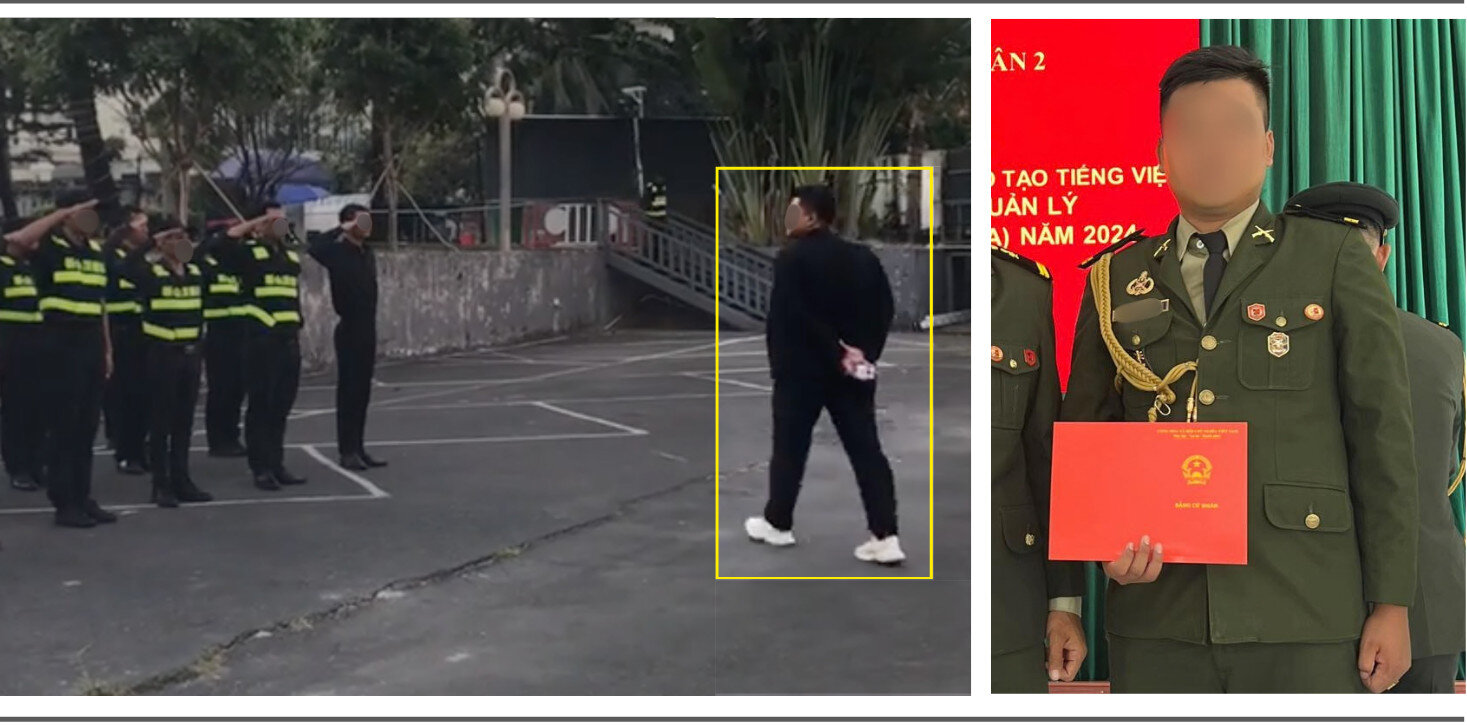
In three compounds, active military members trained or led security guards. Individuals were seen instructing guards or being saluted by them, typically standing at the front of a group of guards. These exercises served an organizing function by transmitting skills and standardizing the practices of the guard force. This was often necessary because compounds routinely employed more than 100 security guards, and many had no prior experience in security roles.
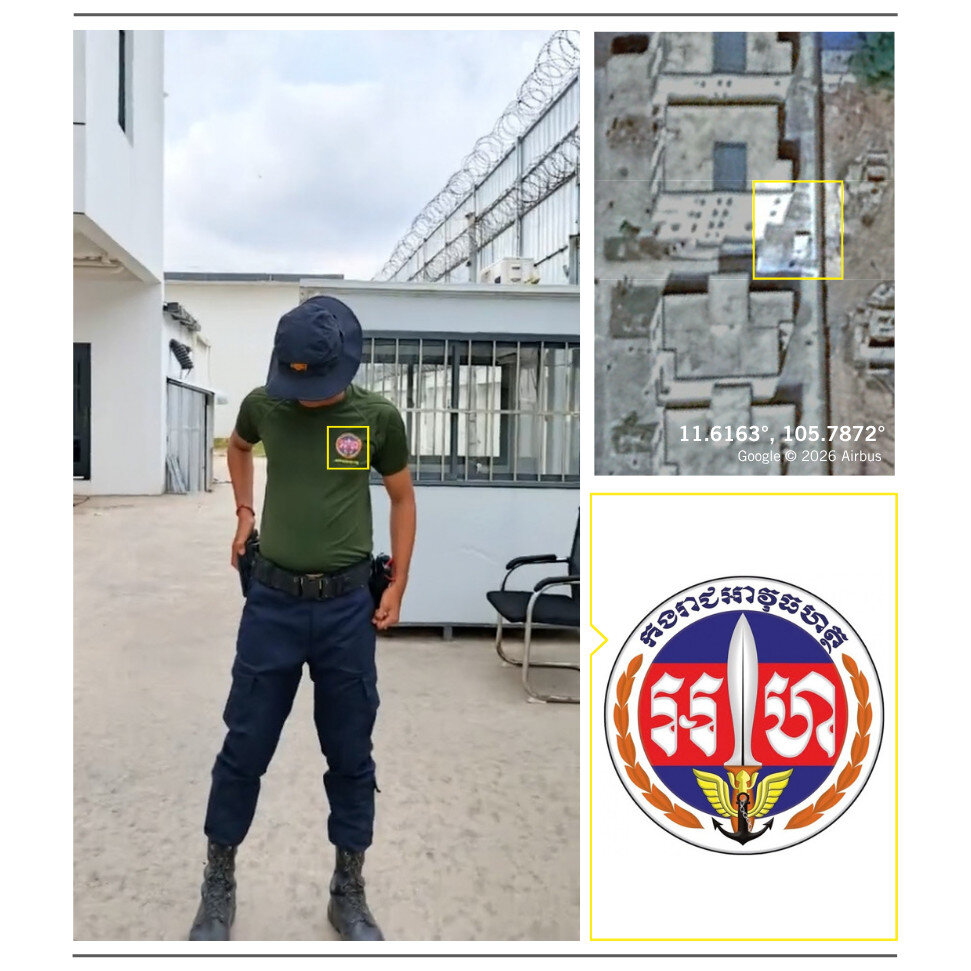
For example, TikTok user NC001 (account name changed to protect identity), pictured below, was a member of the RCAF during the same period that he published videos in which he is seen leading the security guards at the SI12 compound. At least two other guards at the same compound were confirmed members of the RCAF.
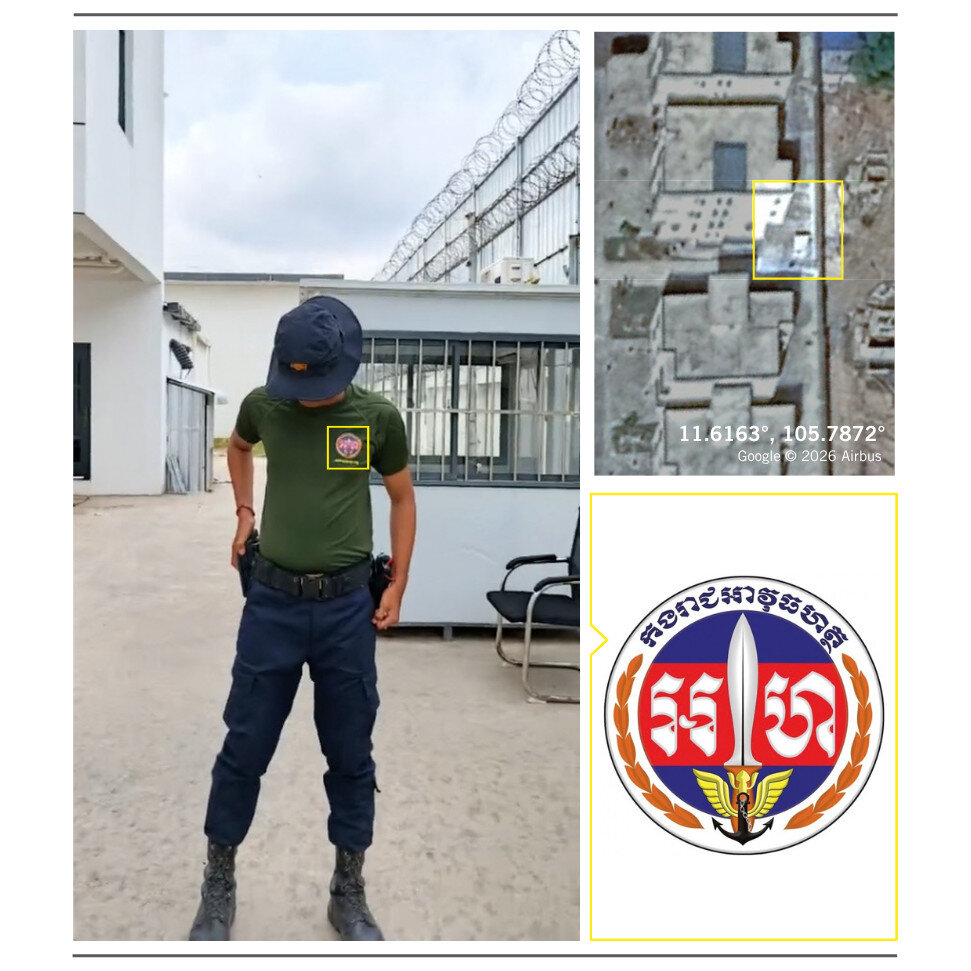
In three cases, Amnesty International suspected members of the RCAF or police openly carrying firearms while inside scamming compounds.
These findings suggest that serving members of the military and police were directly involved in providing security at compounds where serious human rights abuses were committed. Because security guards played a central role in confining and abusing people inside the compounds, these personnel may themselves have participated in, contributed to or been responsible for those abuses. More broadly, the findings strongly suggest that collusion between compound operators and state officials has helped the industry to persist despite the authorities’ repeated, highly publicized crackdowns.
1.6 LEGAL FRAMEWORK AND ANALYSIS
Amnesty International’s research has found that scamming compounds in Cambodia were characterized by a recurring pattern of human trafficking, forced labour, child labour, torture and other ill-treatment, rape, unlawful deprivation of liberty and, in many cases, enslavement. Security guards played a central role in maintaining these systems of abuse.
Across the compounds documented by Amnesty International, guards received trafficked persons on arrival, controlled entry and exit points, prevented escape, recaptured escapees, enforced work requirements, escorted victims to punishment facilities, administered or facilitated beatings and electric shocks, and maintained continuous surveillance over those confined.
RESPONSIBILITY OF SECURITY COMPANIES
Guards employed by all five security companies—Leap Somnang, Security Response, ZD Security, DAS and Best Security—were linked to compounds where survivors described serious human rights abuses, including torture, forced labour, unlawful confinement, human trafficking and enslavement, with child labour documented at compounds linked to Leap Somnang and Best Security, and rape at a compound linked to Security Response. Across all five companies, the evidence indicates that guards were not merely providing perimeter security but were often integral participants in the systems through which severe abuses were carried out.
Many of the abuses documented in this report may constitute serious crimes under international law and Cambodian law, including trafficking in persons, torture, rape, unlawful confinement and enslavement. Guards who themselves inflicted violence may be characterized as direct perpetrators, while those who enforced confinement, prevented escape, escorted people to punishment rooms or stood guard during abuses provided assistance that may be characterized as aiding and abetting, or as intentional contribution to crimes committed by a group acting with a common purpose. Managers and executives of the security companies may bear superior responsibility, and under Cambodian law the security companies may themselves bear criminal responsibility as legal entities. Torture and slavery are crimes under international law subject that may be prosecuted under universal jurisdiction; trafficking may also be prosecuted by states whose nationals were victims or perpetrators.
RESPONSIBILITY OF CAMBODIAN AUTHORITIES
Under international human rights law, Cambodia has an obligation to protect all individuals within its territory from human rights abuses, including those committed by non-state actors, and to respond effectively when they occur by investigating the facts, holding those responsible to account and ensuring remedies for victims. Amnesty International concludes that Cambodia has failed to adequately protect people from these abuses. Despite extensive evidence linking security companies to compounds where serious human rights violations occurred, Amnesty International is unaware of investigations into the companies profiled in this report, their leadership or their wider networks. The government’s response did not identify any such investigation. The evidence further suggests failures to regulate private security providers, monitor the use of weapons, investigate links between security companies and members of the military or police, or hold accountable actors connected to the scamming industry.
Further, where members of the military and police are involved, Cambodia’s responsibility is not limited to a failure to exercise due diligence. Under customary international law, the conduct of police and military personnel, as organs of the state, is attributable to the state, even where they exceed their authority or contravene instructions, provided they act in an official capacity or with apparent authority. Where officials have participated in, facilitated or protected abuses within scamming compounds, Cambodia’s responsibility is therefore engaged not only for failing to exercise due diligence, but directly for the abuses themselves. With limited exceptions, including the arrest of Ly Kuong, many of the companies, senior individuals and politically connected actors linked to the scamming compound industry appear to have remained largely untouched, contributing to a climate of impunity that may enable the continued operation of the industry.
In its response to Amnesty International, received on 15 October 2026, Cambodia’s Ministry of Interior stated that between 1 July 2025 and 31 August 2026, authorities “cracked down on a total of 832 online scam sites” and sent “3,477 suspects (including 491 Cambodian nationals) and 446 case files to court.” The Ministry said this showed the law is enforced “regardless of status or level of responsibility, including private security companies and private security agents.” The figures included 10 security guards sent to court after a crackdown in Poipet, and six private security agents detained for illegal use of weapons. The Ministry also reported that “77 police officers received severe disciplinary measures” and that the Anti-Corruption Unit had “detained 17 suspects who were police, military, and civil officials,” filing four cases to court for collusion with criminal groups. Describing the private security sector as “a support force for the National Police,” the Ministry identified as a priority “strengthening the management and inspection of private security companies […] to prevent security services being used for illegal purposes.”
Although the Ministry of Interior reported significant enforcement activity, its response did not identify any investigation into the security companies, military and police personnel or business networks profiled in this report, and did not show whether any charges relate to torture, forced labour or trafficking or whether trafficking victims were among those prosecuted. The full response is included in Annex III.
1.7 CONCLUSION
Security companies and the guards employed by transnational criminal organized groups were essential to the operation of the compounds. These companies and their personnel were also linked to a wider network of actors, including members of the military and police, politically exposed persons, and powerful political and business interests. Despite years of public reporting, the Cambodian authorities have failed to investigate these companies or the networks of protection around them.
Accountability is essential for the victims and survivors of serious human rights abuses. Those who committed, facilitated or knowingly contributed to these abuses must be identified and, where sufficient admissible evidence exists, prosecuted in fair trials without the recourse to the death penalty. Survivors must also receive effective remedies and full reparation from the Cambodian state, which bears responsibility for failing to protect them and, where its agents were involved, for the abuses themselves, and, where relevant, from the security companies.
Such accountability is also indispensable to any credible and sustainable effort to end the scamming compound industry in Cambodia. Raids may temporarily disrupt operations, free victims, close compounds or lead criminal syndicates to relocate, but without further investigations, they will not dismantle the security infrastructure and networks of protection on which the industry depends and to which it could return.
1.8 RECOMMENDATIONS
TO THE CAMBODIAN AUTHORITIES
- Establish prompt, independent, impartial and adequately resourced investigations into the role of private security companies in the scamming compound industry in Cambodia, including the companies identified in this report and any other providers operating at scamming compounds.
- Suspend the licences of security companies credibly implicated in serious human rights abuses pending effective investigations, and revoke licences where companies are found to have committed, facilitated or knowingly contributed to abuses.
- Investigate all members of the RCAF, Cambodian National Police, military police and other state security and law enforcement bodies credibly suspected of owning, managing, recruiting for, training, supervising or working for private security companies linked to scamming compounds.
- Investigate the wider networks enabling scamming compounds, including security companies, casinos, property owners, developers, recruiters, financial actors, telecommunications providers and politically connected individuals.
TO PRIVATE SECURITY COMPANIES OPERATING IN CAMBODIA
- Immediately cease providing services at any location where people are unlawfully confined, trafficked, forced to work, tortured or otherwise subjected to serious human rights abuses.
- Provide or contribute to effective remedy for all human rights abuses suffered by victims linked to security guard companies.
TO FOREIGN GOVERNMENTS AND THE INTERNATIONAL COMMUNITY
- Press Cambodia to promptly, impartially and independently investigate companies, company leadership and state officials linked to scamming compounds, including through international and domestic mechanisms, rather than measuring progress through raids, arrests or deportations.
- Review law enforcement, military, financial and security cooperation with Cambodian institutions and individuals credibly implicated in enabling or protecting scamming compounds.
- Exercise jurisdiction, including universal or other extraterritorial jurisdiction where available, over groups, companies and people suspected of responsibility for crimes under international law, in the scamming compound industry, and if enough admissible evidence exists, issue arrest warrants.
2. METHODOLOGY
Over the past three years, Amnesty International has investigated the scamming industry in Cambodia, identifying 86 compounds across the country, interviewing more than 150 survivors and reviewing records of more than 400 additional victims. That research culminated in the publication of two earlier reports: “I Was Someone Else’s Property”: Slavery, Human Trafficking and Torture in Cambodia’s Scamming Compounds (June 2025) and Falling Through the Cracks: Cambodia’s “Crackdown” on Scamming Compounds and the Victims it has Failed (June 2026).2 Both reports documented systematic human rights abuses in the scamming industry.
The present report examines one of the key players in perpetrating such abuses in these scamming compounds: the private security companies guarding every one of the 86 compounds identified.3 These companies do not operate in a vacuum. They are embedded in networks connecting them to military personnel, police officials, politically exposed persons (PEPs),4 powerful business interests and actors directly linked to the scamming industry.
Identifying the security providers operating at scamming compounds, as well as the individuals behind these companies and the military and police personnel working within them, is exceptionally challenging. The scamming compound ecosystem is opaque, and those involved often take steps to obscure both operational and ownership structures. Nevertheless, Amnesty International identified and verified the presence of security providers, military personnel, and police officers at scamming compounds by triangulating multiple independent sources, including survivor testimony, direct observation, social media content, corporate records, and open-source analysis. Taken together, these sources provide a robust evidentiary basis for the findings and conclusions presented in this report.
2.1 IDENTIFICATION OF COMPANIES AND AUTHORITIES
Amnesty International identified at least five security companies providing services – from as early as December 2021 to June 2026 – to at least 23 scamming compounds spread across the country, including in the provinces of Sihanoukville, Koh Kong, Banteay Meanchey, Svay Rieng, Kampot, Tbong Khmum, Mondulkiri, Prey Veng, Takeo, and Preah Vihear. It also found 19 cases in which members of the Royal Cambodian Armed Forces (RCAF) and the Cambodian National Police either worked as guards, trained guards or had unusual access to scamming compounds. Amnesty International included findings only where it could corroborate information through multiple sources, including survivor testimony, site visits, verified social media content, recruitment advertisements, and corporate records. Therefore, the involvement of the state security apparatus is likely deeper and wider than this report indicates.
2.1.1 COMPANY IDENTIFICATION
In identifying security companies operating at scamming compounds, Amnesty International relied on various sources of information, as outlined below.
First, Amnesty International researchers visited 82 of the 86 scamming compounds identified in its 2025 and June 2026 reports. During these visits, researchers photographed security guards, enabling them to identify companies’ logos and uniforms, and later showed these photographs to survivors. Amnesty International directly identified the companies providing security to 10 scamming compounds from site visits alone.
Second, between January 2023 and September 2026, Amnesty International interviewed 151 survivors of scamming compounds in Cambodia. Survivors were asked about the security features at compounds, including the location, role and appearance of security guards, as well as any interactions with them, including abuses committed by or in the presence of guards. Survivors provided information that helped identify specific security providers, including descriptions of company logos and uniforms, and in some cases, survivors positively identified individual guards in photographs.
In conducting interviews, Amnesty International asked survivors to describe the uniforms and logos worn by the security guards at scamming compounds. In more than 30 cases, this led to survivors identifying either the company uniform, the company logo, or individual security guards, which Amnesty International then linked to a security company. However, in many cases, survivors were unable to identify a specific security company – most likely because security companies often took steps to conceal their corporate footprint by not using logos on their uniforms.
Some of the testimonies and survivor accounts included in this report have been published previously in Amnesty International’s earlier research on scamming compounds in Cambodia. These accounts are revisited here to examine a specific aspect that was not the primary focus of earlier reports: the role of guards and security personnel in maintaining systems of confinement, control and forced labour. All survivors have been given pseudonyms.
Third, Amnesty International also documented employment advertisements for security guards from company pages on Telegram, Facebook and TikTok, published between January 2025 and August 2026. The majority of these advertisements did not specify an exact work location, referring instead to general areas, but in some cases, companies recruited directly to scamming compounds and included photographs of their own personnel at these sites.
Amnesty International’s research also included online investigations of companies’ public Telegram, Facebook, TikTok and other social media pages, sometimes prompted by information and leads obtained from other sources. Researchers reviewed over 500 public social media accounts across various platforms, of which 222 were confirmed to show or belong to guards working at scamming compounds. Between June and August 2026, Amnesty International reviewed more than 25,000 videos and pictures posted on or by these 222 accounts. Of these, Amnesty International geolocated videos showing security guards that were filmed at 35 scamming compounds and identified the companies at those compounds in 23 cases.
GEOLOCATION AND CHRONOLOCATION
Amnesty International researchers geolocated videos posted by 222 publicly accessible TikTok accounts belonging to security guards who worked at scamming compounds or who appeared in videos that could be geolocated to a scamming compound. An example of geolocation and company identification is included below.
Geolocation assessments were conducted by analyzing a combination of visual landmarks, satellite imagery, architectural features, signage, road layouts, vegetation, and perimeter structures and comparing them to photographs taken during site visits. In many instances, multiple images or videos from the same account were analyzed before a location determination was made.
Videos posted on the 222 social media accounts examined by Amnesty International were geolocated to 35 scamming compounds, some of which are captured in the table below. All TikTok accounts have been assigned a random number or given a code to protect the identity of users.
| SECURITY PROVIDER | NUMBER OF GUARDS’ SOCIAL MEDIA ACCOUNTS IDENTIFIED | GEOLOCATED TO SCAMMING COMPOUNDS |
|---|---|---|
| Leap Somnang | 31 | BA11, BM02, BS02, CH01, KA02, MD02, PO17, SI15, SI16, SI39, TBK04 |
| Security Response | 16 | KA01, KA03, PV01, SI02, TK01 |
| ZD Security | 17 | BS04, BS02 |
| Dara Security (DAS) | 11 | SI03, SI50 |
| Best Security | 6 | BA06 |
| Other companies | 13 | BA11, OS01, PSP01, PSP02, SI45 |
| State authorities (suspected active military personnel or police) | 19 | BM02, CH01, KA02, OS02, PSP01, PSP02, PV01, SI03, SI12, SI45, SI54, TBK04 |
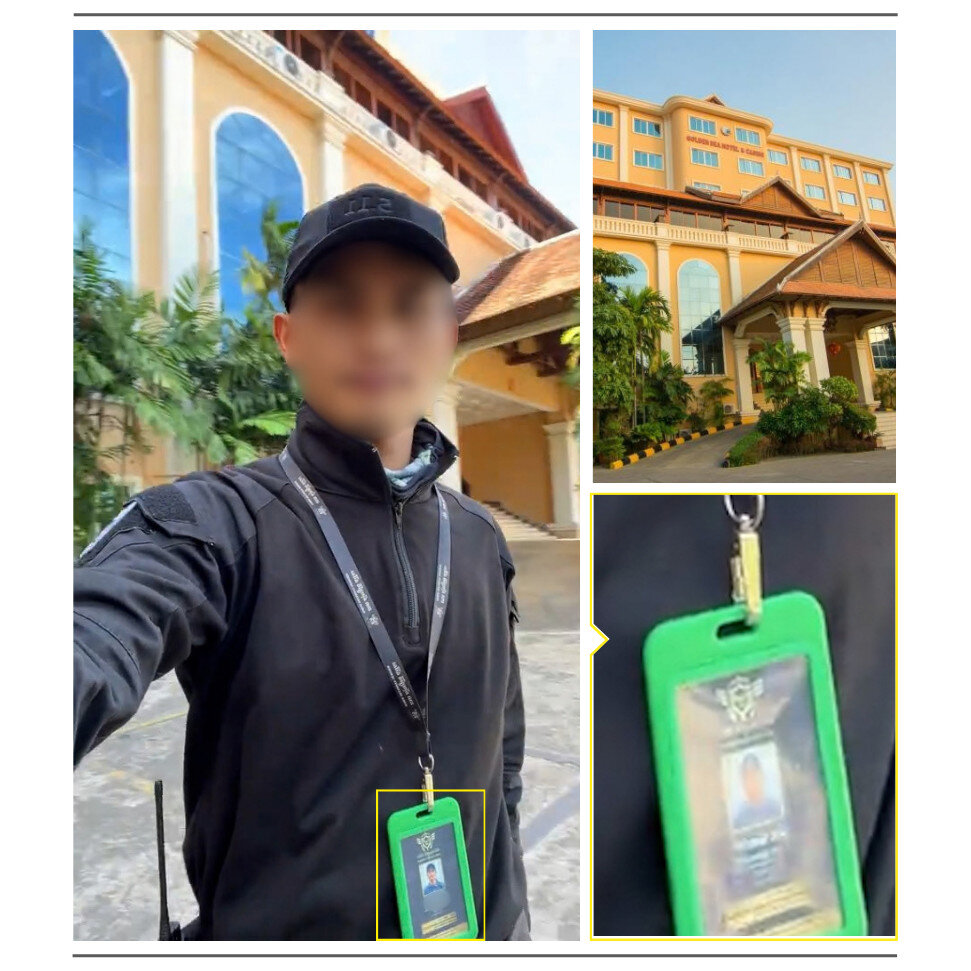
In addition to determining where security guards were operating, Amnesty International sought to establish when they were present at particular scamming compounds. Establishing precise dates and patterns of entry was often more challenging than determining location because social media users may upload photographs and videos days, weeks or months after they were recorded. To assess likely periods of presence, Amnesty International relied on a combination of posting dates, account activity, survivor testimony, company recruitment advertisements, site visits and other corroborating evidence. Where available, researchers compared multiple accounts relating to the same location to establish overlapping timeframes during which a security company was present.
Exact dates were included only when supported by the available evidence. Where precise dates could not be established, Amnesty International adopted the most conservative timeframe supported by the evidence and identified broader periods during which a company was likely providing security services at a particular compound.
Annex I to this report sets out a profile for each of the 23 scamming compounds linked to a known security company.
CORPORATE DATA
Finally, in order to assess the ownership, shareholding and business operations of the companies featured in this report, Amnesty International reviewed information and documents published by the companies themselves, including on websites and social media accounts. While basic corporate records in Cambodia, including company names, registration numbers and registered addresses, are publicly accessible through the Ministry of Commerce’s business registry, information relating to shareholding structures and beneficial ownership is not publicly available. As a result, ownership assessments in this report rely on open-source indicators, including corporate communications, social media activity, documented business affiliations and other publicly available information. Amnesty International therefore could not independently verify the ultimate beneficial ownership of the companies examined through official public sources.
2.1.2 STATE AUTHORITIES’ PRESENCE
Amnesty International identified members of the RCAF and the Cambodian National Police at scamming compounds through a similar methodology to that used to identify private security companies. Amnesty International researchers examined videos and photos published on social media accounts showing military personnel and police officers present at scamming compounds, acting as guards, training guards, providing security services directly, visiting compounds or otherwise demonstrating unusually frequent access to scamming compounds and their operations. As with company identification, Amnesty International relied on geolocation and chronolocation techniques to determine where and when individuals were present.
To determine whether individuals were current or former members of the military or police, Amnesty International analyzed uniforms, insignia, rank markings, unit patches, identification cards, training activities, official events and other indicators visible in photographs and videos. Researchers compared these materials with publicly available images of Cambodian military and police uniforms and structures. In many cases, individuals also concurrently identified themselves as members of the armed forces or police through social media posts, photographs in official settings or references to military or police units. The evidence captures only individuals who chose to post publicly in identifiable uniforms, or where the evidence strongly suggested an official link to the military or police. As a result, the total number of personnel identified in the report is strictly a minimum and it is likely that other military or police personnel were entering or acting as guards at scamming compounds but did not publicly disclose their affiliation.
Amnesty International also used AI-detection tools to screen suspicious pictures, especially those showing guards carrying weapons, to assess whether they had been created or modified using AI tools. Researchers flagged images or videos that showed military-grade weapons, were tagged as AI-generated by social media platforms, or showed other suspicious signs, and submitted them to AI-detection tools. These tools assessed the likelihood that the image was generated using AI. This research included only results with less than a 5% likelihood of being AI-generated or modified. In analyzing video and photographs involving guns, Amnesty International only included instances in which the same gun appeared in numerous photographs, or where the likelihood of the image being AI-generated or modified was less than 1%.
Annex II to this report sets out evidence linking 19 social media accounts detailing compound presence or activity, to what appear to be active members of the RCAF and police.
2.2 INFORMATION ON TRANSNATIONAL CRIMINAL ORGANIZED GROUPS
Although Amnesty International’s research in the last three years has not focused on the criminal syndicates operating the scamming industry, evidence concerning their structure, activities and methods has emerged through more than 151 interviews with survivors, and further interviews with experts and anti-trafficking organizations. This report at times relies on some of this information. Amnesty International also draws on the work of other authoritative bodies, including the United Nations and the United Nations Office on Drugs and Crime (UNODC), when their findings align with and reinforce Amnesty International’s own research.
2.3 LIMITATIONS
It is important to note the limitations faced by researchers in gaining access to information about companies, military and police. Cambodia’s business registration system is less transparent than many other jurisdictions, and its land titling system is not fully transparent. Security company guards often do not wear a standard uniform and security companies may not display their logos prominently or at all. Compounds themselves often deterred investigations by placing “No photos” signs around compound perimeters and instructed guards to prevent people from taking photographs or asking questions. There was a clear intention from many of these companies to hide their identifying information. As a result, the findings should be understood as a minimum indicator of the involvement of private security companies and military and police personnel in the scamming industry. The true extent of that involvement is likely greater than can presently be documented through publicly accessible information and field research alone.
2.4 CONTACTING COMPANIES AND THE GOVERNMENT
Amnesty International wrote to all the companies, corporate entities and individuals identified in this report in September and October 2026, to provide them with an opportunity to respond to the organization’s findings. Amnesty International reviewed the responses and, where relevant, updated its findings and reflected the information provided in the report. In addition, copies of the these can be found in Annex III of this report.
Amnesty International wrote to the government on 30 September 2026 to provide an opportunity to respond to the organization’s findings. Its response, received on 15 October 2026, has been reflected throughout the report where relevant. A copy of the government’s written response to Amnesty International’s findings and allegations, in Khmer and English, is reproduced in Annex III.
2.5 ACKNOWLEDGEMENTS
This report builds on a substantial body of evidence uncovered by civil society organizations, activists and journalists. In conducting this research, Amnesty International worked closely with rescue organizations, journalists, independent activists, researchers, including Cyber Scam Monitor, and consultant groups. FIND.ngo assisted Amnesty International with corporate research relating to several of the companies featured in this report. More than 150 survivors shared their experiences, and in many cases, evidence about the companies and compounds featured in this report, often despite the lasting trauma of their experiences.
This report would not have been possible without the bravery of survivors and victims who shared their stories with Amnesty International, the many organizations that have rescued or helped to rescue thousands of victims, and the fearless journalists who have documented abuses across the scamming industry despite facing harassment, threats and, in some cases, detention by the state and security guards as a result of their work.
3. BACKGROUND
Since the Covid-19 pandemic, Cambodia became one of the major global hubs for the online scamming industry. What likely began as a network of illicit gambling operations and fraud schemes evolved into a highly organized criminal ecosystem operating from hundreds of locations across the country. According to the United Nations Office on Drugs and Crime (UNODC), transnational criminal syndicates established industrial-scale scamming operations throughout Southeast Asia, generating billions of US dollars in illicit profits each year through investment fraud, romance scams and other forms of online deception.5 These operations depended on large numbers of workers, many of whom were trafficked into Cambodia through false job advertisements and subsequently subjected to coercion, violence and exploitation.
3.1 AMNESTY INTERNATIONAL’S PAST FINDINGS
In June 2025 and June 2026, Amnesty International published two reports documenting a large-scale human rights crisis affecting thousands of individuals.6 Amnesty International identified 86 scamming compounds across Cambodia, defined as locations where online scamming or online gambling operations were run and where trafficked persons or migrant workers involved directly or indirectly in such operations were subjected to deprivation of liberty and/or other human rights abuses carried out primarily by organized criminal actors. Some compounds held hundreds, and potentially thousands, of people at a time.
Based on interviews with more than 150 survivors, Amnesty International documented a widespread pattern of slavery, human trafficking for the purpose of forced labour or forced criminality, deprivation of liberty and torture or other ill-treatment. Some survivors were children, whereas others, especially women, described sexual abuse inside scamming compounds. Survivors consistently described a system in which they were recruited through deception, trafficked into Cambodia, confined behind guarded perimeters, and subjected to violence and coercion, to force their participation in online fraud operations.
The scams that survivors were forced to run involved creating false online personas, cultivating relationships through social media and messaging platforms, and persuading targets to invest in fraudulent schemes, particularly cryptocurrency scams. In other cases, trafficked people were forced to recruit additional victims or open accounts used to facilitate criminal activity.
3.2 TRANSNATIONAL ORGANIZED CRIMINAL GROUPS
The principal perpetrators of these abuses were transnational organized criminal groups. The United Nations Convention against Transnational Organized Crime (UNTOC) defines an “organized criminal group” as “a structured group of three or more persons, existing for a period of time and acting in concert with the aim of committing one or more serious crimes or offences […] in order to obtain, directly or indirectly, a financial or other material benefit”.7 Their activities were also transnational within the meaning of the Convention: people were recruited from dozens of countries from around the world, operations were directed across borders, even globally, and syndicates repeatedly relocated in and out of Cambodia following law enforcement crackdowns in Cambodia and elsewhere in the region.
Syndicates operated simultaneously in illicit and licit spheres within Cambodia. While the fraud itself was criminal, it was conducted through what were, in form, legitimate commercial structures: compounds were situated within lawfully owned or leased properties, serviced by registered businesses, including security companies, and connected to formal banking and telecommunications systems and, in some instances, embedded within licensed casinos, hotels or special economic zone developments.
In its 2026 report on transnational organized criminal groups in Southeast Asia, UNODC described the major syndicates operating in the region, including Cambodia, through a layered enterprise model whose division of criminal labour “mirrors legitimate multinational corporate structures”.8 These groups operated industrial-scale online fraud and money laundering activities, with the UNODC finding the industry to have generated financial losses for the ultimate scamming victims of up to USD 114 billion in 2025 alone, across East and Southeast Asia and the wider region, sustained by purpose-built compounds, dedicated financial infrastructure and standing security forces.9 Methods of control were consistent across sites, especially the use of armed guards, surveillance systems, debt bondage and the confiscation of workers’ documents, indicating a common operating model rather than the isolated practices of individual operators.10
3.3 THE GOVERNMENT’S CRACKDOWN
In July 2025, following sustained international pressure and mounting evidence of widespread abuses, the Cambodian government launched a nationwide crackdown on scamming compounds. Authorities subsequently reported hundreds of operations, arrests and rescues. Between July 2025 and mid-April 2026, authorities reported action against more than 250 online scam cases nationwide, including the closure of 91 casino locations, the deportation of 13,039 foreign nationals and the voluntary departure of 241,888 individuals.11
Amnesty International reported on these actions but found serious shortcomings in the government’s response.12 It documented repeated failures to screen and identify potential trafficking victims, instances in which people subjected to forced criminality were treated as immigration offenders rather than victims of trafficking, as well as shortcomings in efforts to investigate those most responsible for abuses. Amnesty International also identified multiple compounds linked to licensed casinos and highlighted longstanding evidence suggesting that parts of the industry had operated openly and on a large scale for years.13
On 20 August 2026, the Secretariat of the government-instituted Ad-Hoc Commission for Combatting Online Scams (CCOS) stated that there were “currently no online scam compounds operating in the country” and that a “complete eradication of large-scale operations” had taken place.14 CCOS said it had taken down 86 online scam compounds and apprehended more than 29,000 suspects of 39 nationalities.15
Several banks and casinos were also investigated or had their permission to operate removed.16 High-profile arrests, however, remain few. Two Chinese nationals were extradited to China,17 and only one high-profile Cambodian person has been arrested.18 Ly Kuong, a Neak Okhna19 title holder, was linked to three scamming compounds, each of which was guarded by a security company profiled in this report. Three of Ly Kuong’s casinos had their recognition regranted during the crackdown period.
The long-term success of the government’s response must be measured not only by the closure of compounds, but by whether those suspected of being responsible for human rights abuses are identified, prosecuted if necessary, and prevented from re-establishing their operations.
This background is consistent with what regional analysts and investigative journalists have long argued about links between major Cambodian conglomerates and the scam economy, and with UNODC’s warning that cyberfraud networks in Southeast Asia have become embedded in local political and economic systems and have benefited from corruption and weak governance.20 An industry of this scale, operating openly for years from licensed premises, could not have done so without protection.21
4. ROLE OF SECURITY GUARDS
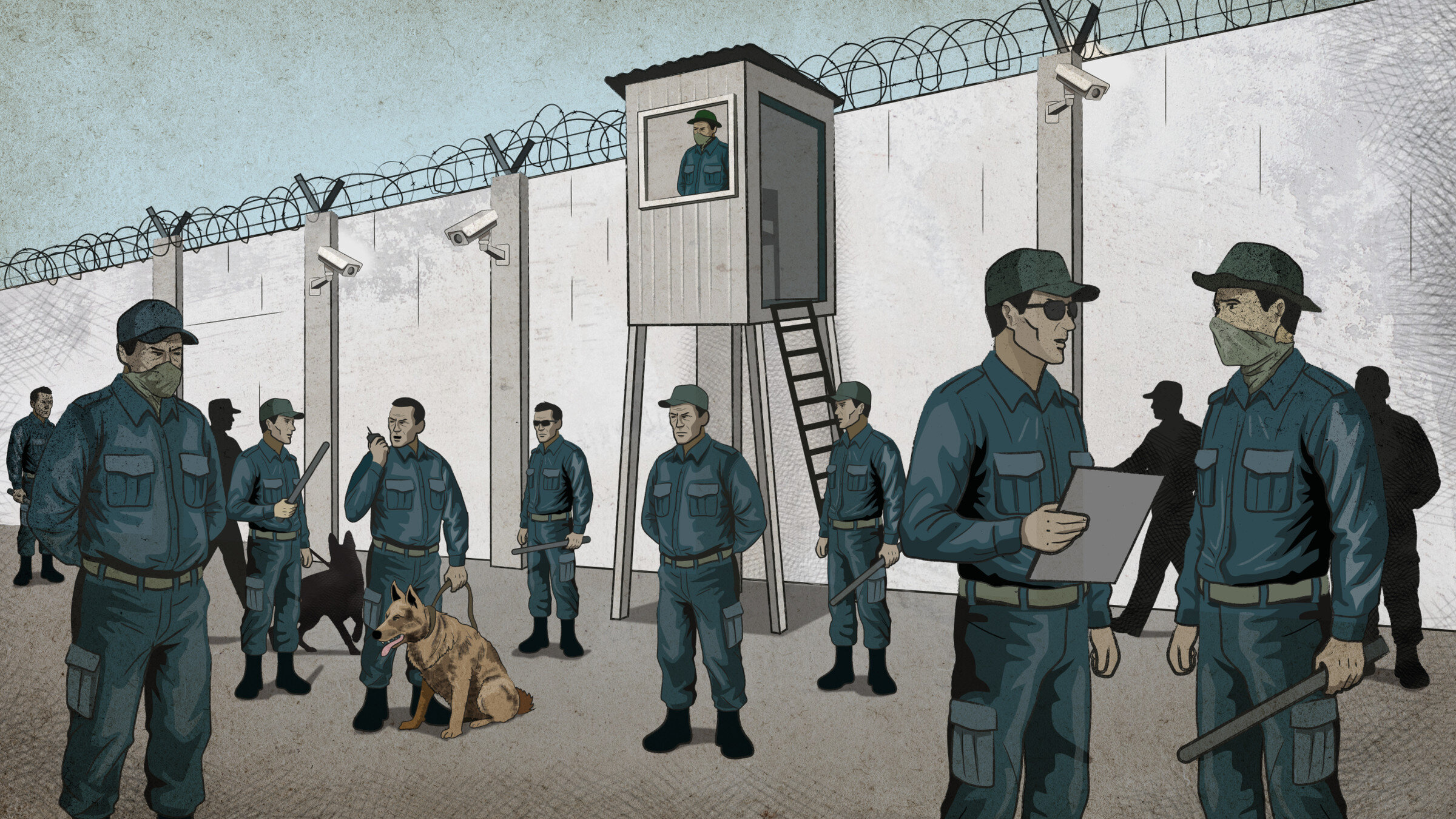
“They didn’t need any razor wire […] there were so many security guards.”22
Security guards were a defining feature of scamming compounds in Cambodia. All 82 compounds visited by Amnesty International in 2024, 2025 and 2026 employed security personnel as part of their perimeter security. Video evidence from more than 200 TikTok users believed to be working as guards at more than 35 compounds corroborated this.23
Interviews with survivors, social media content and satellite imagery indicated that many more guards were deployed throughout the compounds. Survivors frequently described compounds staffed by dozens, and sometimes hundreds, of guards.24 For example, Claire (not her real name), a Cameroonian woman confined in PV01 (Park 8), estimated that more than 200 security guards operated in the section of the compound visible to her and said that when she first arrived, she believed she had been taken to a prison.25 PV01 was a large compound, with dozens of guards sighted at the gates during Amnesty International’s 2025 visits.26 TikTok accounts also showed dozens of guards marching through the compound.
Advertisements reviewed by Amnesty International on Telegram, TikTok, Facebook and other platforms further suggest that security companies were recruiting guards in large numbers to work at scamming compounds.27
Security guards were not merely present at sites where abuses occurred. They were a core component of the systems of confinement, surveillance, coercion and punishment through which scamming compounds deprived trafficked people of their liberty and maintained forced labour, torture, rape and, in many cases, conditions amounting to enslavement. This chapter describes the practices reported by witnesses.28
4.1 KEEPING PEOPLE INSIDE
Survivor testimony indicates that security guards controlled access to compounds, searched or screened vehicles and visitors, monitored workers’ movements, escorted people within compounds and responded to escape attempts.
Almost every survivor interviewed by Amnesty International described security guards as being responsible for preventing escape.29 Many reported witnessing or experiencing guards beating people who attempted to flee.30 Lisa (not her real name), a Thai woman confined at PP09 (Mango 1) said she was captured by security guards after attempting to escape.31 Most survivors said escape was effectively impossible because of the number of guards deployed throughout the compounds. Some organizations assisting victims reported that guards could face financial penalties or dismissal when people escaped.32 Survivors, witnesses and residents also consistently described guards pursuing and recapturing people who escaped. Several reported that guards actively searched for escapees outside compounds, including individuals who had climbed perimeter walls or fled into surrounding areas.33
The consequences for escape attempts could be severe. At PO21, a compound in Poipet referred to by survivors as “Blackgate”, a child survivor from Thailand said a guard beat him so severely he could not sit down.34 Five other survivors told Amnesty International they tried to launch a mass escape in July 2025, in part because of the violence:35
“Seventeen others tried to escape […] only thirteen escaped. The guards caught many of the women […] we don’t know what happened to them.”36
4.1.1 SECURING ENTRANCES AND EXITS
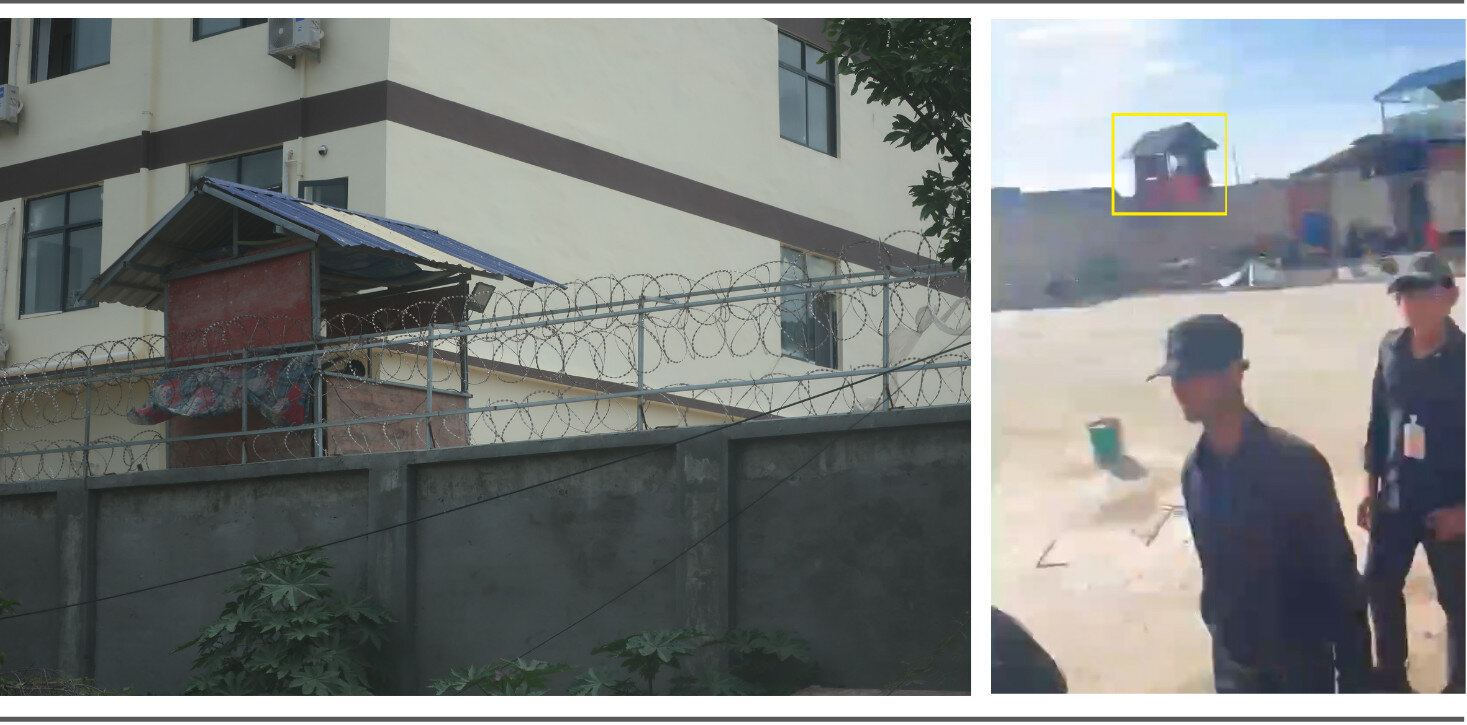
Satellite imagery also revealed probable guard posts positioned along the interior perimeters of 26 compounds.37 These positions frequently had overlapping fields of view and appeared to be designed to monitor activity inside the compounds rather than outside them. Their placement and height suggest they were intended to detect and prevent escape attempts rather than provide external security. A Cameroonian survivor, Bringer (not their real name), described guard positions inside PV01 (Park 8) as specifically designed to prevent people climbing the walls:
“They would put a guard in a little hut on the walls to stop people trying to escape.”38
At least four compounds also included guard towers, some equipped with floodlights, CCTV cameras, or both.39 The towers faced inward and provided clear surveillance of activities within the compounds. Amnesty International geolocated images showing guards at several sites around the same time periods they posted video footage showing themselves monitoring CCTV feeds from dedicated control rooms.40
4.2 VIOLENCE, TORTURE AND OTHER ILL-TREATMENT
“They stood at the door when he would come into the room when he would rape me.”41
Security guards did not merely enforce confinement. Survivors described guards as active participants in systems of coercion, punishment and abuse. Their presence, authority and willingness to use violence enabled managers and others within compounds to commit violence with impunity. Fear of violence, particularly following escape attempts, refusal to work or failure to meet targets, was reported by almost every survivor interviewed and was a key mechanism through which control was maintained and trafficked people were compelled to continue carrying out scam work.
For some survivors, guards were directly involved in nearly every stage of their abuse. Maia, a Cameroonian mother of four, said guards escorted her into PV01, physically restrained her while she was forced to sign documents, took her to a dark room where she was tortured for failing to meet the monthly performance targets and raped by the compound managers while the security personnel stood guard throughout the assaults.
“They would come in to use me […] The security guards stood guard at the door.”42
Kenyangi, a 20-year-old Ugandan woman from the same compound, was also raped under similar circumstances. She described her Chinese boss entering her room in Park 8 multiple times to rape her throughout 2025. She said the security guards would stand on surveillance at the door. Kenyangi said her friend had also been raped by the same man and that when she had died it was security guards who had stopped her from entering the room to touch her friend’s body.
TORTURE AND OTHER ILL-TREATMENT
“The guards took me to a dark room and shocked me. I spent days inside that room […] I was hospitalised.”43
Numerous survivors said that guards inflicted or facilitated acts which amount to torture or other cruel, inhuman or degrading treatment or punishment. Amnesty International’s previous research demonstrated how authorities were aware of torture or other ill-treatment inside of compounds but failed to act.44 Where torture and other ill-treatment occurred but was not directly committed by state actors, the authorities can still be responsible if they knew or had reasonable grounds to believe torture or other ill-treatment was occurring or failed to exercise due diligence to investigate, prosecute and punish such non-state actors.45 Violence was commonly used to punish people who attempted to escape, resisted orders or failed to meet work targets. Survivors described guards carrying weapons, handcuffs and electric shock batons.
A Ugandan man said a security guard at KA02, guarded by the Leap Somnang company, punched him so hard that he lost a tooth.46 Kane (not his real name), another survivor of the KA02 site, said that guards had taken him to a “dark room” after he had refused to work and was asking to leave the compound.47 According to Kane, the room was divided into small cells by metal bars, where detainees were forced to sleep on the ground while guards remained stationed outside with electric shock batons and metal poles. He said guards regularly entered the cells and beat detainees on the orders of compound managers. Kane showed Amnesty International scars that he said resulted from beatings with a metal pole and said that, given the choice, he would “rather be beaten with the metal pole” than subjected to electric shocks.
Other survivors reported being shocked with electric batons, beaten, restrained and placed in isolation. A Thai man, held at PP04 in 2025, said he was “beat[en] and electrocuted” by security guards,48 while Akbar (not his real name), a Pakistani survivor, explained he was beaten, shocked and subjected to isolation by security guards at PP23.49
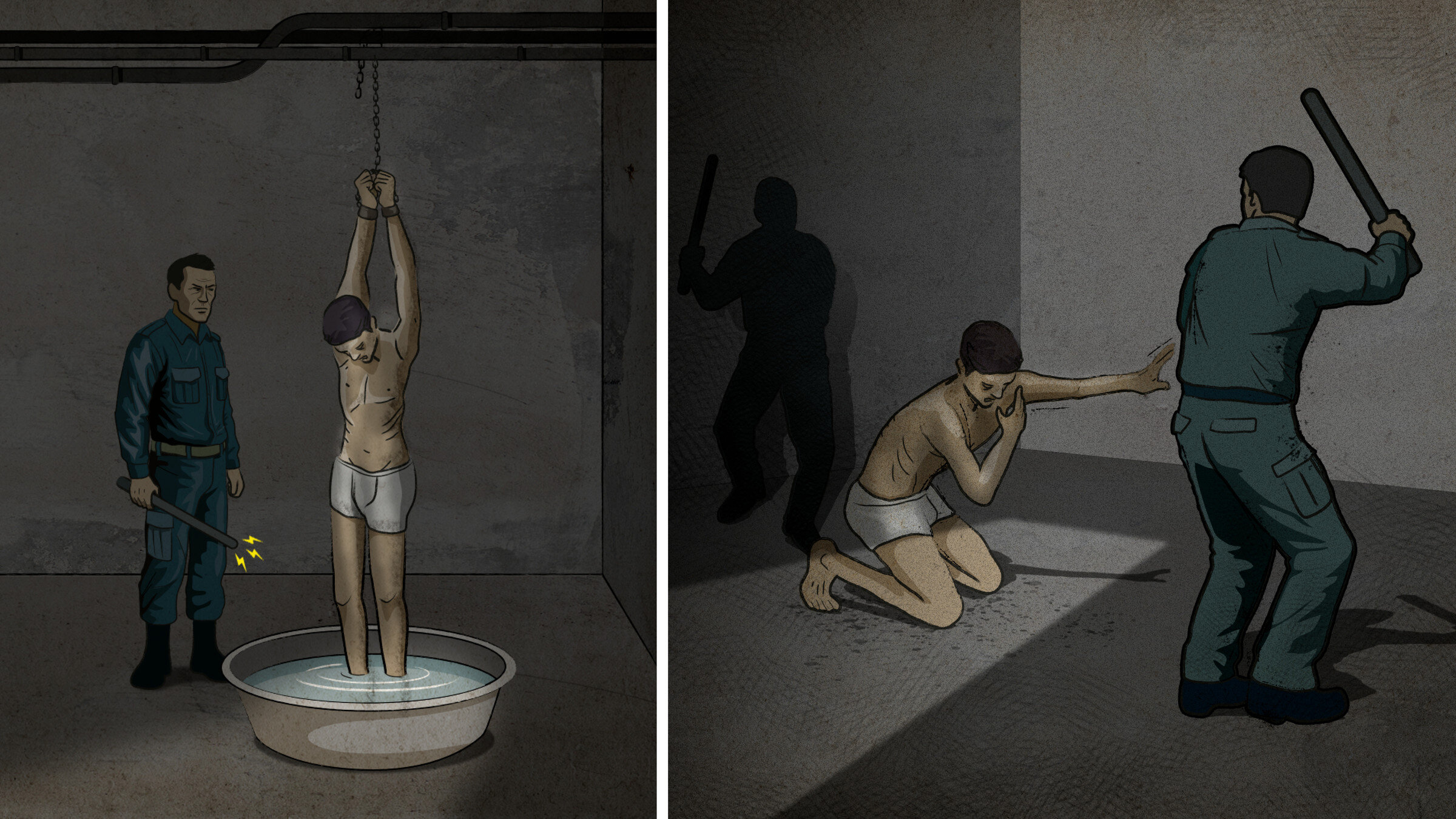
Gabe (not his real name) said he was tortured at PV01 (Park 8) by “bouncers” or “bodyguards”, people he described as older Cambodian security guards wearing different uniforms to the perimeter guards. Gabe said he was taken to a dark room with large basins of water:50
“They would make me stand in the water in my underwear for hours. Sometimes they would chain me to the pole above the water by my hands. Sometimes they would come in and just beat me for hours on end […] they would also shock me with an [electric baton] while I was in the basin.”
Gabe told Amnesty International he was later put in a car with two of these armed men and described being taken to Myanmar where he was sexually assaulted with a metal pole by a manager after trying to secure his release. He told Amnesty International he was traumatized:
“If my story can help anyone then I want to tell it […] I don’t know what to tell [my daughters].”51
Wambui (not her real name), a female Kenyan survivor who was trafficked into the BA01 compound that was located on the property of D.T.G. Casino,52 said the guards physically placed her inside of a van where they kicked and beat her and then drove her to a field in the middle of the night where they threw her out and left her.53
Brandon (not his real name), who identified the security guards of the Leap Somnang company (see Chapter 5), said he was taken to the MD02 compound and after refusing to work was escorted to a dark room by security guards who guarded the door and tortured him with electric shock batons over a period of weeks.
4.2.1 POSSESSION OF WEAPONS BY SECURITY GUARDS
“The security guards said ‘we will kill you’”.54
Survivor testimony, social media evidence and Amnesty International’s previous investigations indicate that security guards at scamming compounds routinely possessed and used weapons. Survivors described guards carrying or having immediate access to electric shock batons, firearms and, in some cases, using dogs to support perimeter security. The presence of these weapons strengthened guards’ capacity to intimidate, punish and control trafficked people and reinforced the coercive environment within compounds.
ELECTRIC SHOCK BATONS
Most of the 151 survivors interviewed by Amnesty International reported seeing guards carrying or having access to electric shock batons. Survivors consistently described these weapons as tools of intimidation, ill-treatment and punishment, particularly against people who attempted to escape, resisted instructions or failed to meet work targets.
A survivor of the P018 compound began to cry as she recalled the sound the electric shock batons made. According to Pattara (not her real name), guards at the compound, which is inside of Crown Resorts casino and operated by state-affiliated Anco Brothers Co. Ltd.,55 would routinely enter rooms full of victims with shock batons drawn and engaged to deter any possible resistance as they searched bags and questioned victims. She said children inside the room would cry during these periods.56
Amnesty International’s previous research documented the use of electric shock batons in acts amounting to torture and other ill-treatment. The organization found no evidence of any legitimate or lawful purpose for the possession or use of such weapons within scamming compounds. Rather, survivor testimony suggests that electric shock batons formed part of a broader system of coercion designed to maintain control over and extract labour from trafficked people.57
FIREARMS
More than a third of the 151 survivors interviewed reported seeing security guards or other people carrying firearms, including pistols and rifles. Survivors reported seeing weapons at nearly 20 different scamming compounds, including at facilities protected by the security companies examined in this report.
For example, a male survivor, Van (not his real name) reported seeing many security guards holding rifles while he was at BA02 in Bavet in 2024.58 At the SI02 compound in Sihanoukville, another survivor from Malaysia, Adam (not his real name), said he saw guards carrying guns in 2023.59 Amir (not his real name), another Malaysian survivor, also reported seeing guards carrying guns at the SI15 compound in Sihanoukville and the BS04 compound in Koh Kong in 2024.60 All three compounds were guarded by security companies documented in this report.
Several survivors said a security guard at the Park 8 scamming compound, PV01, fired shots into the air after survivors demanded they be given back their passports.61 Amnesty International reviewed images posted online that show three guards carrying firearms, including one guard who brought a pistol into Park 8 in 2025. 62 Guards with firearms are linked to the police and military in Chapter 7 of this report.
Amnesty International identified images posted online showing an individual at SI03 alongside a Dara Security guard carrying a pistol tucked into his waistband.63 A group of five survivors from the SI03 site said that some guards carried pistols.
Evidence collected by Amnesty International further suggests that members of the RCAF, police officers or individuals linked to security forces entered or worked at certain compounds, sometimes while armed. As discussed in Chapter 6 below, the presence of military and police personnel within some compounds may help explain survivors’ consistent reports of firearms being carried by guards and other personnel.
DOGS
“They had big dogs. The guards had them.”64
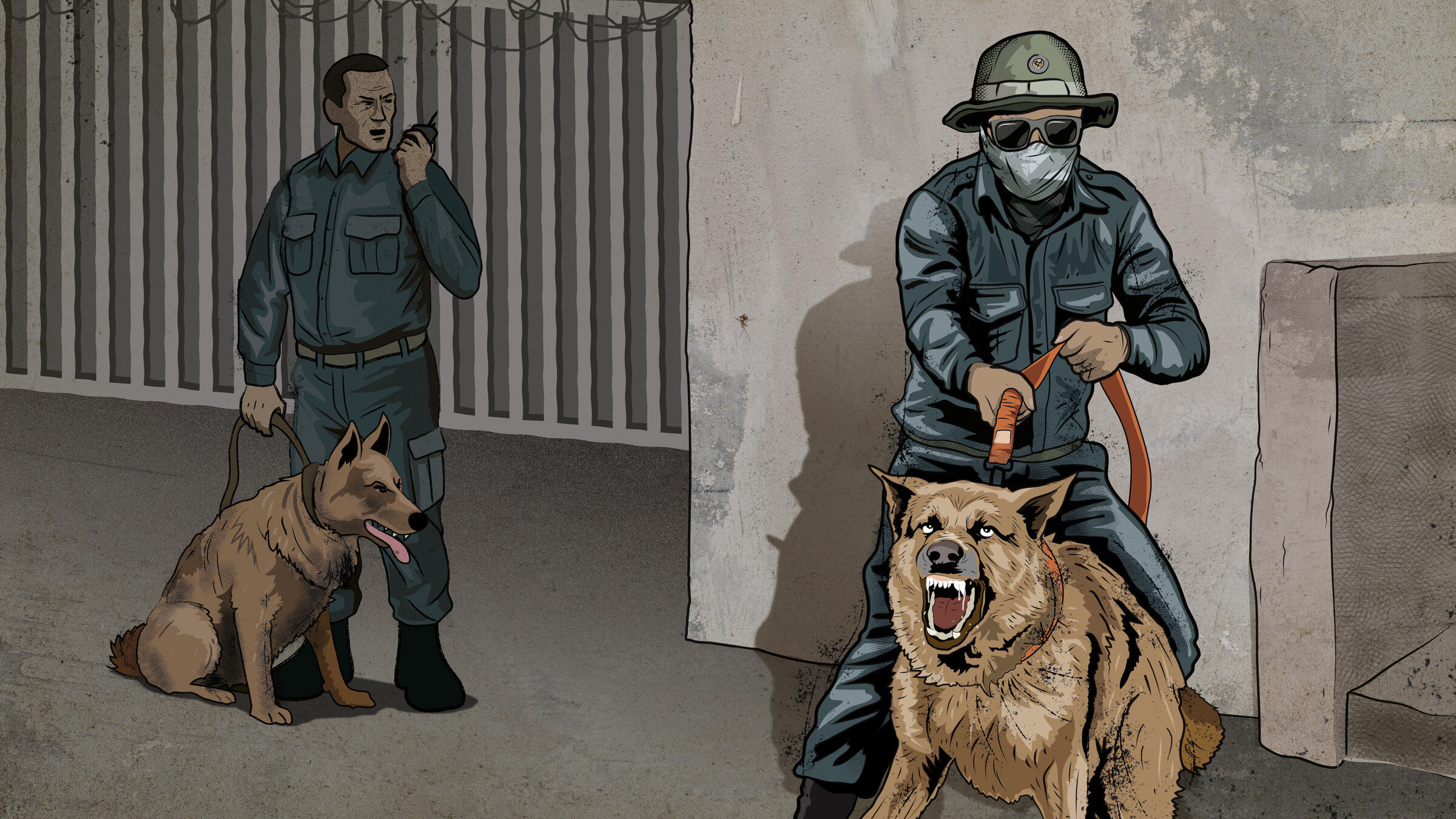
Amnesty International also gathered evidence suggesting that security guards used dogs as part of compound security operations. Four survivors reported seeing guard dogs in at least two compounds,65 including German Shepherds posted at entrances and perimeter areas.66 One survivor stated that dogs were used to pursue people attempting to escape.67 Although he could not confirm he had seen a dog chase anyone, he said multiple guards stationed along the perimeter wall held the dogs on leads.
These accounts were supported by publicly available photographs and videos appearing to show security guards with dogs at multiple compounds. For example, Amnesty International identified images of what appears to be a German Shepherd at a guard station at BS04.68 Open-source evidence links guards from companies including Leap Somnang, Security Response and ZD Security to the handling of such dogs at or near compound entrances, for example in BS04,69 SI01,70 PSP02,71 and TBK0472.
4.3 LINKS TO POLICE AND OTHER AUTHORITIES
Security guards’ positions within compounds are also shaped by their links to state authorities. Guards commonly acted as intermediaries during visits by police or other authorities. Survivors reported that when police arrived seeking a particular victim after a request was made by a relative or rescue organization, security guards or managers would locate and escort that person to the gate of the compound.73 The Cambodian government has acknowledged involving “premises’ owners” in locating potential victims during interventions.74 In other instances, compound managers appeared to know when victims had tried to contact police for help. Some survivors also said that police officers even visited compounds socially.75 Finally, during the government crackdown (see Chapter 3.3 above), at least six survivors told Amnesty International their managers were tipped off by police ahead of interventions.76
5. SECURING A PROFIT
Although security guards were central to the operation of scamming compounds, little is known about the companies that employed and deployed them. The five companies profiled in this chapter are linked to some of the largest scamming compounds and, in all cases, to compounds where Amnesty International documented slavery, human trafficking, forced labour, child labour, torture and other ill-treatment, deprivation of liberty, sexual violence or other serious human rights abuses. The evidence gathered by Amnesty International indicates that these companies are not isolated commercial actors. Rather, they are embedded within networks that connect private security providers to military personnel, police officials, politically exposed persons and powerful business interests.
5.1 SECURITY COMPANIES
The five companies examined in this chapter are Leap Somnang, Security Response, ZD Security, Dara Security and Best Cambodia Security. This chapter provides information on each company’s business practices, management and ownership, the logos and uniforms used by its security guards, and its links to scamming compounds.
Table 2 below summarizes Amnesty International’s findings linking these companies to at least 23 scamming compounds. In addition, Annex I to this report contains detailed information for each compound determination, including the documented abuses, the evidence linking specific security companies to individual compounds and the period of each company’s presence at the respective compound.
| # | SCAMMING COMPOUND | LOCATION | HUMAN RIGHTS ABUSES77 | SECURITY COMPANY | EVIDENCE LINKING SECURITY COMPANY AND COMPOUND |
|---|---|---|---|---|---|
| 1 | BA11 | Bavet, Svay Rieng province; 11.0715, 106.1636 | Human trafficking, forced labour, child labour, torture and other ill-treatment, deprivation of liberty, enslavement | Leap Somnang | Geolocation of videos posted by a guard from the company |
| 2 | BM02 | Banteay Meanchey province; 13.5506, 102.5692 | Human trafficking, forced labour, torture and other ill-treatment, deprivation of liberty, enslavement | Leap Somnang | Positive identification of logo by two survivors; geolocation of videos posted by a guard from the company |
| 3 | BS02 | Botum Sakor, Koh Kong province; 10.8886, 103.1461 | Deprivation of liberty | Leap Somnang | Site visits identified guards wearing the uniform and logo; geolocation of videos posted by a guard from the company |
| 4 | CH01 | Choam, Preah Vihear province; 14.3432, 104.0568 | Human trafficking, forced labour, torture and other ill-treatment, deprivation of liberty | Leap Somnang | Geolocated videos posted by a guard show two other security guards wearing a Leap Somnang shirt or logo at the site |
| 5 | KA02 | Kampot province; 10.4404, 104.4424 | Human trafficking, forced labour, torture and other ill-treatment, deprivation of liberty, enslavement | Leap Somnang | Site visits identified guards wearing the uniform and logo; geolocation of videos posted by a guard from the company; positive identification of logo by five survivors; additional photographs posted by the wife of the chairman of Leap Somnang on 1 December 2021 show the chairman at KA02 observing Leap Somnang security guards |
| 6 | MD02 | Mondulkiri province; 12.3872, 107.3147 | Human trafficking, forced labour, torture and other ill-treatment, deprivation of liberty, enslavement | Leap Somnang | Site visits identified guards wearing the uniform and logo; geolocation of videos posted by guards from the company; geolocation of photographs included in advertisements; positive identification by two survivors; identification of guards in news reports, including guards under arrest |
| 7 | PO17 | Poipet City; 13.6495, 102.5977 | Deprivation of liberty | Leap Somnang | Site visits identified guards wearing the uniform and logo; positive identification by a survivor; geolocation of videos posted by guards from the company |
| 8 | SI01 | Sihanoukville, Preah Sihanouk province; 10.5792, 103.5572 | Human trafficking, forced labour, torture and other ill-treatment, deprivation of liberty, enslavement | Leap Somnang | Geolocation of photographs from the company’s Facebook page |
| 9 | SI02 | Sihanoukville, Preah Sihanouk province; 10.5750, 103.5526 | Human trafficking, forced labour, torture and other ill-treatment, deprivation of liberty, enslavement | Leap Somnang | Geolocation of photographs from the company’s Facebook page |
| 10 | SI12 | Sihanoukville, Preah Sihanouk province; 10.6338, 103.5061 | Deprivation of liberty | Leap Somnang | Geolocation of a photograph showing a Leap Somnang guard at the site |
| 11 | SI15 | Sihanoukville, Preah Sihanouk province; 10.6268, 103.5029 | Human trafficking, forced labour, deprivation of liberty | Leap Somnang | Site visits identified guards wearing the uniform and logo; geolocation of videos posted by 10 guards from the company; geolocation of photographs from the company’s Facebook page |
| 12 | SI16 | Sihanoukville, Preah Sihanouk province; 10.6240, 103.5024 | Human trafficking, forced labour, child labour, deprivation of liberty, enslavement | Leap Somnang | Site visits identified guards wearing the uniform and logo; geolocation of videos posted by five guards from the company |
| 13 | SI39 | Sihanoukville, Preah Sihanouk province; 10.6210, 103.5002 | Deprivation of liberty | Leap Somnang | Site visits identified guards wearing the uniform and logo; geolocation of videos posted by three guards from the company |
| 14 | TBK02 | Tbong Khmum province; 11.6427, 105.8266 | Human trafficking, forced labour, deprivation of liberty, enslavement | Leap Somnang | Positive identification by two survivors of the guards at the site |
| 15 | TBK04 | Tbong Khmum province; 11.6900, 105.9702 | Human trafficking, forced labour, deprivation of liberty | Leap Somnang | Site visits identified guards wearing the uniform and logo; geolocation of videos posted by five guards from the company |
| 16 | KA01 | Bokor Mountain, Kampot province; 10.6347, 104.0170 | Deprivation of liberty | Security Response | Security guards working at the compound posted videos showing they previously worked for or with Security Response guards; advertising to the general area |
| 17 | KA03 | Bokor Mountain, Kampot province; 10.6665, 104.0162 | Human trafficking, forced labour, torture and other ill-treatment, deprivation of liberty | Security Response | Security guards working at the compound posted videos showing they previously worked for or with Security Response guards; analysis of online videos shows a similar uniform, including the distinctive green shirt; a security guard trainer who trained Security Response guards at SI01 is seen in videos filmed at the site; advertising to the general area, including to a more specific location “near 100 rice fields on Bokor Mountain” |
| 18 | PV01 | Prey Veng province; 11.6111, 105.7847 | Human trafficking, forced labour, torture and other ill-treatment including rape, deprivation of liberty, enslavement | Security Response | Security guards identified by survivors at the location wearing the uniform; analysis of online videos shows a similar uniform, including the distinctive green shirt; advertising to the general area; a recruiter affiliated with Security Response posted advertisements and provided coordinates showing he was at the site. |
| – | SI02 | Sihanoukville, Preah Sihanouk province; 10.5750, 103.5526 | Human trafficking, forced labour, torture and other ill-treatment, deprivation of liberty, enslavement | Security Response | Security guards sighted at the location wearing the uniform; social media posts of six guards geolocated to the compound; advertising to the general area |
| 19 | TK01 | Takeo province; 11.3308, 104.7495 | Deprivation of liberty | Security Response | Security guards sighted at the location wearing the uniform; advertising to the general area; social media posts of two guards wearing the company uniform geolocated to the compound |
| 20 | BS04 | Botum Sakor, Koh Kong province; 10.9087, 103.1278 | Human trafficking, forced labour, torture and other ill-treatment, deprivation of liberty, enslavement | ZD Security | 19 security guards working at the compound posted videos showing them at sites geolocated to positions in and around the compound; guards are often seen wearing a BIC Security hat and with the words “Long Bay” on their right sleeve |
| – | BS02 | Botum Sakor, Koh Kong province; 10.8886, 103.1461 | Deprivation of liberty | ZD Security | Social media posts of one guard who posts the ZD Security logo to his account geolocated to the compound |
| 21 | SI03 | Sihanoukville, Preah Sihanouk province; 10.5733, 103.5578 | Human trafficking, forced labour, torture and other ill-treatment, deprivation of liberty | DAS | Site visits documented security guards with uniforms matching the DAS uniform; seven security guards working at the compound posted TikTok videos showing they previously worked for or with DAS guards; five survivors identified the DAS uniform |
| 22 | SI50 | Sihanoukville, Preah Sihanouk province; 10.6371, 103.5029 | Human trafficking, forced labour, torture and other ill-treatment, deprivation of liberty, enslavement | DAS | Site visits documented security guards with uniforms matching the DAS uniform; four security guards posted videos at the compound showing them wearing the DAS uniform |
| 23 | BA06 | Bavet, Svay Rieng province; 11.0694, 106.1700 | Human trafficking, forced labour, child labour, deprivation of liberty | Best Security | Four security guards posted videos at the compound showing them wearing the Best Security uniform |
5.2 LEAP SOMNANG
5.2.1 COMPANY INFORMATION AND OWNERSHIP
Leap Somnang Security Co., Ltd. (ក្រុមហ៊ុនសន្តិសុខ លាភសំណាង ស៊ីឃ្យួរឹធី ឯ.ក) (Leap Somnang) is a private limited company registered with the Cambodian Ministry of Commerce since 2 August 2016.78 According to company records, it is involved in “private security”.79 Although the company does not appear to have an official website, it has a Facebook page,80 and one employee-operated YouTube channel that posted frequently about the company.81
Corporate records maintained by the Cambodian Ministry of Commerce identify one individual, Phat Kimleap, as the sole director and chair of the Board of Directors of Leap Somnang.82 However, social media posts linked to the company and personnel present its leadership differently. For example, videos posted to what appears to be a staff-run YouTube channel describe Ban Sophat (បាន សុផាត) as chairman of the board of directors.83 The most recent video referring to him in that role was published in January 2024,84 and Amnesty International has not identified any subsequent public material indicating that the position has changed.
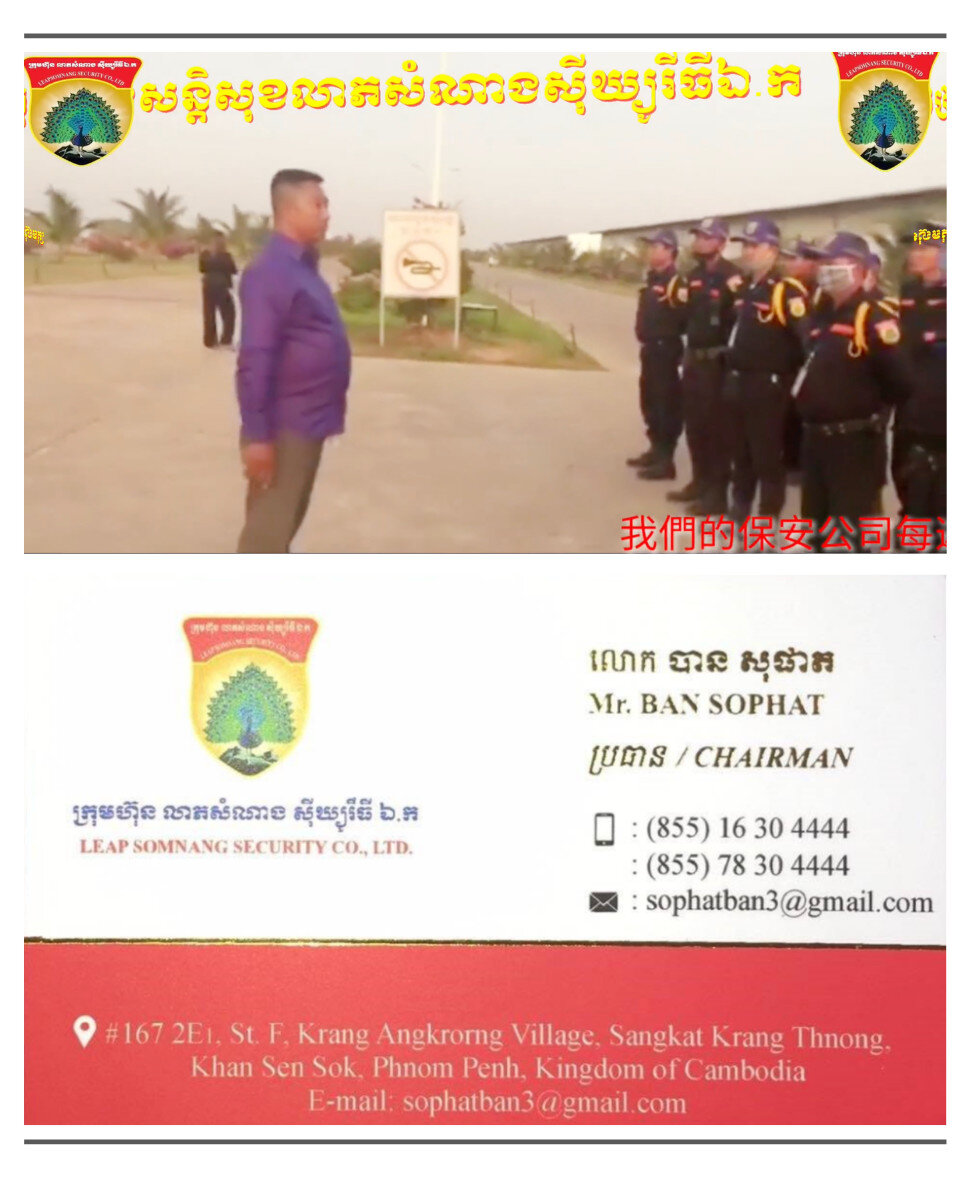
Ban Sophat’s role as chairman and his apparent control over Leap Somnang is independently corroborated by his extensive social media evidence. On 1 June 2019, a Facebook account in his name posted a business card bearing the Leap Somnang logo, his photograph and the title “Mr Ban Sophat, Chairman”.85 The same account contains over a hundred photographs showing him with uniformed Leap Somnang personnel at the company’s premises, events and ceremonies. As of October 2026, his Facebook account’s cover photo continued to depict him alongside Leap Somnang staff, and no content suggests any change in his relationship with the company. The evidence indicates that Ban Sophat has acted as the company’s public leader since its founding.86
Beyond his role as company chairman, Ban Sophat held a formal position within the RCAF during at least a part of, if not the full, period in which he led Leap Somnang (and at the time of publication).
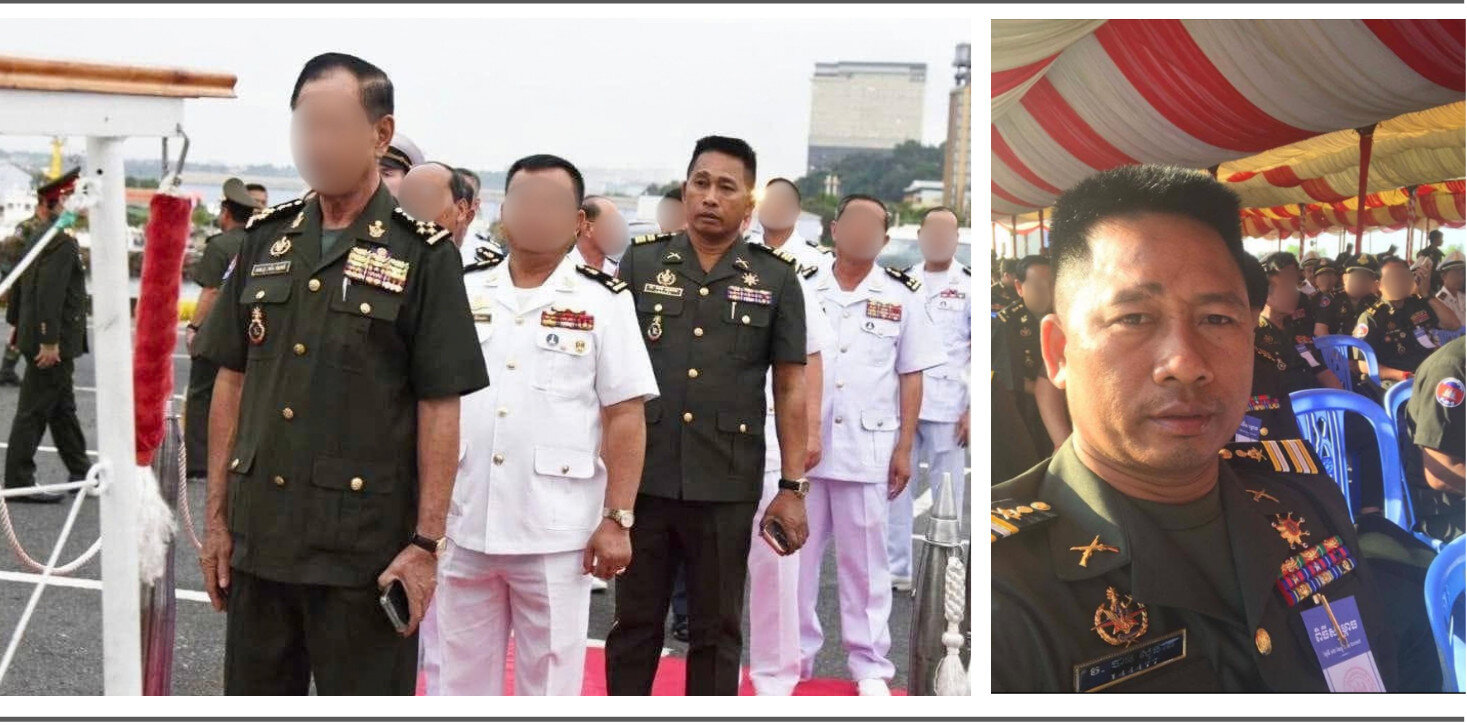
In December 2022, Ban was among a group of officers to be promoted to the rank of colonel, by then Prime Minister Hun Sen.87 The official announcement of his promotion described him as holding the position of advisor (ជំនួយការ) to General Chhin Chanpor (ឈិន ច័ន្ទពណ៌), a Deputy Commander-in-Chief of the RCAF.88
His role in the military is well documented. From December 2017 onwards, Ban appears in military uniform in many photographs and videos promoted on social media.89 For example, on 6 January 2024, the Leap Somnang staff-run YouTube channel posted a video dedicated to Ban Sophat, in which he appears (alone and, at times, with a woman the video identifies as his wife) in both civilian and military attire, while the video simultaneously displays Leap Somnang advertising, including a telephone number associated with the company (see images below).
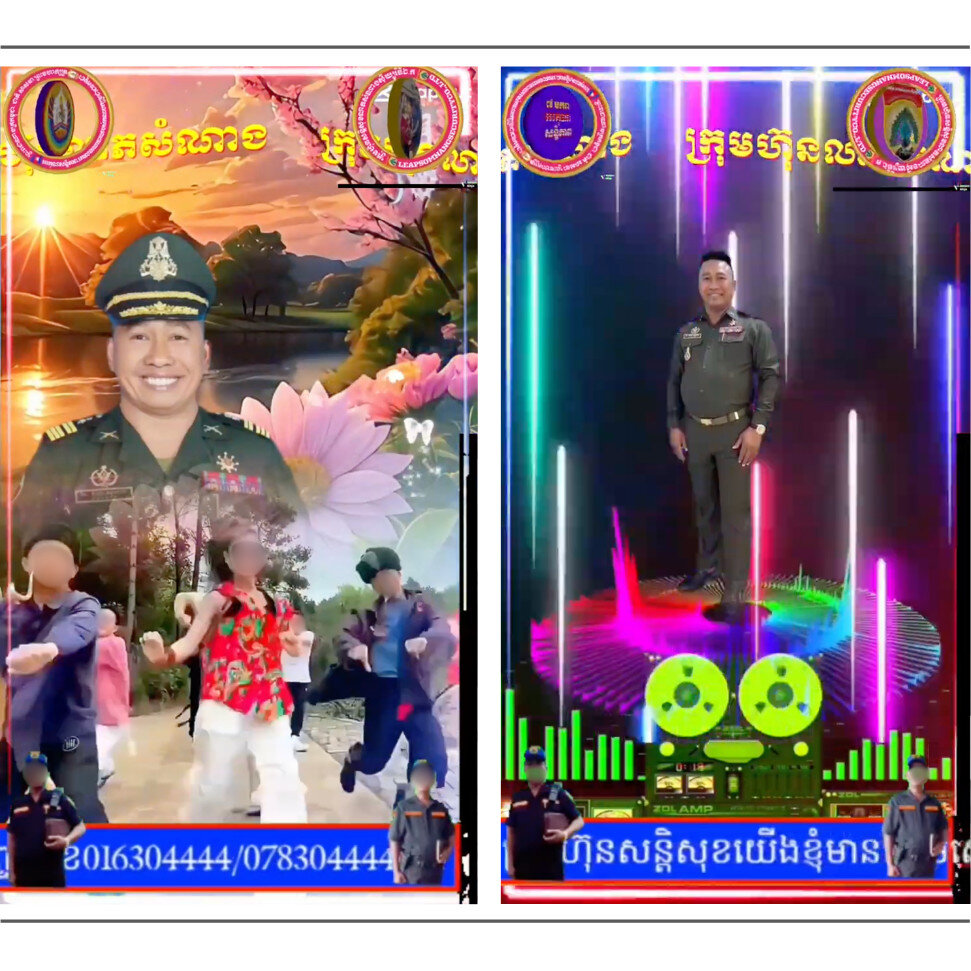
Photographs posted to Facebook, YouTube and Telegram in August 2024 also showed one or more vehicles bearing RCAF license plates that appeared to be owned by, or at least driven by, Ban Sophat.90 On this basis, Amnesty International concludes that Ban Sophat maintained a formal association with the RCAF under a consistent service number from at least December 2017 until at least August 2024, throughout the period in which he was publicly presented, and presented himself, as chairman of Leap Somnang. The available documents do not establish whether this reflected active military service or the conferral of rank and title of the kind frequently extended to businesspeople in Cambodia; in either case, it evidences a formal institutional link between the company’s chairman and the RCAF.
Amnesty International also identified evidence linking Leap Somnang and Ban Sophat to at least one prominent member of Cambodia’s business elite who is currently under investigation for alleged involvement in the scamming industry. Three compounds guarded by Leap Somnang – SI15, SI16 and KA02 – were all linked to land developer and casino operator, Ly Kuong,91 who was arrested in January 2026 on charges including illegal recruitment for exploitation, organized crime and money laundering.92 At the time of his arrest, he held the honorific Neak Oknha title, one of Cambodia’s highest royal honours bestowed on business figures.93 Amnesty International documented serious human rights abuses at all three compounds during periods when Leap Somnang provided security services. Corporate records and official statements further link Ly Kuong to the casino properties associated with the SI15, SI1694, and KA0295 compounds. In addition, an Instagram account under the name “Ban Sophat” had only two posts as of August 2026, one of which was a recognition/congratulations to Okhna Ly Koung, posted on 21 June 2023.96
In response to these findings, Sophat Ban denied holding any ownership, director or management role in Leap Somnang or involvement in the company’s operations or alleged abuses, stating that he had “served as an advisor to the company owner” and “did not authorize, direct or take part in any abuse of any person” and condemned “human trafficking, forced labor, confinement and violence.” He admitted to producing the business card that names him as the “Chairman” and confirmed he “helped promote the company, spread awareness of its services, and support its marketing efforts”.
When asked about pictures showing him at the SI02 and KA02 scamming compounds, he replied that “the fact that I may appear in a photograph taken at a particular location does not mean that I have knowledge of, or involvement in, the activities or operations conducted there. Regarding the photographs associated with the two locations you identified in your report, the individuals shown appear to resemble me. However, I do not have a clear recollection of the specific circumstances surrounding those photographs and cannot accurately recall all the details.”
Annex II lists evidence showing Ban Sophat with Leap Somnang guards at two scamming compounds, while Annex III provides his full response to allegations.
5.2.2 LOGOS AND UNIFORMS
Leap Somnang uses several uniform variations, but its most distinctive identifying feature is its colourful peacock logo (see below), which appeared on guards’ shirts, hats, lapels, lanyards and other uniform items. Survivors repeatedly identified the logo, and researchers observed it during site visits. However, not all guards associated with the company appeared to wear the peacock logo. In some cases, the logo was absent or only minimally visible.
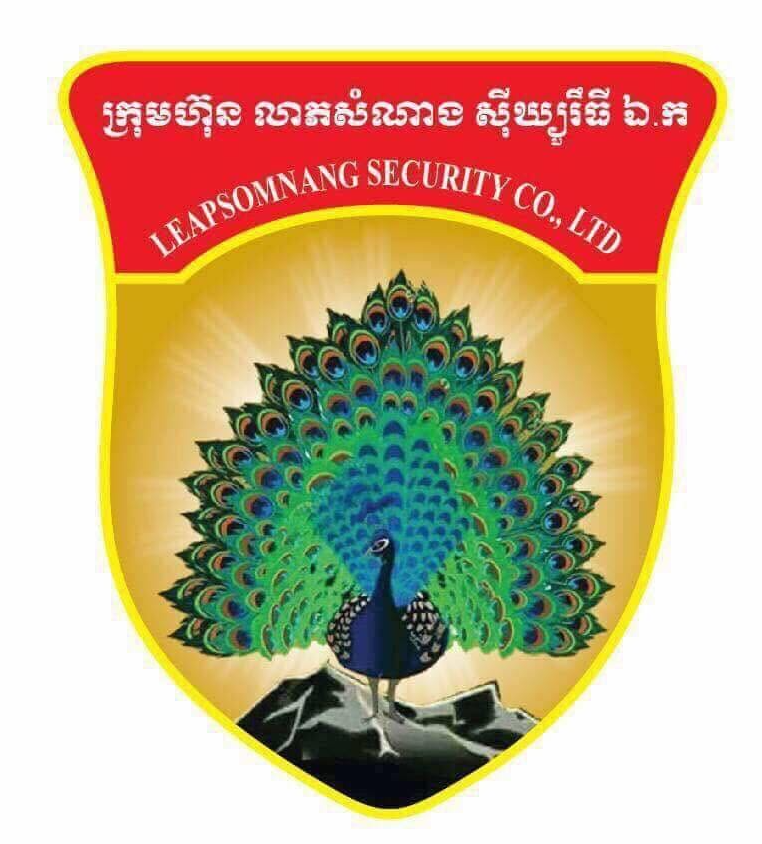
5.2.3 SCAMMING COMPOUNDS
Amnesty International has concluded that Leap Somnang provided security services to at least 15 scamming compounds across Cambodia from November 2019 to February 2026, more than any other security company identified during this investigation. The company was linked to compounds in Sihanoukville, Koh Kong, Mondulkiri, Kampot, Banteay Meanchey, Preah Vihear, Svay Rieng and Tbong Khmum provinces.
Amnesty International identified guards wearing Leap Somnang uniforms during site visits to 8 of the 15 compounds and geolocated content from 31 TikTok accounts belonging to security guards associated with the company to 10 scamming compounds. In addition, 12 survivors positively identified the company’s logos, uniforms or guards in 5 compounds. Together, this evidence demonstrates a broad and sustained presence at scamming compounds across Cambodia. Detailed information on the evidence linking Leap Somnang to each compound is provided in Annex I.
SURVIVOR TESTIMONIES
All 12 survivors who identified Leap Somnang uniforms or logos said that the company’s guards deprived them of their liberty under the threat of violence.97 Several survivors also described Leap Somnang guards actively participating in physical abuse and torture.98
Of the 12 survivors interviewed by Amnesty International, four survivors from the KA02 compound said they were confined by Leap Somnang security guards.99 KA02, also known as “Casino Kchom”, was investigated by police during the latest crackdown and was linked to Okhna Ly Koung. It was a sprawling compound located in a small town near the Vietnamese border.
One survivor said he was punched in the face by a Leap Somnang guard at KA02. He showed researchers that several teeth had been removed as a result of the assault.100 Messus (not his real name), a Ugandan survivor, said the Leap Somnang guards broke his friend’s leg after he attempted to resist.101
Similar accounts emerged from the MD02 compound, a compound located in the remote province of Mondulkiri near the border of Viet Nam. The MD02 compound was investigated in 2025 during the crackdown but remained operational afterwards.
Brandon (not his real name), a Ghanian survivor who identified the Leap Somnang uniform, told Amnesty International that security guards at MD02 repeatedly beat him, subjected him to electric shocks and threatened to kill him if he did not continue working.102 He said the abuse left him with ongoing pain months after his escape. Two other survivors from the compound likewise identified Leap Somnang guards and said they had been deprived of their liberty at the site.
Finally, Elouise (not her real name), described being deprived of her liberty at the PO17 compound in Poipet in early 2026. She identified photographs of the compound and identified the uniform and logo of Leap Somnang. She said she was handcuffed, received no payments if she didn’t make her work targets and felt she had “no choice” but to participate in the scams because bosses had taken her passport when she entered the compound.
5.3 SECURITY RESPONSE (CAMBODIA)
5.3.1 COMPANY INFORMATION AND OWNERSHIP
Security Response (Cambodia) Co., Ltd. (ស៊ីឃ្យូរីធី រីស្ប៉ន (ខេមបូឌា) ឯ.ក) (Security Response) is a private limited company registered with the Cambodian Ministry of Commerce since 8 August 2022.103 According to the company’s records, its business activity is “private security”.104 According to a company spokesperson, by 2023 it employed 200 employees and offered security dispatch, bodyguard, rapid response and security training services.105 The company did not appear to have a website but maintained active Facebook106 and TikTok107 accounts until late 2025, predominantly advertising vacancies for security guards and Chinese-Khmer translators.
No public information identified the owners of Security Response. However, as set out below, three strands of evidence connected the company closely to the now-defunct Panda Commercial Bank PLC (Panda Bank), a digital bank in Cambodia offering general and digital-first services enhanced by blockchain-based technology, and to Huione Group, a Cambodian fintech conglomerate.
First, since May 2024, Security Response’s registered address has been at the site of the Panda Bank Building (referred to as “Panda Tower TK”) in Tuol Kork, Phnom Penh. In 2022, Panda Tower TK was described as Panda Bank’s “corporate office” and was the site of one of its branches.108 The only other companies registered at this address are themselves linked to Huione Group through shared directorships and/or media reporting.109
Second, the two individuals who served as Security Response’s only directors from at least May 2023 until June 2025 – Lan Jianping110 and Chen Y Jun111 – held directorships or high-level posts in Panda Bank and Huione Group. Both directors resigned from Security Response in June 2025, one month after the Financial Crimes Enforcement Network (FinCEN) identified Huione Group as a primary money laundering concern. The company appointed two new directors on or around 16 June 2025.112 Their resignations coincided with the redaction of public corporate records across the network: Panda Bank’s historical directors were removed from the Ministry of Commerce registry between June 2024 and April 2025,113 and Huione Pay PLC appears to have been erased from the registry entirely between April and August 2025.114
Finally, Security Response provided services to both Panda Bank and Huione Group. Based on evidence collected by Amnesty International, including sightings at various locations and photo evidence from social media sites, Security Response staff guarded at least two of Panda Bank’s three Phnom Penh branches from April 2023 up to August 2026.115 Security Response’s advertisements previously showed it guarded and ran some of its recruitment drives out of a Panda Bank in Tuol Kork, Phnom Penh, consistent with its business registration at this same address.116 Security Response also entered into business relations with at least one company in the Huione Group: on 29 September 2023, Security Response and Huione Insurance Company Ltd signed a Memorandum of Understanding to establish a rapid, on-site motor vehicle insurance incident response and claims-handling partnership.117
The Huione-Security Response business relationship extended to the scamming compound sector itself, converging at PV01 (Park 8 compound). Cyber Scam Monitor previously linked Huione to the site,118 showing that Huione Technology Co., Ltd. had listed designs for the site on one of its websites.119 Amnesty International’s research corroborates and extends this: several survivors of PV01 interviewed across 2025 reported that a Huione office operated inside the compound and that they were paid, or made purchases, through Huione payment applications.120 Separately, Amnesty International linked 10 security guards to the same site, each of whom appeared to work for Security Response or were seen in videos with guards wearing a Security Response uniform (see below). PV01 was thus the point at which the conglomerate, its affiliated security company, and the compound economy, appeared to intersect.
A further connection runs through Chen Y Jun, one of Security Response’s two original directors who was chair of Golden Sun Sky Entertainment Co., Ltd. (ហ្គោលដេន សាន់ ស្កាយ អេនធើធេនម៉ិន ឯ.ក).121 In 2023, the company was designated under the UK’s Global Human Rights Sanctions Regulations for facilitating and concealing evidence of torture and forced labour;122 it was subsequently renamed T.C. Capital Co., Ltd. (TC Capital). The company advertised the development of a large property, part of which later became the SI02 compound;123 SI02 and several other buildings in the proposed development were guarded by Security Response personnel until early 2026.124 In other words, a Security Response director chaired a sanctioned company that developed a site which Security Response itself then guarded.
Taken together, this evidence suggests that Security Response was closely affiliated with the Panda Bank–Huione network, providing guard services to its own financial institutions, business partners and the scamming compounds.
Huione company designs for the Park 8 location (left) and satellite imagery showing Amnesty International’s assessment of the boundaries of the PV01 compound (Park 8) (right). Sources: 专业服务 – 汇旺科技有限公司 [Huiwang Technology Co., Ltd.], 专业服务 – 汇旺科技有限公司 and Amnesty International.
Figure 1 below maps the corporate and directorship relationships between Security Response, its former directors Lan Jianping and Chen Y Jun, and companies within the Panda Bank and Huione Group network.
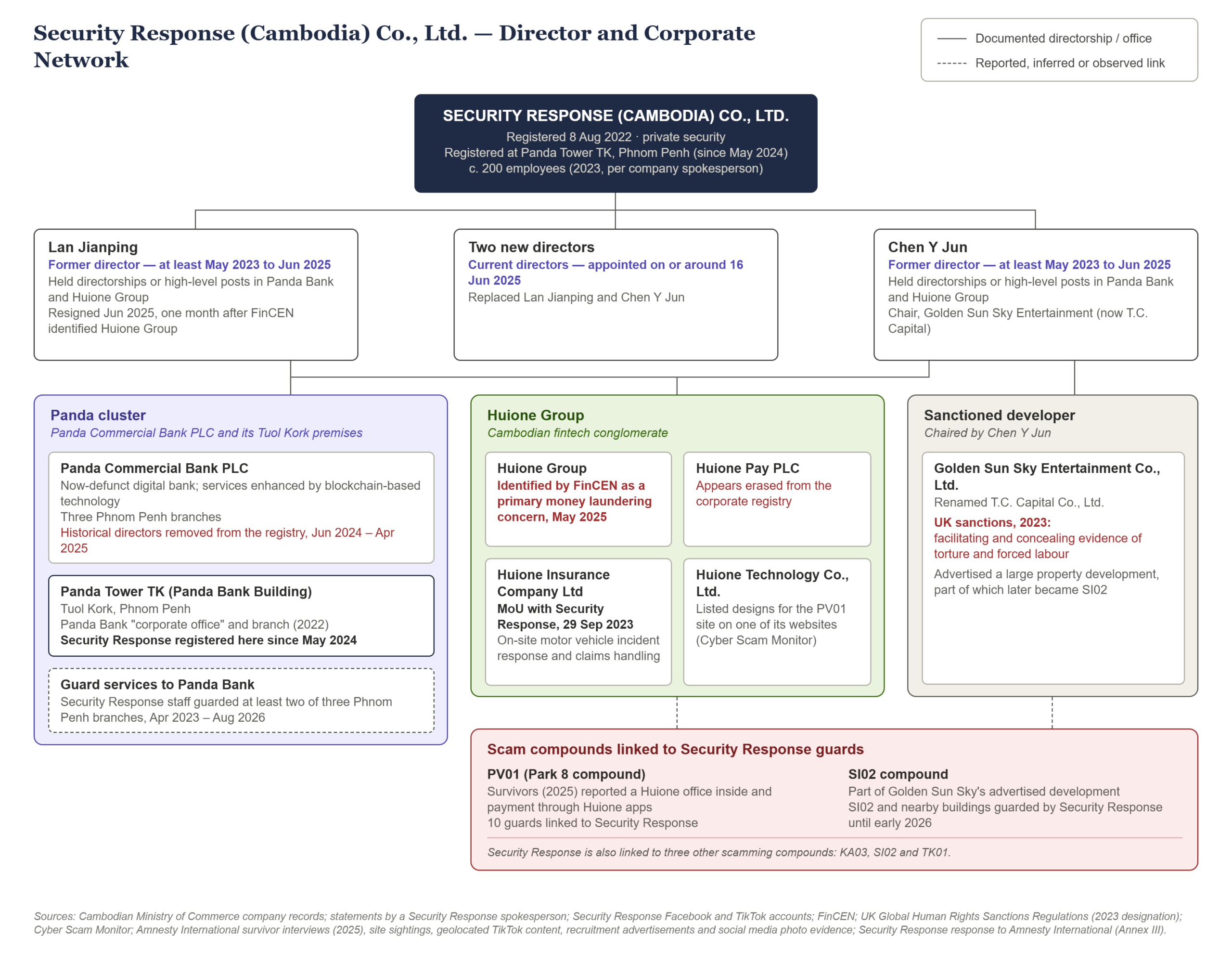
5.3.2 UNIFORMS
Amnesty International identified several different guard uniforms linked to Security Response, one of which is distinctive. At commercial establishments such as Panda Bank, security guards wore a distinctive uniform: black pants; a dull green, long-sleeved button-up shirt; a black belt; and a black hat with a small red tag on the front, at the side where the visor and crown meet.125 Security guards in this uniform were often shown on social media wearing a lanyard with the company logo attached.126
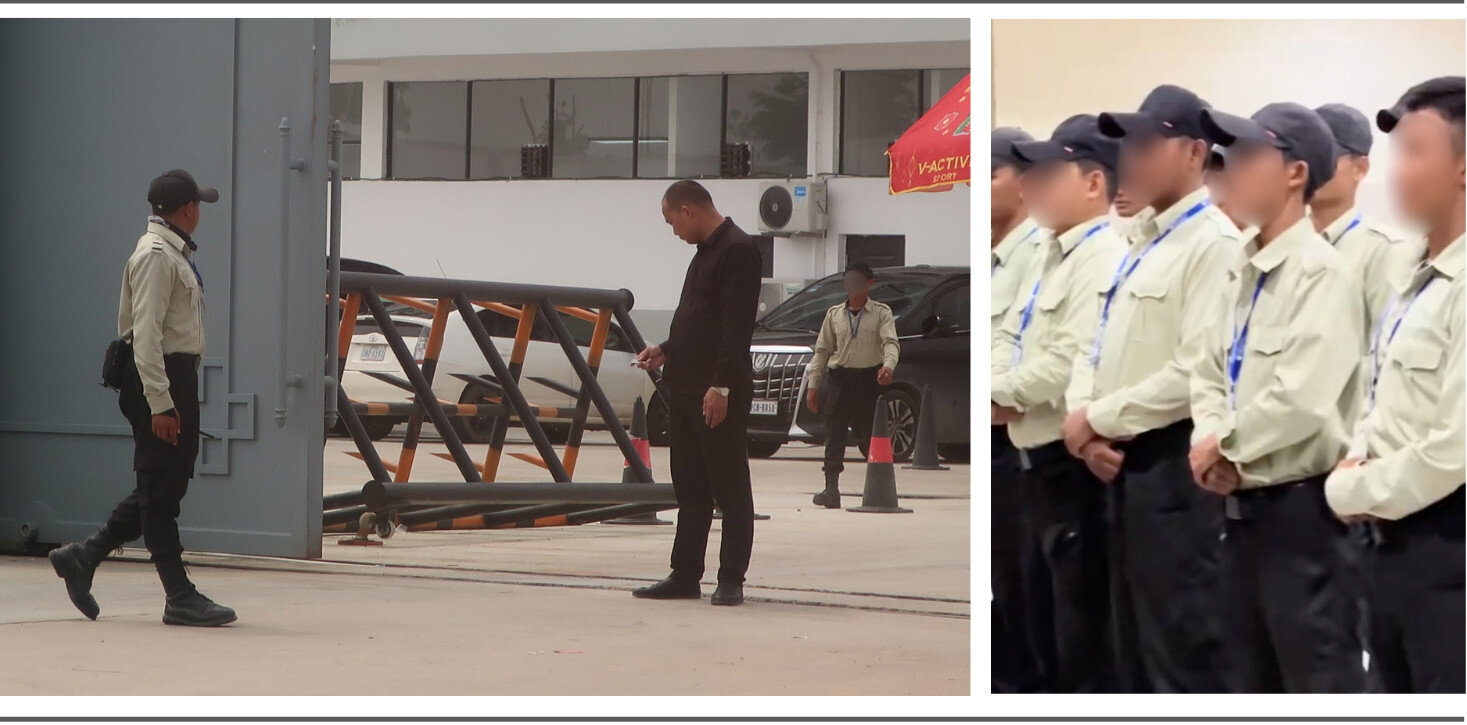
5.3.3 SCAMMING COMPOUNDS
Amnesty International has concluded that Security Response provided security services to at least five scamming compounds across Cambodia from November 2023 to January 2026. Amnesty International documented slavery, human trafficking, forced labour, torture and other ill-treatment, rape and/or unlawful deprivation of liberty at these compounds, which were located across Kampot, Prey Veng, Sihanoukville and Takeo provinces.
Researchers documented Security Response guards or the company’s distinctive green-and-black uniforms at four of the five compounds and geolocated content from 10 TikTok accounts belonging to or associated with Security Response guards to four of the five compounds guarded by the company. Recruitment advertisements were also linked to the general areas where the five scamming compounds were located (in some cases, these were remote areas with the compound being the only significant site). In addition, more than 20 survivors either recognized specific Security Response guards from TikTok videos or identified the company’s distinctive green-and-black uniforms. These survivors were all from the Park 8 (PV01) scamming compound. Together, this evidence demonstrates Security Response’s presence at multiple scamming compounds across Cambodia.
Detailed information on the evidence linking Security Response to each compound is provided in Annex I.
SURVIVOR TESTIMONIES
All eight survivors who identified Security Response uniforms or logos said that the company’s guards deprived them of their liberty under threat of violence.127 Three survivors of the KA03 compound identified guards from TikTok videos and said they deprived them of their liberty by controlling access to and from the compound.128 All three survivors said they observed dozens of guards stationed at entrances and exits. They also reported seeing security personnel burn documents before fleeing the compound in late 2025 amid concerns about a possible police intervention.
Some of the strongest evidence of Security Response’s role at compounds came from the PV01 site, also known as Park 8. More than 13 survivors identified guards at the site, including by reference to individual guards and the company’s green-and-black uniform.129 Survivors consistently described guards as playing an active role in maintaining control over victims inside the compound. Maia said guards restrained her when she arrived at the compound and forced her to sign a contract.130 Maia and Kenyangi said guards stood outside the rooms where managers raped them.131 Gabe told Amnesty International that guards tied his hands to a pipe, submerged him in water and subjected him to electric shocks.132
Almost all of the survivors interviewed from PV01 reported seeing guards carrying firearms within the compound.133 More than a dozen also recalled Cambodian police entering the site during the period they were detained.134 However, they said the intervention did not result in victims being released, despite the continued presence of trafficked persons within the compound.
Security Response responded to these allegations and said that they “categorically deny the allegations contained in your correspondence [and] has never engaged in, provided, authorized, or participated in any of the activities described therein.” The company described itself as “a duly registered company [and] actively cooperate with the relevant authorities in connection with training programs and other initiatives, and participate in activities organized by the government […] We further affirm that our personnel have not participated in any of the unlawful or improper activities alleged in your correspondence. We are also unaware of any illegal activities taking place at the premises you referred to, and we have never authorized or instructed any of our personnel to participate in such activities.”135
Security Response did not specifically deny having a business relationship with Panda Bank or Huione Group. Their full response is included in Annex III.
5.4 ZD SECURITY
5.4.1 COMPANY INFORMATION AND OWNERSHIP
ZD Security Co., Ltd. (ហ្សេតឌី ស៊ីឃ្យួរឹធី ឯ.ក and 安保) (ZD Security) is a private limited company registered with the Cambodian Ministry of Commerce since 21 January 2019.136 The company was previously registered under the name B.I.C. Security Co., Ltd. (ប៊ី.អាយ.ស៊ី ស៊ីឃ្យួរឹធី ឯ.ក) (BIC Security), with the change of name recorded on 8 April 2024.137 Despite the name change, ZD Security remains the same legal entity as BIC Security, retaining the same registration number, business activity and address. References in this report to BIC Security before April 2024 and ZD Security thereafter therefore concern the same company. As set out below, the change of the company’s name (and before it, of its directors) coincided with the sanctioning by foreign governments and public exposure of the corporate network to which the company belonged.
CURRENT OPERATIONS AND PROFILE
According to the company’s records and website, its business activities are in the field of “private security”,138 including “full-scenario security solutions for government agencies, multinational companies and industry associations”,139 advertising services including “general security services” (for example, security guards), “VIP close protection”, “advanced intelligent [sic] equipment” and “safety risk assessment, management and training”.140 ZD Security has a website,141 a Facebook account,142 a TikTok page,143 and a Telegram chat for recruitment and promoting their business.144 On its website, ZD Security identifies numerous clients,145 including major Chinese companies.146
In addition, and according to its many public announcements, ZD Security has or had a close relationship with Chinese diplomatic and business circles in Cambodia.147 Between 2024 and 2026, ZD Security staff provided security services or attended a wide range of high-profile Chinese diplomatic and economic events, including receptions for incoming and outgoing Chinese ambassadors,148 Chinese provincial chamber of commerce inaugurations,149 investment promotion conferences,150 visits by Chinese state-owned enterprises,151 and a PLA Navy port visit.152 The company’s chairman/general manager was present at several of these events, including engagements involving Chinese diplomats, military representatives and major Chinese investors.
OWNERSHIP AND THE ZHENGHENG NETWORK
Archived versions of the website of ZhengHeng Group Co., Ltd. (ZhengHeng Group), captured between at least September 2022 and May 2023, listed ZD Security (then operating as BIC Security) as a group company of ZhengHeng Group, a Cambodian conglomerate with activities including banking, investment, property, telecommunications and software, among others. An organizational chart published in 2022 on ZhengHeng Group’s website showed BIC Security under the direct reporting line of the group’s president (although the chart does not specify the precise nature of the hierarchy).153
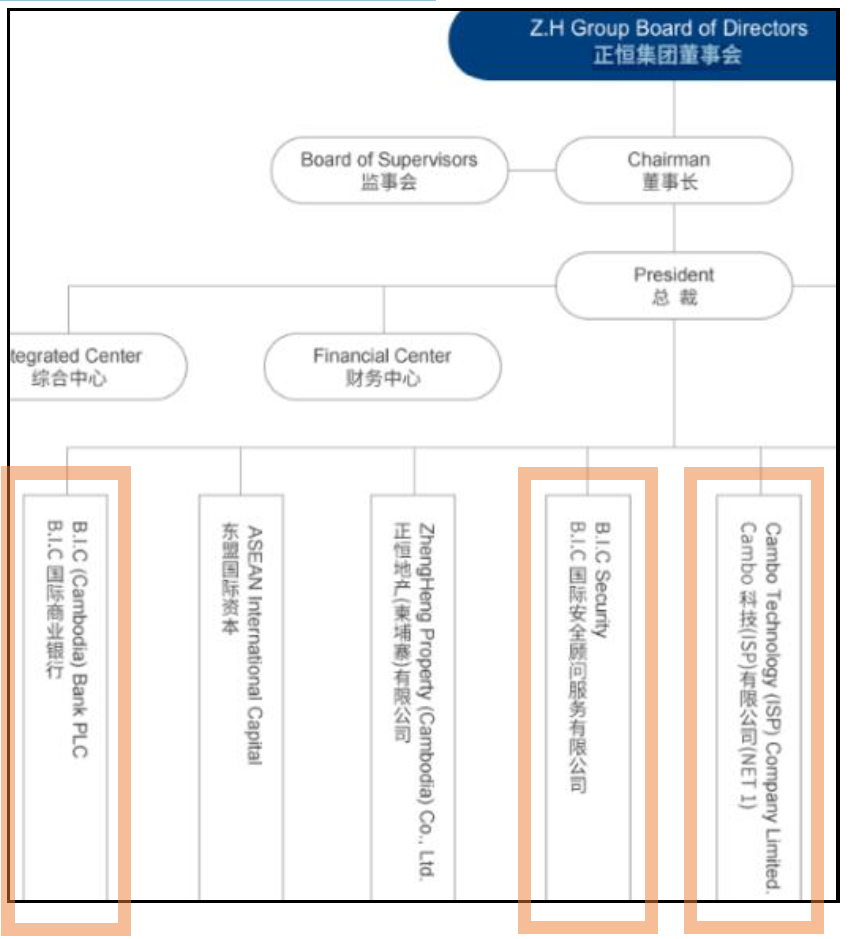
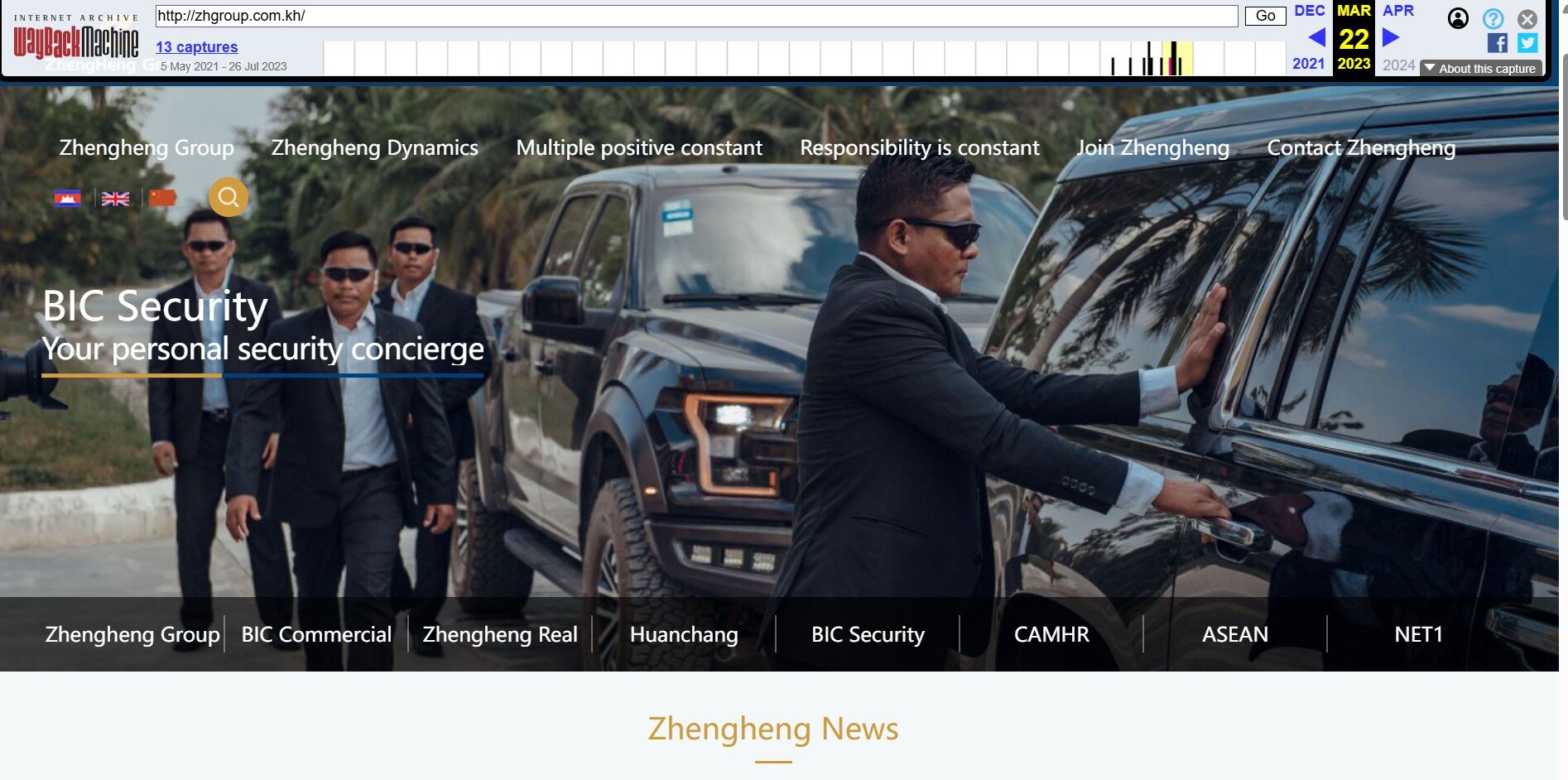
In addition to the company’s now-defunct website, other evidence links ZD Security to the ZhengHeng network, including through the company’s directors, as set out below.
THE ZHENGHENG GROUP
The ZhengHeng Group was incorporated in 2021 with the Ministry of Commerce.155 However, according to its now-defunct website, a business network using this name was “established in 2017” with headquarters in Phnom Penh and a “business presence” in China, the USA, Thailand and Laos.156 As of 2023, ZhengHeng Group’s chairman was Deng Pibing, who was also the chairman of the board of directors of ZD Security until 27 October 2023.157
ZhengHeng Group’s most prominent investment is Long Bay, a development in the Dara Sakor special economic zone in Koh Kong province.158 Long Bay appears to be the site of BS04, a compound identified by Amnesty International and linked to ZD Security (see below). In December 2023, the UK sanctioned ZhengHeng Group under its Global Human Rights sanctions regime, stating that individuals had been held at the Long Bay development “premises owned by ZhengHeng Group where they were forced to work as scammers”.159 ZhengHeng Group denied the allegations, asserting its “non-involvement in the alleged activities”.160
COMPANY CHANGES
The two individuals who served as directors of ZD Security during its BIC Security era were Deng Pibing (តឹង ភីពីង) (likely from the company’s incorporation until 27 October 2023)161 and Yim Leak (យឹម លក្ខណ៍) (dates uncertain but likely overlapping with Deng Pibing).162 Deng Pibing was chairman of the ZhengHeng Group (see box above). Yim Leak, chairman of iBank (Cambodia) PLC (formerly B.I.C (Cambodia) Bank PLC)163 and a son of a former Deputy Prime Minister, had sat on the boards of several companies within the BIC group of entities.164 Historical records and public materials reviewed by Amnesty International indicate connections between the BIC group of entities and ZhengHeng Group, although Yim Leak’s lawyers dispute that Leak or iBank were part of or affiliated with ZhengHeng Group.165
Mirroring the removal of Panda Bank’s and Huione Pay’s records described above, many of Yim Leak’s directorships disappeared from public view in 2025, with many – including B.I.C. Insurance PLC, B.I.C. Trust Co., Ltd., B.I.C Development Co., Ltd. and B.I.C Group Co., Ltd. – having been removed from the Ministry of Commerce’s online registry without any record of dissolution.166
On 27 October 2023, Pibing and Leak were replaced by a single new director, Soy Sotheary (សយ សុទ្ធារី), who served until 7 March 2026.167 The change of directors did not appear to have removed the company from its original group of companies. For example, Soy Sotheary is the sole director of Baiying Trading Co., Ltd., a company registered in the same building as ZhengHeng Group.168 Further, ZD Security’s registered address also remained unchanged through both the director replacement and the rename.169
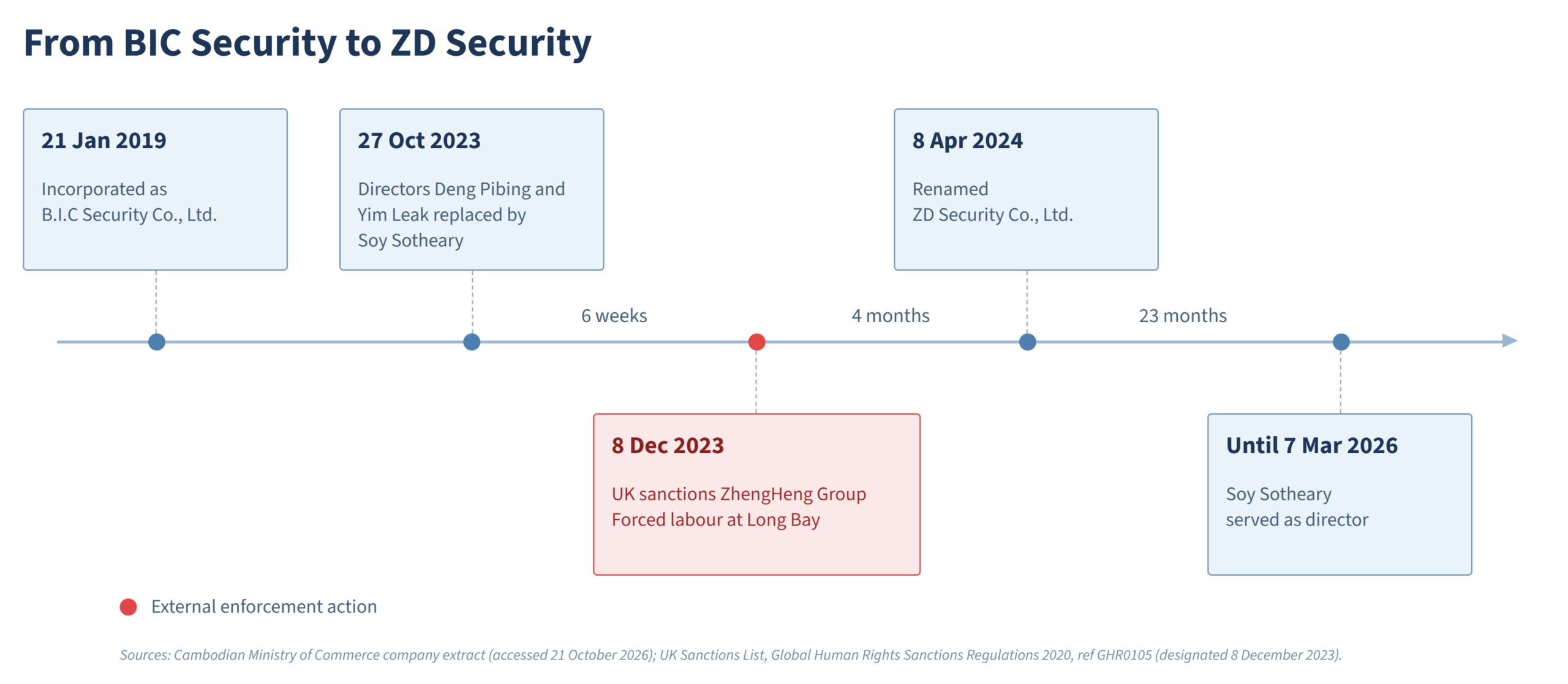
Figure 4 below maps the corporate and directorship relationships between ZD Security, the ZhengHeng Group and the BIC Group of entities.
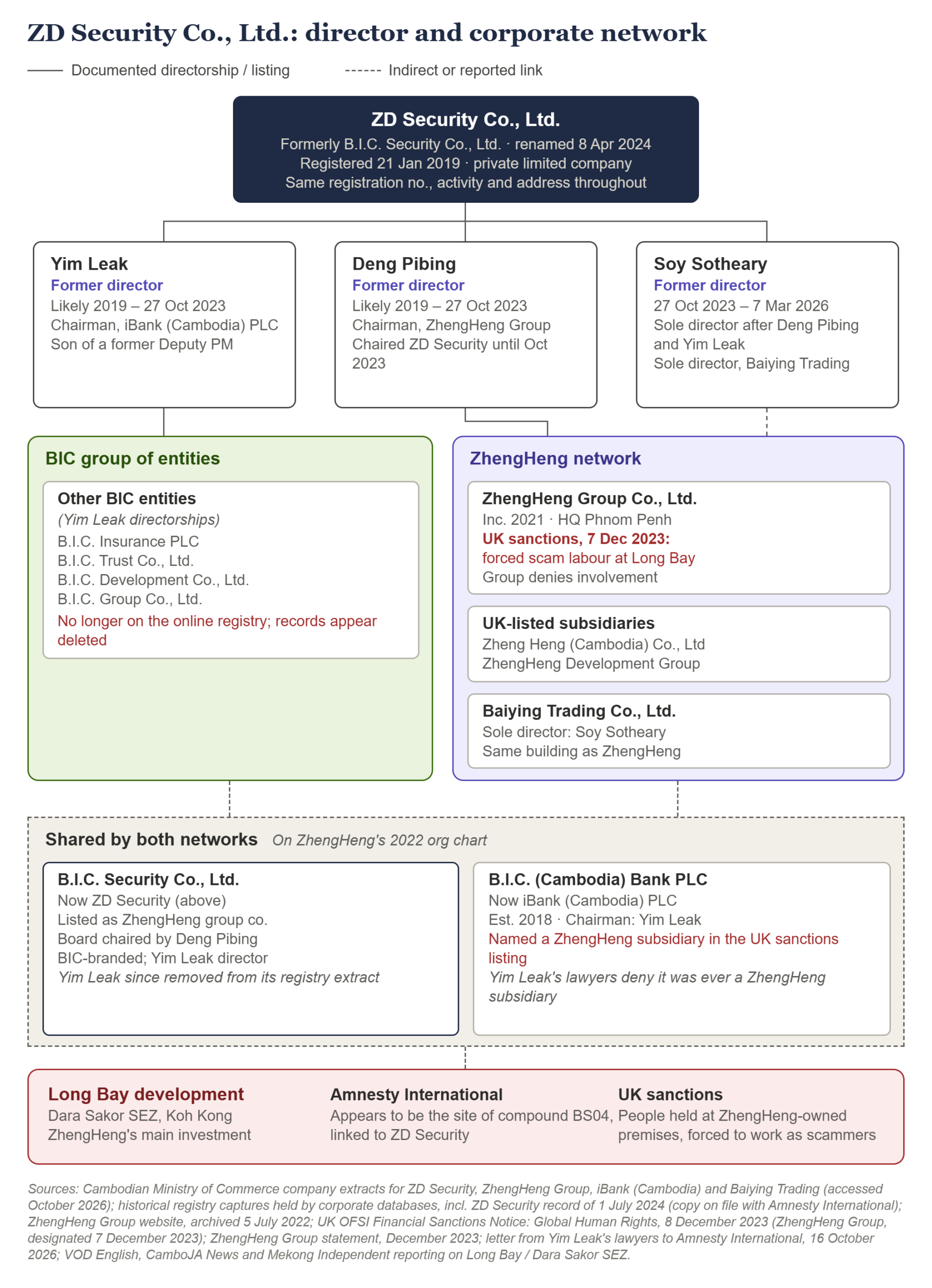
5.4.2 LOGOS AND UNIFORMS

Amnesty International identified several guard uniforms linked to ZD Security, one of which was distinctive and appeared to be used only at the BS04 site. This uniform included a hat with BIC Security’s logo and a dark blue button-up shirt with lapels. The words “Long Bay” appeared on one arm of the uniform.
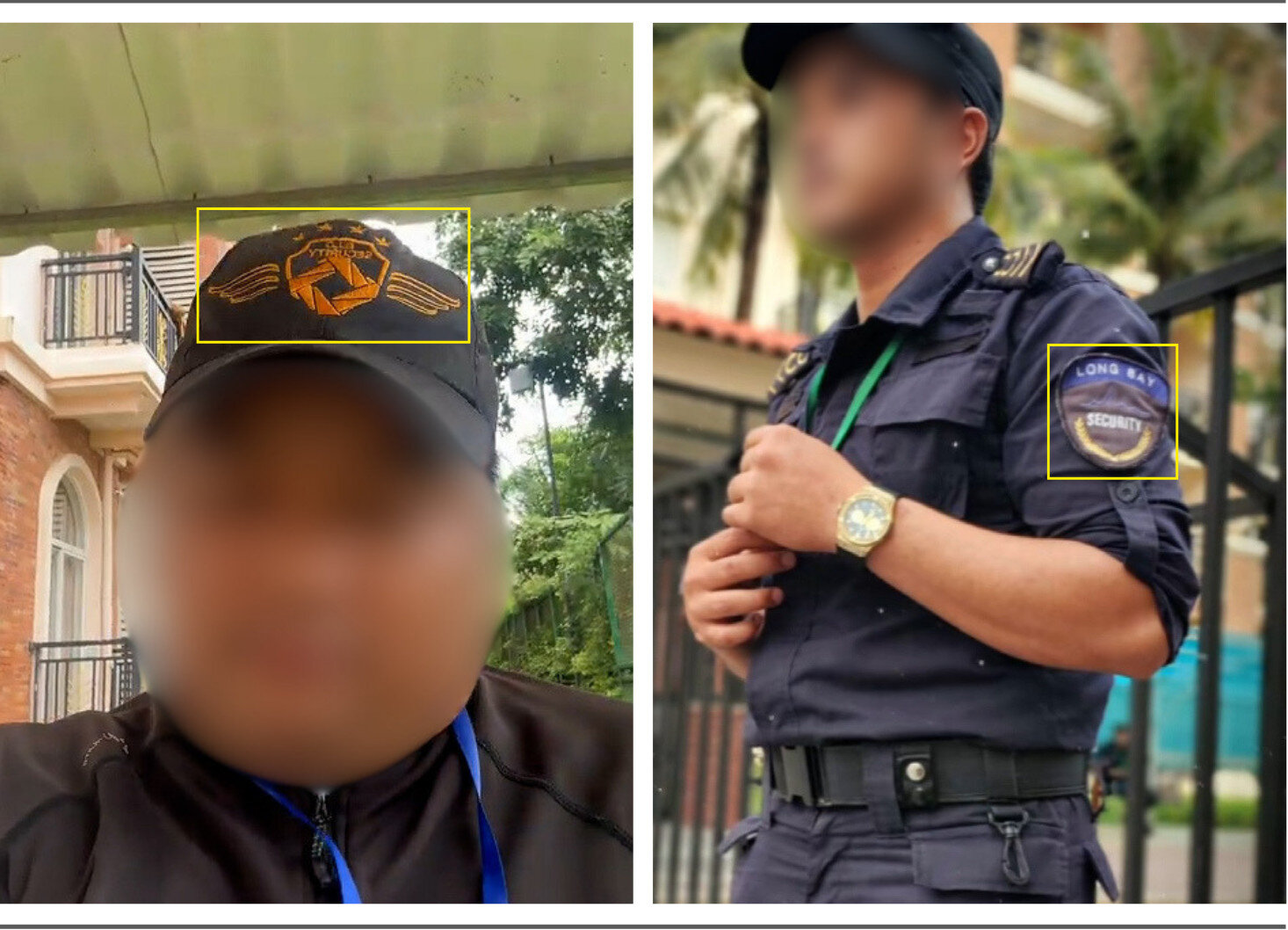
Since rebranding to ZD Security, the uniforms and logo changed, but some company advertisements still used the BIC logo. For example, a post from the company’s TikTok page on 26 April 2025 showed a guard in a uniform with “ZD” on the shirt but “BIC Security” on the hat.170 Amnesty International could not geolocate images showing guards that were wearing an updated “ZD” logo on their uniform.
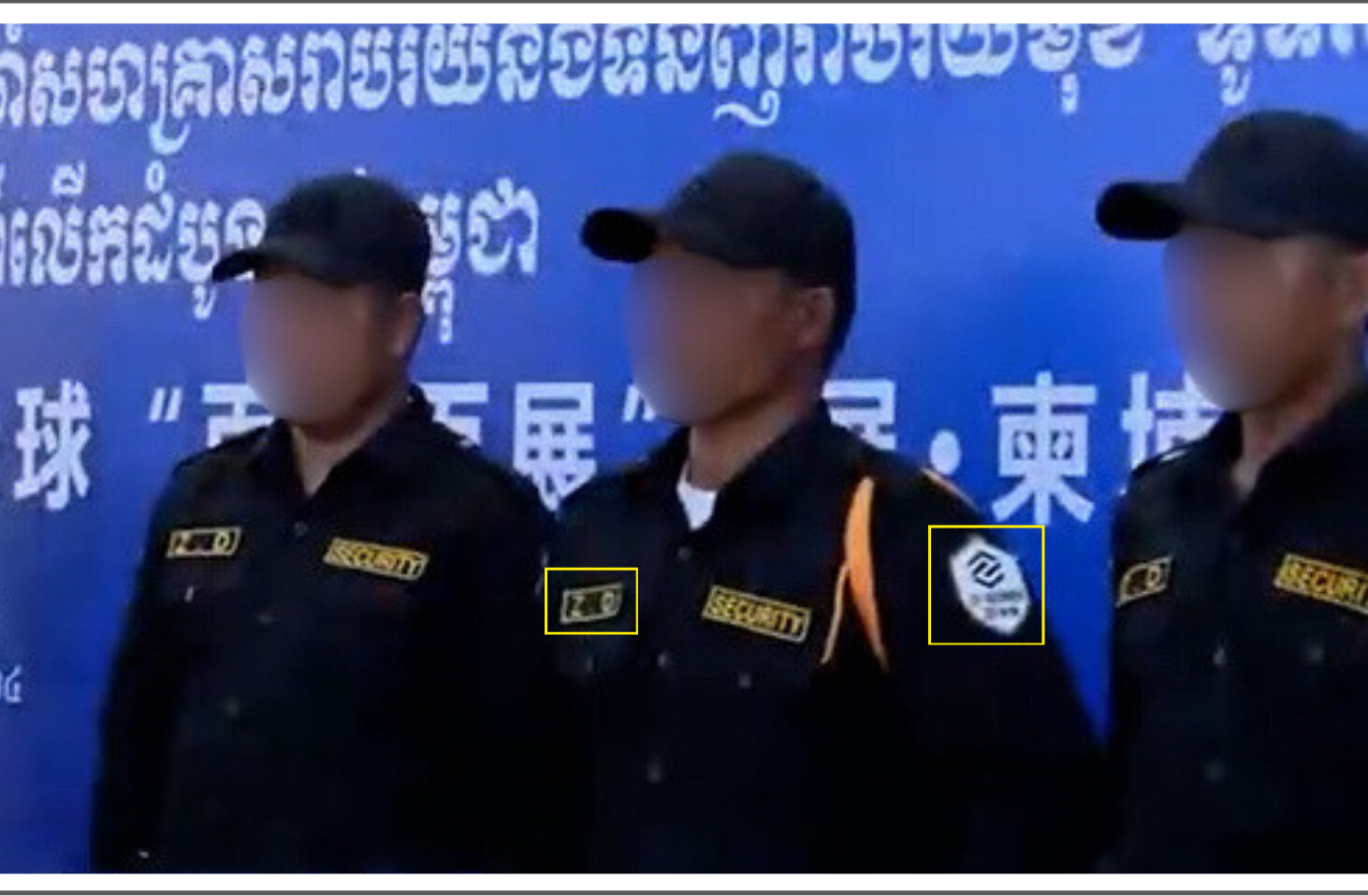
Images of security guards from the ZD Security website continued to show the BIC Security uniform, which was very similar to those worn by security guards at the BS04 site, possibly indicating they continued to use the older BIC uniforms.171 The guards at the BS02 compound did not appear to wear a discernible ZD Security uniform; their uniforms appeared generic and lacked any identifying company information.
5.4.3 RECRUITING AND TRAINING
ZD Security appeared to recruit security guards primarily through advertisements posted on its social media channels, including Telegram, Facebook and TikTok.172 These advertisements were generic in nature, setting out the recruitment criteria, the salary offered and contact information for prospective applicants. Most advertisements did not specify an exact work location, instead referring to general areas like Koh Kong. Between March and May 2025, a channel linked to ZD Security advertised six times to recruit 50 security guards to Koh Kong, an area where BS02 and BS04 were located, but did not further specify a location. A post from the company’s TikTok channel on 16 June 2025 sought to recruit 10 people to “Koh Kong Star Sakor”.173
5.4.4 SCAMMING COMPOUNDS
Amnesty International has concluded that ZD Security provided security services to BS02 and BS04 in Botum Sakor from at least August 2021 to May 2026. Police intervened at BS02 seven times between August 2022 and the end of 2025. Amnesty International documented deprivation of liberty at BS02 and human trafficking, forced labour, torture and other ill-treatment, deprivation of liberty and enslavement at BS04.174 Researchers reviewed TikTok videos from 18 accounts to confirm the presence of ZD Security guards at these sites. In one example, an individual who appeared to be a company guard, as seen in images geolocated to the BS02 compound, posted an image on 24 October 2025 showing three security guards overlooking what is possibly the Dara Sakor site. The post prominently displayed a large ZD Security logo, which had been added to the image.175
Amnesty International also identified a recruitment advertisement for the “Dara Sakor” site posted on TikTok by an individual associated with ZD Security. The user’s posts through 2024 and 2025 document his association with the company, including photographs showing him at ZD Security’s office, wearing the ZD logo on his clothes and with other staff wearing ZD’s logo. They suggest he had been connected to ZD Security for several years. On 5 January 2026, amid the nationwide crackdown, the same account posted an advertisement recruiting security guards for “Koh Kong, Dara Sakor”.176 In the scamming industry, “Dara Sakor” typically refers to a site Amnesty International has coded as BS04. Another name for this site is “Long Bay” or “Seven Stars”. Although the advertisement contained neither a company name nor a logo, the listed contact number matched a Telegram account with photos of the same individual, indicating applicants were directed to the same person. Posts on the same account from early February 2026 further indicate that the user was physically present at Dara Sakor during this period, including exercising in the immediate vicinity of the BS04 scamming compound. Based on his TikTok post history, Amnesty International believes this person was employed by ZD Security at the time of the January 2026 advertisement. His direct recruitment of guards for “Dara Sakor” and his presence at the site, when considered together with ZD Security’s documented presence at the BS04 and BS02 sites described below, strongly suggest a continued relationship between ZD Security and the provision of security guards to these sites. The absence of any company branding from the advertisements, posted at the height of the government’s crackdown, is consistent with this pattern of hiding the company affiliation.
SURVIVOR TESTIMONIES
Several victims trafficked to the BS04 compound described being subjected to torture and other forms of violence.177 Amnesty International interviewed five people who were sold or trafficked to BS04 between 2024 and 2025.178 Three of them said they had been tortured while at the compound.179 Three reported being beaten after contacting authorities to seek assistance leaving the site, suggesting communication between authorities and compound managers.180 Another survivor said he was taken off-site after refusing to work, beaten and tied to a bed for a week.181 Shi (not her real name), a Chinese woman who was sold to BS04 from the CT05 compound after deteriorating health prevented her from working, said she had been hurt by people at BS04 but did not want to share the details of her experiences.182
Rachel (not her real name), a survivor of BS04, told Amnesty International that she was brought into Cambodia across a river from Viet Nam at night before being taken to the compound.183 She said the large number of guards stationed at the compound made escape impossible. According to Rachel, guards carried “large guns” and would harm anyone who attempted to leave. Her account is consistent with social media footage geolocated by Amnesty International to the entrance of BS04 in 2025, which appears to show a mass escape attempt.184 In the footage, guards appear to intercept an individual attempting to climb a perimeter fence and begin beating him.
Local residents also said security personnel played an active role in preventing escapes. During site visits, Amnesty International spoke to several villagers living near the compound who said that guards would sometimes travel through the area by motorbike, asking whether local people had seen Chinese individuals, apparently searching for escapees.
ZD Security’s presence at BS04 is particularly significant given the compound’s size and prominence within the scamming industry. Cambodian authorities intervened at BS04 more than at any other site that Amnesty International has documented, but it was not shuttered until early 2026 during the latest crackdown. Despite the extensive reporting and scrutiny directed at BS04 and associated abuses, ZD Security appears to have faced limited public scrutiny. This, together with its wider links to prominent business and political networks discussed above, suggests that ZD Security occupies an influential position within both Cambodia’s private security sector and the scamming compound ecosystem.
Detailed information regarding the evidence linking ZD Security to specific compounds is provided in Annex I.
Leak, one of two of ZD Security’s directors up to 2023, denies any involvement in or responsibility for the alleged abuses relating to the operations of ZD Security, condemns such abuses and argues that this report does not provide any evidence that he knew of, participated in, facilitated, supervised or exercised control over the conduct in question, and therefore provides no factual or legal basis for attributing personal responsibility to him.185 Amnesty International does not make any finding as to Leak’s personal responsibility for the abuses documented in this report.
Amnesty International wrote to ZD Security on 2 October 2026 but did not receive a response.
5.5 DARA SECURITY (DAS)
5.5.1 COMPANY INFORMATION AND OWNERSHIP
Dara Security Service Co., Ltd. (តារា ស៊ីឃ្យួរឹធី សឺវីស ឯ.ក) (DAS) is a private limited company registered with the Cambodian Ministry of Commerce since 28 June 2019. It provides “private security services”. 186 The company has a Facebook page.187
A set of official and promotional documents was published on the company’s Facebook page. These included correspondence and permissions from the Ministry of Interior and National Police, including: a June 2019 police recommendation and the Minister of Interior’s authorization of 30 May 2019 permitting the company to provide private security services; a 2024 patent tax certificate from the General Department of Taxation naming Sab Dara as owner of the company; and a Cambodian People’s Party document listing Sab Dara among proposed members of the Prey Veng provincial grassroots working group.
5.5.2 LOGOS AND UNIFORMS
According to the company’s Facebook and TikTok accounts, which appear linked to Sab Dara and the company, DAS uses two logos and several uniform variants.
The logo most commonly associated with DAS is a green shield with a gold border, displaying the company name in Khmer and English, a large central gold emblem and five small gold stars beneath. A second logo is a black-and-gold emblem featuring a shield beneath a spread-winged eagle, flanked by stylised wings and topped by five stars, with the company name in Khmer and English (as seen below).
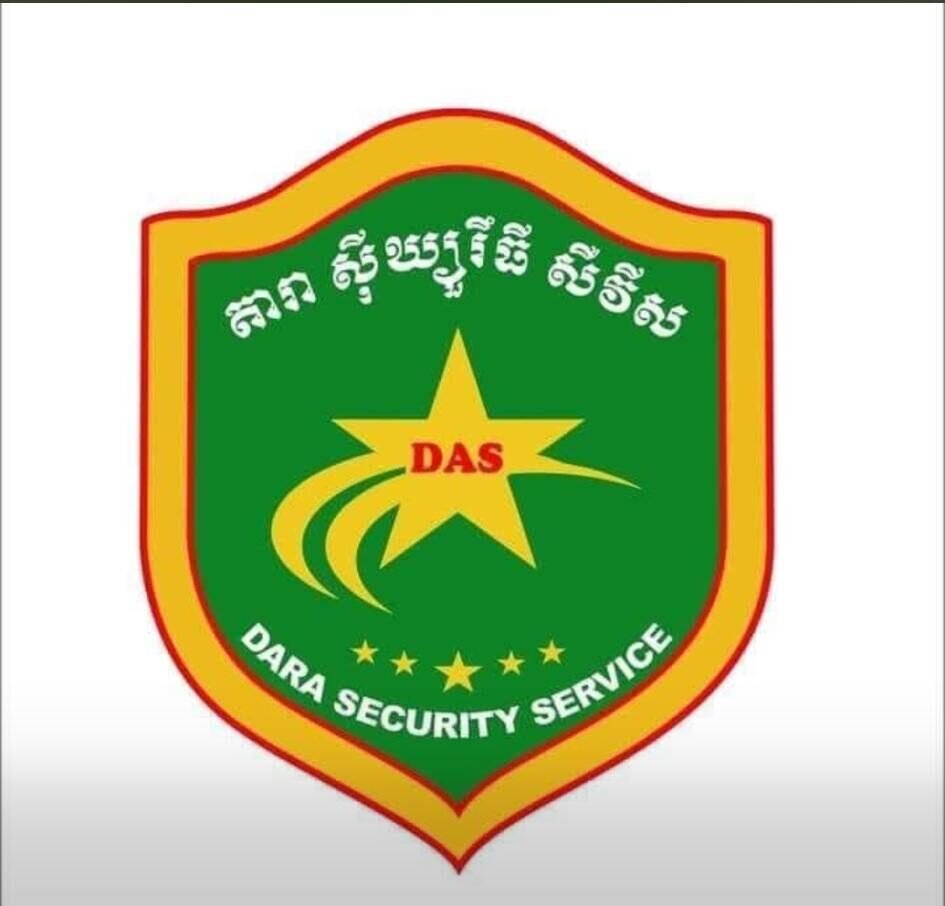
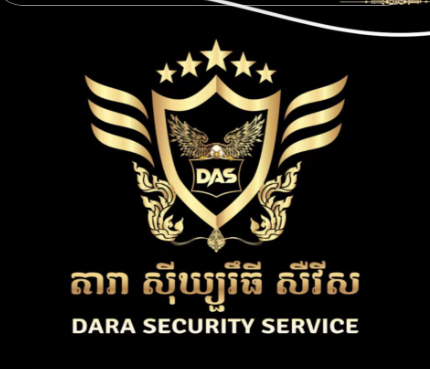
DAS’ older logo (left) and new logo (right). Source: TikTok user @dasbestservice168.
Images posted on Facebook and TikTok show security guards wearing a range of uniforms. The most common consists of a plain black long-sleeved shirt, black trousers, boots and a black cap bearing the company’s green shield logo. In many cases, the logo also appears on one of the upper sleeves. Some guards wear green lanyards and black utility belts, although these are not present in all images.188
5.5.3 SCAMMING COMPOUNDS
Amnesty International has concluded that DAS provided security services to SI03 and SI50 in Sihanoukville from at least April 2024 to February 2026.189 Researchers reviewed TikTok videos from 12 accounts to confirm the presence of DAS guards at these sites, along with testimony from five SI03 survivors who identified the guards’ uniforms, including one who appeared to be a trainer.190 Amnesty International also geolocated an image of the company’s owner, Sab Dara, to the SI03 compound on 14 December 2024.191
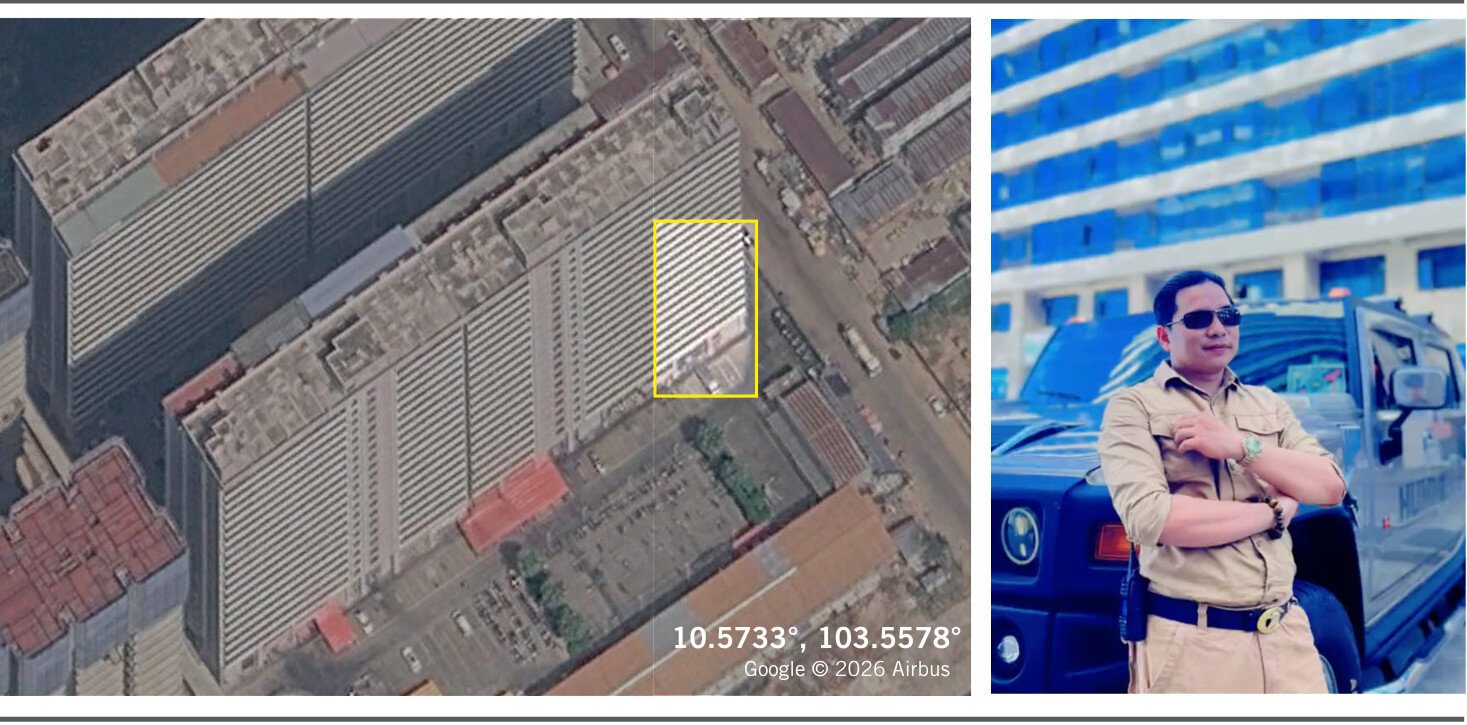
SURVIVOR TESTIMONY
Five survivors of SI03 described being trafficked to the site in early 2025 and escaping in early 2026 after guards abandoned the compound fearing a police intervention.192 All five said the guards carried firearms and electric shock batons. A TikTok image further corroborates the presence of at least one individual inside the SI03 compound with a pistol.193 Rakib (not his real name) said he witnessed an Indian man die by suicide after being tortured and prevented from returning home by the compound’s bosses:
“He was my friend at the time. I worked almost one month with him […] he jumped after they told him he couldn’t go home […] the hospital came and took away the body […] All the guards have electric shock. Some have gun. Small gun.”194
Amnesty International also interviewed three survivors of SI50. One of them, Abu (not his real name), reported he was subjected to electric shocks when he was not able to meet his work targets.195
5.6 BEST (CAMBODIA) SECURITY
5.6.1 COMPANY INFORMATION AND OWNERSHIP
Best (Cambodia) Security Service Co., Ltd. (បេស (ខេមបូឌា) ស៊ីឃ្យូរឹធី សឺវីស) (Best Security) is a private limited company registered with the Cambodian Ministry of Commerce since 13 July 2006.196 Amnesty International was unable to obtain information regarding the company’s ownership or management.
5.6.2 LOGO AND UNIFORMS
The Best Security logo features a green shield with an eagle in the middle. Five stars sit above the eagle’s head, and “BCS” is written in red letters on the eagle’s body. The bottom of the shield has the words “Best Cambodia Security” written on it. The logo appears to be the consistent element of the uniform, typically appearing on the hat or arm of security guards. The guards appear to wear black button-up shirts at the compounds, sometimes with “Security” written on the sleeves.
5.6.3 SCAMMING COMPOUND
Amnesty International has concluded that Best Security likely provided security services to BA06 in Bavet from at least August 2025 to October 2025. Researchers geolocated images showing six security guards to BA06, four of whom were observed wearing uniforms bearing the Best Security logo. Videos posted on these guards’ TikTok accounts show them stationed at the compound’s entrance gates and at locations further inside the compound with other guards.
Amnesty International found strong indications that the abusive system documented at BA06 as of May 2023 remained in place during the period in which Best Security was linked to the compound. Evidence suggests the compound continued operating until police interventions in late 2025 and early 2026, after which workers departed and activities were reported to have wound down.197 Amnesty International’s visits in 2024 and 2025 also documented extensive perimeter security, guard towers and the construction of additional inward-facing guard posts,198 features associated with the confinement and monitoring of victims at scamming compounds and consistent with the continuation of abusive practices at BA06.
On 8 September 2025, US Office of Foreign Assets Control (OFAC) sanctioned Heng He Bavet Property Co., Ltd. and the owner of the Heng He Casino and the associated complex of buildings in Bavet, stating that the company was involved in virtual currency scams and forced labour and had received workers from Sihanoukville previously linked to cyber scams.199 Therefore, Amnesty International believes BA06 operated as a scamming compound until at least October 2025.
In response to these allegations Best Security’s chairman said they had searched company records to confirm it “has no history of providing services at location BA06.” Additionally, he said he was “surprised” by the findings and requested more information in order to “find out the truth more clearly” and to “take legal action if someone has stolen his company’s uniform.”200 He reiterated that the company’s policy was to verify the “location information” of prospective customers to ensure they “avoid being involved in any illegal activities” and that “company’s employees have also been trained on: how to record incidents, identify suspicious activities related to criminal offenses, and report them to the authorities, which is also a mechanism to participate in maintaining social security”. 201
5.7 CONCLUSION
This chapter examined links between five private security companies – Leap Somnang, Security Response, ZD Security, DAS and Best Security – and at least 23 scamming compounds where serious human rights violations were documented, including human trafficking, forced labour, child labour, enslavement, torture, rape, deprivation of liberty and other ill-treatment. The findings suggest that these security firms were not merely providing perimeter protection but were embedded within broader networks involving PEPs, military and police officials, major business interests and, in some cases, entities linked to sanctioned actors and alleged money laundering networks.
The company with the largest footprint was Leap Somnang, which Amnesty International connected to 15 compounds across Cambodia and whose chairman is a colonel in the RCAF. Other companies were linked to influential business networks, including Security Response, connected to the Huione and Panda Bank network, and ZD Security, with historical links to the ZhengHeng Group, both associated with the scamming economy. Across all five company case studies, the evidence indicates that these private security firms were critical enablers in the operation of scamming compounds, helping sustain systems of exploitation and abuse while benefiting from relationships with powerful political, military and commercial actors.
6. MILITARY AND POLICE LINKS TO COMPOUNDS
For years, survivors have described the presence of individuals they believed to be members of the Cambodian military or police at the compounds these survivors were trafficked into, where they were deprived of their liberty and subjected to other serious human rights abuses including enslavement, forced labour and torture.202 Additional evidence suggested that compound operators were routinely forewarned of police raids and rescue attempts.203 Until now, these accounts could not be independently verified.
This chapter sets out new evidence, collected and verified by Amnesty International, linking members of the Royal Cambodian Armed Forces (RCAF) and the Cambodian National Police, both to the private security companies that guard scamming compounds and to the scamming compounds themselves.
Evidence is presented in four parts:
- First, three high-ranking military officers are shown to have had direct links to at least 16 different scamming compounds.
- Second, at least 19 members of the RCAF and the police were identified as having worked as guards or otherwise having unexplainable access to 12 separate scamming compounds. Military and police having access to scamming compounds was considered “unusual” primarily because scamming compounds were not open to the public, they were tightly controlled. It is unlikely anyone could enter a scamming compound without being given permission by scamming compound bosses and without knowing what happens inside of a compound. Amnesty International reviewed photographs and social media posts that showed active military personnel had entered compounds numerous times, while they were active, and in some cases had done so with other members of the military, across a period of months or years.
- Third, military and police personnel are shown to have directed, trained and supervised private security guards deployed at the scamming compound sites.
- Fourth, firearms and military vehicles were observed inside compound perimeters, alongside further indications of military or police involvement.
Taken together with the ownership connections between the military and at least one security guard company, Leap Somnang, documented in Chapter 5, this evidence suggests a pattern of involvement by serving military and police personnel in the scamming industry. This evidence does not establish a formal policy or direction by the RCAF or the Cambodian police as institutions. However, given that Cambodian authorities are not known to have investigated the role of the military or police in the scamming industry, the findings indicate, at a minimum, knowledge and acquiescence within parts of the military and police. Under international law, Cambodia bears state responsibility both for unlawful conduct of its security personnel while carrying out official functions and for its failure to prevent, investigate and punish that conduct.
6.1 THE ARMED FORCES
In Cambodia, the boundary between the armed forces and private commercial interests has long been blurred, including through official arrangements. In 2010, a government sub-decree formalized a “sponsorship” system under which wealthy business figures, including oknha, could provide financial support to specific RCAF units.204 Media reporting indicates that the system enabled private actors to fund military units, including the purchase of military equipment.205
Civil society, journalists and foreign governments have documented Cambodian military actors being involved in large-scale human rights abuses that benefited private interests. For instance, investigators have linked military protection to the illegal logging that once plagued the country,206 and to the arrest, murder207 and intimidation of activists who investigated it.208 The military carried out forced evictions so that private companies could access land, including operations in which soldiers burned houses and threatened or physically assaulted protesting families.209 The Cambodian government has not investigated the military commanders behind these abuses, despite documentation and international sanctions.210 In a case linked to the scamming industry, the US Treasury Department imposed sanctions on the Union Development Group for allegedly using Cambodian military forces to intimidate villagers and clear land for a development in Koh Kong province, where two of the compounds documented in this report are located.211
The overlap between military rank and private business interests is reflected in the number of armed forces and police officials that held the oknha title. In 2019, then Prime Minister Hun Sen ordered military, police and military police personnel with the title to choose between retaining it and remaining in state service.212 The Ministry of National Defence identified 99 oknha within the military, including within RCAF general command and the ministry itself, while media outlets reported that the government had identified 132 military or police officers holding the title.213 Hun Sen subsequently requested that the title be stripped from 75 armed forces members who chose to remain in service.214
6.2 HIGH RANKING MILITARY AND POLICE OFFICERS WITH DIRECT LINKS TO COMPOUNDS
At least three high-ranking military and police officers had links to 16 scamming compounds, indicating involvement in the scamming industry:
- RCAF Colonel Ban Sophat, who, despite his denial of any involvement, Amnesty International concluded led and controlled Leap Somnang, a company that provided security services to at least 15 scamming compounds (see Section 5.2 above).
- Deputy Police Chief Lay Channy, who, according to Best Security (see Section 5.6 above), owns the property rented by a Best Security branch office and whose private phone number the company confirmed was displayed on the company’s signage as a client contact number.
- Brigadier General Tek Bunthoeun, whose links to companies run by his wife, as well as other evidence, suggest military involvement at the BM02 site.
6.2.1 DEPUTY POLICE CHIEF LAY CHANNY
Lay Channy, the deputy police chief of Svay Reing province, is linked to Best Security, the company that provided security services to the BA06 compound in Bavet, Svay Rieng province.215
A roadside sign in Bavet displays the company name in Khmer, English and Chinese, together with three separate telephone numbers and an address. It also features the company’s crest and an image of a uniformed security guard saluting. Two of the phone numbers listed on the sign link to Deputy Chief Channy.216 A bank account under the name “Lay Channy” lists the first number “012 551 111”, confirming Channy owns the number.217 This indicates that Channy was associated with Best Security during at least part of 2025, the same period in which the company is documented as providing security services to BA06.
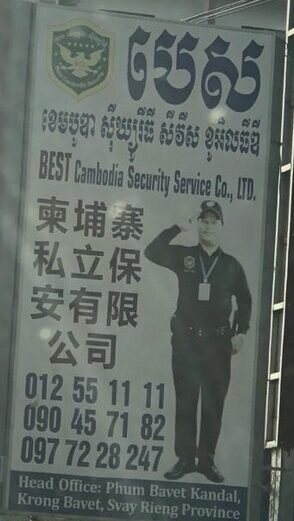
Channy’s connection to Best Security is particularly significant given his role as a senior police officer involved in efforts to combat the scamming industry. Public posts on his Facebook account indicate that he played an active role in operations targeting suspected scamming compounds. For example, on 3 February 2026 and 19 June 2026, he posted photographs showing he was present during raids on suspected scamming sites.218
Best Security responded in relation to listing Channy’s phone number on their sign in Bavet. In his response, the Chairman confirmed that the number listed belonged to Channy because “Lay Channy is the owner of the office that my company rents (branch in Svay Rieng province).” The response stated that Channy’s number appeared on the sign because “[w]hen the company expanded its business from Phnom Penh to open a branch in Svay Rieng Province, the staff sent from Phnom Penh were not familiar with the local area, and the company also lacked communication staff. At that time, I asked the owner to put his phone number on the company sign, because I understood that when customers contacted him, he would be familiar with the local area and could help the company temporarily.” The chairman said the phone number “had not been changed because I, like him, think it has no ill effects. In addition, the company also has a phone number on the label that accompanies it.” He also explained that “[f]or operational work, general management and all decisions are my exclusive responsibility, without involving Mr. LAY CHANNY.”219
6.2.2 BRIGADIER GENERAL TEK BUNTHOEUN
Significant evidence links serving military personnel to the BM02 scamming compound; in particular, there were connections related to the land on which it is located, the vehicles that transported victims there, and the people who guarded the compound. At the centre of these links is Brigadier General Tek Bunthoeun, a member of the Prime Minister’s bodyguard unit.
In early 2026, Amnesty International interviewed two survivors who had been trafficked from the CT01 scamming compound in Chrey Thom to BM02 in Banteay Meanchey.220 They reported being escorted by a vehicle bearing an RCAF licence plate during this approximately eight-hour journey across the country. They also described how once inside BM02, they frequently saw vehicles with military licence plates entering the compound.
BM02 was located on land being developed by a company called the Pang Nakry Real Estate Group (Pang Nakry Group).221 Incorporated on 18 September 2021, the company’s sole director is listed as Pang Nakry, the wife of Tek Bunthoeun, a brigadier general in the RCAF.222 Amnesty International reviewed promotional materials published by Pang Nakry Real Estate, including a video containing a development map for the Woodland Vegas Co., Ltd. project.223 The video indicates that the company is developing the land on which BM02 is located and describes part of the area as “Woodland Casino” (see images below).224 Both survivors reported the presence of a casino at this location and provided photographs consistent with this description.225
Tak Buntheoun’s involvement goes beyond his wife’s directorship. The same promotional video shows both him and Pang Nakry attending a ceremony at the development site,226 and separate media reporting describes him as representing the Pang Nakry company.227 Taken together, this evidence indicates that Tek Bunthoeun, despite being a high-ranking member of the military, has or had a direct (and potentially controlling) interest in the development where BM02, a compound in which serious human rights abuses occurred, was located.
The military links extend from those who control the land to those who guarded the people held there. Two survivors identified Leap Somnang, a security company whose links to military personnel are documented above, as one of the security providers at BM02, recognizing the company’s logo on the guards’ uniforms.228 Amnesty International independently geolocated a March 2026 photograph to the site showing a Leap Somnang guard wearing a company-branded cap.229
Other guards at BM02 also appear to have military connections. During a site visit in late 2025, Amnesty International researchers observed an individual wearing a military uniform at the entrance.230 A TikTok video posted on 19 December 2024 by NC020 (not shows a guard positioned at the entrance gate wearing a military-style jacket, alongside another individual dressed in military fatigues.231 The account holder also appears in other photographs displaying military insignia.232 In a separate image posted by the same user on 4 December 2025, two individuals dressed in military clothing are visible near what is likely an entrance to the compound, with a Leap Somnang security guard visible in the background.233
The guards themselves appear to have been trained by a serving RCAF officer. Amnesty International identified TikTok user NC018 (not their real username), as a suspected serving member of the RCAF who trained and directed security guards at BM02 and a neighbouring site. Videos posted by TikTok user NC018 showed him instructing, training and directing guards at a location Amnesty International believes is very likely BM02,234 including areas associated with the Woodland Vegas development. At the neighbouring site, which police raided in March 2026 as part of a crackdown on scamming operations,235 researchers geolocated images of three security guards and documented TikTok user NC018 directing guard operations and bringing guns into areas with guards, possibly for training purposes.
NC018’s online presence leads back to the same military unit as Tek Bunthoeun. A phone number publicly associated with his TikTok account links to a Telegram profile containing photographs of RCAF facilities, images of NC018 in military fatigues and photographs showing him inside an office displaying the logo of the Prime Minister’s bodyguard unit. Taken together, this evidence suggests that he was likely an active RCAF member while training and supervising guards at BM02 and the neighbouring compound.
The evidence therefore places military actors at various levels of BM02’s operation, raising questions about the links between members of the Cambodian military and the scamming industry.
6.3 SERVING RCAF PERSONNEL WORKING AS GUARDS INSIDE COMPOUNDS
Amnesty International has identified 19 RCAF or police officers, in some cases linked to Leap Somnang, Security Response and DAS, and geolocated images showing them at 12 scamming compounds.236 According to their social media posts, all of these individuals appeared to be serving members of the armed forces, or were carrying weapons or wearing clothing that indicated they were active with the armed forces. Amnesty International verified photographs of official uniforms and used publicly available official records to create timelines to show that guards were very likely active members of the armed forces when they were inside scamming compounds.237
Annex II details the evidence and verification steps behind Amnesty International’s conclusion that 19 individuals were serving members of the RCAF or police forces when they published images of themselves at scamming compounds.
6.3.1 TRAINING OR LEADING THE GUARDS
In three compounds, active military members trained or led security guards. Individuals were seen instructing guards or being saluted by them, typically standing at the front of a group of guards.
DAS employed former or active members of the military in training and leadership roles at the SI03 compound in 2024 and 2025. Amnesty International identified at least two DAS trainers or managers from the Cambodian military. One of these individuals, DAS-BT01 (not their real username) appeared in photographs from 14 March 2023 wearing a RCAF uniform and, six days later, in photographs wearing a DAS uniform.238 His role within the company is likely that of a senior guard, and multiple photographs posted in March 2023 show him driving or accompanying Sab Dara, DAS’s sole director.239 Additional photographs from 2024 show him with DAS guards at the SI03 compound.
Amnesty International also identified individuals linked to the military or police who recruited, trained or supervised security guards for other companies. In one case, a TikTok user who regularly posted photographs with Leap Somnang guards and whose videos were geolocated to the TBK04 compound also posted recruitment advertisements for the company.240 The user occupied a supervisory role, with videos showing him paying guards and overseeing training exercises.
Finally, Amnesty International identified at least two Security Response recruiters, trainers or guards with links to the military or police. Both appeared in images that were geolocated to the PV01 compound – a location where more than a dozen survivors previously reported the presence of guns and police. One individual from the site acted as a recruiter and was identified as a captain of the guards.241 The same individual appears in photographs with a gun and with police logos on his t-shirt. Another individual, profiled below, was an active member of the military police while also a guard at the compound, bringing a firearm into the location.
CASE STUDY: THE SI12 COMPOUND
Evidence collected by Amnesty International indicates that at least three individuals who appeared to be serving members of RCAF were involved in guarding, supervising or directing security personnel at the SI12 scamming compound during 2025 and 2026.
SI12 was investigated by police over scamming and torture in 2022.242 In late 2024, a local organization received a credible rescue request from the site. By 2025, the site had installed guard towers. In December 2025, Peak Casino, operated by Conglomerate Development Group Co. Ltd., had its land map approved by the Commercial Gambling Management Commission of Cambodia (CGMC), which showed that the casino was the scamming compound SI12.243
One individual, TikTok user NC001, was a member of the RCAF during the same time period that he published videos in which he is seen leading the security guards at the SI12 compound. Dozens of social media posts made between 20 September 2023 and 17 April 2026 show the user in military uniform, displaying an identification number and attending a military event in Viet Nam, apparently as part of a Cambodian military delegation.244 Amnesty International geolocated 15 videos he posted between 23 December 2024 and 31 October 2025 to the SI12 compound. The videos show the individual occupying guard positions within the compound and directing security guards. In one video posted on 31 October 2025, security guards can be seen standing in formation and saluting him, suggesting he exercised authority over personnel working at the site.245
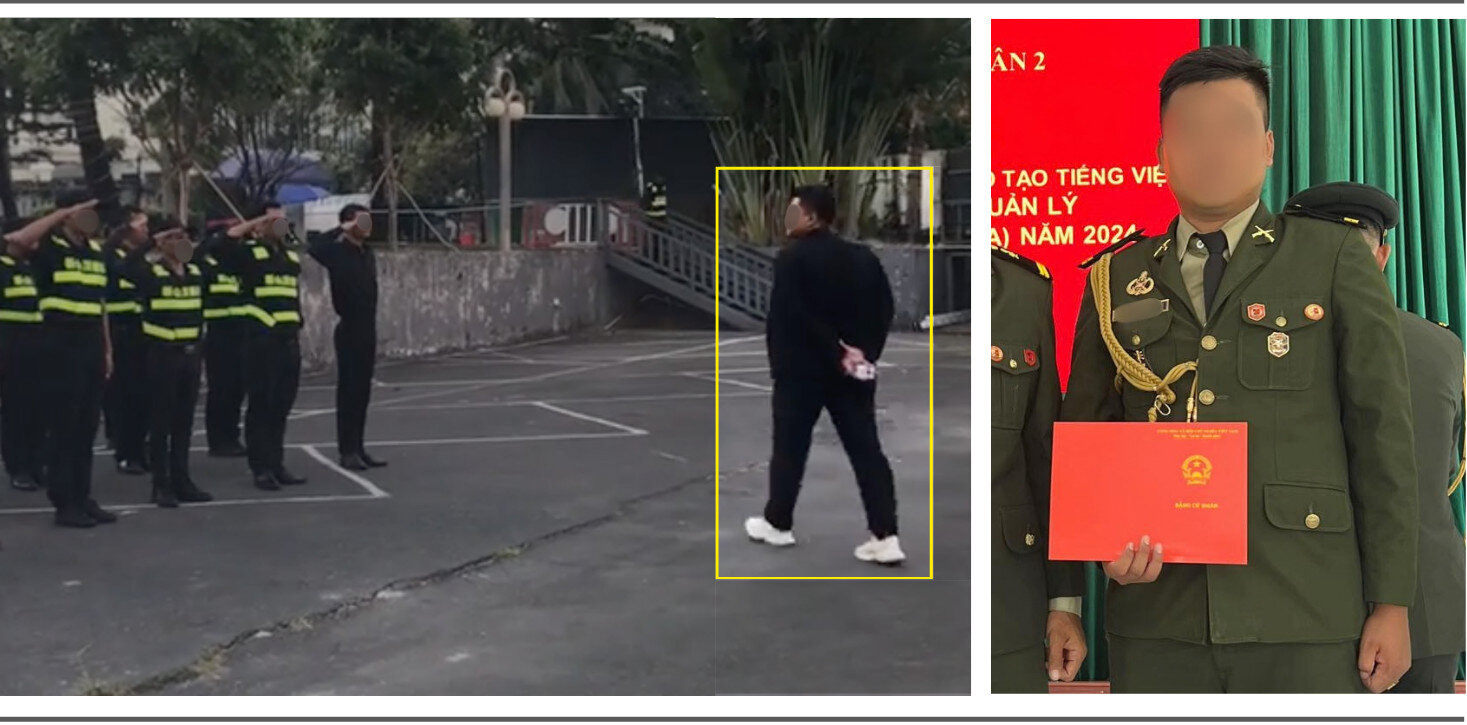
Amnesty International also identified two other RCAF members to the site.246 One appears to be directing guards,247 while a second is seen sitting at a guard station.248 Both are confirmed to be active members of the RCAF while holding these roles at the SI12 compound.
Therefore, at least three active members of the RCAF were involved in guarding, training and supervising security personnel at the SI12 compound across 2025.
6.3.2 POSSESSION OF FIREARMS
In three cases, Amnesty International documented members, or suspected members, of the RCAF openly carrying firearms while inside scamming compounds. These videos and images can be geolocated to three separate scamming compounds. In one other case, Amnesty International documented a guard captain pictured with an SDM AK-103 firearm at what it suspects is a scamming compound next to BM02.249 This same guard acted as a captain or trainer and is seen in several photographs geolocated to a location investigated for scamming operations. He is pictured with an SDM AK-103 firearm and with another other person who is holding a firearm.250 This individual trained the guards at the nearby BM02 compound around the same period in 2025.251
Under Cambodia’s Law on the Management of Weapons, Explosives and Ammunition (2005), private persons may not lawfully possess or carry firearms, although the armed forces and police may.252 The presence of openly armed guards suggests they were serving members of the security forces, or they were unlawfully armed private persons.
More than 19 survivors said they had seen someone with a firearm inside the compound where they were abused. Several victims from PV01 reported the use of a firearm by a guard who shot a pistol in the air.253 Amnesty International confirmed at least one guard, a military police officer, had brought a pistol into the compound on at least one occasion, according to videos posted by the user on 14 April 2025.254 The presence of people within a compound who had access to weapons that are only legally attainable by military or police further entrenched victims’ suspicions regarding military or police involvement in the scamming industry.
For example, TikTok user DAS01 was a security guard who worked for DAS at the SI03 site from early 2024 until August 2025. On 29 December 2024, he posted a photograph Amnesty International geolocated to the SI03 site, which showed a person wearing a DAS hat standing next to DAS guards with a pistol clearly visible and holstered in their belt.255 A photo posted on social media the same day shows the same individual standing next to a confirmed member of the RCAF who was also in the compound and working as a DAS guard.256 This testimony matches that of five Bangladeshi survivors of SI03 who reported that some security guards had brought “small guns” into the SI03 compound before.257
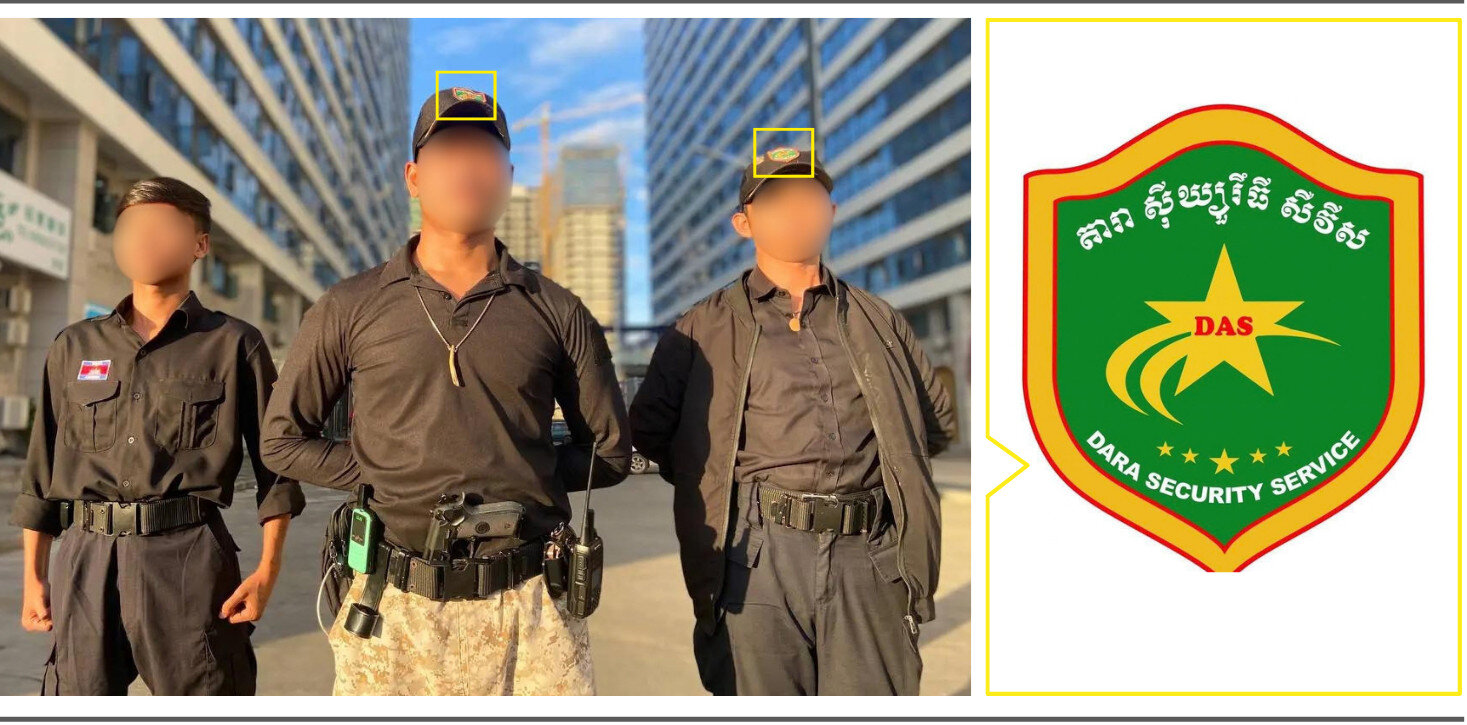
6.3.3 RCAF VEHICLES AND OTHER EVIDENCE OF MILITARY OR POLICE INSIDE AND SERVICING COMPOUNDS
Amnesty International documented three cases in which vehicles bearing RCAF license plates were reported or confirmed to be inside of scamming compounds. In one case, two survivors told Amnesty International that a vehicle with RCAF plates trailed a bus transferring them and other individuals from CT01 compound to BM02 compound.258 The survivor was confident the car was trailing them because it stayed with them on an eight-hour journey that crossed the entire country. In another case, a survivor of the KA02 compound said cars with “red and blue” license plates regularly came into the compound.259 Red and blue are the colours of license plates issued to the RCAF. The survivor identified a random photograph of a military license plate shown to him. Finally, Amnesty International geolocated one video from TikTok that showed a car with military license plates inside of the TBK04 compound in April 2025.260
Amnesty International also documented five cases in which guards wore military insignia or police clothing inside of scamming compounds. In two cases, the guards were confirmed to be active members of the military at the time. In three other cases, the evidence was inconclusive. Regardless of whether the guards were active or not, it is illegal under Cambodian law for security guards to wear uniforms that resemble police or military uniforms.261 In several cases, guards wore hats with police logos, or the word “POLICE” written on them, or police logos, while guarding scamming compounds. This undoubtedly contributed to the feeling of hopelessness described by many survivors when they witnessed their captors wearing these types of hats.
6.3.4 RELATIONSHIP BETWEEN COMPOUNDS AND POLICE
The findings in this chapter also build on Amnesty International’s previous documentation of apparent collusion between scamming compound managers and state authorities. In its 2025 and 2026 reports, Amnesty International found repeated indications that compound operators received advance warning of police interventions, enabling them to move victims and continue operations at another location. Survivors across multiple compounds described managers informing them that police were coming and then transporting them to other compounds elsewhere in the country. Amnesty International documented several instances in which trafficking victims were transferred between compounds specifically to evade anticipated police action, including movements during the 2025-2026 nationwide crackdown.262
Survivors also described police officers visiting compounds, carrying out limited interventions, removing bodies or interacting with compound personnel without shutting sites down.263 Up until 2025, human rights abuses continued after police raids or other state interventions in at least a third of all compounds identified by Amnesty International.264
These findings strongly suggest that collusion, forewarning, acquiescence or other forms of cooperation between compound operators and state officials may have played a role in enabling the industry to persist despite repeated publicly declared enforcement efforts. The evidence presented in this chapter furthers those concerns by documenting the links between scamming compounds and Cambodia’s military and police institutions.
Evidence from MD02 suggests that Leap Somnang guards continued operating at the compound despite a police intervention and arrest of its guards. Survivors who had been held at the compound told Amnesty International that Cambodian authorities entered the site in July 2025.265 News reports about the raid showed several individuals identified as Leap Somnang security guards detained with their hands bound.266 Yet, Amnesty International witnessed other Leap Somnang guards at the site after the police intervention,267 and geolocated TikTok photographs and videos showing individuals wearing Leap Somnang uniforms within the compound, including in areas survivors identified as locations where detainees were held following the intervention and up until November 2025. Two survivors who remained at the compound during this period identified the company’s logo and said that Leap Somnang guards continued to deprive them of their liberty during and after the police operation.268
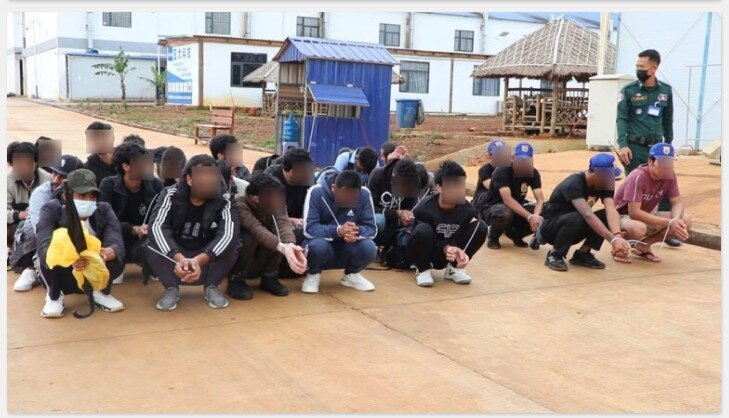
6.4 CONCLUSION: DIRECT INVOLVEMENT
These findings suggest that serving members of the military and police were directly involved in providing security at compounds where serious human rights abuses were committed. Because security guards played a central role in confining and abusing people inside the compounds, these personnel may themselves have participated in, contributed to or been responsible for those abuses.
The evidence is geographically distributed: the involvement of serving military personnel and police officers is documented across 12 compounds in eight provinces, rather than being confined to an isolated or exceptional case in a single location or company.
Further, the involvement of military and police personnel in the scamming compounds was often highly visible. Individuals identified in this report publicly posted photographs and videos of themselves in military or police uniforms, including content geolocated to scamming compounds, using their own public social media accounts over extended periods. In several instances, individuals appeared to carry firearms into compounds without apparent efforts to conceal their activities. The apparent absence of enforcement action against these individuals does not, by itself, establish official authorization, but it is consistent with a degree of tolerance or acquiescence within relevant military and police structures.
Finally, the evidence shows military and police involvement at multiple levels of the scamming compound security apparatus. The individuals acted not only as guards, but also as company directors, beneficial owners, recruiters, trainers and captains. In several cases, serving military and police personnel appear to have exercised authority over compound security operations or over private security companies providing services to compounds. This suggests that the overlap between state security institutions and the scamming compound industry extends beyond the actions of individual guards and may involve more structured relationships.
The significance of the range of roles military and police personnel exercised should not be understated. Security guards deployed at scamming compounds were fundamental to their operation and to the commission of the abuses that occurred within them. Guards prevented trafficked persons from leaving, maintained conditions of unlawful detention and enslavement, enforced compliance through threats and violence, recaptured escapees, and, in many cases, directly participated in torture and other ill-treatment. Their actions made possible the abuses committed by compound managers and operators and their involvement may help explain the collusion between state authorities and the industry. Evidence that serving military personnel and police officers performed, supervised, recruited or trained individuals for such roles should be considered deeply alarming for the international community that is attempting to protect people in other countries from scamming, rescue its trafficked citizens from compounds, and work with Cambodian authorities to investigate this industry.
Taken together, the evidence substantially strengthens concerns previously raised by Amnesty International and others regarding the relationship between the Cambodian state and the scamming compound industry. Amnesty International’s earlier findings highlighted state acquiescence and possible complicity on the basis of repeated failures to act, despite extensive evidence of human rights abuses. The findings presented in this chapter go further: members of the military and police were directly involved in securing compounds in which serious human rights abuses were committed, and due to the role of security guards in the scamming industry, members of the military and police were themselves involved in, contributed to or were responsible for these abuses.
7. LEGAL FRAMEWORK AND ANALYSIS
This chapter sets out the legal frameworks that apply to the human rights abuses documented by Amnesty International, and to the companies, individuals and authorities connected to them. Section 7.1 defines each of the abuses under international law and sets out the frameworks under which they may give rise to criminal liability: international criminal law, Cambodian criminal law, extraterritorial and universal jurisdiction, and the liability of companies. Section 7.2 applies these frameworks to the role played in each abuse by guards employed by the five security companies documented in this report, building on Amnesty International’s earlier findings on the abuses themselves, before considering the forms of criminal responsibility their conduct may engage. Section 7.3 turns to the UN Guiding Principles on Business and Human Rights, explaining why they are of limited use for assessing the security companies themselves but remain the principal framework for their customers and business partners. Section 7.4 examines Cambodia’s obligations under international human rights law to protect people from these abuses, and its failure to enforce domestic laws governing private security companies, weapons and the conduct of military personnel.
7.1 LEGAL FRAMEWORK
7.1.1 DEFINITIONS OF THE ABUSES UNDER INTERNATIONAL LAW
HUMAN TRAFFICKING
The Palermo Protocol, to which Cambodia is a state party, defines human trafficking as having three elements:269
- an “action”: the recruitment, transportation, transfer, harbouring or receipt of persons;
- a “means” by which that action is achieved: threat or use of force or other forms of coercion, abduction, fraud, deception, abuse of power or a position of vulnerability, or the giving or receiving of payments or benefits to achieve the consent of a person having control over another person; and
- a “purpose”: exploitation.
All three elements must be present in order to constitute the crime of trafficking in persons. The only exception is when the victim is a child, in which case the “means” requirement is no longer an element.270 The agreed definition of trafficking in persons further states that consent to the intended exploitation is irrelevant where any of the means of trafficking have been used.271
FORCED LABOUR
The International Labour Organization (ILO)’s Forced Labour Convention (ILO Convention 29), ratified by Cambodia, defines forced labour as “any work or service which is exacted from any person under the menace of any penalty and for which the said person has not offered himself voluntarily”.272 The ILO has emphasized that “menace of penalty” refers not only to penal sanctions but also to various forms of coercion, such as threats, violence, retention of identity documents, and confinement or non-payment of wages. The Convention does not exclude work that is illegal, such as scamming, from its definition of forced labour.273 Forced criminality has the same legal definition as forced labour, which makes no distinction between legal and illegal labour, and is treated as a sub-category of forced labour.274 The International Covenant on Civil and Political Rights (ICCPR), to which Cambodia is a party, requires that state authorities ensure that no one is held in slavery or servitude or required to perform forced or compulsory labour.275
CHILD LABOUR
The Convention on the Rights of the Child, to which Cambodia is a state party, obliges states to protect children from economic exploitation. This includes protecting children from performing any work that is likely to be hazardous or to interfere with the child’s education, or to be harmful to the child’s health or physical, mental, spiritual, moral or social development.276 The Convention on the Worst Forms of Child Labour (ILO Convention 182), ratified by Cambodia, prohibits any work which, by its nature or the circumstances in which it is carried out, is likely to harm the health, safety or morals of children.277
TORTURE AND OTHER ILL-TREATMENT
Article 1 of the Convention against Torture and Other Cruel, Inhuman or Degrading Treatment or Punishment (CAT), to which Cambodia is a state party, defines torture as:
“any act by which severe pain or suffering, whether physical or mental, is intentionally inflicted on a person for such purposes as obtaining from him or a third person information or a confession, punishing him for an act he or a third person has committed or is suspected of having committed, or intimidating or coercing him or a third person, or for any reason based on discrimination of any kind, when such pain or suffering is inflicted by or at the instigation of or with the consent or acquiescence of a public official or other person acting in an official capacity. It does not include pain or suffering arising only from, inherent in or incidental to lawful sanctions.”278
Where torture or other ill-treatment occurs but is not directly committed by state actors, the authorities can still be responsible if they knew or had reasonable grounds to believe it was occurring, or failed to exercise due diligence to investigate, prosecute and punish the non-state actors responsible.279 In any event, an act committed by a private individual can constitute torture or other ill-treatment within the meaning of international and regional human rights law and standards.
The definition of torture differs under international criminal law. The Rome Statute of the International Criminal Court defines torture as a crime against humanity as “the intentional infliction of severe pain or suffering, whether physical or mental, upon a person in the custody or under the control of the accused”.280 Unlike the Convention against Torture, this definition does not require the involvement of a public official. The Rome Statute Elements of Crimes also make clear that no specific purpose needs to be proved.281 The International Criminal Tribunal for the former Yugoslavia likewise held that the official-capacity requirement is not part of the customary definition of torture when determining individual criminal responsibility outside the framework of the Convention against Torture.282 Torture committed by private actors may therefore constitute a crime under international law regardless of any state involvement. Cambodian law reflects this: the Cambodian Criminal Code criminalizes torture as a crime against humanity when committed as part of a widespread or systematic attack directed against any civilian population.283
RAPE
Rape is defined under international law as sexual penetration or “invasion”, however slight, when committed by force, by threat of force or coercion, by taking advantage of a coercive environment, or against a person incapable of giving genuine consent.284 Human rights law and international criminal law recognize that the pain and suffering caused by an act of rape is severe enough to reach the threshold of torture, both physically and psychologically.285
UNLAWFUL DEPRIVATION OF LIBERTY
In addition to constituting a distinct human rights violation, unlawful deprivation of liberty, sometimes referred to as confinement, is a possible element in situations of slavery, human trafficking, forced labour, and torture and other ill-treatment, making these crimes easier by exerting control over a person’s liberty and security. Liberty and security of person are guaranteed by Article 9 of the ICCPR, which states that “[n]o one shall be deprived of his liberty except on such grounds and in accordance with such procedure as are established by law”.286 The UN Human Rights Committee has stated that states “must protect individuals against abduction or detention by individual criminals or irregular groups, including armed or terrorist groups, operating within their territory. They must also protect individuals against wrongful deprivation of liberty by lawful organizations, such as employers, schools and hospitals.”287
SLAVERY
The prohibition of slavery and the slave trade is a peremptory norm of international law (jus cogens).288 It has been universally accepted by the international community, achieving the status of customary international law, and cannot be derogated from under any circumstances.289 Slavery constitutes both a violation of international human rights law and a crime under international law.290 The Slavery Convention defines slavery as “the status or condition of a person over whom any or all of the powers attaching to the right of ownership are exercised”.291 The Supplementary Convention on the Abolition of Slavery, the Slave Trade, and Institutions and Practices Similar to Slavery, to which Cambodia is a state party, builds on this. It sets out four overarching practices considered “similar to slavery”: debt bondage, serfdom, forced marriage, and the trafficking of children for exploitation.292 The Rome Statute, which Cambodia ratified in 2002, similarly defines “enslavement” as a crime against humanity as “the exercise of any or all of the powers attaching to the right of ownership over a person” .293 Slavery is also prohibited under Article 8 of the ICCPR.294
The legal definition of slavery has been interpreted broadly by domestic and international courts, which have often relied on indicators that show control or power equating to de facto ownership. Indicators of slavery may include:
- The ability to sell, buy or loan a person;
- Control of a person’s movement and physical environment;
- Measures taken to confine them or prevent escape;
- Use of psychological control, intimidation, threat of violence or coercion;
- Use of torture or other cruel, inhuman or degrading treatment;
- Subjection to forced labour, often without pay;
- Abuse of a vulnerability, such as the person’s migration status;
- Exploitation, usually involving some gain for the perpetrator.295
7.1.2 INTERNATIONAL CRIMINAL LAW
Each of the abuses defined above is capable of constituting a crime under international law. Torture, enslavement, imprisonment or other severe unlawful deprivation of physical liberty, rape, sexual slavery and other forms of sexual violence of comparable gravity are enumerated, among others, as crimes against humanity, “when committed as part of a widespread or systematic attack directed against a civilian population, with knowledge of the attack”.296 Trafficking in persons is expressly encompassed within the Rome Statute’s definition of enslavement297 and accordingly may amount to enslavement where acts of trafficking coincide with the exercise of powers attaching to the rights of ownership. Forced labour, including the forced labour of children, may also constitute enslavement298 or other inhumane acts.299
This report does not determine whether the conduct documented amounts to crimes against humanity, but uses this framework to indicate actual and potential crimes under international law that may have been committed in the compounds.
Individual criminal responsibility extends beyond those who commit crimes directly. In addition to direct perpetration, the Rome Statute provides for several further forms of responsibility, including:
- Aiding and abetting:300 those who aid, abet or otherwise assist in the commission of a crime, subject to proof of the required mental element.
- Contribution to a group crime:301 those who intentionally contribute to a crime committed by a group acting with a common purpose, with knowledge of the group’s intention.
- Superior responsibility:302 civilian superiors may bear responsibility for crimes committed by personnel under their effective authority and control where they knew, or consciously disregarded information clearly indicating, that such crimes were being committed, and failed to take necessary and reasonable measures to prevent or repress them.
Cambodia ratified the Rome Statute in 2002. The Court may therefore in principle exercise jurisdiction over Rome Statute crimes committed on Cambodian territory, whatever the nationality of the individuals concerned.303
While the specific jurisdiction of the Court to attribute criminal responsibility under the Rome Statute attaches to natural persons only, private and other non-state actors, such as armed groups or private companies, can commit crimes against humanity under general international law. Any non-state actor, including individuals organized in criminal gangs or groups, can be considered responsible for committing crimes against humanity under general international law; the offender need not be a state official or agent.304 Since the Nuremberg Tribunal in the 1940s, it has been accepted that legal (or “juridical”) persons, especially companies, have repeatedly been involved in the commission of crimes under international law, including crimes against humanity.305
7.1.3 CAMBODIAN CRIMINAL LAW
The same conduct is also criminalized in Cambodian law. The Criminal Code criminalizes crimes against humanity, including enslavement and torture, when committed as part of a widespread or systematic attack directed against any civilian population, punishable by life imprisonment.306 It also criminalizes torture and other acts of cruelty,307 unlawful confinement,308 and rape.309 The Law on the Suppression of Human Trafficking and Sexual Exploitation (2008) criminalizes the component acts of trafficking, including the sale of persons and the receiving and harbouring of trafficked persons, and separately criminalizes confinement.310
7.1.4 UNIVERSAL AND OTHER EXTRATERRITORIAL JURISDICTION
Criminal exposure is not confined to Cambodia. Torture is, in itself, a crime under international law regardless of whether it is committed as part of a widespread or systematic attack on a civilian population. The UN Convention against Torture requires each state party to establish jurisdiction over torture and over complicity or participation in torture, where the alleged offender is present in its territory, and either to extradite or to prosecute.311 All states have an obligation to investigate and, where enough admissible evidence is gathered, prosecute persons suspected of torture, including by exercising universal jurisdiction and other applicable domestic legislation over related crimes.
The prohibitions of slavery and the slave trade have long been understood to support universal jurisdiction as a matter of custom. The UN Organized Crime Convention and its Trafficking Protocol require criminalization of trafficking and of participation in it as an accomplice, and provide broad jurisdictional bases with an obligation to extradite or prosecute. Many states have enacted legislation permitting prosecution of crimes against humanity on a universal or quasi-universal basis. The states of which victims are nationals or habitual residents may also have jurisdiction on the basis of the passive personality principle.
7.1.5 LIABILITY OF COMPANIES
While no general regime of corporate criminal responsibility presently exists under international law, it is increasingly recognized that companies can participate in conduct prohibited by international law and should not be insulated from accountability merely because such conduct is carried out through a corporate form. A growing number of domestic legal systems across the world permit corporations to be investigated, prosecuted or sanctioned for conduct amounting to crimes under international law,312 including crimes against humanity, war crimes and related offences. Where a domestic system recognizes corporate criminal liability, the prohibitions set out above may be enforced against companies themselves. In Cambodia, the Criminal Code provides for the criminal responsibility of legal entities.313
7.2 APPLICATION TO THE SECURITY COMPANIES
Amnesty International’s 2025 and 2026 reports documented in detail how human trafficking, forced labour, child labour, torture and other ill-treatment, rape, unlawful deprivation of liberty and slavery took place in scamming compounds across Cambodia. Those reports, based on interviews with more than 150 survivors since September 2023, found that the abuses overlapped and compounded one another, creating a climate of fear that enabled managers to exert control over people confined in the compounds, and concluded that most of the survivors interviewed had likely been enslaved. This section does not revisit those findings. Instead, it builds on them by examining the role guards employed by the five security companies documented in this report played in each of these abuses. Section 7.2.8 then considers the forms of criminal responsibility this conduct may engage.
7.2.1 HUMAN RIGHTS ABUSES
HUMAN TRAFFICKING
Across the scamming compounds documented by Amnesty International, security guards were involved in multiple stages of the movement and control of trafficked persons. Survivors described guards receiving new arrivals at compound gates, escorting trafficked persons into compounds, controlling entry and exit procedures, accompanying transfers between compounds and receiving trafficked persons following transfers. Survivors also reported being moved between compounds to avoid police investigations, with guards escorting or supervising such movements. Guards assumed responsibility for controlling trafficked persons immediately upon arrival and maintained that control throughout their confinement.
Amnesty International identified guards employed by the five security companies documented in this report at compounds where human trafficking was found to have occurred. Guards employed by Leap Somnang,314 Security Response,315 ZD Security,316 DAS,317 and Best Security,318 were linked to compounds where Amnesty International documented human trafficking. For example:
- At PV01, a compound which Amnesty International linked to Security Response, survivors reported being escorted into the compound by guards upon arrival and remaining under guard supervision throughout their confinement. Survivors also reported being transferred from PV01 to TBK02 after being told police were coming.
- At BM02, a compound linked to Leap Somnang, survivors described being transported from CT01 and received into a heavily guarded compound where they remained confined.
- At BS04, a compound linked to ZD Security, survivors described being transferred between compounds and guarded throughout their confinement.
UNLAWFUL DEPRIVATION OF LIBERTY
Across the compounds documented by Amnesty International, guards staffed gates, perimeter walls, watchtowers and interior guard posts, preventing people confined inside from leaving. Survivors described guards monitoring movements, conducting room searches, confiscating phones, controlling access to buildings and escorting people within compounds. Numerous survivors also described guards pursuing, recapturing and returning people who attempted to escape.
The five companies documented in this report were linked to compounds where Amnesty International documented unlawful deprivation of liberty. Guards employed by Leap Somnang,319 Security Response,320 ZD Security,321 DAS,322 and Best Security323 were identified at compounds where survivors consistently reported that guards prevented them from leaving and enforced systems of confinement. For example:
- At KA02, a compound linked to Leap Somnang, local residents reported seeing individuals flee the compound and stated that guards would search for and recapture escapees.
- At PV01, a compound linked to Security Response, survivors described multiple guard-controlled gates, armed guards and constant monitoring.
- At BS04, a compound linked to ZD Security, survivors reported that guards carrying electric shock batons prevented them from leaving and monitored movements throughout the site.
FORCED LABOUR
Across the scamming compounds documented by Amnesty International, guards played a central role in enforcing work. Survivors described guards monitoring compliance with managers’ instructions, responding to refusals to work and escorting individuals to punishment rooms after they failed to meet work targets. Survivors also described guards carrying electric shock batons and participating in disciplinary measures imposed on workers.
The five companies were linked to compounds where Amnesty International documented forced labour.324 Guards employed by these companies were identified at compounds where survivors were required to undertake scamming or related work under threat of punishment and where guards enforced compliance with work requirements. For example:
- At KA02, a compound linked to Leap Somnang, one survivor said guards carrying electric shock batons and metal poles stood at the entrance of dark rooms and entered them to beat detainees who failed to comply with work demands.
- At MD02, guarded by Leap Somnang, a survivor reported being escorted by guards to a room where he was subjected to electric shocks after refusing to work.
- At SI03, a compound linked to DAS, survivors described guards enforcing confinement and work requirements while carrying electric shock batons.
CHILD LABOUR
Across the compounds documented by Amnesty International, children were present and confined in compounds where guards controlled movement, conducted searches, monitored dormitories and patrolled common areas. Children as young as 14 years old reported being subjected to the same confinement systems and work requirements as adults. Survivors described guards regularly observing, escorting and monitoring children within compounds.
Amnesty International identified child labour at compounds linked to guards employed by Leap Somnang325 and Best Security.326 For example:
- At BA11, a compound linked to Leap Somnang, Amnesty International interviewed child survivors who reported being trafficked, confined and forced to work at the compound.
- At SI16, guarded by Leap Somnang, a child survivor described being trafficked to the compound, forced to engage in scam-related work and prevented from leaving.
- At BA06, a compound linked to Best Security, organizations documented327 multiple child victims confined at the site, including children trafficked for forced labour.
TORTURE AND OTHER ILL-TREATMENT
Across the compounds documented by Amnesty International, survivors reported that guards directly participated in acts of violence as punishment or ill-treatment, including beatings, electric shocks, isolation and confinement in punishment rooms. Survivors described guards escorting people to punishment facilities, standing outside punishment cells carrying electric shock batons, entering cells to administer beatings and guarding locations where detainees were subjected to violence. Guards were also reported to have been present during assaults, including rape, carried out by managers.
Guards employed by Leap Somnang,328 Security Response,329 ZD Security,330 and DAS331 were identified at compounds where survivors reported beatings, electric shocks, punishment rooms and other forms of abuse. For example:
- At MD02, guarded by Leap Somnang, survivors described guards escorting individuals to dark rooms where electric shocks were administered and, in some cases, administering them directly.
- At PV01, guarded by Security Response, survivors reported guards escorting victims to dark rooms, guarding the doors, and participating in systems of punishment involving electric shocks and beatings.
RAPE AND OTHER SEXUAL VIOLENCE
Across the compounds documented by Amnesty International, survivors described guards controlling access to locations where rapes occurred, remaining stationed outside rooms during assaults and escorting them to locations connected with sexual abuse. Survivors also reported that guards accompanied women to medical appointments following pregnancies resulting from rape. The rapes documented in the June 2026 report were committed by managers or other persons acting under their authority.
The clearest evidence linking a security company to rape and other sexual violence concerns Security Response:332
- At PV01, survivors reported that guards stood outside rooms while managers raped women held at the compound.
- One survivor stated that guards later accompanied her to a doctor after she became pregnant as a result of rape by a manager.
SLAVERY
Across the compounds documented by Amnesty International, guards maintained systems through which victims were bought, sold and transferred between compounds. Survivors reported that guards escorted transferred persons, received people arriving from other compounds, prevented escape, recaptured escapees, monitored movements, enforced punishment and maintained continuous surveillance of those confined. Survivors repeatedly described being informed that they had been sold, witnessing the transfer or sale of others, or being moved between compounds against their will by guards.
All five security companies documented in this report were linked to compounds where Amnesty International documented enslavement.333 For example:
- At BS04, a compound linked to ZD Security, survivors described being bought, sold and transferred between compounds while under guard control.
- At PV01, a compound linked to Security Response, survivors reported being prevented from leaving, transferred to other compounds during the crackdown, and subjected to continuous guard supervision.
- At KA02, BM02 and MD02, compounds linked to Leap Somnang, survivors described transfers, confinement, punishment and constant guard oversight.
7.2.2 FORMS OF RESPONSIBILITY
The conduct of guards described in this section corresponds to each of the forms of individual criminal responsibility set out in Section 7.1.2. Guards who themselves inflicted violence on people under their control, such as by administering electric shocks or beatings, may be characterized as direct perpetrators. Guards who enforced confinement, prevented escape, escorted people to punishment rooms or stood guard during abuses provided assistance that may be characterized as aiding and abetting, subject to proof of the required mental element, or as intentional contribution to crimes committed by a group acting with a common purpose. Managers and executives of the security companies may bear superior responsibility for crimes committed by guards under their effective authority and control, where they knew, or consciously disregarded information clearly indicating, that such crimes were being committed and failed to take necessary and reasonable measures to prevent or repress them.
The same conduct may also engage Cambodian criminal law. The harbouring and confinement offences under the Law on the Suppression of Human Trafficking and Sexual Exploitation are directly relevant to the functions of guards, and under Article 42 of the Criminal Code the security companies may themselves bear criminal responsibility as legal entities.
7.3 RESPONSIBILITY OF COMPANIES TO RESPECT HUMAN RIGHTS
According to the UN Guiding Principles on Business and Human Rights (UN Guiding Principles), companies have a responsibility to respect all human rights wherever they operate in the world.334 This responsibility requires companies to avoid causing or contributing to human rights abuses through their own business activities and to address impacts with which they are involved, including by remediating any actual impacts. It also requires them to seek to prevent or mitigate adverse human rights impacts directly linked to their operations or services by their business relationships, even if they have not contributed to these impacts. A company’s “business relationships” include “relationships with business partners, entities in its value chain and any other non-state or state entity directly linked to its business operations, products or services.”335
To meet this responsibility, companies are expected to carry out human rights due diligence: to identify and assess actual and potential human rights impacts, integrate the findings and act upon them, track the effectiveness of their responses, and communicate how impacts are addressed.336 Due diligence should cover impacts the company may cause or contribute to through its own activities, and impacts that may be directly linked to its operations, products or services by its business relationships.337 It should be conducted appropriately to the circumstances and, where necessary, be prioritized according to severity and likelihood of adverse human rights impacts. Severity of impacts is assessed by scale, scope and irremediability. The more severe the impact, the more urgent and decisive the response.338 The UN Guiding Principles further provide that companies should treat the risk of causing or contributing to gross human rights abuses as a legal compliance issue wherever they operate, and the commentary to the Principles expressly contemplates that corporate complicity may arise in the context of aiding and abetting international crimes.339
Enslavement, deprivation of liberty, human trafficking, forced labour, rape and torture and other ill-treatment sit at the highest end of that severity scale. A company operating in Cambodia’s security, casino, property development or related sectors cannot treat the risk of involvement in these abuses as an ordinary business risk. The human rights abuses documented by Amnesty International have been the subject of extensive national and international reporting, several of the entities involved have been designated under sanctions regimes, and the sectors in which they operate have been repeatedly identified as high risk. In these circumstances, a company that engages, contracts with or otherwise maintains a business relationship with a security provider operating at scamming compounds cannot credibly claim to be unaware of the risk.
This report names three types of companies: the security guard companies themselves; the companies that likely own, control or are affiliated with those security companies; and the customers and business partners of the security companies. The UN Guiding Principles apply to all three, but they are not equally useful for assessing each.
THE SECURITY COMPANIES AND THEIR OWNERS: THE LIMITS OF THE FRAMEWORK
Measured against the UN Guiding Principles, the conduct of the security companies fails at the most basic level. The UN Guiding Principles require companies to avoid causing or contributing to adverse human rights impact through their own activities, and to cease those impacts where they occur. However, this report documents how security guards directly carried out abuse.
In this context, the UN Guiding Principles are of limited use: Due diligence, leverage and mitigation are designed for companies whose adverse impacts arise from, or are connected to, otherwise legitimate operations, and they assume that the harm can be separated from the service. At the compounds documented by Amnesty International, preventing people from leaving, torturing people when they did not meet their work targets or guarding while managers raped victims was what the guarding services, at least in part, delivered. Treating these companies as if they could manage these abuses sufficiently through due diligence alone would suggest that torture and enslavement are risks to be reduced, when they are in fact crimes to be investigated and punished. The UN Guiding Principles also have no enforcement mechanism: they do not create binding legal obligations, and a company that fails to meet them faces no consequences under the framework itself.
As noted above, the UN Guiding Principles themselves recognize that conduct of this severity is a matter of legal liability. For that reason, this report assesses the security companies and the companies that own, control or are affiliated with them, together with the individuals who work for, own and direct them, primarily under the legal frameworks set out in Sections 7.1.2–7.1.5 above. Under those frameworks, the conduct documented is capable of engaging the individual criminal responsibility of guards who carried out or assisted in abuses, and of those who directed them. Depending on the jurisdiction, it may also engage the criminal, civil or administrative liability of the companies themselves.
CUSTOMERS AND BUSINESS PARTNERS OF THE SECURITY COMPANIES
For the third category, the UN Guiding Principles remain the principal framework. A company that engages one of the private security providers to guard a factory, hotel, development or office is not itself confining anyone, but may be linked to human rights harm in at least two ways. First, the guards deployed to its premises are recruited, trained, equipped and directed by the same management and in the same methods as those deployed to the compounds. Second, its custom supplies the revenue and commercial standing on which the provider’s continued operation depends and allows the provider to present itself as an ordinary business. The practical consequence is not that such a company is a perpetrator, but that the responsibility to respect human rights requires it to know who it is contracting with, to make the due diligence inquiries that would reveal the provider’s other operations, and to act on what it finds.
A company in a business relationship with one of the security companies is at minimum linked to the human rights abuses through its own operations or services and is therefore expected to seek to prevent or mitigate them by using and, where necessary, building its leverage over the security provider.340 Where leverage is insufficient and cannot be increased, the company should consider ending the relationship, weighing the potential adverse human rights impacts of doing so.341 The more severe the abuse, the sooner a company must see change before deciding whether to terminate. Given the widespread scale and scope of the enslavement, imprisonment, trafficking and torture discussed above, the abuse documented by Amnesty International should be treated as a priority risk due to its severity. As long as the abuse continues and the company remains in the relationship, it should be able to demonstrate its own ongoing efforts to mitigate the impact and should be prepared to accept the consequences of the continuing connection, including legal consequences.342
7.4 RESPONSIBILITIES OF THE CAMBODIAN AUTHORITIES
Under international human rights law, Cambodia has an obligation to protect all individuals within its territory and jurisdiction or otherwise subject to its authority, power or effective control, from human rights abuses, including abuses committed by private or other non-state actors. This requires the state to exercise due diligence to prevent, prohibit, investigate, prosecute and punish conduct such as slavery, human trafficking, forced labour, torture, unlawful deprivation of liberty and other abuses, and to identify, assist and protect victims without discrimination. Where authorities know, or ought to know, that such abuses are occurring, they are required to take reasonable measures to prevent them and respond effectively.
In its June 2025 report, Someone Else’s Property, Amnesty International concluded that Cambodia had grossly failed in its duty to take adequate steps to stop widespread human rights abuses in scamming compounds despite being made aware of those abuses, in many cases repeatedly. Given the scale, visibility and persistence of the abuses, Amnesty International concluded then that the state’s failures demonstrated acquiescence and pointed to complicity in the human rights abuses occurring within the industry.
Amnesty International’s June 2026 report, Falling through the Cracks, reaffirmed those conclusions and found that Cambodia’s response continued to fall significantly short of its international obligations. That report concluded that state interventions were frequently reactive, incomplete or undermined by apparent collusion between compound managers and local authorities; that victims of trafficking were routinely not identified, protected or supported; and that authorities had recognized or approved plans for casinos directly linked to known scamming compounds, despite public information linking them to serious human rights abuse. Amnesty International concluded that these failures in enforcement, victim protection, regulation and accountability allowed human rights abuses to continue and reflected broader deficiencies in the state’s fulfilment of its duty to protect against human rights abuses within the scamming industry.
The findings of this present report further reinforce Amnesty International’s conclusion that Cambodia has failed to fulfil its duty to protect individuals from serious human rights abuses committed by non-state actors. Under international human rights law, the state is required not only to prevent abuses, but also to respond effectively when such abuses occur by investigating the facts, holding those responsible to account and ensuring effective remedies and reparations for victims. Yet the evidence presented in this report suggests that the Cambodian authorities have not discharged these responsibilities. Amnesty International is not aware of any investigations into the private security companies profiled in this report or their leadership, despite evidence linking them to compounds where human rights abuses occurred. Nor is Amnesty International aware of any measures taken to suspend their operations, revoke their licences or otherwise prevent them from continuing to provide security services.
The failures identified in this report extend beyond the security companies themselves. As demonstrated in Chapter 5, several companies linked to scamming compounds have relationships with politically connected business elites. Further, Chapter 6 documents significant links between scamming compounds, security providers and members of the military and police.
The involvement of state agents has implications that go beyond the duty to protect. Under customary international law, as reflected in the International Law Commission’s Articles on State Responsibility,343 the conduct of police and military personnel, as organs of the state, is attributable to the state.344 This holds even where they exceed their authority or contravene instructions, provided they act in an official capacity or with apparent authority.345 Conduct of private actors may also be attributable where they act on the instructions of, or under the direction or control of, the state.346 Where officials have participated in, facilitated or protected abuses within scamming compounds, Cambodia’s responsibility is therefore engaged not only for failing to exercise due diligence, but directly for the abuses themselves. Further, under the Convention against Torture, pain or suffering inflicted by non-state actors with the consent or acquiescence of public officials constitutes torture for which the state is responsible.347
Despite extensive public reporting, repeated state interventions at compounds, and the evidence documented by Amnesty International across now three reports, there is little indication that authorities have undertaken meaningful investigations into these broader networks of responsibility. With limited exceptions, including the arrest of Ly Kuong,348 many of the companies, senior individuals and politically connected actors linked to the scamming compound industry appear to have remained largely untouched. This apparent lack of accountability contributes to a climate of impunity that enables the continued operation of the industry and undermines the state’s obligations to prevent, investigate, prosecute and punish, and remedy gross human rights abuses.
7.4.1 RESPONSE OF CAMBODIAN AUTHORITIES
In response to these allegations, the Ministry of Interior noted that “the Royal Government of Cambodia has strictly and firmly implemented a policy and resolute stance against online scams under the principles of “no tolerance, no exemption, and no retreat” […] [which] provides for the prosecution of all persons involved, including masterminds, organizers, recruiters, brokers, site owners, and complicit officials, while cutting off the flow of financial transactions and the criminal ecosystem, in order to strengthen the effectiveness of law enforcement, prevent crime, and reinforce the rule of law.” In support of this, the Ministry reported its actions under four main headings.
- Under law enforcement operations, the Ministry reported that between 1 July 2025 to 31 August 2026, competent authorities “cracked down on a total of 832 online scam sites […] investigated and sent 3,477 suspects (including 491 Cambodian nationals) and 446 case files to court for legal proceedings.” The Ministry noted that “[t]hese operations show that the law is enforced against every person who committed, took part in, or was connected with any type of offense at scam sites, regardless of status or level of responsibility, including private security companies and private security agents.”
- In addition, the “General Commissariat of National Police also sent to court 16 suspects who were masterminds and accomplices (5 Chinese and 11 Cambodian nationals). Ten of them were private security agents connected to the tracking and surveillance of the authorities during a crackdown on an online scam site in Poipet City, Banteay Meanchey Province, for further proceedings under the law. Procedures concerning the company owner are also continuing.”
Under management of private security and the use of equipment, the Ministry noted “the private security sector […] serves as a support force for the National Police” and confirmed that “the use of equipment, materials, techniques, and means for security protection activities, equipping agents with weapons, explosives, ammunition, and equipment the law does not permit is prohibited.” As evidence, the Ministry submitted that “the General Commissariat of National Police investigated and detained 6 private security agents in connection with the illegal use of weapons and sent them to court for proceedings under the law [and] this measure is also applied to private security agents connected with the use of weapons or prohibited equipment inside online scam sites.” The Ministry stated that the priority measures to prevent, investigate, and crack down on human trafficking, confinement, torture, violence, and forced labor at online scam sites that involve private security companies include, among other things, “strengthening the management and inspection of private security companies by checking the implementation of licensing conditions, service contracts, operating sites, and the duties of security agents, to prevent security services being used for illegal purposes.”
Under strengthening integrity and law enforcement, the Ministry reported “[i]n accordance with the high-level approach of Samdech Akka Moha Sena Padei Techo Hun Sen, President of the Senate, who gave the instruction that “the crackdown on online scams must go hand in hand with the crackdown on involved officials,” 77 police officers received severe disciplinary measures in the form of removal from post, reduction of rank, and dismissal from the force, as of September 2026. At the same time, the Anti-Corruption Unit detained 17 suspects who were police, military, and civil officials, and filed 4 case to court for collusion with and facilitation of the activities of criminal groups.”
Finally, under victim protection and civil compensation, the Ministry reported that from “January to August 2026, authorities identified 246 victims [whom] received legal protection until their safe repatriation to their home countries.”
The full response from the Ministry is contained in Annex III.
Amnesty International welcomes the government’s engagement and recognizes that the figures provided indicate significant enforcement activity. However, the response does not address the central concerns raised in this report, and in several respects it reinforces them.
First, the response provides no information about the companies, individuals or networks profiled in this report. The Ministry asserts that the law is enforced “regardless of status or level of responsibility, including private security companies,” yet it does not name a single security company that has been investigated, sanctioned or had its licence suspended or revoked, nor any owner, director or senior manager of such a company who has faced charges. The only private security personnel referred to are 10 guards in Poipet and six agents detained for weapons offences, which are likely to be low-level individuals. Against the scale of the industry described by the Ministry itself, with 832 sites subject to crackdowns, these numbers are limited and do not demonstrate accountability for the companies whose role this report documents.
Second, the headline figures are not disaggregated in a way that allows their significance to be assessed. The response does not say what offences the 3,477 suspects were charged with, how many were alleged organizers or perpetrators of abuses as opposed to people working in the compounds, or how many cases have resulted in convictions.
Third, the measures reported against state officials fall short of what Cambodia’s obligations require. The 77 police officers subject to removal from post, reduction in rank or dismissal faced administrative sanctions, not criminal proceedings, and the response does not specify what conduct these sanctions related to or how this was connected to scam compounds. Where officials are alleged to have participated in or protected serious abuses, disciplinary measures alone are not an adequate substitute for criminal investigation and prosecution. Of the 17 officials detained by the Anti-Corruption Unit, only four cases had been sent to court, and these concern “collusion with and facilitation” of criminal groups, not the abuses themselves. The response gives no information about the rank or seniority of those detained, how many were military personnel or the outcome of any proceedings, so it cannot be established whether any senior or politically connected officials have been held to account. This is consistent with Amnesty International’s finding that, with limited exceptions such as the arrest of Ly Kuong, such actors appear to have remained largely untouched.
Finally, the Ministry’s identification of stronger licensing, contract and site inspections as a priority amounts to an implicit acknowledgement that oversight of private security companies has so far been inadequate. The response sets out no timeline, responsible body, resources or concrete steps for this work, and does not explain how weapons held by private security providers will be monitored.
Amnesty International therefore maintains its conclusion that Cambodian authorities have failed to adequately protect people from abuses in scamming compounds and to ensure accountability for them, including where state agents are implicated.
7.4.2 DOMESTIC LAW
Cambodia has criminalized many of the offences found in the underlying conduct documented above. However, as these are covered under international criminal law and human rights law, this section focuses on the domestic law that regulates security companies, weapons and the military and shows how the Cambodian government has laws in place that should have been used to investigate and regulate security companies which in turn would have helped the state uphold its human rights responsibilities.
FAILURE TO MONITOR SECURITY PROVIDERS FOR HUMAN RIGHTS ABUSES
Sub-Decree 289 regulates all types of private security.349 The Ministry of Interior authorizes security companies under the General Commission of the National Police.350 Article 6 of Sub-Decree 289 provides that the General Commission is responsible, among other things, for providing training to security personnel on relevant laws and professional skills.351 This would reasonably be expected to include training on their permission (including limitations) to detain a person (for example, as a citizen arrest), to use any coercive means, including weapons and equipment, as well as how to do this and the implications if they commit unlawful deprivation of liberty or bodily harm. It is unclear to what extent the National Police provide training to security personnel, or what is covered in that training. It is also not clear to what extent police monitor security companies following authorization. However, the human rights abuses documented in this report suggest that security guards are not properly applying the training if it is happening at all.
For years, authorities have been aware of widespread abuses within scamming compounds. Yet Amnesty International found no evidence of systematic efforts to scrutinize the companies whose personnel played a direct role in enforcing confinement, preventing escapes, and perpetrating violence against victims. The MD02 case study discussed in Chapter 6 provides one of the few examples of police arresting security personnel linked to a scamming compound. However, Amnesty International found no publicly available evidence that the authorities subsequently investigated Leap Somnang itself. Nor is there evidence that the company ceased providing security services at the compound. On the contrary, the available evidence indicates that Leap Somnang personnel continued guarding the site and participating in abuses for months afterwards. This suggests a failure by the authorities not only to investigate individual guards but also to examine the responsibility of the security company that continued to operate at the compound.
The Ministry of Interior said the General Commissariat of National Police had sent to court 16 suspects who were masterminds and accomplices, ten of whom were security guards, during the crackdown. In addition, the Ministry noted that “77 police officers received severe disciplinary measures in the form of removal from post, reduction of rank, and dismissal from the force, as of September 2026. At the same time, the Anti-Corruption Unit detained 17 suspects who were police, military, and civil officials, and filed 4 case to court for collusion with and facilitation of the activities of criminal groups.”
The government also noted that “priority measures to prevent, investigate, and crack down on human trafficking, confinement, torture, violence, and forced labor at online scam sites that involve private security companies and agents included [s]trengthening the management and inspection of private security companies by checking the implementation of licensing conditions, service contracts, operating sites, and the duties of security agents, to prevent security services being used for illegal purposes [and] [s]trengthening proper investigations […] into suspicions that security agents or company managers committed, took part in, or were connected with human trafficking, confinement, torture, violence, or forced labor.”
FAILURE TO MONITOR THE USE OF ILLEGAL WEAPONS INCLUDING SHOCK BATONS AND FIREARMS
Articles 12 and 13 of Sub-Decree 289 require private security providers to apply to the police for permission to use “tools, materials, techniques, means or animals for security safeguarding activities”.352 As Chapters 3 and 6 show, Amnesty International has documented the widespread practice of security guards using electric shock batons, and a few cases in which guns and dogs appear to have been used in security activities. It is highly likely the security guards had no lawful reason to use these weapons.
Chapter 7 provides evidence, including photographs, that show firearms were taken into and used inside of at least three, and likely more, compounds by security providers. More than 30 people reported seeing guns inside of scamming compounds. Chapter 3 documented the presence of dogs inside of scamming compounds, which two survivors said were used to prevent escapes.
The widespread presence of electric shock batons, as well as documented cases of firearms and guard dogs inside scamming compounds, suggests security providers anticipated the use of violence in their roles. These weapons were not used to provide everyday private security services. Rather, they were deployed as part of a system designed to maintain confinement, suppress resistance, deter escape attempts and facilitate serious human rights abuses. Private persons are not allowed to carry firearms in Cambodia.353 The use, or threat of use, of weapons when committing “acts of intentional violence” is considered an aggravating circumstance under Cambodia’s Criminal Code.354
In response to questions put forth by Amnesty International, the Ministry of Interior stated that private security cannot use “weapons, explosives, ammunition, and equipment the law does not permit”. Additionally, the Ministry explained that “[p]rivate security agents stationed outside premises or buildings may use only protective and communication equipment such as batons, flashlights, or radios. Persons who use stun batons or weapons without permission and who are not within the framework of private security agents of a lawfully authorized company are treated as separate cases, and are to be verified and subjected to legal measures.” The Ministry noted that the National Police had investigated and detained six private security guards in connection with the illegal use of weapons and also applied this measure to private security at scamming compounds.
FAILURE TO MONITOR THE RECRUITMENT OF RCAF OR POLICE
Under national law, when hiring for private security guard positions, prioritization should be given to former national police, armed forces and civil servants.355 However, Article 16 of the Sub-Decree 289 on private security management (2013) prohibits recruiting private security agents who are in-service civil servants or active members of armed forces of all kinds.356 Article 25 of the 1998 General Statute of Military Personnel of the Royal Cambodian Armed Forces strictly prohibits military personnel from using their position, power or influence to intimidate or threaten citizens.357
Chapter 7 of this report documents 19 persons who appear to be active members of the RCAF or police, most of whom were working at scamming compounds and who publicized their presence at scamming compounds and their links to the security companies profiled. Chapter 7 also documents the involvement of a deputy police chief in a company that guarded a compound in Bavet, and a brigadier general’s company’s land being linked to a compound in Banteay Meanchey. Chapter 6 documents a colonel in the RCAF and his involvement with Leap Somnang, including his visits to several scamming compounds.
The evidence used to make these findings was publicly available and these individuals took almost no steps to hide their involvement in one of the most notorious industries in the world. The potential for abuse – due to the powerful connections that members of the RCAF or police have, and their access to weapons – is deeply worrying. It may help to explain the advance warnings that compounds received regarding enforcement measures and the impunity those involved enjoyed. These findings require an immediate investigation, and it is entirely possible, if not likely, that a larger number of RCAF personnel and police officers have worked as guards in the scamming industry. Indeed, dozens of survivors reported seeing guns inside of scamming compounds.
Security guards are also prohibited from using uniforms or rank insignias similar to those of the armed forces or state institutions.358 Chapter 7 provides evidence of compound guards wearing “POLICE” hats inside of scamming compounds. Amnesty International also documented several cases where guards wore military insignia inside of compounds, likely while guarding. While it was not possible to confirm whether these people were members of the RCAF or police forces, or if they were actively serving, it is deeply concerning nonetheless that they felt comfortable wearing this clothing inside of scamming compounds.
MILITARY OWNERSHIP OR CONTROL OVER SECURITY PROVIDERS
Article 25 of the 1998 General Statute of Military Personnel of the Royal Cambodian Armed Forces strictly prohibits military personnel from privately managing companies or serving on their board and forbids the abuse of authority associated with military rank. This prohibition is particularly significant given the military’s documented history of protecting private interests and facilitating human rights abuses in Cambodia.
In this context, the evidence concerning Leap Somnang is highly problematic. As discussed in Chapter 5, Colonel Ban Sophat openly presented himself as the company’s leader, publicly describing himself as its “Chairman”, appearing in company signage and promotions, and regularly publishing photographs of himself in Leap Somnang uniforms. At the same time, he made no attempt to conceal his military position, including by posting photographs of himself in military uniform alongside Leap Somnang guards and publicly serving as an advisor to a Deputy Commander-in-Chief of the RCAF after his promotion to colonel in 2022.
There were multiple occasions on which authorities should reasonably have become aware of both Leap Somnang’s role in securing scamming compounds and Sophat’s connection to the company. For example, there was a 2019 social media post showed him receiving an award or accreditation from a police officer while wearing a Leap Somnang uniform. More significantly, seven of the 15 compounds where Leap Somnang guards were seen were subject to police intervention or investigation during the 2025-2026 crackdown period. In one case, Leap Somnang guards were arrested. In three others, Okhna Ly Koung was arrested in connection with scam-related criminal activity at sites that were likely guarded by Leap Somnang at the time.
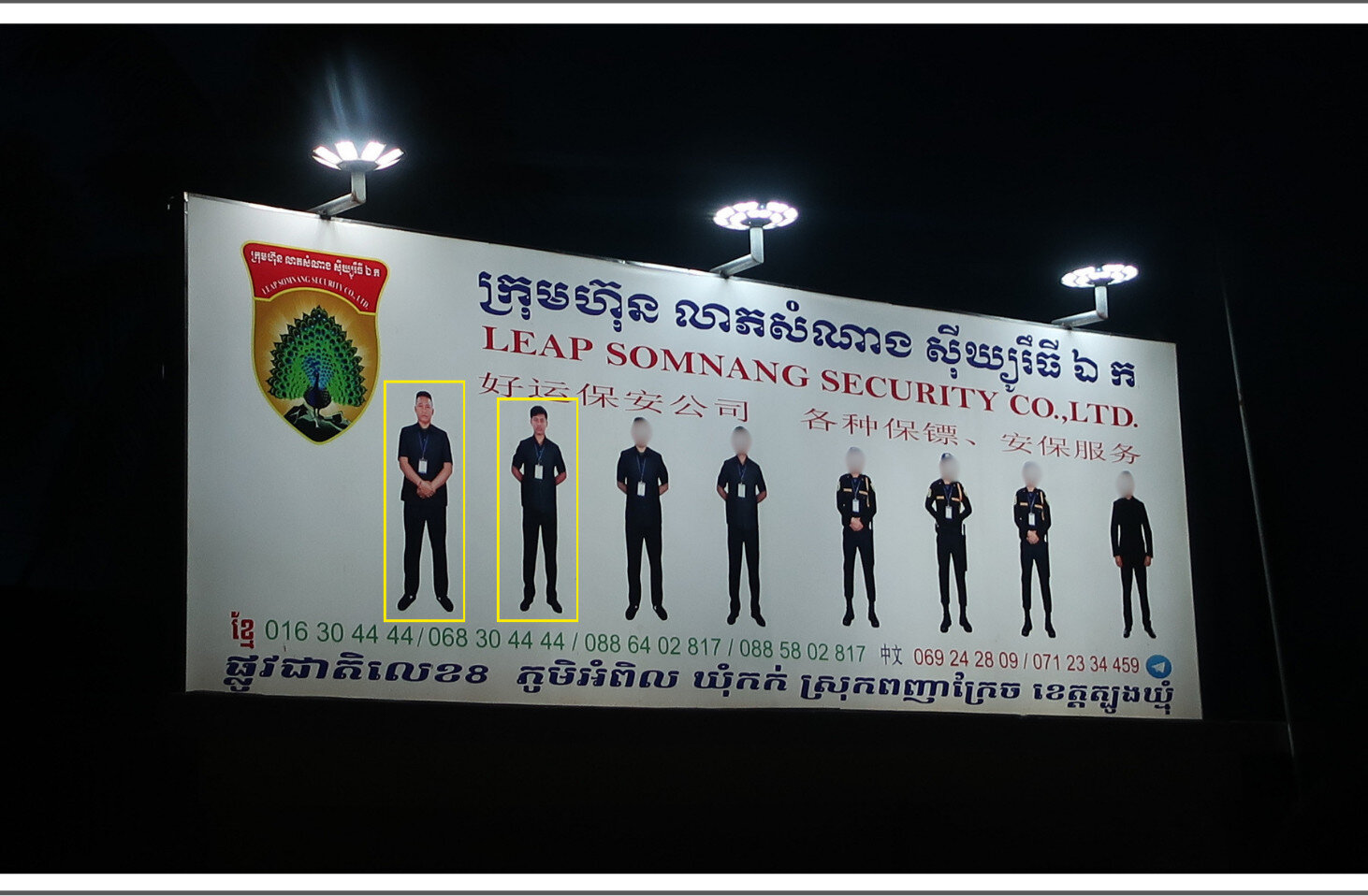
These repeated encounters should have brought the company’s role to the attention of authorities. Any investigation into Leap Somnang would have identified Ban Sophat, given the public nature of his association with the company. Yet Amnesty International is unaware of any public evidence that the company itself was investigated, including after the arrest of its guards.
Taken together, these facts strongly imply that security companies benefited from a failure to uphold domestic law. This further explains how the state has failed to uphold its international responsibilities, as it failed to investigate key perpetrators of human rights abuses despite having laws in place that should have been used to investigate security companies.
8. CONCLUSION
Evidence collected by Amnesty International over the past four years indicates that the scamming industry in Cambodia has involved the widespread and systematic commission of serious human rights abuses. Security companies and the guards employed by transnational criminal organized groups were essential to the operation of the compounds: they confined trafficked people, prevented and responded to escape attempts, enforced compliance through threats and use of violence and, in some cases, directly participated in torture and other ill-treatment. These companies and their personnel were also linked to a wider network of actors, including members of the military and police, politically exposed persons and powerful political and business interests.
Amnesty International is not aware of any investigations by Cambodian state authorities into the companies documented in this report, their owners and managers, or the individual guards who committed or facilitated abuses. Nor is Amnesty International aware of any meaningful efforts to investigate the wider networks of commercial relationships, state connections and protection that allowed security companies and criminal syndicates to operate across Cambodia on such a scale. The continued operation of some companies after police interventions, including at compounds where their guards were arrested, demonstrates the limitations of pursuing individuals or particular sites without scrutinizing the companies and networks behind them. The connections between security guards and companies and the state may explain why the industry thrived for so long in Cambodia, and continues to do so, despite international outcry.
Accountability is essential for the victims and survivors of imprisonment, slavery, human trafficking, forced labour, torture, rape and other serious human rights abuses. Those who committed, facilitated or knowingly contributed to these abuses must be identified and, where sufficient admissible evidence exists, prosecuted in fair trials. This requires full and independent investigations not only into compound operators, but also into security companies, their owners, directors and managers, potentially individual guards, and any military, police, politically connected or business actors who may have enabled, protected or participated in their activities.
Such accountability is also indispensable to any credible and sustainable effort to end the scamming compound industry. Raids may temporarily disrupt operations, free victims, close particular compounds or lead criminal syndicates to relocate, but they will not dismantle the security infrastructure and networks of protection on which the industry depends. If the Cambodian government is serious about ending the industry, its crackdown must include comprehensive investigations, fair prosecutions supported by evidence, the suspension or revocation of company licences where appropriate, and effective measures to end the involvement of state personnel in compound security. Without accountability, the structures enabling the industry will remain intact and the same abuses will be able to re-emerge.
9. RECOMMENDATIONS
9.1 TO THE CAMBODIAN AUTHORITIES
The following recommendations are made to the Cambodian authorities responsible for oversight of criminal activity, corruption, the financial and business sectors, human trafficking, the police and the RCAF:
INVESTIGATIONS AND ACCOUNTABILITY
- Establish prompt, independent, impartial and adequately resourced investigations into the role of private security companies in the scamming compound industry in Cambodia, including the companies identified in this report and any other providers operating at scamming compounds.
- Investigate company owners, directors, managers, recruiters, trainers and guards to determine their involvement in slavery, human trafficking, forced labour, unlawful deprivation of liberty, torture and other ill-treatment, rape and other serious human rights abuses.
- Conduct financial investigations into relationships between security companies, compound operators, casinos, property owners, developers, financial institutions and other businesses linked to scamming compounds. Freeze and, following lawful and fair proceedings, confiscate any assets that can be legally secured, prioritizing their use for survivor reparations.
- Review previous police interventions at scamming compounds, particularly cases in which guards were arrested but the companies employing them were not investigated and continued operating.
- Investigate all instances in which the presence of weapons must have been observed by police and should have triggered police interventions in order to determine why the confiscation of weapons or further actions did not occur.
SECURITY COMPANY LICENCES AND OPERATIONS
- Suspend the licences of security companies credibly implicated in serious human rights abuses pending effective investigations, and revoke licences where companies are found to have committed, facilitated or knowingly contributed to abuses.
- Require guards to carry individually numbered identification cards and wear uniforms prominently displaying their employer’s name and logo and clearly distinguishing them from police, military and other state authorities.
WEAPONS, EQUIPMENT AND USE OF COERCIVE MEANS
- Prohibit the use and carrying of electric shock batons by private security companies and conduct raids on locations where electric shock batons are likely to be stored.
- Immediately prohibit the sale of electric shock batons in or to Cambodia for law enforcement or private security purposes.
- Prohibit private security personnel from possessing or using electric shock batons and other direct-contact electric shock weapons, remove such weapons from circulation and investigate their importation, distribution and use.
- Investigate every documented instance of a private guard possessing or using a firearm and strictly enforce the general prohibition on firearm possession by private persons, and off-duty carrying or use by security personnel.
- Enforce human rights-compliant rules on the use of coercive means, including weapons and equipment by private guards and independently investigate every incident involving death, injury or other allegations of violence.
REGULATION AND OVERSIGHT
- Conduct an independent review of the Ministry of Interior and National Police’s licensing and oversight of the private security sector, including compliance with the reporting obligations established under Sub-Decree 289. Immediately identify areas where reform is needed to strengthen effective control and oversight over security companies and implement such a reform speedily
- Investigate and publish the required security plans and monthly reports in relation to the companies documented in this report and investigate whether officials failed to act on information indicating unlawful confinement or other abuses.
DISMANTLING THE ENABLING SYSTEM
- Investigate the wider networks enabling scamming compounds, including security companies, casinos, property owners, developers, recruiters, financial actors, telecommunications providers and politically connected individuals.
- Suspend relevant commercial or operating licences, including casinos, where premises are credibly suspected of being used for serious human rights abuses and the responsible business has failed to prevent or address them.
- Immediately suspend the gambling licenses of the casinos named in Amnesty International’s June 2026 report and conduct a full, independent and transparent investigation into the violations documented at those sites. Investigate all those suspected of individual responsibility for crimes under international law or other gross human rights violations, including the owners, financiers and operators of those casinos.
SURVIVORS’ RIGHTS AND REMEDY
- Treat all individuals found inside scamming compounds as potential victims of human trafficking, forced labour, slavery or other abuses and provide individualized assessments by trained, independent specialists.
- Provide survivors with safe accommodation, food, medical and psychological care, interpretation, legal assistance and access to families and consular representatives.
- Protect survivors and witnesses against intimidation, reprisals and re-trafficking, and ensure that assistance is not conditional on cooperation with law enforcement.
- Do not detain, prosecute, fine or otherwise punish trafficked persons for immigration offences or unlawful acts they were compelled to commit as a direct consequence of trafficking.
- Respect the principle of non-refoulement and ensure that any return to a survivor’s home or preferred country is safe, informed and voluntary.
- Guarantee access to effective remedy, including restitution, compensation, rehabilitation, satisfaction and guarantees of non-repetition, supported where possible by assets confiscated from responsible actors.
TRANSPARENCY AND INTERNATIONAL COOPERATION
- Publish disaggregated data on compound interventions, including sites investigated, trafficking assessments conducted, victims identified, arrests made, charges brought and companies investigated.
- Preserve and disclose records of interventions, including information about security providers encountered and action taken against them.
- Allow independent human rights monitors and defenders, journalists and civil society organizations to investigate, and citizens to report on, affected locations and engage with survivors without intimidation or retaliation.
- Release and drop all charges against journalists who have been arrested and charged with crimes because of their reporting on the scamming industry, and encourage citizens, journalists and other witnesses to report on the presence of scamming compounds.
- Cooperate with international investigations, mutual legal assistance requests, UN human rights mechanisms and efforts to trace and recover assets connected to the scamming industry and associated human rights abuses.
9.2 TO THE CAMBODIAN NATIONAL POLICE, ROYAL CAMBODIAN ARMED FORCES AND OTHER SECURITY BODIES
- Identify and thoroughly, independently and impartially investigate serving police, military and other security personnel who own, manage, recruit for, train, supervise or work for private security companies linked to scamming compounds. Require personnel to disclose relevant financial, managerial and employment interests.
- Require officers intervening at suspected scamming compounds to record the identity, employer, role and equipment of all security personnel encountered and to preserve relevant contracts, guard lists, deployment records and communications. Confiscate all weapons unlawfully possessed by security personnel and investigate related offences thoroughly and immediately.
- Investigate the misuse of official authority, information or resources, including allegations that officials provided operators with advance warning of interventions or that military weapons, vehicles, licence plates, uniforms, premises or training facilities were used in private security operations.
- Ensure independent prosecutorial oversight of investigations involving police officers, military personnel, politically connected individuals or senior company officials. Internal disciplinary proceedings must not replace criminal investigations where the conduct may constitute a criminal offence under domestic or international law.
9.3 TO PRIVATE SECURITY COMPANIES OPERATING IN CAMBODIA
- Immediately cease providing services at any location where people are unlawfully confined, trafficked, forced to work, tortured or otherwise subjected to serious human rights abuses.
- Cooperate fully with independent investigations and preserve contracts, personnel and deployment lists, communications, financial information and other potentially relevant evidence in line with existing law.
- Disclose the company’s ultimate beneficial owners, directors, senior managers and all personnel deployed to scamming compounds.
- Suspend personnel credibly implicated in abuses pending independent investigation and ensure that internal disciplinary action does not obstruct criminal accountability.
- Undertake effective human rights due diligence before accepting or continuing contracts at casinos, hotels, special economic zones, large compounds or other high-risk sites.
- Provide or contribute to effective remedy for all human rights abuses suffered by victims linked to security guard companies.
9.4 TO COMPANIES AND ORGANIZATIONS ENGAGING PRIVATE SECURITY PROVIDERS
- Conduct human rights due diligence before contracting, financing, insuring, training, partnering with or publicly endorsing security providers in Cambodia.
- Review existing relationships with companies, including those identified in this report, and suspend them where credible allegations cannot be effectively addressed, pending investigation.
- Require providers to disclose their ownership, deployment locations, clients, involvement of state personnel, weapons and equipment, complaints and grievance mechanisms, and record of complaints or disciplinary action.
- Terminate relationships with providers that conceal relevant information, obstruct investigations or fail to prevent serious abuses.
- Provide or contribute to remedy where the business caused or contributed to harm, rather than relying solely on contract termination.
9.5 TO FOREIGN GOVERNMENTS AND THE INTERNATIONAL COMMUNITY
- Prioritize funding rescue shelters and civil society organizations that are working on this issue and supporting the victims.
- Press Cambodia to treat survivors as victims of human trafficking. Deploy diplomatic and consular staff to visit the immigration detention centres and rescue shelters.
- Press Cambodia to promptly, impartially and independently investigate companies, company leadership and state officials linked to scamming compounds, including through international and domestic mechanisms, rather than measuring progress through raids, arrests or deportations.
- Review law enforcement, military, financial and security cooperation with Cambodian institutions and individuals credibly implicated in enabling or protecting scamming compounds.
- Investigate people and companies within their jurisdiction that financed, trained, supplied, insured or otherwise contributed to scamming compound operations.
- Establish and exercise jurisdiction, including universal or other extraterritorial jurisdiction where available, over groups, companies and people suspected of responsibility for serious human rights abuses including crimes under international law in the scamming compound industry, and if enough admissible evidence exists, issue arrest warrants and seek to prosecute them in fair trials without recourse to the death penalty.
- Consider launching asset tracing and recovery, survivor-centred investigations, witness protection, and reparations.
- Support independent Cambodian journalists and civil society organizations.
- Use the powers at their disposal, including diplomatic and law enforcement, in line with international human rights law and standards, to press for investigations into security companies, compound operators and politically connected actors, and other actions.
- Investigate nationals, companies and financial networks linked to the ownership, financing, management or protection of Cambodian scamming compounds.
- Require state-owned enterprises, chambers of commerce and other businesses to conduct human rights due diligence before engaging Cambodian security providers or businesses linked to compounds.
- Ensure that bilateral anti-scam operations include individualized human rights-based trafficking screening, legal assistance and protections against arbitrary detention and forced return.
9.6 TO GOVERNMENTS OF COUNTRIES WHOSE NATIONALS ARE TRAFFICKED TO CAMBODIA
- Provide accessible consular assistance, legal support and safe temporary accommodation to nationals escaping or rescued from scamming compounds.
- Train consular officials to identify trafficking for forced criminality and avoid presuming that people involved in scamming operations acted voluntarily.
- Investigate recruiters, brokers and companies operating in countries of origin that deceptively recruit people into scamming compounds.
- Facilitate safe and voluntary return and provide rehabilitation and reintegration support.
- Apply fully and rigorously the non-punishment principle, do not prosecute compound victims for conduct they were compelled to undertake as a direct consequence of trafficking, and ensure that trafficked persons are never held in immigration detention or other forms of custody.
- Ensure that bilateral anti-scam operations include individualized human rights-based trafficking screening, legal assistance and protections against arbitrary detention and forced return.
- States, individually and collectively, should effectively exercise jurisdiction, whether passive personability, universal or other extraterritorial jurisdiction in respect of groups, companies and persons involved in the scamming compound industry whenever they travel outside of Cambodia to investigate their responsibility for serious human rights abuses including crimes under international law.
9.7 TO FINANCIAL INSTITUTIONS, INSURERS AND PAYMENT SERVICE PROVIDERS
- Conduct due diligence on security companies, casinos, developers and other compound-linked businesses and individuals presenting heightened trafficking or money laundering risks.
- Investigate suspicious transactions involving security companies operating at scamming compounds and report them to competent authorities where required.
- Preserve relevant records and cooperate with lawful investigations, asset tracing and recovery efforts.
- Provide or contribute to remedy where their services caused or contributed to human rights abuses.
This annex sets out evidence linking scamming compounds in Cambodia to private security companies – namely Leap Somnang, Security Response, ZD Security, Dara Security and Best Security. All compounds included in the annex were previously identified by Amnesty International as scamming compounds in 2025 and 2026. Unless otherwise indicated, the human rights abuses described in each profile were previously documented and published by Amnesty International. This documentation relied on survivor testimony, photographs, videos, media reporting and information from organizations.
The profiles below also set out the evidence linking individual security companies to the scamming compounds. The evidence of company presence includes geolocated TikTok and Facebook content, site visits documenting guards in identifiable uniforms, survivor identification of company logos or uniforms, company recruitment advertisements, photographs used in recruitment posts, media reports and, in some cases, images of guards during police interventions. References to guards appearing at specific compounds are based on Amnesty International’s geolocation of the relevant video or photograph, carried out by comparing visible features in the content, including buildings, gates, roads, perimeter walls, landmarks, terrain, signage and other distinctive markers, with satellite imagery, site visit observations and other available visual evidence. In some cases, the same compound appears more than once because the evidence links different security companies to the same site.
The tables indicate that the involvement of private security companies was not isolated to a single company, location or time period. Several companies appear across multiple compounds, and the evidence often shows guards present over sustained periods, including during periods when abuses were reported by survivors, civil society organizations and media outlets. The overall pattern supports the conclusion that private security companies form part of the scamming compound industry.
1. LEAP SOMNANG
1.1 BA11 (BAVET, SVAY RIENG PROVINCE; 11.0715, 106.1636)
BA11 was identified as a scamming compound by Amnesty International in June 2025.359
Amnesty International geolocated one TikTok user’s videos and photographs to BA11. The account had previously posted content from BS02 showing the user in a Leap Somnang uniform and logo and later showed the user wearing the same uniform at BA11.
| HUMAN RIGHTS ABUSE | PRESENCE OF SECURITY GUARD COMPANY | ||
|---|---|---|---|
| DATE | ABUSE | DATE | GUARD PRESENCE |
| Early 2024 | Three survivors interviewed by Amnesty International escape BA11after being trafficked to the site for labor exploitation, confined at the site by security guards and told they would be “sold” to another compound if they did not do the scamming work.360 All three identified the site by pictures provided by Amnesty International. | ||
| Second half of 2024 | Amnesty International interviewed three children and one adult who were at this site in the second half of 2024. The children had been trafficked to the site and then confined there.361 The adult had initially entered the compound to work there willingly, but was physically assaulted when he tried to leave.362 The children were able to identify the site as BA11. | ||
| Second half of 2024 | An organization says three victims were released from the BA11 site with assistance from local authorities.363 Another organization says a group of victims is seeking help to leave the BA11 site.364 | 30 December 2024 – 1 June 2025 | A TikTok user wearing a Leap Somnang uniform can be geolocated to the site in posts as early as December 2024 and through to June 2025.365 |
| 7 January 2025 | Saigon News reports that Cambodian authorities arrested five individuals on human trafficking charges. The article says that authorities identified, amongst others, a casino located at the front of BA11 as a location where illicit activities under coercive measures took place.366 | ||
| 17 January 2025 | Vietnamese news outlet NGHE AN 24H reports that debt collectors at a casino detained a man at a building in BA11 in November/December 2024 until he could repay his debts. The organized criminal group members allegedly called the man’s wife demanding a ransom and threatening to kill the man. The man tried to escape, upon which the compound guards recaptured him. He was reportedly transferred out of the compound but was killed by his captors in the process.367 The news report refers to a casino located at the front of BA11 as the site where this took place.368 Amnesty International interviewed two children from BA11 who were threatened while their families’ were told to pay ransoms to secure their release.369 | ||
1.2 BM02 (BANTEAY MEANCHEY PROVINCE; 13.5506, 102.5692)
BM02 was confirmed as a scamming compound by Amnesty International in June 2026.370 Amnesty International geolocated one TikTok user’s videos and photographs to this site, which included videos showing himself wearing the Leap Somnang uniform at the compoud. Two survivors identified the Leap Somnang logo as the one that guards had on their uniforms.
| HUMAN RIGHTS ABUSE | PRESENCE OF SECURITY GUARD COMPANY | ||
|---|---|---|---|
| DATE | ABUSE | DATE | GUARD PRESENCE |
| January 2026 | Survivor M contacts Amnesty International with information that suggests they are at the BM02 compound, including providing photographs that can be geolocated to the site. The person also provides evidence of crimes being committed at the site including torture or other ill-treatment and confinement.371 | 25 July 2025 – 2 June 2026 | TikTok posts from one user geolocated to the compound show him wearing a Leap Somnang hat on 25 March 2026. Two survivors identified the Leap Somnang logo and said that guards wearing the logo were at the site in early 2026. In addition, Amnesty International has geolocated one member of the RCAF to the compound where he is seen leading and training guards from October 2025 to April 2026. |
| Early 2026 | Survivor F tells Amnesty International they were trafficked to the site and deprived of their liberty there during the crackdown period. The victim identifies the location from photographs.372 | ||
| Early 2026 | Survivor M tells Amnesty International the site is being raided by authorities. The survivor provides photographs of people escaping the location.373 | ||
1.3 BS02 (BOTUM SAKOR, KOH KONG PROVINCE; 10.8886, 103.1461)
BS02 was confirmed as a scamming compound by Amnesty International in June 2025.374 Amnesty International geolocated two TikTok users’ videos and photographs to guard positions within this site, including videos that showed dozens of guards wearing Leap Somnang uniforms and logos at BS02.
| HUMAN RIGHTS ABUSE | PRESENCE OF SECURITY GUARD COMPANY | ||
|---|---|---|---|
| DATE | ABUSE | DATE | GUARD PRESENCE |
| Late 2024: | An organization shares information that four people are rescued from the site by local authorities.375 | 30 May 2024 – 1 December 2024 | TikTok posts from two users that can be geolocated to the site show Leap Somnang security guards guarding the location from at least May 2024 until February 2025. In mid-2024, Amnesty International visits the site and documents Leap Somnang security guards at the location. |
| Early 2025: | An organization shares information that a person is seeking to be rescued from BS02 after being tortured.376 | ||
| Mid-2025: | An organization shares information that one person is rescued from the site by local authorities.377 | ||
1.4 CH01 (CHOAM, PREAH VIHEAR PROVINCE, 14.3432, 104.0568)
CH01 was confirmed as a scamming compound by Amnesty International in June 2025.378 Amnesty International geolocated one TikTok user’s videos and photographs to this site, which included videos showing guards wearing the Leap Somnang uniform at the site. Amnesty International identified five other TikTok accounts posting evidence of themselves or others guarding the CH01 compound, including two accounts believed to be guards that were active police or military.
| HUMAN RIGHTS ABUSE | PRESENCE OF SECURITY GUARD COMPANY | ||
|---|---|---|---|
| DATE | ABUSE | DATE | GUARD PRESENCE |
| Second half of 2024 | Amnesty International interviews two survivors of the CH01 compound. Both survivors reported being trafficked to, beaten and confined at the site in 2024 before escaping. Survivors were able to identify the site based on photographs and accurately described the journey to the site.379 | 3 June 2024 – 31 October 2025 | TikTok posts from one user geolocated to the compound show Leap Somnang guards at the site in four posts from 3 June 2024 until 31 October 2025. In addition, Amnesty International has geolocated one member of the RCAF and one police officer to guard positions at the compound during 2025. |
| End of 2024 | An organization says they are assisting a victim from this compound.380 | ||
| Early 2025 | An organization says they are assisting a victim from this compound.381 | ||
1.5 KA02 (KAMPOT PROVINCE; 10.4404, 104.4424)
KA02 was confirmed as a scamming compound by Amnesty International in June 2025. 382 Amnesty International geolocated three TikTok users’ videos and photographs to guard positions within this site, including videos that show the Leap Somnang logo being worn by guards, suggesting Leap Somnang guarded the site. One of the users appears to have been active military personnel while guarding the site. All four survivors identified the Leap Somnang security company as providing security at the site in late 2025 and early 2026.383
| HUMAN RIGHTS ABUSE | PRESENCE OF SECURITY GUARD COMPANY | ||
|---|---|---|---|
| DATE | ABUSE | DATE | GUARD PRESENCE |
| 24 May 2022 | VOD profiles a Chinese national who said was detained and tortured in KA02. The victim’s case gained attention after he posted on a Facebook live stream of the Prime Minister, saying “Hello Prime Minister Hun Sen, I am a Chinese. I was tricked into a scam park in Baima City, Kampot Province, forcing me to work in fraud, if I didn’t work they would shock me with an electric baton, hit me with a stick, please help me, I really I don’t want to die, please.” The victim’s case was dropped by police after they learned he had entered into a contract with a company operating at the site, with police claiming “There is no detention, it is just they do not allow him to get out.”384 | 1 December 2021 – February 2026 | TikTok posts from three TikTok users geolocated to the compound show Leap Somnang guards at the site in guard posts between 1 December 2021 and 11 November 2025. A post from 1 December 2021 from a Facebook user appears to show Colonel Ban Sophat at the site near Leap Somnang guards. At least one guard that can be geolocated to the compound appears to be RCAF personnel. Survivors who were inside the compound during 2025 recognised the Leap Somnang logo and said it was worn by the guards who abused them. |
| Mid-2024: | Amnesty International delegates visit the site and interview two residents. The first recalls military police coming to their house two days earlier to ask if they had seen a woman who had run away from the KA02 site.385 The second resident reported witnessing “several” Chinese nationals who had attempted to run away from the site. The second resident said he told foreign nationals to return to the KA02 site because otherwise the guards would find them and hurt them.386 | ||
| Early to late-2025 | Amnesty International interviewed one survivor who said they were trafficked to the compound, forced to work, deprived of their liberty by armed security guards, and subjected to torture while at the site.387 | ||
| 2025 – February 2026 | Amnesty International interviewed three survivors who said they were trafficked to the compound, forced to work, deprived of their liberty by armed security guards, and subjected to torture while at the site.388 | ||
| 10 February 2026 | Police intervened and ultimately shut down this location on 10 February 2026.389 | ||
1.6 MD02 (MONDULKIRI PROVINCE; 12.3872, 107.3147)
MD02 was confirmed as a scamming compound by Amnesty International in June 2026.390 One additional survivor was interviewed in mid-2026 and described being physically assaulted by guards wearing the uniform and logo of Leap Somnang. Two other survivors identified the logo of Leap Somnang as being worn by guards at this site and provided photos that showed this. Amnesty International has geolocated videos and pictures from six TikTok accounts to guard positions within the site, including pictures that show guards wearing the Leap Somnang logo. A recruitment from the company Facebook page includes pictures of Leap Somnang guards that can be geolocated to the MD02 site. Finally, published photos of police interventions at the site shows the arrest of Leap Somnang guards at that time.391
| HUMAN RIGHTS ABUSE | PRESENCE OF SECURITY GUARD COMPANY | ||
|---|---|---|---|
| DATE | EVIDENCE OF ABUSES | DATE | GUARD PRESENCE |
| Early 2025 | Amnesty International interviewed a survivor who was very likely at the site at this time. The survivor identified the road to the compound, described travel times that matched the driving times required to have gone from another compound to this compound, and described the scenery in a way that was consistent with the area.392 | 3 March 2025 – early 2026 | TikTok posts from six users geolocated to the compound show Leap Somnang guards at the site in guard posts between 26 March 2025 and early 2026. A recruitment for security guards posted to the Leap Somnang Facebook page on 3 March 2025 include images of guards in uniform at the MD02 compound. In July 2025, photographs shows the arrest of Leap Somnang security guards during the intervention. 393 In August 2025, Amnesty International visits the site and documents security guards. The security guards at the site were identified as Leap Somnang security guards. Survivors who were inside the compound during August 2025 sent the logo of Leap Somnang security guards and said they were guarding the site during their period at this site and previously at TBK02. |
| 21 July 2025 | The site is investigated by provincial police. According to Kohsantepheap Daily, 139 people were arrested during the intervention, of which all were foreign nationals except for 35 Cambodian guards, cleaners and gardeners.394 | ||
| Mid-2025 | Amnesty International interviewed a survivor, who was at the site at this time and identified pictures of the site.395 | ||
| Late 2025 | Amnesty International interviewed two survivors, who were at the site at this time and identified pictures of the site and provided images of security guard logos. Additionally, they identified a man they said was a translator in the compound from a news report about the location. The identified man was pictured standing with police while others, possibly under arrest, were sitting.396 | ||
1.7 PO17 (POIPET CITY; 13.6495, 102.5977)
PO17 was confirmed as a scamming compound by Amnesty International in June 2026.397 Amnesty International identified the logo and uniform of the company on guards at the site during site visits in late-2025. Additionally, one survivor, interviewed by Amnesty International in August 2026, confirmed the logo of Leap Somnang on the guards at the site. Amnesty International geolocated one TikTok users’ videos and photographs to guard positions at this site, including videos and photographs showing more than five guards wearing Leap Somnang uniforms at the gates of the site.
| HUMAN RIGHTS ABUSE | PRESENCE OF SECURITY GUARD COMPANY | ||
|---|---|---|---|
| DATE | EVIDENCE OF ABUSES | DATE | GUARD PRESENCE |
| January 2026 | An organization reports a rescue from this site of seven people in January 2026.398 | August 2025 – Early 2026 | In August 2025, Amnesty International visits the site and documents Leap Somnang security guards at the gates and other security features. TikTok posts from one TikTok user geolocated to the compound show Leap Somnang guards at the site in guard posts between 2 November 2025 to early 2026. |
| 29 April 2025 | A video published by Fresh News appears to show authorities intervening at the site.399 | ||
| October 2025 | A survivor tells Amnesty International they were abused at the PO17 compound and identified Leap Somnang’s logo and the gate from photographs.400 | ||
1.8 SI01 (SIHANOUKVILLE, PREAH SIHANOUK PROVINCE; 10.5792, 103.5572)
SI01 was confirmed as a scamming compound by Amnesty International in June 2025.401 Photographs from Leap Somnang’s Facebook page can be geolocated to show the company’s guards in uniform at the site, including a photograph of Colonel Ban Sophat with Leap Somnang guards.
| HUMAN RIGHTS ABUSE | PRESENCE OF SECURITY GUARD COMPANY | ||
|---|---|---|---|
| DATE | ABUSE | TIMELINE | GUARD PRESENCE |
| In late 2021 | An organization says that three people escape SI01. All three people reported being forced to work and not allowed to leave the compound. They also said they were “sold” to the site by managers.402 | November 2019 – February 2022 | A photograph posted to Leap Somnang’s Facebook page on 9 November 2019 shows Ban Sophat with four security guards and one other person inside of what appears to be SI01.403 A photograph posted to Leap Somnang’s Facebook page on 30 December 2020 shows 11 security guards wearing the Leap Somnang uniform inside of what appears to be SI01.404 Three photographs posted to Leap Somnang’s Facebook page on 23 February 2022 shows more than 20 security guards wearing the Leap Somnang uniform inside of SI01.405 |
| Early 2022 | An organization is in contact with a victim who was “sold” to SI01 and is working at the site under the threat of violence.406 | ||
| 17 February 2022 | VOD reports that a Chinese man is trafficked to Cambodia where he eventually ends up in SI01 and has his blood taken against his will.407 The Chinese Embassy also released information confirming that the victim’s blood was harvested.408 | ||
| 18 February 2022 | VOD reports that a Chinese man was kidnapped and later sold to SI01. VOD also reports that dozens of trafficking victims had told rescue groups of forced labor at the site.409 | ||
| February – March 2022 | A survivor tells Amnesty International that in February and March 2022 they are confined against their will at the SI01 location after being sold there from another location. At SI01 they reported hearing screaming from the use of shock batons and reported there being a “dark room” in the building that was used for torture.410 | ||
| 2 April 2022 | Beijing Youth Daily reports that a Chinese man and woman were separately trafficked from two compounds to SI01. The man said that, upon his arrival, he was threatened with beating or killing as punishment. He noted the presence of a “small dark room” on each floor, containing electric batons, needles, pliers, ropes and handcuffs, and that the residential rooms were kept under strict surveillance. He reported that there were armed security guards inside and outside the building to guard against escape, and that free movement was not permitted. The woman reported that she was forced to work 12 hours each day, and that her entry and exit were strictly regulated. She noted that she had to “purchase” her own freedom from the company.411 | ||
| April – September 2022 | An organization says that 10 victims are rescued with assistance of local authorities from this location.412 | ||
| 11 August 2022 | Al Jazeera reports having spoken to two victims who had been trafficked to the SI01 site and “enslaved” there.413 | ||
| 26 August 2022 | VOD reported on a Vietnamese victim who had been trafficked to SI01 where he was subjected to torture or other ill-treatment, forced to run scamming operations and confined against his will.414 | ||
| 3 September 2022: | Mothership news reports that, based on the testimony of two victims of scam compounds, there were four Singaporean nationals at the SI01 site and described them as “victims”.415 | ||
| 19 September 2022 | VOD reported speaking to workers at SI01 amidst crackdowns on compounds in Sihanoukville. One worker who was cutting down barbed wire noted that they had detained people at the site. A guard told the reporter that more than 1,000 people had left the compound days before.416 | ||
| 19 September 2022 | VOD reported speaking to workers at SI01 amidst crackdowns on compounds in Sihanoukville. One worker who was cutting down barbed wire noted that they had detained people at the site. A guard told the reporter that more than 1,000 people had left the compound days before.417 | ||
| 29 September 2022 | VOD reported speaking to a security guard at SI01 who had worked to prevent escapes from the site.418 | ||
| 8 December 2023 | The UK government sanctions a company located at the site of SI01, for links to forced labor schemes.419 | ||
| First half of 2025 | An organization says two victims are released from SI01 with assistance of local authorities.420 | ||
| 7 October 2025 | Police reportedly investigated the site after a protest by Pakistani and Bangladeshi nationals. 2,910 foreigners were detained.421 | ||
| Late 2025 | An organization says three victims are released from SI01 with assistance of local authorities.422 | ||
1.9 SI02 (SIHANOUKVILLE, PREAH SIHANOUK PROVINCE; 10.5750, 103.5526)
SI02 was confirmed as a scamming compound by Amnesty International in June 2025.423 Photographs from Leap Somnang’s Facebook page can be geolocated to show the company’s guards in uniform at the site.
| HUMAN RIGHTS ABUSE | PRESENCE OF SECURITY GUARD COMPANY | ||
|---|---|---|---|
| DATE | ABUSE | DATE | GUARD PRESENCE |
| 17 February 2022 | VOD reports that a Chinese man is trafficked to Cambodia, where he was taken to “Jinshui Building 10” at SI02. The man reports being instructed to conduct scamming operations, and when he refused, being beaten.424 | 23 February 2022 – 4 November 2020 | A photograph posted to Leap Somnang’s Facebook page on 4 November 2020 shows around 20 security guards wearing the Leap Somnang uniform inside of what appears to be SI02.425 A photograph posted to Leap Somnang’s Facebook page on 23 February 2022 shows more than 20 security guards wearing the Leap Somnang uniform directly outside of SI02.426 A separate photograph posted on the same date shows Leap Somnang security guards inside of the SI02 compound. |
| April through September 2022 | An organization records rescues of 26 people from the SI02 compound in at least three different rescue operations, all of which involve Cambodian authorities, after these individuals sought help to leave the site.427 | ||
| 2 April 2022 | Beijing Youth Daily reports that a Chinese man, after a failed escape from another compound, was sold/trafficked to SI02 around June 2021. The alleged victim reported hearing “screaming at night”. The news report alleges that “beating and killing people are common” at this compound.428 | ||
| Second half of 2022 | A survivor is released from SI02 by police in the second half of 2022 and explains that, during the “rescue”, the police entered the compound perimeter but did not go into the buildings where the victim had been held .429 | ||
| March 2023 | An ABC Australia reporter speaks with a Chinese man who says he was trafficked to and held at SI02 for several months. He describes feeling as though he were in jail and being deprived of sunlight.430 | ||
| June 2023 | An alleged victim of several compounds who spoke to Voice of America (VOA) in 2024 says he was sold to the SI02 compound in June 2023. He claims several of the buildings in the compound held trafficking victims from China, Indonesia, South Korea and Japan.431 | ||
| Late 2023: | State authorities intervene to remove a survivor from the SI02 compound. Amnesty International later interviews this survivor.432 | ||
1.10 SI12 (SIHANOUKVILLE, PREAH SIHANOUK PROVINCE; 10.6338, 103.5061)
SI12 was confirmed as a scamming compound by Amnesty International in June 2025.433 Amnesty International has identified one TikTok account that posted evidence of a Leap Somnang security guard that can be geolocated to the SI12 scamming compound. During site visits, Amnesty International did not identify the security guards as working for Leap Somnang. Amnesty International has geolocated the TikTok accounts of three active members of the RCAF to the location, two of which can be seen in videos directing security guards at the site.
| HUMAN RIGHTS ABUSE | PRESENCE OF SECURITY GUARD COMPANY | ||
|---|---|---|---|
| DATE | ABUSE | DATE | GUARD PRESENCE |
| 17 September 2022 | VOD reports that authorities raided SI12, while investigating human trafficking, sex trafficking, torture and detention. Authorities reported that 141 foreigners – including 130 Chinese nationals and 11 Vietnamese nationals – had entered the country illegally and were sent to the national immigration department. The authorities also found that 262 foreigners were working without work permits and would be fined. Authorities also confiscated “$78,840 in cash, as well as 8,776 phones, 804 computers, 16 laptops, 36 passports, four pairs of handcuffs, 10 different electric shock tools and documents.”434 | ||
| First half of 2024 | An organization reported to Amnesty International that they had received a credible request for a rescue from this location.435 | ||
| Second half of 2024 | An organization reported to Amnesty International that they had received a credible request for a group of people to be rescued from this location.436 | ||
| Late 2024 | Amnesty International site visits confirm presence of more than 10 security guards at the gate and perimeters, including security guards in guard towers that face internally.437 | ||
| 12 December 2025 | A TikTok user posts a photograph of a Leap Somnang guard at the site. | ||
1.11 SI15 (SIHANOUKVILLE, PREAH SIHANOUK PROVINCE; 10.6268, 103.5029)
SI15 was confirmed as a scamming compound by Amnesty International in June 2025.438 Amnesty International geolocated 10 TikTok users’ videos and photographs to guard positions at this site, including videos showing the guards wearing the uniform and logo of Leap Somnang. Additionally, Amnesty International sighted the uniform and logo of the company on guards during site visits in mid-2024 and August 2025.
| HUMAN RIGHTS ABUSE | PRESENCE OF SECURITY GUARD COMPANY | ||
|---|---|---|---|
| DATE | ABUSE | DATE | GUARD PRESENCE |
| July-September 2022 | An organization reports three people are rescued from the SI15 compound with the assistance of local authorities.439 | 24 September 2022 – 24 July 2026 | Photographs posted to the company Facebook page on 24 September 2022 show Leap Somnang guards at a building connected to the compound. TikTok posts from 10 TikTok users geolocated to the compound show Leap Somnang guards at the site in guard posts between 2022 and mid-2026. Two of the users wore t-shirts or other clothing items with military logos, one of them wore these clothes inside the compound. |
| Mid-2022 | A survivor told Amnesty International they are deprived of their liberty at SI15, before being sold to the BS04 compound.440 | ||
| Second half of 2022 | A survivor told Amnesty International they are confined against their will at SI15 before being trafficked to Phnom Penh before she escaped. The survivor provided pictures of the site and identified other buildings at the site as well as the gate in photos provided by Amnesty International.441 | ||
| Second half of 2024 | An organization says a person is rescued with the assistance of local authorities from SI15.442 | ||
1.12 SI16 (SIHANOUKVILLE, PREAH SIHANOUK PROVINCE;10.6240, 103.5024)
SI16 was confirmed as a scamming compound by Amnesty International in June 2025.443 Amnesty International geolocated five TikTok users’ videos and photographs to guard positions within this site, including videos showing guards wearing the uniform and logo of Leap Somnang. Additionally, Amnesty International sighted the uniform and logo of the company on guards during site visits in mid-2024 and August 2025.
| HUMAN RIGHTS ABUSE | PRESENCE OF SECURITY GUARD COMPANY | ||
|---|---|---|---|
| DATE | ABUSE | DATE | GUARD PRESENCE |
| Second half of 2024 | Amnesty International interviewed a child who said they had been trafficked to the SI16 site, identified pictures of the location (including the entrance), described being confined there and forced to run scams.444 | 15 June 2024 – 11 March 2026 | TikTok posts from five TikTok users geolocated to the compound show Leap Somnang guards at the site in guard posts between June 2024 and March 2026. |
1.13 SI39 (SIHANOUKVILLE, PREAH SIHANOUK PROVINCE; 10.6210, 103.5002)
SI39 was confirmed as a scamming compound by Amnesty International in June 2025.445 Amnesty International geolocated three TikTok users’ videos and photographs to this site, including videos showing guards wearing the uniform and logo of Leap Somnang. Additionally, Amnesty International sighted the uniform and logo on the guards during site visits in 2024 and 2025.
| HUMAN RIGHTS ABUSE | PRESENCE OF SECURITY GUARD COMPANY | ||
|---|---|---|---|
| DATE | ABUSE | DATE | GUARD PRESENCE |
| 10 May 2022 | A Bangladeshi person claims that they were taken to SI39 alongside nine other people who had previously been detained at BS04. The person says they were forced to conduct scams for two different “companies” while at SI39. They claim that it was not possible to escape because “it was highly guarded by security personnel.” 446 | ||
| Late 2022 | An organization says a rescue from the site with the assistance of local authorities occurred and shares videos that corroborate the location as the place where a victim was seeking to be rescued from.447 | ||
| 14 March 2024 – late 2025 | TikTok posts from three TikTok users geolocated to the compound show Leap Somnang guards at the site in guard posts between between March 2024 and July 2025. Amnesty International visits the site in late 2025 and documents Leap Somnang security guards at the gates and other security features. | ||
1.14 TBK02 (TBONG KHMUM PROVINCE; 11.6427, 105.8266)
TBK02 was confirmed as a scamming compound by Amnesty International in June 2026.448 Two survivors interviewed by Amnesty International identified the Leap Somnang company as having guarded the compound and showed photographs of the guards that included the logo.
| HUMAN RIGHTS ABUSE | PRESENCE OF SECURITY GUARD COMPANY | ||
|---|---|---|---|
| DATE | ABUSE | DATE | GUARD PRESENCE |
| Mid-2025 | Amnesty International interviewed two survivors who were at the site at this time (during the crackdown period) and were able to identify TBK02 compound buildings from pictures taken from the exterior.449 | Mid-2025 | Both survivors sent the logo of Leap Somnang to Amnesty International and said this was the security company at the TBK02 compound and which moved with them to, and then guarded, the MD02 compound.450 |
| Mid-2025 | Amnesty International visits the compound and finds it abandoned. | ||
| Early 2026 | A survivor tells Amnesty International he was forcibly moved to the site from PV01 to escape a police intervention. The survivor identified TBK02 from pictures of the gate and main building. The police then intervened at the site, and the survivor was told to leave the area.451 | ||
1.15 TBK04 (TBONG KHMUM PROVINCE; 11.6900, 105.9702)
TBK04 was confirmed as a scamming compound by Amnesty International in June 2026.452 Amnesty International geolocated five TikTok users’ videos and photographs to this site, including videos showing guards wearing the uniform and logo of Leap Somnang. Additionally, Amnesty International sighted guards wearing the companies’ uniform and logo during site visits in mid-2025. Amnesty International identified six other TikTok accounts posting evidence of guards at the site but could not confirm they were Leap Somnang guards.
| HUMAN RIGHTS ABUSE | PRESENCE OF SECURITY GUARD COMPANY | ||
|---|---|---|---|
| DATE | ABUSE | DATE | GUARD PRESENCE |
| Late 2024 | An organization reports a person is rescued with the assistance of local authorities from this location.453 Photographs of the victim show injuries. | 9 November 2024 – 16 June 2026 | TikTok posts from five TikTok users geolocated to the compound show Leap Somnang guards at the site in guard posts between between November 2024 and June 2026. In addition, Amnesty International visited the site in mid-2025 and documents Leap Somnang security at the gates. |
| July 2025 | An organization reports a person is rescued with the assistance of local authorities from this location.454 | ||
| August 2025 | An organization reports 12 victims are rescued from this site.455 | ||
2. SECURITY RESPONSE
2.1 KA01 (BOKOR MOUNTAIN, KAMPOT PROVINCE, 10.6347, 104.0170)
KA01 was confirmed as a scamming compound by Amnesty International in June 2025. News reports suggested the location was used as a scamming compound in 2022, but was abandoned or shuttered. Afterwards, Amnesty International reviewed rescue records, including photographs, provided by an organization that indicated people sought rescue from the location in second half of 2024 and in the beginning of 2025.456
Amnesty International geolocated one TikTok user’s videos and photographs to this site including showing him dressed as a security guard. The user previously posted videos that could be geolocated to SI02 and that show guards wearing the uniform of Security Response, suggesting Security Response may be guarding the KA01 site. Additionally, 20 recruitment advertisements posted to the Security Response Telegram chat are to ‘Bokor Mountain’, likely alluding to the KA01 or KA03 sites or both.
| HUMAN RIGHTS ABUSE | PRESENCE OF SECURITY GUARD COMPANY | ||
|---|---|---|---|
| DATE | ABUSE | DATE | GUARD PRESENCE |
| 5 October 2022 | CTS News reports speak to one victim who was confined and shocked with an electronic shock baton at a site where KA01 is located in July 2022.457 | ||
| 9 February 2023 | Camboja reports that Taiwan National Police Agency’s Criminal Investigation Bureau (CIB) told them in 2022 that Taiwanese victims had been trafficked to the KA01 compound. In addition, Humanity Research Consultancy reports that dozens of Taiwanese victims were held at the KA01, were violently beaten and threatened with death if they spoke to the media.458 | ||
| 24 October 2024 | Benar News reports speaking to a Vietnamese man who was confined in a compound in Bavet before being moved to KA01 where he was beaten and shocked with electric shock batons.459 | 20 April 2024 – 12 January 2025 | TikTok posts from a user geolocated to the compound show guards at the site in guard posts between between April 2024 and January 2025. Between 1 December 2024 and 20 April 2025, the TikTok user posted content that can be geolocated to the SI02 site, including in guard positions with Security Response guards. Amnesty International visited the site in late 2025 and saw guards at the site but was not able to identify the security company at the time. Between 7 August 2024 and 4 July 2025, the Security Response’s Telegram channel posts 20 recruitments for guards to “Bokor”, amongst other locations. |
| (Early 2025) April 2025 | An organisation reports four people were rescued from this location.460 | December 2024 – April 2025 | |
| (late) October 2025 | An organisation reports a person was rescued from this location.461 | ||
2.2 KA03 (BOKOR MOUNTAIN, KAMPOT PROVINCE; 10.6665, 104.0162)
KA03 was confirmed as a scamming compound by Amnesty International in June 2026.462 Amnesty International geolocated five TikTok user’s videos and photographs to guard positions at this site, including videos that showed several guards wearing the Security Response uniform, suggesting Security Response guarded the site. Amnesty International geolocated one account of a guard trainer to both the SI02 and KA03 compounds. SI02 was also guarded by Security Response during that time period. Additionally, 20 recruitment advertisements posted to the Security Response Telegram chat are to “Bokor Mountain”, likely alluding to KA01 or KA03 sites. Twelve of these recruitments to “Bokor Mountain” also make reference to “100 Rice Fields”, a location near to the KA03 site.
| HUMAN RIGHTS ABUSE | PRESENCE OF SECURITY GUARD COMPANY | ||
|---|---|---|---|
| DATE | ABUSE | DATE | GUARD PRESENCE |
| Early 2025 | An organization reports a victim seeking to be rescued from this site.463 | 18 October 2024 – 1 January 2026 | TikTok posts from five users geolocated to the compound show guards at the site in guard posts between between October 2024 and January 2026. This time frame corroborates the testimony of the three victims who said the site was being abandoned in mid-November 2025. Several videos show three or more guards wearing the uniform of Security Response. One trainer seen in videos from the site can also be seen in videos geolocated to SI02 where he is seen instructing guards and which is another compound guarded by Security Response. Amnesty International visited the site in October 2025 and documented security guards at the location. Between 7 August 2024 and 4 July 2025, the Security Response’s Telegram channel posts 20 recruitments for guards to “Bokor”, amongst other locations. 12 of these posts make reference to “100 Rice Fields” a location near to the KA03 site. |
| Mid-2025 (pre-July) | An organization reports two victims are seeking to be rescued from this site.464 | ||
| 8 August 2025 | A South Korean man is found dead, with signs of torture. Media reports that investigations were focused on Bokor mountain and led to the arrests of suspects.465 | ||
| 19 August 2025 | Police investigate a location on Bokor mountain over the death of the South Korean man and publish an image of the gate to KA03, suggesting that this was the compound they investigated at that time.466 | ||
| Mid to late-2025 | An organization reports 36 victims are rescued from the site with the assistance of local authorities over several interventions.467 | ||
| January – November 2025 | Three victims tell Amnesty International they were deprived of their liberty at the site, which they identify from photographs, for nearly 11 months during 2025 and only escaped in November 2025.468 | ||
2.3 PV01 (PREY VENG PROVINCE; 11.6111, 105.7847)
PV01 was confirmed as a scamming compound by Amnesty International in June 2026.469 Amnesty International geolocated 13 TikTok user’s videos and photographs to guard positions at this site, including videos that showed dozens of guards wearing the Security Response uniform. Additionally, six of the survivors identified specific security guards and the Security Response uniform as being worn by the security provider at the site. Further, Amnesty International contacted a recruiter who had posted recruitment advertisements for Security Response who shared his location which showed he was inside of the PV01 compound. Additionally, 28 urgent recruitments for the general area in which the compound is found were posted to the Security Response Telegram channel across 2024 and 2025.
| HUMAN RIGHTS ABUSE | PRESENCE OF SECURITY GUARD COMPANY | ||
|---|---|---|---|
| DATE | ABUSE | DATE | GUARD PRESENCE |
| Late 2024 | An organization reports victim A is rescued with the assistance of local authorities from this location.470 | 26 March 2024 – 12 June 2026 | Between 26 March 2024 and 27 May 2025, the Security Response’s Telegram channel posts 28 “urgent” recruitments for guards to “Road No 8, Prey Veng”, amongst other locations. These recruitments are believed to be for the PV01 compound – also known as Park 8. TikTok posts from 13 users geolocated to the compound show guards at the site in guard posts between between March 2025 and June 2026. Most of these users include content that shows the uniform of Security Response. At least one user has consistently tagged ‘Security Response’ while posting videos of guards at the PV01 compound. In mid-2025, Amnesty International identifies and speaks with a recruiter that has advertised and recruited for Security Response previously. The user shared his live location showing that he was at the PV01 site. At least one police officer worked as a guard either for or with Security Response guards at this site across 2025. Two other guards at the site are suspected to be active police officers. |
| Late 2024 | An organization reports victim B is rescued with the assistance of local authorities from this location.471 | ||
| Early 2025 | An organization reports victim C is rescued with the assistance of local authorities from this location.472 | ||
| Late 2025 | Amnesty International interviews a victim who says she was deprived of her liberty at the site up until late-2025.473 | ||
| Early 2026 | Amnesty International interviews nine victims who were inside of PV01 during the crackdown period, many of whom were inside until late 2025 or early 2026.474 | ||
| Early 2026 | Amnesty International interviews a victim who reported being moved from this compound in January 2026 to the TBK02 compound.475 | ||
| April 2026 | Mekong Independent reports an investigating judge visited the site.476 | ||
2.4 SI02 (SIHANOUKVILLE, PREAH SIHANOUK PROVINCE; 10.5750, 103.5526)
SI02 was confirmed as a scamming compound by Amnesty International in June 2025.477 Amnesty International geolocated six TikTok users’ videos and photographs to this site, including videos that showed guards wearing the Security Response uniform and lanyards with a matching logo, suggesting Security Response guarded the site. Additionally, Amnesty International confirmed the presence of the guards wearing the company uniform during site visits in August 2025.
| HUMAN RIGHTS ABUSE | PRESENCE OF SECURITY GUARD COMPANY | ||
|---|---|---|---|
| DATE | ABUSE | DATE | GUARD PRESENCE |
| 17 February 2022 | VOD reports that a Chinese man is trafficked to Cambodia, where he was taken to “Jinshui Building 10” at SI02. The man reports being instructed to conduct scamming operations, and when he refused, being beaten.478 | ||
| April through September 2022 | An organization records rescues of 26 people from the SI02 compound in at least three different rescue operations, all of which involve Cambodian authorities, after these individuals sought help to leave the site.479 | ||
| 2 April 2022 | Beijing Youth Daily reports that a Chinese man, after a failed escape from another compound, was sold/trafficked to SI02 around June 2021. The alleged victim reported hearing “screaming at night”. The news report alleges that “beating and killing people are common” at this compound.480 | ||
| Second half of 2022 | A survivor is released from SI02 by police in the second half of 2022 and explains that, during the “rescue”, the police entered the compound perimeter but did not go into the buildings where the victim had been held .481 | ||
| March 2023 | An ABC Australia reporter speaks with a Chinese man who says he was trafficked to and held at SI02 for several months. He describes feeling as though he were in jail and being deprived of sunlight.482 | ||
| June 2023 | An alleged victim of several compounds who spoke to Voice of America (VOA) in 2024 says he was sold to the SI02 compound in June 2023. He claims several of the buildings in the compound held trafficking victims from China, Indonesia, South Korea and Japan.483 | ||
| Late 2023: | State authorities intervene to remove a survivor from the SI02 compound. Amnesty International later interviews this survivor.484 | 5 November 2023 – 23 January 2026 | Six TikTok users post evidence of Security Response guards guarding the main gate of the SI02 compound. Amnesty International visits SI02 six times and documents the presence of guards wearing the Security Response uniform at the entrance gates and around the exterior of the SI02 property. Between 3 September 2024 and 27 May 2025, the Security Response’s Telegram channel posts 18 recruitments for guards to “Otres” or “Chinatown”, amongst other locations. These posts refer to the area in which SI02 is located. |
| 15 December 2025 | Fresh News reports authorities intervened at the compound. Pictures show authorities inside the compound.485 | ||
2.5 TK01 (TAKEO PROVINCE; 11.3308, 104.7495) “MANGO 2”
TK01 was confirmed as a scamming compound by Amnesty International in June 2025.486 Amnesty International geolocated two TikTok user’s videos and photographs to this site, including videos that showed three guards wearing the Security Response uniform, suggesting Security Response guarded the site. Both accounts later post videos suggesting they were moved to PV01 during a time period in which the compound is alleged to have fled. As above, PV01 is also guarded by Security Response. Additionally, Amnesty International sighted and photographed three guards at TK01 wearing the Security Response uniform at the entrance to the site in early-2025.
| HUMAN RIGHTS ABUSE | PRESENCE OF SECURITY GUARD COMPANY | ||
|---|---|---|---|
| DATE | ABUSE | DATE | GUARD PRESENCE |
| 23 October 2024 | South Korean news KBS reports speaking to seven victims of scam compounds and locates PP09 and TK01 as scam compound sites.487 | 27 August 2024 – 27 July 2025 | Two TikTok users post evidence of Security Response guards guarding the main gate of the SI02 compound. One guard who advertises for Security Response and who appears in the Security Response uniform posted videos on 19 August 2024 which appears to show him at the TK01 site. Amnesty International visits the site in mid-June and documents guards in the distinctive Security Response uniform at the site. Between 10 May 2024 and 27 May 2025, the Security Response’s Telegram channel posts 39 recruitments for guards to “Road No 3, Deum Roka Market, Takeo”, amongst other locations. These posts refer to a large area near, and likely including, PV01. |
| 25 October 2024 | CamboJa News reports that more than 1000 foreigners were detained by police from PP09 and TK01 site after police intervention.488 | ||
| 4 November 2024 | Khmer Times reports that only 25 foreigners were sent to court for questioning after raids on the PP09 and TK01 compound.489 | ||
| Early 2025 | An organization says that a victim is rescued with assistance of local authorities from TK01.490 | ||
| February 2026 | The site is converted into an immigration detention center by authorities.491 | ||
3. ZD SECURITY
3.1 BS04 (BOTUM SAKOR, KOH KONG PROVINCE, 10.9087, 103.1278)
BS04 was confirmed as a scamming compound by Amnesty International in June 2025.492 Amnesty International geolocated 19 TikTok users’ videos and photographs to this site, including videos showing dozens of guards at gates and inside of the compound wearing the BIC Security uniform, suggesting ZD Security, which was previously named ‘BIC Security’, guarded the site. Additionally, a separate account of a staff member of ZD Security can be geolocated to the site in February of 2026. This user posted recruitments for security guards to the site on 5 January 2026.
| HUMAN RIGHTS ABUSE | PRESENCE OF SECURITY GUARD COMPANY | ||
|---|---|---|---|
| DATE | ABUSE | DATE | GUARD PRESENCE |
| 10 June 2022 | VOD reports that a group of organizations and the father of a Taiwanese victim held at BS04 presented an official letter from Taiwanese diplomats requesting assistance from the Cambodian government regarding the trapped individual to the local authorities. After ransom payment and negotiation with the bosses of the compound, the trapped individual is released.493 | ||
| 22 August 2022 | VOD reports the Philippines embassy in Phnom Penh requests Cambodian officials’ help to rescue four people trapped in a compound in Koh Kong’s controversial Union Development Group project. It is not clear which building the four people are trapped in but BS04 is one of two possible compounds that Amnesty International has identified in the project area. A Cambodian police official acknowledged that foreigners from two or three countries had requested rescues and that all of the requests for rescue came from an area that includes BS04. The police officials disputed whether people were confined at the site or not.494 | 4 August 2021 – 13 May 2026 | Nineteen TikTok users post videos of themselves and others guards wearing the BIC Security uniform guarding the main gate, in the immediate vicinity of, and in other areas inside of the BS04 compound. A separate account of a staff member of ZD Security can be geolocated to the site in January 2026. This user posted recruitments for security guards to “Dara Sakor” but did not specify any company names in the recruitment. These recruitments are consistent with other recruitments that do not give precise locations. ZD Security recruitment channels on Telegram posted 12 advertisements between 12 November 2024 and 4 March 2025 for security guard positions in “Koh Kong” amongst other places. Two of these advertisements referred to “Dara Sakor” (29 July 2025) or “Star Bay” (16 June 2025), which likely refers to the BS04 site. |
| Mid-2022 | An organization shares information suggesting four victims of trafficking for the purposes of forced labour are being deprived of their liberty at this site. The statement from one victim indicates violence, including electric shocks, is being used at the site and that one of the victims has been put into a “dark room” for five days.495 | ||
| August – September 2022 | An organization says rescues of 10 people from this location take place.496 | ||
| 11 April 2024 | The Straits Times interviews a Bangladeshi man who claims to have been confined at BS04 for approximately one month in 2022.497 | ||
| Late 2022 | A survivor interviewed by Amnesty International is freed from the site by Cambodian authorities after being transferred to the site from SI15 compound.498 | ||
| Early 2023 | An organization says two victims are rescued from this site with assistance from local authorities.499 | ||
| July – September 2023 | An organization says three victims are rescued from this site with assistance from local authorities.500 | ||
| December 2023 | A survivor interviewed by Amnesty International, is freed from the site by state authorities after being trafficked to the site on a false job promise.501 | ||
| First half of 2024 | An organization says three people are rescued from this site on two different occasions with assistance from Cambodian authorities.502 | ||
| Mid-2024 | A survivor interviewed by Amnesty International is freed from the site after being sold to the site from CT03.503 Additionally, another survivor interviewed said they would have been sold to BS04 but were rescued along the route after their driver, and possible trafficker, refused to take them to the area because of its reputation for violence.504 | ||
| Late 2024 | A survivor interviewed by Amnesty International is released by BS04 bosses after he was tortured for a series of days because he could not type on a computer keyboard.505 | ||
| First half of 2025 | An organization says a victim is rescued from this site with assistance from local authorities.506 | ||
| Second half of 2025 | An organization says two victims are rescued from this site in two separate instances with assistance from local authorities.507 | ||
3.2 BS02 (BOTUM SAKOR, KOH KONG PROVINCE; 10.8886, 103.1461)
BS02 was confirmed as a scamming compound by Amnesty International in June 2025.508 Amnesty International geolocated one TikTok user’s videos and photographs to this site, including videos of more than ten guards at an entrance gate and one image of three guards with a ‘ZD’ logo imposed over the image, suggesting ZD Security guarded the site.
| HUMAN RIGHTS ABUSE | PRESENCE OF SECURITY GUARD COMPANY | ||
|---|---|---|---|
| DATE | ABUSE | DATE | GUARD PRESENCE |
| Late 2024: | An organization shares information that four people are rescued from the site by local authorities.509 | 15 October 2024 – 24 October 2025 | One TikTok user posts numerous videos of himself and other guards at the site in this period. A post from 24 October 2025 includes the ZD Security logo imposed over a picture of three guards, indicating the user and the guards work for ZD Security. |
| Early 2025: | An organization shares information that a person is seeking to be rescued from BS02 after being tortured.510 | ||
4. DARA SECURITY (DAS)
4.1 SI03 (SIHANOUKVILLE, PREAH SIHANOUK PROVINCE; 10.5733, 103.5578)
SI03 was confirmed as a scamming compound by Amnesty International in June 2026.511 Amnesty International geolocated seven TikTok users’ videos and photographs to this site, including videos that showed the users and dozens of other guards at the entrance gate and inside of the compound wearing the DAS uniform. TikTok accounts for the DAS company have also posted images of DAS guards that can be geolocated to the site.512 DAS’ director, Sab Dara, can also be geolocated to the site in a TikTok post dated 14 December.513 Additionally, five survivors identified DAS guards as the security provider at the site and Amnesty International confirmed the presence of the companies’ guards by sighting their uniforms during site visits in late-2025.
| HUMAN RIGHTS ABUSE | PRESENCE OF SECURITY GUARD COMPANY | ||
|---|---|---|---|
| DATE | ABUSE | DATE | GUARD PRESENCE |
| June 2025 | The location is listed on Amnesty International’s ‘suspicious locations’ list and published.514 | 24 April 2024 – 26 December 2025 | Seven TikTok users post videos of themselves and other guards wearing the DAS uniform, including the logo, guarding the main gate and other areas of the SI03 compound. Amnesty International visits the site and documents security features.515 At least one active member of the RCAF entered the compound throughout 2025. Another person carried a firearm inside of the compound during the same time period while wearing a DAS hat. A third suspected former member of the RCAF appears to have been directing or training the guards at the site during 2025. |
| Early 2026 | Five victims tell Amnesty International they were trafficked to the site and deprived of their liberty there during 2025 and during the crackdown period. The victims identify the location from photographs, including identifying a security guard.516 | ||
4.2 SI50 (SIHANOUKVILLE, PREAH SIHANOUK PROVINCE; 10.6371, 103.5029)
SI50 was confirmed as a scamming compound by Amnesty International in June 2025.517 Amnesty International has geolocated four TikTok users’ videos and photographs to this site, including videos that show the users and several other guards in DAS uniforms at the entrance gate and inside of the site. A DAS company account has posted images of DAS security guards in what appear to be training drills that can be geolocated to the site next door. Additionally, Amnesty International confirmed the presence of the companies’ guards during site visits in late-2025.
| HUMAN RIGHTS ABUSE | PRESENCE OF SECURITY GUARD COMPANY | ||
|---|---|---|---|
| DATE | ABUSE | DATE | GUARD PRESENCE |
| Late 2024 | Amnesty International visits the site and documents security guards at the gates and other security features. | ||
| Early 2025 | A survivor interviewed by Amnesty International reports being kept at this site for several weeks in early 2025. The survivor gave the name of the location, provided photographs and identified the building on a map. The survivor also provided evidence that they were physically harmed, which they said happened at the site.518 | 8 August 2025 – 20 February 2026 | Four TikTok users post videos of themselves and other guards wearing the DAS uniform, including the logo, guarding the main gate and other areas of the SI50 compound. |
| Early 2025 | Another survivor interviewed by Amnesty International reported being kept at this site for less than a month in early 2025. The survivor provided the name of the location and identified the site from photographs.519 | ||
5. BEST CAMBODIA SECURITY (BEST)
5.1 BA06 (BAVET, SVAY RIENG PROVINCE; 11.0694, 106.1700)
BA06 was confirmed as a scamming compound by Amnesty International in June 2025.520 Amnesty International has geolocated six TikTok users’ videos and photographs to this site, including videos from four users that show they and other guards are wearing the Best Security uniform at guard positions around the site.
| HUMAN RIGHTS ABUSE | PRESENCE OF SECURITY GUARD COMPANY | ||
|---|---|---|---|
| DATE | ABUSE | DATE | GUARD PRESENCE |
| 29 June 2022 | News outlet Gia Lai documents and provides photo evidence of the release of a man from BA06 after his family pays a ransom when he was confined at the site.521 | ||
| Mid-2022 | An organization says that four children are being confined against their will in BA06.522 The children were trafficked for the purposes of forced labour and are described as being concerned for their safety. | ||
| Mid-2022 | An organization says that two people, one of whom is a child, are rescued by state authorities from this location. The organization says that both persons were trafficked to the site for the purposes of forced labour.523 | ||
| 24 October 2022 | News outlet SMoney reports BA06 as a site where workers are confined and beaten.524 | ||
| 4 November 2022 | News outlet ZNews reports speaking to witnesses who identify the BA06 site as a site that confines people. One witness who claims to work at the BA06 site said her job is to deceive Vietnamese people into coming to the site where they will then be indebted and forced to work the debt off or pay to secure their release from the site.525 | ||
| 22 May 2023 | CCTV footage posted online captures a man attempting to run out of the gate of BA06 and being captured by security guards and returned to the site.526 | ||
| June 2023 – August 2025 | Construction of internally facing guard towers, consistent with prison-design methodology and that suggest the operators of the site continued to employ highly abusive carceral practices. | ||
| 3 January 2025 – 14 January 2026 | Six TikTok users post videos of themselves and others guards at the entrance gate to and inside of the BA06 compound. Four of these guards are either wearing the Best Security uniform, including the logo, or include videos of guards wearing the uniform. | ||
This annex sets out evidence linking 19 members of the Royal Cambodian Armed Forces and the Cambodian National Police to scamming compounds. This documentation relied on publicly posted photographs and videos from TikTok, Telegram and Facebook users. To protect their identities, each user has been assigned a pseudonym.
The tables shows that the involvement of members of the RCAF and police in scamming compounds was not confined to a single instance, location or time period. Several individuals appeared as trainers or captains, while others carried firearms inside compounds.
The table below includes two groups of evidence. The first is ‘Evidence of compound activity’ which includes three columns:
- The ‘Compound’ column includes the compound codes that Amnesty International was able to identify a user being present at. Amnesty International geolocated user’s photographs to show they were inside of a compound that Amnesty International had documented in its previous reports.
- A second column is the ‘Period’, which lists the dates that Amnesty International was able to chrono locate a user to the compound.
- Finally, ‘Role’ is an assessment of what the user was doing at the compound. Where a person was seen instructing or training guards, they were described as a ‘Captain / Trainer’. In cases where the user advertised or recruited for the company or for security guards at a compound, the user was assigned as a ‘Recruiter’. Where a person was seen wearing a guard uniform or sitting in guard positions, they were described as a ‘Guard’. Finally, where no role was identified, the user’s position was assigned as ‘Unknown’. The ‘Unknown’ position refers to individuals who did not appear to be carrying out law enforcement duties and instead seemed to be present casually, for example passing time or visiting.
‘Evidence of state security links’ is the second group of evidence which also includes three columns:
- Under this evidence group, ‘Rank’ provides the assessed military or police rank of the user where that can be determined. For example, a user may have published official information showing the were promoted to the position of ‘Lieutenant’ in the RCAF.
- ‘Evidence’ lists the relevant evidence that was used to make this determination, for example, photographs showing the user in an official uniform, or at a military ceremony.
- A final column is the ‘Period’, which lists the dates that Amnesty International believes the user was a member of the RCAF of police.
When both evidence groups are combined, they demonstrate that individuals were geolocated to scamming compounds at the same time periods in which they held positions within the RCAF and police.
Note: for security purposes, precise dates and details are not always included.
| RCAF AND POLICE INSIDE SCAMMING COMPOUNDS | ||||||
|---|---|---|---|---|---|---|
| Identifier (pseudonym) | Evidence of compound activity | Evidence of state security links | ||||
| Compound | Period | Role | Rank | Period | Evidence | |
| NC001 | SI12 | 23 December 2024 – 31 October 2025 | Captain / trainer | RCAF, officer | 20 September 2023 – 17 April 2026 | 44 photographs showing user in military clothing, including visible official insignia and identification numbers |
| NC003 | SI12 | 2 September 2025 – 19 January 2025 | Captain / trainer / recruiter | RCAF, First Lieutenant | 27 January 2025 – 23 May 2025 | Five photographs showing user in military clothing, including visible official insignia and identification numbers |
| NC005 | SI54 | 17 November 2025 – 5 December 2025 | Unknown | RCAF Warrant Officer at Artillery Command | 14 August 2022 – 23 February 2026 | 19 photographs showing user in military clothing, including visible official insignia and identification numbers |
| NC006 | PSP01 | 14 August 2025 | Unknown | RCAF Warrant Officer, Ministry of Defence | 15 December 2024 – 25 April 2026 | 19 photographs showing user in military clothing, including visible official insignia and identification numbers |
| NC007 | PSP02 / PSP01 | PSP02 – 14 December 2021 – 2 August 2022, PSP01 – 14 August 2025 | Unknown | RCAF Warrant Officers, Ministry of Defence | 17 December 2021 – 31 July 2026 | 22 photographs showing user in military clothing, including visible official insignia and identification numbers |
| NC008 | PSP02 | 19 February 2022 – 5 May 2022 | Unknown | RCAF, unknown | 30 April 2022 – 3 February 2026 | Four photographs showing user in military clothing |
| DAS01 | SI03 | 29 December 2024 | Trainer for DAS | Unconfirmed | 2025 | Two photographs showing another person with a gun, who is presumed to be military or police |
| NC011 | CH01 | 13 September 2024 – 16 April 2025 | Guard | Border Police | 19 May 2023 – 22 July 2026 | 21 photographs showing user in military clothing, including with identifying numbers |
| LS003 | TBK04 | 14 July 2024 – 23 November 2024 | Guard for Leap Somnang | RCAF, soldier | 28 October 2024 – 29 May 2025 | Five photographs showing user in police clothing, including with identifying numbers |
| LS004 | TBK04 | 2025 | Recruiter for Leap Somnang | RCAF, unconfirmed | 26 November 2024 – 10 January 2026 | 16 photos in a police t-shirt, one with a military shirt |
| NC013 | SI45 | 11 October 2025- 25 March 2026 | Unknown | RCAF, unconfirmed | 20 March 2026 – 31 March 2026 | Two photographs showing user in military clothing |
| NC016 | SI12 | 14 May 2025 – 25 January 2026 | Guard | RCAF, First Lieutenant, Air Force | 28 January 2026 | Two photographs showing user in military clothing, including identifying numbers |
| DAS02 | SI03 | 10 April 2024 – 29 December 2024 | Guard for DAS | RCAF, unconfirmed possibly Chief Corporal, Staff Sergeant or Master Sergeant | 25 June 2024 – 4 April 2026 – | 14 photographs showing user in military clothing, including identifying numbers |
| NC018 | BM02 | 26 April 2026 – 23 October 2025 | Captain / trainer | Unconfirmed, likely Prime Minister’s Body Guard Unit | 2025 | Two photographs indicating employment with military, access to weapons, brings guns into a location searched by Cambodian police for scamming activities |
| NC019 | PV01 | 24 July 2026 | Captain | Police, possibly border patrol | 13 March 2025 – 13 August 2026 | Four photographs showing user in police clothing |
| PV001 | PV01 | 19 February 2025 – 3 March 2026 | Guard, posts with Security Response guards | Gendarmerie, Senior Officer | 9 November 2023 – 11 July 2026 | More than 50 photographs showing user in authority clothing, including identifying numbers, brought pistol into PV01 |
| NC026 | OS02 | 8 July 2025 – 18 December 2025 | Guard | RCAF, soldier | 18 December 2025 | One photograph showing user in military clothing, including identifying numbers |
| NC033 | CH01 | 25 January 2025 – 3 April 2025 | Guard | RCAF, unknown rank | 30 January 2025 | Four photographs showing user in military clothing, including identifying numbers |
| NC034 | KA02 | 12 July 2025 – 22 December 2025 | Guard | RCAF, unknown rank | 24 December 2025 – 4 March 2026 | Four photographs showing user in military clothing, including identifying numbers |
1. MINISTRY OF INTERIOR, CAMBODIAN GOVERNMENT
Letter from the Ministry of Interior of the Kingdom of Cambodia, Phnom Penh, received on 15 October 2026.
ENGLISH (THE MINISTRY’S UNOFFICIAL TRANSLATION)
I. Introduction
The Ministry of Interior of the Kingdom of Cambodia would like to thank Amnesty International for reaching out to request the Ministry’s views before publishing its report.
The Royal Government of Cambodia has strictly and firmly implemented a policy and resolute stance against online scams under the principles of “no tolerance, no exemption, and no retreat” toward this crime and its related offenses. This is a permanent security obligation, so that Cambodia does not become a haven or operating base for transnational criminal networks. Cambodia now has a legal framework to act against online scams and other related offenses at scam sites. It provides for the prosecution of all persons involved, including masterminds, organizers, recruiters, brokers, site owners, and complicit officials, while cutting off the flow of financial transactions and the criminal ecosystem, in order to strengthen the effectiveness of law enforcement, prevent crime, and reinforce the rule of law.
II. Response
1) Law enforcement operations
From 1 July 2025 to 31 August 2026, competent authorities at all levels investigated and cracked down on a total of 832 online scam sites. They sent 3,477 suspects (including 491 Cambodian nationals) and 446 case files to court for legal proceedings. These operations show that the law is enforced against every person who committed, took part in, or was connected with any type of offense at scam sites, regardless of status or level of responsibility, including private security companies and private security agents.
Recently, the General Commissariat of National Police also sent to court 16 suspects who were masterminds and accomplices (5 Chinese and 11 Cambodian nationals). Ten of them were private security agents connected to the tracking and surveillance of the authorities during a crackdown on an online scam site in Poipet City, Banteay Meanchey Province, for further proceedings under the law. Procedures concerning the company owner are also continuing.
2) Management of private security and the use of equipment
Since 2013, the Ministry of Interior, as the core institution for security matters, has defined key actors, including the private security sector, which serves as a support force for the National Police and was established with three main objectives:
a. To encourage the private security sector to take part in maintaining security and public order in line with government policy.
b. To reduce the use of competent authority forces in maintaining security, safety, and public order.
c. To prevent all activities contrary to the law that affect national security and the functioning of the state in any form.
In line with the legal standards for the private security sector, private security companies, enterprises, or establishments that employ private security agents must request permission from the General Commissariat of National Police. Regarding the use of equipment, materials, techniques, and means for security protection activities, equipping agents with weapons, explosives, ammunition, and equipment the law does not permit is prohibited. Private security agents stationed outside premises or buildings may use only protective and communication equipment such as batons, flashlights, or radios. Persons who use stun batons or weapons without permission and who are not within the framework of private security agents of a lawfully authorized company are treated as separate cases, and are to be verified and subjected to legal measures. In practice, the General Commissariat of National Police investigated and detained 6 private security agents in connection with the illegal use of weapons and sent them to court for proceedings under the law. This measure is also applied to private security agents connected with the use of weapons or prohibited equipment inside online scam sites, who are detained and sent to court for proceedings in accordance with law and procedure.
Priority measures to prevent, investigate, and crack down on human trafficking, confinement, torture, violence, and forced labor at online scam sites that involve private security companies and agents include:
a. Strengthening the management and inspection of private security companies by checking the implementation of licensing conditions, service contracts, operating sites, and the duties of security agents, to prevent security services being used for illegal purposes.
b. Strengthening proper investigations, in line with law and procedure, into suspicions that security agents or company managers committed, took part in, or were connected with human trafficking, confinement, torture, violence, or forced labor.
c. Strengthening inspections of high-risk sites, paying close attention to suspected sites showing signs of restriction of freedom, abnormal control of entry and exit, confiscation of travel documents, and the use of security forces to prevent people from leaving.
d. Protecting and rescuing victims by strengthening mechanisms for receiving information and complaints, victim identification, rescue, support services, and protection from threats, as well as the situation of persons who may have been forced to take part in criminal activity.
e. Strengthening inter-institutional cooperation through information exchange and coordination among police units, local authorities, private security entities, and relevant institutions, so that timely action can be taken through both administrative and judicial legal measures.
3) Strengthening integrity and law enforcement
This work has been carried out firmly, in accordance with prevailing legal standards and Directive No. 01 BB of the Royal Government on the campaign to eradicate online scams, through strict measures with no exemption for officials or competent forces who are involved or colluding with criminal groups.
In accordance with the high-level approach of Samdech Akka Moha Sena Padei Techo Hun Sen, President of the Senate, who gave the instruction that “the crackdown on online scams must go hand in hand with the crackdown on involved officials,” 77 police officers received severe disciplinary measures in the form of removal from post, reduction of rank, and dismissal from the force, as of September 2026. At the same time, the Anti-Corruption Unit detained 17 suspects who were police, military, and civil officials, and filed 4 case to court for collusion with and facilitation of the activities of criminal groups. Taken together, the administrative and judicial measures clearly demonstrate transparent law enforcement consistent with the Royal Government’s principle of “Zero Tolerance.”
4) Victim protection and civil compensation
Protecting and rescuing victims is a priority in the work of the competent forces. When information about victims at target sites is received, the authorities focus on searching, interviewing, identifying, and verifying information in order to distinguish victims from suspects. They follow the guidelines on the procedures for preliminary identification of victims of human trafficking issued by the National Committee for Counter Trafficking in Persons, the Standard Operating Procedures (SOP) of the General Commissariat of National Police, and the Palermo Protocol, to ensure victim protection. Suspects go through legal proceedings, with masterminds detained and sent to court, while foreign nationals who voluntarily worked at the sites are subject to deportation procedures.
From January to August 2026, the authorities found and identified 246 victims (of 6 nationalities), detained 34 suspects and sent them to court, and are still pursuing 8 more suspects. These victims received legal protection until their safe repatriation to their home countries, based on respect for their rights, their decisions, and their best interests, in line with procedure and in cooperation with the relevant embassies.
III. Conclusion
The Amnesty International report shares perspectives, opportunities, and challenges, but it reflects only one facet of the challenges in the campaign to eradicate online scams and in victim protection. It does not yet respond comprehensively to the actual situation regarding Cambodia’s persistent efforts and commitment to strengthening the effectiveness of law enforcement and international cooperation with partners and the international community.
The Ministry of Interior reaffirms the resolute stance of the Royal Government in combating online scams and related offenses. The Ministry has continued to introduce various measures and arrangements to ensure effectiveness, to make improvements, and to minimize as far as possible any challenges or shortcomings that may arise in connection with online scam operations in Cambodia, so that together we can cut the chain of online scams and bring them to an end. This is in line with the Phnom Penh Declaration, the outcome of the international conference on combating online scams held in September 2026, which was welcomed and recognized by representatives of various countries and international organizations for Cambodia’s efforts.
The Ministry of Interior expects that the report Amnesty International will publish will provide a fair, transparent, and balanced assessment, and will not have negative effects that hinder or obstruct the commitment, efforts, and tangible achievements of the Royal Government in preventing, stopping, and cracking down on these offenses. The Ministry will continue its operations regularly, strengthen cooperation with all relevant national and international partners, and remain open to receiving information from all sources, so that online scams and related crimes are eliminated together.
Phnom Penh,
2026
KHMER (ORIGINAL)
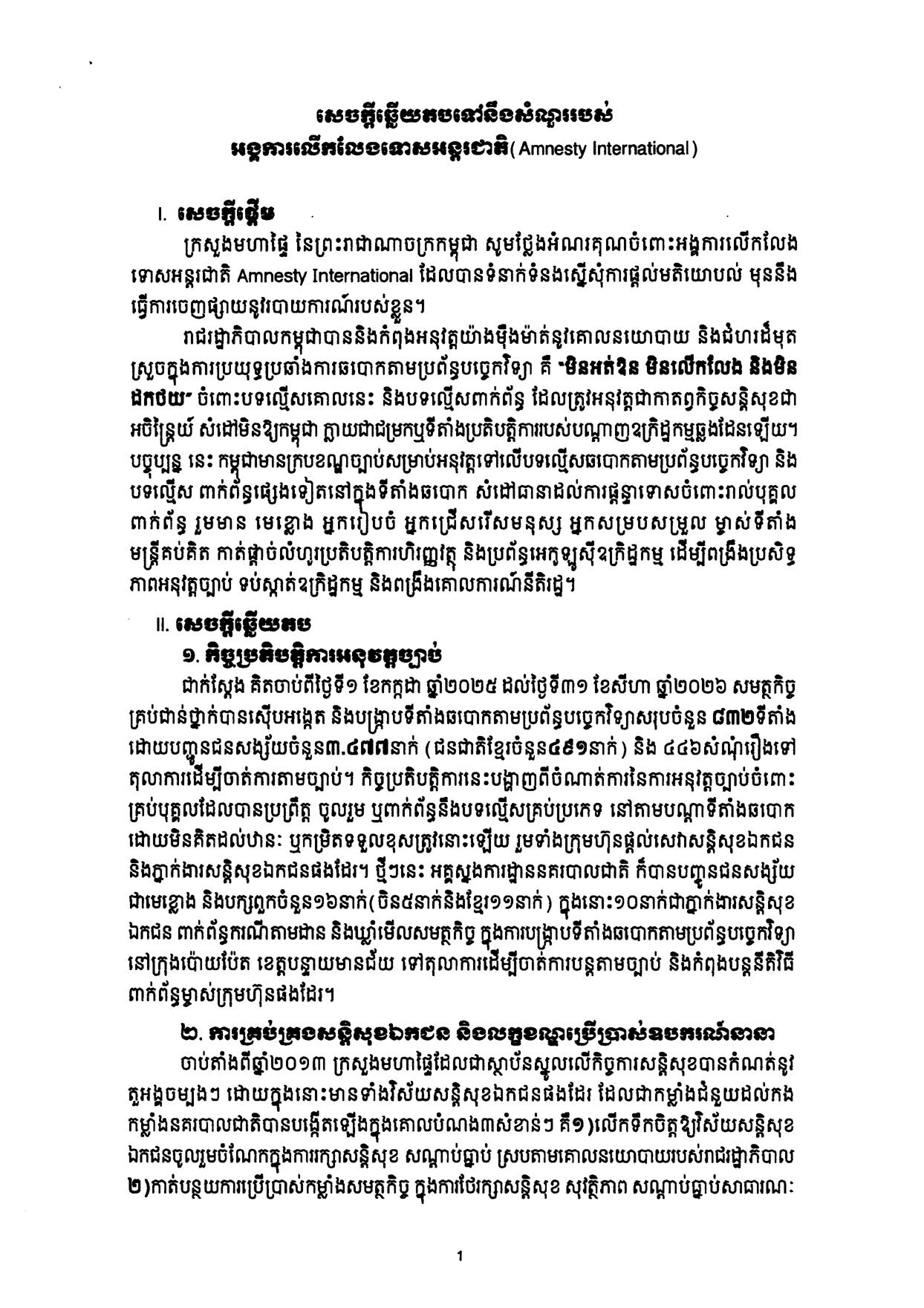
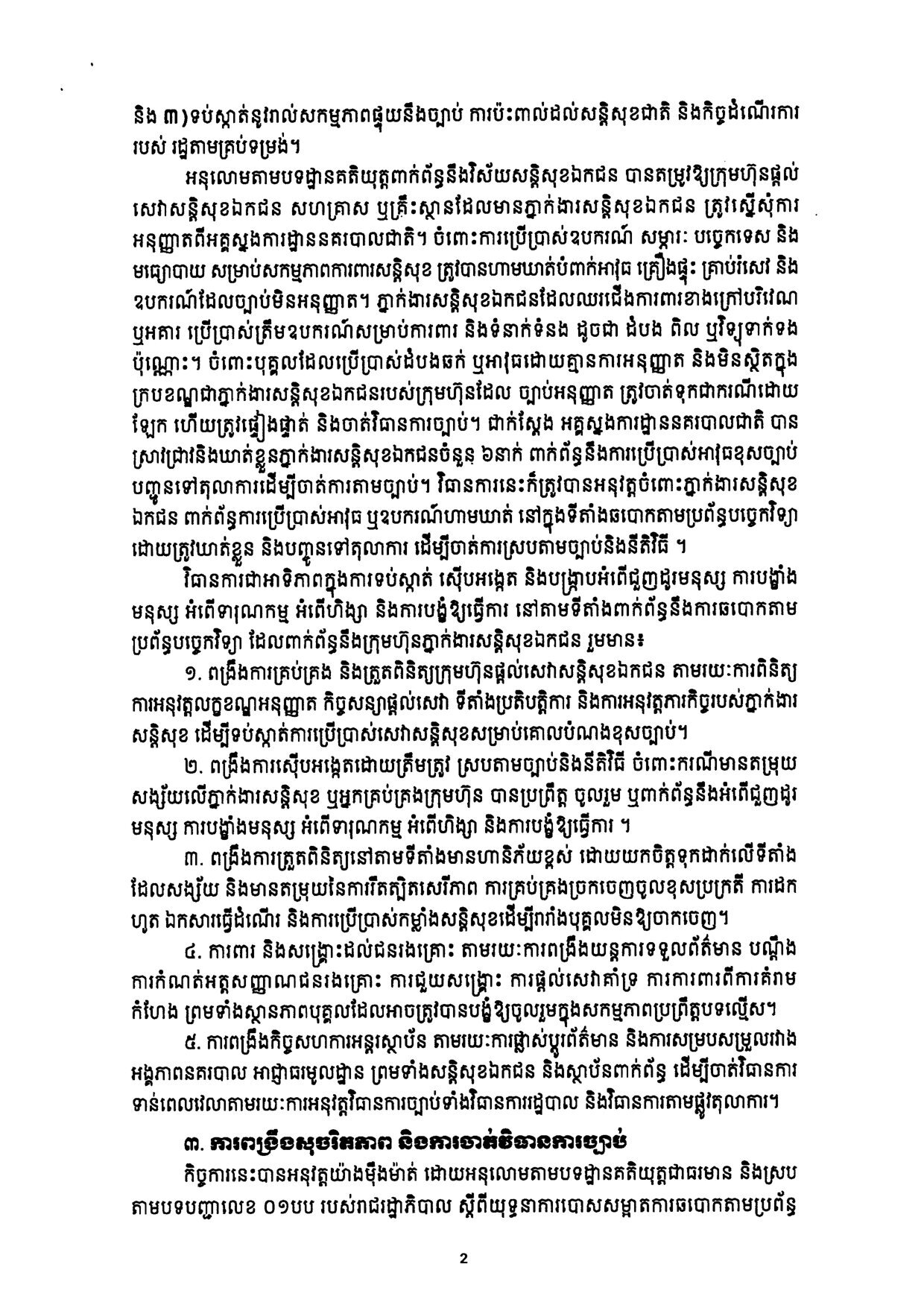
The Ministry of Interior’s letter in Khmer, pages 1 and 2 of 4.
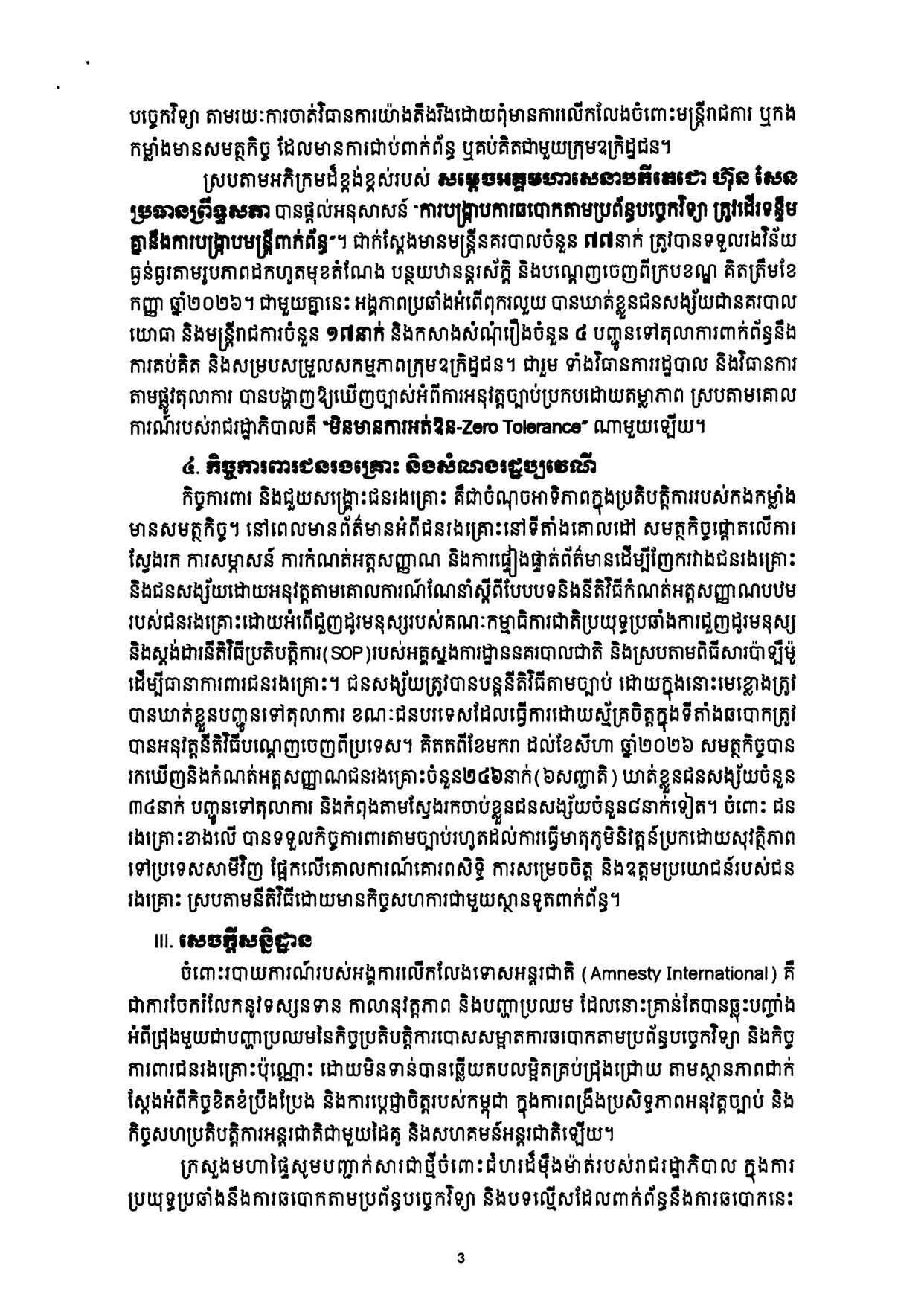
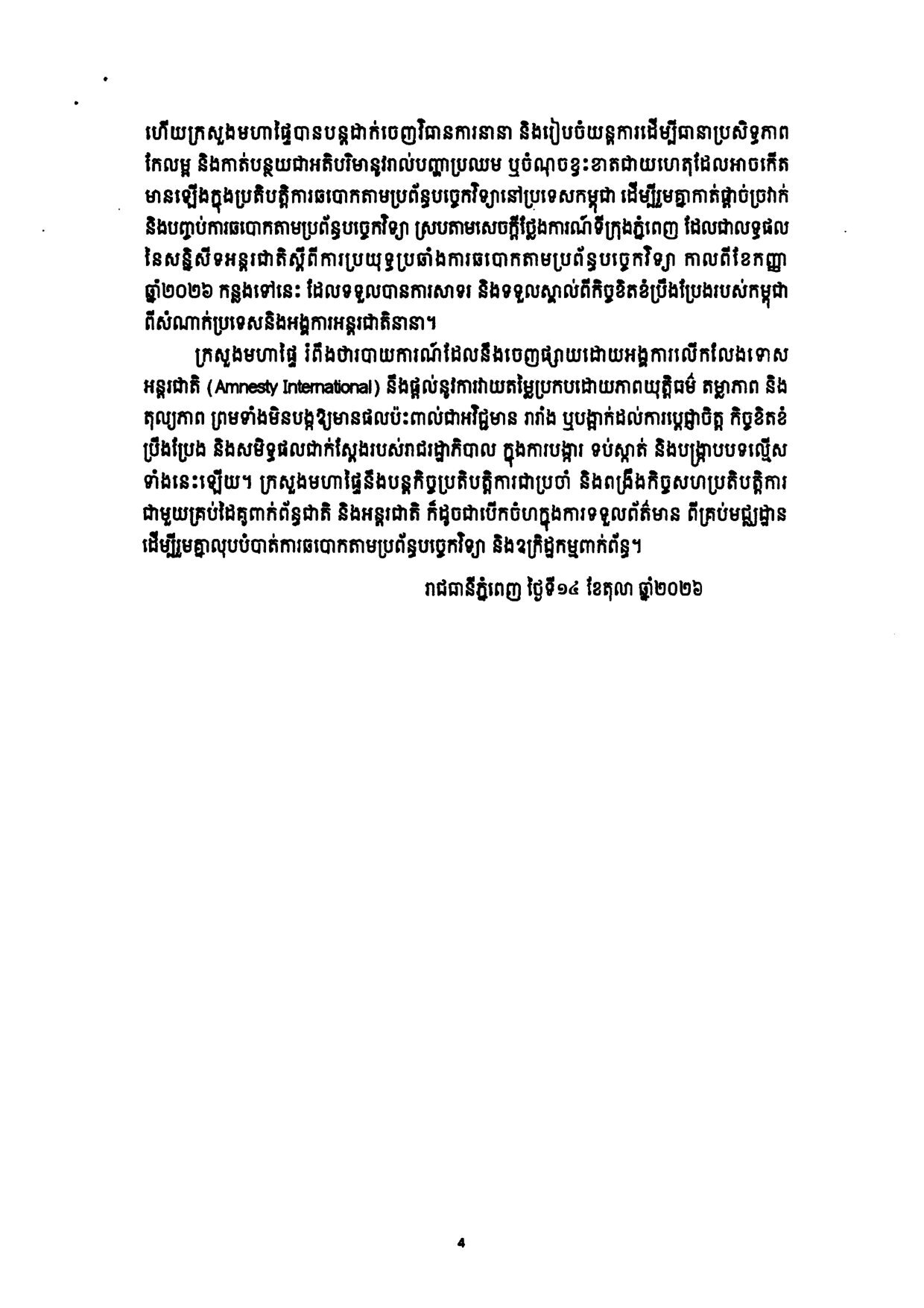
The Ministry of Interior’s letter in Khmer, pages 3 and 4 of 4.
2. COLONEL BAN SOPHAT
Response received via email on 8 October 2026:
Dear [redacted],
I confirm receipt of your letter dated 30 September 2026 (ref. TC ASA 03/2026.7965), on which I was copied. However, I only received a copy from the department staff yesterday, which doesn’t give me ample time to gather all the information.
I am responding in my personal capacity. I do not hold any ownership, director or management role in Leap Somnang Security Co., Ltd., and I have never directed its guard deployments or contracts. I know the company’s owner, and company staff have shown me respect and sometimes treated me as a senior figure. I did not authorize, direct or take part in any abuse of any person, and I condemn human trafficking, forced labor, confinement and violence.
The business card giving my name and the title as the “Chairman” I produced the company’s business cards for myself and served as an advisor to the company owner. I also helped promote the company, spread awareness of its services, and support its marketing efforts.
I would be grateful if you could share the specific materials that show me present at SI01 and KA02 (posts of 9 November 2019 and 1 December 2021), so that I can respond accurately.
I request an extension until October 30th,2026 to provide documents. I ask that you publish my response in full, or if you quote it, quote it accurately and in context.
P.S : I have attached the file you provided to me in this email as well.
Sincerely,
Sophat Ban
Response received via email on 19 October 2026:
Dear [redacted],
Thank you for responding to my email request and providing detailed information regarding the two items (SI01 and KA02) mentioned in your report. I will briefly respond to the best of my knowledge and provide additional information in response to your inquiries.
1. Company Owner’s Information
Regarding your request for the owner’s information, I can provide the following details. Unfortunately, I only know his first name and do not know his last name. Name (redacted), Telephone (redacted).
You may contact the owner directly if you need further information regarding this matter.
2. My Involvement with the Security Company
In response to your email, I appreciate you’re allowing me additional time to prepare my response. Regarding my involvement with the security company mentioned in your report, I would like to clarify that I have no ownership interest in the company and hold no authority to deploy, direct, or instruct its security guards. I also have no knowledge of whether the company’s security guards provided services at the locations mentioned in connection with the alleged coupon-scamming activities. As an advisor, I have a very minute role and advise whenever I have the free time. During my free time, I occasionally visit various locations and may encounter people I know. On some occasions, they have asked to take photographs with me. However, the fact that I may appear in a photograph taken at a particular location does not mean that I have knowledge of, or involvement in, the activities or operations conducted there. Regarding the photographs associated with the two locations you identified in your report, the individuals shown appear to resemble me. However, I do not have a clear recollection of the specific circumstances surrounding those photographs and cannot accurately recall all the details.
I hope this information helps clarify my position and addresses your inquiries to the best of my knowledge.
Thank you for your time and consideration.
Sincerely,
Sophat Ban
3. BEST (CAMBODIA) SECURITY
Letter from Ham Sithoun, Chairman of the Board, Best (Cambodia) Security Services (BCS), 11 October 2026.
ENGLISH (TRANSLATION)
From me, Ham Sithuon
Chairman of the Board of Directors
Best (Cambodia) Security Services (BCS) Company
October 11, 2026
To [name redacted]
Amnesty International
First of all, I would like to thank you for your letter to me, requesting confirmation of the information your organization has found and is planning to publish in a forthcoming report. Giving me the opportunity and time to respond is a very professional and appropriate way to work.
Referring to the subject of your letter and having reviewed the text in “ANNEX 1: FINDINGS”, I would like to respond only to the information related to Best (Cambodia) Security Services (BCS) Company “at point 2 (II. FINDINGS RELATEING TO BEST SECURITY AND LAY CHANNY)”. Because the content in the other points is a synthesis of the writer and I do not know whether any arguments (Argument/Reasoning) and hypotheses (Hypothesis) were used for the assessment (Assessment) and reaching those conclusions (Conclusion).
Therefore, I would like to respond to point 2 (II. FINDINGS RELATING TO BEST SECURITY AND LAY CHANNY) as follows:
About the relationship
LAY CHANNY is the owner of the office that my company rents (branch in Svay Rieng province).
Using the homeowner’s phone number on the company sign because:
When the company expanded its business from Phnom Penh to open a branch in Svay Rieng Province, the staff sent from Phnom Penh were not familiar with the local area, and the company also lacked communication staff. At that time, I asked the owner to put his phone number on the company sign, because I understood that when customers contacted him, he would be familiar with the local area and could help the company temporarily.
The phone number has also been posted since then, but has not been changed because I, as well as him, think it has no ill effects. In addition, the company also has a phone number on the label that accompanies it.
For operational work, general management and all decisions are my exclusive responsibility, without involving Mr. LAY CHANNY.
I believe your organization has also contacted Mr. LAY CHANNY to confirm this directly.
Since you mentioned my company and his name in this email, I am not sure if you intend for my company to share this email with Mr. LAY CHANNY or how?
About the TIK TOK account and the 6 guards at location BA06
I would like to thank you very much and was very surprised when you informed me that there were 6 guards at location BA06 wearing uniforms with my company logo.
After receiving the information from you, I assigned staff to research documents and verify all internal data to find out the history of providing services in the past. As a result, I can confirm that my company has no history of providing services at location BA06.
Based on the information you provided, I really want to find out the truth more clearly and to show the cleanliness of my company, I would like to request that you please share the TIK TOK video or pictures of the 6 guards you found with me so that I can take legal action if someone has indeed stolen my company’s uniform. Your help will help me in the process of establishing the truth about this matter.
I would also like to take this opportunity to reiterate my company’s policy:
Previously, we only provided services to garment factory locations, banking and financial institutions, and restaurants.
Meanwhile, every time a customer wants to use my company’s services, our company always verify their location information in order to avoid being involved in any illegal activities. Meanwhile, my company’s employees have also been trained on: how to record incidents, identify suspicious activities related to criminal offenses, and report them to the authorities, which is also a mechanism to participate in maintaining social security.
Once again, I am truly grateful to you for providing me with this information. And I sincerely hope that you can share with me the TIK TOK videos or pictures of the six guards that your organization found so that we can work together to establish the truth about this matter. I also sincerely appreciate your professional work in giving me the opportunity to respond to what your organization found. I look forward to working with you to prove my company’s innocent.
Best regards!
Ham Sithoun
Chairman of the Board
Base (Cambodia) Security Services (BCS) Company
KHMER (ORIGINAL)
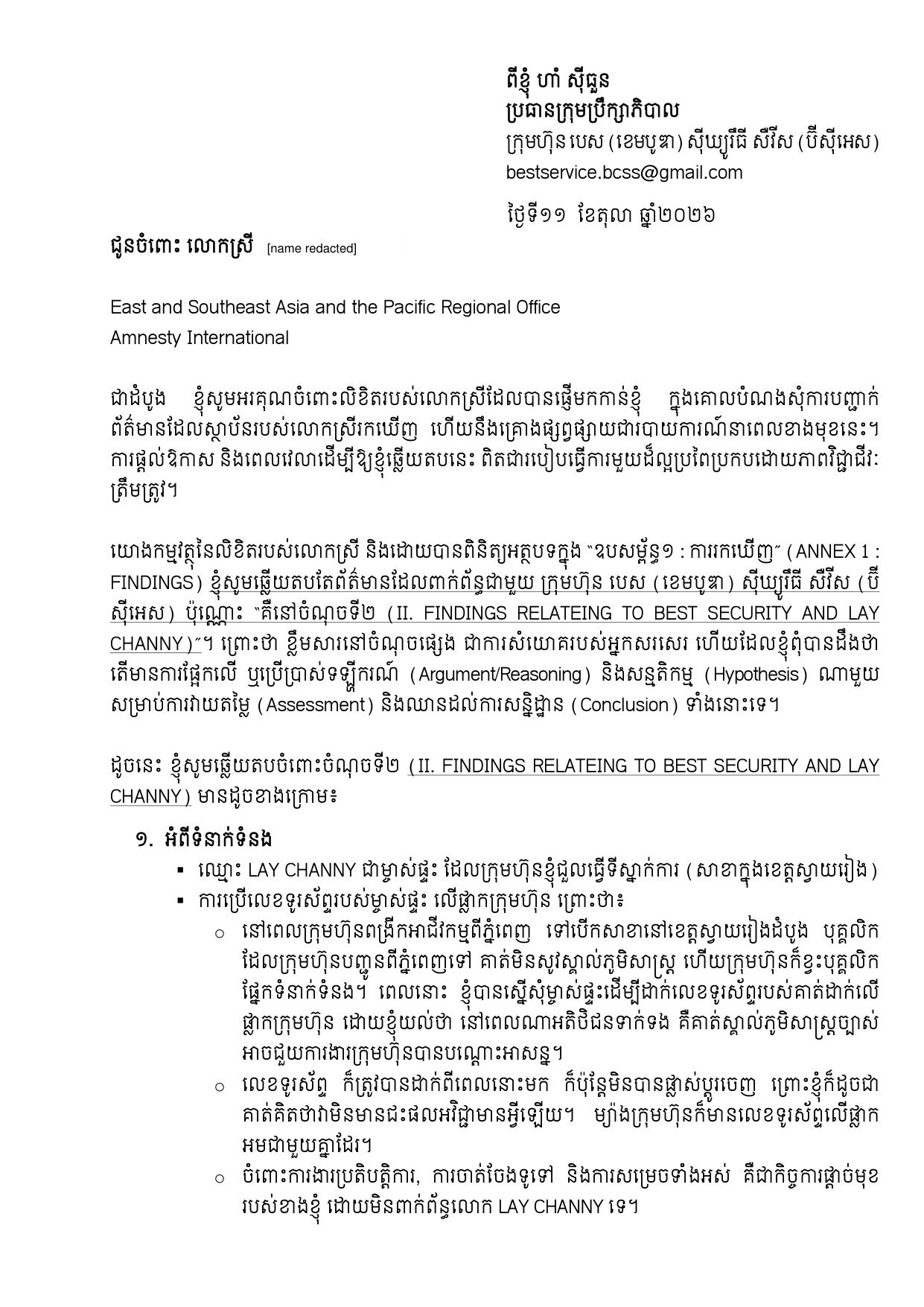
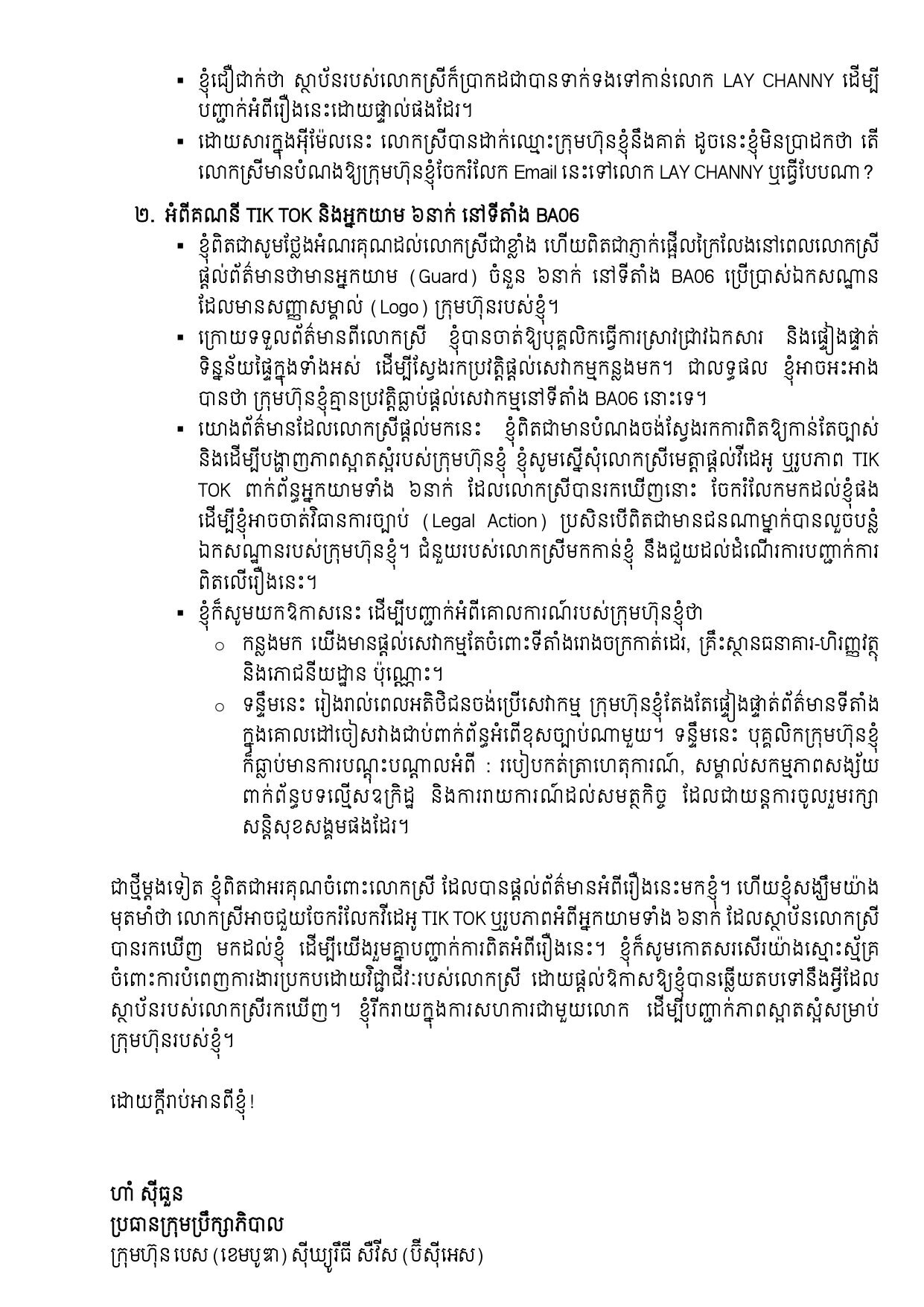
Best (Cambodia) Security’s letter in Khmer, pages 1 and 2 of 2.
4. YIM LEAK
Excerpt of response of Yim Leak’s lawyers, received via email 16 October 2026:
1. Mr. Yim denies any involvement in the abuses described in Annex I. He condemns human trafficking, forced labor, unlawful confinement and torture, and supports accountability for those responsible. Annex I does not provide any evidence that Mr. Yim knew of, ordered, directed, authorized, approved, encouraged, participated in, financed, assisted or facilitated any of the alleged abuses, or knowingly concealed or tolerated them. Nor does it provide evidence that he exercised operational control over the activities at issue or supervised those allegedly responsible. No factual or legal basis has therefore been established for attributing personal responsibility to Mr. Yim for any of the alleged abuses described in Annex I.
2. Mr. Yim has never been an employee or executive of ZhengHeng Group Co., Ltd. and has never held any position or interest in it. The statement in Annex I that he was among the “senior employees of the ZhengHeng Group” is incorrect. B.I.C (Cambodia) Bank Plc is not and has never been a subsidiary of ZhengHeng Group. Its shareholding history, certified by the Ministry of Commerce on October 13, 2025, records no shareholding by ZhengHeng Group or Mr. Deng Pibing. ZhengHeng Group listed B.I.C (Cambodia) Bank Plc among its companies on its website without the bank’s authorization, and the bank asked ZhengHeng Group to remove the listing. In December 2023 the bank asked the United Kingdom Foreign, Commonwealth and Development Office to correct the description of the bank as a ZhengHeng Group subsidiary in the UK sanctions listing.
5. SECURITY RESPONSE
Response received via email on 13 October 2026:
Dear whom it may concern
We categorically deny the allegations contained in your correspondence. Our company has never engaged in, provided, authorized, or participated in any of the activities described therein. We are a duly registered and lawfully operating security services company. We conduct our operations within the lawful scope of our business and provide standard security services in accordance with applicable industry requirements and standards, with the aim of protecting our clients’ personal safety and property.
As a duly registered company, we actively cooperate with the relevant authorities in connection with training programs and other initiatives, and participate in activities organized by the government. We remain committed to conducting our business in compliance with the law and fulfilling our corporate responsibilities and obligations.
We further affirm that our personnel have not participated in any of the unlawful or improper activities alleged in your correspondence. We are also unaware of any illegal activities taking place at the premises you referred to, and we have never authorized or instructed any of our personnel to participate in such activities.
Regarding the company’s registered address mentioned in your correspondence, you may already be aware of our previous change of address. The address you referred to is located in a commercial building open to the public, where commercial premises are available for lease to various businesses and tenants. The address alone therefore does not establish that our company conducted, organized, or participated in any of the alleged activities at that location, nor should it serve as a basis for concluding that our company is connected with such activities.
We trust that the above clarifies these matters and helps prevent any misunderstanding arising from address information or unverified allegations.
Thank you for your understanding and attention to this matter.
Yours sincerely,
- Amnesty International uses codes to refer to scamming compounds. An example is the code “PV01”. Codes are preferred because many compounds are referred to by multiple names, most of which are unofficial and can be confusing. Where a compound is referred to by the same name by multiple victims, Amnesty International will use that name and then the Amnesty-allocated compound code, for example “Park 8” (the name) and “PV01” (the code). All codes for compounds, as well as full descriptions of compounds, are found in Annexes to Amnesty International’s previous reports on Cambodian scamming compounds. See Amnesty International, “I Was Someone Else’s Property”: Slavery, Human Trafficking and Torture in Cambodia’s Scamming Compounds, (Index: ASA 23/9447/2025), 26 June 2025, https://www.amnesty.org/en/documents/asa23/9447/2025/en/ (hereafter Someone Else’s Property ); and Amnesty International, Falling Through the Cracks: Cambodia’s “Crackdown” on Scamming Compounds and the Victims it has Failed, (Index: ASA 23/1093/2026), 8 June 2026, https://www.amnesty.org/en/documents/ASA23/1093/2026/en/ (hereafter Falling Through the Cracks ). ↩︎
- See Amnesty International, “I Was Someone Else’s Property”: Slavery, Human Trafficking and Torture in Cambodia’s Scamming Compounds, (Index: ASA 23/9447/2025), 26 June 2025, https://www.amnesty.org/en/documents/asa23/9447/2025/en/ (hereafter Someone Else’s Property ); and Amnesty International, Falling Through the Cracks: Cambodia’s “Crackdown” on Scamming Compounds and the Victims it has Failed, (Index: ASA 23/1093/2026), 8 June 2026, https://www.amnesty.org/en/documents/ASA23/1093/2026/en/ (hereafter Falling Through the Cracks ). ↩︎
- The climate of fear is described in Chapter 6 of Amnesty International’s first report on the scamming industry, Someone Else’s Property (previously cited). It refers to survivors inside scamming compounds having their agency taken away and knowing they could be tortured or even killed at any time. It describes the carceral environment of the compound in order to place the abuses within that context and show they are all interrelated. ↩︎
- “Politically exposed persons” (PEPs) refers to people with links to government or other high-ranking people that could benefit because of these links. For example, the family members of politicians are PEPs. ↩︎
- See generally UN Office on Drugs and Crime (UNODC), An Interconnected Criminal Ecosystem: Transnational Organized Crime Threat Assessment for South-East Asia 2026, 21 July 2026, https://www.unodc.org/roseap/uploads/documents/Publications/2026/TOCTA_South-East_Asia_2026.pdf ↩︎
- See Amnesty International, Someone Else’s Property (previously cited); and Amnesty International, Falling Through the Cracks (previously cited). ↩︎
- United Nations Convention against Transnational Organized Crime, adopted 15 November 2000, entered into force 29 September 2003, Article 2(a). ↩︎
- UNODC, Transnational Organized Crime Threat Assessment for South-East Asia 2026 (previously cited), pp. 35-36. ↩︎
- UNODC, Transnational Organized Crime Threat Assessment for South-East Asia 2026 (previously cited), pp. 35-36; See also Amnesty International, Someone Else’s Property (previously cited) and Amnesty International, Falling Through the Cracks (previously cited), especially Annexes I of both reports which highlight specific security features that indicate a “purpose-built” model. ↩︎
- See Amnesty International, Someone Else’s Property (previously cited), Chapters 5 and 6; UNODC, Transnational Organized Crime Threat Assessment for South-East Asia 2026 (previously cited), pp. 22, 46. ↩︎
- UNODC, Transnational Organized Crime Threat Assessment for South-East Asia 2026 (previously cited), p. 44. ↩︎
- For a complete assessment of the crackdown see Amnesty International, Falling Through the Cracks (previously cited). ↩︎
- See Amnesty International, “Cambodia: Casinos get state approval despite links to human rights abuse at scamming compounds”, 2 April 2026, https://www.amnesty.org/en/latest/news/2026/04/cambodia-casinos-get-state-approval-despite-links-to-human-rights-abuse-at-scamming-compounds/; Amnesty International, Falling Through the Cracks (previously cited). ↩︎
- Ministry of Information, ទីតាំង ប្រព្រឹត្ត បទ ល្មើស ជាង ៧០០ ត្រូវ បាន បោសសម្អាត កម្ពុជា ពុំមាន មជ្ឈមណ្ឌល ឆបោក តាម ប្រព័ន្ធ បច្ចេកវិទ្យា ទៀត ទេ [“More than 700 crime scenes have been cleared, Cambodia no longer has a center for cybercrime”], 28 August 2026, https://www.information.gov.kh/articles/200519 (in Khmer). ↩︎
- Khmner Times, “Cambodia dismantles 86 scam compounds as South Korea hails 90% drop in victim reports”, 31 August 2026, https://www.khmertimeskh.com/502014928/cambodia-dismantles-86-scam-compounds-as-south-korea-hails-90-drop-in-victim-reports/ ↩︎
- Cambodianess, “Cambodia shuts three banks, says financial system remains stable”, 3 August 2026, https://cambodianess.com/article/cambodia-shuts-three-banks-says-financial-system-remains-stable ↩︎
- Cambodianess, “Cambodia defends deportation of Chen Zhi, 27 January 2026, https://cambodianess.com/article/cambodia-defends-deportation-of-chen-zhi; Kiripost, “China and Cambodia Intensify Cybercrime Fight After Li Xiong Arrest and Deportation”, 1 April 2026, https://kiripost.com/stories/china-and-cambodia-intensify-cybercrime-fight-after-li-xiong-arrest-and-deportation ↩︎
- Kiripost, “Court detains Ly Koung for alleged tech fraud”, 16 January 2026, https://kiripost.com/stories/court-detains-ly-koung-for-alleged-tech-fraud ↩︎
- Neak Oknha (អ្នកឧកញ៉ា) is a rank within the Oknha (ឧកញ៉ា) honours, a Khmer title of pre-colonial origin revived by decree in 1994 and conferred by royal decree, on the recommendation of the government, upon citizens deemed to have contributed to national development. In practice it is held overwhelmingly by business figures. Under the Royal Decree of 11 October 2023, replaced by a Royal Decree of 23 October 2024, the honour is graded into three ranks – Lok Neak Oknha, Neak Oknha and Oknha – of which Neak Oknha is the intermediate. Conferral has long been conditioned on a minimum donation to the state: raised from USD 100,000 to USD 500,000 by sub-decree in March 2017 and set on a tiered basis by sub-decree in June 2024 at approximately USD 4 million, USD 1 million and USD 500,000 for the three ranks respectively, before the October 2024 decree annulled that sub-decree and left the thresholds to further regulation. ↩︎
- See UNODC, Inflection Point: Global Implications of Scam Centres, Underground Banking and Illicit Online Marketplaces in Southeast Asia, April 2025, https://www.unodc.org/roseap/uploads/documents/Publications/2025/Inflection_Point_2025.pdf ↩︎
- See The Conversation, “Cambodia is vowing to ‘rid’ the country of scam compounds. But we’ve seen several still operating in the open”, 8 August 2025, https://theconversation.com/cambodia-is-vowing-to-rid-the-country-of-scam-compounds-but-weve-seen-several-still-operating-in-the-open-262792; VOD, “Enslaved: Meet Cambodia’s cyber slaves”, https://vodenglish.news/enslaved/; Al Jazeera, “Cambodia’s cyber slaves”, https://www.aljazeera.com/features/longform/2022/8/11/meet-cambodia-cyber-slaves ↩︎
- Amnesty International, interview in person with Ai (not their real name), 2024. ↩︎
- Many of the videos posted to Tiktok show more than 20 guards at gates, inner areas of compounds and doing training drills. ↩︎
- Amnesty International, interviews in person with Adam, Da, Van and Claire (not their real names), 2024 and 2026. ↩︎
- Amnesty International, interview in person with Claire, 2026. ↩︎
- Amnesty International site visits, 2025. ↩︎
- Telegram channels for Security Response and ZD Security posted recruitments believed to be for scamming compounds at least once per month, and sometimes several times per month, often “urgently” recruiting between 20-50 security guards, including during the first few months of the 2025/2026 crackdown. Amnesty International also spoke with several recruiters who confirmed they needed security guards urgently during 2025. ↩︎
- Chapter 7 provides a legal assessment of the abuses committed by security guards. ↩︎
- Amnesty International site visits, 2024. ↩︎
- Amnesty International, interview in person with Gabe (not his real name), 2025. ↩︎
- Amnesty International, interview in person with Lisa (not her real name), 2025. ↩︎
- Amnesty International, interviews in person with organizations 2 and 4, 2024; Amnesty International site visits, 2024. ↩︎
- Amnesty International, interviews in person with local residents, 2024 and 2025. ↩︎
- Amnesty International, interview in person with Nok (not their real name), 2025. ↩︎
- Amnesty International, interviews in person with Nok, Meow, Pla, Poo and Nuu (not their real names), 2025. ↩︎
- Amnesty International, interviews in person with Nok and Meow, 2025. ↩︎
- BA01, BA05, BA06, BM03, BS02, BS04, CT02, CT05, CT08, KA01, KA03, MD02, OS02, P017, PP09, PSP01, PV01, SI12, SI42, SV04, TD01, TBK02, TBK03, TBK04, TBK05, TK01. ↩︎
- Amnesty International, interview in person with Demar (not their real name), 2026. ↩︎
- BA06, SI12, SI42, TD01. ↩︎
- On file with Amnesty International. ↩︎
- Amnesty International, interview in person with Kenyangi (not her real name), 2026. ↩︎
- Amnesty International, interview in person with Maia (not her real name), 2026. ↩︎
- Amnesty International, interview in person with Akbar (not his real name), 2025. ↩︎
- For more information, see Amnesty International, Someone Elses’ Property, Chapter 7.13. ↩︎
- According to the UN Committee against Torture, the terms “consent” and “acquiescence” in Articles 1 and 16 of Convention Against Torture (CAT) are to be interpreted as ensuring that states will also be responsible for acts committed by non-state actors (private individuals) where they have failed to take steps to adequately protect against such acts and prevent them. The Committee against Torture has noted that where “[s]tate authorities or others acting in official capacity or under colour of law, know or have reasonable grounds to believe that acts of torture or ill-treatment are being committed by non-State officials or private actors and they fail to exercise due diligence to prevent, investigate, prosecute and punish such non-State officials or private actors consistently with the Convention, the State bears responsibility and its officials should be considered as authors, complicit or otherwise responsible under the Convention for consenting to or acquiescing in such impermissible acts”: UN Committee against Torture, General Comment 2: The implementation of article 2 by States parties, 24 January 2008, UN Doc. CAT/C/GC/2, para. 18. ↩︎
- Amnesty International, interview in person with Don (not his real name), 2026. He showed Amnesty International pictures to corroborate the story and identified the logo of the security company and the buildings at the site. ↩︎
- Amnesty International, interview in person with Kane (not his real name), 2026 ↩︎
- Amnesty International, interview in person with Ploy (not his real name), 2025. ↩︎
- Amnesty International, interview in person with Akbar (not his real name), 2025. ↩︎
- Amnesty International, interview in person with Gabe (not his real name), 2026. ↩︎
- Amnesty International, interview w in person with Gabe, 2026. ↩︎
- See Amnesty International, Falling Through the Cracks (previously cited), p. 81. ↩︎
- Amnesty International, interview in person with Wambui (not her real name), 2026. ↩︎
- Amnesty International, interview in person with Brandon (not his real name), 2026. ↩︎
- See Amnesty International, “Cambodia: Casinos get state approval despite links to human rights abuse at scamming compounds” (previously cited). ↩︎
- Amnesty International, interviews in person with Thapol and Pattara (not their real names), 2025. ↩︎
- See Amnesty International, Someone Else’s Property (previously cited), Chapters 5 and 6. ↩︎
- Amnesty International, interview in person with Van (not his real name), 2024. ↩︎
- Amnesty International interview in person with Adam (not his real name), 2024. ↩︎
- Amnesty International interview in person with Amir (not his real name), 2024. ↩︎
- Amnesty International interviews in person with Elise, Akella, Namazi, Nalini, and Mutoni (not their real names), 2025, 2026. ↩︎
- On file with Amnesty International. ↩︎
- See Chapter 7 below. ↩︎
- Amnesty International, interview in person with Gabe, 2026. ↩︎
- Amnesty International, interviews in person with Gabe, Bolin, Emile and Brandon (not their real names), 2025, 2026. ↩︎
- Amnesty International, interview in person with Gabe, 2026. ↩︎
- Amnesty International, interview in person with Emile (not their real name), 2026. ↩︎
- On file with Amnesty International. ↩︎
- On file with Amnesty International. ↩︎
- TikTok user 82 (not their real username), a Security Response guard or trainer, has posted several videos of himself, or taken by himself, at the gate of SI01. In one video, he is seen with a German Shepherd. This is possibly the same dog shown in videos in a post from May 2025 by TikTok user 83 (not their real username), which show the user holding a German Shepherd on a leash inside SI01. User 83 is frequently seen in his videos instructing and training guards and wearing a t-shirt that has “ARMY” written on the sleeve. ↩︎
- In another case, TikTok user 295 (not their real username), who is also a guard at the PSP02 compound, is pictured in a security guard uniform holding a Huskey on a leash. The location of this picture from January 2025 is very likely at one of the entrance gates to the compound. ↩︎
- TikTok user LS003 (not their real username), who had previously been shown to be dressed in military fatigues with a gun, and also working as a Leap Somnang security guard, is seen in one image from April 2025 holding a German Shepherd on a leash. The user appears to be wearing the Leap Somnang security uniform but is not at the TBK04 compound, although he has been geolocated to be very nearby, at a location frequented by other Leap Somnang guards. Another TikTok user LS004 (not their real username), who appears to be a manager working for Leap Somnang and who also may be a local police officer, posted a video of TikTok user LS003 with what is likely the same dog based on location and appearance. ↩︎
- Amnesty International, interviews in person with Amir, Adam, Sawat, Pranee, Porameth and Wittaya (not their real names), 2024. ↩︎
- Response from Cambodia’s National Committee to Combat Human Trafficking received via email on 26 May 2025: Amnesty International, Someone Else’s Property (previously cited), Annex III, page 238. ↩︎
- Amnesty International, interviews in person with Elise, Akella, Namazi, Nalini, Mutoni, Kenyangi, Dembe and Nasiche (not their real names), 2025 and 2026. ↩︎
- See Amnesty International, Falling Through the Cracks (previously cited); Amnesty International, interviews in person with Messus, Bringer, Andres, Valentina, Winta and Gabe (not their real names), 2026. ↩︎
- The human rights abuses listed in this column are the confirmed abuses. It is possible, and likely, that other abuses also occurred at these compounds. ↩︎
- Leap Somnang Security Co., Ltd. (company number 00017567), Company Extract, Cambodian Ministry of Commerce (accessed 2 October 2026). Its registered address at the time of publication was 164E0, Street F, Krang Angkrang, Sangkat Krang Thnong, Khan Por Sen Chey, Phnom Penh. It appears to have at least two more offices in Sihanouvkille and Tbong Kmum. Further, a company contact card circulated in its videos lists the telephone / Telegram contacts 016 30 4444 and 078 30 4444. ↩︎
- Leap Somnang Company Extract (previously cited). ↩︎
- Leap Somnang Facebook profile, https://www.facebook.com/profile.php?id=100059037496067. The Facebook page appears to have ceased posting new content since 3 March 2025. This cessation coincides with a period of heightened media, NGO and government attention to scam compounds in Cambodia; however, no evidence has been identified establishing a causal connection between that scrutiny and the channel’s inactivity, and the timing may be coincidental. ↩︎
- Leap Somnang YouTube channel, https://www.youtube.com/@krochbros-leapsomnangsecurity. This channel, which states the company’s name in both Chinese and Khmer script, appears to be run by a Leap Somnang employee who posted videos apparently on behalf of the company and its General Manager. The YouTube channel appears to have ceased posting new content relating to the company’s operations from 2024 onward. ↩︎
- Cambodian Ministry of Commerce records for Leap Somnang Security Co., Ltd. (company number 00017567), available at https://www.businessregistration.moc.gov.kh/cambodia-br-companies/viewInstance/view.html?id=48e104de66a7c46f0057fe540258afcdbbeecc77e666a2c424273d46cad23d15&_timestamp=7812219599151994 (accessed October 2026). ↩︎
- The most recent social media video attributing the chairmanship to Ban Sophat is dated January 2024, and no subsequent photograph or video suggests the position has changed. ↩︎
- The YouTube channel appears to have ceased posting new content relating to the company’s operations from 2024 onward, although it remains online. This cessation coincides with a period of heightened media, NGO and government attention to scam compounds in Cambodia; however, no evidence has been identified establishing a causal connection between that scrutiny and the channel’s inactivity, and the timing may be coincidental. ↩︎
- Ban Sophat, Facebook post, 1 June 2019, https://www.facebook.com/ban.sophat.9 (accessed 12 June 2026). ↩︎
- First, Ban Sophat serves as the company’s operational lead and has been its public leader continuously since its founding, with no reference identified in social media to any individual holding a position senior to his, nor to a board, investors or parent entity. Second, his social media presence consistently portrays him as the face and leader of the business: he represents the company at public-facing events and is primarily the one photographed engaging with senior military and police officials outside the company. Third, the company’s operations appear intertwined with Ban Sophat’s personal and family sphere: the company’s publicly listed phone number matches what appears to be his personal number (as indicated by the associated Telegram account); a woman who appears to be his wife posted at least one job advertisement stating that “my company is looking for [staff]”; and vehicles featured on Ban Sophat’s personal social media accounts appear to be the same vehicles shown in the company-affiliated YouTube channel. ↩︎
- The sub-decree of the Royal Government of Cambodia (No. 1144 អនក្រ.តត), dated 20 December 2022 and signed by then-Prime Minister Hun Sen, promoted a list of RCAF officers from the rank of Lieutenant Colonel (វរសេនីយ៍ទោ) to Colonel (វរសេនីយ៍ឯក). Entry number 10 of that list is Ban Sophat (បាន សុផាត), identified by service number 144477. His service number matches the number visible on the uniform he wears in a photograph posted to his personal Facebook account on 12 December 2017, in which the rank insignia (five stripes grouped three and two, alternating gold and silver) corresponds to a lieutenant colonel, indicating that Ban Sophat’s formal association with the RCAF under the same service number dates back to at least December 2017, five years before the sub-decree. ↩︎
- This is corroborated by imagery posted by Ban Sophat, including numerous photographs and videos posted between December 2017 and January 2024 across social media platforms (Facebook, Telegram) and on the company-affiliated YouTube channel, where he is wearing the uniform of the Royal Cambodian Army (the land component of the RCAF) bearing field-grade officer insignia (Lieutenant Colonel. ↩︎
- See further, GlobalSecurity.org, “Rank and Insignia of the Cambodian Armed Forces”, available at https://www.globalsecurity.org/military/world/cambodia/army-fark-rank.htm (accessed 25 August 2026); Wikipedia, “Military ranks of the Royal Cambodian Armed Forces”, available at https://en.wikipedia.org/wiki/Military_ranks_of_the_Royal_Cambodian_Armed_Forces (accessed 25 August 2026). ↩︎
- See Annex II. ↩︎
- The Commercial Gambling Management Commission of Cambodia (CGMC) stated that properties under Ly Kuong’s control had been used both to conduct online scams and to conceal the origins of illicit funds. For more information about the investigations that linked three compounds to Kuong’s casinos, see Amnesty International, “Cambodia: Casinos get state approval despite links to human rights abuse at scamming compounds” (previously cited) and Amnesty International, Falling Through the Cracks (previously cited). ↩︎
- BBC News, “Alleged scam mastermind arrested after being exposed by BBC”, 20 January 2026, https://www.bbc.com/news/articles/cwy8v31kkv1o; Mekong Independent, “My Casino, Kampot: Tycoon, 50 officers in jail over scams at rural casino”, 1 July 2026, https://mekongindependent.com/2026/07/tycoon-50-officers-in-jail-over-scams-at-rural-casino/ ↩︎
- CamboJA News, “Owner of alleged scam compound receives title of nobility from government”, 23 June 2023, https://cambojanews.com/owner-of-alleged-scam-compound-receives-title-of-nobility-from-government/; Mekong Independent, “My Casino, Kampot: Tycoon, 50 officers in jail over scams at rural casino” (previously cited). ↩︎
- In April 2026, following the Cambodian Gambling Commission’s publication of official maps of licensed casinos, Amnesty International linked the Majestic Hotel & Casino and Majestic Two, both operated by Big House Commercial Corporation, to the scamming compounds SI15 and SI16, respectively. Amnesty International documented evidence of human trafficking, forced labour, child labour and enslavement at both compounds during the same period in which the organization concluded that Leap Somnang was providing security services at the sites. Corporate records show that Ly Kuong served as a director of Big House Commercial Corporation until December 2025. See Big House Commercial Corporation, Company extract, Cambodian Ministry of Commerce, last accessed on 29 September 2026. ↩︎
- Amnesty International identified KA02 as a scamming compound in June 2025, and again in April 2026, linking it to Casino Kchom (also referred to as My Casino or Wo Casino), following the publication of official maps by CGMC. Following Ly Kuong’s arrest, Cambodian authorities claimed he was the owner of Casino Kchom, but Amnesty International has not been able to independently confirm this. In July 2026, the CGMC finally revoked the casino’s license, operated by Zhou Cheng K.P. Hotel Co. Ltd. The CGMC stated that properties under Ly Kuong’s control had been used both to conduct online scams and to conceal the origins of illicit funds. Reuters, “Cambodian scam centre known as ‘My Casino’ used for scam operations, following recent crackdown on transnational fraud, in Kampot province”, 11 February 2026, https://www.reutersconnect.com/item/cambodian-scam-centre-known-as-my-casino-used-for-scam-operations-following-recent-crackdown-on-transnational-fraud-in-kampot-province/dGFnOnJldXRlcnMuY29tLDIwMjY6bmV3c21sX1JDMjNKSkE5UUczNw; Mekong Independent, “My Casino, Kampot: Tycoon, 50 officers in jail over scams at rural casino” (previously cited); South China Morning Post, “’A game of whack-a-mole’: How could the scam industry bring China and the US together?”, 4 April 2026, https://www.scmp.com/news/china/diplomacy/article/3348930/game-whack-mole-how-could-scam-industry-bring-china-and-us-together ↩︎
- On file with Amnesty International. ↩︎
- Amnesty International interviews in person with Andres, Valentina, Evelyn, Brandon, Bringer, Messus, Don, Graham, Gabe, Kane, Winta and Julia (not their real names), 2025 and 2026. ↩︎
- Amnesty International, interviews with Bringer, Don, Graham and Messus (not their real names), 2026. ↩︎
- See Amnesty International, Someone Else’s Property (previously cited), Annex I, “KA02 profile”. ↩︎
- Amnesty International, interview in person with Bringer, 2026. ↩︎
- Amnesty International, interview in person with Messus, 2026. ↩︎
- Amnesty International, interview in person with Brandon, 2026. ↩︎
- Security Response (Cambodia) Co., Ltd. (company number 00064265), Company Extract, Cambodian Ministry of Commerce (accessed 2 October 2026). Its registered address at the time of publication is អគារ Panda Tower TK ផ្ទះលេខ62 ជាន់ទី 2-2A (2Floor-2A), ផ្លូវលេខ289 កែងផ្លូវលេខ528, Phum 10, Boeng Kak Muoy, Tuol Kouk, Phnom Penh. ↩︎
- Security Response Company Extract (previously cited). ↩︎
- Sabay Digital, “ក្រុមហ៊ុន ស៊ីឃ្យួរីធីរីស្ប៉ន(ខេមបូឌា)ឯ.ក. និងក្រុមហ៊ុន ហួយវ័ន អ៉ិនសួរេន ម.ក សហការគ្នាក្នុងការផ្តល់សេវាកម្មដោះស្រាយសំណងយ៉ាងឆាប់រហ័ស” [“Security Response (Cambodia) Co., Ltd. and Hui Wan Insurance Co., Ltd. collaborate to provide rapid compensation settlement services”], 2 October 2023, https://news.sabay.com.kh/article/1349223 (in Khmer). ↩︎
- Security Response, Facebook profile, https://www.facebook.com/p/Security-Response-61550358909518 (accessed 24 November 2025; the page has since been deactivated or blocked). ↩︎
- Security Response, TikTok account, https://www.tiktok.com/@securityresponsee (accessed 1 September 2026). ↩︎
- See Panda Commercial Bank PLC, https://www.pandabank.com.kh/About/ExecutiveITOperation (accessed 11 October 2026); Amnesty International site visits, 2024, 2025, 2026. ↩︎
- In reference to the company’s registered address being at the same location as a Panda Bank office, the company said “[t]he address you referred to is located in a commercial building open to the public, where commercial premises are available for lease to various businesses and tenants. The address alone therefore does not establish that our company conducted, organized, or participated in any of the alleged activities at that location, nor should it serve as a basis for concluding that our company is connected with such activities.” Annex III, Security Response, email to Amnesty International, 13 October 2026, on file with Amnesty International. ↩︎
- Lan Jianping served as Chairman of Panda Bank from 31 October 2024 until the bank’s licence was revoked and liquidation proceedings commenced. He also held senior positions at Panda Bank from at least 2020, serving first as Acting Chief Executive Officer during the bank’s formative period (approximately 2019-2021) and later as Deputy Chief Executive Officer (2021-2024). Lan’s signature appears on the bank’s most recent available financial statements in his capacity as Chairman, signed on 26 March 2025. See Association of Banks in Cambodia, ABC Directory Booklet 2021, July 2021, https://www.abc.org.kh/wp-content/uploads/2023/07/Final_ABC-Year-Review-Directory-Book-2021.pdf, p. 74; Panda Bank, Annual Report 2022; Panda Bank financial statements signed 26 March 2025. As of the date of publication, Lan Jianping was also a director of Huione Life Insurance PLC, and, until his resignation on 22 May 2025, a director of Holink Control Technology Co. Ltd., formerly known as Huione Technology Co. Ltd. See Cambodia Ministry of Commerce, Huione Life Insurance PLC company profile, director details (accessed 17 July 2026); Cambodia Ministry of Commerce, Holink Control Technology Co. Ltd. company profile, director details (accessed 17 July 2026). ↩︎
- Chen Y Jun was the sole director of the now-dissolved Huione Golf Club Co., Ltd. This company appears to have run a Huione-branded driving range in Phnom Penh until its dissolution around 2022. See Tnaot.com, 9 April 2019, https://www.tnaot.com/km/m/detail/article/1419531.html (in Khmer) (accessed 16 January 2026). See Cambodia’s Ministry of Commerce, Huione Technology Co. Ltd. company profile (renamed to Holink Control Technology Co., Ltd. on 10 June 2025), Director details (accessed 19 October 2026). ↩︎
- In May 2025, FinCen issued a Notice of Proposed Rulemaking under Section 311 of the USA PATRIOT Act identifying the Huione Group as a foreign financial institution of primary money-laundering concern, based on its alleged role in laundering proceeds linked to cyber-scams, DPRK cyber-crime and transnational criminal networks. The binding measure severing Huione Group from the US financial system was finalized in October 2025 and took effect on 17 November 2025: FinCEN, “FinCEN issues final rule severing Huione Group from the US financial system”, 14 October 2025, https://www.fincen.gov/news/news-releases/fincen-issues-final-rule-severing-huione-group-us-financial-system; Federal Register, “Imposition of special measure regarding Huione Group, as a foreign financial institution of primary money laundering concern”, 16 October 2025, https://www.federalregister.gov/documents/2025/10/16/2025-19571/imposition-of-special-measure-regarding-huione-group-as-a-foreign-financial-institution-of-primary ↩︎
- Scraped records from the Cambodian Ministry of Commerce on 30 June 2024 show that at this time the platform listed “former directors”, as is standard for company profiles, however by April 2025 no “former directors” were listed. ↩︎
- Scraped records from the Cambodian Ministry of Commerce on 11 April 2025 show that Huione Pay PLC was a registered company at the time, however details of the company have since been removed from the company register. ↩︎
- Tiktok user @securityresponsee; Amnesty International site visits, 2025 and 2026. ↩︎
- Tiktok user @securityresponsee, posted on 29 July 2023 (Tuol Kork office) and 10 April 2023 (posted on 10 April 2024) (Boeung Kheng Kong office). ↩︎
- This company changed its name to Proteva Insurance PLC in February 2025: see Huione Insurance, LinkedIn post, “Security Response (Cambodia) Co. Ltd. and Huione Insurance sign MoU on rapid motor‑vehicle claims handling”, 2 October 2023, https://www.linkedin.com/posts/huione-insurance-plc_huioneinsurance-securityresponse-mou-activity-7114579812102373376-CvXC (accessed 16 January 2026); see also Sabay News, “ក្រុមហ៊ុន ស៊ីឃ្យួរីធីរីស្ប៉ន(ខេមបូឌា)ឯ.ក. និងក្រុមហ៊ុន ហួយវ័ន អ៉ិនសួរេន ម.ក សហការគ្នាក្នុងការផ្តល់សេវាកម្មដោះស្រាយសំណងយ៉ាងឆាប់រហ័ស”, [“Security Response (Cambodia) Co. Ltd. and Huione Insurance collaborate on rapid motor insurance claims handling”], 2 October 2023, https://news.sabay.com.kh/article/1349223 (in Khmer). ↩︎
- Cyber Scam Monitor, “Meun Chey Commercial City / #8 Park / Legend Park”, 10 June 2025, https://cyberscammonitor.net/profile/meun-chey-commercial-city-8-park-legend-park/ ↩︎
- 专业服务 – 汇旺科技有限公司 [Huiwang Technology Co., Ltd.], 专业服务 – 汇旺科技有限公司 (accessed August 2026). ↩︎
- Amnesty International, interviews in person with Maia, Narembo and Akella, (not their real names), 2025 and 2026. ↩︎
- T.C Capital Co., Ltd., previously ‘Golden Sun Sky Entertainment Co., Ltd’, (company number 00024082), Company Extract, Cambodian Ministry of Commerce (accessed 2 October 2026). ↩︎
- Golden Sun Sky Entertainment Co., Ltd. is listed under the Global Human Rights Sanctions Regulations 2020, UK Sanctions List Ref: GHR0097, Group ID: 16298, date designated 7 December 2023. ↩︎
- Amnesty International reviewed plans for the development that was advertised on Facebook and found that the SI02 compound was located on the premises of the planned development. The planned development has largely now been built, confirming that the original plans were credible. ↩︎
- See Annex I, “Security Response”. ↩︎
- Security Response, advertisements from Telegram and TikTok, @securityresponsee, on file with Amnesty International; Amnesty International, site visits to Panda Bank headquarters, 2025 and 2026. ↩︎
- On file with Amnesty International. ↩︎
- Amnesty International, interviews in person with Nalini, Mutoni, Kenyangi, Dembe, Nasiche, Gabe, Emile, Maia, Alpha, Brima and Prince (not their real names), 2025 and 2026. ↩︎
- Amnesty International, interviews in person with Alpha, Brima and Prince (not their real names), 2026. ↩︎
- Amnesty International, interviews in person with Nalini, Mutoni, Kenyangi, Dembe, Nasiche, Gabe, Emile, Maia, Mirembo, Akella, Namazi, Demar and Claire (not their real names), 2025 and 2026. ↩︎
- Amnesty International, interview in person with Maia, 2026. ↩︎
- Amnesty International, interview in person with Maia and Kenyagi, 2026. ↩︎
- Amnesty International, interview in person with Gabe, 2026. ↩︎
- Amnesty International, interviews in person with Elise, Akella, Namazi, Nalini, Mutoni, Kenyangi, Dembe, Maia and Nasiche (not their real names), 2025 and 2026. ↩︎
- Amnesty International interviews in person with Elise, Akella, Namazi, Nalini, Mutoni, Kenyangi, Dembe, Maia and Nasiche, 2025 and 2026. ↩︎
- Annex III, Security Response, email to Amnesty International, 13 October 2026. See also Annex III. ↩︎
- ZD Security Co., Ltd. (company number 00039788), Company Extract, Cambodian Ministry of Commerce (accessed on 2 October 2026). Its registered address is Tuol Sangkae, Ruessei Kaev, Phnom Penh, Cambodia. ↩︎
- ZD Security, Company Extract (previously cited). ↩︎
- In Khmer: ខសេតឌ៊ី ស ៊ីឃ្យួរឹធ៊ី ឯ.ក. See Cambodian Ministry of Commerce records for ZD Security Co., Ltd (company number 00064265), available at https://www.businessregistration.moc.gov.kh/cambodia-br-companies/viewInstance/view.html?id=48e104de66a7c46f0057fe540258afcdf7128b67955132f7284a6d742333ce95&_timestamp=8658442447943759 ↩︎
- ZD Security ’s social media profiles on Facebook (https://www.facebook.com/ZDCambodia/ ) and TikTok (https://www.tiktok.com/@zd.security2019 ) (last accessed 16 July 2026) feature promotional and recruitment content which coheres with its website. ↩︎
- ZD Security, “Our Service”, https://zdsecuritycambodia.com/en/ourservice/ ↩︎
- https://zdsecuritycambodia.com/en/ ↩︎
- https://www.facebook.com/ZDCambodia ↩︎
- https://www.tiktok.com/@zd.security2019 ↩︎
- On file with Amnesty International. ↩︎
- ZD Security, “合作伙伴” [“Partners”], https://zdsecuritycambodia.com/en/partner/?c=23 (in Chinese). ↩︎
- For example, on 10 Dec 2024, ZD Security signed a Memorandum of Understanding with Khmer Times Chinese, for implementation of Belt and Road Initiative: Khmer Industrial Economy, “ZD安保携手Khmer Times中文网,为“一带一路”的顺利实施保驾护航” [“ZD Security has joined forces with the Khmer Times Chinese-language website to ensure the smooth implementation of the ‘Belt and Road’ initiative”], 10 December 2024, https://www.khmertimeschinese.com/sytg/12480.html (in Chinese). ↩︎
- For example, ZD Security, “携手共进 · 共启新程| ZD 安保助力柬埔寨贵州总商会成立大会圆满举行” [“Moving forward together – embarking on a new journey: ZD Security helps ensure the successful inaugural conference of the Cambodia-Guizhou Chamber of Commerce”], 8 January 2026, https://zdsecuritycambodia.com/news/352.html (in Chinese). ↩︎
- ZD Security, “王文天大使夫妇离任欢送会ZD SECURITY为欢送会保驾护航” [“Farewell Reception for Ambassador Wang Wentian and His Wife: ZD Security ensured the event ran smoothly”], 4 June 2026, https://zdsecuritycambodia.com/news/264.html (in Chinese); ZD Security, Telegram account post, 29 July 2024, https://t.me/ZDSECURITY/132 (in Khmer and Chinese). ↩︎
- ZD Security, “ZD Security: 专业护航柬埔寨湖南总商会第三届就职典礼,以卓越安保实力赢得赞誉” [“ZD Security provided professional security support for the third inauguration ceremony of the Hunan Chamber of Commerce in Cambodia, earning praise for its outstanding security capabilities”], 22 May 2025, https://zdsecuritycambodia.com/news/287.html (in Chinese) and ZD Security, ““浙江总商会第四届理事会就职典礼”圆满举行” [“‘Inauguration ceremony for the Fourth Council of the Zhejiang General Chamber of Commerce’ was successfully held”], 16 September 2024, https://zdsecuritycambodia.com/news/279.html (in Chinese); ZD Security, “携手共进·共启新程|ZD安保助力柬埔寨贵州总商会成立大会圆满举行” [“Moving forward together – embarking on a new journey: ZD Security helps ensure the successful inaugural conference of the Cambodia-Guizhou Chamber of Commerce”], 8 January 2026, https://zdsecuritycambodia.com/news/352.html (in Chinese). ↩︎
- ZD Security, “ZD Security 圆满完成首届柬埔寨王国首相洪玛内亲王及投资者商会联盟的商务晚宴的高级安保服务” [“ZD Security successfully provided high-level security services for the inaugural business dinner hosted by His Royal Highness Prince Hun Manet, Prime Minister of the Kingdom of Cambodia, and the Federation of Investors’ Chambers of Commerce”], 9 May 2024, https://zdsecuritycambodia.com/news/257.html (in Chinese); ZD Security, “信任之选,共筑安全未来 |ZD安保护航柬埔寨国际投资促进交流会暨首相晚宴” [“The Trusted Choice: Building a Secure Future Together – ZD Security supports the Cambodia international investment promotion and exchange conference and the Prime Minister’s banquet”], 30 June 2025, https://zdsecuritycambodia.com/news/338.html (in Chinese). ↩︎
- ZD Security, “深化交流 共促发展 | 中建三局领导莅临ZD Security考察指导” [“Deepening exchange, promoting development together: Leaders from China Construction Third Engineering Bureau visit ZD Security for an inspection and guidance”], 30 June 2025, https://zdsecuritycambodia.com/news/336.html (in Chinese). ↩︎
- ZD Security, “ZD Security受邀参与海军83舰队欢迎活动现场秩序维护” [“ZD Security was invited to assist with maintaining order at the welcome ceremony for the Navy’s 83rd Fleet”], 20 May 2024, https://zdsecuritycambodia.com/news/259.html (in Chinese). ↩︎
- ZhengHeng Group website, archived version (Internet Archive) from 5 July 2022 (accessed 2 October 2026). ↩︎
- Letter from Leak’s lawyers, 16 October 2026. ↩︎
- ZhengHeng Group Co., Ltd. (company number 00058479), Company Extract, Cambodian Ministry of Commerce (accessed 18 October 2026), with registered address CASA បន្ទប់លេខ(ZH03) A02-01, A02-02, Harvard, Diamond Island, Phum 14, Tonle Basak, Chamkar Mon, Phnom Penh, 12301. ↩︎
- ZhengHeng Group Co., Ltd. Company Extract (previously cited). ↩︎
- ZhengHeng Group Co., Ltd. Company Extract (previously cited). ↩︎
- On scam operations at Long Bay and the Dara Sakor SEZ, see VOD English, “Rescue reveals scam compound at Koh Kong’s UDG”, 24 August, https://vodenglish.news/rescue-reveals-scam-compound-at-koh-kongs-udg/; CamboJA News, “Company linked to scams, human trafficking ousted from Cambodia Property Awards”, 26 July 2023, https://cambojanews.com/company-with-ties-to-scams-human-trafficking-ousted-from-cambodia-property-awards/; Mekong Independent, “Some Koh Kong compounds emptied, others still lively amid scam crackdown”, 8 February 2026, https://mekongindependent.com/2026/02/some-koh-kong-compounds-emptied-others-still-lively-amid-scam-crackdown/ ↩︎
- UK Office of Financial Sanctions Implementation, (OFSI), Financial Sanctions Notice: Global Human Rights, 8 December 2023 (ZhengHeng Group Co. Ltd, Group ID 16306, designated 7 December 2023, subsidiaries listed as BIC Bank, Zheng Heng (Cambodia) Co., Ltd and ZhengHeng Development Group), available at https://assets.publishing.service.gov.uk/media/6572d548049516000d49be78/Notice_Global_Human_Rights_081223.pdf ↩︎
- ZhengHeng Group denies the allegations: see its statement of December 2023, reproduced by the Business & Human Rights Resource Centre, https://www.business-humanrights.org/en/latest-news/zhengheng-group-response-re-being-listed-in-a-sanction-list-of-alleged-involvement-in-forced-labour-scheme/ ↩︎
- ZhengHeng Group Co., Ltd. Company Extract (previously cited). ↩︎
- As of 18 October 2026, the online company extract for ZD Security/BIC Security on the Cambodian Ministry of Commerce registry does not contain reference to Yim Leak as a previous director. This information appears likely to have been deleted, as it appears in historical records captured by other corporate databases, including one capture dated 1 July 2024: copy on file with Amnesty International. Ministry of Commerce records do not provide appointment dates for directors. The captured record for ZD Security of 1 July 2024 lists Yim Leak and Deng Pibing as the company’s only “previous directors”. Assuming these records list all former directors, this indicates that at least one of them was appointed when the company was incorporated. Leak’s lawyers do not dispute that he was director of ZD Security during at least these dates. ↩︎
- IBank (Cambodia) PLC (company number 00029200), Company Extract, Cambodian Ministry of Commerce (accessed 2 October 2026). ↩︎
- See, for example, B.I.C. Development Co., Ltd. and BIC Insurance PLC. As of 2 October 2026, company extracts for these companies were no longer available on the Ministry of Commerce’s online registry and appear likely to have been deleted as they are accessible in their respective historical records captured by corporate databases. ↩︎
- In response to Amnesty International, Yim Leak’s lawyers stated that he “has never been an employee or executive of ZhengHeng Group Co., Ltd.” and that B.I.C. (Cambodia) Bank Plc “is not and has never been a subsidiary of ZhengHeng Group”. They further stated that references on the ZhengHeng Group website identifying the bank as part of the group were made without the bank’s authorization. Annex III, Yim Leak’s lawyers, letter to Amnesty International, 16 October 2026, on file with Amnesty International. ↩︎
- See Section 5.3 above; similarly, the records for these companies were no longer available on the Ministry of Commerce’s online registry as of 18 October 2026 yet were accessible in historical records captured by online corporate databases. ↩︎
- ZD Security Co., Ltd., Company Extract, Cambodian Ministry of Commerce (accessed 18 October 2026). ↩︎
- Baiying Trading Co., Ltd. (company number 00070359), Company Extract, Cambodian Ministry of Commerce (accessed on October 2026). Registered address ផ្ទះលេខ បន្ទប់លេខ B02-01 (03), ផ្លូវHarvard, Diamond, Phum 14, Tonle Basak, Chamkar Mon, Phnom Penh, 12301. ↩︎
- ZD Security Co., Ltd., Company Extract, Cambodian Ministry of Commerce (accessed 18 October 2026). ↩︎
- TikTok user @zd.hrrecruitor, 26 April 2025. ↩︎
- See IMG_0766, https://zdsecuritycambodia.com/en/partner/212.html, (accessed October 2026). ↩︎
- All of these social media handles and channels are confirmed as being linked to this company by the use of the company logo and corroborating advertisements across channels and through other guards working for the company. ↩︎
- TikTok account @zd.hrrecruitor, 16 June 2025, (accessed 20 June 2025). ↩︎
- For the complete list and profiles for each compound, see the Annexes to Amnesty International, Someone Else’s Property (previously cited) and Amnesty International, Falling Through the Cracks (previously cited). ↩︎
- On file with Amnesty International. ↩︎
- On file with Amnesty International. ↩︎
- Amnesty International, interviews in person with Da, Bao, Shi and Amir (not their real names), 2024, 2025. ↩︎
- Amnesty International, interviews in person with Da, Bao, Shi and Amir, 2024, 2025. ↩︎
- Amnesty International, interviews in person with Da, Bao and Amir, 2024. ↩︎
- Amnesty International, interviews in person with Da, Bao and Amir, 2024. ↩︎
- Amnesty International, interview in person with Bao, 2024. ↩︎
- Amnesty International, interview in person with Shi, 2024. ↩︎
- Amnesty International, interview in person with Rachel (not her real name), 2026. ↩︎
- Video anonymously posted to a Telegram channel. Amnesty International geolocated the video the BS04 site but could not identify the guards nor the cause of the incident. Video on file with Amnesty International. ↩︎
- See Annex III for full response of Yim Leak’s lawyers. ↩︎
- Dara Security Company (company number 00044158), Company Extract, Cambodian Ministry of Commerce (accessed 18 August 2026). ↩︎
- Amnesty International concludes that the Facebook page “Dara Security Service Co., Ltd.”, https://www.facebook.com/dasbestservice/ can be attributed to the company because: it is named for the company, categorized as a “security guard service” and gives a Siem Reap location consistent with the company’s tax registration in that province; it displays as its profile image personnel in the black “DAS”-marked uniform appearing in the company’s own promotional material; it publishes as featured content the official certificates and letters issued to the company by name, including material identifying the company’s registered owner and director; and, most directly, the contact email address given on the page corresponds to the address recorded for the company in the Ministry of Commerce business registry. ↩︎
- See TikTok user @dasbestservice168, https://www.tiktok.com/@dasbestservice168 (accessed 12 October 2026). ↩︎
- For the complete list and profiles for each compound, see the Annexes to Amnesty International, Someone Else’s Property (previously cited) and Amnesty International, Falling Through the Cracks (previously cited). ↩︎
- Amnesty International, interviews in person with Rakib, Rezaul, Saiful, Arif and Tanmay (not their real names), 2026. ↩︎
- TikTok user @dasbestservice168, https://www.tiktok.com/@dasbestservice168/video/7448086008299572498 (accessed 12 October 2026). ↩︎
- Amnesty International, interviews in person with Rakib, Rezaul, Saiful, Arif and Tanmay, 2026. ↩︎
- On file with Amnesty International; see Chapter 6. ↩︎
- Amnesty International, interview in person with Rakib, (not his real name), 2026. ↩︎
- Amnesty International, interview in person with Abu (not his real name), 2026. ↩︎
- Best Security Service (company number 00015731), Company Extract, Cambodian Ministry of Commerce (accessed 29 September 2026). ↩︎
- Operations at the site continued until law enforcement intervention. In October 2025, Cyber Scam Monitor reported via its X account the presence of police at the compound: https://x.com/CyberScamWatch?lang=en; Amnesty International concludes these videos posted by Cyber Scam Monitor were from the BA06 site after geolocating them to the site, as well as matching them with videos from guards at the site. Subsequently, on 18 January 2026, Mekong Independent reported this site had been largely emptied, with security guards and workers preparing to leave, some entrances left unguarded and no foreign workers remaining. The publication cited local residents who described a police inspection followed by the departure of large numbers of foreign workers. During the same period, Svay Rieng provincial authorities reported inspections of 27 locations and the arrest of approximately 500 people in the area: Mekong Independent, “Barbed wire comes down at Bavet scam-linked compound”, 24 January 2026, https://mekongindependent.com/2026/01/barbed-wire-comes-down-at-bavet-scam-compound/. Amnesty International concludes that BA06 is the same site as featured in this article because of an image in the article that was geolocated to the site. ↩︎
- During each visit, researchers observed multiple security guards at the main entrance and in guard towers along the eastern perimeter of the compound: Amnesty International site visits, 2024 and 2025. Amnesty International also documented the construction of internally facing guard towers at some point between early 2024 and August 2025: assessment partially completed using satellite imagery. ↩︎
- US Department of the Treasury, “Treasury sanctions Southeast Asian networks targeting Americans with cyber scams”, 8 September 2025, https://home.treasury.gov/news/press-releases/sb0237 ↩︎
- Unofficial translation of the company’s response in Khmer. See Annex III, Best Security, letter to Amnesty International, 13 October 2026, on file with Amnesty International. ↩︎
- Unofficial translation of the company’s response in Khmer. See Annex III, Best Security, letter to Amnesty International, 13 October 2026, on file with Amnesty International. ↩︎
- Testimonies provided to Amnesty International by victims and witnesses have long suggested that individuals working inside or for scamming compounds may have links to the military or police, although such allegations were often difficult to verify. Survivors frequently described individuals who appeared to be military personnel based on factors such as military clothing, the open carrying of firearms or the presence of vehicles bearing RCAF licence plates. Amnesty International interviewed survivors from multiple compounds, including PO11, PV01 and KA02, who independently reported armed individuals in military attire inside compounds, including men carrying firearms; several of these accounts were corroborated by other survivors. See Amnesty International, interviews in person with Dam, Em, Peter, Gabe, Bringer, Maia, Chanai, Jumpan, Adam, George, Jenny, Demar, Claire, Emile (not their real names), 2024, 2025 and 2026. ↩︎
- See Amnesty International, Someone Else’s Property (previously cited), Chapter 7: “Pattern of state intervention”; Amnesty International, Falling Through the Cracks (previously cited) Chapter 5, “Collusion between compound managers and police”. ↩︎
- The Diplomat, “Cambodia’s well-heeled military patrons”, 10 August 2015, https://thediplomat.com/2015/08/cambodias-well-heeled-military-patrons/; see also Mongabay, “Island shopping: Cambodian officials buy up the Cardamoms’ Coast”, 10 December 2022, https://pulitzercenter.org/stories/island-shopping-cambodian-officials-buy-cambodias-coast / ↩︎
- Penh Post, “In praise of RCAF Inc”, 30 July 2015, https://www.phnompenhpost.com/national/praise-rcaf-inc/ ↩︎
- Global Witness, “Cambodia’s family trees”, 31 May 2007, https://globalwitness.org/en/campaigns/forests/cambodias-family-trees/ ↩︎
- Mongabay, “Forest activist shot dead in Cambodia allegedly over photos of illegal logging”, 25 April 2012, https://news.mongabay.com/2012/04/forest-activist-shot-dead-in-cambodia-allegedly-over-photos-of-illegal-logging/ ↩︎
- Amnesty International interviewed 20 members of the Prey Lang Community Network in 2022 who described threats from military personnel over their investigations into illegal logging. Amnesty International’s previous research documented the human rights impact of the logging: see Amnesty International, “Cambodia: Widespread illegal logging in Prey Lang rainforest amid ban on community patrols”, 25 February 2021, https://www.amnesty.org/en/latest/news/2021/02/cambodia-widespread-illegal-logging-in-prey-lang-rainforest-amid-ban-on-community-patrols/. See also, The Diplomat, “Cambodia’s well-heeled military patrons” (previously cited); Global Witness, “Cambodia’s family trees” (previously cited). ↩︎
- Amnesty International, “Cambodia: Security forces in Cambodia forcibly evict 300 families”, 20 November 2008, https://www.amnesty.org/en/latest/news/2008/11/security-forces-cambodia-forcibly-evict-300-families-20081120/ ↩︎
- See Radio Free Asia, “Cambodia angered over US sanctions on two businessmen accused of graft, illegal logging”, 10 December 2019, https://www.rfa.org/english/news/cambodia/sanctions-12102019171904.html; US Department of the Treasury, “Treasury sanctions Chinese entity in Cambodia under global Magnitsky authority”, 15 September 2020, https://home.treasury.gov/news/press-releases/sm1121 ↩︎
- US Department of the Treasury, “Treasury sanctions Chinese entity in Cambodia under global Magnitsky authority” (previously cited). ↩︎
- Phnom Penh Post, “Oknhas told to choose between army and title”, 25 August 2019, https://www.phnompenhpost.com/national/oknhas-told-choose-between-army-and-title/ ↩︎
- Khmer Times, “Hun Sen asks King to remove Oknha titles of 75 officers” 27 September 2019, https://www.khmertimeskh.com/50646273/hun-sen-asks-king-to-remove-oknha-titles-of-75-officers/; Khmer Times, “Choosing between being an Oknha or armed officer”, 19 September 2019, https://www.khmertimeskh.com/644068/choosing-between-being-an-oknha-or-armed-officer/; Khmer Times, “Oknha titles of senior police officers revoked”, 4 December 2019, https://www.khmertimeskh.com/666749/oknha-titles-of-senior-police-officers-revoked/; Phnom Penh Post, “Ninety-nine oknha in army”, 8 September 2019, https://www.phnompenhpost.com/national/ninety-nine-oknha-army/; Radio Free Asia, “Cambodia’s ‘Oknha’ tycoons abuse power to commit crimes”, 10 September 2019, https://www.rfa.org/english/news/cambodia/oknha-09102019173610.html ↩︎
- CamNess, “Hun Sen asks to take away the Oknha title of military officers”, 25 September 2019, https://www.cambodianess.com/article/hun-sen-asks-to-take-away-the-oknha-title-of-military-officers ↩︎
- See Amnesty International, Someone Else’s Property (previously cited), Annex I, “BA06”. ↩︎
- The first number (012551111) was linked to a Telegram account displaying several photographs of Channy in 2025. The same number appeared in a 2 June 2021 Facebook post from one of Channy’s accounts advertising bicycles for sale and listing the number as a contact. As of 30 July 2026, the number was also linked to a WhatsApp account displaying a profile picture of Channy in police uniform. A second number listed on the company sign (097 722 8247) was connected to a Telegram account using a different photograph of Channy. ↩︎
- Channy is also listed among the Facebook friends of Best Security ’s sole director. ↩︎
- Lay Channy, Facebook post, 3 February 2026, facebook.com/lay.channy.92 (accessed October 2026); Lay Channy, Facebook post, 19 June 2026, facebook.com/lay.channy.92 (accessed October 2026). ↩︎
- Unofficial translation of letter in Khmer. See Annex III, Best Security, letter to Amnesty International, 13 October 2026, on file with Amnesty International. ↩︎
- Amnesty International, interviews in person with Winta and Gabe (not their real names), 2026. ↩︎
- Amnesty International compared satellite imagery to confirm the locations from two videos: Pangnakry, Woodland Present V1 2, https://pangnakry.com/; The Grey Design Studio, “Malai 73ha urban planning & development”, https://www.thegreydesignstudio.com/malai-73ha ↩︎
- Facebook photo, 25 May 2024, https://www.facebook.com/photo.php?fbid=1041118264164496&set=pb.100047989971174.-2207520000&type=3 (accessed October 2026). ↩︎
- Pangnakry, Pangnakry, Woodland Present V1 2, https://pangnakry.com/ – Pangnakry | Beyond forward together. ↩︎
- Pangnakry, Pangnakry, Woodland Present V1 2, https://pangnakry.com/– Pangnakry | Beyond forward together; The Grey Design Studio, “Malai 73ha urban planning & development”, https://www.thegreydesignstudio.com/malai-73ha ↩︎
- Amnesty International, interviews in person with Winta and Gabe (not their real names), 2026. ↩︎
- Pangnakry, Pangnakry, Woodland Present V1 2, https://pangnakry.com/ – Pangnakry | Beyond forward together; The Grey Design Studio, “Malai 73ha urban planning & development”, https://www.thegreydesignstudio.com/malai-73ha ↩︎
- Khmer Times, “First steel processing plant in Banteay Meanchey province inaugurated”, 9 March 2022, https://www.khmertimeskh.com/501038668/first-steel-processing-plant-in-banteay-meanchey-inaugurated/ ↩︎
- Amnesty International, interviews in person with Winta and Gabe (not their real names), 2026. ↩︎
- On file with Amnesty International. ↩︎
- Amnesty International site visit, 2025. ↩︎
- On file with Amnesty International. ↩︎
- On file with Amnesty International. ↩︎
- TikTok user NC020, on file with Amnesty International. ↩︎
- Satellite imagery used in the Pang Nakry promotional video was analysed and found to be at the same location as the BM02 site. In addition, Amnesty International noted the Pang Nakry office at the entrance location to the site. ↩︎
- Amnesty International, interviews in person with Gabe, 2026; See also, Mekong Independent, Raids strike remote compounds outside Poipet city”, 20 March 2026, https://mekongindependent.com/2026/03/raids-strike-remote-compounds-outside-poipet-city/ ↩︎
- BM02, CH01, OS02, KA02, PSP01, PSP02, PV01, SI03, SI12, SI45, SI54, TBK04. ↩︎
- First, in the photographs verified by Amnesty International, the RCAF or police uniforms worn by these individuals display name tapes and service identification numbers, indicating that the uniforms are of specific serving members of the armed forces. In nine cases, Amnesty International was able to cross-reference these names against publicly available RCAF or police records, including official ceremony photographs and promotion announcements. Second, Amnesty International reviewed social media activity from before, during and after the periods in which the 19 individuals were verified as present at scamming compounds. All posted photographs of themselves in military or police uniforms, or in military or police settings, or with weapons indicating they had access to firearms, both before and after being geolocated inside compounds. In many cases, they used profile pictures showing themselves in RCAF uniform while simultaneously appearing as compound guards, indicating a substantial overlap between military service and employment in compound security. ↩︎
- Facebook profile for DAS-BT01 (not their real username), on file with Amnesty International. ↩︎
- Facebook profile for DAS-BT01 (not their real username), on file with Amnesty International. ↩︎
- Telegram user SR003 (not their real username), on file with Amnesty International. ↩︎
- An individual, who acted as both a recruiter and captain for guards, posted videos of Security Response guards and in one case, posted a list of photographs of management-level guards and their positions. Although the TikTok post included only a headshot, Amnesty International matched the image to a Telegram account that it had used to contact a Security Response recruiter in 2025 after responding to guard recruitment advertisements. During the recruitment call, the individual stated that he was actively recruiting security guards for a location near the PV01 compound. The Telegram account displayed a profile photograph of the individual holding a large firearm, while other photographs and images associated with the account showed him wearing a green shirt marked “Police” (see below). Taken together, this evidence suggests that an individual involved in recruiting and supervising Security Response guards may also have had links to the police or military. ↩︎
- Voice of Democracy, “Eerie silence descends on notorious Sihanoukville scam compounds”, 19 September 2022, https://vodenglish.news/eerie-silence-descends-on-notorious-sihanoukville-scam-compounds/ ↩︎
- See Amnesty International, Falling Through the Cracks (previously cited), p. 66. ↩︎
- TikTok user NC001, on file with Amnesty International. ↩︎
- TikTok user NC001, on file with Amnesty International. ↩︎
- On file with Amnesty International. ↩︎
- Eleven videos from this user posted between 19 January 2025 and 2 September 2025 were geolocated to the site. Two videos from January 2025 show the individual instructing security guards during drills inside the compound. Photographs posted on 27 January 2025 and 23 May 2025 show him wearing military fatigues, while the 27 January image displays an identification number consistent with RCAF service. ↩︎
- Two photographs posted by this user on 28 January 2026 indicate that the individual was a member of the RCAF. Separately, a video posted on 14 May 2025 by TikTok user NC003 (not their real username) suggests that the same individual was working in a guard role at SI12. Amnesty International additionally geolocated at least one Leap Somnang security guard to the compound, although the available evidence is insufficient to determine whether the company formally provided security services at the site. ↩︎
- TikTok user NC018, on file with Amnesty International. ↩︎
- TikTok user NC018, on file with Amnesty International. ↩︎
- Amnesty International geolocated numerous videos and photographs showing the individual instructing or directing security guards at the BM02 site. ↩︎
- The Law on the Management of Weapons, Explosives and Ammunition (2005), Article 4. ↩︎
- Amnesty International, interviews in person with Elise, Akella, Namazi, Nalini, Mutoni (not their real names), 2025 and 2026. ↩︎
- TikTok user PV001, on file with Amnesty International. ↩︎
- The identified firearm is not a model known to be used by the Cambodian military. ↩︎
- TikTok user DAS01, on file with Amnesty International. ↩︎
- Amnesty International, interviews in person with Rakib, Rezaul, Saiful, Arif and Tanmay, 2026. ↩︎
- Amnesty International, interview via telephone with Winta and Gabe, 2026. ↩︎
- Amnesty International, interview in person with Messus, 2026. ↩︎
- On file with Amnesty International. ↩︎
- Sub-Decree 289 on private security management (2013), Article 16. ↩︎
- See Amnesty International, Someone Else’s Property (previously cited), Section 5.3.3 “Collusion Between Compound Managers and Police”. ↩︎
- See Amnesty International, Someone Else’s Property (previously cited), Chapter 7; Amnesty International, Falling Through the Cracks (previously cited), “Case Study: PV01”. See Amnesty International, Someone Else’s Property (previously cited), Chapter 7; Amnesty International, Falling Through the Cracks (previously cited), “Case Study: PV01”. ↩︎
- See Amnesty International, Someone Else’s Property (previously cited), Chapter 7. ↩︎
- Amnesty International, interviews in person with Andres and Valentina, 2025. ↩︎
- Koh Santepheap Daily, “ព័ត៌មានលម្អិតករណីបង្ក្រា.បទីតាំងអនឡាញខុសច្បាប់នៅតំបន់ដាក់ដាំ ខេត្តមណ្ឌលគិរី” [“Details of the case of the illegal online location being seized in the Daekdam area of Mondulkiri province”], 22 July 2025, https://kohsantepheapdaily.com.kh/article/2105319.html (in Khmer). ↩︎
- Amnesty International site visits, 2025. ↩︎
- Amnesty International, interviews in person with Andres and Valentina, 2025. ↩︎
- Protocol to Prevent, Suppress and Punish Trafficking in Persons, Especially Women and Children, Supplementing the United Nations Convention against Transnational Organized Crime (Palermo Protocol), Article 3(a). ↩︎
- Palermo Protocol, Article 3(c). See also UNODC, “Issue paper: The concept of ‘exploitation’ in the Trafficking in Persons Protocol”, 2015, https://www.unodc.org/documents/human-trafficking/2015/UNODC_IP_Exploitation_2015.pdf, p. 5. ↩︎
- Palermo Protocol, Article 3(b). ↩︎
- ILO Forced Labour Convention (ILO Convention 29), Article 2(1). ↩︎
- ILO, “Tool No. 2: Forced labour and related concepts”, in Toolkit on Developing National Action Plans on Forced Labour, 2020, https://www.ilo.org/media/389941/download; ILO, Guidelines concerning the measurement of forced labour, 2018 (Doc: ICLS/20/2018/Guidelines) https://www.ilo.org/sites/default/files/wcmsp5/groups/public/@dgreports/@stat/documents/meetingdocument/wcms_648619.pdf; ILO, Indicators of Forced Labour (Revised edition), 2025 https://www.ilo.org/sites/default/files/2025-11/ILO%20Indicators%20of%20Forced%20Labour%202025.pdf ↩︎
- See generally OHCHR Regional Office for South-East Asia, Online Scam Operations and Trafficking into Forced Criminality in Southeast Asia: Recommendations for a Human Rights Response, 2023, https://digitallibrary.un.org/record/4020504/files/1382629_EN.pdf, pp. 23 and 31; footnote 31. ↩︎
- ICCPR, Article 8; see also International Covenant on Economic, Social and Cultural Rights, Article 6. ↩︎
- Convention on the Rights of the Child, Article 32(1). ↩︎
- ILO Worst Forms of Child Labour Convention (ILO Convention 182), Article 3. ↩︎
- Convention against Torture and Other Cruel, Inhuman or Degrading Treatment or Punishment (CAT), Article 1. ↩︎
- HRC, General Comment 20: Prohibition of Torture, or Other Cruel, Inhuman or Degrading Treatment or Punishment (Article 7), 10 March 1992, para. 2. ↩︎
- Rome Statute of the International Criminal Court, Article 7(2)(e). The provision excludes pain or suffering arising only from, inherent in or incidental to, lawful sanctions. ↩︎
- International Criminal Court, Elements of Crimes, Article 7(1)(f), footnote 14. ↩︎
- International Criminal Tribunal for the Former Yugoslavia (ICTY), Prosecutor v. Kunarac, Kovač and Vuković, Case IT-96-23 and Case IT-96-23/1-A, Appeals Chamber judgment, 12 June 2002, paras 145-148. ↩︎
- Cambodian Criminal Code (2010), Articles 188(6) and 189. ↩︎
- International Criminal Court, Elements of Crimes, Article 7(1)(g)-1, Element 1. ↩︎
- Amnesty International, Rape and Sexual Violence: Human Rights Law and Standards in the International Criminal Court (Index: IOR 53/001/2011), 1 March 2011, p. 42. ↩︎
- Universal Declaration of Human Rights, Article 3; ICCPR, Article 9. ↩︎
- UN Human Rights Committee, General Comment 35: Liberty and security of person (Article 9), 16 December 2014, UN Doc. CCPR/C/GC/35, para. 7. ↩︎
- United Nations, Report of the International Law Commission Seventy-third session (18 April–3 June and 4 July–5 August 2022), https://legal.un.org/ilc/reports/2022/english/a_77_10_advance.pdf, Chapter IV, pp. 9-16. ↩︎
- Report of the ILC (previously cited). ↩︎
- Rome Statute, Article 7(1)(c); International Convention to Suppress the Slave Trade and Slavery (Slavery Convention), Article 1. ↩︎
- Slavery Convention, Article 1. ↩︎
- Supplementary Convention on the Abolition of Slavery, the Slave Trade, and Institutions and Practices Similar to Slavery. ↩︎
- Rome Statute, Article 7(2)(c). ↩︎
- ICCPR, Article 8. ↩︎
- See, for example, ICTY, Prosecutor v. Kunarac, Kovač and Vuković (previously cited), para. 542; ICC, Prosecutor v. Dominic Ongwen, Case ICC-02/04-01/15, Trial Chamber IX, 2021, para. 2712; European Court of Human Rights (ECtHR), Rantsev v. Cyprus and Russia, Application 25965/04, 2010; ICC Office of the Prosecutor, Policy on Slavery Crimes, December 2024, paras 68–69. ↩︎
- Rome Statute, Article 7(1). ↩︎
- Rome Statute, Article 7(2)(c). ↩︎
- Rome Statute, Article 7(2)(c). ↩︎
- Rome Statute, Article 7(1)(k). ↩︎
- Rome Statute, Article 25(3)(c). ↩︎
- Rome Statute, Article 25(3)(d). ↩︎
- Rome Statute, Article 28(b). ↩︎
- Rome Statute, Article 12(2)(a). ↩︎
- ILC, Draft articles on Prevention and Punishment of Crimes Against Humanity, with commentaries (Commentary on the Draft Articles on Crimes against Humanity), 2019, UN Doc. A/74/10, pp. 40-41, para. 31: “While an organized criminal group or gang normally does not commit the kind of widespread or systematic violations covered by draft article 2, it might in certain circumstances.” ↩︎
- See also, TRIAL International, “The liability of legal persons in the future Convention on the Prevention and Punishment of Crimes Against Humanity”, January 2026, https://trialinternational.org/wp-content/uploads/2026/01/CAH-Briefing-Paper.pdf, as endorsed by Amnesty International, ECCHR, FIDH, REDRESS, and Women’s Initiatives for Gender Justice. ↩︎
- Cambodia, Criminal Code, Articles 188–189. ↩︎
- Cambodia, Criminal Code, Article 210. ↩︎
- Cambodia, Criminal Code, Articles 253–254. ↩︎
- Cambodia, Criminal Code, Article 239. ↩︎
- Cambodia, The Law on the Suppression of Human Trafficking and Sexual Exploitation (2008), Articles 13–22. ↩︎
- Convention Against Torture, Articles 4, 5(2) and 7(1). ↩︎
- International Commission of Jurists, Corporate Complicity and Legal Accountability, Volume 1, 2008, pp. 1-18; Anita Ramasastry and Robert Thompson, Commerce, Crime and Conflict, 2006. ↩︎
- Cambodia, Criminal Code, Article 42. ↩︎
- See Annex I on Leap Somnang, showing how this company was present at the following compounds: BA11 (guard presence: Dec 2024-Jun 2025; trafficking documented: 2024-2025); BM02 (guard presence: Jul 2025-Jun 2026; trafficking documented: Jan-Mar 2026); CH01 (guard presence: Jun 2024-Oct 2025; trafficking documented: 2024-2025); KA02 (guard presence: Dec 2021-Feb 2026; trafficking documented: 2024-2026); MD02 (guard presence: Mar 2025-early 2026; trafficking documented: 2025); SI01, SI02, SI15, SI16, TBK02 and TBK04 during periods overlapping trafficking findings. ↩︎
- See Annex I on Security Response, showing how this company was present at the following compounds: KA03 (Oct 2024-Jan 2026; trafficking documented throughout 2025); PV01 (Mar 2024-Jun 2026; trafficking documented 2024-2026); and SI02 (Nov 2023-Jan 2026; trafficking documented 2022-2025). ↩︎
- See Annex I on ZD Security, showing how this company was present at the following compound: BS04 (Aug 2021-May 2026; trafficking documented repeatedly between 2022-2025). ↩︎
- See Annex I on Dara Security (DAS), showing how this company was present at the following compounds: SI03 (Apr 2024-Dec 2025; trafficking documented 2025-2026); SI50 (Aug 2025-Feb 2026; trafficking documented during early 2025). ↩︎
- See Annex I on Best Security, showing how this company was present at the following compound: BA06 (Jan 2025-Jan 2026; trafficking and forced labour documented from at least 2022 onwards). ↩︎
- See Annex I on Leap Somnang (deprivation of liberty): BA11, BM02, BS02, CH01, KA02, MD02, PO17, SI01, SI02, SI12, SI15, SI16, SI39, TBK02 and TBK04. Company presence overlapped with documented confinement at each site. ↩︎
- See Annex I on Security Response (deprivation of liberty): KA01, KA03, PV01, SI02, SI29 and TK01. Company presence overlapped with documented confinement at each site. ↩︎
- See Annex I on ZD Security (deprivation of liberty): BS04 and BS02. Company presence overlapped with documented confinement at each site. ↩︎
- See Annex I on Dara Security (DAS) (deprivation of liberty): SI03 and SI50. ↩︎
- See Annex I on Best Security (deprivation of liberty): BA06. ↩︎
- See Annex I on Leap Somnang (forced labour): BA11, BM02, CH01, KA02, MD02, SI01, SI02, SI15, SI16, TBK02 and TBK04; Security Response (forced labour): KA03, PV01 and SI02; ZD Security (forced labour): BS04; Dara Security (DAS) (forced labour): SI03 and SI50; Best Cambodia Security (forced labour): BA06. ↩︎
- See Annex I on Leap Somnang (child labour): BA11 and SI16. ↩︎
- See Annex I on Best Security (child labour): BA06. ↩︎
- Amnesty International, Falling Through the Cracks (previously cited), pp. 120-121. ↩︎
- See Annex I on Leap Somnang (torture and other ill-treatment): BA11, BM02, CH01, KA02, MD02, SI01 and SI02. ↩︎
- See Annex I on Security Response (torture and other ill-treatment): KA03, PV01 and SI02. ↩︎
- See Annex I on ZD Security (torture and other ill-treatment): BS04. ↩︎
- See Annex I on Dara Security (DAS) (torture and other ill-treatment): SI03 and SI50. ↩︎
- See Annex I on Security Response (rape and sexual violence): PV01. ↩︎
- See Annex I on Leap Somnang (slavery): BA11, BM02, KA02, MD02, SI01, SI02, SI16 and TBK02; Security Response (slavery): PV01 and KA03; ZD Security (slavery): BS04; Dara Security (DAS) (slavery): SI50; Best Security (slavery): BA06. ↩︎
- UN Office of the High Commissioner for Human Rights (OHCHR), Guiding Principles on Business and Human Rights: Implementing the United Nations “Protect, Respect and Remedy” Framework, (UN Doc HR/PUB/11/04), 2011, www.ohchr.org/Documents/Publications/GuidingPrinciplesBusinessHR_EN.pdf ↩︎
- UN Guiding Principles, Principles 11 and 13 including Commentary. ↩︎
- UN Guiding Principles, Principle 17. ↩︎
- UN Guiding Principles, Principle 17(a). ↩︎
- UN Guiding Principles, Principles 14 and 24. ↩︎
- UN Guiding Principles, Principle 23(c) and Commentary; see also Commentary to Principle 17. ↩︎
- UN Guiding Principles, Principle 13(b) and Principle 19 Commentary. ↩︎
- UN Guiding Principles, Principle 19 Commentary. ↩︎
- UN Guiding Principles, Principle 19 Commentary. ↩︎
- International Law Commission, Articles on Responsibility of States for Internationally Wrongful Acts, annexed to UN General Assembly Resolution 56/83, 12 December 2001, UN Doc. A/RES/56/83 (ARSIWA). For the commentaries, see Yearbook of the International Law Commission, 2001, vol. II, Part Two. On the customary status of the attribution rules, see International Court of Justice (ICJ), Application of the Convention on the Prevention and Punishment of the Crime of Genocide (Bosnia and Herzegovina v. Serbia and Montenegro), Judgment, ICJ Reports 2007, p. 43, paras 385 and 398. ↩︎
- ARSIWA, Article 4 and Commentary to Article 4, para. 6 (organs of all branches and at all levels of the state). See also ICJ, Difference Relating to Immunity from Legal Process of a Special Rapporteur of the Commission on Human Rights, Advisory Opinion, ICJ Reports 1999, p. 62, para. 62. ↩︎
- ARSIWA, Article 7 and Commentary to Article 7, paras 7–8 (distinguishing conduct carried out in an official capacity or with apparent authority from purely private conduct). See also ICJ, Armed Activities on the Territory of the Congo (Democratic Republic of the Congo v. Uganda), Judgment, ICJ Reports 2005, p. 168, para. 214 (conduct of soldiers attributable to the state irrespective of whether they acted contrary to instructions or exceeded their authority); Inter-American Court of Human Rights, Velásquez Rodríguez v. Honduras, Judgment of 29 July 1988, Series C No. 4, para. 170. ↩︎
- ARSIWA, Article 8 and Commentary to Article 8. On the “effective control” standard, see ICJ, Bosnia and Herzegovina v. Serbia and Montenegro (previously cited), paras 400–407; ICJ, Military and Paramilitary Activities in and against Nicaragua (Nicaragua v. United States of America), Merits, Judgment, ICJ Reports 1986, p. 14, para. 115. ↩︎
- Convention against Torture and Other Cruel, Inhuman or Degrading Treatment or Punishment (1984), Article 1(1); Committee against Torture, General Comment No. 2: Implementation of article 2 by States parties, 24 January 2008, UN Doc. CAT/C/GC/2, para. 18. Cambodia acceded to the Convention on 15 October 1992. ↩︎
- See Section 5.2.1 above. ↩︎
- Sub-Decree 289 on private security management (2013). ↩︎
- Sub-Decree 289 on private security management (2013). ↩︎
- Sub-Decree 289, Article 6. ↩︎
- Sub-Decree 289, Articles 12 and 13. ↩︎
- The Law on the Management of Weapons, Explosives and Ammunition (2005), Article 4. ↩︎
- Cambodia, Criminal Code (2009), Article 218. ↩︎
- Sub-Decree 289 on private security management (2013). ↩︎
- Sub-Decree 289 on private security management (2013), Article 16. ↩︎
- Cambodia, General Statute of Military Personnel of the Royal Cambodian Armed Forces, 1998, Article 25. ↩︎
- General Statute of Military Personnel of the Royal Cambodian Armed Forces (1998). ↩︎
- See Annex I, ‘BA11 profile’, of ‘Someone Else’s Property’ for full information (previously cited). ↩︎
- Amnesty International interview with survivor, 2024. ↩︎
- Amnesty International interview with survivor, 2024. ↩︎
- Amnesty International interview with survivor, 2024. ↩︎
- Information provided by organization 1 on file with Amnesty International. ↩︎
- Information provided by organization 7 on file with Amnesty International. ↩︎
- On file with Amnesty International. ↩︎
- Saigon News, HCMC police break up human trafficking ring to Cambodia, 7 January 2025, https://en.sggp.org.vn/hcmc-police-break-up-human-trafficking-ring-to-cambodia-post115023.html ↩︎
- NGHE AN 24H, Băng nhóm người Việt tại Campuchia cho vay tiền, sát hại dã man con bạc, 17 January 2025, https://nghean24h.vn/bang-nhom-nguoi-viet-tai-campuchia-cho-vay-tien-sat-hai-da-man-con-bac-a742706.html and Hai Duong Online Newspaper, Thousands of police hunt for group that tortured and disposed of gambler’s body, 2 February 2025, https://baohaiduong.vn/en/hang-nghin-canh-sat-truy-bat-nhom-tra-tan-phi-tang-xac-con-bac-404304.html ↩︎
- NGHE AN 24H, Băng nhóm người Việt tại Campuchia cho vay tiền, sát hại dã man con bạc, 17 January 2025, https://nghean24h.vn/bang-nhom-nguoi-viet-tai-campuchia-cho-vay-tien-sat-hai-da-man-con-bac-a742706.html and Hai Duong Online Newspaper, Thousands of police hunt for group that tortured and disposed of gambler’s body, 2 February 2025, https://baohaiduong.vn/en/hang-nghin-canh-sat-truy-bat-nhom-tra-tan-phi-tang-xac-con-bac-404304.html ↩︎
- Amnesty International interview with survivor, 2024. ↩︎
- See Annex I, ‘BM02 profile’, of ‘Falling through the cracks’ for full information (previously cited). ↩︎
- Amnesty International interview with survivor, 2026. ↩︎
- Amnesty International interview with survivor, 2026. ↩︎
- Amnesty International interview with survivor, 2026. ↩︎
- See Annex I, ‘BS02 profile’, of ‘Someone Else’s Property’ for full information (previously cited). ↩︎
- Information shared by organization 1, on file with Amnesty International. ↩︎
- Information shared by organization 4, on file with Amnesty International. ↩︎
- Information shared by organization 1, on file with Amnesty International. ↩︎
- See Annex I, ‘CH01 profile’, of ‘Someone Else’s Property’ for full information (previously cited). ↩︎
- Amnesty International interview survivors, 2024. ↩︎
- Information shared by organization 1, on file with Amnesty International ↩︎
- Information shared by organization 1, on file with Amnesty International ↩︎
- See Annex I, ‘KA02 profile’, of ‘Someone Else’s Property’ for full information (previously cited). ↩︎
- Amnesty International interviews with survivors, 2025, 2026. ↩︎
- Voice of Democracy, A Friend’s Journey Attempting Rescue From Alleged Slave Compound, 24 May 2022, https://vodenglish.news/a-friends-journey-attempting-rescue-from-alleged-slave-compound/ ↩︎
- Amnesty International interview with local resident 1, early-2024. ↩︎
- Amnesty International interview with local resident 2, early-2024. ↩︎
- Amnesty International interview with survivor, 2026. ↩︎
- Amnesty International interview with survivor, 2026. ↩︎
- AML Intelligence.com, “Cambodia shuts nearly 200 scam centers in fraud crackdown”, 12 February 2026, https://www.amlintelligence. com/2026/02/news-cambodia-shuts-nearly-200-scam-centers-in-fraud-crackdown/, (accessed 20 May 2026). ↩︎
- See Annex I, ‘MD02 profile’, of ‘Falling Through the Cracks’ for full information (previously cited). ↩︎
- Koh Santepheap Daily, “Details of the case of illegal online suppression in the cultivation area, Mondulkiri Province”, 22 July 2025, https://kohsantepheapdaily.com.kh/article/2105319.html, (accessed 20 May 2026). ↩︎
- Amnesty International interview with survivor, 2025. ↩︎
- Koh Santepheap Daily, “Details of the case of illegal online suppression in the cultivation area, Mondulkiri Province”, 22 July 2025, https://kohsantepheapdaily.com.kh/article/2105319.html, (accessed 20 May 2026). ↩︎
- Koh Santepheap Daily, “Details of the case of illegal online suppression in the cultivation area, Mondulkiri Province”, 22 July 2025, https://kohsantepheapdaily.com.kh/article/2105319.html, (accessed 20 May 2026). ↩︎
- Amnesty International interview with survivor, 2025. ↩︎
- Amnesty International interview with survivors, 2025. ↩︎
- See Annex I, ‘PO17 profile’, of ‘Falling Through the Cracks’ for full information (previously cited). ↩︎
- Information provided by organization 3 on file with Amnesty International. ↩︎
- Fresh News, “កម្លាំងសមត្ថកិច្ចសម្រេចផ្ទុះអាវុធនៅក្នុងប្រតិបត្តិការយ៉ាងក្តៅគគុកបង្ក្រាបបទល្មើស Scam Online នៅក្រុងប៉ោយប៉ែត (Video inside)”, 29 April 2026, https://freshnews.com.kh/localnews/426099-2026-04-29-15-30-32, (accessed 20 May 2026). ↩︎
- Amnesty International interview with survivor, 2026. ↩︎
- See Annex I, ‘SI01 profile’, of ‘Someone Else’s Property’ for full information (previously cited). ↩︎
- Information provided by organization 2 on file with Amnesty International. ↩︎
- Leap Somnang Facebook profile, https://www.facebook.com/profile.php?id=100059037496067 ↩︎
- See Leap Somnang Facebook page (previously cited). ↩︎
- See Leap Somnang Facebook page (previously cited). ↩︎
- Information provided by organization 2 on file with Amnesty International. ↩︎
- Voice of Democracy, Trafficking Victim Alleges His Blood Was Harvested in Sihanoukville, 17 February 2022, https://vodenglish.news/trafficking-victim-alleges-his-blood-was-harvested-in-sihanoukville/ ↩︎
- Embassy of the People’s Republic of China in the Kingdom of Cambodia, 驻柬埔寨使馆发言人关于中国公民被网赌集团圈养充当“血奴”案的谈话 (Spokesperson of the Chinese Embassy in Cambodia on the case of Chinese citizens being kept as “blood slaves” by online gambling gangs), 16 February 2022, https://kh.china-embassy.gov.cn/dssghd/202202/t20220216_10642854.htm (in Simplified Chinese) ↩︎
- Voice of Democracy, Victims Allege Sihanoukville Precincts with Ties to Major Businesses Are Sites of Scams, Torture, Detention, 18 February 2022, https://vodenglish.news/victims-allege-sihanoukville-precincts-with-ties-to-major-businesses-are-sites-of-scams-torture-detention/ ↩︎
- Amnesty International interview with survivor, 2024. ↩︎
- Beijing Youth Daily, 不能赚钱或赎身,就会被倒卖:淘金者想要逃离西港“中国城” (If you can’t make money or redeem yourself, you will be resold: Gold diggers want to escape from Sihanoukville’s “Chinatown”), 2 April 2022 ,https://app.bjtitle.com/8816/newshow.php?newsid=6129129&typeid=109&uid=1&did=&mood= (in Simplified Chinese). ↩︎
- Information provided by organization 1 on file with Amnesty International. ↩︎
- Al Jazeera, Meet Cambodia’s cyber slaves, 11 August 2022, https://www.aljazeera.com/features/longform/2022/8/11/meet-cambodia-cyber-slaves ↩︎
- Voice of Democracy, Behind a Slave Rescue from a Cambodian Scam Operation, 26 August 2022, https://vodenglish.news/behind-a-slave-rescue-from-a-cambodian-scam-operation/ ↩︎
- Mothership, Are there S’poreans trapped in Cambodia by criminal syndicates to scam others?, 3 September 2022, https://mothership.sg/2022/09/scammed-singaporeans-stuck-cambodia/ ↩︎
- Voice of Democracy, Eerie Silence Descends on Notorious Sihanoukville Scam Compounds, 19 September 2022, https://vodenglish.news/eerie-silence-descends-on-notorious-sihanoukville-scam-compounds/ ↩︎
- Voice of Democracy, Eerie Silence Descends on Notorious Sihanoukville Scam Compounds, 19 September 2022, https://vodenglish.news/eerie-silence-descends-on-notorious-sihanoukville-scam-compounds/ ↩︎
- Voice of Democracy, Amid Ongoing Scam Raids, Sihanoukville Residents Recall Insecurity, 29 September 2022, https://vodenglish.news/amid-ongoing-scam-raids-sihanoukville-residents-recall-insecurity/ ↩︎
- Foreign, Commonwealth & Development Office, Home Office, The Rt Hon Lord Cameron and The Rt Hon James Cleverly MP, Press release: UK and allies sanction human rights abusers, 8 December 2023, https://www.gov.uk/government/news/uk-and-allies-sanction-human-rights-abusers ↩︎
- Information provided by organization 1 on file with Amnesty International. ↩︎
- Post on X (formerly Twitter), available at: https://t.co/8d2pG3tfwd (accessed 29 April 2026). ↩︎
- Information provided by organization 1 on file with Amnesty International. ↩︎
- See Annex I, ‘SI02 profile’, of ‘Someone Else’s Property’ for full information (previously cited). ↩︎
- VOD, Trafficking Victim Alleges His Blood Was Harvested in Sihanoukville, 17 February 2022, https://vodenglish.news/trafficking-victim-alleges-his-blood-was-harvested-in-sihanoukville/ ↩︎
- Leap Somnang Facebook profile, https://www.facebook.com/profile.php?id=100059037496067 ↩︎
- Leap Somnang Facebook profile, https://www.facebook.com/profile.php?id=100059037496067 ↩︎
- Information provided by organization 1 on file with Amnesty International. ↩︎
- Beijing Youth Daily, 不能赚钱或赎身,就会被倒卖:淘金者想要逃离西港“中国城” [If you can’t make money or redeem yourself, you will be resold: Gold diggers want to escape from Sihanoukville’s “Chinatown”], 2 April 2022, https://app.bjtitle.com/8816/newshow.php?newsid=6129129&typeid=109&uid=1&did=&mood= (in Simplified Chinese). ↩︎
- Amnesty International interview with survivor, 2024. ↩︎
- ABC News, VIDEO: Cambodia’s Cyber Slaves, 15 March 2023, https://www.abc.net.au/news/2023-03-15/cambodias-cyber-slaves/102096904 ↩︎
- VOA, Scam Victims Say Human Trafficking Still a Problem in Cambodia, 9 March 2024, https://www.voanews.com/a/scam-victims-say-human-trafficking-still-a-problem-in-cambodia/7520511.html ↩︎
- Amnesty International interview with survivor, 2024. ↩︎
- See Annex I, ‘SI12 profile’, of ‘Someone Else’s Property’ for full information (previously cited). ↩︎
- Voice of Democracy, Eerie Silence Descends on Notorious Sihanoukville Scam Compounds, 19 September 2022, https://vodenglish.news/eerie-silence-descends-on-notorious-sihanoukville-scam-compounds/ ↩︎
- Information provided by organization 7 on file with Amnesty International. ↩︎
- Information provided by organization 7 on file with Amnesty International. ↩︎
- Amnesty International site visit, late-2024. ↩︎
- See Annex I, ‘SI15 profile’, of ‘Someone Else’s Property’ for full information (previously cited). ↩︎
- Information shared by organization 1 on file with Amnesty International. ↩︎
- Amnesty International interview with survivor, 2024. ↩︎
- Amnesty International interview with survivor, 2024. ↩︎
- Information shared by organization 1 on file with Amnesty International ↩︎
- See Annex I, ‘SI16 profile’, of ‘Someone Else’s Property’ for full information (previously cited). ↩︎
- Amnesty International interview with survivor, 2024. ↩︎
- See Annex I, ‘SI39 profile’, of ‘Someone Else’s Property’ for full information (previously cited). ↩︎
- Humanity Research Consultancy, The Horrible 5-Month Life in Scamming Compounds, 13 July 2024, https://www.humanity-consultancy.com/updates/the-horrible-5-month-life-in-scamming-compounds ↩︎
- Information shared by organization 1, on file with Amnesty International. ↩︎
- See Annex I, ‘TBK02 profile’, of ‘Falling Through the Cracks’ for full information (previously cited). ↩︎
- Amnesty International interview with survivors, 2025. ↩︎
- Amnesty International interview with survivors, 2025. ↩︎
- Amnesty International interview with survivor, 2026. ↩︎
- See Annex I, ‘TBK04 profile’, of ‘Falling Through the Cracks’ for full information (previously cited). ↩︎
- Information provided by organization 1 on file with Amnesty International. ↩︎
- Information provided by organization 1 on file with Amnesty International. ↩︎
- Information provided by organization 3 on file with Amnesty International. ↩︎
- See Annex I, ‘BA11 profile’, of ‘Someone Else’s Property’ for full information (previously cited). ↩︎
- China Television System, 誆投資變詐騙 遭囚柬國波哥山!逃回台滿身傷 (Imprisoned in Cambodia’s Bokor Mountain for deceiving investors into fraud! Escaped to Taiwan with injuries), 5 October 2022, https://news.cts.com.tw/cts/society/202210/202210052094538.html (in Simplified Chinese) ↩︎
- Camboja News, Scams, Human Trafficking Thrived at Bokor Mountain Behind Tycoon’s Luxury Hotel, 9 February 2023, https://cambojanews.com/scams-human-trafficking-thrived-at-bokor-mountain-behind-tycoons-luxury-hotel/ ↩︎
- Benar News, Escaping from scam center on Cambodia’s Bokor Mountain, 20 December 2024, https://www.benarnews.org/english/news/thai/scam-center-escape-12202024083549.html ↩︎
- Information provided by organization 1 on file with Amnesty International. ↩︎
- Information provided by organization 1 on file with Amnesty International. ↩︎
- See Annex I, ‘KA03 profile’, of ‘Falling Through the Cracks’ for full information (previously cited). ↩︎
- Information provided by organization 1 on file with Amnesty International. ↩︎
- Information provided by organization 1 on file with Amnesty International. ↩︎
- Phnom Penh Post, “Chinese nationals charged for high-profile murder of South Korean”, 11 October 2025, https://phnompenhpost.com/national/chinese-nationals-charged-for-high-profile-murder-of-south-korean/, (accessed 20 May 2026). ↩︎
- Cambodian Ministry of Information, “Large-scale crackdown operations on tech phishing offenses have culminated in the detention and detention of suspects in murder, human trafficking, and the rescue of multiple victims”, 19 August 2025, https://www.information.gov.kh/articles/167444, (accessed 20 May 2026). ↩︎
- Information provided by organization 1 on file with Amnesty International. ↩︎
- Amnesty International interview with three survivors, 2026. ↩︎
- See Annex I, ‘PV01 profile’, of ‘Falling Through the Cracks’ for full information (previously cited). ↩︎
- Information provided by organization 1 on file with Amnesty International. ↩︎
- Information provided by organization 1 on file with Amnesty International. ↩︎
- Information provided by organization 1 on file with Amnesty International. ↩︎
- Amnesty International interview with survivor, 2025. ↩︎
- Amnesty International interviews with survivors, 2025, 2026. ↩︎
- Amnesty International interview with survivor, 2026. ↩︎
- Mekong Independent, “Cambodia says new law tightens net on online scams”, 4 April 2026, https://mekongindependent.com/2026/04/cambodia-says-new-law-tightens-net-on-online-scams/, (accessed 20 May 2026). ↩︎
- See Annex I, ‘SI02 profile’, of ‘Someone Else’s Property’ for full information (previously cited). ↩︎
- VOD, Trafficking Victim Alleges His Blood Was Harvested in Sihanoukville, 17 February 2022, https://vodenglish.news/trafficking-victim-alleges-his-blood-was-harvested-in-sihanoukville/ ↩︎
- Information provided by organization 1 on file with Amnesty International. ↩︎
- Beijing Youth Daily, 不能赚钱或赎身,就会被倒卖:淘金者想要逃离西港“中国城” [If you can’t make money or redeem yourself, you will be resold: Gold diggers want to escape from Sihanoukville’s “Chinatown”], 2 April 2022, https://app.bjtitle.com/8816/newshow.php?newsid=6129129&typeid=109&uid=1&did=&mood= (in Simplified Chinese). ↩︎
- Amnesty International interview with survivor, 2024. ↩︎
- ABC News, VIDEO: Cambodia’s Cyber Slaves, 15 March 2023, https://www.abc.net.au/news/2023-03-15/cambodias-cyber-slaves/102096904 ↩︎
- VOA, Scam Victims Say Human Trafficking Still a Problem in Cambodia, 9 March 2024, https://www.voanews.com/a/scam-victims-say-human-trafficking-still-a-problem-in-cambodia/7520511.html ↩︎
- Amnesty International interview with survivor, 2024. ↩︎
- Fresh News, សមត្ថកិច្ចបើកប្រត្តិបត្តការចុះស្រាវជ្រាវទីតាំងកាស៉ីណូ ជីងសួយ នៅក្រុងព្រះសីហនុ ក្រោយសង្ស័យមានការបង្ខាំងមនុស្ស [Authorities Launch Investigation at Jing Suoy Casino in Preah Sihanouk City Following Suspicions of Human Confinement], 24 April 2026, https://freshnews. com.kh/localnews/412097-2025-12-15-15-00-50?fbclid=IwY2xjawR6MKtleHRuA2FlbQIxMQBicmlkETF2UU9BTWZGbjRiMnVDNTY2c3 J0YwZhcHBfaWQQMjIyMDM5MTc4ODIwMDg5MgABHvLgW3ZhmvdSjaKoWjU_EbPhl6WzuPYm7_7SYyL0ejTGzANVF2K_zlZuC_1A_aem_ XI2ZZ5KdLYZLUsyVDcMEIw, (accessed 29 April 2026). ↩︎
- See Annex I, ‘BA11 profile’, of ‘Someone Else’s Property’ for full information (previously cited). ↩︎
- KBS News, 직접 가본 캄보디아 ‘범죄도시’…한국인 납치되는 이유는?, 23 October 2024, https://www.youtube.com/watch?v=l_AzoduLZnc ↩︎
- Camboja News, 1,000 Foreign Workers Found in Raid on Suspected Kampong Speu Scam Compound, 25 October 2024, https://cambojanews.com/1000-foreign-workers-found-in-raid-on-suspected-kampong-speu-scam-compound/ ↩︎
- Khmer Times, Foreigners sent to court after major raid on foreign compound, 4 November 2024, https://www.khmertimeskh.com/501584628/foreigners-sent-to-court-after-major-raid-on-foreign-compound/ ↩︎
- Information shared by organization 1 on file with Amnesty International. ↩︎
- CamboJA News, “Scam Hub ‘Mango Park 2’ Shut, Converted to Holding Center”, 13 February 2026, https://cambojanews.com/ scam-hub-mango-park-2-shut-converted-to-holding-center/ ↩︎
- See Annex I, ‘BA11 profile’, of ‘Someone Else’s Property’ for full information (previously cited). ↩︎
- Global Anti-Scam Organisation (GASO), Trafficked Taiwanese rescued from a scam company in Cambodia… was it worth it?, 15 June 2022, https://www.globalantiscam.org/post/is-human-trafficking-victim-still-a-victim-in-the-end and Voice of Democracy, Rescue Reveals Scam Compound at Koh Kong’s UDG, 24 August 2022, https://vodenglish.news/rescue-reveals-scam-compound-at-koh-kongs-udg/ ↩︎
- Voice of Democracy, Philippine Embassy Urges Rescue From UDG, Americans Rescued in Sihanoukville, 22 August 2022, https://vodenglish.news/philippine-embassy-urges-rescue-from-udg-americans-rescued-in-sihanoukville/ ↩︎
- Information provided by local organization 2 on file with Amnesty International. ↩︎
- Information provided by local organization 1 on file with Amnesty International. ↩︎
- The Straits Times, I was told to scam Singaporeans: Bangladeshi man who was trafficked to scam compounds, 11 April 2024, https://www.straitstimes.com/singapore/courts-crime/i-was-told-to-scam-singaporeans-bangladeshi-man-who-was-trafficked-to-scam-compounds ↩︎
- Amnesty International interview with survivor, 2024. ↩︎
- Information provided by organization 1 on file with Amnesty International. ↩︎
- Information provided by organization 1 on file with Amnesty International. ↩︎
- Amnesty International interview with survivor, 2024. ↩︎
- Information provided by organization 1 on file with Amnesty International. ↩︎
- Amnesty International interview with survivor, 2024. ↩︎
- Amnesty International interview with survivor, 2024. ↩︎
- Amnesty International interview with survivor, 2024. ↩︎
- Information provided by organization 1 on file with Amnesty International. ↩︎
- Information provided by organization 1 on file with Amnesty International. ↩︎
- See Annex I, ‘BS02 profile’, of ‘Someone Else’s Property’ for full information (previously cited). ↩︎
- Information shared by organization 1, on file with Amnesty International. ↩︎
- Information shared by organization 4, on file with Amnesty International. ↩︎
- See Annex I, ‘PV01 profile’, of ‘Falling Through the Cracks’ for full information (previously cited). ↩︎
- See TikTok user dasbestservice168. ↩︎
- See TikTok user dasbestservice168. ↩︎
- See Annex III of “I was someone else’s property” (previously cited). ↩︎
- Amnesty International site visit, late 2025. ↩︎
- Amnesty International interview with survivors, 2026. ↩︎
- See Annex I, ‘SI50 profile’, of ‘Someone Else’s Property’ for full information (previously cited). ↩︎
- Amnesty International interview with survivor, 2025. ↩︎
- Amnesty International interview with survivor, 2025. ↩︎
- See Annex I, ‘BA06’ profile’, of ‘Someone Else’s Property’ for full information (previously cited). ↩︎
- Gia Lai Onlibe, Nhức nhối lừa bán lao động qua Campuchia: Chuộc người từ bên kia biên giới (The pain of labor trafficking to Cambodia: Redeeming people from across the border), 29 June 2022 , https://baogialai.com.vn/nhuc-nhoi-lua-ban-lao-dong-qua-campuchia-chuoc-nguoi-tu-ben-kia-bien-gioi-post93083.html (in Vietnamese). ↩︎
- Information provided by organization 11 on file with Amnesty International. ↩︎
- Information provided by organization 11 on file with Amnesty International. ↩︎
- Smony, Rào thép gai bủa vây nơi lao động của người Việt tại Campuchia (Barbed wire fences surround Vietnamese workers’ workplace in Cambodia), 24 October 2022, https://smoney.vn/rao-thep-gai-bua-vay-noi-lao-dong-cua-nguoi-viet-tai-campuchia-post686737.html (in Vietnamese). ↩︎
- Tri Thuc Electronic Magazine, Cơn khát lao động tại thủ phủ cờ bạc Bavet (Labor shortage in gambling capital Bavet), 4 November 2022, https://znews.vn/con-khat-lao-dong-tai-thu-phu-co-bac-bavet-post1359146.html (in Vietnamese). ↩︎
- Josimar, Everyone who hears the name is afraid, 15 September 2023, https://josimarfootball.com/2023/09/15/everyone-who-hears-the-name-is-afraid/ ↩︎