
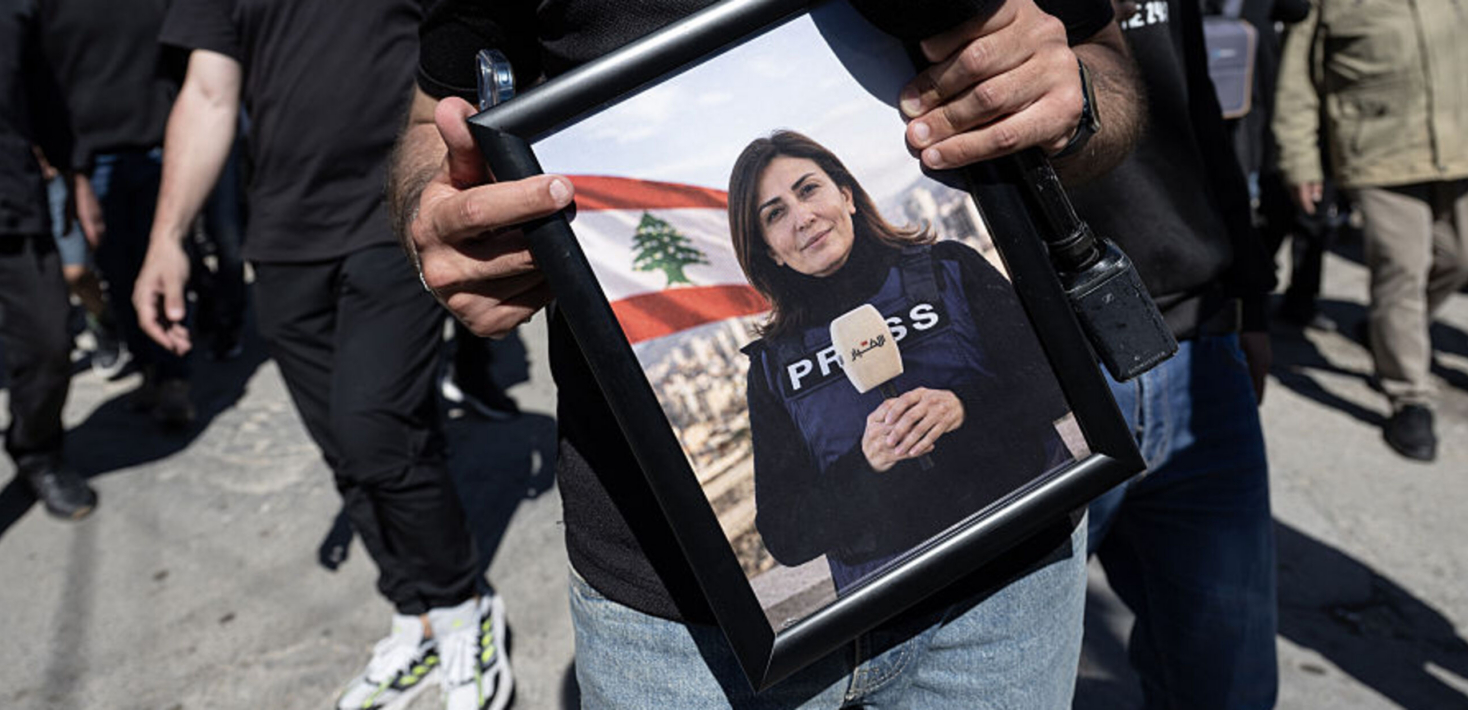


An Israeli attack that killed Lebanese journalist Amal Khalil and seriously wounded camerawoman Zeinab Faraj in south Lebanon on 22 April 2026 was a direct attack on civilians which should be investigated as a war crime, said Amnesty International today.
Testimonies from the sole survivor and first responders, corroborated by audiovisual material, coordination records, and external reporting, indicate that the two journalists, both civilians, had taken shelter after an air strike on the car in front of them had killed two men. Over the following two hours, with drones hovering at close range overhead, two further air strikes hit first their car parked near them and then the building where they were sheltering.
Amnesty International’s investigation paints a harrowing picture of a direct attack on two civilians while they had sought refuge from Israeli attacks.
Heba Morayef, Amnesty International
“Amnesty International’s investigation paints a harrowing picture of a direct attack on two civilians while they had sought refuge from Israeli attacks. After the first strike had eliminated the military-stated target, and with two drones flying low overhead, the Israeli military knew or should have known that two civilian women were sheltering in that building. Despite this, they proceeded with what we have reasonable grounds to believe amounted to a direct attack on civilians, demonstrating a shocking disregard for international humanitarian law,” said Heba Morayef, Regional Director for the Middle East and North Africa at Amnesty International.
“The fact that the two journalists were in what Israel has designated a no-return zone does not make them lawful targets. All parties to a conflict have a clear obligation to distinguish between civilians and military targets at all times and to direct their attacks only at military objectives. There can be no justification for targeting civilians who sought shelter in search of safety. This attack must be promptly, independently and impartially investigated as a war crime.”
On 22 April, the Israeli military carried out three strikes in the village of al-Tiri, Nabatieh governorate, which falls within an area the Israeli military has unilaterally designated as a “Forward Defence” zone and banned civilian residents from returning. The first strike hit a car at 2.25pm and killed two men. The two journalists, who had been following the two men in a second car, left their car and sought shelter in a nearby structure, including because two drones were hovering overhead and they feared this meant further strikes.
Around an hour later, a second strike targeted the journalists’ vehicle which was parked nearby, and they were wounded in the blast. Approximately one hour later, a third strike hit the building where they were sheltering, leading to the death of Amal Khalil, a journalist for the Lebanese newspaper Al Akhbar and seriously wounding Zeinab Faraj.
Throughout the two-hour attack two drones hovered overhead. Zeinab Faraj told Amnesty International:
“The drones got extremely close, coming through the broken roof. Less than a meter away. I was covering my face, thinking of a video I had seen where a drone killed someone like that. I thought it would explode in my face. The drones didn’t carry visible explosives, but they were hovering and provoking fear constantly.”
Declared targets by the Israeli military
Israeli surveillance drones hovering at close range, as early as after the first air strike and for a period of around two hours, meant that the Israeli military was aware, or should have been aware, that the two individuals it claimed to be targeting for alleged involvement in Hezbollah’s military activities had been killed immediately in the first strike. At that point, with the intended targets killed, and Israeli drones hovering over the scene where the two unarmed women in civilian clothing were sheltering, Israeli forces should have cancelled their strikes and allowed the journalists to seek safety.
In a statement published in Arabic on their spokesperson account on X at 8:22pm Beirut time, the Israeli military said Israeli forces:
“IDF forces in southern Lebanon spotted two vehicles emerging from a military building used by the terrorist Hezbollah. The vandals crossed the Forward Defence line and approached the forces in a manner that posed an immediate threat. After identifying that they were breaching the ceasefire agreement, the Air Force struck one of the vehicles, then targeted a building where the infiltrators had taken shelter. Reports indicated two journalists were injured as a result of the strikes, and the IDF is not preventing access by rescue teams to the area at this stage. Details of the incident are under review. It is noteworthy that a map of the forward defence line has been published, and the area has been evacuated. The IDF does not target journalists in any way and works as much as possible to minimize harm that may befall them while maintaining the security of our forces.”
In response to a letter from Amnesty International sent on 12 June as part of its investigation into the attack, the Israeli military wrote on 22 June stating that the strike on 22 April “in which a journalist was killed…occurred as part of a series of events during which two Hezbollah military operatives, Ali Nabil Bazi and Mohammad Al-Khourani, were struck and eliminated.”
It added that “the incident underwent a preliminary review, and relevant lessons were implemented accordingly” stating that the Israeli military “regrets any harm caused to journalists. It respects freedom of press and does not intentionally target them as such. It should be emphasized that, prior to every strike, the relevant operational circumstances at that time are assessed, including the nature of the target, its military use, the intelligence available in real time, the anticipated incidental damage, and the precautions that can be taken to mitigate it.” The statement also said advance warnings are issued where operationally feasible.
Under international humanitarian law, civilians are protected and cannot be targeted, unless and for such time as they take a direct part in hostilities. The onus is on the attacking party to do everything feasible to verify whether a person is a fighter who can be attacked. In case of doubt, a person must be considered a civilian.
Direct attacks on civilians and civilian objects are prohibited and constitute war crimes. Under IHL, journalists are civilians and must be protected accordingly.
Location of the attack – the Forward “Defence” zone
The attack took place in the village of al-Tiri, located about seven kilometres from the Israeli border in the Bint Jbeil district of south Lebanon, which falls within the Forward “Defence” zone which covers 6% of Lebanese territory. The Israeli military is deployed in this no-return zone and has carried out extensive destruction within it.
“Declaring an area off-limits for civilians does not absolve Israel of its obligations under international humanitarian law; particularly, it does not grant the right to treat these areas as open-fire zones where every civilian left or returned is considered a military target,” said Heba Morayef.
At all times and in all places, including off-limits area, the Israeli military must distinguish between civilians and fighters, as well as between civilian objects and military objectives, and do everything feasible to verify that an intended target is a military objective or a fighter. When engaging a military target, the Israeli military must take all feasible precautions to avoid or minimize incidental harm to civilians.
Since October 2023, Amnesty International has documented a broader pattern of unlawful Israeli air strikes in Lebanon, such as direct attacks on civilians and civilian objects, including journalists and medical personnel, and indiscriminate attacks. The organization has called for these to be investigated as war crimes and repeatedly warned that persistent impunity for such violations emboldens Israeli forces to continue carrying out unlawful attacks without fear of accountability.
First strike on two men in a moving vehicle
Journalists Amal Khalil (42) and Zeinab Faraj (21) had been reporting across southern Lebanon, documenting the impact of the armed conflict.
After receiving reports that the Israeli army had withdrawn from al-Tiri village, they drove to the area to verify this information, following another vehicle carrying Ali Nabil Bazzi, Bint Jbeil’s Mukhtar (local mayor), and Mohammed Hourani, his friend and a displaced resident, who also wanted to confirm firsthand the Israeli withdrawal from al-Tiri, according to Zeinab Faraj.
At around 2:25pm, right after entering al-Tiri, the vehicle carrying Ali Bazzi and Mohammed Hourani was struck, with the Lebanese Red Cross receiving the first ambulance call at 2:38pm. In their response to Amnesty International, the Israeli military described Ali Bazzi and Mohammed Hourani as “two Hezbollah military operatives” who were “struck and eliminated.”
Zeinab Faraj told Amnesty International that she and Amal Khalil were in Amal’s car behind when the strike occurred. She said they saw how the strike caused the car in front to explode, throwing the men from the vehicle and setting it on fire.
Amal Khalil immediately called Lebanese Civil Defence rescuer Moussa Chaalan at 2:36pm to report the strike. Moussa Chaalan told Amnesty International Amal had informed him that “two men [were] hit in front of me in al-Tiri” and he immediately began calling his colleagues at the Civil Defence and the Lebanese Red Cross, and officers in the Lebanese Army in charge of coordinating deconfliction requests through the monitoring mechanism. On his way to the location, Moussa Chaalan was told to halt at a Lebanese military checkpoint at the entry of al-Tiri while rescue workers waited for authorization by the Israeli military to access the village safely via the monitoring mechanism.
Authorization to access villages inside the so-called “Forward Defence” zone is coordinated by the Military Technical Committee for Lebanon (MTC4L), commonly referred to as the Ceasefire Implementation and Monitoring Mechanism,which includes the UN Interim Force in Lebanon (UNIFIL), established to monitor and implement the November 2024 ceasefire agreement between Lebanon and Israel – including coordinating safe routes for rescue teams once the Israeli military agrees to hold fire.
According to an investigation by the Washington Post: “A representative for UNIFIL said the Red Cross first contacted the agency with a planned route just before 3pm. UNIFIL, which facilitates safe passage for rescue crews, immediately passed the information, including the location of the journalists, to the Israeli military. Around the same time, the Lebanese army contacted an international committee known as the ceasefire mechanism… Red Cross management said its vehicles departed for the scene just before 5pm, after UNIFIL confirmed a safe route. The IDF acknowledged the request around this time, the representative for UNIFIL said, but it had not yet granted safe passage for the rescuers.”
Second strike on the journalists’ car near where they sheltered
While waiting for the Civil Defence to arrive, as drones circled overhead, the two journalists left their car and took shelter against a low wall near a deserted building in the village with a ground-floor shop, beneath a damaged tin roof.
Amnesty International’s Evidence Lab verified images taken by Zeinab Faraj between 2:35pm and 2:49pm showing the journalists’ car on the side of a road about five metres away from the destroyed vehicle. One of the images also shows the roof under which the journalists were waiting for the rescue teams.
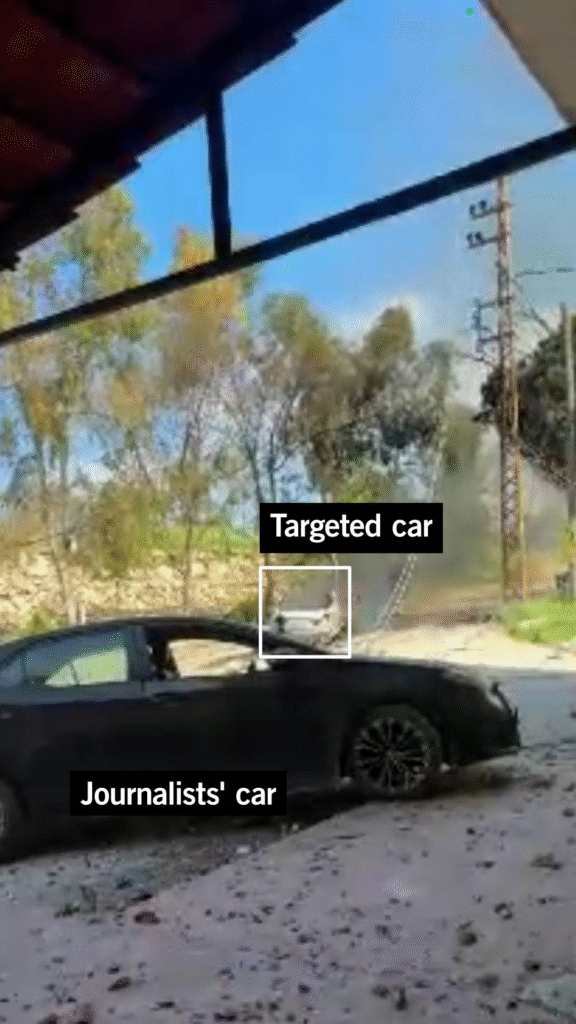
Zeinab Faraj spoke to Amnesty International 10 days after the attack and described how drones had flown overhead right after the first strike on the car, stating she remembered clearly how “the drones came extremely close through the roof, less than a metre from my face and Amal’s.”
Given that surveillance drones were circulating at close range overhead, the Israeli military knew, or should have known by then, that the two men it claimed to have targeted for alleged affiliation with Hezbollah had been killed instantly in the initial strike. Given how the drones were flying at such close range, the Israeli military should have been able to identify the two women journalists as civilians.
Civil defence rescuer, Moussa Chaalan, who was still at the checkpoint, called Amal Khalil at 3:31pm urging her to get back into the car and leave the area because he had not yet received monitoring mechanism authorization to enter the village, which means that he had no guarantees that the Israeli army would not strike.
At around 3:40pm, a second strike hit the journalists’ parked vehicle near their shelter.
At 3:48pm, Amal Khalil called Moussa Chaalan back to report that she had been injured in a second air strike on her car: “I can’t do anything. Moussa, come get me.”
Both women were injured in the blast. The explosion propelled a car door toward them, which Zeinab Faraj used to shield them from the flames. She said:
“Glass and debris flew toward us. My ear felt like it burst. She [Amal Khalil] was bleeding heavily from the nose and head and had shrapnel wounds in her arm and thigh; she couldn’t move her leg.”
As the burning fire intensified, the two women managed to crawl into the building through its damaged roll-up door and hid in a small room.
Inside, Amal Khalil continued making calls requesting rescue. However, Zeinab Faraj said that everyone they called said they would not be able to access their location because “they were waiting for authorization” from the monitoring mechanism, which would in practice mean that the Israeli military had agreed to hold fire to allow rescue teams to enter.
Moussa Chaalan told Amnesty International: “I told the army officer at the checkpoint that I would go in, despite the risk. But he convinced me not to, when he said: what if you were hit before reaching her? Better wait for the authorization, for her and your sake.”
Eventually, Amal Khalil became very weak, Zeinab Faraj said: “I saw her fading… and I lost consciousness”.
Amal Khalil’s last phone call was to her sister, at 4:22pm.
Third strike on building they were sheltering in
At approximately 4:25pm, a third strike hit the three-storey building where the journalists were sheltering, causing it to collapse and burying both women beneath the rubble. “I came to [consciousness] struggling to breathe,” Zeinab Faraj recalled.
Moussa Chaalan told Amnesty International that from his location, about two kilometres away, he witnessed an air strike at that time:
“I saw the air force plane rise and fire. I realized they were the target. I called her [phone] again; no answer. I said to myself: ‘They’re gone’.”
An Amnesty International weapons specialist reviewed video footage from the strike location and found the damage consistent with what would be caused by an air strike. Satellite imagery from 24 April also shows a new burn scar at the building site which has been commonly seen in areas where the Israeli military has conducted air strikes.
Shortly after 5pm, authorization to enter the area was granted but only to the Lebanese Red Cross. Rescuers extracted Zeinab Faraj, who had sustained a fractured skull, severe injuries to her right leg and eye, and a crushed hand. Rescuers were not able to access Amal Khalil who remained missing under the rubble.
Shortly before 6pm, the Lebanese Red Cross volunteers at the location said they were forced to withdraw due to threats of further attacks, taking with them the injured Zainab Faraj and the bodies of the two men killed in the first attack.
Following another round of calls from the Lebanese authorities, including the Office of the President, the Office of the Prime Minister, and international bodies, at 7:20pm authorization was once again granted allowing Red Cross rescue workers, an ambulance, and a small bulldozer to return to the strike site. The rescuers needed heavier equipment to clear the debris of the three collapsed storeys. Recovery operations, using an excavator, began around 9pm.
Moussa Chaalan said they found Amal Khalil buried under a column and a wall: “she was completely crushed… I removed her with my own hands,” he said.
In her death certificate, the forensic pathologist had listed her time of death as 7pm caused by “cardiac arrest due to a head trauma and severe bleeding.”
Israeli forces’ impunity
Amnesty International and other human rights and journalists’ organizations have repeatedly condemned the killing of journalists by Israeli forces with complete impunity, in Lebanon and in the occupied Gaza strip.
In 2023, Amnesty International published an in-depth investigation in the killing of Reuters journalist Issam Abdallah, finding that the Israeli military’s air strike that killed him and wounded six other journalists amounted to a direct attack on civilians and called for it to be investigated as a war crime.
The impunity enjoyed by Israeli forces for the killing of journalists and other civilians in Lebanon over the past three years has enabled the Israeli military to continue with its unlawful air strikes, including direct attacks on civilians.
Heba Morayef, Amnesty International
“The impunity enjoyed by Israeli forces for the killing of journalists and other civilians in Lebanon over the past three years has enabled the Israeli military to continue with its unlawful air strikes, including direct attacks on civilians. Amal Khalil’s killing must be independently and impartially investigated. It is well past time that the international community impose a comprehensive arms embargo on Israel,” said Heba Morayef.
“We also urge the Lebanese government to accept the International Criminal Court jurisdiction over crimes committed on its territory since October 2023 and to initiate domestic investigations into war crimes.”
Background
On 8 October 2023, Hezbollah launched rockets into Israel, followed by Israeli military operations that intensified in September 2024. Although a so-called ceasefire was agreed on 27 November 2024, hostilities continued along the border. Hostilities escalated once again on 2 March 2026 and have persisted despite further ceasefire announcements.
On 20 April 2026, the Israeli military designated what they called a “Forward Defence” zone extending 8–12 km into Lebanon (around 600 km²), restricting access to dozens of villages and areas south of key geographic features, including the Litani River.
Since 2 March, 4,333 people were killed in Lebanon, according to the Ministry of Public Health which does not disaggregate by civilians versus fighters killed. Hezbollah strikes on Israel have killed at least two civilians in Israel, while Israeli media reports indicate that at least 39 Israeli soldiers have been killed in southern Lebanon.