


The effects of the past
In 1994, the new democratic government of South Africa inherited an unsustainable budget deficit, rampant inflation (18.9% in 1991), depressed investor confidence, a mountain of debt and a currency crisis from the apartheid state. The previous regime had racked up debt to cope with the sanctions placed upon the country from the 1980s onwards and sustain the apartheid regime. In addition to high levels of debt, the new African National Congress (ANC) government had to table a budget that for the first time was aimed at providing adequate services to the entire country, including the majority population who had previously been wholly marginalised and underserved.
From 1994 to 2008, government policies focused on restoring macroeconomic stability. Total public sector debt was reduced from 44% of GDP to less than 20%. Through a strategy of redistribution and growth, the government increased the tax base, streamlined the revenue authority and tax system, implemented an inflation target, improved the debt mix in favour of lower interest rates, better credit ratings, and a balance in favour of domestic debt over external debt. This allowed government to increase funding to the social sector (including education, housing, water and sanitation, and health) by an average annual real growth of 2.1% between 1995 and 2000 and 8.3% between 2000 and 2006.
Early gains revised
By 2006, the budget balance was in surplus. Spending on education took the largest share of total expenditure at 18.2%.
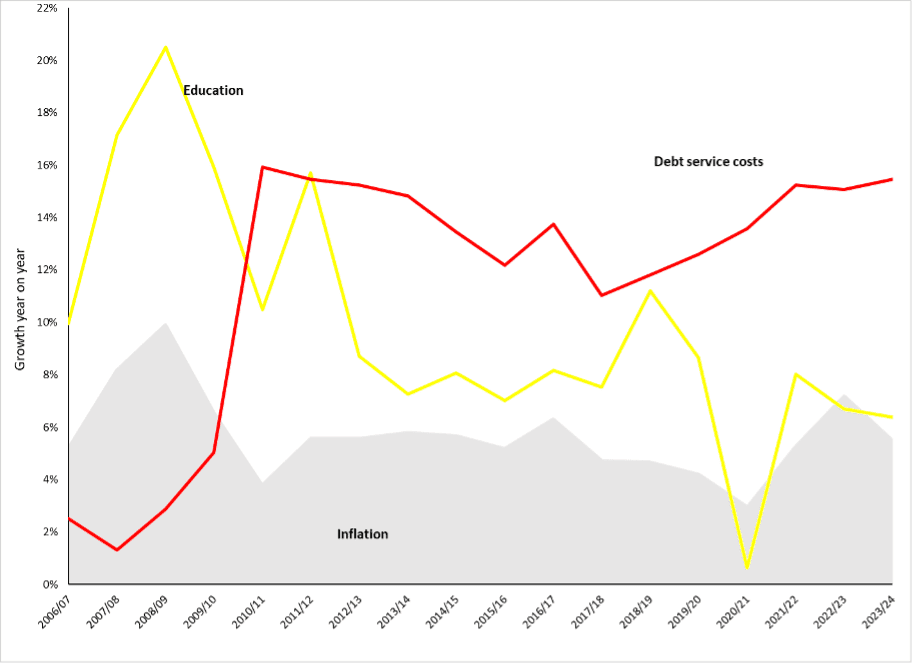
However, following the housing and credit crisis that rocked the global economy in 2008, the budget balance of 1.7% of GDP moved into deficit at -3.8%. Nevertheless, the government still managed to maintain spending in key areas like education, while the global economy began to slowly recover. As the economic crisis continued, government began to reprioritise spending and decrease additional allocations to the public sector (see graph below). Unknown at the time, this decline in government resources was also severely hampered by corruption and what we now know to be state capture.
The 2016 State of Capture Report revealed systemic corruption at the political level of the country, which influenced state decision-making in favour of private individual interests. The Zondo Commission was established in 2018 to investigate allegations of state capture and in 2022 the final reports were released. It has been estimated that South Africa lost R50 billion to state capture – equivalent to one-sixth of the total basic education budget for 2023/24.
The Covid-19 pandemic further constricted the country’s finances with a loss of 8.2% in GDP in 2020, widening the budget deficit to 9.9% of GDP. In addition, long-term debts held by government from the early years of democracy were due for re-financing. This, however, has come at the cost of higher interest rates following the economic shocks of 2009 and 2020, combined with rising global interest rates in response to inflation. State capture and the weakening of economic institutions, a worsening exchange rate, and continued state-owned enterprise defaults on government-guaranteed debt also pushed up the risk profile of South Africa and thus increased interest costs on new debt.
These combined effects pushed the debt to GDP ratio from 20% in 2008 to 74% by the end of 2023. This has meant interest and repayment costs have incrementally eaten away at growth in spending on public services. In the 2024 Budget, debt service costs were the second largest area of expenditure at R382.2 billion, after social protection, with basic education being third at R324.5 billion.
The right to education in South Africa
Section 29 (1)(a) of the South African Constitution guarantees the right to a basic education for everyone. Section 29 (1)(b) elaborates that everyone has the right “to further education, which the state, through reasonable measures, must make progressively available and accessible.” In other words, primary and secondary education is a right that must be immediately realisable, and must be of adequate quality, and available and accessible to all. However, in ratifying the UN International Covenant on Economic, Social and Cultural Rights (ICESCR), South Africa declared that, contrary to S29(1)(a) it will “give progressive effect to the right to education… within the framework of the National Education Policy and available resources thereby effectively making a reservation to Articles 13(2)(a) and 14”. This has been held by the Constitutional Court to breach Section 29 of the Constitution.
In 2024, education received 6.4% of GDP, a sizeable portion of the government budget. Basic education is over two thirds of total education spending, but many primary and secondary schools continue to charge fees in addition to the indirect costs for transportation and uniforms that students and their families must find. Several schools still have inadequate and unsafe infrastructure, including basic pit toilets, which are in breach of the government’s own targets. Many schools suffer from classroom overcrowding with very high student to teacher ratios. This, together with a lack of equal access for poor and black learners, and sub-standard quality of training of teachers, contributes to poor literacy and numeracy outcomes. Amnesty International has documented how this undermines the right to education as guaranteed by the constitution and international law.
Clearly South Africa’s budget plays a key role in ensuring that education is available and accessible to all. The graph shows the growth in debt service costs, the education budget and inflation. As the figure indicates, the austerity approach to budgeting, to manage rising debt costs, has slowed annual growth in education spending since the 2008 crisis. Since COVID-19, growth in education expenditure has barely kept pace with inflation. Debt service costs, however, shot up in 2009, and have remained so. Debt has certainly played a role in crowding out spending on education. This has been echoed by Equal Education and Save the Children.
Conclusions
In South Africa, 5.8% of the population pays about 92% of all personal income tax. This group is also paying about 85% of value-added tax. Together with the country’s already high indebtedness, this suggests limited options for generating additional resources. And it will clearly impact the ability of government to provide quality basic education for all. Concurrently, the government’s approach of implementing austerity has failed to curb the growth in debt as budgets have shrunk. On top of this, the revelation of extensive state corruption has impeded progress. It is clear that the lack of sufficient finance may simply be a symptom of the state of how South Africa’s institutions are managed and resourced.
To date the country has not had to seek debt relief through programmes such as the Heavily Indebted Poor Countries Initiative or Common Framework. If current trends in debt management continue, however, South Africa will be increasingly more reliant on the international global financial architecture and Bretton Woods Institutions to determine its future.
If the Government of National Unity wishes to truly transform the economy, it will need to strengthen institutions, reduce corruption, re-evaluate the equity of the tax system, and invest more in education, including training quality teachers, building adequate and well-equipped schools and ensuring pupils emerge from schooling able to contribute to human capital and the future of the country.